

Desire Has Power
In Erosia, desire is not a diversion from adventure. It is one of the forces from which adventure is born. Longing can awaken magic. Attraction can become leverage. Devotion can sustain a miracle. Temptation can fracture concentration, expose hidden truths, or draw a creature toward choices it would otherwise fear to make. A whispered invitation may alter the course of an encounter as surely as a sword drawn from its sheath.
The Mechanics of Desire provide rules for these moments.
They do not attempt to simulate intimacy, measure attraction, or dictate what a character feels. Instead, they represent the mounting tension that surrounds desire: distraction, anticipation, vulnerability, surrender, restraint, revelation, and release. Hit points measure how long a creature can endure injury.
- Arousal measures how deeply a creature has entered a charged state of desire.
- Libido measures how much erotic or ecstatic intensity a creature can channel before it must recover.
- Climax releases that accumulated tension in a moment of physical, emotional, magical, or divine culmination.
Together, these mechanics create a second rhythm of play—one in which a character can be overcome without being wounded, transformed without being defeated, and brought to a turning point without losing ownership of their choices.
The Rule of Sacred Agency
Desire mechanics can influence a character’s body, concentration, senses, magic, and immediate circumstances. They never determine whom a player character loves, what the character permanently desires, or whether the character consents to an intimate act.
A player always retains authority over their character’s lasting feelings, identity, relationships, and boundaries.
What Desire Can Represent
Although the language of these rules is sensual, Arousal need not represent literal sexual excitement in every scene. Depending on the character, effect, and agreed tone of play, rising Arousal might represent:
- physical excitement;
- romantic tension;
- flustered distraction;
- magical overstimulation;
- hypnotic fixation;
- devotional ecstasy;
- primal instinct;
- emotional vulnerability;
- intoxicating curiosity;
- the mounting pressure of resisting something deeply wanted.
The table may rename Arousal for a particular character or campaign. Heat, Temptation, Ecstasy, Resonance, or Pressure all use the same rules. The mechanics remain identical. Only their expression changes.
A Second Path Through Encounters

Desire is not a replacement for combat, social interaction, or exploration. It moves through all three. A guard might be distracted by flirtation long enough for an ally to slip past. A monster might feed upon mounting fascination rather than blood. A sacred rite might require participants to hold a rising state of divine ecstasy without releasing it too soon. A rival could be defeated through steel, persuasion, seduction, revelation, or some union of all four.
The Mechanics of Desire are therefore not confined to erotic scenes. They may appear during:
- combat;
- negotiations;
- performances;
- rituals;
- chases;
- dream sequences;
- magical hazards;
- divine encounters;
- consensual intimacy;
- moments of emotional confession.
The Dungeon Master should introduce these mechanics only when desire meaningfully changes the choices, tension, or outcome of the scene.
If tracking Arousal would add nothing, do not track it.
The Core Principle
Desire creates pressure. Choice determines what that pressure becomes.
A creature may resist it. A creature may redirect it. A creature may accept it. A creature may use it.
A creature may leave. No response is inherently correct, and participation in a Desire encounter never requires participation in an intimate scene.
Choosing Your Level of Play

Whispers of Erosia supports three presentations of mature content. The group chooses its general level before play, but any scene may be softened, veiled, or ended at any time.
Classic Play
Classic Play uses standard 5e rules without tracking Arousal or Libido.
Desire remains part of the setting, but it is expressed through roleplay, existing conditions, ability checks, and saving throws.
When an Erosian feature refers to an EROSave, use the ordinary saving throw named in the feature. When no save is named, use a Wisdom saving throw.
When an effect would increase Arousal, use the listed Classic Play alternative. Common alternatives include:
- the charmed condition;
- disadvantage on the next attack roll or ability check;
- inability to take reactions;
- reduced speed;
- temporary hit points;
- psychic damage;
- advantage on a social check.
Classic Play is ideal for groups that want the world, classes, deities, and adventures of Erosia without a separate Desire subsystem.
Veiled Play
Veiled Play introduces Desire as a lightweight narrative mechanic. It is intended for:
- public-facing games;
- convention play;
- quickstart adventures;
- groups that prefer implication;
- scenes that fade before explicit intimacy;
- tables that want flirtation and temptation without extensive tracking.
In Veiled Play, a creature is either Composed, Stirred, or Overwhelmed.
Composed
The creature is not presently affected by Desire pressure.
Stirred
The creature is visibly or emotionally affected. A Stirred creature has disadvantage on the next ability check it makes to conceal its feelings, maintain an unaffected façade, or ignore the source of its distraction. The condition then ends unless an effect states otherwise.
Overwhelmed
The creature reaches the emotional or magical peak of the scene. Resolve the effect that caused the state, then end the creature’s Desire condition. This resolution may be a magical burst, a moment of vulnerability, a confession, a withdrawal, or a veiled Climax. Veiled Play does not track Libido unless a class feature specifically requires it.


Unveiled Play
Unveiled Play uses the complete Mechanics of Desire:
- EROSaves;
- the six-stage Arousal Track;
- Desire Actions;
- Libido;
- Climax Effects;
- Depletion;
- Rhythm of Endurance;
- detailed intimate encounters.
Unveiled Play is opt-in.
Choosing Unveiled Play does not mean every intimate scene must be described, mechanically resolved, or played without a fade to black. It means the complete system is available whenever everyone involved wishes to use it. A table may use Unveiled mechanics during combat or ritual scenes while still veiling private intimacy.
Changing Modes
The group may move between modes as needed. A scene can begin in Unveiled Play and become Veiled the moment someone invokes the Veil. A Veiled encounter can briefly use an Unveiled Climax Effect if the group wants a more mechanically significant culmination. Classic Play can adopt a single EROSave without adopting Arousal or Libido.
When changing modes, follow these principles:
- Never increase detail without agreement.
- Always allow a scene to move toward greater abstraction.
- Preserve existing outcomes where possible.
- Do not penalize a player for choosing to Veil or disengage.
- When uncertain, use the simpler mode.
The Veil Is Always Available
Invoking the Veil changes presentation, not necessarily consequence.
The fiction may continue. The camera turns away.
Resolve only the rolls and outcomes needed to move forward.
Consent, Boundaries, and Scene Authority
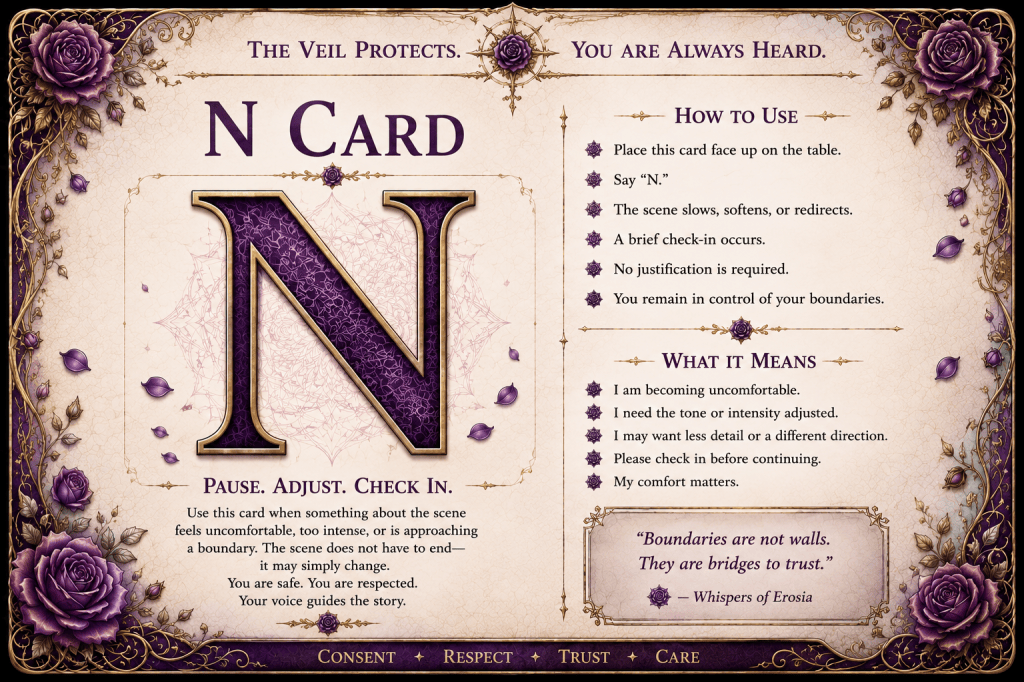
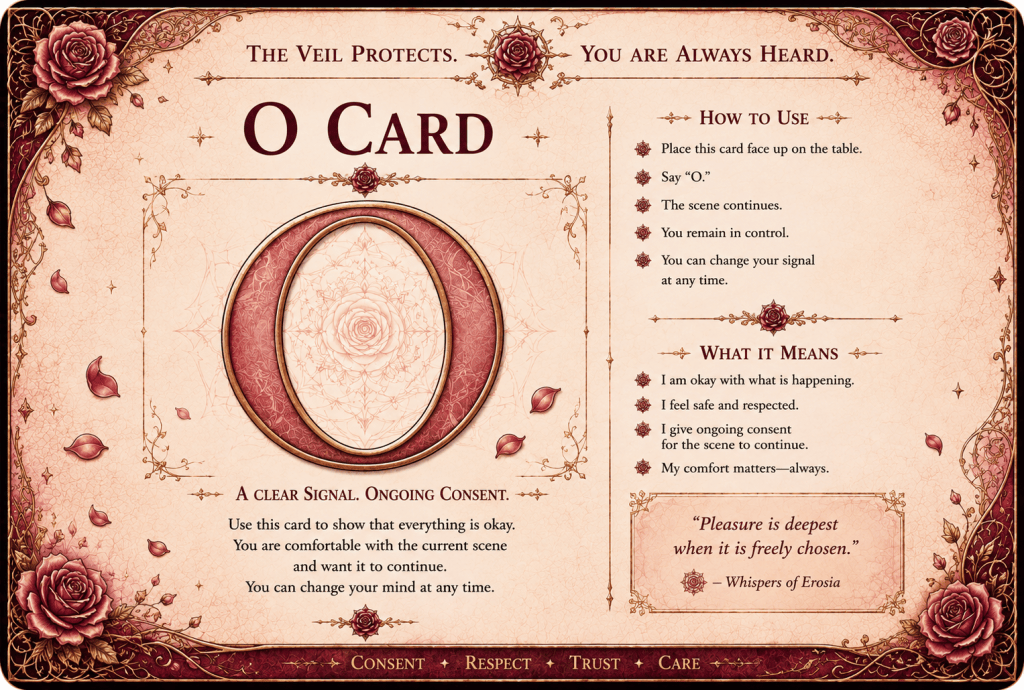
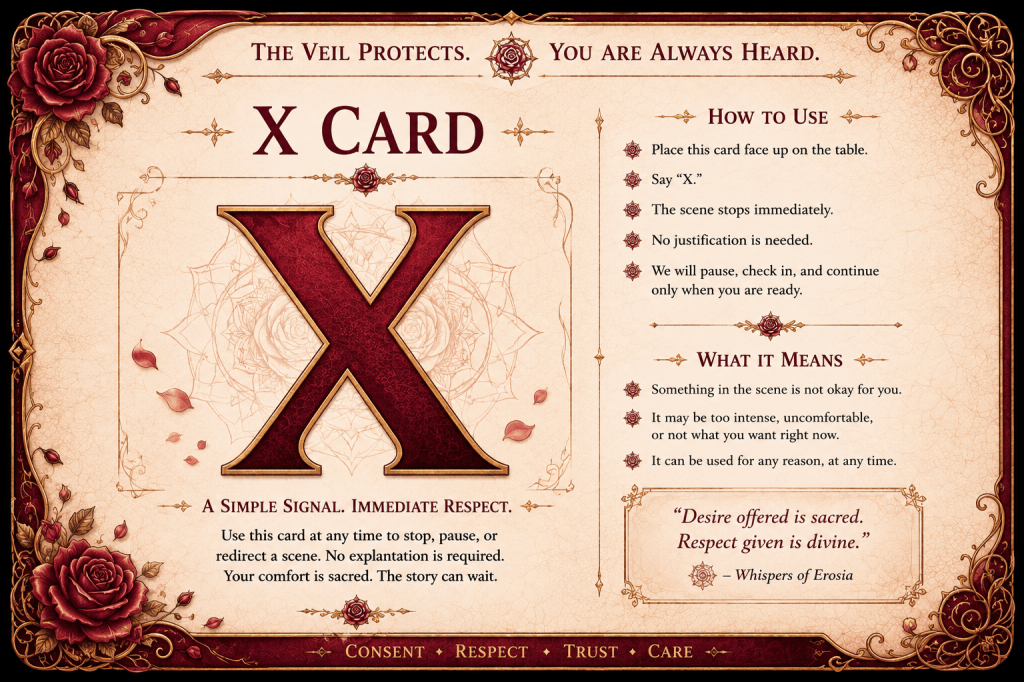
The Mechanics of Desire begin before initiative, before Arousal, and before the first EROSave. They begin with agreement. Erotic fantasy asks players to enter scenes involving vulnerability, temptation, attraction, restraint, surrender, exposure, or transformation. These themes can create powerful stories, but only when the people at the table remain more important than the fiction.
Table Consent and Character Consent
Whispers of Erosia recognizes two separate layers of consent.
Table Consent
Table consent is the real agreement among players and the Dungeon Master regarding what material may enter play and how it may be presented. Table consent is absolute. It cannot be bypassed by dice, magic, setting lore, monster abilities, or character decisions.
Character Consent
Character consent exists inside the story. Characters may misunderstand one another, refuse invitations, negotiate boundaries, make reckless choices, or face supernatural temptation. Character consent may be dramatically complicated, but only within the boundaries established by the players. A player may permit their character to experience something the player would never personally choose. A player may also forbid material even if their character would plausibly accept it. The player’s boundary governs the scene.
Scene Authority
Every player possesses Scene Authority over their own character. Scene Authority means that only the player decides:
- whether their character consents to intimacy;
- how their character interprets attraction;
- whether a magical response is welcome, frightening, confusing, or unwanted;
- what permanent feelings emerge from a scene;
- whether description remains Veiled or becomes Unveiled;
- when participation ends.
A failed EROSave may impose a mechanical effect. It does not write the character’s inner life. The Dungeon Master may say:
“The perfume leaves your thoughts hazy, and you gain 1 Arousal.”
The Dungeon Master may not declare:
“You now desire the priestess and willingly submit to her.”
The first describes a supernatural pressure. The second takes control of the character.
Willing Failure
A creature may willingly fail an EROSave. This represents conscious acceptance of an effect, not blanket consent to everything that may follow. Before a creature willingly fails, the player must understand the immediate mechanical consequence. The Dungeon Master should state:
- what is being resisted;
- what failure causes;
- whether further escalation is possible;
- whether the effect can be ended.
A willing failure may deepen trust, empower a ritual, trigger a class feature, or allow an ally’s Desire effect to function without resistance.
The Right to Withdraw
A character may attempt to leave a Desire encounter at any time. An enemy may pursue them. A magical hazard may make retreat difficult. A ritual may fail when abandoned. Those are fictional consequences. The player’s decision to disengage remains valid. No rule should make continued erotic participation the only method of avoiding punishment.
Safety Signals
Tables may use any safety tools they trust. The following are especially suited to Erosian play:
- Line. The subject does not appear.
- Boundary. The subject may exist in the setting but is not directly engaged.
- Veil. The event may occur, but its description fades or shifts away.
- Pause. Play stops briefly without requiring explanation.
- End Scene. The current interaction ends and the fiction moves forward.
- Rewind. The table returns to a point before the unwanted element entered play.
No justification is required when using a safety signal.
Consent Is Not a Bonus
Players should never receive mechanical rewards merely for allowing content that makes them uncomfortable. Likewise, choosing to Veil, withdraw, or refuse intimacy never causes:
- loss of experience;
- reduced treasure;
- class-feature failure;
- divine punishment;
- loss of relationship progress;
- disadvantage on unrelated rolls.
Characters may face consequences for how they address an encounter, but players are not punished for protecting the table.

The Desire Sequence
When a Desire effect occurs in Unveiled Play, resolve it in the following order.
1. Invitation
The source introduces Desire pressure.
This may be:
- a spell;
- a creature ability;
- a Desire Action;
- a ritual;
- an environmental effect;
- consensual intimacy;
- a class feature;
- a divine manifestation.
The source must state its range, target, EROSave, and effect.
2. Response
The target chooses how to respond.
Unless the effect states otherwise, the target may:
- resist;
- willingly fail;
- use a reaction or feature that alters the effect;
- leave the source’s range if movement is currently possible;
- invoke the Veil at the table level.
3. EROSave
If the target resists, it makes the required EROSave.
- On a success, the creature resists or reduces the effect as described.
- On a failure, apply the listed Arousal, condition, movement, damage, or other consequence.
4. Escalation
If the effect raises Arousal, advance the creature along the Arousal Track.
Apply the effect of the creature’s new stage immediately.
A creature normally gains only 1 Arousal from a single effect, unless that effect explicitly states otherwise.
5. Threshold
If the creature reaches Arousal 6, resolve a Climax. The triggering effect determines whether the Climax is:
- personal;
- class-based;
- deity-based;
- monster-based;
- environmental;
- ritual;
- chosen from the general Climax Effects.
6. Release
Resolve the Climax Effect.
Reduce Libido by 1.
Reset Arousal to 0.
7. Depletion
If the creature has no Libido remaining, it becomes Depleted.
A creature may continue to act normally while Depleted, but forcing another Climax carries the risk of Exhaustion. Traditional 5e Exhaustion mechanics apply.
8. Aftermath
Resolve any immediate emotional, magical, or environmental changes. The scene may continue, soften, shift into aftercare, or end. Climax does not automatically end an encounter unless an effect states that it does.
EROSaves
An EROSave is a saving throw made against temptation, sensual magic, emotional pressure, involuntary arousal, ecstatic force, and other Desire effects. An EROSave is not a new ability score. It uses one of two existing saving throws.
Endurance or Composure
When making an EROSave, choose one of the following:
Constitution represents bodily endurance, breath control, pain tolerance, physical discipline, and the ability to withstand overwhelming sensation.
Wisdom represents emotional clarity, self-awareness, instinct, meditative focus, and the ability to recognize and resist manipulation.
The creature chooses which saving throw to use unless the effect specifically names one. This choice should reflect how the creature resists.
- A Chainborn monk might endure a wave of sensation through Constitution.
- A Veilwalker might recognize the emotional trap and use Wisdom.
Both are valid defenses.
EROSave Proficiency
A creature adds its proficiency bonus to an EROSave only if it is proficient in the saving throw being used. EROSave proficiency is never gained separately from Constitution or Wisdom saving throw proficiency unless a feature explicitly says otherwise.
EROSave DC
When a player character creates an EROSave, use:
EROSave DC = 8 + proficiency bonus + the feature’s named ability modifier
If the feature names no ability, use Charisma.
Monster and NPC EROSave DCs appear in their stat blocks.
For improvised effects, use the following guidance:
| Intensity | DC |
|---|---|
| Playful or fleeting | 10 |
| Noticeable temptation | 12 |
| Potent sensual magic | 14 |
| Overwhelming supernatural effect | 16 |
| Divine or legendary pressure | 18–20 |
Success and Failure
The effect states what occurs on a success or failure.
When no specific result is provided:
Success: The creature gains no Arousal.
Failure: The creature gains 1 Arousal.
An effect that would impose a severe condition, force movement, or gain more than 1 Arousal should always describe its full result.
Repeated Saves
A continuing effect should not demand an EROSave every round unless constant pressure is central to the encounter.
As a general rule:
- save once when entering an aura;
- save again only when the aura escalates;
- save at the end of the creature’s turn to end a continuing condition;
- do not repeatedly roll for unchanged circumstances.
The system should build tension, not bury the table beneath dice.
The Arousal Track
Arousal measures the growing pressure of desire upon body, mind, and spirit. It is not inherently pleasurable, nor is it always sexual. Depending upon the source, Arousal may represent mounting attraction, divine ecstasy, emotional vulnerability, supernatural temptation, magical overload, or the effort required to resist an overwhelming experience.
- In Unveiled Play, creatures track Arousal on a scale from 0 to 6.
- At Arousal 0, a creature is composed.
- At Arousal 6, the creature immediately resolves a Climax unless an effect states otherwise.
- A creature can never possess more than 6 Arousal.
Gaining Arousal
A creature gains Arousal only when an effect specifically instructs it to do so. Unless stated otherwise:
- A creature gains 1 Arousal from a single effect.
- Multiple effects can increase Arousal during the same round.
- A creature cannot gain more than 3 Arousal during a single turn, unless the additional Arousal is granted by a Climax Effect, legendary creature, artifact, or feature that explicitly ignores this limit.
This limit prevents overwhelming combinations while allowing exceptional abilities to remain dramatic.
Designer’s Note: Pressure, Not Punishment
The Arousal Track is not intended to function as a second pool of hit points.
Early stages primarily communicate narrative tension while introducing only minor mechanical pressure. The greatest danger lies in the later stages, where failed EROSaves can rapidly escalate toward Climax.
This design encourages meaningful decision-making. Players are not punished simply for engaging with the Mechanics of Desire. Instead, they feel the mounting pressure, weigh the risks, and decide whether to resist, embrace, redirect, or release that tension before reaching the threshold of Climax.
Losing Arousal
Unless an effect states otherwise, Arousal decreases only through one of the following:
- Resolving a Climax.
- A class feature or subclass feature.
- A spell or magical effect.
- A magic item.
- A ritual or period of meditation.
- Completing a Long Rest.
A Short Rest does not normally reduce Arousal. Because Arousal does not fade quickly, the emotional and magical tension of one encounter may continue into the next, creating meaningful choices about when to press onward and when to recover.
Arousal Stages
As a creature’s Arousal rises, desire becomes increasingly difficult to ignore. Each stage represents a growing degree of physical, emotional, or supernatural pressure. Unless a stage states otherwise, its effects are cumulative.
Arousal 0 — Composed
Your breathing is steady. Your thoughts remain clear. Whether through discipline, indifference, or simple circumstance, desire holds no influence over your actions. You suffer no effects.
Arousal 1 — Stirred
Something has changed. A lingering glance. The warmth of another’s touch. The scent of rare perfume. The quiet thrill of forbidden magic. You remain fully in control, but your awareness has shifted toward the source of that growing desire.
Mechanical Effect. You suffer no penalties. Whenever an effect would increase your Arousal, you automatically become aware of its source unless that source is hidden by magic or another feature. Some class features, feats, or monsters may trigger additional effects when a creature first becomes Stirred.
Arousal 2 — Flushed
Your pulse quickens. Maintaining composure now requires conscious effort. Others familiar with the signs of desire may begin to notice subtle changes in your breathing, posture, or expression.
Mechanical Effect. You have disadvantage on ability checks made solely to conceal your emotional state or physical signs of arousal. This penalty never applies to:
- initiative.
- attack rolls;
- saving throws;
- Concentration checks;
- initiative.
Arousal 3 — Distracted
The pressure begins competing with everything else. Your thoughts drift. Your focus slips. Your attention repeatedly returns to the source of your desire despite your best efforts. You remain free to act however you choose, but discipline now requires genuine effort.
Mechanical Effect. The first time during each round that you make either:
- a Constitution saving throw to maintain Concentration, or
- an EROSave,
you make that roll with disadvantage.
After resolving that roll, no additional disadvantage from this stage applies until the start of your next turn.
Arousal 4 — Intensified
Every sensation feels sharper. Every touch lingers longer. Every heartbeat reminds you how close you have come to losing control. Desire now presses insistently against your restraint.
Mechanical Effect. Whenever you fail an EROSave while at this stage, you immediately gain 1 additional Arousal. This additional Arousal may trigger a Climax.
Arousal 5 — Overwhelming
You stand upon the very edge of release. Every breath requires discipline. Every distraction threatens to become the final push. You are still in control—but only because you choose to remain so.
Mechanical Effect. Whenever you begin your turn while at Arousal 5 and are affected by an ongoing Desire effect, immediately make an EROSave against that effect.
- On a failed save, you gain 1 Arousal.
- On a successful save, nothing happens.
Arousal 6 — Climax
The accumulated pressure reaches its inevitable release.
Resolve the Climax Effect that caused this increase in Arousal.
After the Climax resolves:
- Reduce your Libido by 1.
- Reset your Arousal to 0.
- Resolve any additional class features, monster abilities, deity features, spell effects, or environmental effects triggered by your Climax.
If you have no remaining Libido after reducing it, you become Depleted. Climax does not automatically end an encounter unless the triggering effect states otherwise.
Narrative Interpretation
Although the mechanics of the Arousal Track remain constant, its narrative expression may differ from one creature to another. For one character, rising Arousal may represent mounting romantic anticipation. For another, it may be divine ecstasy experienced during sacred ritual. A bard may interpret it as the intoxicating exhilaration of commanding an audience. A Veilwalker may experience it as the overwhelming resonance of Veil magic. A creature resisting a siren’s song may describe the same mechanics as an increasingly difficult struggle to preserve its own thoughts. The rules remain unchanged. Only the story surrounding them evolves.
 Whispers of Erosia
You must be logged in to post a comment.