

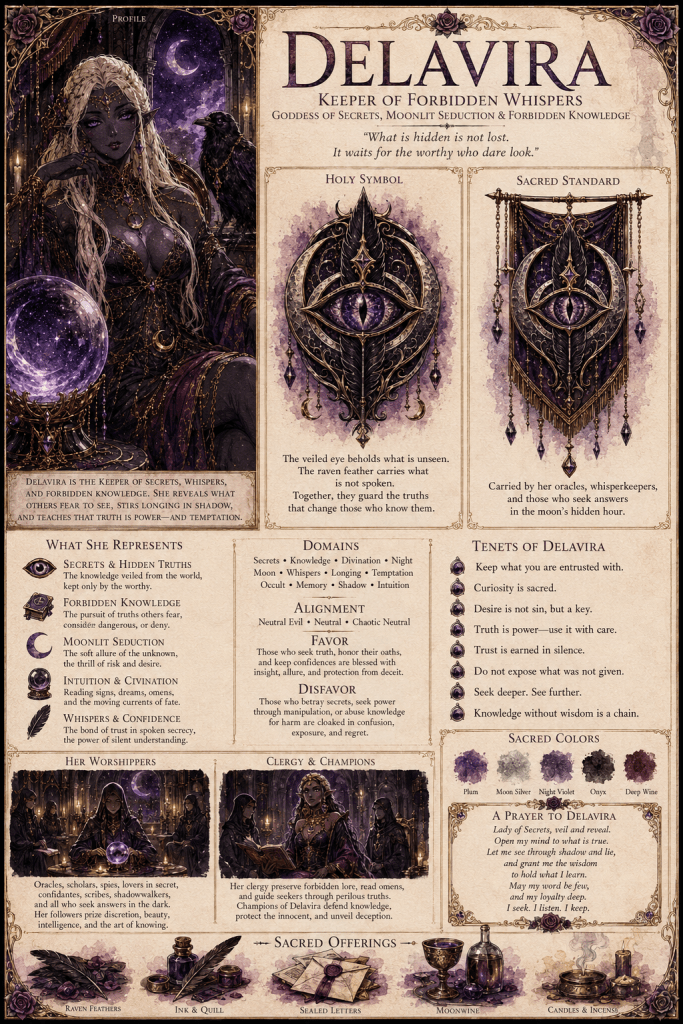
Delavira is the silence between breaths when longing goes unspoken. She is the glance held too long across candlelight, the confession swallowed before it can ruin a life, the ache of wanting without certainty of return. Where Velyssara teaches openness, Delavira reigns over distance, secrecy, restraint, and the exquisite danger of emotional exposure.
She is not the goddess of rejection, but of guarded desire.
Her faithful believe there is holiness in what remains hidden. Not every truth is safe when spoken aloud. Not every longing survives the light. Delavira teaches that vulnerability carries consequence—and that privacy, caution, and emotional boundaries are sacred protections rather than shameful barriers.
Her temples are quiet places of curtains, mirrors, hidden corridors, soft lanterns, and whispered prayers spoken behind veils. Those who fear exposure often seek her comfort:
forbidden lovers,
spies,
widows,
masked nobles,
closeted souls,
secret keepers,
and those who watch the world from emotional distance.
Across Erosia, she is known as:
The Touchless One
Lady Behind the Veil
She Who Watches in Silence
The Keeper of Hidden Longing
The Quiet Reflection
Quick Reference
| Aspect | Details |
|---|---|
| Alignment | Neutral |
| Domains | Secrecy, Longing, Observation, Distance, Hidden Desire |
| Divine Realm | The Veiled Reflection |
| Sacred Animal | Velvet Spiders |
| Sacred Flower | Midnight Orchid |
| Sacred Metals | Silver, Obsidian Glass |
| Clergy Titles | Veilkeepers, Whisper Nuns, Mirror Wardens |
| Common Worshippers | Spies, forbidden lovers, nobles, observers, archivists, mourners |
| Holy Symbol | A veiled eye framed within layered curtains |
| Sacred Colors | Violet, Silver, Midnight Blue, Black, Pearl |
| Favored Offerings | Perfumed letters, hidden confessions, silver mirrors, silk veils, sealed lockets |
The Divine Myth
The oldest myths claim Delavira emerged from the first desire never spoken aloud.
When mortals first learned intimacy through Velyssara’s grace, many found joy—but others discovered fear. To love openly was to risk humiliation, betrayal, exile, or loss. Some hid their hearts behind silence. Some watched from afar, believing themselves unworthy of touch. From those hidden aches, Delavira awakened.
One sacred tale speaks of a noblewoman who stood behind a curtain for seven years, secretly listening to the laughter of the woman she loved but dared never approach. On the final night before war separated them forever, the noblewoman wept alone before a polished mirror and whispered:
“If my longing cannot be held, let it at least be witnessed.”
The mirror darkened. A pale hand touched the reflection from within.
Delavira emerged clothed in black silks and silver veils, her eyes filled not with cruelty, but understanding.
She taught mortals:
that hidden feelings still possess truth,
that privacy is not dishonesty,
and that longing itself can become sacred even when unanswered.
Unlike many gods, Delavira did not build empires or command armies. Her worship spread quietly:
through hidden letters,
through silent prayers,
through longing glances,
through secret meetings,
and through the comfort of being unseen when the world felt dangerous.
Even now, her clergy teach that every hidden desire leaves an echo within the Veiled Reflection—the realm where unspoken truths drift like lanterns across black water.
Divine Philosophy
Delavira’s faith teaches that emotional distance is not inherently coldness. Boundaries protect the soul. Her worshippers believe:
- not every truth belongs to the public,
- privacy is sacred,
- vulnerability should be offered carefully,
- and longing does not lose meaning simply because it remains hidden.
Her teachings are often misunderstood by outsiders as cynical or manipulative, yet her clergy reject cruelty and emotional exploitation. Delavira does not encourage deception for power’s sake. Rather, she teaches discernment:
- when to reveal oneself,
- when to remain silent,
- and when observation reveals more than confrontation ever could.
Her faith warns against:
- reckless emotional exposure,
- performative intimacy,
- false vulnerability used for manipulation,
- and the violation of another’s emotional boundaries.
To Delavira’s faithful, trust is not freely demanded. It is slowly, carefully earned.
Worship & Temples

Temples of Delavira are known as Veilhouses, Quiet Sanctums, or Houses of Reflection.
Unlike the warmth of Bloomhouses, Delaviran sanctuaries are hushed, intimate, and shadow-softened. Common features include:
- layered curtains,
- reflective black pools,
- silver mirrors,
- hidden alcoves,
- candlelit corridors,
- perfumed chambers,
- whispering galleries,
- and secluded garden courtyards veiled by hanging silk.
Worship practices often involve:
- anonymous confessions,
- letter-burning ceremonies,
- mask rituals,
- silent vigils,
- mirror meditations,
- private mourning rites,
- and devotional observation rituals.
Many temples also serve as:
- safehouses,
- archives of forbidden histories,
- refuges for the emotionally vulnerable,
- discreet diplomatic grounds,
- and sanctuaries for those fleeing public shame.
Silence itself is often considered prayer.
Clergy & Divine Orders
The Veilkeepers
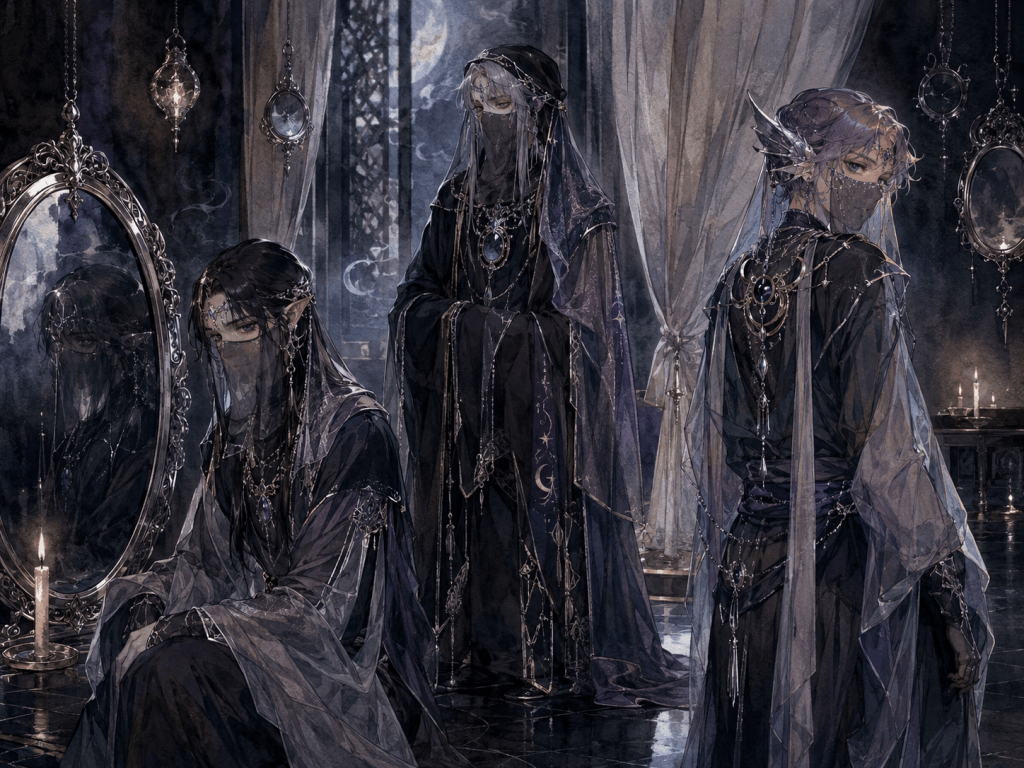
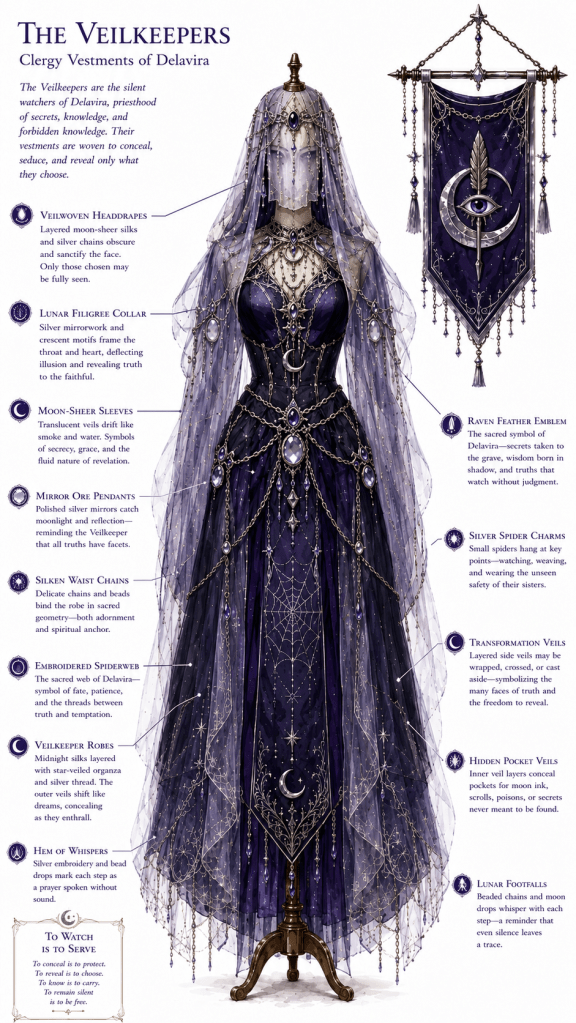
The primary priesthood of Delavira.
They serve as:
- confessors,
- record keepers,
- emotional mediators,
- observers,
- and protectors of privacy.
Their garments favor:
- layered dark silks,
- silver-thread embroidery,
- soft ceremonial veils,
- mirror jewelry,
- and long draping sleeves concealing the hands.
Their faces are often partially obscured during ritual services.
The Mirror Wardens

Protectors of sacred secrets and guardians of vulnerable worshippers.
Many serve as:
- spies,
- bodyguards,
- couriers,
- watchers,
- and escorts for politically dangerous meetings.
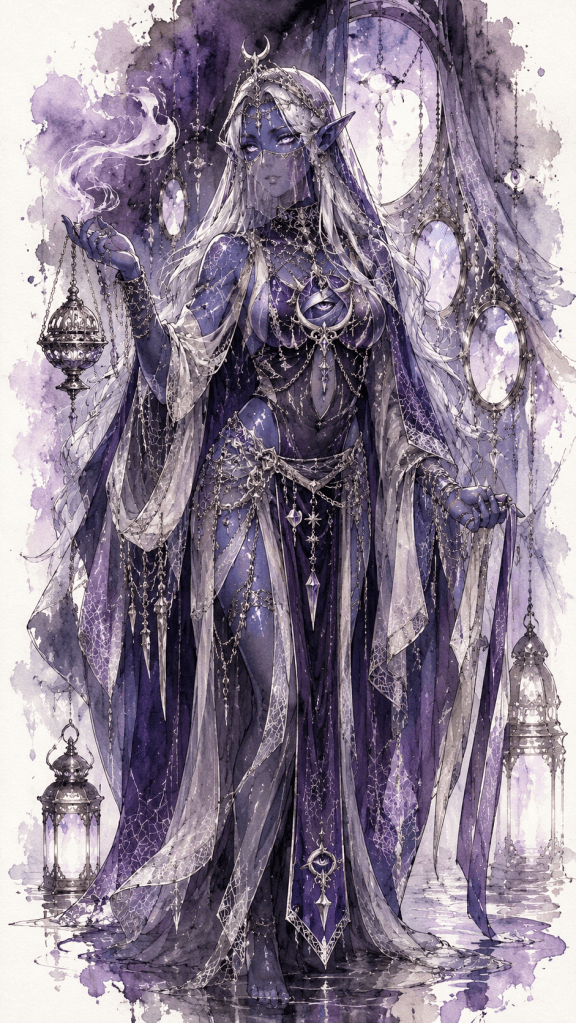
Their philosophy teaches:
“To protect what is fragile, one must first remain unseen.”
The Whispered Choir

Mystics and contemplatives who pursue revelation through silence, dreams, and observation.
Many become:
- dream interpreters,
- prophets of hidden truths,
- masked performers,
- or wandering listeners who gather emotional confessions from across Erosia.
Some are believed capable of seeing truths reflected in mirrors before they occur.
Relationships Within the Pantheon
Velyssara — The Open Bloom. Delavira and Velyssara are philosophical opposites bound by mutual understanding. Velyssara teaches openness and vulnerability. Delavira teaches caution and restraint.
Their faithful often clash over questions of emotional honesty, yet many worshippers invoke both deities during fragile relationships where trust has not yet fully formed.
Together they embody:
- the fear of vulnerability,
- and the hope that vulnerability may still be worth the risk.
Velzhari — The Mirror Bride. Delavira distrusts Velzhari’s obsession with public admiration and performative beauty. To Delavira, desire loses meaning when transformed into spectacle. Yet mirrors remain sacred to both goddesses for very different reasons.
Velzhari asks:
“Will they adore me?”
Delavira asks:
“Will they truly see me?”
Eshthara — The Dreamweaver’s Tongue. Delavira respects Eshthara’s mastery over secrecy, dreams, and hidden thought, though she remains wary of manipulation.. Their temples sometimes cooperate in matters involving:
- dream interpretation,
- memory rituals,
- and the protection of dangerous knowledge.
Regional Worship
Amarosa
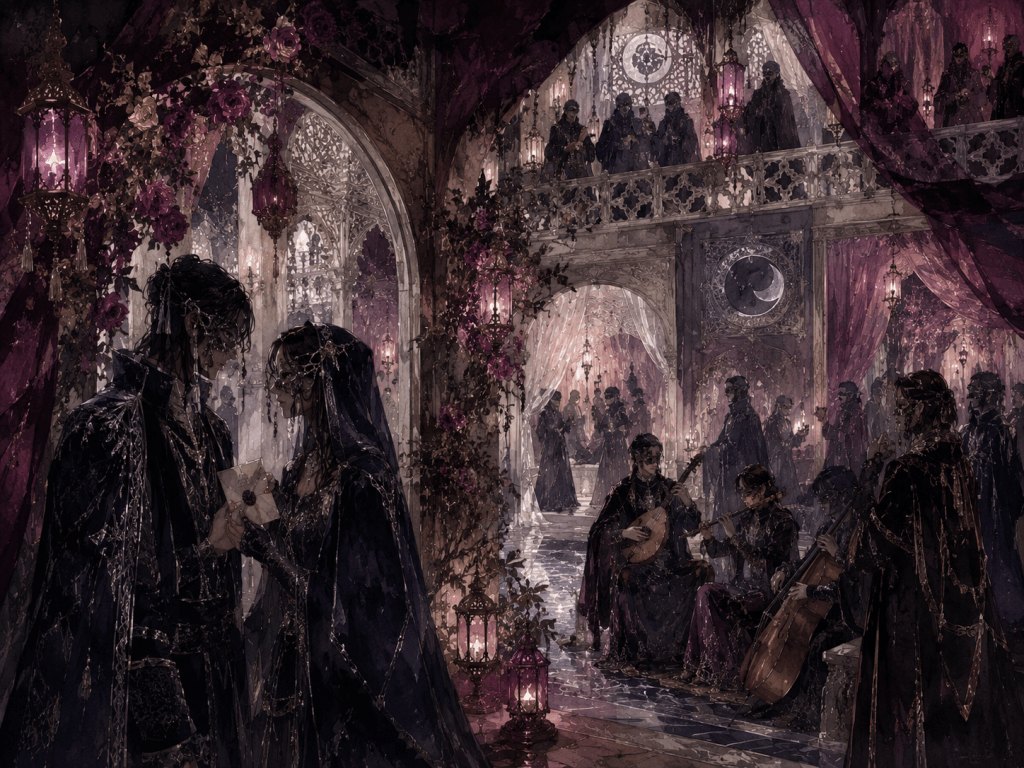
Among the nobility of Amarosa, Delavira is worshipped quietly through masked salons, private confession rituals, and secret correspondence networks.
Many political marriages maintain hidden shrines to her.
Umbral Settlements
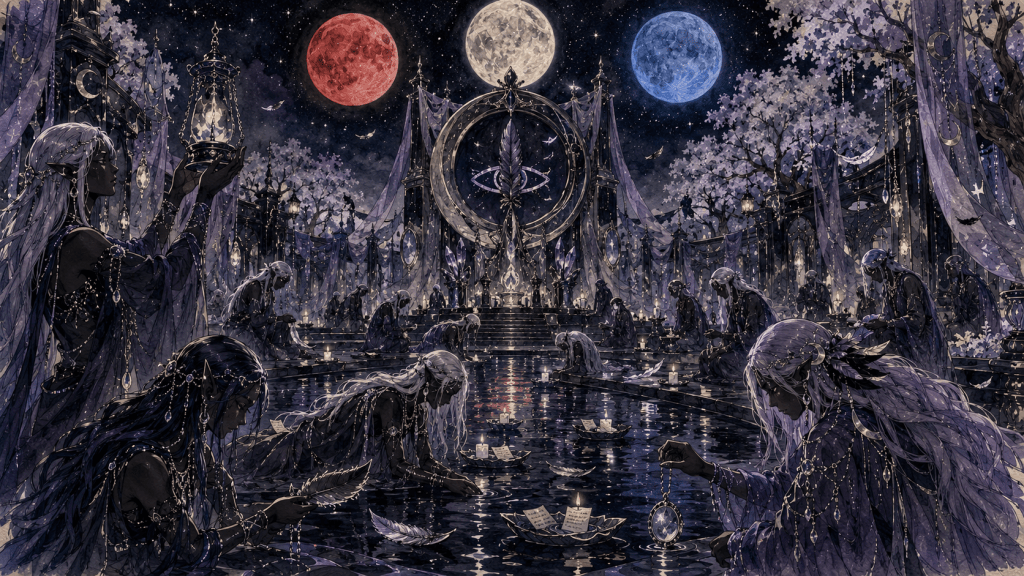
Among Umbral peoples, Delavira is associated with emotional composure, privacy, and dignified restraint. Worship emphasizes:
- silence,
- memory,
- careful trust,
- and controlled vulnerability.
Frontier Villages
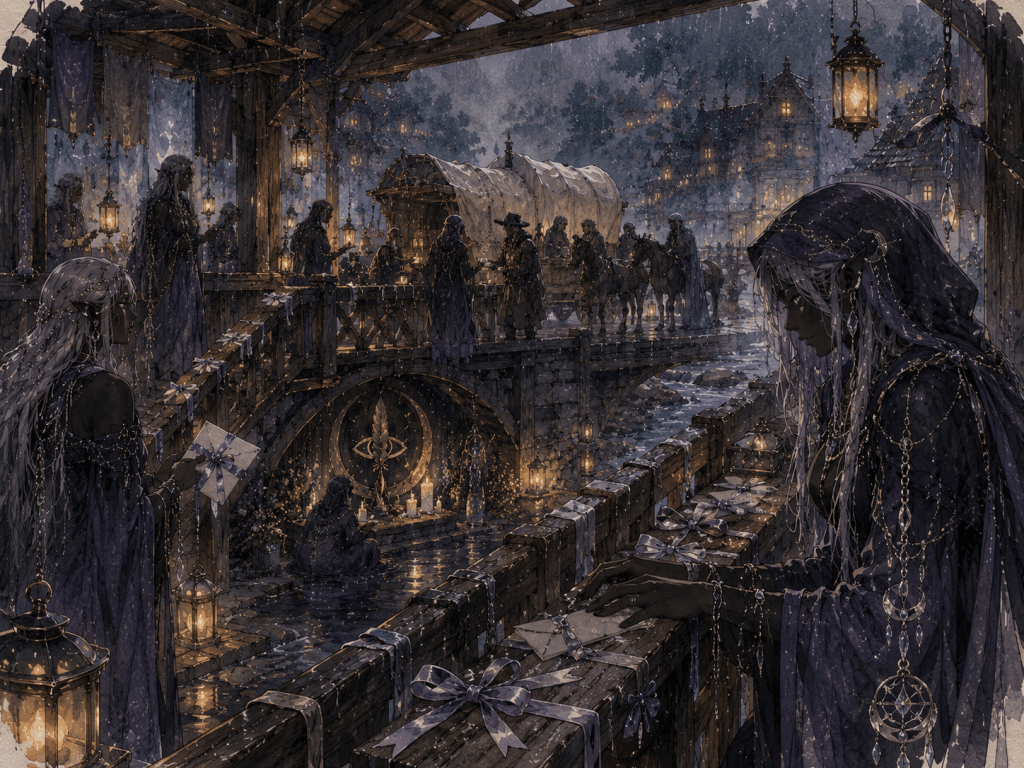
In isolated regions, Delavira is often invoked by widows, travelers, and those separated from loved ones by war or distance.
Small shrines frequently appear beside roadsides or beneath covered bridges where letters are secretly exchanged.
Sacred Creatures
Creatures associated with Delavira include:

Velvet Spiders

Mirror Ravens
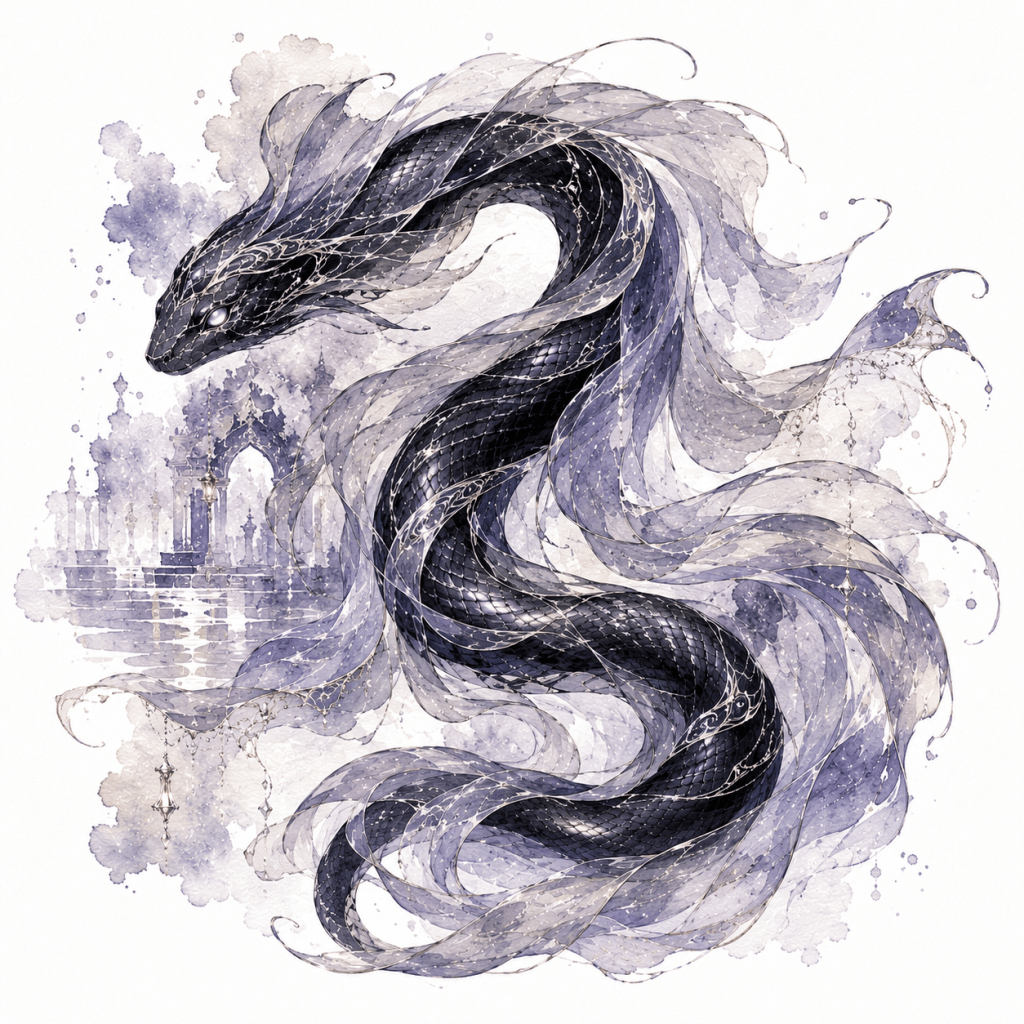
Veil Serpents
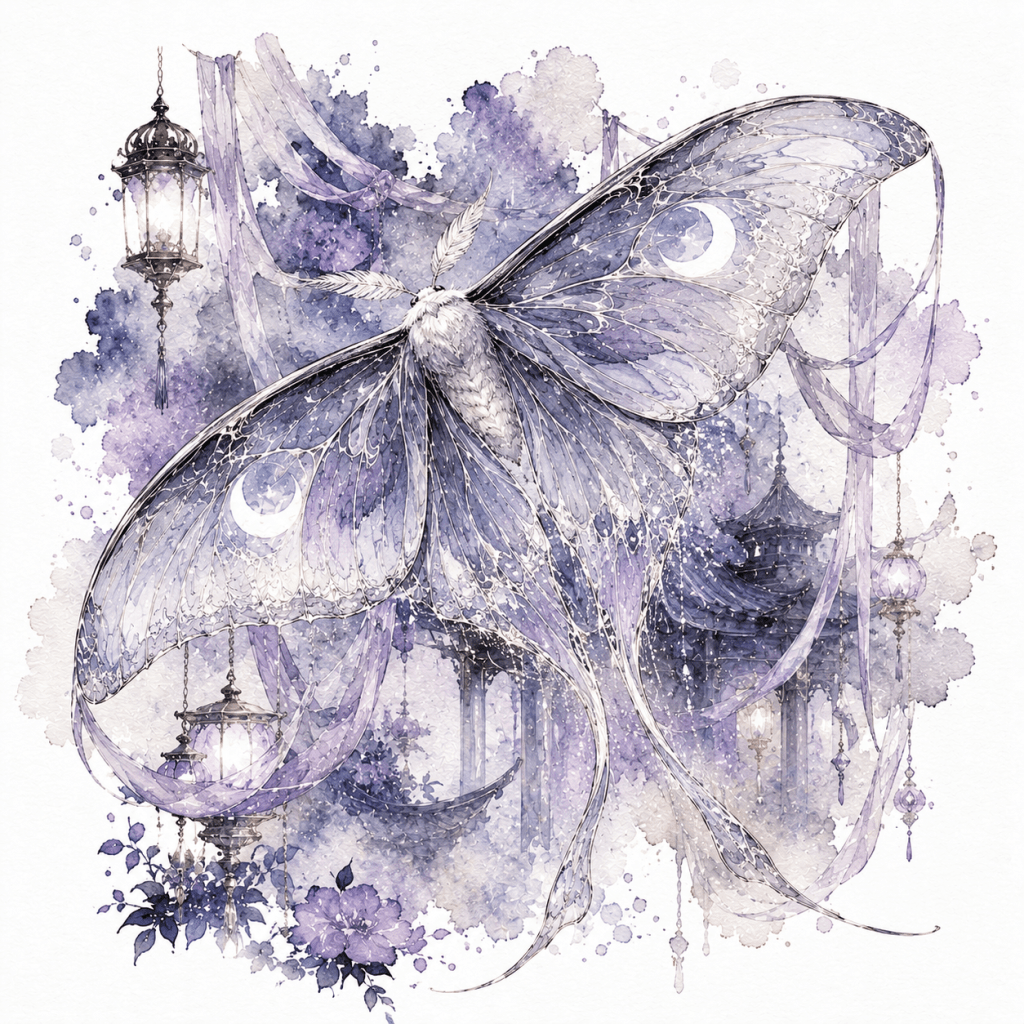
Moonmoths
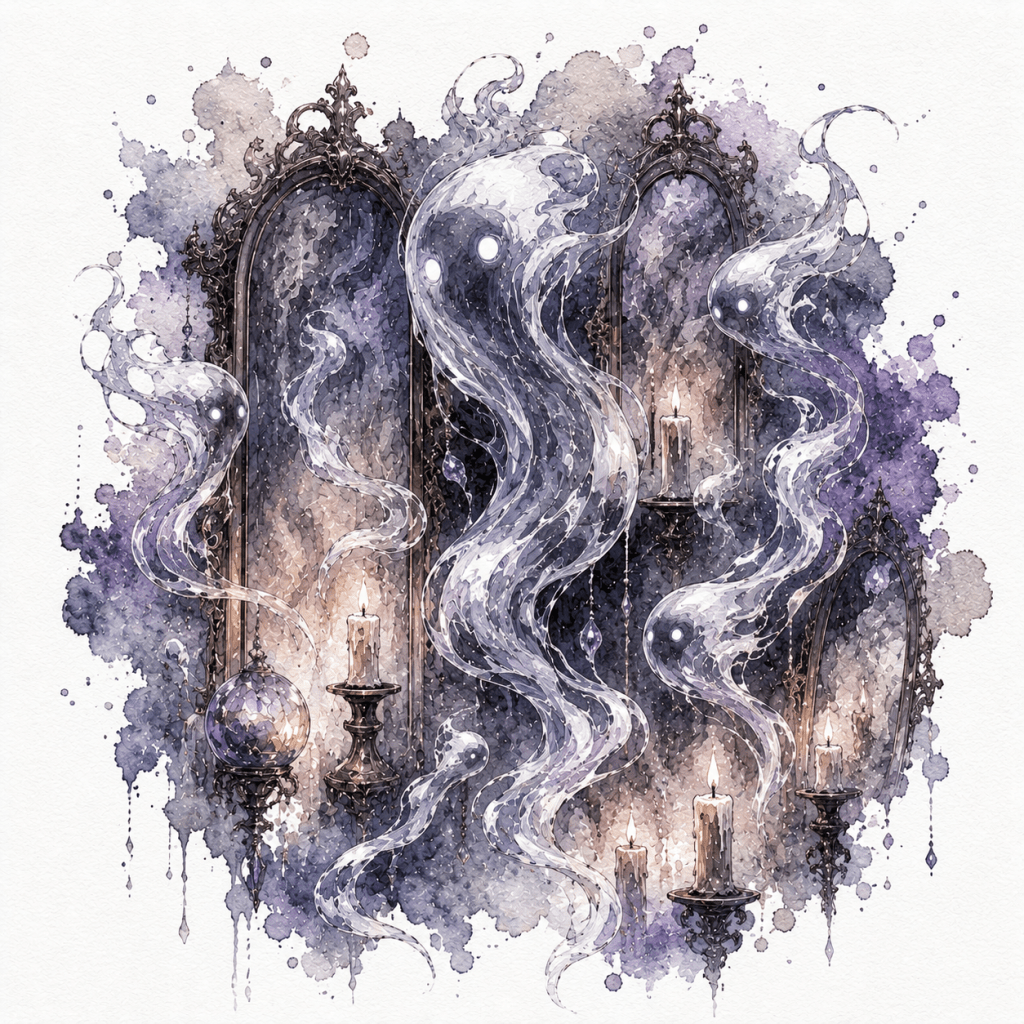
Reflection Wisps
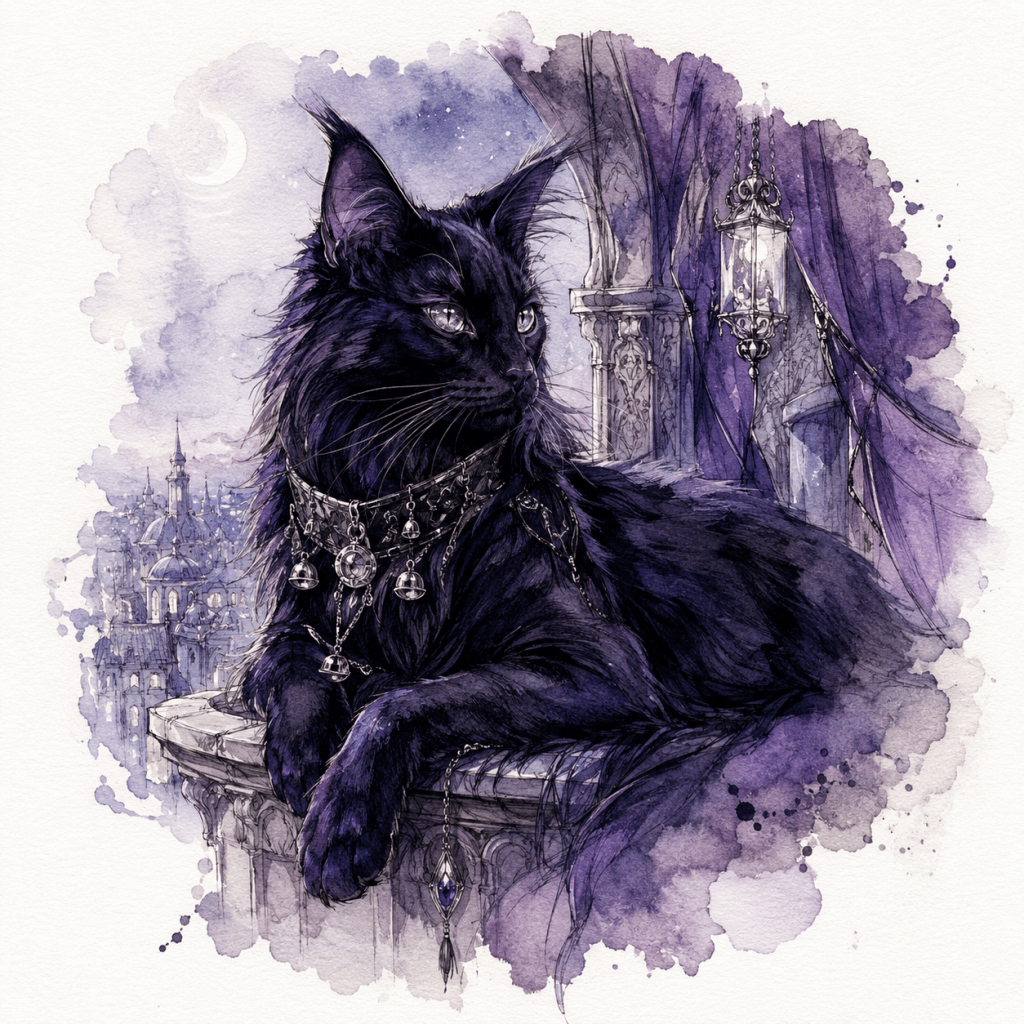
Silent Watchcats
Legends also speak of the Pale Observer—a massive silver-eyed spider said to dwell within abandoned Veilhouses and silently guard forgotten confessions.
Divine Magic & Blessings
Delavira’s magic manifests through:
- soft silver reflections,
- veil-like shadows,
- floating eye sigils,
- silent winds,
- perfume-like dusk haze,
- and mirrors darkening without warning.
Her miracles rarely force revelation.
Her blessings often appear as:
- heightened intuition,
- concealed presence,
- emotional clarity through solitude,
- shielded thoughts,
- or the calming of overwhelming longing.
Instead, they create safety for truth to emerge willingly.
Player Options
Followers of Delavira commonly include:
- Veilwalkers
- Pactsworn
- Stillhearts
- Sigilwrights
- Oathsworn
Common character concepts:
- masked investigators,
- secret keepers,
- wandering confessors,
- political spies,
- emotionally distant guardians,
- dream interpreters,
- and hidden romantics terrified of vulnerability.
Adventure Hooks
The House Without Reflections. A Veilhouse suddenly loses all reflections. Mirrors become black voids, and worshippers vanish after staring too long into them.
The Whisper Archive. A hidden archive containing decades of political confessions has been stolen. If released publicly, it could collapse multiple noble houses and ignite civil conflict.
The Veiled Wedding. Two rival noble heirs intend to secretly marry beneath Delavira’s blessing, but assassins, spies, and fanatics hunt them before the vows can be completed.
The Pale Observer. Travelers disappear near an abandoned sanctuary deep within the woods. Survivors speak of silver eyes watching from behind curtains that move without wind.
Gallery & Visual Archive
Common Visual Motifs
- veils
- curtains
- silver mirrors
- floating eyes
- spider iconography
- obsidian glass
- soft candlelight
- perfume smoke
- moonlit reflections
- layered drapery
Temple Architecture
- hidden corridors
- sunken reflection pools
- arched silk canopies
- moon windows
- black marble floors
- silver lanterns
- mirror sanctums
- spiral observation balconies
Clergy Aesthetics
- dark layered silks
- silver chains
- veil masks
- long gloves
- mirror pendants
- embroidered sleeves
- soft translucent fabrics
- ritual blindfolds





 Whispers of Erosia
You must be logged in to post a comment.