
Aratheia
The Harvest Mother • The Milkmaid Divine
Goddess of Nourishment, Care and Abundance
“What is given freely sustains the world.”
Aratheia is the divine answer to hunger: the warm meal waiting after a hard journey, the breast that nourishes, the hand that offers without demanding repayment and the harvest shared before winter closes the roads. She governs nourishment in all its forms, from grain and milk to shelter, tenderness, rest and the intimate vulnerability of allowing another to care for you. Across the Velvet Court, she represents the desire to nurture and be nurtured.
Farmers pray to Aratheia before planting. Midwives invoke her during difficult births. Shepherds tie bells beneath her symbol, cooks set aside the first portion of a meal in her name, and travelers know that an Aratheian sanctuary rarely asks who they are before placing food before them. Her worship is especially beloved wherever survival depends upon people accepting a simple truth: abundance has meaning only when it moves from one life to another.
Older traditions call her the Milkmaid Divine, emphasizing lactation, bodily nourishment, fullness and sensual generosity. Other communities favor the Harvest Mother, She of the Open Table, the Lantern in Winter, the Hearth Sovereign or the Gentle Horn. These names do not describe different goddesses. They reveal the many forms taken by the same sacred promise: when life cries out in need, something should answer.
Lore & Mythos
When Hunger First Cried
No single account of Aratheia’s beginning is accepted throughout Erosia. Some of the oldest traditions do not describe her as being born at all. They say that in the earliest dawn, when the first mortal cried out in need, something warm answered, and that answer was Aratheia.
In this telling, the early world already possessed life, but life knew only how to preserve itself. Creatures could hunger, consume and survive, yet they had not discovered the sacred possibility of sustaining another without making that act a transaction. Aratheian mystery traditions teach that the goddess changed this when she gave freely. What passed from her into another did not leave her diminished; instead, the gift allowed life to continue beyond the boundaries of a single body.
Thus, Aratheia did not create hunger. She revealed what hunger could awaken in another.
The Lantern in Winter
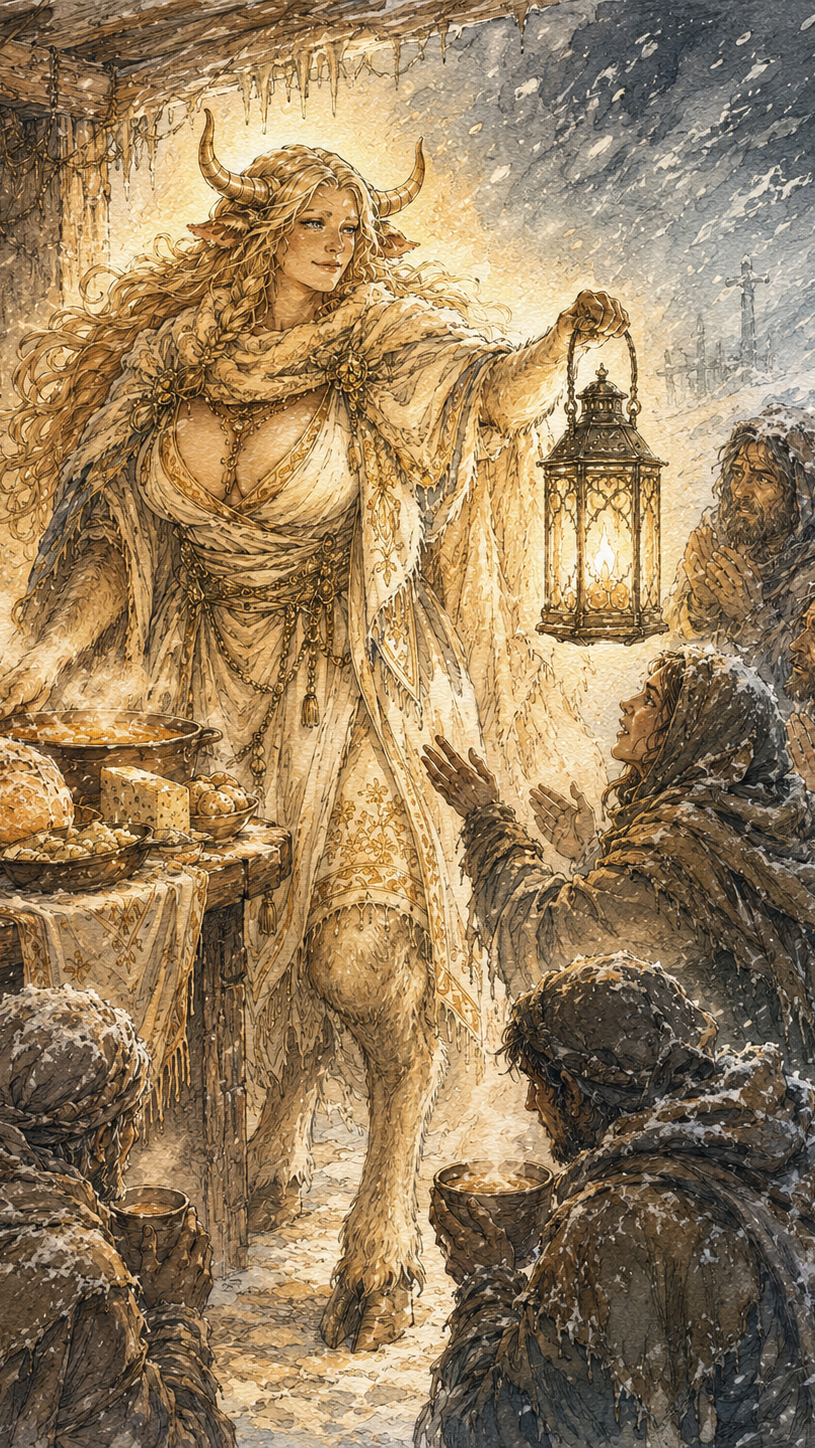
A later and widely beloved harvest myth places Aratheia’s revelation during the first great winter famine. Mortal communities had begun hoarding what remained behind barred doors. Fear transformed scarcity into cruelty, and people who might have survived together instead watched their neighbors starve.
The oldest harvest hymns tell of a wandering woman who entered those settlements carrying a lantern and a basket of impossible grain. She condemned no one for their fear and demanded nothing in return. She simply fed the starving first. Wheat rose through snow where her tears touched the ground, frost withdrew before her lantern, and by morning the stranger had vanished. A flowering orchard, grazing cattle and a shrine remained where she had passed.
Aratheian theologians rarely argue over whether this story is literal. Its meaning matters more: civilization survives when fear does not have the final word.
The First Offering
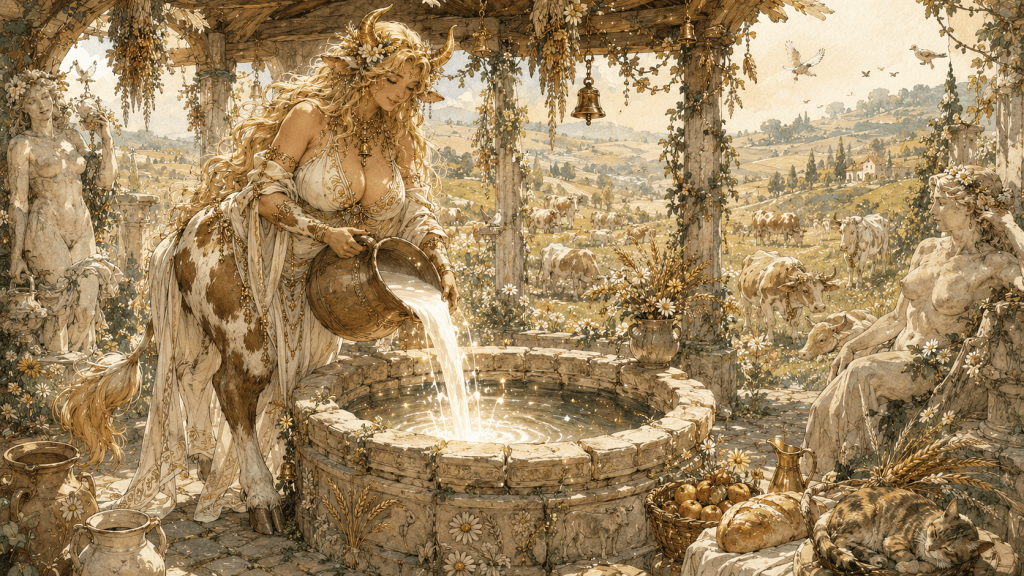
Another tradition remembers neither famine nor winter. It teaches that Aratheia appeared beside an empty well and poured luminous milk from a humble clay vessel until the basin overflowed. Those who drank were strengthened, but the vessel never emptied.
This story became the foundation of the Festival of First Milk and one of the central mysteries of Aratheian theology. The miracle was not that the goddess possessed an endless supply. The miracle was that what was given did not diminish; it multiplied.
For this reason, different Aratheian traditions can tell very different stories about her first appearance without considering one another heretical. Whether she carried grain, milk, warmth or her own body as the first vessel, the sacred act remains the same.
Something was needed. Something was freely given. Life continued.
The Desire She Embodies
Aratheia embodies the desire to nurture and be nurtured.
Her domain begins with physical hunger but extends far beyond it. A weary traveler needs rest. A frightened person needs reassurance. A wounded adventurer needs someone willing to remain beside them. A community struck by disaster needs people prepared to share what remains. Even the strong eventually need somewhere safe enough to set down what they carry.
Aratheia teaches that such needs are not defects in mortal existence. Need creates the possibility of connection.
Her faithful therefore reject the idea that absolute self-sufficiency is a virtue. Strength is not proven by never needing another person. It is demonstrated by knowing when to give, when to receive and how to do either without turning care into ownership.
Nourishment and Abundance
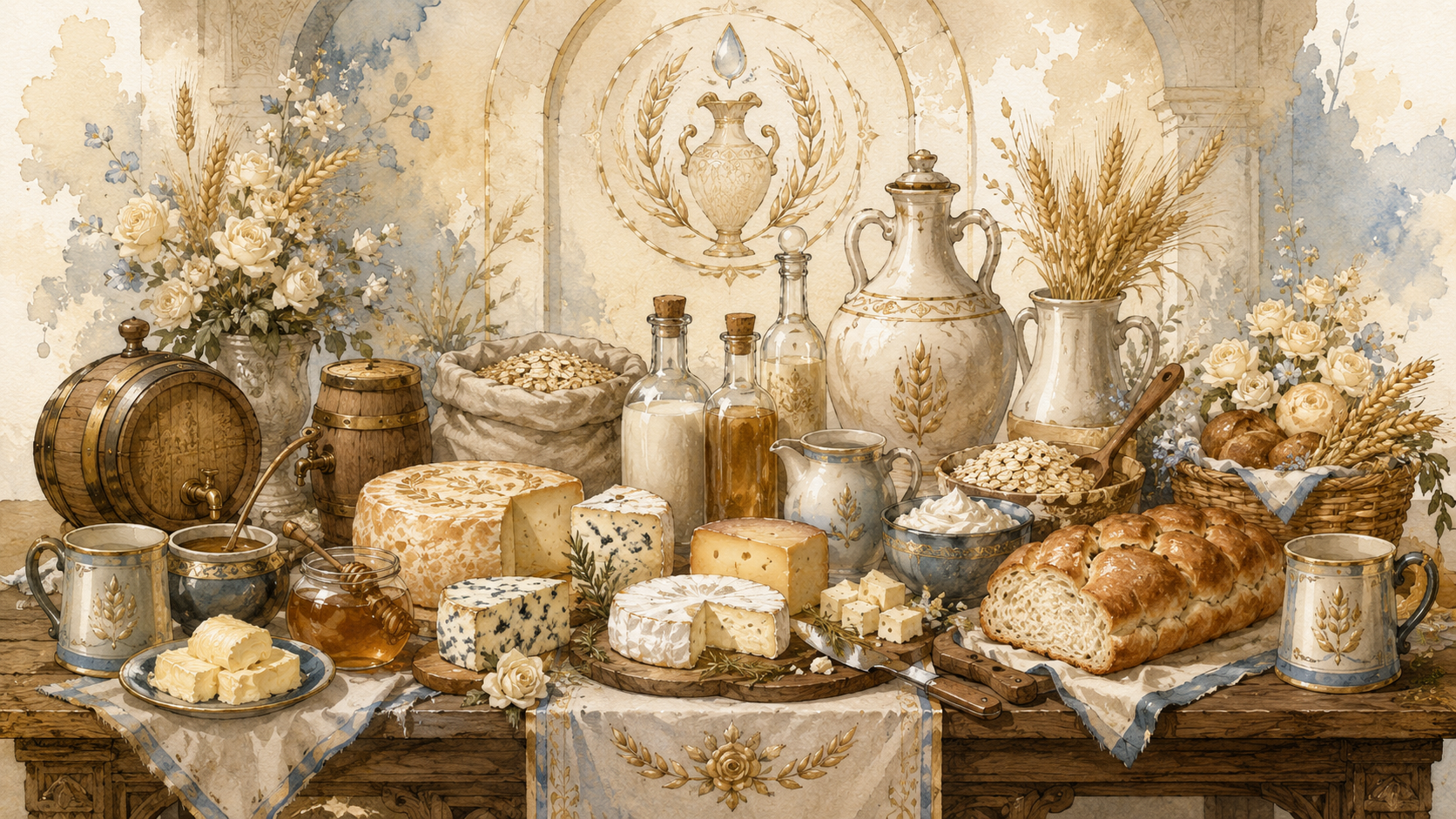
To Aratheia, abundance is not possession. It is circulation. A granary filled while neighbors starve is not blessed. Milk left to sour while children hunger is not prosperity. Wealth kept only because its owner fears tomorrow has ceased to fulfill its sacred purpose. Aratheian communities consequently place tremendous cultural value on communal stores, public kitchens, shared tables and reserves maintained for winter, disaster and travelers.
This does not mean her faith condemns preparation. Aratheia’s clergy are often meticulous stewards. They preserve fruit, age cheese, store grain and maintain carefully counted emergency supplies. The distinction lies between keeping so that something may later be given and hoarding so that no one else may have it.

The Ever-Giving Body
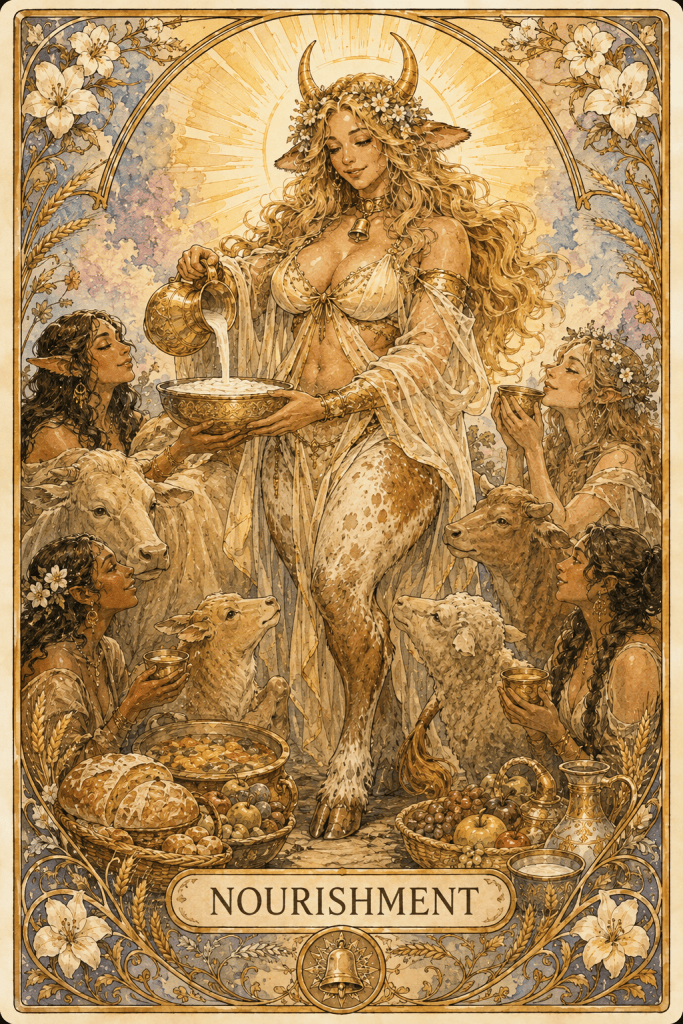
Aratheia’s most intimate mysteries carry this theology into the body itself. Lactation is sacred to her because it makes her central mystery flesh: the body becomes capable of producing nourishment for another. Milk therefore appears throughout Aratheian worship as food, sacrament, blessing, metaphor and erotic symbol. The breast is similarly honored as an image of fullness, vulnerability, nourishment and embodied generosity.
Older devotional traditions are considerably more sensual than many public ceremonies. They celebrate fullness, suckling, feeding, bodily worship and the intimacy of accepting nourishment directly from a willing giver. The archives are unequivocal that this erotic dimension belongs to Aratheia rather than being a later corruption of her worship.
Yet the same theology establishes its boundary.
Nothing given unwillingly is sacred.
An Aratheian offering may be food, milk, touch, emotional care, magical sustenance, bodily intimacy or simply someone’s presence. Its holiness comes from willingness, not from the form the offering takes. Aratheian ritual traditions consequently treat consent as inseparable from nourishment: what is freely offered may become sacred, while what is extracted has already ceased to belong to Aratheia.
Holy Symbol & Iconography
The Pearl of Plenty
Aratheia’s holy symbol is a radiant golden harvest medallion centered upon a large, luminous pearl-white stone. A circular sunburst surrounds the pearl, while four ornamental points extend along the cardinal directions and hold smaller milk-white gems. Golden heads of wheat rise and curve around the central medallion, creating the impression of abundance gathered protectively around a living source of nourishment.
The symbol carries several meanings at once. Wheat is nourishment cultivated. The pearl is nourishment embodied. The encircling vessel is nourishment held until it may be offered. The radiant gold surrounding them represents abundance carried outward rather than locked away.
Older symbols survive throughout Erosia. Some depict overflowing vessels, chalices, drops of milk or abstract curves associated with the nourishing breast. These remain recognized Aratheian devotional imagery, particularly in intimate sanctuaries, but the pearl-and-wheat medallion has become the faith’s most widely recognized public emblem.
Sacred Colors and Materials
Aratheian sanctuaries favor harvest gold, cream, ivory, oat, honey amber and warm earth tones. Brass is common among ordinary worshippers, while wealthier temples use gold, pearl, pale stone and polished horn.
Ceramic vessels are particularly beloved. Aratheian theology places little value on a chalice being expensive merely for the sake of expense; a clay bowl that has fed generations of travelers may possess greater religious importance than a jeweled cup that has never been used.

Bells, Grain and Vessels
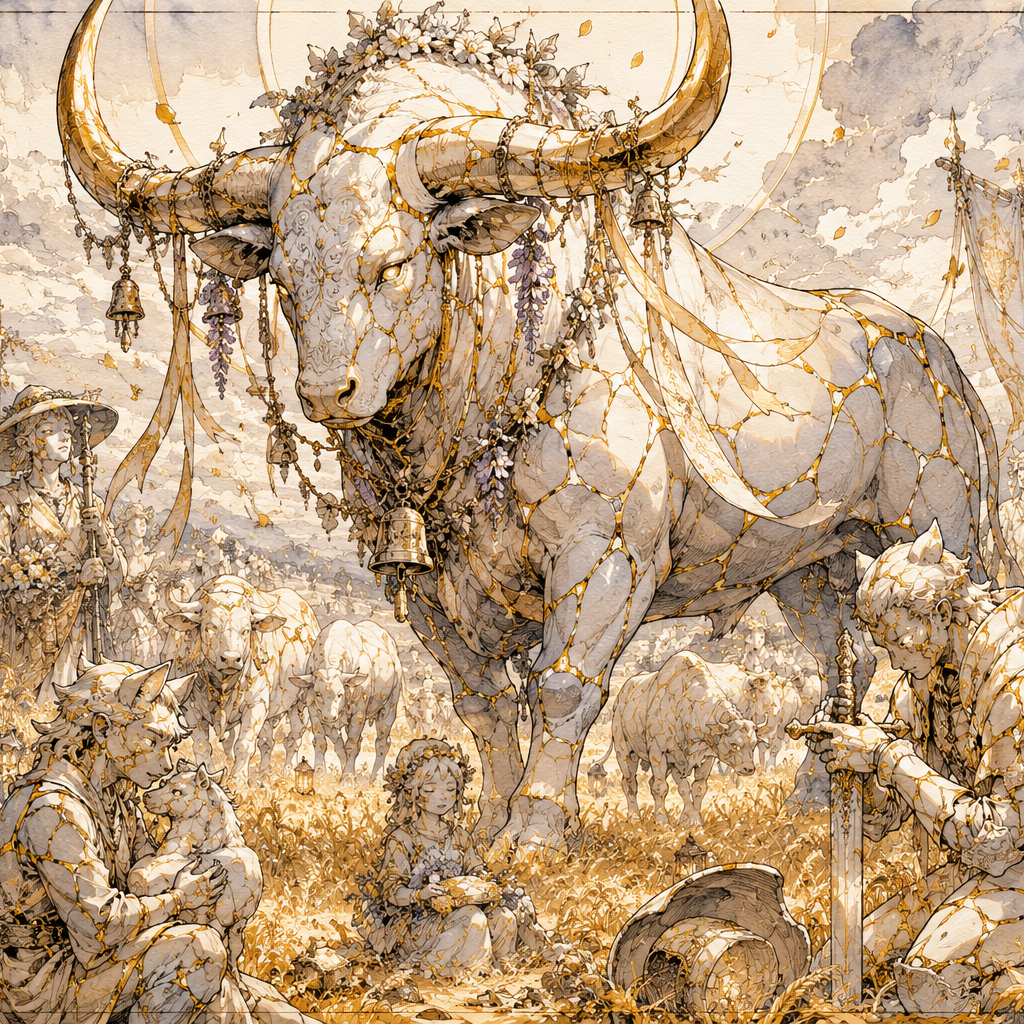
Bells are among the most persistent secondary symbols of the faith. Small brass bells hang from livestock, temple doors, priestly bracelets and Milkroad wagons. Their sound means many things depending on context: a herd returning home, a meal being served, a caravan departing or help approaching from somewhere beyond the road. Sacred herds commonly wear bells, and temple pastures themselves are considered extensions of Aratheian sanctuaries.
Grain, chalices, jugs, bowls, lanterns, honey, flowing milk and overflowing vessels appear repeatedly in temple decoration. The faith’s visual tradition returns constantly to one image: something full enough to share.

Sacred Creatures
Cattle and goats are Aratheia’s most familiar sacred animals, particularly milk-bearing breeds tended by temple communities. Doves and calves also appear in older traditions, while regional worship associates her with Moonhorn cattle, meadow elk, hearth hounds, lantern beetles, grain doves and honeytail bees.
Stories also speak of the Golden Herd, celestial cattle whose appearance is said to precede seasons of extraordinary plenty. Whether the Golden Herd exists as literal divine creatures or represents a recurring visionary omen remains a subject of theological debate.
Depictions of Aratheia
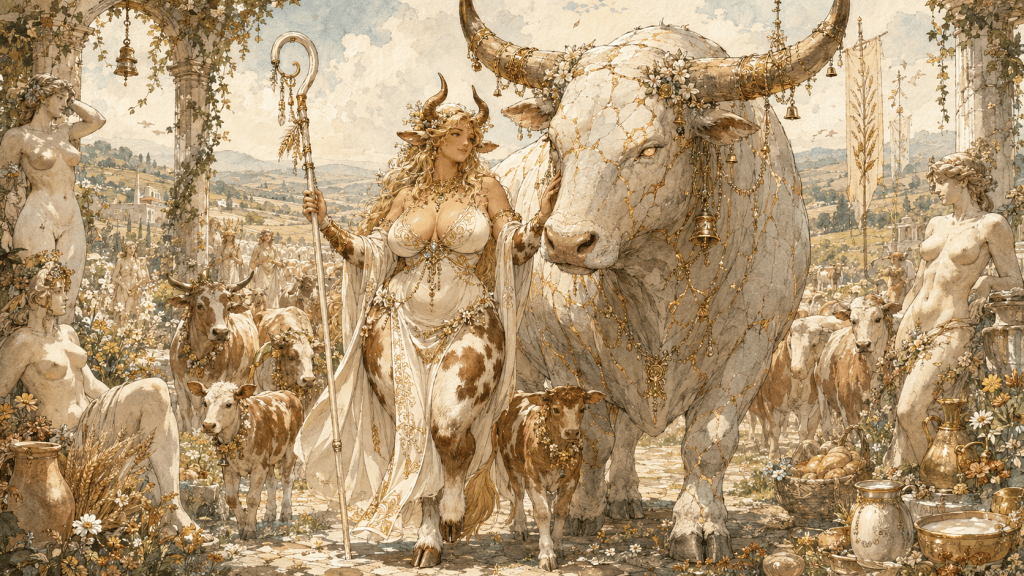
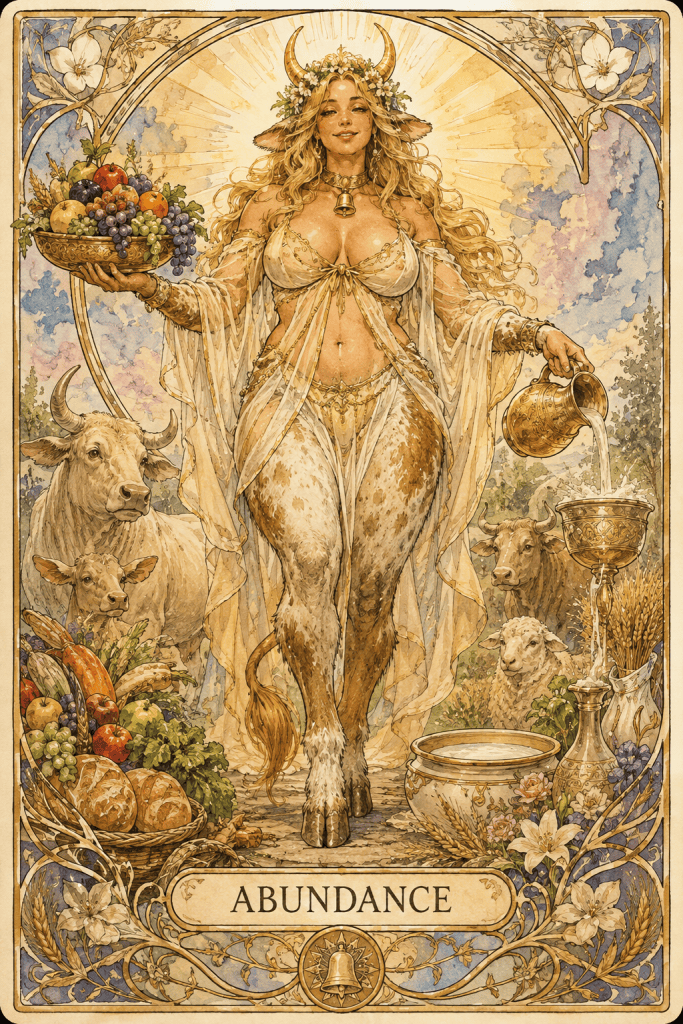
Sacred art traditionally portrays Aratheia as a mature, voluptuous divine woman whose sacred form unites human and bovine features. She stands upright upon exactly two powerful bovine legs ending in cloven hooves, with a single bovine tail. Her upper body is predominantly human in form, while soft bovine fur emerges across portions of her limbs and lower body. She bears broad bovine ears and elegant golden horns while retaining a fully human face.
Her long wheat-blonde hair, luminous blue eyes and abundant feminine figure are recurring features of Aratheian iconography. Her physical fullness represents health, nourishment, generosity and plenty rather than excess.
She is commonly depicted in flowing pastoral silks and ceremonial drapery embroidered with flowers and grain, adorned with bells, gold ornaments and sacred vessels. In more intimate devotional art, her breasts are prominent symbols of nourishment, sacred fullness and the Ever-Giving Body rather than incidental anatomy.
Aratheia’s divine form should never be interpreted as a taur, centaur, satyr or woman joined to the body of a cow. She possesses a single upright humanoid body plan: one torso, two arms, two legs and one tail.
Her presence should communicate comfort before grandeur:
You are cared for here.
Worship & Daily Devotion
Aratheia is among the easiest gods to worship without ever entering a temple. Cooking for someone who cannot cook for themselves can be prayer. Carrying provisions to an elderly neighbor can be prayer. Repairing a communal fence, nursing a sick animal, leaving bread for travelers or sitting beside someone who should not be alone can all become devotional acts when performed freely and with care. This practicality makes Aratheia particularly beloved among farmers, shepherds, brewers, bakers, cooks, innkeepers, gardeners, healers, midwives and others whose labor sustains everyday life.
The Open Portion
Many households reserve a small portion of whatever they prepare for someone who may need it. The practice varies by region. It might be a loaf kept near the door, a bowl that can always be filled from the evening pot or preserved food stored specifically for unexpected guests.
The important rule is that the portion is not counted as wasted if no one claims it. Its existence reminds the household that abundance includes the possibility of generosity.
The Shared Table
Communal meals are among the most common expressions of Aratheian worship. Seating arrangements frequently mix strangers, families and social classes deliberately, reinforcing the principle that hunger grants no one greater or lesser dignity.
Refusing food politely is acceptable. Forcing hospitality upon someone is not. Aratheian etiquette places equal importance on learning to offer graciously and learning to hear no without offense.
Favored Offerings
Traditional offerings include bread, milk, honey, preserved fruit, handwoven cloth and shared meals.
Food offered at a shrine rarely remains there long enough to spoil. Most temples distribute edible offerings through their kitchens or place them where travelers can take them. Destroying useful nourishment merely because it has been “given to the goddess” would strike many Aratheians as missing the point entirely.
The Milkroads
In regions where Aratheian worship is strong, temple communities maintain pastoral trade routes commonly called Milkroads. Caravans transport milk, butter, cheese, bread, medicine and other provisions between settlements, temples and neighboring lands.
Departure itself is ritualized. Before dawn, an Aratheian priestess may fasten small bells to wagons and bless both the nourishment being carried and those entrusted with delivering it. The Milkroad Departure makes the journey part of the offering: the food has been produced, but the sacred cycle remains incomplete until it reaches someone who needs it.
Clergy & Temples
Hearthkeepers
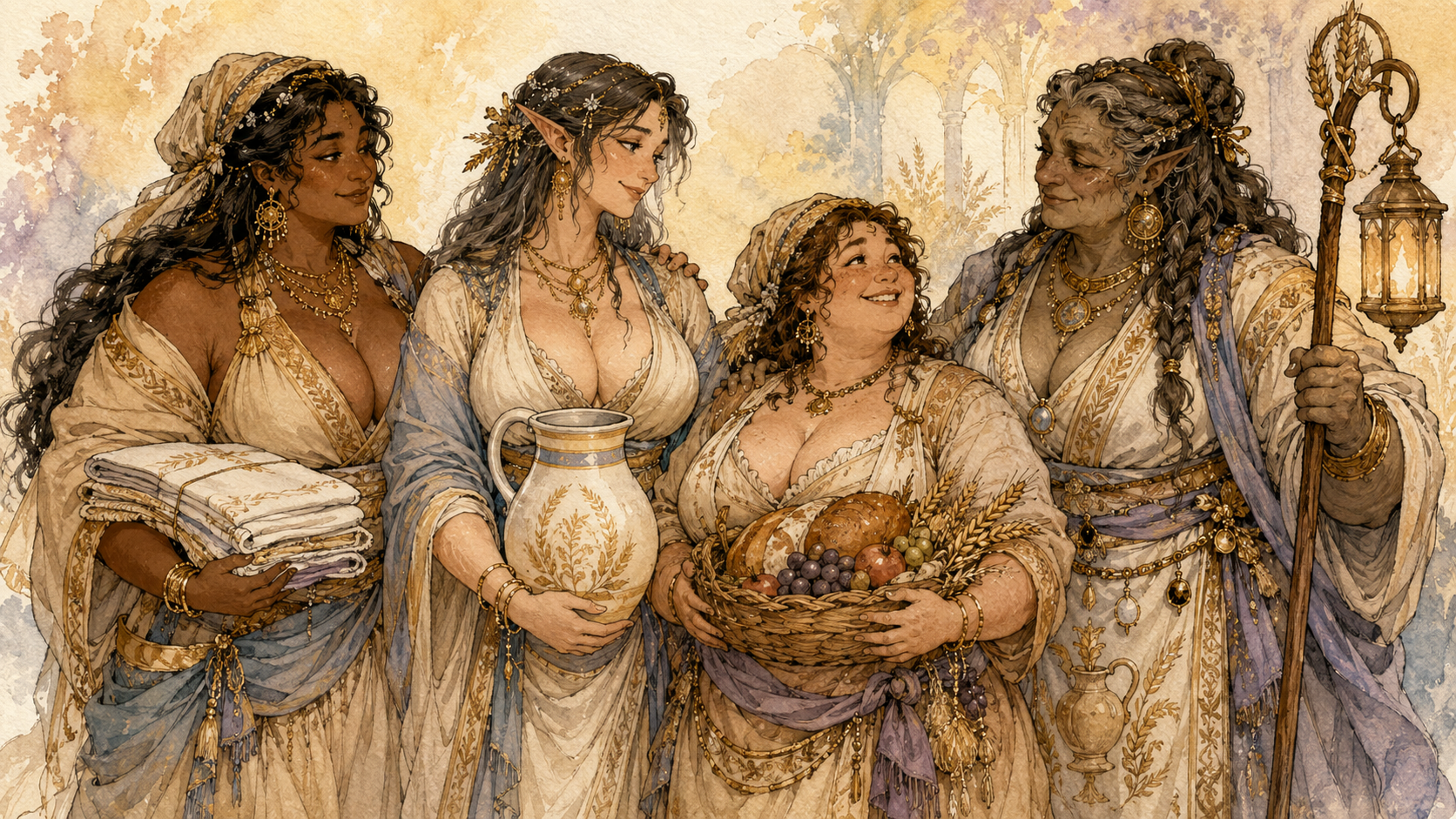
The Hearthkeepers form Aratheia’s primary priesthood. They maintain kitchens, shrines, food stores, healing halls and community shelters. Their vestments favor layered cream and oat-colored fabrics, practical aprons, soft wool, brass jewelry and floral embroidery, with lantern charms, grain motifs and ceremonial bells serving as common signs of office. A Hearthkeeper may spend more time kneading bread, balancing winter stores or treating fever than conducting formal worship. No contradiction exists between these duties and priesthood. Within Aratheian theology, they are priesthood.
Milkwardens
Milkwardens carry Aratheia’s protection beyond established sanctuaries. They escort caravans bearing food and medicine, protect refugees and travelers, defend pastoral communities and ensure that supplies reach settlements isolated by disaster or conflict.
Many are Oathsworn protectors, mounted wardens or wandering folk heroes. Their traditional saying captures the order’s character: “No road is too long if someone waits hungry at its end.”
Lantern Shepherds
The Lantern Shepherds preserve the faith’s quieter inheritances: recipes, lullabies, oral histories, healing practices and ancestral stories. In isolated communities, they often become healers, spiritual guides and surrogate elders whose authority comes less from hierarchy than from being the person others trust when something has gone wrong.
Hearthhouses & Granaries of Grace
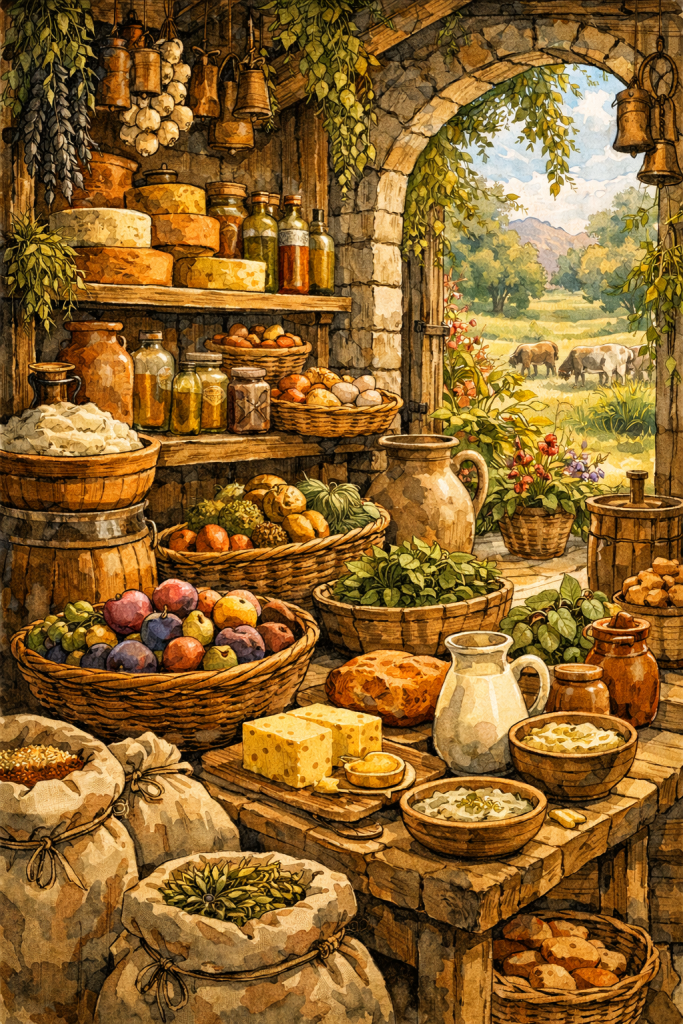
Aratheian temples are often called Hearthhouses, Granaries of Grace or Lantern Sanctums. Few resemble monumental cathedrals. They are deliberately integrated into the life around them and may contain communal kitchens, harvest halls, bathhouses, infirmaries, breweries, greenhouses, sleeping chambers and extensive food stores.
Long tables matter more than thrones. Great hearths burn through winter. Herbs dry from rafters, grain fills carefully maintained silos, ceramic milk vessels line kitchen shelves and temple gardens provide both medicine and food.
A visitor may initially have difficulty identifying where ordinary work ends and religious ceremony begins.
That ambiguity is intentional.

Rites, Taboos & Divine Signs
The Festival of First Milk
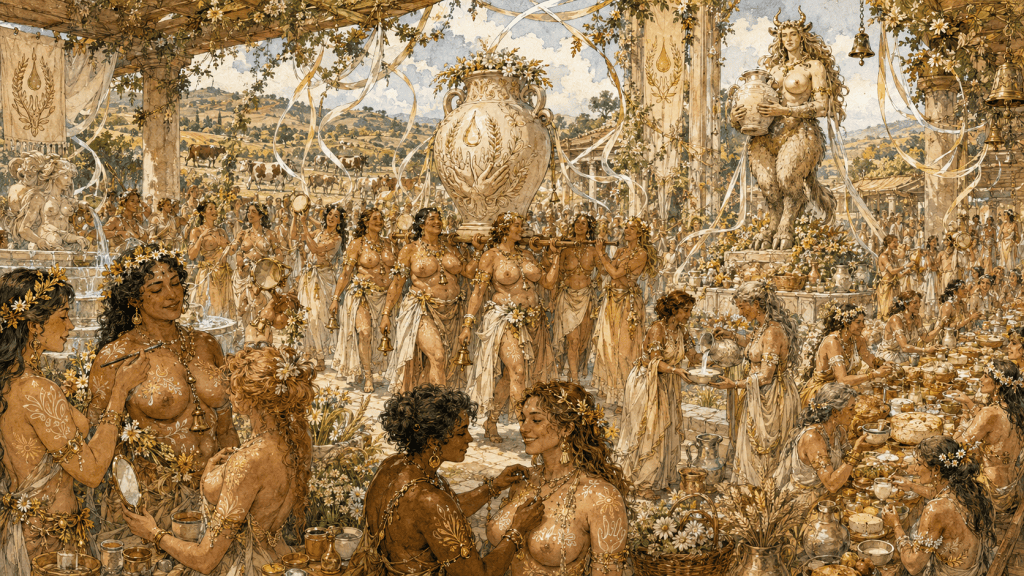
The Festival of First Milk commemorates Aratheia’s primordial act of freely given nourishment. Its oldest rites center upon a vessel filled by a giver, accepted by a receiver and witnessed by the community. Modern celebrations range from quiet household observances to major public festivals.
Food, milk, cream, cheeses, breads and sweets fill communal tables. Processions carry vessels and bowls through the streets while bells, flutes and drums accompany dancers. Wheat, flowers, ribbons and gold thread adorn participants and sacred images.
Some communities also honor the body itself as a vessel of nourishment. Ritual toplessness may be culturally accepted during the festival, particularly among adults directly honoring Aratheia, with floral painting, oils, wheat garlands and delicate jewelry used to adorn the chest. The practice is devotional rather than compulsory, and fully clothed participation carries equal religious legitimacy.
The Pouring
The Pouring is a simple rite of trust in which blessed milk or another nourishing liquid is slowly poured into a vessel or over the hands or wrists of a willing participant. The act represents the decision to receive rather than endure need alone. Variations occur throughout Erosia, ranging from public blessings to deeply intimate ceremonies between partners.
The Shared Bowl
Participants drink from the same wide vessel, affirming companionship and mutual care. The rite is particularly common when welcoming someone into a household, traveling company or religious community. The bowl symbolizes a shared condition rather than ownership: everyone may need, everyone may give, and neither state makes one person greater than another.
The Rite of Blessed Overflow
Older rites describe lines of supplicants receiving blessed nourishment from a devotee serving as the ritual vessel. Some traditions use enchanted milk or prepared sacramental drink; more intimate forms may involve bodily nourishment offered directly. The central principle remains unchanged regardless of expression: giver and receiver participate willingly, and neither role is considered spiritually superior.
The Mother’s Embrace
The Mother’s Embrace is a healing rite in which an injured or distressed person is held against a willing caregiver while restorative magic is channeled through touch, warmth and breath. Older forms specifically describe a priestess cradling the wounded against her breast. Modern temples often adapt the rite according to the relationship and comfort of those involved. Its sacred element is not a prescribed position but the willingness to become vulnerable enough to receive care.
The Quiet Letting
The Quiet Letting is a private practice for releasing accumulated tension, shame or emotional hunger. Archival traditions describe meditation, gentle self-touch and, for those able to do so, the slow expression of milk as possible forms of the rite. It is one of Aratheia’s few significant solitary devotions. Even here, however, the theology remains one of care: the worshipper temporarily becomes both giver and receiver.
The Great Prohibition
Aratheia possesses many customs but one overriding taboo: Nourishment may never be taken and called an offering.
Coerced feeding, forced bodily participation, deliberate starvation as control and the exploitation of another person’s need are profound violations of her faith. Hoarding necessary supplies during genuine scarcity may likewise become sacrilegious when motivated by greed rather than responsible stewardship.
The faith’s principle is preserved succinctly in ritual teaching: “Nourishment offered is sacred. Nourishment taken is nothing.”
Signs of Aratheia
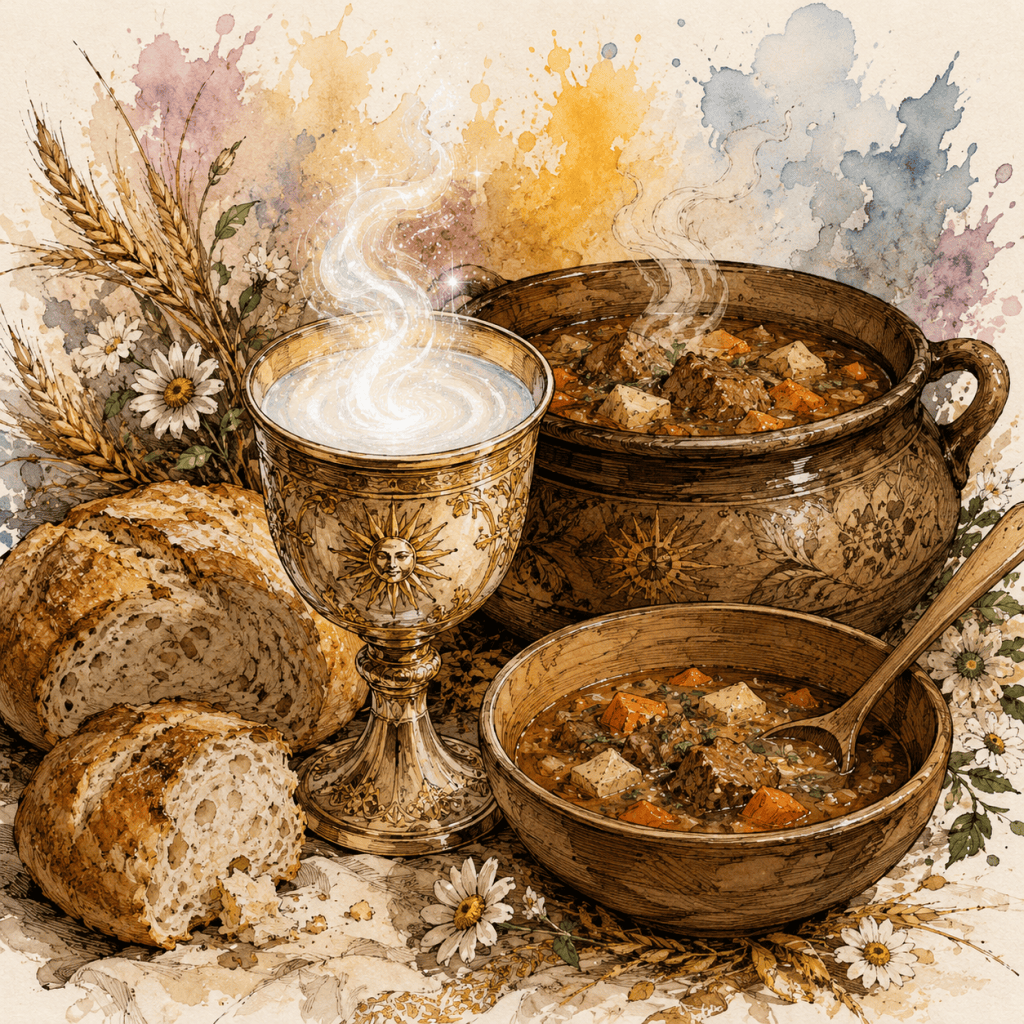
Her favor rarely arrives with thunder. Bread remains warm long after leaving an oven. A nearly empty pot somehow provides one more bowl. A frightened animal approaches someone it should not trust. Milk glimmers faintly gold beneath moonlight. Wheat bends despite the absence of wind. Bells are particularly significant. Hearing a gentle bell where no bell should be present is traditionally interpreted not as a command but as a question: Who nearby needs care?
Aratheia and the Velvet Court
Within the Velvet Court, Aratheia embodies Nourishment, Care and Abundance. Where Velyssara affirms desire as a sacred current of life, Aratheia asks what happens after desire awakens: who tends what has been created, who feeds what has been born and who remains when passion gives way to vulnerability.
Her place within the Court is therefore neither passive nor secondary. Desire without sustenance burns itself empty. Transformation without care leaves wounds. Pleasure without aftercare may become consumption. Aratheia represents the divine principle that what is awakened must also be sustained.
Her relationship with Velyssara is especially close, and their worship frequently overlaps around fertility, reconciliation, love and the care of new life. Other traditions pair Aratheia with deities whose domains concern release, protection or communal survival, but Aratheian theologians generally resist reducing these relationships to fixed divine alliances.
The Harvest Mother does not ask every god to become gentle.
She asks what they intend to do with what remains after their miracles.
Miracles & Divine Presence
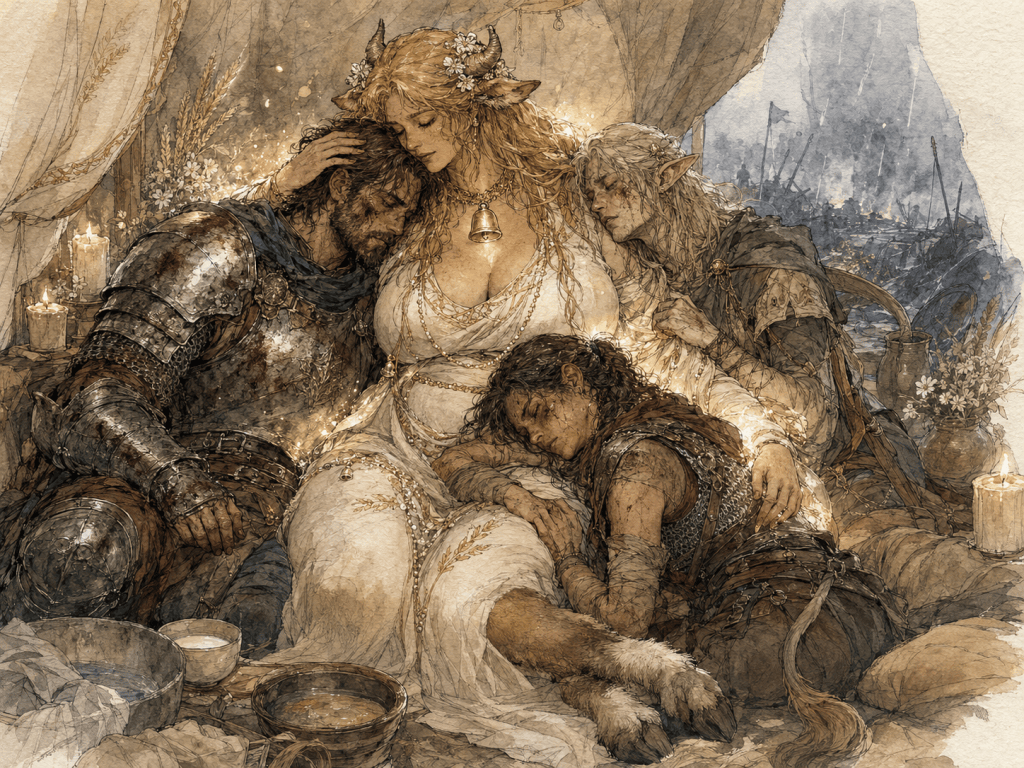
Aratheia’s miracles often resemble fortunate ordinary events until one looks twice. A starving community discovers that its last sacks of grain contain enough seed for spring and enough flour for winter. A spring runs white and sweet for three days after refugees arrive. A woman who believed her body could no longer nourish produces milk when an abandoned infant is placed in her arms. A wounded soldier wakes beneath a wool blanket to discover that someone they cannot remember has washed the blood from their hands.
The archives describe statues weeping milk during festivals, wells becoming warm cream and mortally exhausted warriors recovering while held against an Aratheian priestess. More often, her presence is subtler. Hunger eases before food arrives. Shoulders unclench. Animals settle. A room seems warmer without the fire changing. People who have spent days refusing help suddenly find themselves capable of saying, yes, please. When Aratheia’s power becomes unmistakable, it manifests as milk-light: warm ivory radiance touched with gold, flowing like liquid without wetting what it crosses. Bells sometimes sound within it, distant and soft, as though a herd were returning home beyond the horizon.
What Her Faith Teaches
Aratheia teaches that need is not weakness. Every living thing requires something beyond itself. Food. Water. Shelter. Touch. Community. Rest. Care. Even the person capable of carrying everyone else will eventually need to be carried. The lie of absolute self-sufficiency therefore has little place in her theology. Aratheia does not glorify helplessness, but neither does she glorify suffering alone. Her faithful are taught that giving and receiving are complementary disciplines. To give well requires attentiveness, restraint and the humility not to make another person’s need about oneself. To receive well requires trust and the courage to acknowledge that something is wanted. This produces several principles repeated throughout Aratheian teaching:
- Abundance must circulate. What grows plentiful should move toward need rather than remain locked away.
- Labor deserves dignity. Cooking, cleaning, farming, nursing, mending, carrying and tending are not lesser forms of service because they lack spectacle.
- Rest is necessary. Exhaustion is not proof of devotion. A caretaker who never receives care eventually loses the ability to give it freely.
- The body may be sacred through what it offers. Milk, warmth, touch, pleasure and physical comfort can all become expressions of generosity when they are freely shared.
- Receiving is an act of trust. The person accepting care is not beneath the person giving it.
- And above all: Nothing given unwillingly is sacred.
At the Table

Aratheia works best in a campaign when her presence appears between the moments that traditionally receive the most attention. She belongs after battles, during travel, in shelters, kitchens, festivals, recovery scenes and communities deciding whether scarcity will make them generous or cruel.
Her faith gives a GM an immediate way to make ordinary hospitality feel distinctly Erosian. An Aratheian NPC does not need to preach theology. They can simply push a warm bowl across a table before asking why the adventurers came.
Aratheian Characters
Characters drawn toward Aratheia commonly include healers, protectors, cooks, farmers, herbalists, brewers, caravan guards, midwives and anyone who understands strength primarily as the ability to sustain others.
Her faith also suits characters learning the opposite lesson. A fiercely independent warrior who cannot accept help, a caretaker destroying themselves for everyone around them or a wealthy character discovering that generosity requires more than charity can all find meaningful conflict within Aratheian theology.
Divine Domains and Traditions
The archives associate Aratheia most strongly with Life and Lust, alongside traditions such as the Oath of Nurture, Oath of Bloom, Circle of Petals and Pact of the Nourishing Heart. These affiliations should be treated as setting hooks where their corresponding player options have not yet received Second Bloom conversion.
Boons of Aratheia
Older accounts preserve several characteristic blessings: the ability to create supernatural nourishment that restores the wounded, an aura that steadies companions and a calming sacrament capable of easing overwhelming desire.
These concepts remain appropriate expressions of Aratheia, but their archived rules predate the current mechanical framework.
(Needs updated mechanics: Base 5e → Veiled → Unveiled.)
Sanctified Nourishment
Aratheian traditions also preserve the concept of Sanctified Mediums: vessels, food, drink, spaces or willing bodies through which nourishing magic may be carried and offered. The concept is strongly established and provides an excellent foundation for future Aratheian mechanics.
Any Second Bloom implementation should preserve its defining rule: the recipient chooses whether to receive the effect.
(Needs updated mechanics: Base 5e → Veiled → Unveiled.)
Sacred Relics

The Chalice of the First Pouring
Tradition claims the earliest of these broad stone chalices were carved from the well associated with Aratheia’s first endless offering. Gold veins run through the pale stone, and liquid placed within it takes on the glow of dawn through cream.
The chalice remembers the principle for which it was made: nourishment exists to be offered.
(Needs updated mechanics: Base 5e → Veiled → Unveiled.)
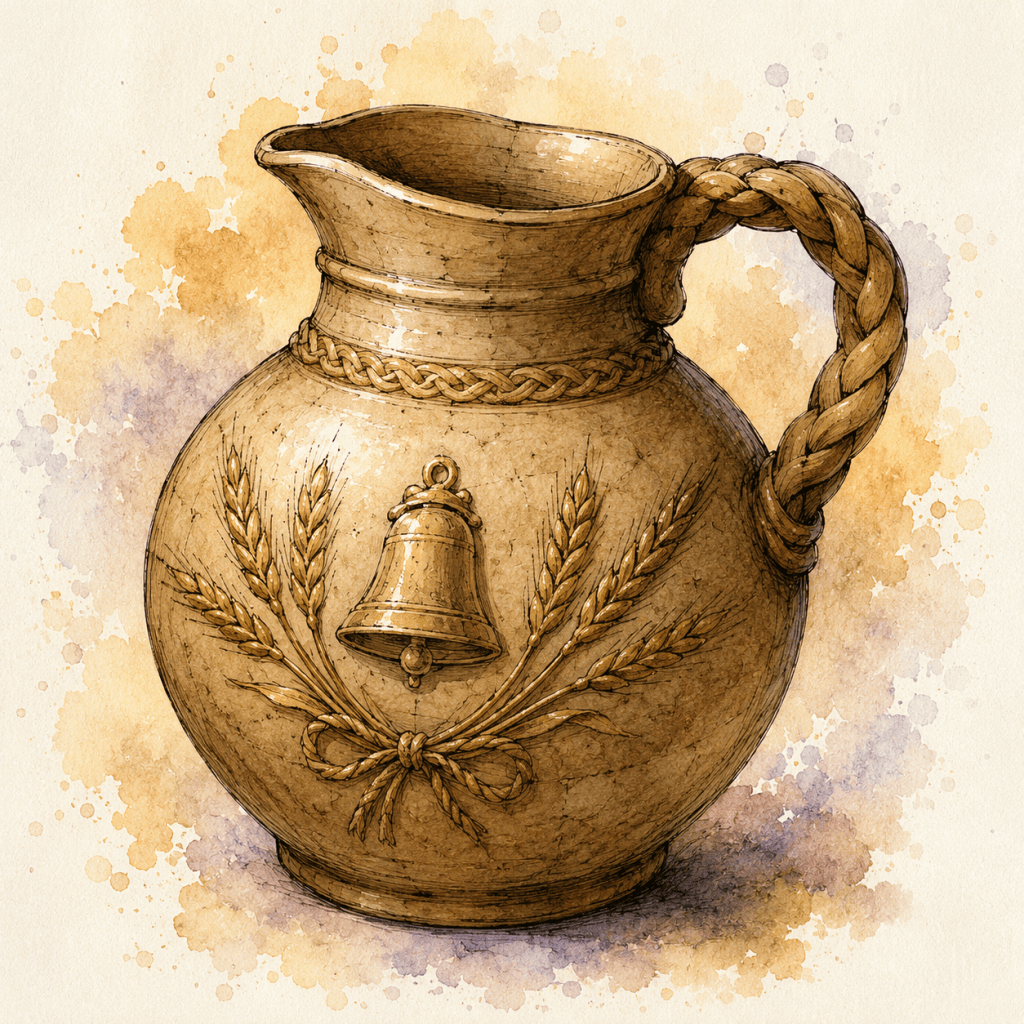
The Milkmaid’s Traveling Jug
This rounded earthen jug bears a braided handle and wheat-and-bell decoration. It remains pleasantly warm even on winter roads and is traditionally associated with wandering priestesses and caretakers who travel beyond the reach of permanent Hearthhouses.
Stories insist that a true Traveling Jug never produces luxury. It produces exactly the sort of nourishment its bearer can meaningfully give away.
(Needs updated mechanics: Base 5e → Veiled → Unveiled.)
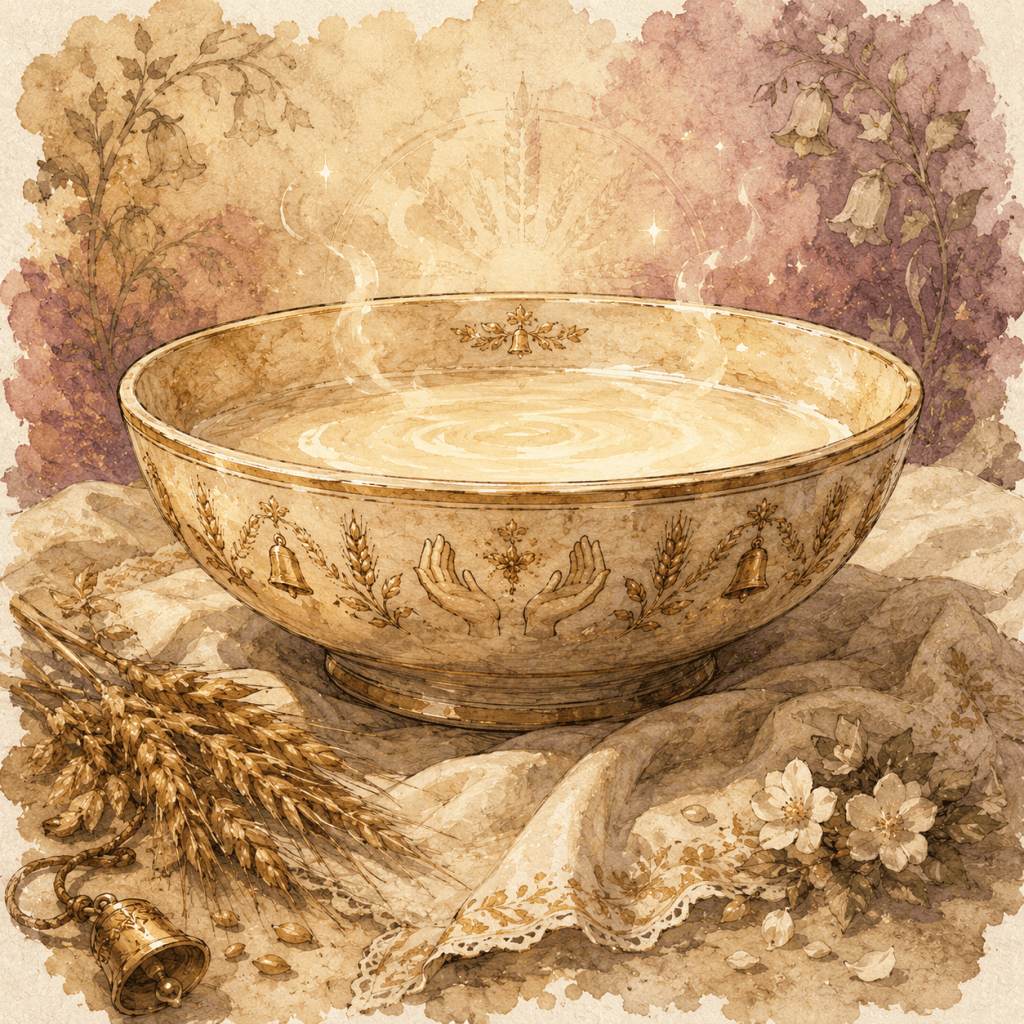
The Bowl of First Comfort
The archives describe a sacred bowl capable of restoring both bodily strength and depleted desire. Its origin is uncertain, with several temples claiming their bowl is the original vessel from which mortals first received Aratheia’s nourishment.
Most theologians consider the argument charmingly contrary to the relic’s purpose. A bowl concerned with being the only true bowl would hardly belong to Aratheia.
(Needs updated mechanics: Base 5e → Veiled → Unveiled.)
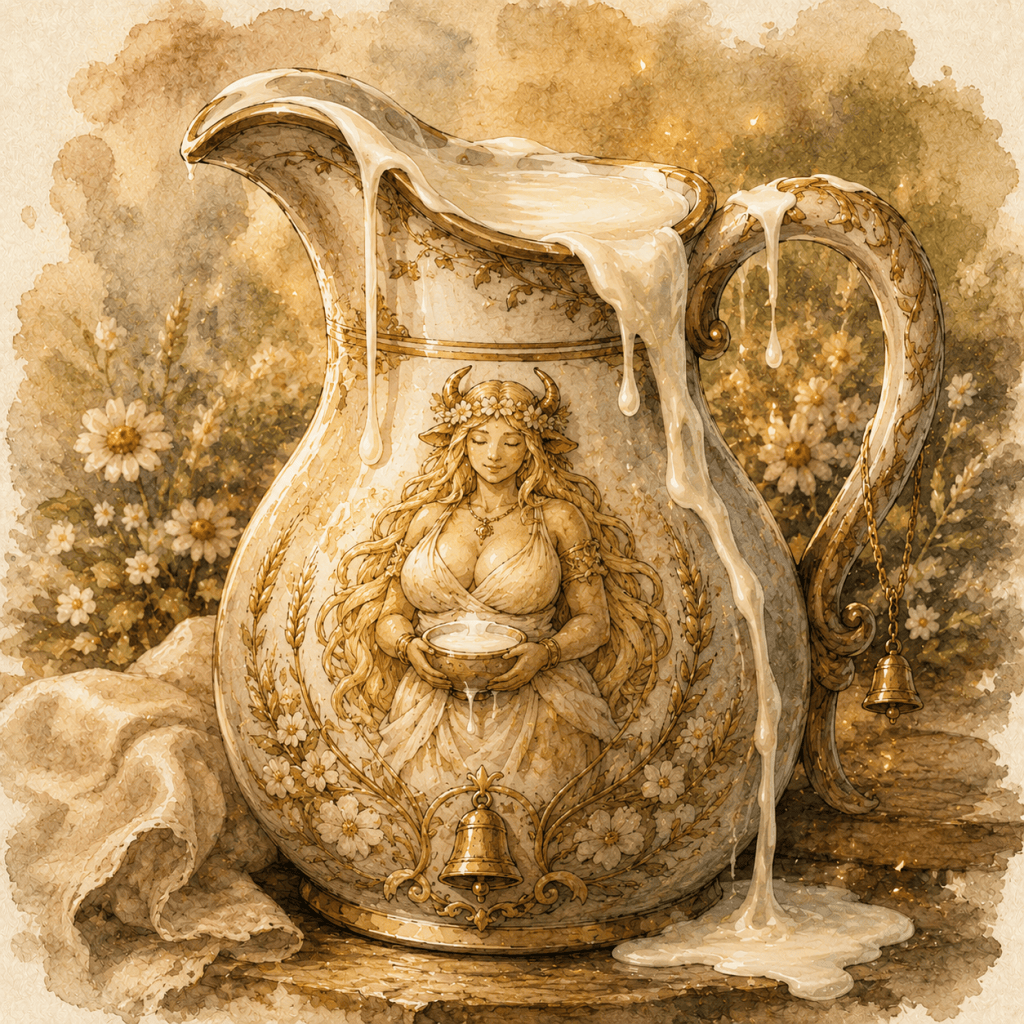
Mother’s Overflowing Pitcher
This legendary pitcher produces divine milk associated with restoration, renewed vitality and the return of strength after profound exhaustion. Surviving descriptions disagree about its appearance, suggesting either multiple pitchers or a relic whose form changes according to the community entrusted with it.
(Needs updated mechanics: Base 5e → Veiled → Unveiled.)

The Calving Bell
The Calving Bell is traditionally sounded during dangerous births, difficult pregnancies and rites concerned with fertility or the safe arrival of new life. Its tone is described as impossibly gentle regardless of how forcefully the bell is struck.
The archives attribute protective and fertility-enhancing magic to it, but those effects require conversion before returning to play.
(Needs updated mechanics: Base 5e → Veiled → Unveiled.)
Adventure Hooks
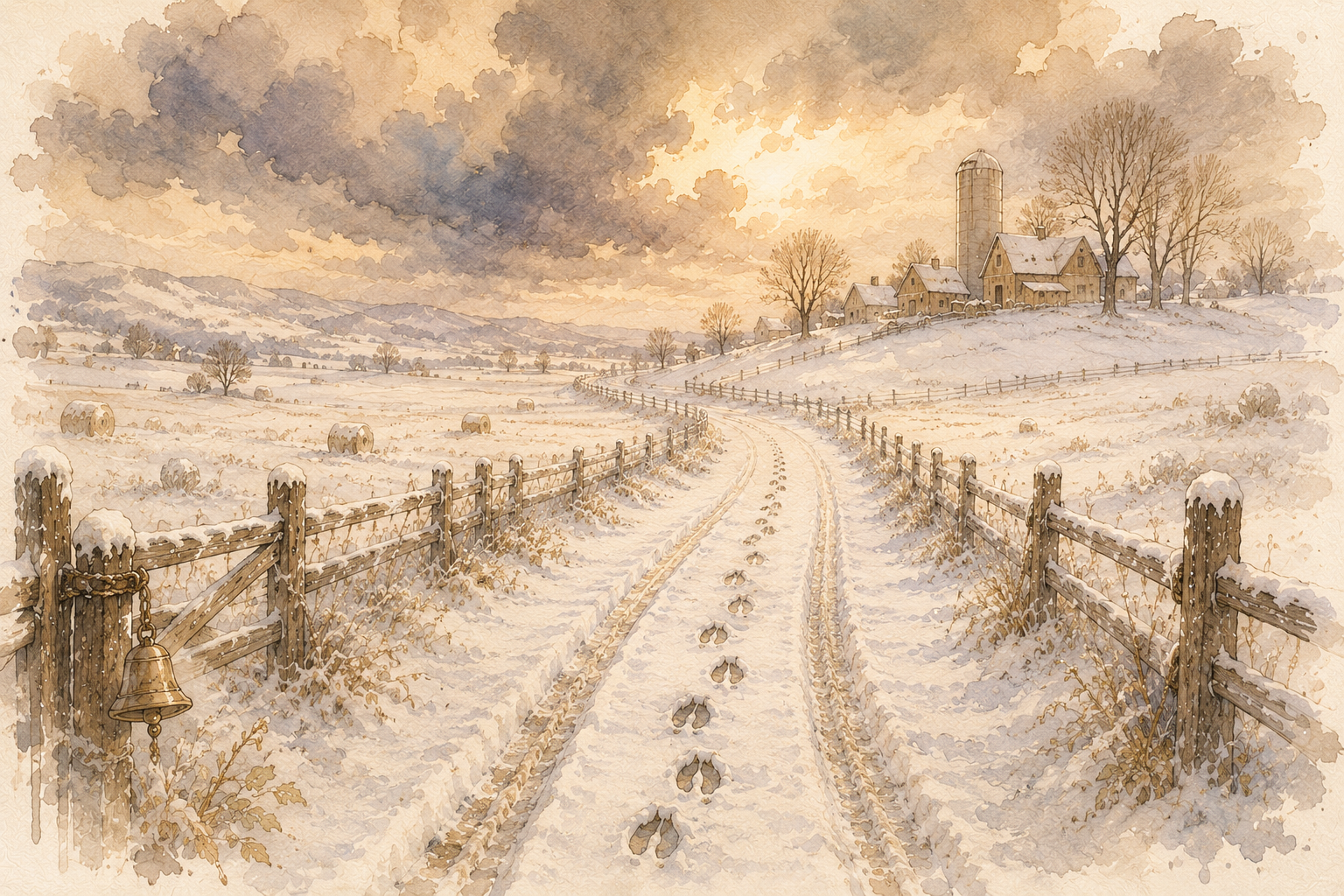
The Bell Beyond the Snow
A Milkroad caravan vanished during a winter storm while carrying enough food to sustain three isolated villages until spring. Searchers find no wreckage and no bodies, yet every night a caravan bell can be heard farther into the mountains. Following it reveals that the supplies are still being delivered — just not to the living.
The Harvest That Will Not End
A valley experiences unprecedented abundance. Wheat regrows overnight, cows produce impossible quantities of milk and fruit trees bend beneath new crops days after being picked. What first appears to be Aratheia’s greatest blessing becomes dangerous as granaries burst, animals sicken from relentless production and neighboring rulers begin preparing armies to seize the valley.
The priests insist Aratheia does not give without rest. Something else has mistaken abundance for excess.
The Empty Bowl
A prosperous city closes its public kitchens after shortages begin elsewhere in the kingdom. Within days, food stored by the wealthiest households begins spoiling while meals shared freely remain fresh. City authorities call it a curse. Aratheian clergy call it a lesson.
The Golden Herd
Celestial cattle appear outside a remote village, fulfilling an omen associated with extraordinary harvests. The animals refuse to enter the settlement, however, and kneel instead before an abandoned cottage beyond its boundary. Someone inside has been forgotten by the community.
Milk-White Dreams
A rural shrine begins overflowing with warm milk every midnight. Anyone who drinks from it dreams of strangers starving somewhere they have never seen. The dreams are real. The difficult question is how far the faithful are obligated to travel simply because Aratheia has shown them someone else’s hunger.
The Withered Harvest
Milk sours, butter blackens and grain rots in a community once famous for its generosity. The corruption began only after fear drove families to hide provisions from one another. Destroying the creature feeding upon that fear may solve the immediate threat. Restoring the village requires something harder: persuading people to trust the shared table again.
Scents for Gameplay
Aratheia’s presence is often smelled before it is seen. Scent is an easy way for a GM to introduce the Harvest Mother without announcing divine intervention outright. A fragrance may linger around a shrine, accompany a blessing, precede a miracle, cling to a sacred relic, or appear suddenly when mortal acts of nourishment and care resonate strongly enough to touch the Shimmering Veil.
Use these scents as atmospheric cues rather than automatic proof of Aratheia’s involvement.
| d12 | Scent | Suggested Moment |
|---|---|---|
| 1 | Fresh bread just broken open | Aratheia’s presence is near. |
| 2 | Warm milk and wildflower honey | Healing, nourishment, aftercare, or physical restoration. |
| 3 | Sun-warmed wheat and dry meadow grass | Harvest, honest labor, provision, or a quiet blessing. |
| 4 | Fresh cream, butter, and warm bread | Hospitality, abundance, communal meals, or celebration. |
| 5 | Clover, clean hay, and summer rain | Sacred herds, pastoral blessings, fertility, or the Golden Herd drawing near. |
| 6 | Warm milk, clean linen, and skin warmed beside a hearth | Physical closeness, caregiving, trust, or vulnerability. |
| 7 | Honeyed cream and meadow flowers | Nurturing desire awakening or an intimate offering of care. |
| 8 | Vanilla, beeswax, and banked hearthwood | Rest, safety, shelter, comfort, or communal aftercare. |
| 9 | Fresh earth, new grain, and milk-white blossoms | New life, fertility, recovery, or abundance returning after hardship. |
| 10 | Golden incense, toasted grain, and myrrh | Formal worship, sacred vows, the Festival of First Milk, or a powerful temple rite. |
| 11 | Warm milk accompanied by the faint scent of impossible summer wheat | A direct omen or unmistakable moment of divine resonance. |
| 12 | Whatever fragrance the character most associates with being cared for | An intensely personal manifestation of Aratheia’s grace. |
Using Scent as Foreshadowing
Repetition gives these fragrances meaning. If the party repeatedly smells warm milk and wildflower honey immediately before Aratheian healing manifests, the scent itself eventually becomes enough to create expectation. If clover, clean hay, and summer rain precedes the appearance of one of Aratheia’s sacred creatures, players may begin searching the horizon the moment it appears. The scent can also arrive before its source.
A starving village wakes to the scent of fresh bread though every oven is cold. A blood-soaked battlefield suddenly smells of clean linen and warm milk moments before an Aratheian priestess arrives. Deep underground, adventurers catch the impossible fragrance of sun-warmed wheat. A character who has spent too long caring for everyone else wakes to discover their blanket carries the scent of the place where they once felt safest.
Nothing needs to be explained. Let the players notice.
 Whispers of Erosia
You must be logged in to post a comment.