
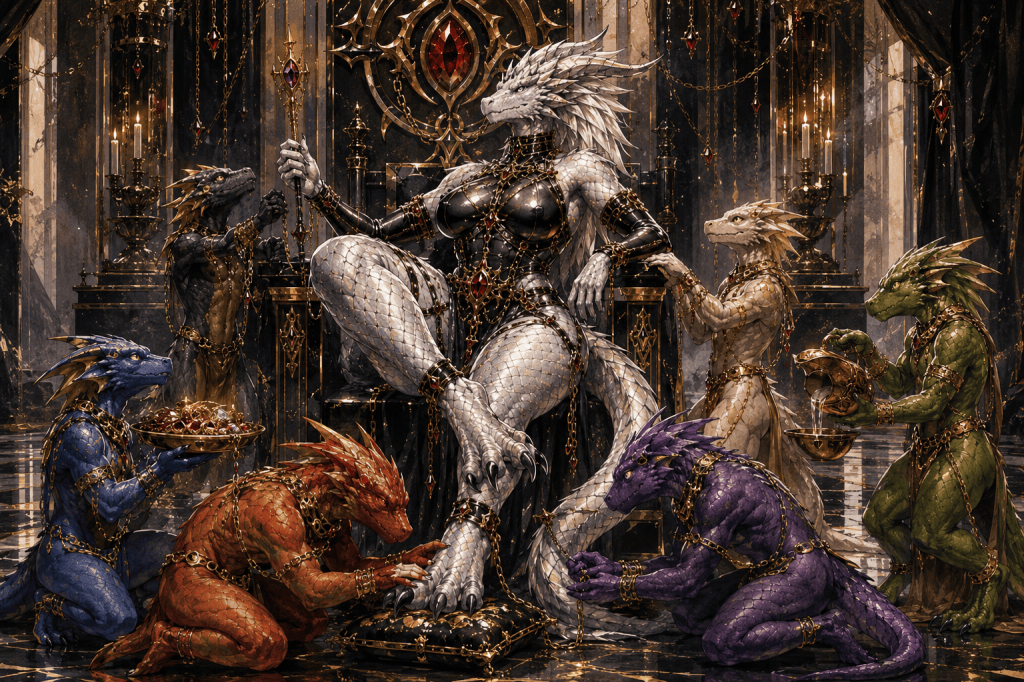
Mirellune
The Silken Sovereign • Empress of Latex, Bondage and Devoted Obedience
Goddess of Trust, Devotion and Surrender
Trust • Devotion • Surrender
Vows, chosen vulnerability, commitment, obedience, ritual binding and the power found in willingly placing oneself within another’s care.
“To entrust oneself is sacred.”
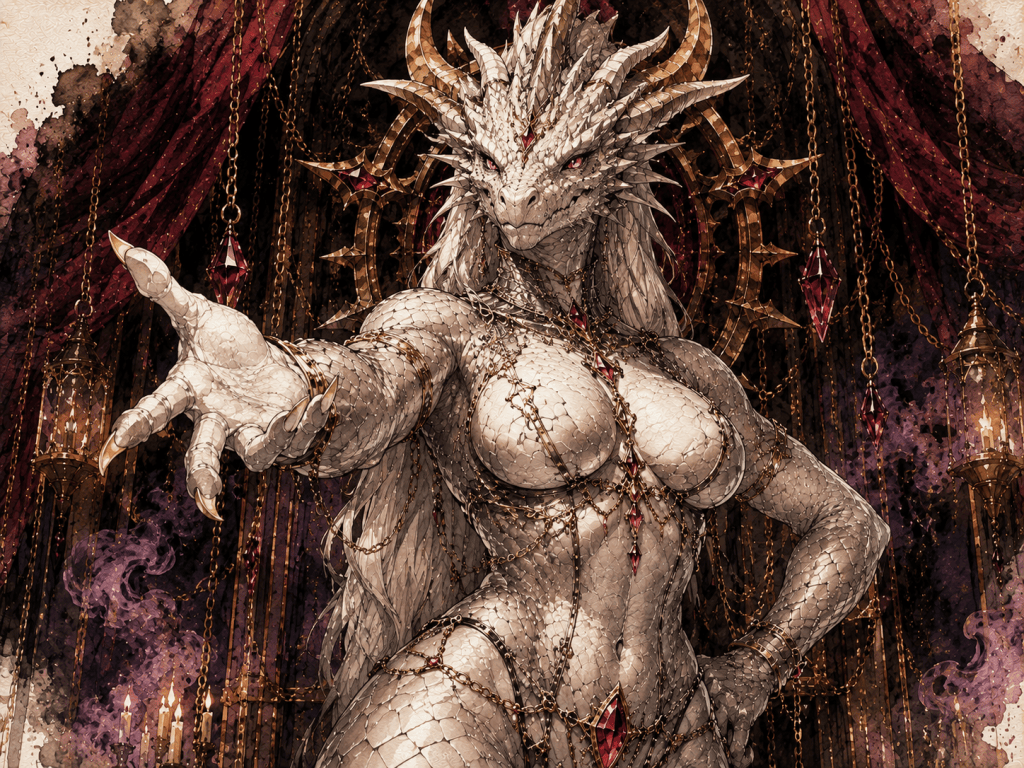
Mirellune is the goddess of the willing bond: the vow deliberately accepted, the command obeyed because the right to command was consciously given, the restraint entered without fear and the extraordinary vulnerability of placing part of one’s freedom into another person’s care. Her sacred current includes trust, devotion, surrender, obedience, restraint, confinement, discipline, hierarchy, ritual contracts and consensual power exchange. Latex, leather, collars, chains, harnesses and fetish armor are among her most recognizable religious languages, but they are not the limits of her divinity. A soldier entrusting herself to a respected commander, an apprentice accepting the discipline of a master craftsperson, a lover surrendering control within carefully established boundaries and a sovereign delegating authority they could retain all move within Mirellune’s domain.
Her faithful therefore reject the assumption that surrender is synonymous with defeat. A person may kneel because they have been conquered, but they may also kneel because they have chosen the person before whom they wish to lower themselves. The physical posture is identical. The spiritual meaning could not be more different.
Older traditions name Mirellune the Silken Sovereign, Empress of Latex, Bondage and Devoted Obedience, She Who Holds and Is Held, the Mistress of the Second Skin and Keeper of the Sovereign Chain. The titles reflect a goddess who embodies both sides of power exchange rather than treating dominance and submission as permanently separate identities.
Mirellune’s oldest surviving mystery summarizes that paradox: Power exchanged is power shared.
Lore & Mythos

The Whisper That Asked for Both
The oldest Mirellunean creation story begins with a desire that seemed impossible. The newborn cosmos had already learned hunger, longing, attraction and the need to possess. Yet one longing appeared that did not fit neatly within those divisions. Someone wished to hold and to be held, to command and to yield, to possess responsibility and to surrender it.
The archives preserve the desire as a whispered prayer: Let me be the one who holds and the one held. Let me command and still know what it means to yield.
The prayer did not ask to choose between opposites. It asked for both. From that contradiction Mirellune emerged.
The oldest accounts describe her body as both feminine and masculine, breasts and phallus existing in sacred harmony rather than as incompatible signs. Her dual-sexed form became the theological expression of a larger truth: Mirellune does not divide existence cleanly between dominants and submissives, rulers and servants, those who bind and those who are bound. Roles may change. Authority may pass from one hand to another. The same person may desire command in one moment and surrender in the next.
Later traditions increasingly depict Mirellune in her platium Dracari form, but the older doctrine remains unchanged. Her body embodies duality without division.
She is the hand holding the chain. She is also the one who chose to wear it.
The First Kneeling
Another tradition claims Mirellune awakened when a mortal first knelt without being conquered. The story tells of a celebrated warrior accustomed to receiving obedience through rank and fear. Soldiers bowed because she commanded them. Prisoners lowered themselves because they possessed no other choice. Servants obeyed because refusal carried consequence.
One evening, someone she loved knelt before her. The warrior immediately ordered them to rise. They remained where they were. Not rebelliously. Not fearfully. They simply looked upward and said, “I know I may stand.”
The warrior understood that what had been offered to her was fundamentally different from every submission she had previously received. The kneeling lover had not lost the ability to rise. That was precisely why remaining upon their knees possessed meaning. The warrior lowered one hand.
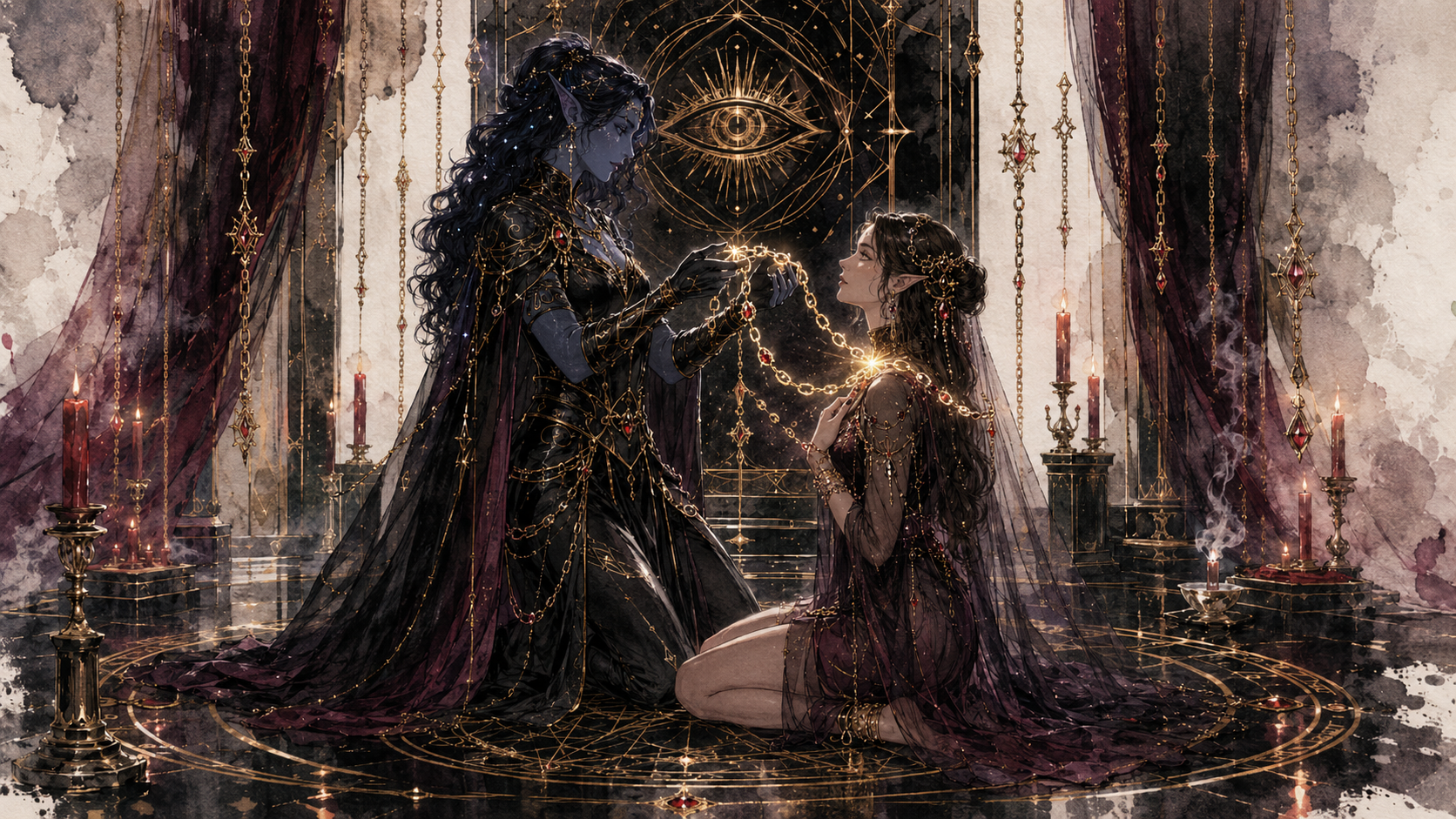
The lover placed their hand within it. The story claims a golden chain briefly appeared between them, although it bound neither wrist. Mirellunean clergy still use the parable when explaining their most fundamental distinction:
Submission taken is defeat. Submission offered is trust.
The Chain That Would Not Hold
A third myth concerns a tyrant who demanded that a master smith create an unbreakable chain. The smith obeyed. The links could withstand horses, siege engines and magical force. The tyrant ordered a political prisoner fastened within it. The chain opened.
The smith reforged it with stronger metal. Again the prisoner was bound. Again the chain opened. The tyrant threatened the smith’s family and demanded perfection. That night, Mirellune entered the forge and asked the terrified craftsperson to place the chain around her own wrists.
The smith did so. The links closed. Mirellune remained bound. “Why does it hold you?” the smith asked. “Because I have chosen to remain.”
The surviving versions disagree over what happened to the tyrant. Some say the chain finally held him instead. Others claim his own guards removed him from power. One particularly Mirellunean version says he was simply left alone in the throne room after everyone stopped obeying.
The theological meaning is consistent: The strongest bond is the one that need not make departure impossible.
The Sovereign Who Surrendered Her Crown
A later tale tells of a ruler who believed that accepting authority required never surrendering it. She approved every law personally. No general could move troops without her decision. No physician could order her to sleep. No steward could alter a household schedule. Even lovers learned to ask what she preferred before expressing desires of their own. Her kingdom prospered.
Its sovereign slowly collapsed beneath the weight of being responsible for everything. When exhaustion finally left her unable to stand, a servant carried her to bed. The ruler immediately attempted to rise. The servant said, “No.” The sovereign threatened dismissal. The servant repeated, “No.” Then Mirellune appeared beside the bed. She asked the ruler why she trusted her authority so little that she could not permit anyone else to hold responsibility temporarily.
For seven days, the sovereign surrendered her crown to seven different people. Her physician decided when she would sleep. Her general commanded the palace guard. Her steward controlled the household. A farmer chosen by lot determined the royal meal. Her oldest friend decided who was allowed to visit. Her lover chose whether they would spend the evening speaking or in silence. On the final day, a child selected which garden they would visit.
When the ruler reclaimed the crown, Mirellune asked whether she possessed less authority than before. The sovereign said no. Mirellune answered that authority capable of being lent and returned was stronger than authority terrified of leaving its owner’s hand.
The Desire She Embodies
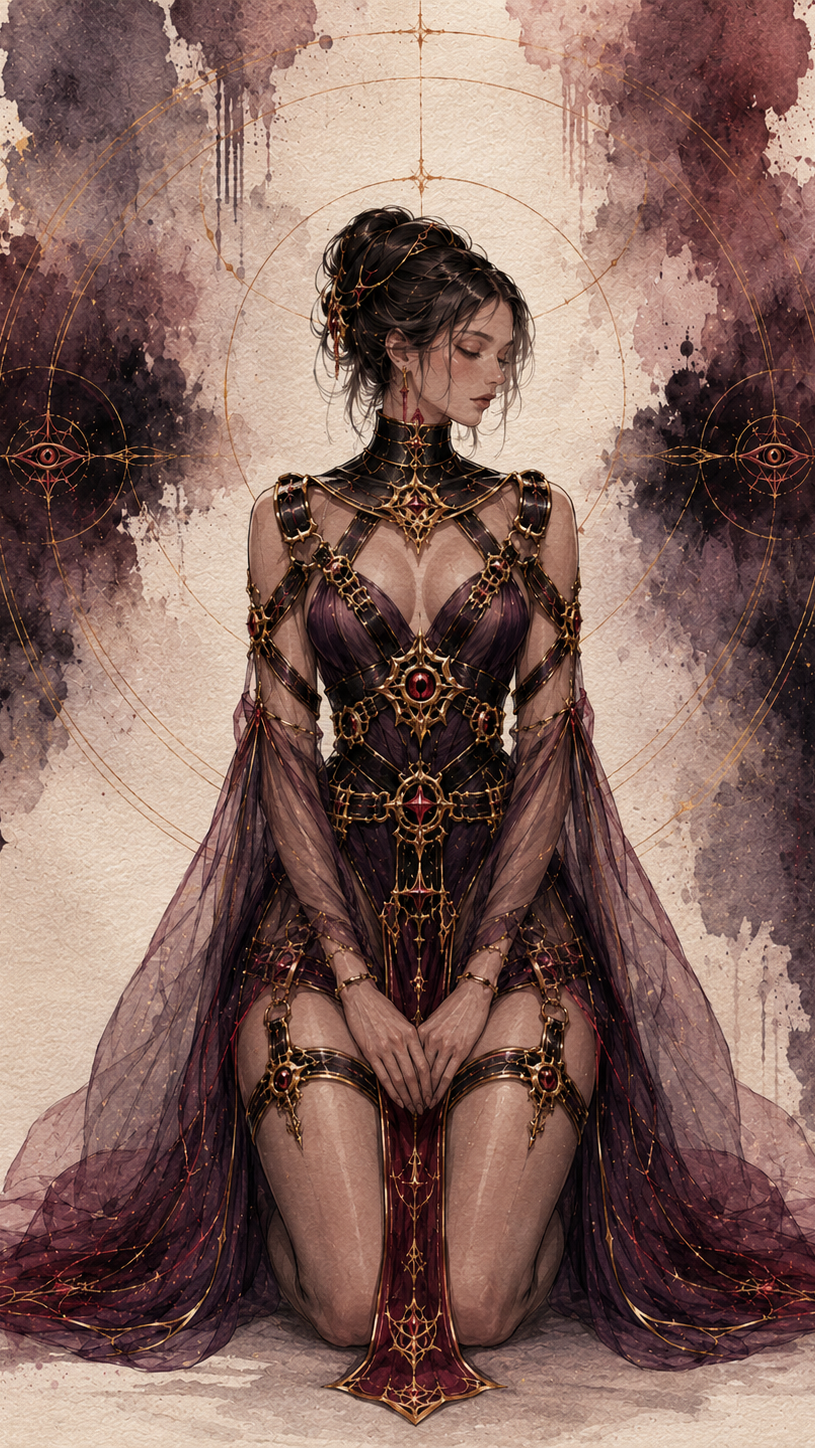
Mirellune embodies the desire to entrust oneself.
Her faith begins with the recognition that freedom can include the freedom to surrender. Mortals often speak about autonomy as though its highest expression were refusing every influence, obligation and limitation. Mirellune disagrees. A person may use their autonomy to make commitments, accept responsibilities, submit to discipline or willingly place certain choices into another person’s keeping.
Her domain is therefore not simply obedience. It is chosen vulnerability given structure.
Trust and the Given Will
Trust is the foundation of Mirellune’s theology. To trust someone is to accept that they possess the ability to affect something valuable to you. Without vulnerability, trust has little substance. A person who cannot harm, disappoint, refuse or fail you may be safe, but safety alone is not the same thing as trust. Mirellune does not romanticize recklessness. Her clergy teach that trust should be informed, deliberate and proportionate. Giving someone authority over a small decision does not grant them authority over everything else. Sharing one vulnerability does not make every boundary available.
The faithful sometimes describe this as the Given Will. What has been consciously given may be held. What has not been given remains one’s own.
Devotion and Commitment
Mirellune also governs the desire to belong to a promise. A vow changes the future by placing limits upon possibility. Before an oath, countless choices remain theoretically available. Afterward, some paths are deliberately closed. Mirellune sees beauty in that narrowing. Marriage vows, military oaths, apprenticeships, devotional service, personal disciplines and intimate agreements all create meaning by excluding certain alternatives. The faithful therefore reject the idea that every limitation is automatically oppressive. Some limitations are the architecture through which trust becomes durable.
A vow freely made is not the destruction of freedom. It is freedom given a direction.
Surrender and the Quieting of Choice
Surrender may offer relief from the constant burden of decision. A person may wish to stop choosing for a little while. They may want a trusted leader to decide the route, a teacher to determine the next exercise, a healer to dictate rest or a lover to establish the pace of an agreed ritual. Mirellune treats this desire seriously.
To surrender a choice temporarily does not make someone lesser. In many traditions, the person receiving surrendered authority carries the greater responsibility because another person’s trust has entered their keeping. This distinction becomes one of the most repeated Mirellunean teachings:
The one who kneels offers trust. The one who stands must become worthy of it.
Bondage, Confinement and Sacred Restraint
Bondage occupies a central place within Mirellune’s intimate mysteries because it makes agreement physical. A cord defines where movement ends. A cuff makes limitation visible. A harness turns the body into sacred geometry. A closed door establishes a space whose boundaries can be felt. A collar marks a role consciously entered. The archives describe latex, leather, chains and ceremonial restraints as Mirellune’s sacred languages because each converts an invisible agreement into something that can be seen, touched and inhabited.
The theological focus is not helplessness. It is clarity. For the duration of the rite, the participant knows where the boundary lies and has chosen to experience what exists within it.
Dominion and Responsibility
Mirellune distinguishes power from authority. Power is the ability to impose an outcome. Authority is the recognized right to make a decision. Someone may possess enormous power while having no legitimate authority whatsoever. Conversely, a trusted person may hold meaningful authority without possessing any ability to enforce obedience physically. Mirellune’s faith therefore places its strictest ethical expectations upon those who command.
Authority is not permission to become careless. It is an obligation to become attentive.
The Second Skin
Latex holds a uniquely sacred place in Mirellune’s worship. The archives call it the Second Skin, a devotional material associated with self-creation, polish, containment and the deliberate shaping of the outward form. It reveals rather than conceals contour, transforming clothing into a visible boundary between body and world. Mirellunean theology treats the act of encasement as symbolic transformation. The devotee chooses the surface through which they will presently be encountered.
Gloss is similarly important. Polishing becomes an act of care and intention. Something maintained carefully acquires meaning through the attention invested in it. For this reason, fetish armor, ceremonial harnesses and latex vestments appear throughout her religion not as modern fashion but as sacred regalia of structure and chosen transformation.
Holy Symbol & Iconography
The Sovereign Eye
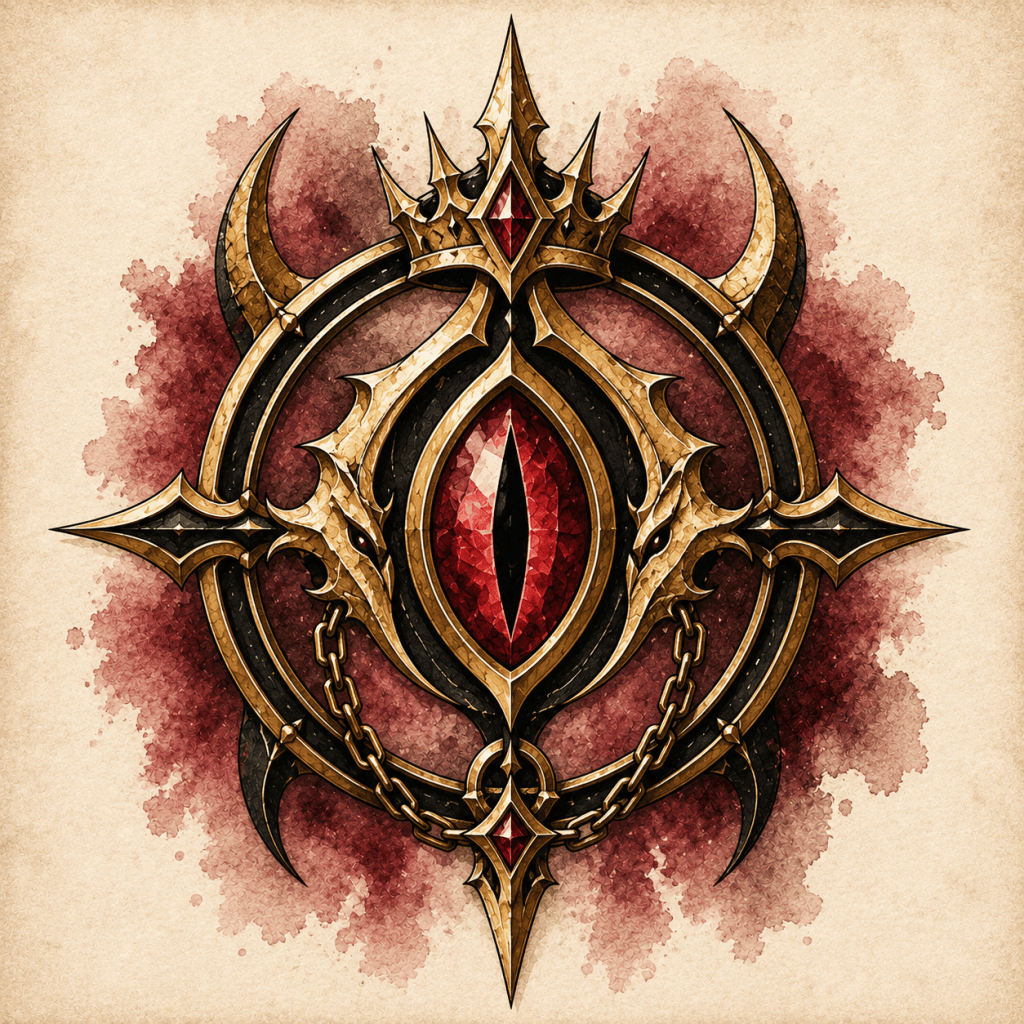
Mirellune’s holy symbol is the Sovereign Eye, an elaborate black-and-gold emblem centered upon a vertically slit crimson gemstone. At the center rests a faceted crimson eye with a narrow black draconic pupil. The eye represents awareness within authority. Mirellunean teaching holds that legitimate command must remain attentive to the person obeying. A sovereign who ceases to see the person placed within their care has begun to mistake obedience for possession.
The eye is surrounded by a perfectly symmetrical framework of polished gold and blackened metal. Its shape evokes several Mirellunean objects simultaneously: crown, collar, harness, closed circle and ceremonial restraint. No single interpretation is considered complete. Above the eye rises a sharp golden crown set with another crimson jewel. The crown represents sovereignty and responsibility. Its position above the eye creates one of the symbol’s oldest teachings: Authority must answer to awareness.
Two stylized draconic forms curve around the central eye. Their mirrored placement reflects Mirellune’s divine body and her mystery of complementary roles. They do not attack or struggle. They hold position.
The outer black-and-gold ring is traditionally called the Ordered Circle. It represents the boundaries within which authority has been granted. The circle does not claim anything outside itself. Across the lower portion hangs a golden chain connecting both sides of the emblem. It is neither taut nor broken. The chain represents relationship rather than captivity: command and obedience joined because both remain part of the same agreement.
A smaller crimson jewel rests at the center of the chain. This is called the Given Will, symbolizing the choice that gives every sacred hierarchy its legitimacy.
The complete symbol is often interpreted through a four-line catechism:
The crown commands.
The eye remains watchful.
The chain binds.
The will remains its own.
Sacred Colors and Materials
Mirellune’s sacred colors are gloss black, metallic gold, deep crimson and dark wine, with restrained chrome or polished silver sometimes used as secondary accents. Gold represents legitimate authority, responsibility and perfection pursued through discipline. Black represents structure, containment, clarity and the removal of distraction. Crimson represents living desire, consent and the mortal will beneath every sacred bond. Dark wine represents intimacy, devotion and the warmth concealed beneath formal control.
Common materials include enchanted latex, lacquered leather, polished black stone, obsidian, gold, fine chain, silk cord, mirror-black glass and immaculately worked metal. Nothing sacred to Mirellune should appear carelessly maintained.
Chains, Collars and Harnesses
Chains are Mirellune’s most common secondary symbols. Where Nyzun’s chains frequently concern endurance, trial and limits tested under pressure, Mirellune’s chains primarily represent relationship, restraint and entrusted authority. A chain connects two places. The spiritual question is not whether it holds, but why.
Collars represent a consciously entered role. They are common in intimate rites, devotional orders and ceremonial office. Mirellunean clergy strongly discourage assuming the meaning of another person’s collar. A symbol may indicate devotion, partnership, religious office, private discipline or nothing available for public interpretation. Harnesses symbolize structure carried upon the body. Their geometry frequently incorporates circles, intersecting lines and repeated points representing vows. Keys symbolize responsibility for release. A person trusted with the key is responsible not merely for keeping something closed, but for knowing when it must open.
Sacred Creatures
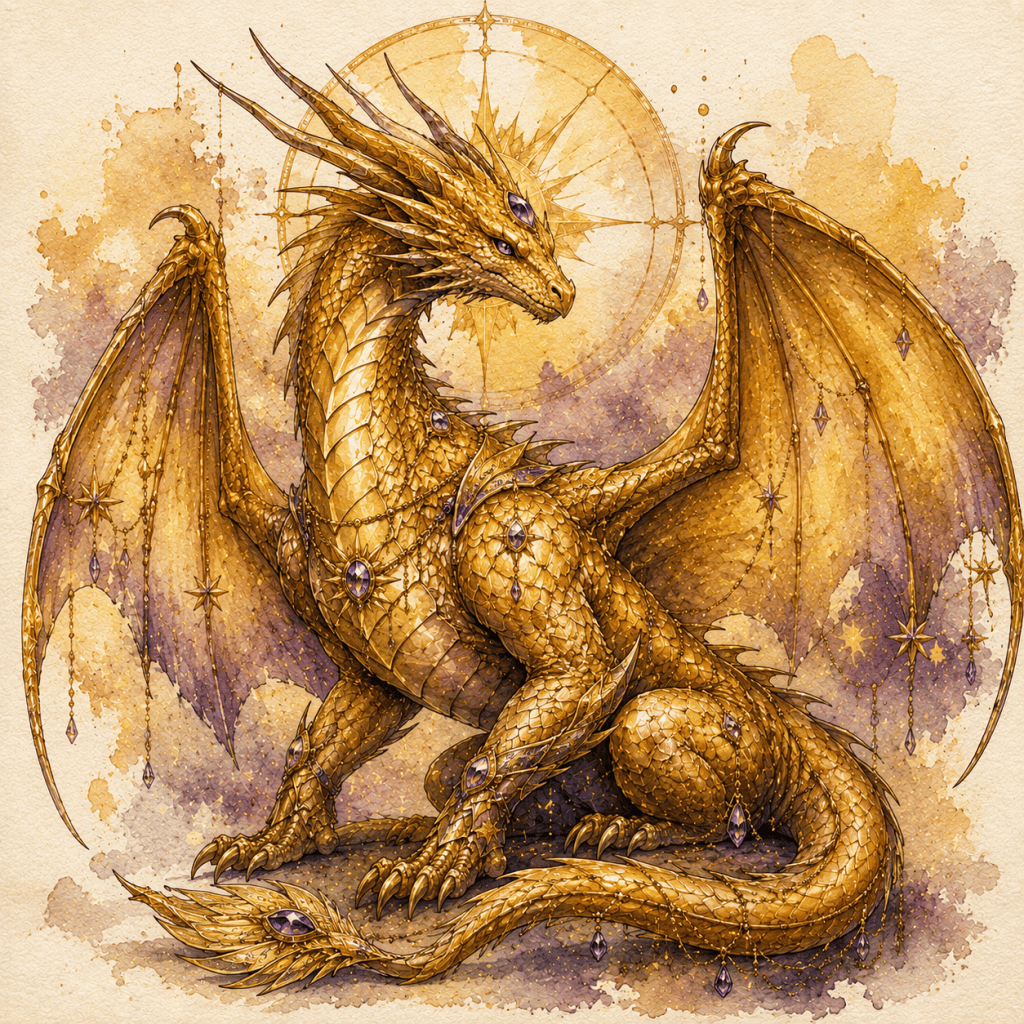
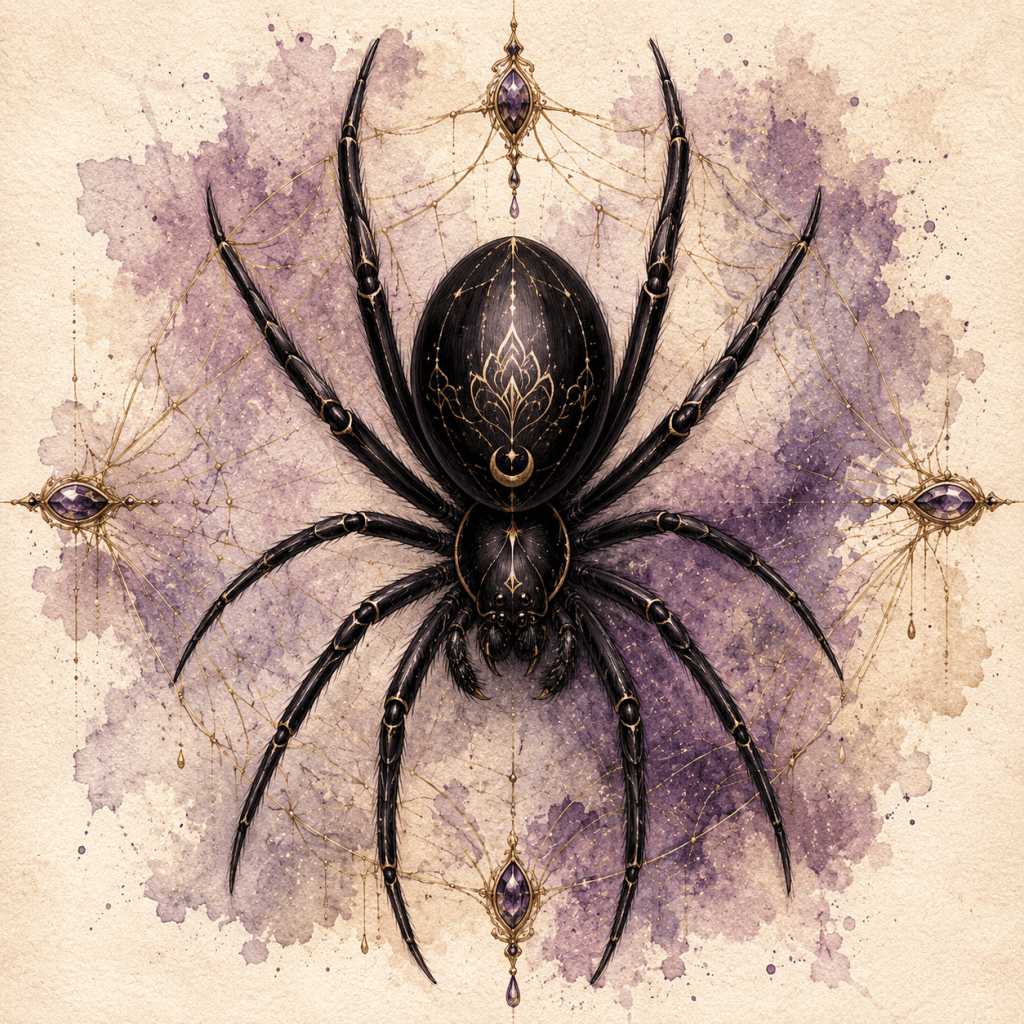
Golden drakes, black serpents, silk spiders and imperial mantises are commonly associated with Mirellune. Golden drakes represent authority carried without unnecessary aggression. Black serpents symbolize controlled motion and the ability to remain still until movement possesses purpose. Silk spiders represent the construction of systems capable of holding tension through careful design. Imperial mantises symbolize precision, posture and absolute economy of action.
Older stories describe Gilded Links, small serpentine celestial beings whose bodies resemble articulated lengths of living gold chain. They are said to appear when a vow of entrusted authority has been honored despite an opportunity to exploit it.
Depictions of Mirellune
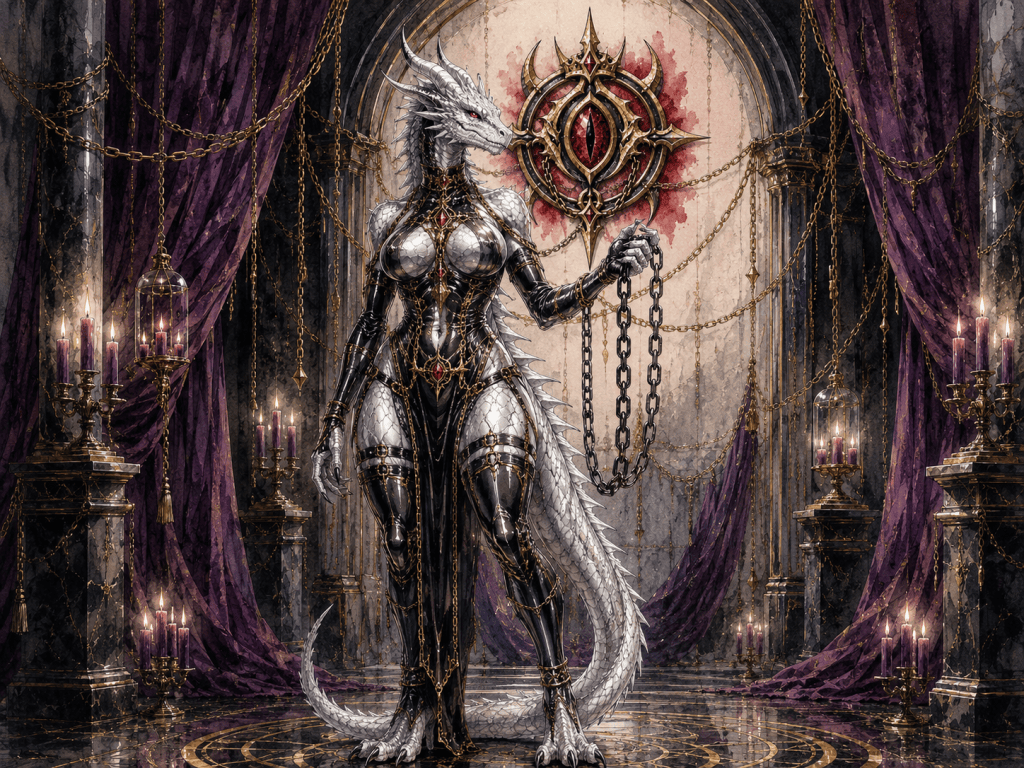
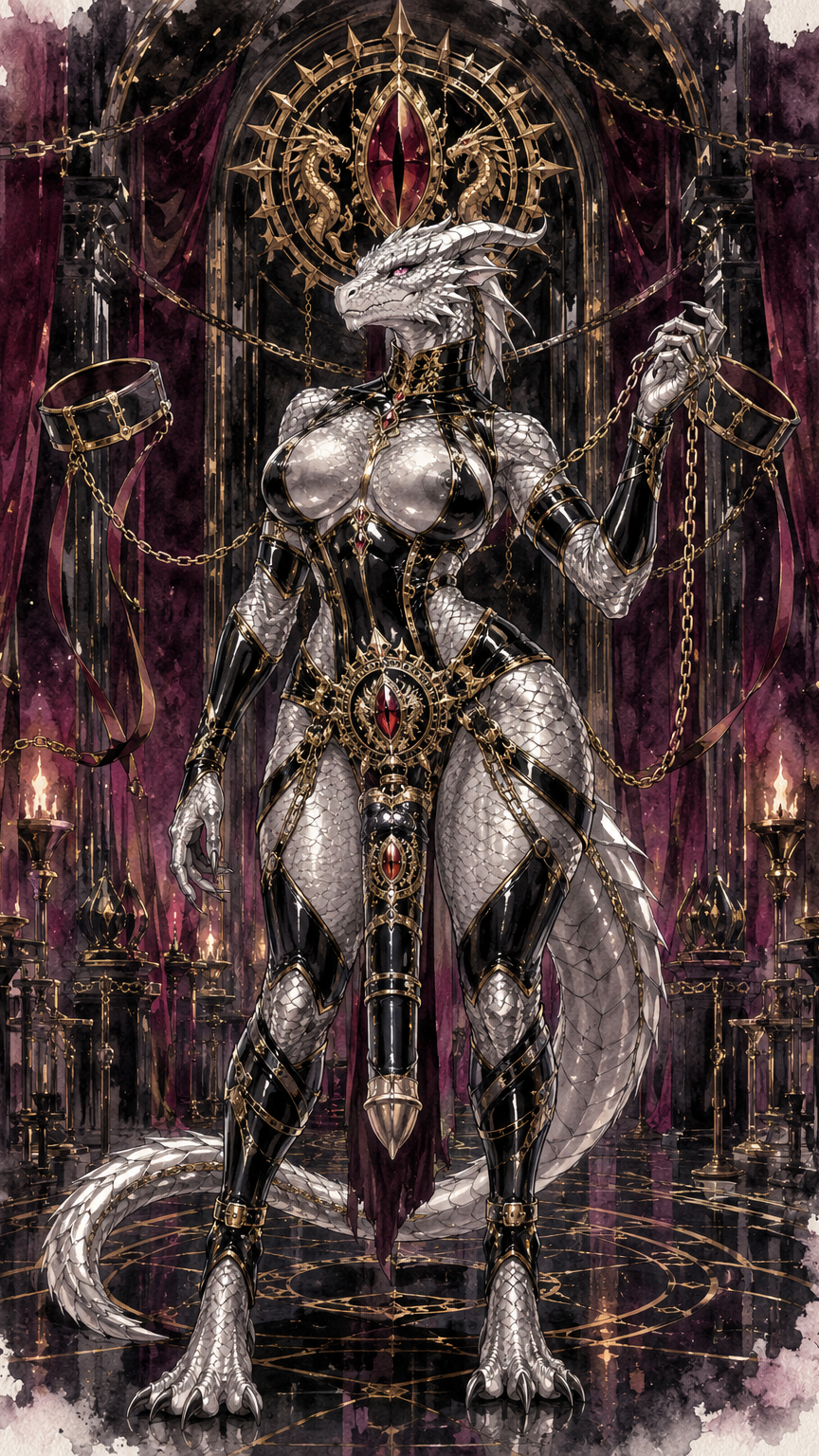
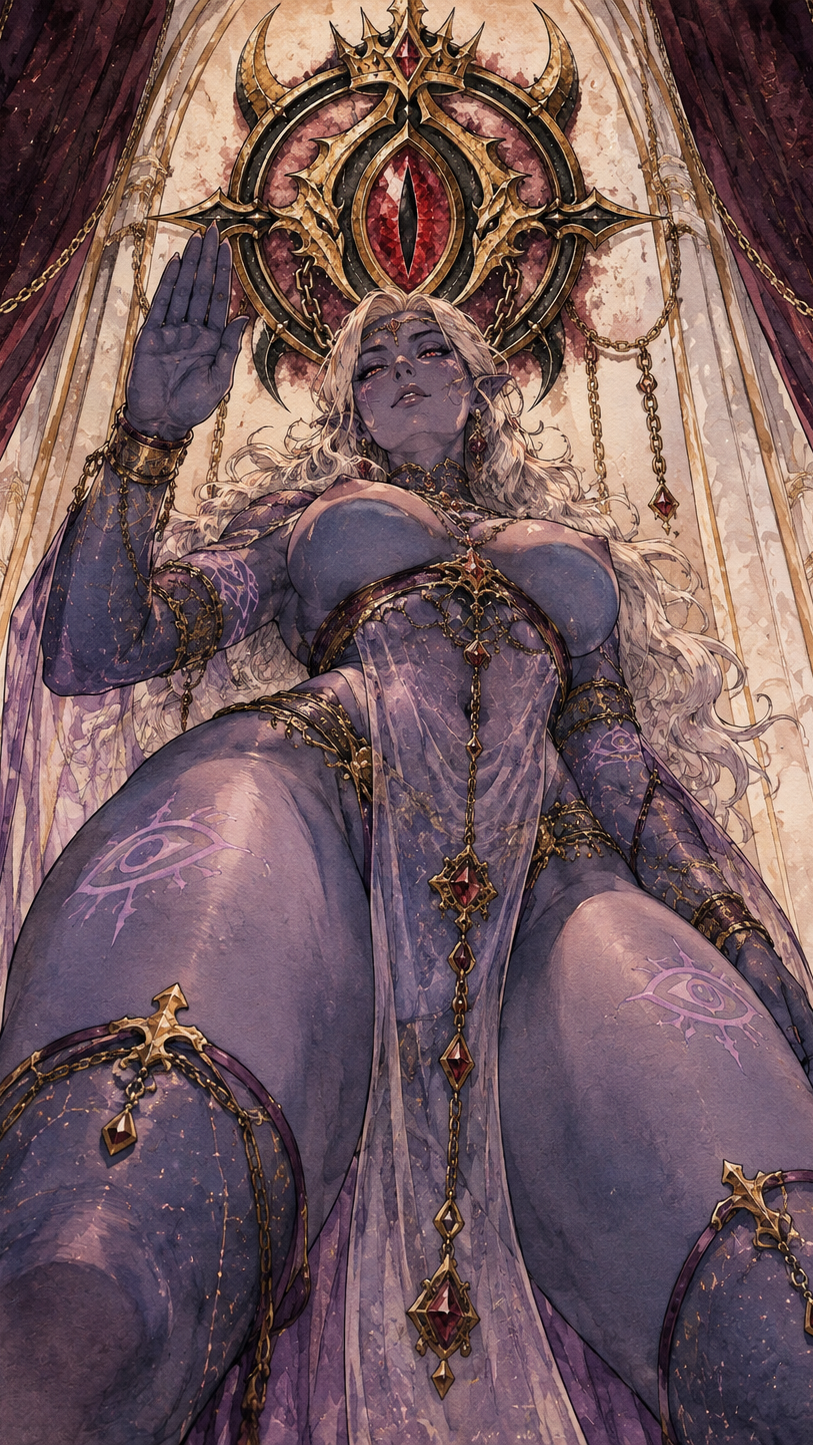
Sacred art portrays Mirellune as a mature futanari platinum Dracari goddess whose form embodies feminine and masculine sexual characteristics in sacred unity. She possesses a fully draconic humanoid body: a reptilian dragon head with an elongated muzzle, elegant horns, metallic platinum scales covering the entire body, clawed hands, powerful digitigrade legs, taloned feet and a substantial dragon tail.
Her upper silhouette is unmistakably feminine and voluptuous. Her dual-sexed anatomy is treated as divine embodiment rather than contradiction. She is not considered androgynous within current Mirellunean visual theology. Her eyes remain calm, commanding and reflective.
Mirellune’s ceremonial vestments favor gloss-black second-skin regalia edged in platinum, structured harnesses, high ritual collars, fetish armor, chains and binding sigils. Black surfaces should appear immaculate. Her platinum scales catch light like living metal. Crimson appears in gemstones, sacred seals and controlled accents.
Ribbons, chains and magical bindings may move around her, but never chaotically. Her posture is perfectly controlled. Her authority does not require aggression. The canonical visual truth remains: Order is beautiful.
Worship & Daily Devotion
Mirellunean worship often looks like discipline before it looks like religion. Keeping an agreement can be prayer. Maintaining equipment can be prayer. Following a schedule one deliberately established can be prayer. Asking another person to take responsibility for a difficult decision can be prayer. Returning authority when its agreed duration has ended can be prayer. Her worship attracts commanders, household stewards, bodyguards, judges, professional attendants, craftspeople, teachers, apprentices, disciplined athletes, ritualists and people drawn toward dominance, submission or structured power exchange.
The Second Skin Offering
The Second Skin Offering survives directly from older Mirellunean practice. Devotees dress in ceremonial latex, lacquered leather or another carefully maintained second-skin material and polish the surface until it reflects light cleanly. The process is deliberately slow.
The worshipper may speak a vow while dressing or remain entirely silent. The rite teaches that self-presentation can be deliberate rather than accidental.
The Ceremony of Kneeling
A worshipper kneels before a shrine, trusted partner, teacher or chosen authority. The posture alone does not complete the rite. Before lowering themselves, the participant names why they kneel.
They may offer obedience, trust, apology, devotion, attention or temporary authority. The recipient may accept or decline. Kneeling without a declared purpose is still permitted in private devotion, but formal ceremonies insist upon clarity. Mirellunean clergy teach that dignity does not disappear because the body lowers.
Armor Polishing
Fetish armor, harnesses, restraints, collars, chains and ritual tools are regularly cleaned and maintained as devotional practice. Neglected equipment is regarded as evidence of neglected responsibility.
This belief extends beyond intimate ritual. A soldier caring for armor, a craftsperson sharpening tools and a steward maintaining household records may all understand the same act through Mirellunean theology. Care demonstrates that something entrusted to you remains worthy of attention.
The Golden Measure
Before accepting meaningful authority, devotees are encouraged to ask three questions: What exactly has been entrusted to me? Where does that authority end? How will I know when it has been withdrawn?
The Golden Measure appears in religious orders, apprenticeships, military structures, intimate relationships and formal contracts.
Favored Offerings
Traditional offerings include polished chain links, black candles, gold rings, signed vows, collars no longer needed, keys, meticulously maintained tools, lacquered leather, silk cord, ceremonial harness fittings and written obligations that have been fulfilled. One of the most respected offerings is simply a promise completed exactly as agreed. The paper upon which the promise was written possesses little sacred value. The fulfilled obligation is the offering.
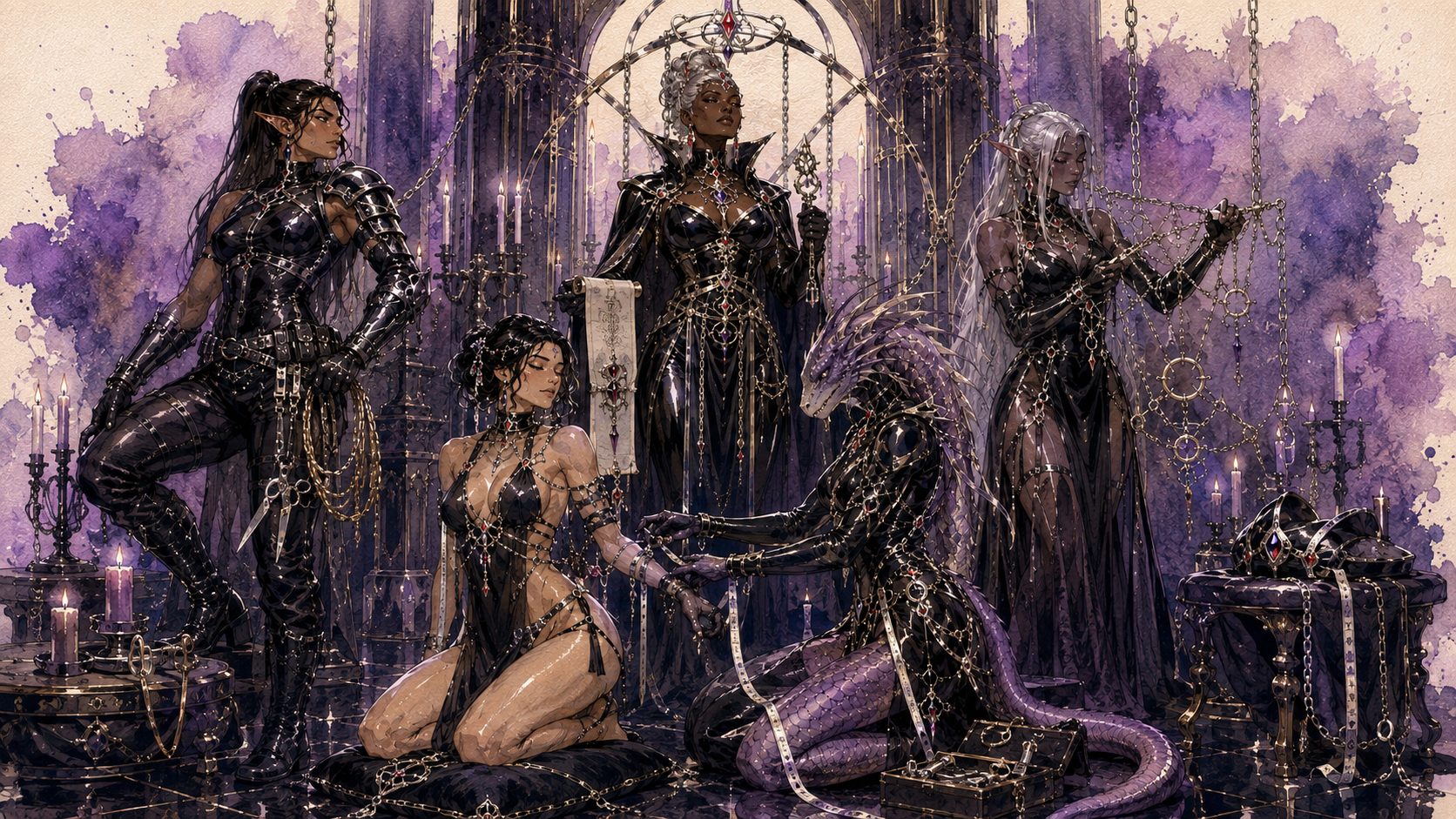
Clergy & Temples
Dominarchs
Dominarchs are Mirellune’s senior ritual authorities. They oversee major vows, power-exchange ceremonies, sacred contracts and rites involving significant transfers of authority. Their title does not imply unrestricted command over ordinary worshippers.
Indeed, Dominarchs are trained extensively in the limits of authority. A Dominarch who cannot explain where their authority ends is considered unfit to hold it.
Velvet Wardens
Velvet Wardens protect temples, participants and sacred spaces. They supervise physical safety during restraint rites, inspect ritual equipment, maintain emergency procedures and intervene when enthusiasm begins outrunning judgment.
Many are warriors, Oathsworn protectors or experienced ritual attendants. Their presence embodies an important Mirellunean principle:
Structure should make vulnerability safer.
Chain-Mistresses
Chain-Mistresses specialize in sacred restraint, ritual geometry and ceremonial bondage. Their work is both technical and theological. They study knots, suspension, enchanted restraints, posture, circulation, comfort, symbolism and methods of release.
Despite the feminine title, different traditions vary in whether the office is gendered. The oldest surviving orders retain the historic name regardless of the identity of the person holding it.
Fettersaints
Fettersaints pursue devotional mastery through discipline and structured vows. Some adopt long-term restrictions on speech, diet, possessions, movement or personal habits. Others become renowned craftspeople, attendants, guardians or submissive devotees.
Their disciplines are self-chosen. A restriction imposed by another person without legitimate authority does not become holy merely because it is difficult.
Latex Heralds
Latex Heralds preserve Mirellune’s mysteries of the Second Skin. They create ceremonial vestments, ritual fetish armor, harnesses and sacred regalia. Many serve simultaneously as artisans, fashioners, armorers and theologians.
Their work emphasizes fit, maintenance, transformation and the visual language of chosen containment.
Houses of the Silken Sovereign
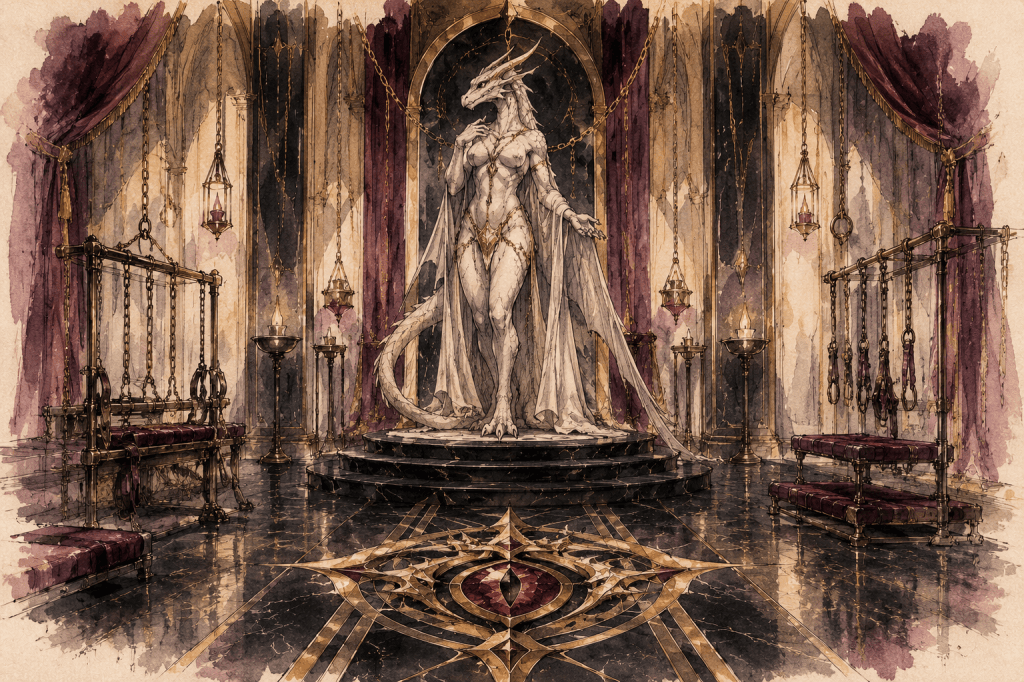
Mirellune’s temples are often called Houses of the Silken Sovereign, Sovereign Sanctums, Dominiums or Houses of the Perfect Bond.
They favor polished black stone, gold geometric inlays, dark wine velvet, mirror-black surfaces and carefully controlled illumination. Chains hang in measured symmetry. Curtains fall cleanly. Ritual furnishings are maintained obsessively. Suspended rigs, restraint frames, kneeling platforms and harness stations may be present, but nothing should resemble a dungeon of punishment. These are sacred implements within a disciplined sanctuary.
The central chamber traditionally contains Mirellune’s Sovereign Eye above an empty black dais. Some temples place a throne there during specific rites. Most leave it empty. Authority is not assumed merely because a seat exists.
Rites, Taboos & Divine Signs
Rite of the Silken Duality
Two willing participants bind one another in mirrored patterns. Each begins in one role. After the first phase is completed, the bindings are released and the roles reverse. The rite descends directly from older Mirellunean traditions and honors her embodiment of both holding and being held. The purpose is not to prove that everyone enjoys both roles equally. It is to remember that neither role possesses greater spiritual dignity.
Rite of the Second Skin
A devotee is anointed with black, wine or gold-inflected gloss and dressed in ceremonial second-skin regalia while speaking vows of self-creation. Each layer represents something deliberately chosen: a role, discipline, promise, responsibility or form of presentation. At the rite’s conclusion, the devotee looks into polished black glass and states what they have chosen to become for the duration of the vow.
Rite of Devoted Tension
Partners exchange commands and responses slowly, building trust through repetition. Commands remain simple at first. The ritual becomes more demanding only according to previously established boundaries. The rite teaches that obedience is not produced merely by increasing force. It develops through reliability. The person giving commands must demonstrate that they can be trusted with increasingly meaningful authority.
Rite of the Sovereign Harness
A ceremonial harness is fitted to a willing participant according to sacred geometric patterns. Each strap or connection corresponds to a stated vow, responsibility or limit. The harness is adjusted until it fits precisely. Pain caused by carelessness is considered evidence of failed preparation, not increased holiness.
The Giving of the Key
One participant places a symbolic key into another person’s palm and states exactly what authority is being entrusted. The recipient repeats the limits aloud. Only after both agree does the recipient close their hand around the key. The ritual appears in intimate practice, apprenticeships, religious appointments and temporary command structures.
Mirror-Kneeling
Mirror-Kneeling is a private rite in which a devotee kneels before their own reflection. The worshipper may issue instructions to themselves, confess where discipline has failed or deliberately experience the posture of submission without another person present. Older texts describe it as a means of remembering that the person who commands and the person who obeys may inhabit the same body.
Self-Encasement
Self-Encasement is a solitary ritual involving carefully chosen restrictive clothing, wrapping, second-skin vestments or other safe forms of containment that do not require another participant. The rite focuses upon self-discipline, bodily awareness and chosen limitation. Traditional teaching strongly discourages forms of restraint from which a solitary participant cannot safely release themselves. The theological lesson is structure. The practical lesson is preparation.
The Great Prohibition
Mirellune possesses many protocols, but one taboo overrides all others: No authority may claim legitimacy that was never given.
Nonconsensual domination, unwanted restraint, punishment outside agreed authority, using bondage for cruelty, exploiting dependency to manufacture obedience, ignoring revoked consent and abandoning someone while they remain physically vulnerable are grave violations of her faith. Older traditions also condemn ritual disorder and unsafe impulsivity. Mirellune’s rites may be intense, intimate and demanding, but intensity does not excuse negligence. Mocking dual-sexed, intersex or otherwise nonconforming bodies is traditionally considered an insult to Mirellune’s own sacred form.
Her clergy preserve the central distinction in a teaching: The chain does not grant the right to hold it.

Signs of Mirellune’s Claim
Older archives describe these manifestations as Markings of Ownership. Many contemporary temples prefer Signs of Devotion or Signs of the Bond, although possessive language remains intentionally preserved within some consensual devotional traditions.
A devotee’s scales or skin may take on a temporary polished sheen. A subtle chain-link shimmer may appear around wrists, thighs or collarbones. The eyes may develop a momentary crimson vertical slit resembling the Sovereign Eye.
Black or gold materials grow pleasantly warm at the devotee’s touch. Knots tied by the marked person seem unusually precise. Clothing or armor may settle into perfect alignment without adjustment. The voice may acquire a faint dual resonance during ritual command. Dreams sometimes feature Mirellune standing silently before the dreamer with an open collar or key resting upon one clawed palm.
Mirellune and the Velvet Court
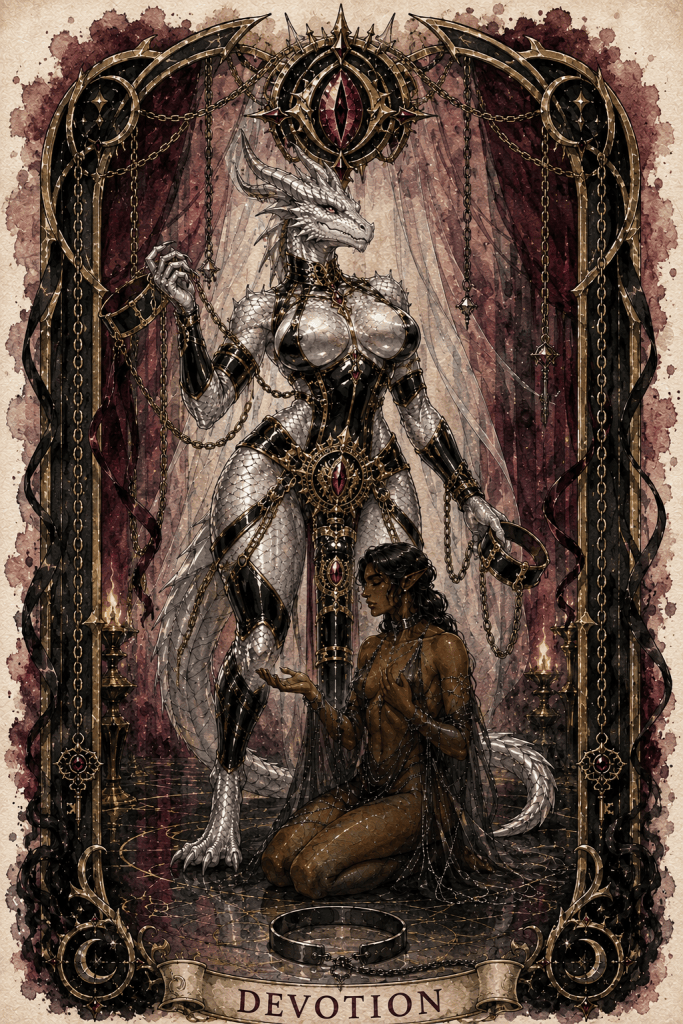
Within the Velvet Court, Mirellune embodies Trust, Devotion and Surrender. Where Velyssara awakens desire, Mirellune asks what it means to place that desire into another person’s care. Her relationship with Solynth is frequently misunderstood as simple dominant and submissive polarity. Their domains overlap, but they are not interchangeable. Solynth concerns purpose, service and belonging: the fulfillment found in contributing to something larger than oneself. Mirellune governs the act of entrusting authority and the structure that makes chosen surrender possible.
Nyzun represents another important distinction. Both deities value discipline and limits, but Nyzun concerns endurance, trial and strength discovered through challenge. Mirellune concerns trust, responsibility and the structure of power exchanged between people. Delavira shares Mirellune’s interest in controlled surrender. Delavira governs pace, anticipation and the authority of not yet. Mirellune governs the clearer boundary of yes, under these terms. Delaviran theology explicitly recognizes Mirellune as the deity whose dominance is more directly concerned with command.
Cyrillith shares Mirellune’s fascination with roles. Cyrillith teaches that a chosen role can reveal truth. Mirellune asks what responsibility comes with inhabiting that role once another person begins trusting it. Velzhari’s traditions intersect with Mirellune through display, polish and the deliberate construction of presence. Older myths portray the two as appreciating one another’s mastery of surface, though for different reasons. Velzhari wishes to be seen. Mirellune wishes every visible element to reveal intentional structure. These relationships remain theological currents rather than permanent social arrangements among literal gods.
Above them all remains Velyssara. Without desire, nothing would be offered. Without choice, nothing offered would be sacred.
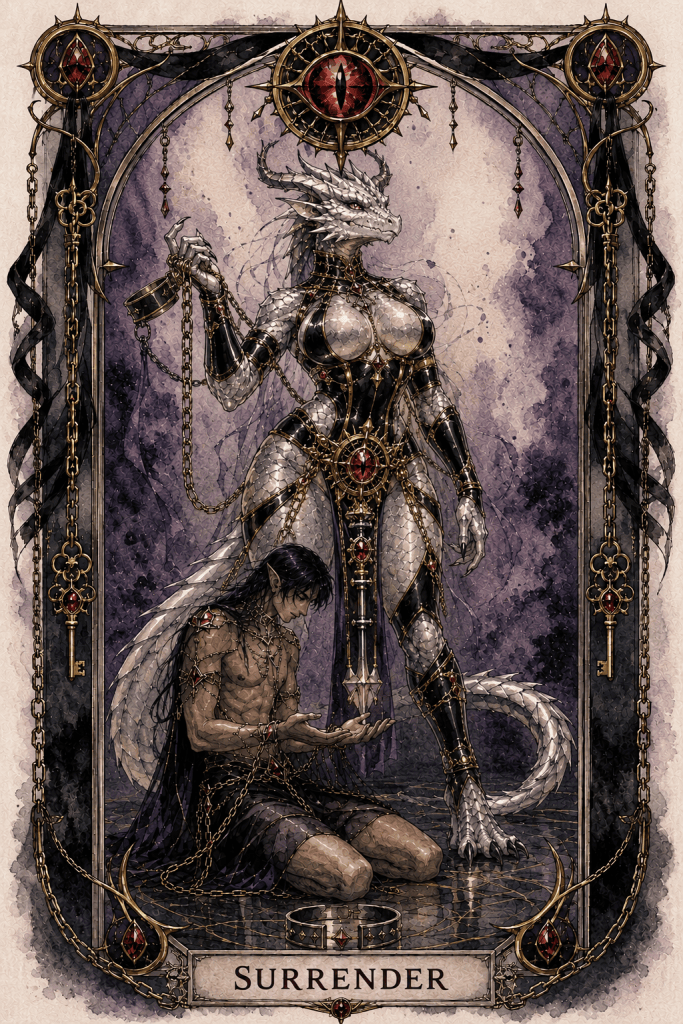
Miracles & Divine Presence
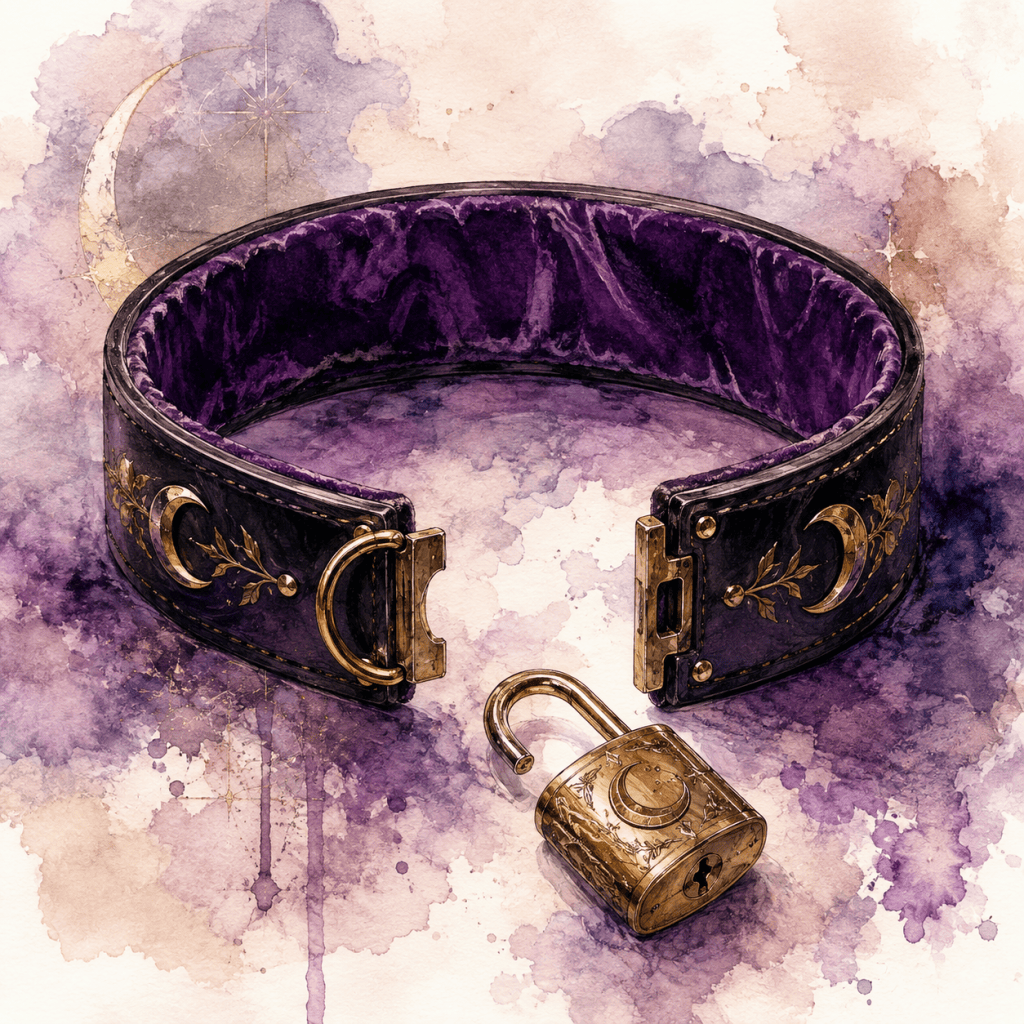
Mirellune’s miracles often resemble disorder discovering its proper place. A loose chain settles into perfect symmetry. A complicated knot unties itself the instant release is requested. A chaotic group unconsciously forms orderly lines around someone in danger. A command whispered across a noisy chamber reaches exactly the people meant to hear it and no one else. A poorly fitted harness adjusts itself without pain.
A locked restraint opens when the authority underlying it is withdrawn. Black stone becomes mirror-perfect. Gold fittings warm beneath a hand that has honored a difficult promise. The archives describe entire sanctuaries in which hundreds of suspended chains began moving together before stopping at precisely the same angle. Other stories tell of dishonest contracts whose ink rearranged itself until concealed obligations became visible.
One of the most famous manifestations is known as the Sovereign Refusal. A collar, chain, lock or binding simply opens. Mirellunean clergy interpret the sign cautiously, but when it occurs during an arrangement whose authority has become coercive, few consider the message subtle. When Mirellune herself manifests, she rarely arrives with thunder.
Reflections sharpen. Loose fabric settles. Chains become still. Crimson gemstones briefly resemble watching eyes. Conversation softens without anyone demanding silence. And everyone present becomes suddenly, intensely aware of who holds authority in the room.
More importantly, they become aware of why.
What Her Faith Teaches
Mirellune teaches that trust becomes meaningful when something valuable is placed within another person’s care.
Her faithful therefore reject both unquestioned authoritarianism and the assumption that surrender is inherently degrading. Power exchange may become sacred when everyone involved understands what has been given, what remains withheld and how the arrangement may end.
Several principles recur throughout Mirellunean theology:
- Trust requires vulnerability. If nothing meaningful can be lost, little has actually been entrusted.
- Submission is not inferiority. Unequal roles do not create unequal persons.
- Authority creates responsibility before privilege. The person receiving control carries an obligation to use it faithfully.
- A boundary can create freedom. Knowing what will not happen can make what remains possible easier to explore.
- Devotion is strengthened by reliability. A promise repeatedly honored becomes more powerful than one dramatically spoken and forgotten.
- Discipline gives desire form. Wanting transformation is different from practicing what transformation requires.
- Release belongs to restraint. A sacred bond must understand how it begins, how it changes and how it ends.
- Authority may be withdrawn. What was granted before does not become permanent property merely because it was once offered.
- The body may express theology. Collars, chains, latex, leather, harnesses and ritual posture can make invisible relationships visible when their meaning is chosen rather than assumed.
Mirellunean traditions preserve several older sayings: Power exchanged is power shared. Surrender is a sacred gift. Discipline reveals the truth of the self.
And above all: To entrust oneself is sacred.
At the Table
Mirellune works best in campaigns involving trust, vows, authority, command, hierarchy, responsibility, loyalty, contracts, restraint and the difference between chosen submission and coercive control. Her influence belongs naturally in military orders, noble courts, artisan guilds, monasteries, pleasure sanctuaries and intimate relationships, but it can appear anywhere someone places meaningful responsibility into another person’s hands. Nothing about Mirellune requires erotic mechanics.
A standard 5e-compatible campaign can use her as a goddess of vows, trust, disciplined service, legitimate authority and sacred obligation. A Mirellunean NPC does not need to order anyone to kneel. They might simply place a key upon the table and ask: “Before I accept this, tell me exactly what you are giving me.”
Mirellunean Characters
Characters drawn toward Mirellune commonly include commanders, knights, guards, judges, attendants, household stewards, craftspeople, apprentices, disciplined warriors, ritualists and people interested in dominance or submission.
Her faith also suits characters whose relationship with control is conflicted. A commander may learn that issuing orders is easier than accepting responsibility for their consequences. A fiercely independent adventurer may discover that refusing every authority can become another form of fear.
A submissive character may learn that surrender does not require abandoning judgment. A dominant character may discover that another person’s obedience is not proof of entitlement. A ruler unable to delegate may confront the possibility that their obsession with control comes not from strength but from distrust.
These are Mirellunean conflicts.
Divine Domains and Traditions
The archives associate Mirellune with Order, Lust, Discipline and Protection, alongside several specifically named traditions. Clerical traditions include Order, Lust, Discipline and Protection. Paladin traditions include the Oath of the Silken Chain and Oath of Obedient Devotion. Bardic traditions include the College of Command and College of Dominance. Warlock traditions include the Pact of the Fetters and Pact of the Bound Will. The archives list no traditional druidic circle strongly associated with Mirellune.
These remain useful Second Bloom setting concepts, but bespoke mechanics require conversion to the current framework.
(Needs updated mechanics.)
Boons of Mirellune
Older accounts preserve three characteristic blessing concepts.
- Dual Majesty enhanced social authority through Mirellune’s embodied duality.
- Second Skin granted defensive benefit while wearing latex, leather or fetish armor.
- Encasing Touch interacted with restraint and the older Arousal framework.
The concepts remain thematically useful, but their archived rules predate current Second Bloom design and should not be reproduced unchanged.
(Needs updated mechanics: Base 5e → Veiled → Unveiled.)
Sovereign’s Command
The archives preserve a once-per-rest ability known as Sovereign’s Command, in which Mirellune’s dual-toned divine voice caused another creature to kneel and become lightly restrained. The conceptual fantasy remains appropriate, but the Second Bloom version should distinguish supernatural battlefield control from narrative obedience and preserve clear avenues for resistance. Future design may also reward stronger effects where a creature has willingly accepted the Mirellunean character’s authority beforehand.
(Needs updated mechanics: Base 5e → Veiled → Unveiled.)
Fetters of the Empress
The archives preserve Fetters of the Empress, a manifestation in which radiant latex-like chains restrain enemies or protect allies through a supernatural second skin. This remains an excellent candidate for Channel Divinity or comparable divine magic because it expresses both halves of Mirellune’s domain: restraint and protection. Any revised implementation should include explicit range, duration, saving throw and ally benefits.
(Needs updated mechanics: Base 5e → Veiled → Unveiled.)
Mirellune and Desire Mechanics
When the optional Desire system is active, Mirellune naturally interacts with restraint, EROS Saves, Arousal and negotiated states of temporary authority. Mechanical restraint must never imply narrative sexual consent. A failed saving throw may represent supernatural binding, pressure, distraction or imposed battlefield control. It does not create permission for erotic participation. Voluntary Mirellunean rites provide a separate design space where willing characters may receive stronger benefits because trust has already been established.
(Needs updated mechanics.)
Sacred Relics
The Collar of the First Vow
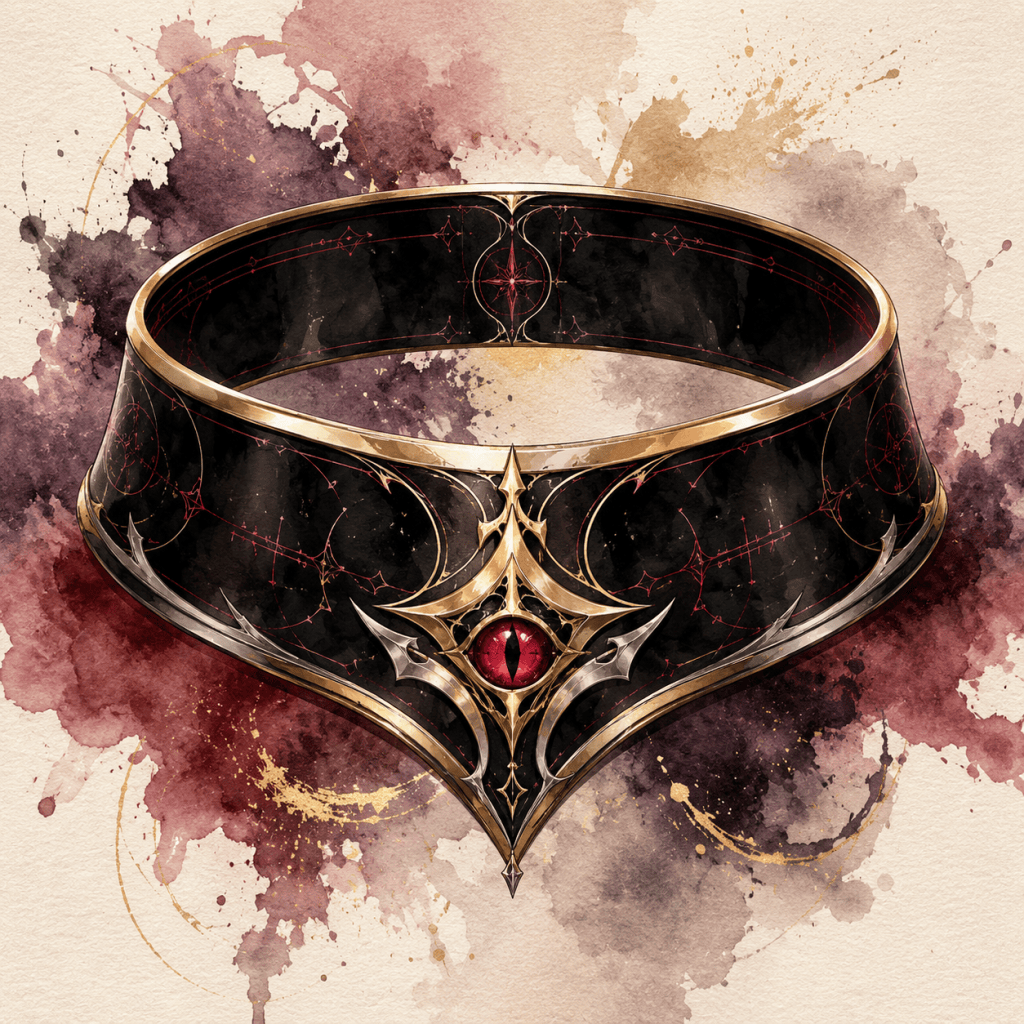
This seamless black-and-gold collar is said to descend from Mirellune’s earliest mysteries. No clasp is visible until the intended wearer touches it. Legends claim the collar cannot be closed by another person’s hand. The wearer must complete the final movement themselves. Once sealed, faint crimson lines appear across its surface representing the vow associated with it. Older stories disagree about whether the original collar still exists or whether every properly consecrated example participates in the same divine mystery.
(Needs updated mechanics: Base 5e → Veiled → Unveiled.)
The Sovereign Key
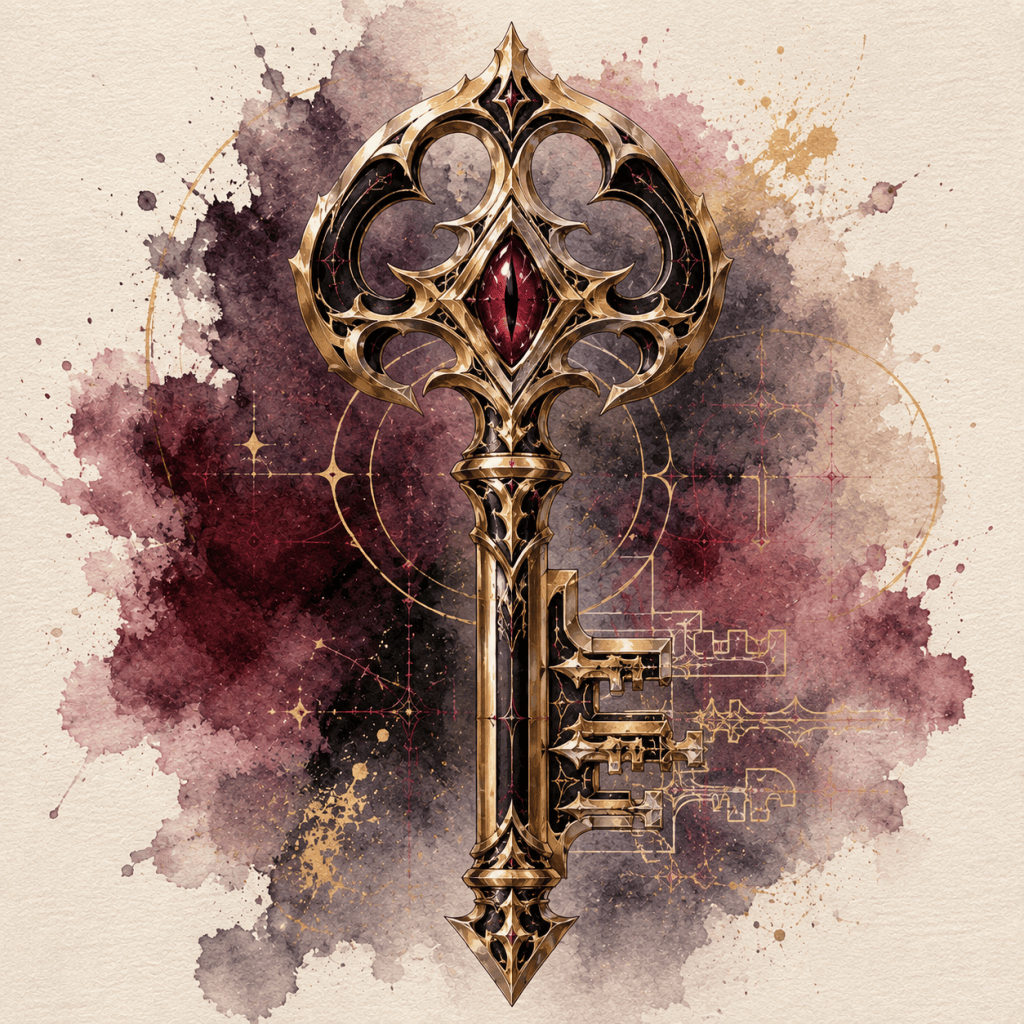
A heavy golden key set with a narrow crimson gemstone. Its teeth subtly change whenever the key is turned in the hand. Tradition claims the Sovereign Key can open any restraint whose authority has legitimately ended. It famously refuses locks belonging to stolen property, illicit prisons or vows still honestly maintained. Mirellunean theologians have argued for centuries over whether the key judges authority or merely recognizes consent.
(Needs updated mechanics: Base 5e → Veiled → Unveiled.)
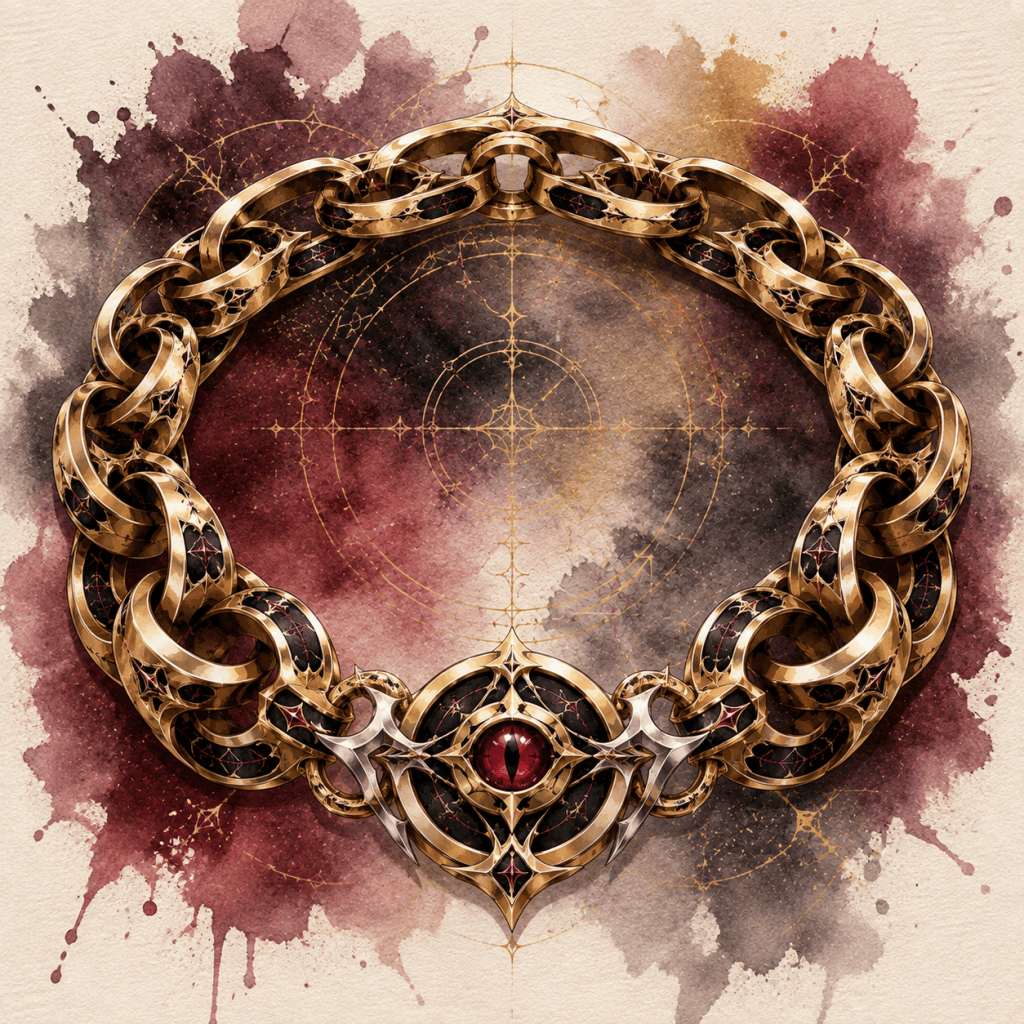
The Chain of Willing Gold
This immaculate chain consists of broad golden links engraved with tiny black sigils. Stories claim it can restrain beings of tremendous physical strength. Its limitation is famous: A creature that has never willingly accepted the chain cannot be held by its sacred form indefinitely. Mirellunean clergy do not regard this as a flaw. They regard it as the point.
(Needs updated mechanics: Base 5e → Veiled → Unveiled.)
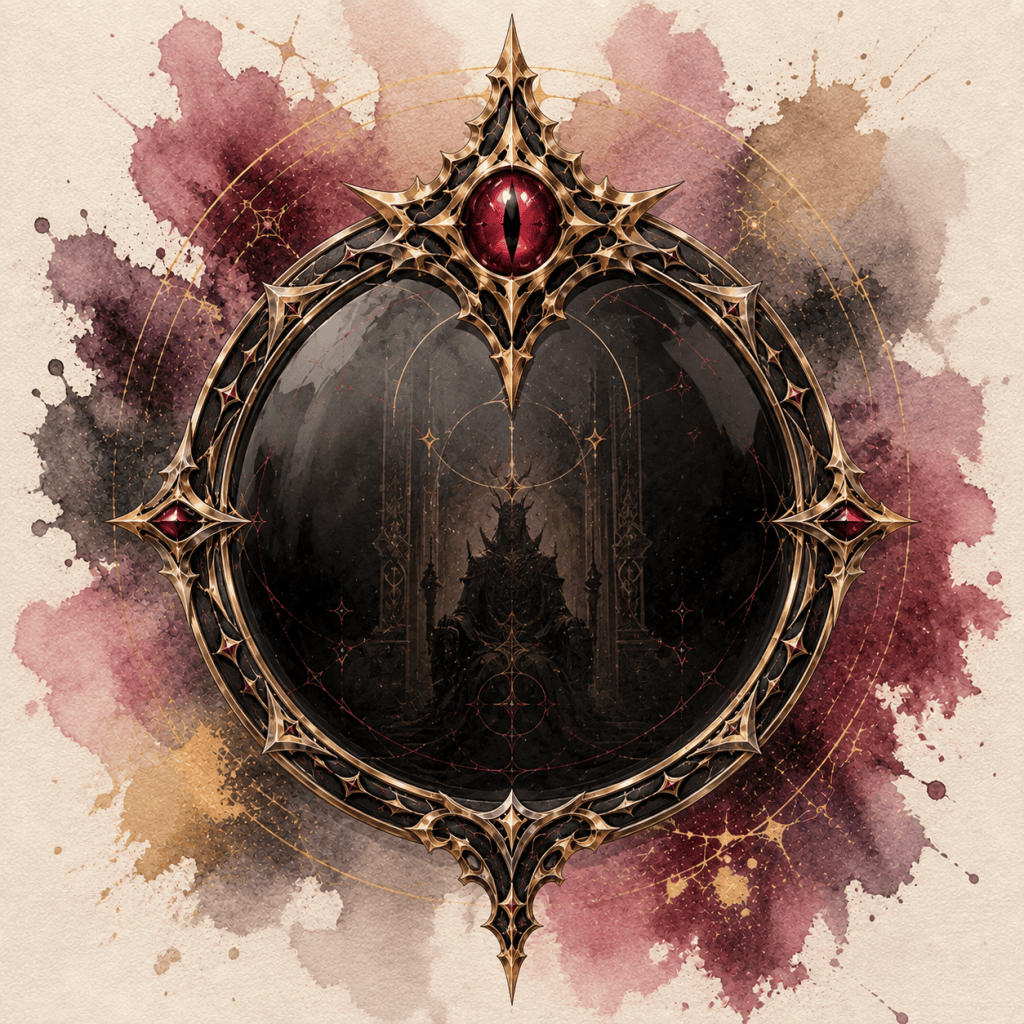
The Black Mirror of Command
This flawless disk of mirror-black glass is bordered in gold and crowned by a crimson eye. When a viewer approaches, the reflection stands as the viewer believes a rightful authority should stand. For some, the reflection appears magnificent. For others, it is exhausting. A handful of rulers are said to have abdicated immediately after looking into the true mirror.
(Needs updated mechanics: Base 5e → Veiled → Unveiled.)
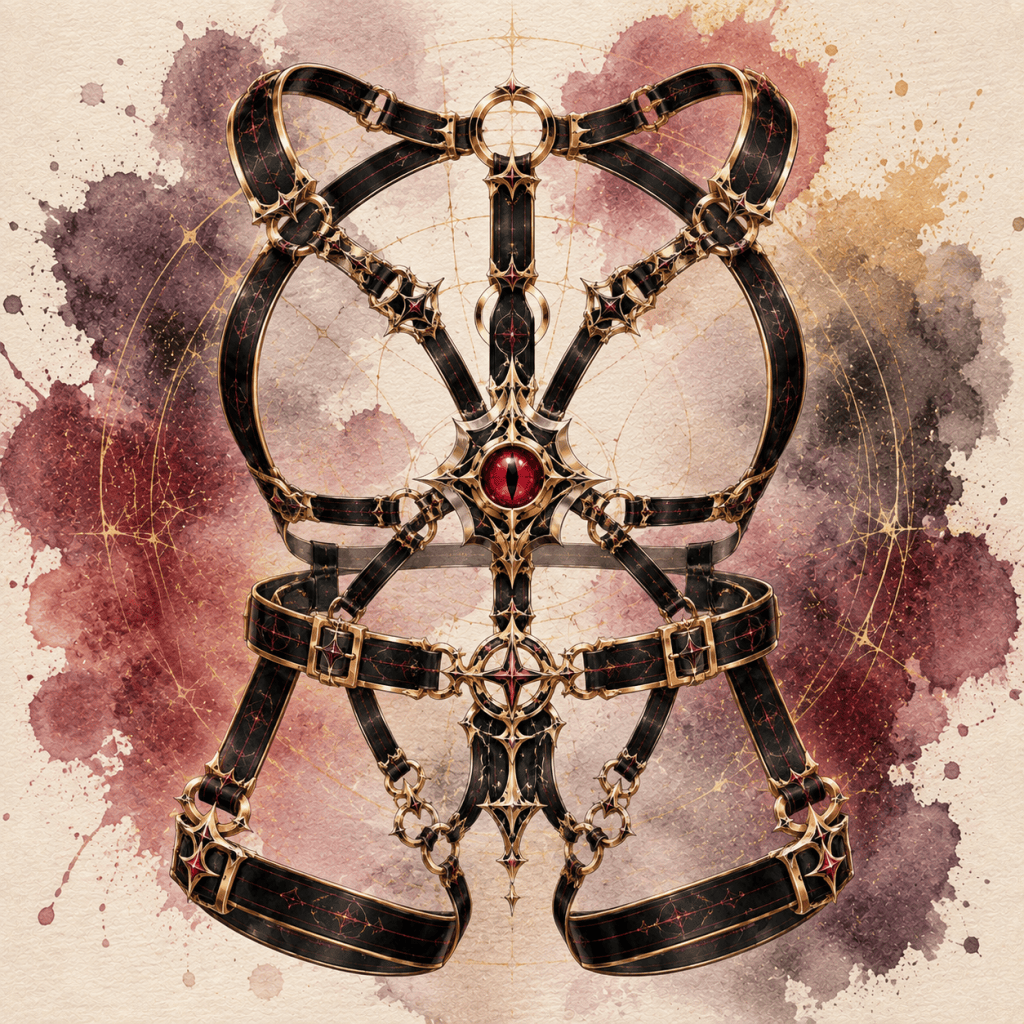
The Harness of Perfect Measure
This legendary network of black enchanted bands and gold fittings reshapes itself precisely to the body of its wearer. No strap chafes. No fastening slips. No connection tightens beyond its intended degree. Each fitting bears one tiny crimson mark resembling Mirellune’s eye. Older traditions claim the harness reveals whether a limitation has been chosen, endured or imposed. Exactly how it accomplishes this remains unexplained.
(Needs updated mechanics: Base 5e → Veiled → Unveiled.)
Adventure Hooks
The Chain Opens
Ceremonial bindings sacred to Mirellune begin opening spontaneously throughout Erosia.Priests initially fear their goddess has rejected restraint itself. Then they discover that every affected bond belongs to an arrangement where authority has quietly become coercive. There are thousands.
The Order That Cannot Be Broken
Soldiers of a celebrated Mirellunean regiment continue receiving flawless orders from their commander. The instructions are tactically brilliant. The regiment has not lost a battle. The commander died three weeks ago.
The Missing Key
A Keeper of the Key disappears while carrying the only known means of releasing an ancient compact binding two powerful noble houses. One house now wishes to withdraw from the agreement. The other insists that withdrawal was never permitted. Mirellune’s temple produces the original contract. Someone has altered it.
The Perfect Servant
A wealthy household boasts of an attendant who never makes mistakes, anticipates every desire and refuses nothing. A visiting Mirellunean priest sees the servant once and immediately demands an investigation. The attendant is not magically controlled. That may make the situation worse.
The Sovereign Refuses
During the coronation of a powerful ruler, the traditional golden chain is lifted to encircle the throne. For the first time in recorded history, it recoils. The new sovereign insists the ceremony continue. Every key in the sanctuary falls to the floor.
The Second Skin
An entire district awakens to discover its inhabitants covered in immaculate black-and-gold magical garments shaped perfectly to each wearer. The clothing cannot be removed. It does not harm anyone. Crimson writing slowly appears across the surfaces, revealing promises each person has made and failed to keep.
Scents for Gameplay
Mirellune’s presence is often recognized through scents that feel deliberate, polished and unusually precise. Her fragrances tend not to blend chaotically. Each note remains distinct.
| d12 | Scent | Suggested Moment |
|---|---|---|
| 1 | Warm leather and polished gold | Mirellune’s presence may be near. |
| 2 | Black vanilla and clean metal | Trust or authority has been consciously accepted. |
| 3 | Cedar incense and heated brass | Formal worship or a Mirellunean sanctuary. |
| 4 | Oiled chain and dark wine | A vow, bond or agreement is being established. |
| 5 | Clean silk and warm skin | Chosen vulnerability, closeness or surrender. |
| 6 | Rain upon polished black stone | Discipline holding under pressure. |
| 7 | Beeswax and freshly worked leather | Preparation, maintenance or sacred restraint. |
| 8 | Smoked plum and cool iron | A command carries unusual significance. |
| 9 | Black tea and sharpened steel | Training, concentration or repeated discipline. |
| 10 | Warm gold and extinguished candle smoke | Authority has ended or been deliberately returned. |
| 11 | Ozone, polished metal and crimson wine | A boundary or existing agreement is about to be tested. |
| 12 | The unmistakable scent of a perfectly prepared chamber waiting for its occupant | A direct omen or powerful Mirellunean manifestation. |
Using Scent as Foreshadowing
Repetition gives Mirellune’s fragrances meaning. If warm leather and polished gold repeatedly precede moments when entrusted authority becomes important, players may eventually recognize the scent before anyone speaks. If warm gold and extinguished candle smoke accompanies released vows, the same fragrance appearing during a ruler’s audience may create immediate tension.
- A prison may suddenly smell of clean silk before several unjust locks open.
- A commander about to issue a disastrous order may catch smoked plum and cool iron.
- A devotee considering whether to break a difficult but meaningful promise may smell oiled chain and dark wine despite standing alone in the wilderness.
- A character who has accepted authority they no longer deserve may wake to the scent of extinguished candles.
- Sometimes nothing else happens.
- A chain simply settles.
- A crimson gemstone catches the light.
Somewhere nearby, a key turns. Mirellune does not need to announce that the terms have changed. Her faithful have learned to listen.
 Whispers of Erosia
You must be logged in to post a comment.