

Velzhari
The Mirror Bride • The Radiant Revelation • The Faceted Bride
Goddess of Divine Vanity, Sacred Visibility and Exhibitionism
Vanity • Visibility • Revelation
Beauty, self-admiration, exhibitionism, chosen exposure, public allure, presentation, adornment, praise, performance, recognition, reputation, envy, mirror magic and the intoxicating pleasure of knowing one has been deliberately seen.
“Behold yourself as I behold you — radiant, shameless, irresistible.”
Velzhari is the goddess of beauty deliberately brought into view: the performer stepping into the exact center of the stage, the artisan drawing the cloth from a finished masterpiece, the lover deciding when the final veil should fall and the private pleasure of catching one’s own reflection and liking what looks back.
She governs Divine Vanity, the refusal to pretend that beauty, skill, achievement or cultivated magnificence becomes less real merely because one recognizes it in oneself. Her faithful reject the belief that humility requires habitual self-denial. A singer may know their voice is extraordinary. A sculptor may know the work is beautiful. A courtesan may delight in the effect of a carefully chosen entrance. Someone may look into a mirror and say, without apology, I look magnificent today.
Velzhari’s most intimate mysteries concern exhibitionism and chosen exposure. Some devotees delight in revealing their bodies before willing eyes. Others find the same current in provocative dress, deliberate posing, performance, translucent veils, mirrors or the electric awareness of being watched while doing something ordinarily private. She does not disguise these desires beneath euphemism. She places them inside a broader sacred truth: being seen can itself be pleasurable.
Yet Velzhari is not simply the goddess of nudity. A permanently uncovered body may cease to feel revealed at all. Her power lives in the threshold between concealed and shown, private and public, anticipation and revelation.
The faithful preserve three teachings above all others: beauty may be named without apology; visibility must be chosen; admiration never becomes ownership.
Lore & Mythos
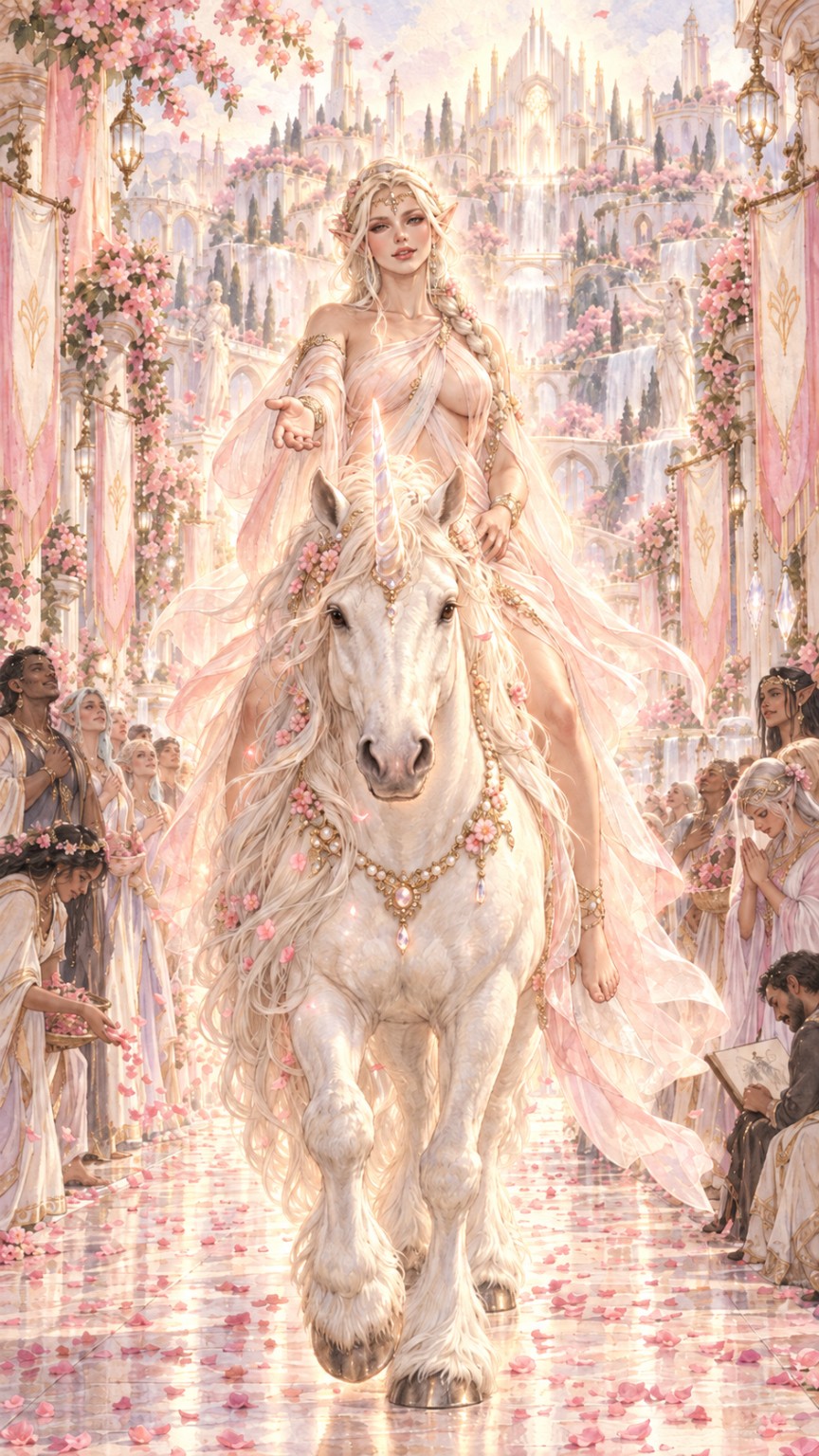
When the First Gaze Became Desire
The oldest Velzharian traditions claim she awakened when someone first realized that another person was not merely looking at them, but admiring them. Velyssara had already filled creation with desire. Mortals had touched, embraced, courted and loved. They knew hunger and affection, but attention itself had not yet become an object of pleasure. Then one person stepped into the light while another remained still and looked.
The one being watched felt the difference immediately. They had been noticed before. Others had seen their face, recognized their clothing or judged whether they were approaching or leaving. This gaze lingered because the observer wanted it to linger. The person beneath that attention realized that being looked upon could become its own sensation.
They did not turn away. They lifted their chin. The archives name this moment the First Gaze. Light gathered between observer and observed, struck the surface of still water and returned brighter than before. From the reflection rose Velzhari, platinum hair falling around her like a curtain, her body already poised as though creation had been waiting for her entrance.
The earliest hymns claim her first expression was not surprise. It was satisfaction. Velzharian theologians emphasize that the miracle required two choices. Someone wished to look, and someone wished to remain beneath the gaze. Neither choice alone created the goddess.
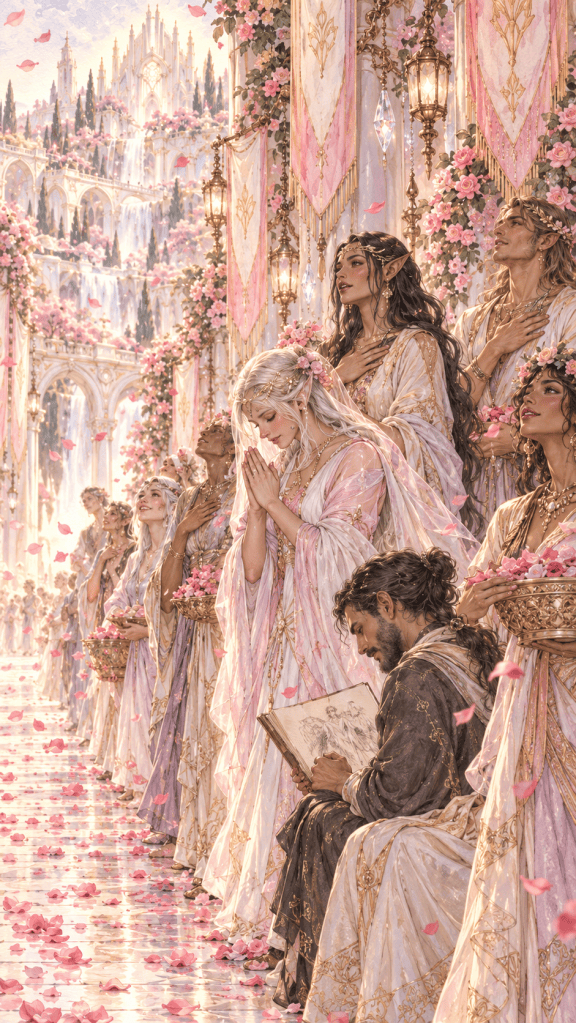
The Wedding of the Mirror
The story behind Velzhari’s most famous title has never been settled. One tradition claims that soon after her awakening, Velzhari became fascinated with reflections. She studied herself in still pools, polished metal, obsidian, silver glass and gemstones. She learned which expressions transformed her face, how movement changed the fall of her hair and how posture could turn an entrance into spectacle.
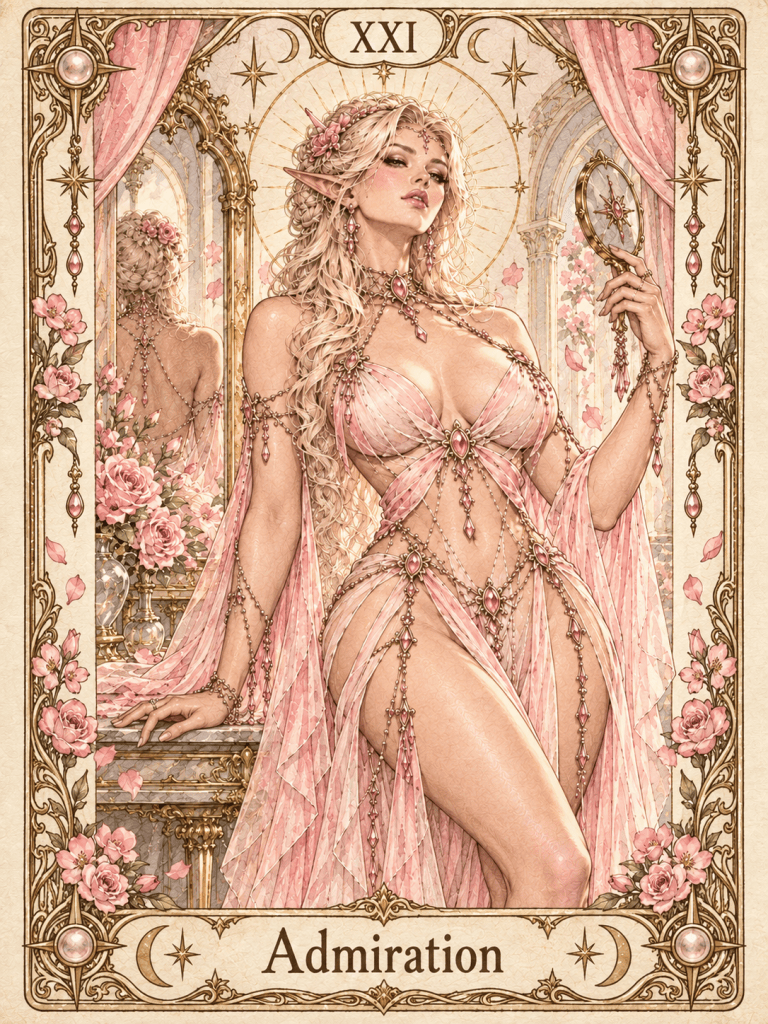
Some gods mocked her. Velzhari continued. Eventually, she commissioned a mirror large enough to hold her complete divine reflection. Before it she dressed as a bride, covering herself in pearl silk and layer after layer of translucent veil. No audience attended. One by one, Velzhari removed the veils until only the goddess and her reflection remained. She studied herself for a long while and then placed one hand against the glass.
The mirror brightened. Some traditions say Velzhari married herself, declaring self-love complete rather than a lesser substitute for another’s affection. Others say she married the Gaze, becoming eternally bride to every willing witness who would ever behold her. A third school teaches that the marriage joined the Presented Self and the Witnessed Self: the person one chooses to show and the person who comes into being when that presentation is genuinely received.
Velzhari has never clarified which account is true. Her clergy consider that refusal characteristically divine.

The Children of the Veil
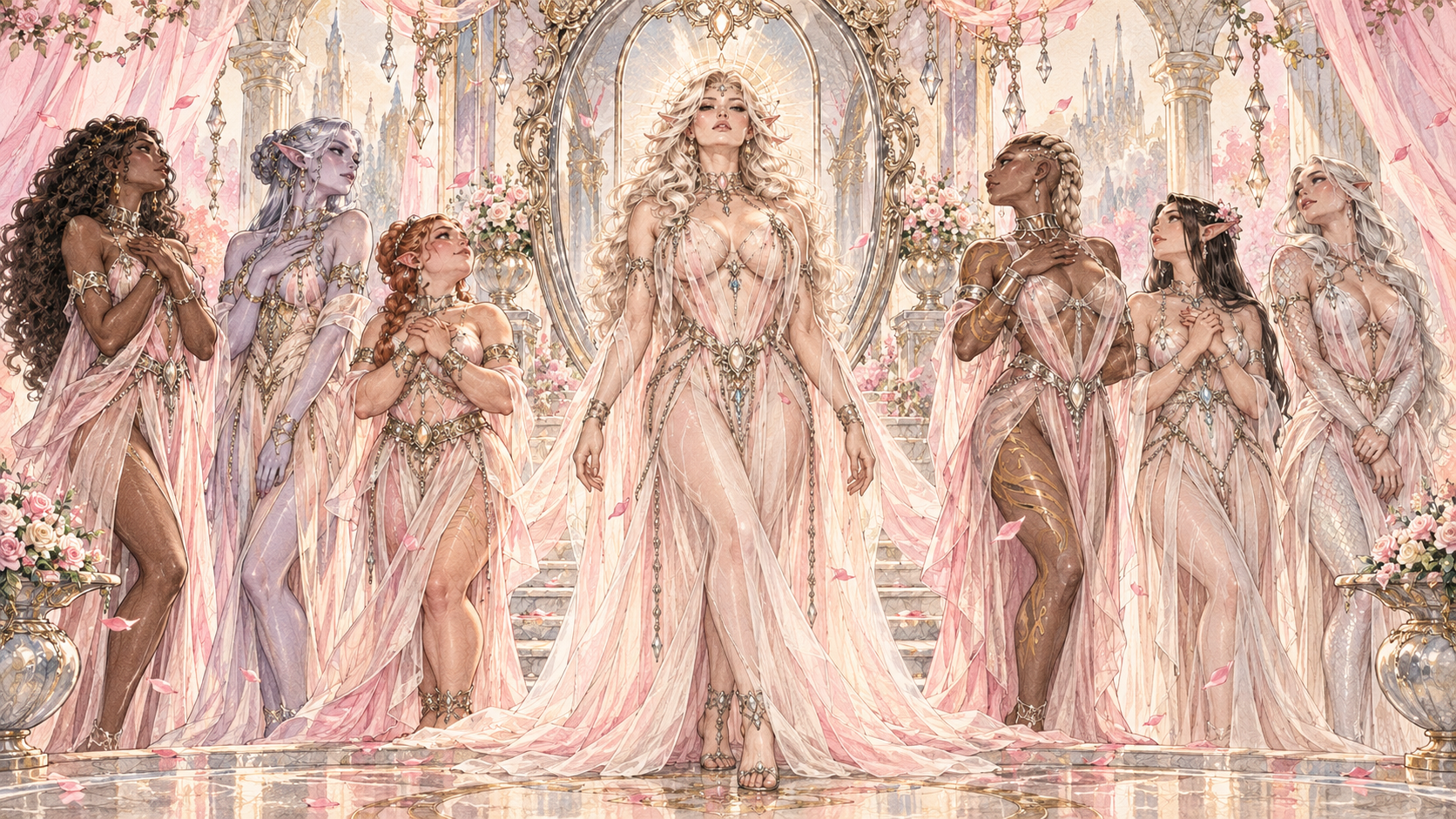
Among the greatest mysteries of Velzhari is one that extends far beyond exhibitionism. She is the divine progenitor of the Children of the Veil, the elven peoples of Erosia. The oldest elven theology does not describe Velzhari molding four peoples independently like statues. It describes a single act of revelation. Velzhari stood before the Veil and allowed her beauty to pass through forces greater than appearance alone. Through Light, her beauty became the Illuminari: radiance, refinement, brilliance and visible splendor.
Through Darkness, it became the Umbrel: depth, contrast, mystery and beauty that does not require illumination to remain real. Through Dream, it became the Dreamborn: possibility, imagination, memory and beauty unconstrained by waking certainty. Through Earth, it became the Greenward: embodied beauty, season, patience, living strength and the grace of things rooted deeply enough to endure. Velzharian theologians summarize the mystery in one sentence:
Velzhari did not create four kinds of elves. She revealed herself four ways.
None is considered the purest, closest or most authentic reflection. The Illuminari are not more Velzharian because her familiar divine avatar resembles them. Orthodox teaching is explicit that all four peoples are equal refractions of the same divine source. Their purpose is not to reproduce Velzhari’s beauty. It is to reveal forms of beauty that could not exist through her alone. This belief carries an important consequence within elven cultures. Diversity among the Children of the Veil is not theological deviation. It is evidence that Velzhari’s first act of creation succeeded.
Change block type or style
The First Unveiling
A beloved later myth concerns a famous dancer who entered Velzhari’s temple convinced that the goddess had abandoned her. The dancer had performed before kings, lovers and thousands of strangers. Audiences had seen nearly every part of her body, and she had once delighted in that attention. Over time, however, exposure became ordinary. The old excitement vanished. She asked Velzhari what remained to reveal when everyone had already seen everything.
Velzhari handed her a veil. The dancer laughed. Velzhari told her to put it on. For seven nights, the dancer performed completely covered. On the first night, nothing was revealed. On the second, one hand emerged. On another, the line of one leg became visible through moving silk. Later she revealed her face, then one shoulder, then the curve of her back beneath translucent fabric. By the seventh performance, the audience was silent before she removed anything at all.
The dancer understood. Exposure had never been sacred simply because skin was visible. The sacred thing was control over revelation. From this story comes one of the faith’s most repeated teachings: The veil does not oppose revelation. The veil gives revelation a door.
The Faceted Bride
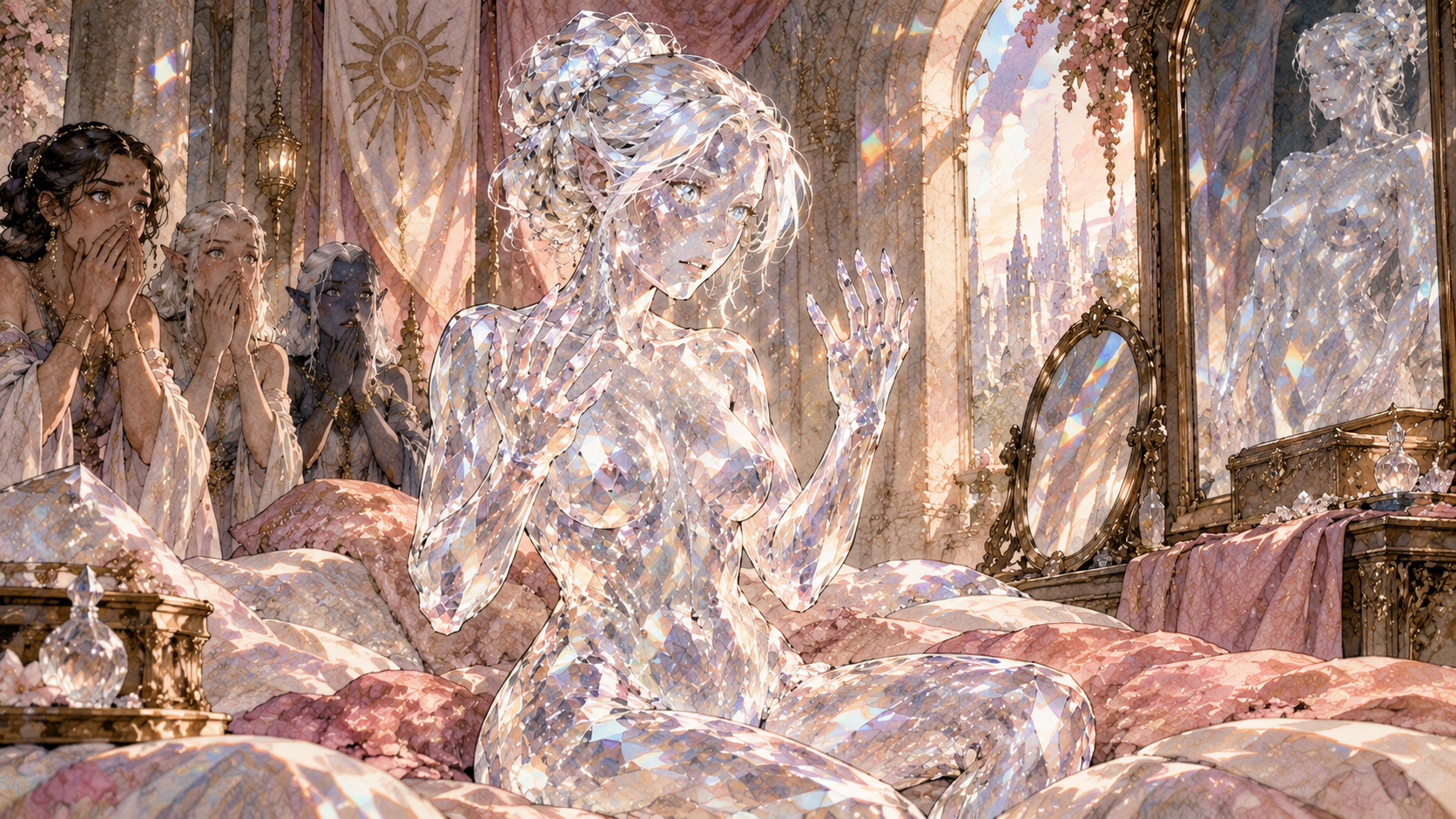
Gem-cutters and Illuminari jewelers preserve another ancient mystery. A legendary artisan once asked whether mortal hands could create something so beautiful that even Velzhari would feel envy. The goddess found the question delightful and accepted the challenge. For years the artisan worked upon one impossible diamond. Every flaw was removed. Every facet was arranged to catch light from several directions. Eventually the stone became a sculpture of Velzhari herself, flawless in proportion and polished until candlelight became rainbows upon the walls.
Velzhari circled the statue. Some versions insist that, for the first time in creation, Divine Vanity became envy. Then the goddess smiled. She touched the sculpture’s lips. The diamond inhaled. Some traditions claim Velzhari stepped permanently into that form. Others say the statue became a second manifestation of her. Mystic schools teach that the story is allegory: admiration struck something worthy and became radiance in return.
Sacred art calls this manifestation the Faceted Bride. In it, Velzhari appears as a perfectly sculpted living diamond woman, still unmistakably elven and voluptuous, with warm golden or champagne light flowing within her crystalline body. Every surface reflects those surrounding her.
A mirror returns an image. The Faceted Bride returns light.
The Empty Gallery
Velzhari’s myths do not praise vanity without examining its danger. One story tells of a dancer who became so celebrated that she eventually refused to rehearse without witnesses. She hired servants to applaud practice sessions, enchanted mirrors to praise her beauty and dismissed friends who offered criticism instead of admiration. Eventually she could no longer tell whether a performance pleased her until someone else reacted.
One night she entered her theater and found every seat empty. The doors locked behind her. The mirrors showed only darkness. She performed anyway. At first she danced angrily, then desperately. Hours passed without applause. Finally, exhausted, she abandoned the celebrated routine and danced something new simply because the movement pleased her. One mirror brightened. Velzhari sat within the reflection. She asked whether the dancer had enjoyed herself.
The dancer admitted that she had. Velzhari answered that she might now safely have an audience again. From this tale comes the faith’s central warning: The audience may amplify the mirror. It must never replace it.
The Desire She Embodies
Velzhari embodies the desire to be seen deliberately. Her current awakens whenever someone changes posture before entering a room because they know others will look. A warrior polishes ceremonial armor not because tarnished steel fails in battle, but because appearance matters at a victory procession. A musician spends another hour perfecting a piece because someone will listen. A lover dresses differently because one particular person will notice.
The audience may be one person or ten thousand. What matters is that witness itself has become meaningful.
Divine Vanity & the Celebrated Self
Vanity is Velzhari’s most controversial virtue.
Her faithful distinguish Divine Vanity from superiority. Divine Vanity is the capacity to recognize one’s own beauty, ability, achievement or cultivated identity and experience genuine pleasure in possessing it. A beautiful person does not insult others by knowing they are beautiful. A brilliant performer need not pretend the audience imagined their talent. A master artisan does not become arrogant merely by admitting the work is exceptional.
Velzhari distrusts compulsory false modesty because it teaches people to lie about what they value merely to appear socially harmless.
Her doctrine does not say: I am worthy because I am beautiful.
It says: This is beautiful, and I am allowed to know that.
Arrogance begins when someone’s self-admiration requires another person to become lesser. Velzhari loves mirrors. She has never demanded that only one reflection be beautiful.
Sacred Visibility
& Witness
Visibility and witness are not identical.
Someone may stand before an enormous crowd and feel unseen. Another person may reveal something to one trusted companion and experience complete recognition.
Velzhari teaches that observation notices; witness receives. Her rites therefore place responsibilities upon the audience. A witness pays attention. They do not immediately redirect the revelation toward themselves. They do not assume that being permitted to see one thing grants access to another.
To witness well is itself a devotional practice. The person revealed is not the only participant in the sacrament.
Exhibitionism
& Chosen Exposure
Exhibitionism forms the erotic heart of Velzhari’s religion. Some devotees enjoy exposing their bodies before willing lovers, ritual communities or audiences. Others prefer translucent clothing, deliberate posing, provocative fashion, mirrors, public performance or the awareness that someone is watching while they perform an act normally kept private.
Velzharian practice emphasizes the reveal. Garments may be designed to loosen, open, part or become translucent in stages. Long hair can conceal until moved aside. Lighting can transform something technically visible into something suddenly noticed. Mirrors provide angles unavailable to direct sight.
Complete exposure is sacred for those who desire it. Partial revelation is equally sacred. Velzhari’s clergy summarize the distinction plainly:
The thrill does not live in how much is shown. It lives in knowing that you chose to show it.
Adornment & the Framed Icon
Velzhari considers adornment one of civilization’s great arts. Jewelry, cosmetics, perfume, elaborate hair, fitted corsetry, stockings, body chains, silk and formal dress can guide the eye as deliberately as brushwork guides attention across a painting. Her religion rejects the idea that an unadorned body is automatically more authentic than an adorned one.
Presentation is not necessarily disguise. It is composition. Tailors and attendants sometimes describe dressing another person as framing the icon. The body remains the body, but the frame tells the viewer where attention is being invited. This principle explains why Velzhari’s own garments are so elaborate despite her association with exposure. She loves clothing because clothing makes revelation possible.
Beauty & the Ideal Form
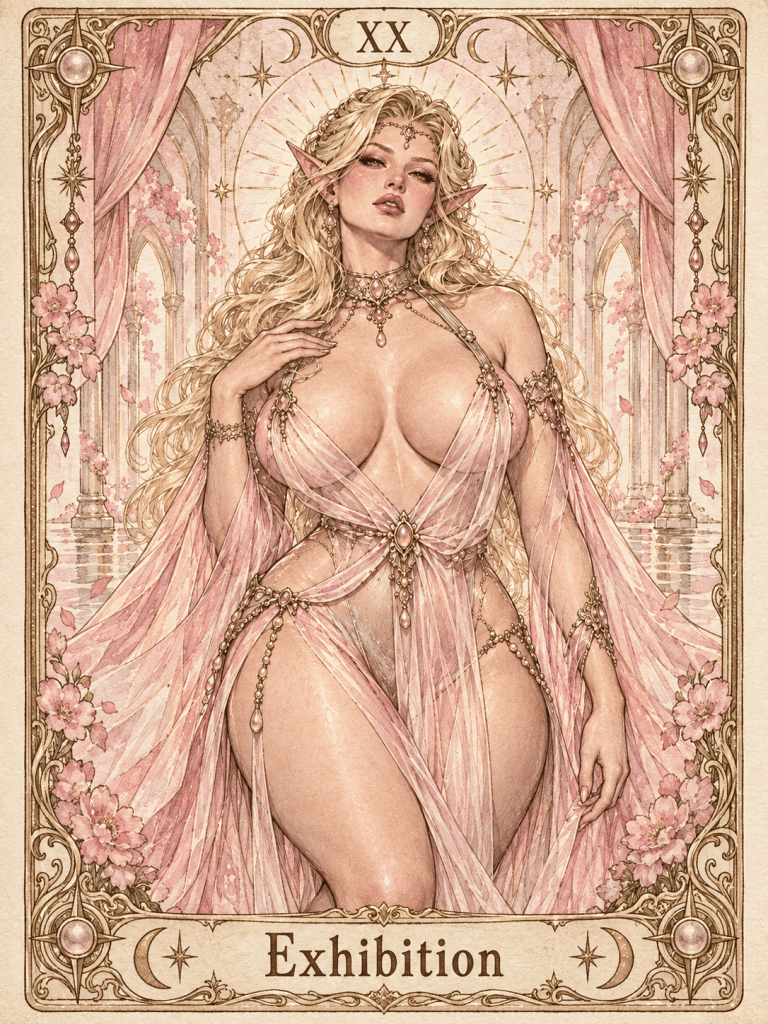
Velzhari herself appears almost impossibly perfect. Her canonical divine form is lush, statuesque, voluptuous and deliberately idealized. Her platinum hair falls in extravagant waves. Her face appears sculpted toward symmetry without losing personality. She walks as though every step has already found its most flattering angle. Her clergy are careful about what this means.
Velzhari’s body is her masterpiece, not a divine blueprint imposed upon everyone else.
This distinction has become particularly important in dialogue with Threxian theology. A person may desire Velzhari’s proportions. Another may desire something entirely different. A third may regard unusual features, scars, age, asymmetry or unconventional proportions as the most beautiful qualities they possess. Velzhari claims the right to admire her own perfection. She grants the same right to everyone else.
Recognition, Reputation & the Social Self
Velzhari’s domain extends beyond physical appearance because being seen involves more than the body. A poet wants the poem read. A soldier wants a victory remembered. A stateswoman wants an entrance to establish authority. A craftsperson wants someone knowledgeable enough to recognize the quality of the work. Recognition gives private accomplishment a social life. Velzhari does not teach that achievement requires witnesses to become real. She teaches that wanting recognition for genuine accomplishment is not inherently shallow.
Her clergy sometimes ask ambitious worshippers: Do you want to accomplish this, or do you want to be known as someone who accomplished it?
Either answer may be honest. Trouble begins when someone cannot distinguish them.
Envy & the Uncomfortable Mirror
Velzhari’s old iconography associates her not only with admiration but with envy. Her faithful do not treat envy itself as moral failure. Instead, they call it the Uncomfortable Mirror. Someone else’s beauty may reveal one’s own longing for beauty. Their confidence may expose years spent making oneself smaller. Their fame may reveal a hunger for recognition never previously admitted.
The feeling contains information. Its danger lies in what comes next. Envy becomes corrupt when admiration turns toward destruction: sabotaging the performer, mocking the beautiful, diminishing achievement or insisting that another person’s confidence must secretly be arrogance.
Velzharians preserve a simple teaching: Breaking another mirror does not improve your reflection.
Holy Symbol & Iconography
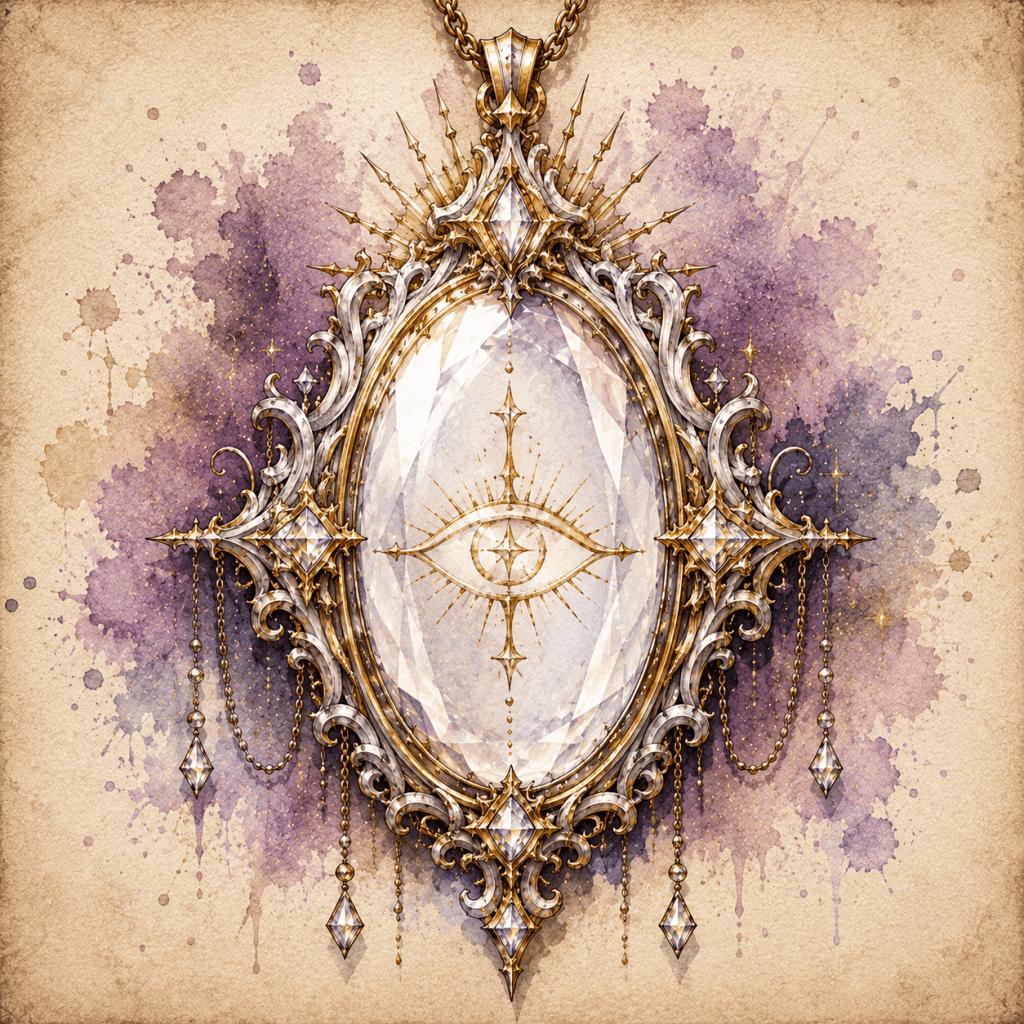
The Eye Within the Mirror
Velzhari’s canonical holy symbol is the Eye Within the Mirror.
It takes the form of an ornate oval mirror or faceted reflective crystal surrounded by elaborate platinum and warm-gold filigree. Radiant points rise around the upper frame like a jeweled crown or sunburst. Fine chains descend from the sides, ending in suspended crystal drops. At the center of the reflective surface rests an elegant stylized eye.
The eye is neither threatening nor all-seeing. It represents the invited witness.
The mirror represents the self deliberately presented. The gold represents admiration bestowed. The crystal represents admiration refracted outward. The ornate frame represents presentation itself: the choice to say that this particular image deserves attention.
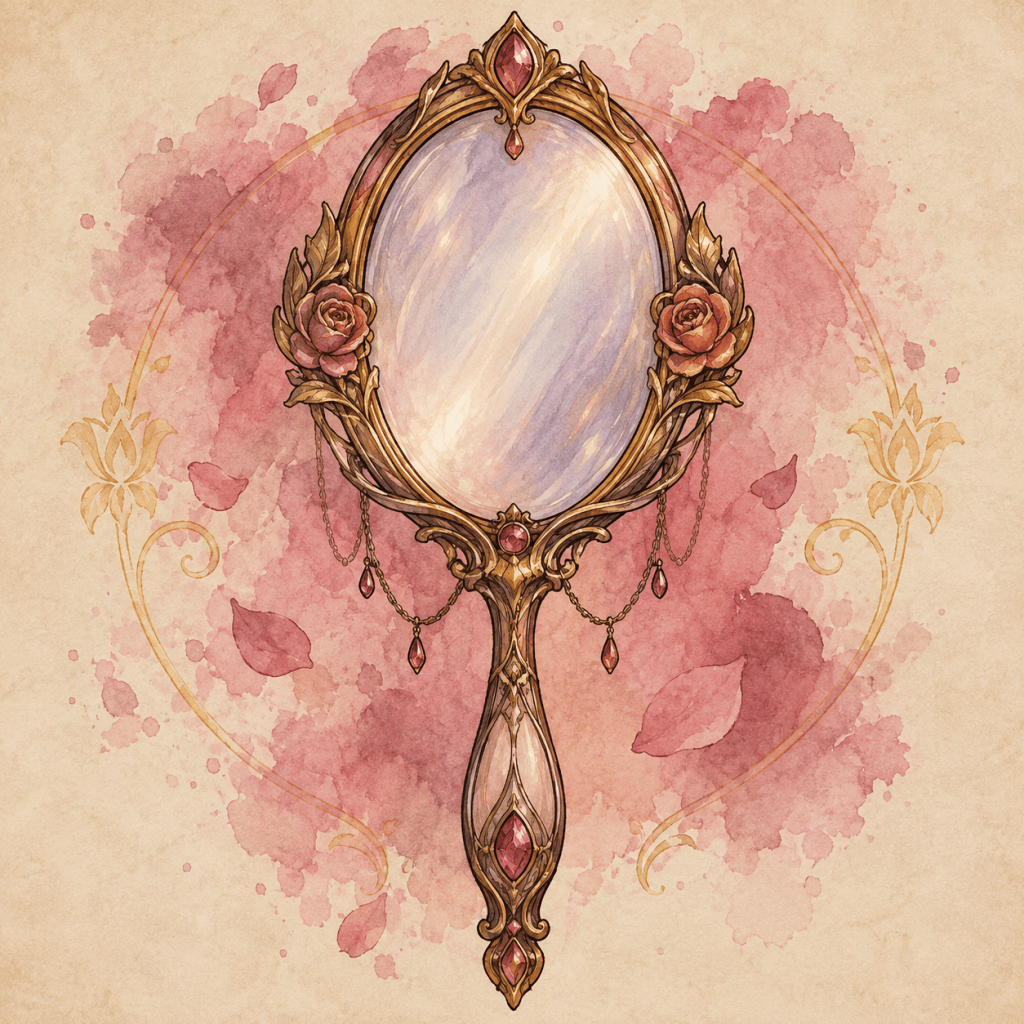
Older devotional emblems use a simpler heart-shaped hand mirror with a flowing ornamental handle. That form remains common on inexpensive pendants, household shrines and cosmetics cases, and it preserves the older meanings of beauty shown, self-love made divine and attention offered and received. The archive tradition explicitly associates Velzhari’s symbol with those meanings.
Sacred Colors & Materials
Velzharian sanctuaries favor platinum white, pearl, champagne, mirror silver, pale blush and bright warm gold. Lavender-violet and soft rose frequently appear through reflected light, while prismatic color is created by crystal rather than painted directly. The archive palette similarly emphasizes silver, pearlescent white, blush pink and bright gold, alongside polished glass, silk, gloss and radiant light. Common materials include polished silver, platinum, clear crystal, diamond, pearl, white silk, translucent gauze, satin, lace, polished marble, mirrored tile and exceptionally clear glass.
Velzharian sacred objects are usually maintained carefully. Tarnish is not sinful, but neglecting something whose purpose is presentation is considered a strange form of devotion.
Mirrors, Veils & Facets
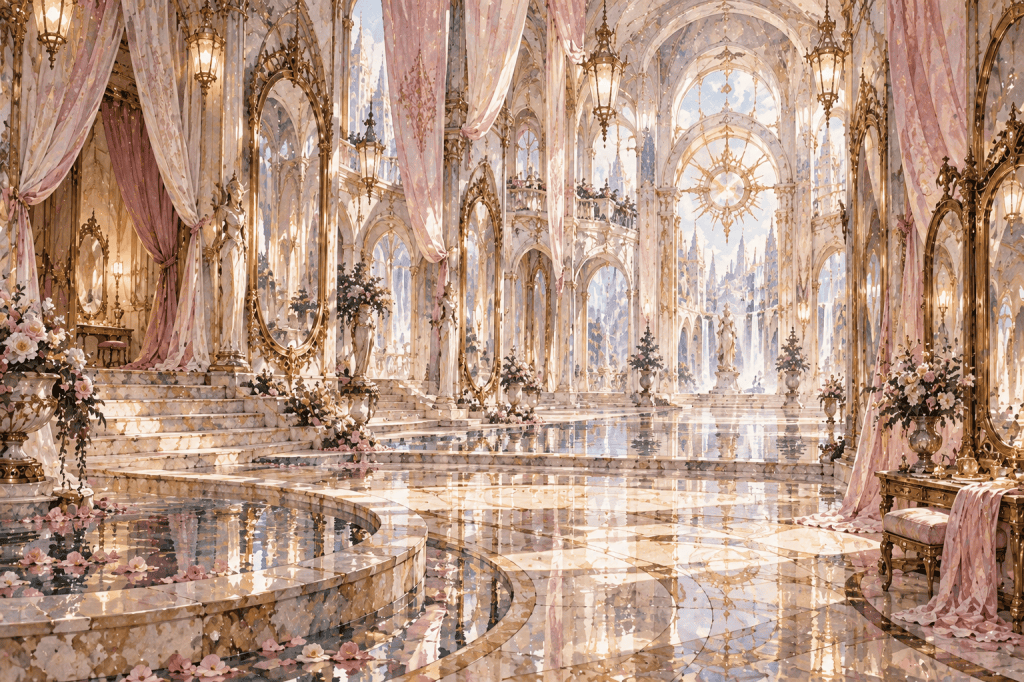
Mirrors dominate the faith’s visual language. A mirror represents self-recognition and witness. A veil represents threshold. A facet represents multiplicity. Temples frequently combine all three. Worshippers pass through veils into mirrored chambers where chandeliers and suspended crystals fracture a single source of light into dozens of reflections. Broken mirrors carry no universal superstition. Depending upon context, they can symbolize damaged reputation, fractured identity, multiplicity or liberation from an old reflection.

Sacred Creatures
Unicorns are Velzhari’s foremost sacred creatures, revered as living expressions of beauty perfected into form. Their grace, luminous presence and impossible elegance reflect her belief that true perfection is not sameness, but becoming completely and unapologetically oneself. A unicorn that chooses to reveal itself is considered a powerful sign of Velzhari’s favor: something magnificent has chosen to be seen.
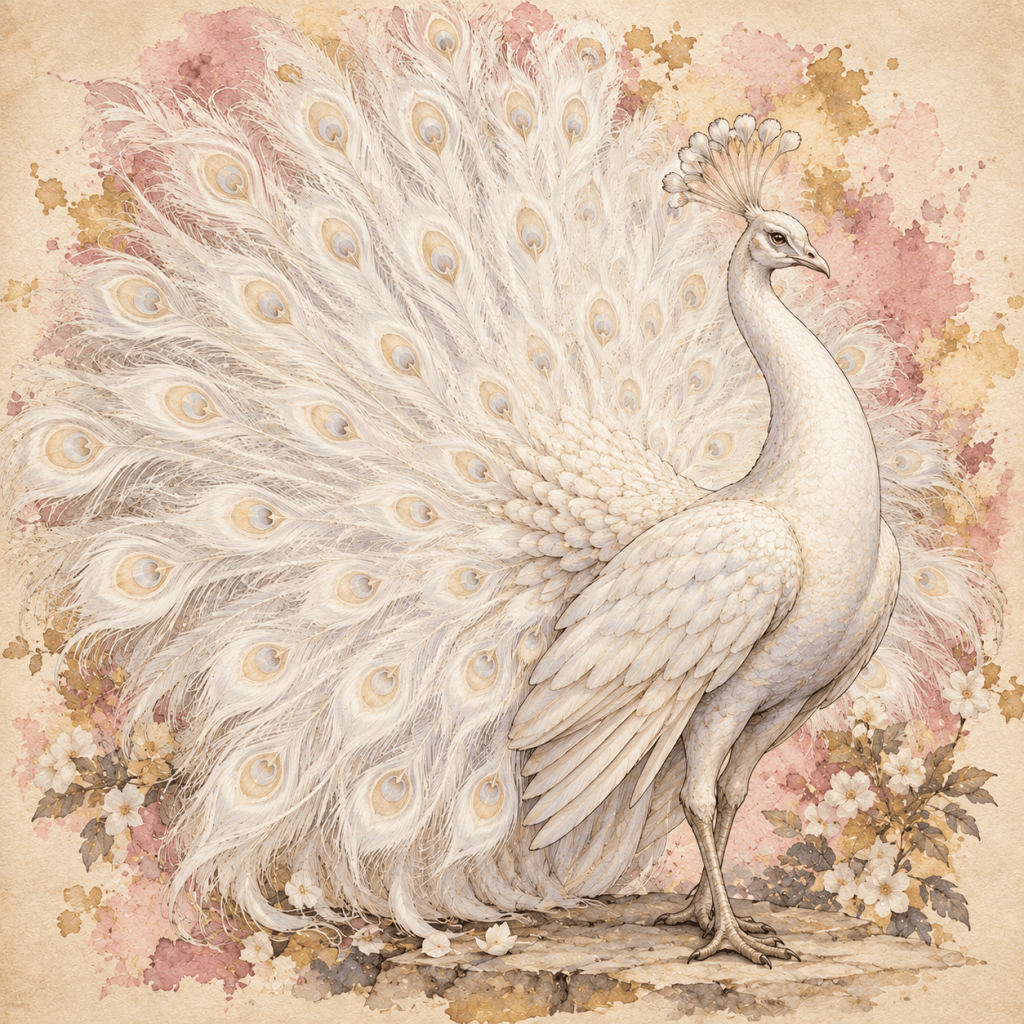
White peafowl are widely associated with Velzhari because their elaborate display makes beauty into action. The animal is not merely attractive; it presents itself. Bowerbirds are honored among artists, decorators and courtship traditions because they create beautiful spaces specifically to be noticed by another.
Illuminari sanctuaries also tell stories of mirrorfinches, small supernatural birds whose pale plumage appears white until they turn, revealing sudden flashes of rose, gold, violet and silver. Their feathers are said to become dull when caged for display and radiant when the bird chooses where to perch.
Depictions of Velzhari
Canonical Second Bloom art portrays Velzhari as a mature adult high-elven goddess of idealized Illuminari appearance. She is extraordinarily voluptuous, statuesque and deliberately perfected, with luminous pearl-champagne skin, extremely long platinum-white hair, elegant elongated ears, rose-violet or opalescent eyes and flawless posture. Her expression carries serene confidence, a knowing smirk or the unmistakable satisfaction of someone entirely aware of the gaze upon her.
Her familiar Illuminari appearance does not make the Illuminari more authentic children of Velzhari than the Umbrel, Dreamborn or Greenward. Some theologians say she adopted this avatar after her children emerged. Others maintain the Illuminari resemble one aspect of her because Light was one of the first forces through which she revealed herself.
Velzhari’s signature ceremonial attire is Mirror-Bride Revelation Regalia: fitted pearl-white elven corsetry, luminous silk, jeweled hip ornaments, moon-silk stockings, platinum filigree, translucent bridal veils and crystal jewelry. Her garments frame rather than hide her figure.
Her hair frequently becomes another veil. This creates one of the most beloved contradictions in Velzharian art: the goddess may appear almost completely revealed while remaining partially concealed by the very beauty being displayed.
In her Mythic Form, Velzhari becomes the Faceted Bride, a living diamond woman filled with champagne-gold light. The visual truth should remain immediate: She knows she is being seen, and she delights in it.

Worship & Daily Devotion
Velzhari can be worshipped anywhere presentation becomes intentional. Dressing can be prayer. Applying cosmetics can be prayer. Polishing armor before appearing at court can be prayer. Rehearsing an introduction can be prayer. Posting a finished painting where others can finally see it can be prayer. Her faith attracts performers, dancers, actors, courtesans, artists, diplomats, nobles, jewelers, tailors, celebrants, public speakers, models, athletes and people learning to inhabit visibility without apology. The older archives especially associate her with dancers, courtesans, models, performers and those who experience the thrill of being watched.
The First Look
Many devotees begin the day before a mirror. The goal is not to search for flaws. The worshipper identifies something they genuinely enjoy or wish to emphasize that day. It may be physical, emotional or purely presentational: the eyes, the hair, a garment, a scar, a practiced expression or simply a posture that feels confident. The devotion ends when preparation begins. Velzharians say a mirror should eventually send you back into the world.
Adornment of Intent
A worshipper chooses one element of appearance deliberately. A ring may communicate office. Red lips may communicate confidence. A bare shoulder may communicate invitation. A severe hairstyle may create distance. A polished breastplate may turn duty into ceremony.
The appearance does not need to be conventionally attractive. It needs to be intentional.
The Compliment Given
Velzharins consider sincere praise a minor offering.
The faithful are encouraged to give specific compliments when genuine opportunities arise. Specificity matters because vague flattery can be performed without attention.
“You are beautiful” is welcome. “The entire room became quiet when you began to sing” is stronger. The practice reminds Velzhari’s followers that admiration is something they should know how to give, not only receive.
The Empty Mirror
Public figures and performers often practice the Empty Mirror. For a period of time, they remove mirrors, audience feedback, applause and deliberate public presentation. They create, dress, move or simply exist without external witness.
This does not condemn attention. It protects enjoyment of attention from becoming dependence.
Favored Offerings
Traditional offerings include mirrors, cosmetics, perfume, jewelry, crystal, portraiture, silk, performance masks, ceremonial garments and tokens connected to meaningful public recognition. Artists often offer the cloth that covered an important work before its unveiling. Performers may offer the first flower thrown onto a stage after a debut. One of the most beloved offerings is a sincere written description of something beautiful another person did, made or became. Major temples preserve enormous collections of such letters.
Clergy & Temples
Mirror-Priests
Mirror-Priests form the broadest body of Velzhari’s clergy.
They maintain shrines and sacred mirrors, conduct ordinary devotion, officiate recognition ceremonies and counsel worshippers concerning confidence, self-presentation and public identity.
Many are trained in rhetoric, etiquette, fashion, cosmetics, lighting or performance.
Their traditional teaching is:
A mirror offers an image. It does not issue a command.
Brides of Reflection
Brides of Reflection specialize in self-regard, confidence and the difficult relationship between private self-image and public attention.
The title is not restricted by gender.
They often counsel people who have learned to minimize themselves through ridicule, social pressure or shame. They also counsel famous performers and leaders who have become unable to recognize value in themselves without applause.
A Bride of Reflection is trained not merely to make someone feel attractive, but to help them distinguish self-recognition from dependence upon validation.
Veilbearers
Veilbearers govern thresholds.
They officiate unveilings, exhibition rites, ceremonial entrances, bridal presentations, artistic debuts and other moments where the timing of visibility matters.
Their responsibility is equally concerned with what remains hidden.
A Veilbearer who knows how to reveal but not how to protect privacy has failed half the office.
Curators of Radiance
Curators of Radiance design presentation itself. They arrange galleries, stages, processions, lighting, mirrors, ceremonial costume and the placement of sacred objects. Some are formal clergy; others are artists serving the temple. The archival title Silken Showmaster survives in theatrical Halls of Reflection, while Radiant Saint is usually an honorific granted to extraordinary exemplars rather than a separate clerical rank. Both older titles belong to the established Velzharian tradition.
Halls of Reflection
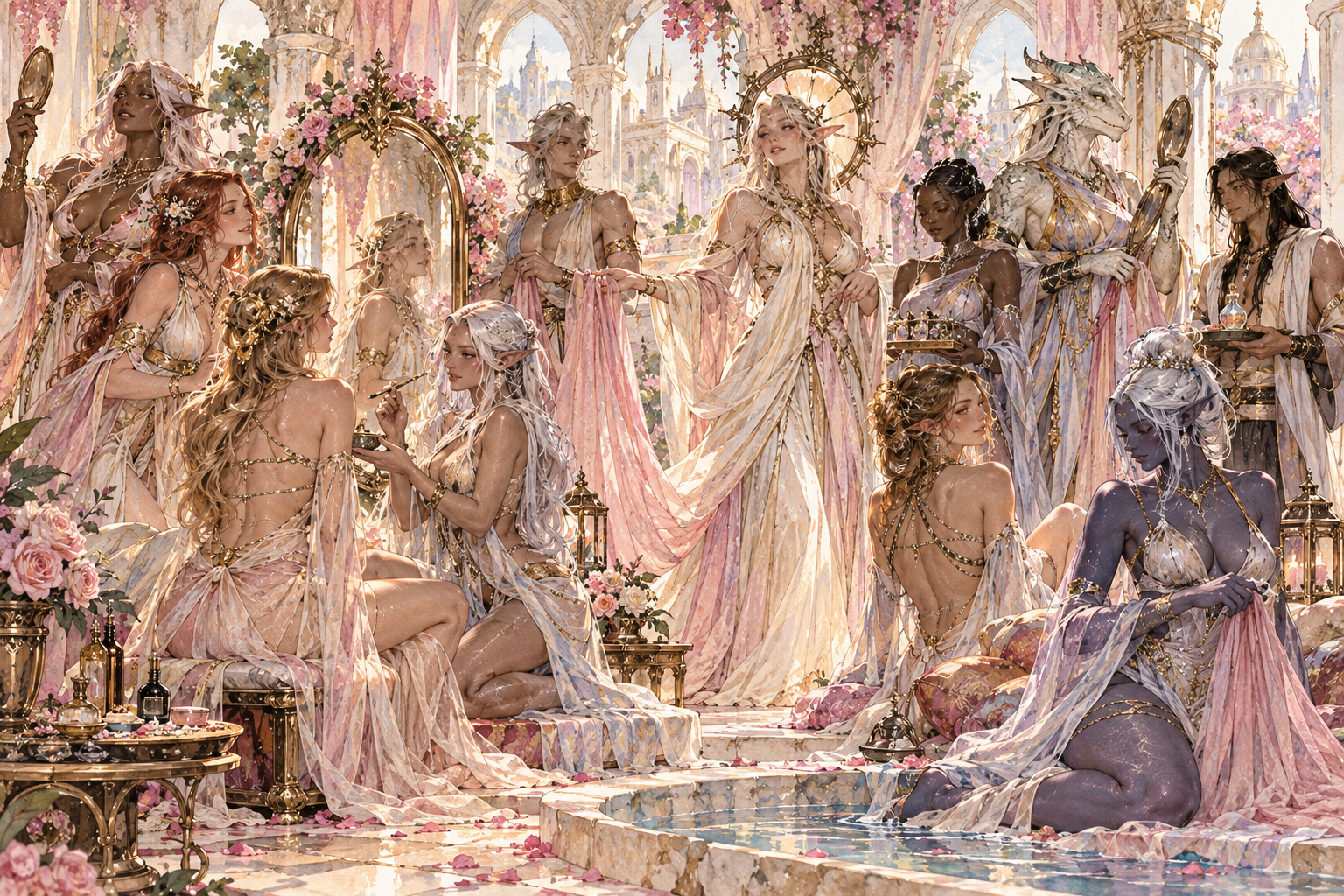
Velzhari’s temples are commonly called Halls of Reflection, with regional names including Mirror Houses, Radiant Galleries and Houses of the Bride. They are among the most deliberately theatrical sacred spaces in Erosia. Polished glass hallways, performance stages, open balconies, reflecting pools, mirrored pillars, glowing lanterns and silk draperies all descend directly from the established temple tradition.
Yet the architecture also preserves privacy. Mirrors can be curtained. Dressing chambers lock. Private exits allow worshippers to leave without crossing the principal gallery. Large temples include quiet chambers where no polished surface provides a reflection at all. This is intentional theology.
Being visible should have a door.
Rites, Taboos & Divine Signs
Rite of the Shining Veil
The Shining Veil is Velzhari’s defining formal rite. A willing participant enters a mirrored space beneath layered translucent fabric. Music, movement and reflected light accompany a sequence of revelations established before the ceremony begins.
Not every veil must be removed. Public versions may involve elaborate formal dress, masks or ceremonial costume. Adult private versions may become strongly exhibitionistic. The rite preserves its archival form of unveiling layer by layer before sacred mirrors while giving greater theological emphasis to control over the pace of revelation.
Rite of Public Adoration
A willing participant presents themselves, an accomplishment or a work before assembled witnesses. Praise may focus upon beauty, artistry, performance, fashion, courage or some other deliberately revealed quality. Painters sometimes sketch the subject during the rite; poets may compose short verses of admiration. Erotic forms exist, but the ritual is not exclusively sexual. The audience’s responsibility remains the same. They witness. They do not claim.
Rite of the Radiant Step
The Radiant Step marks important public entrances. A devotee walks slowly through a prepared temple path while mirrors, lanterns and reflective screens gather light around them. Weddings, new titles, artistic debuts, victories, reclaimed identities and important returns may all be honored through the rite. Its archive form describes light following the devotee like a halo. The modern rite gives that visual phenomenon a deeper meaning: the worshipper has consciously decided how they wish to enter the world now.
Rite of the Mirror Kiss
Two willing lovers stand before a mirror and exchange affection while seeing both one another and themselves reflected together. The ceremony honors doubled awareness: I see you. I see myself beside you. I know that you see me. The Mirror Kiss survives directly from Velzhari’s established ritual tradition.
Private Rite: The Unjudging Mirror
A devotee sits before a covered mirror and names the criticisms they expect to feel when it is uncovered. They remove the covering only when ready. The rite does not require them to call every feature beautiful. Its purpose is more difficult: to look without immediate cruelty.
Private Rite: The Chosen Reflection
A worshipper prepares their appearance entirely for themselves and spends time before a mirror with no audience present. No image is shared afterward unless they genuinely want to share it. The rite is particularly important for devotees who have begun to confuse admiration with survival. It teaches that the first witness of a presented self remains the person who chose that presentation.
The Great Prohibition
Velzhari possesses many taboos, but one stands above the others: The gaze may be invited. It may never be stolen.
Secretly exposing another person’s body, distributing intimate images without permission, magical voyeurism, coerced exhibition, blackmail through private images, revealing identities for spectacle and continuing to watch after permission has clearly ended are profound violations of her faith. The principle is not a modernization that replaces exhibitionism with modesty. It protects exhibitionism’s sacred meaning. An unwillingly exposed person is not participating in Velzhari’s rite merely because someone else enjoys looking.
Visibility without choice is exposure. Visibility with choice is revelation.
Other Taboos
The faith also condemns humiliating another person through their appearance, shaming harmless forms of presentation, sabotaging someone’s success out of envy and giving manipulative praise intended to create emotional dependence. Older teachings condemn “hiding beauty out of shame.” Modern Velzharian clergy interpret this inwardly rather than as an obligation toward public display. Privacy is never a sin. The concern is shame powerful enough to convince someone that they must disappear even when they wish to be seen. Compulsory visibility is no more Velzharian than compulsory modesty.
Signs of Velzhari’s Claim
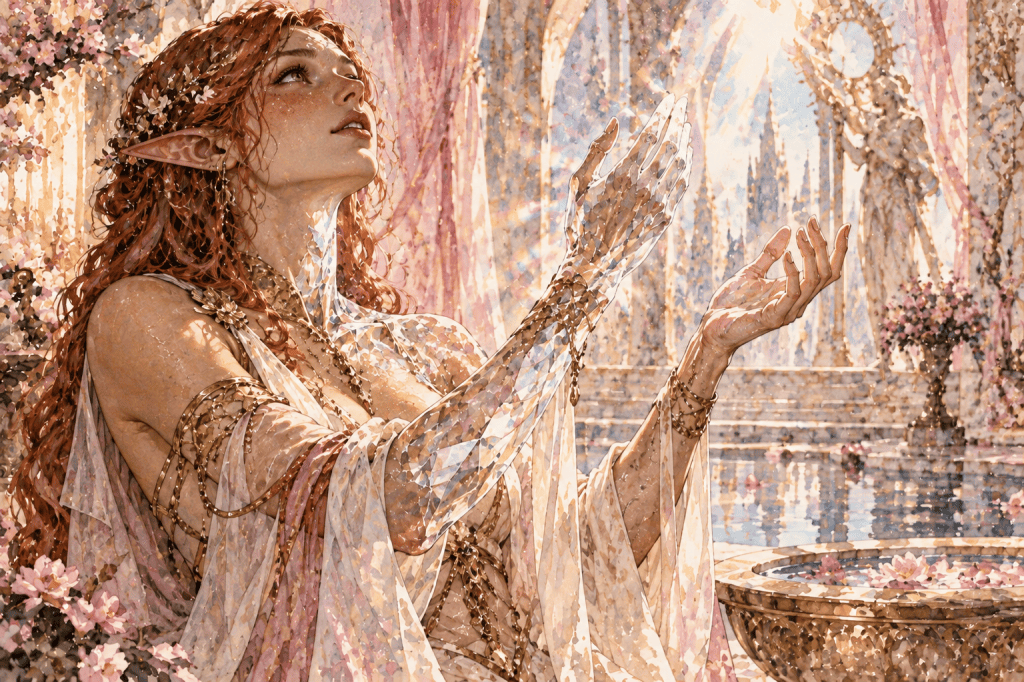
Older traditions describe luminous skin, polished-glass eyes, graceful showy posture, heart-shaped condensation upon mirrors and attention naturally gathering around a devotee. They also preserve a silver line around one eye, bright hair and glimmering lips or collarbones as characteristic marks. Second Bloom traditions often call these Signs of Reflection rather than markings of ownership. A favored devotee’s skin may catch light from impossible angles. Mirrors clear as they approach. Hair gleams like metallic thread. A faint mirror-silver ring may appear around the iris. Some develop tiny crystalline facets beneath the skin of the shoulder, sternum or hips.
The rarest sign is the Living Facet. For several heartbeats, part of the devotee appears to become translucent diamond. Light passing through them breaks into pale rainbows without causing pain or lasting transformation. The faithful consider this one of the clearest signs that the Faceted Bride has looked back.
Velzhari and the Velvet Court
Within the Velvet Court, Velzhari embodies Divine Vanity, Sacred Visibility and Chosen Revelation. Where Velyssara gives desire permission to exist, Velzhari gives desire a stage upon which to become visible. Velyssara’s intimacy may thrive in privacy. Velzhari asks what changes when someone knowingly permits that desire to be witnessed.
Her strongest theological counterpoint is Delavira. Both understand the gaze and the erotic power of mirrors, but Delavira preserves distance while Velzhari invites revelation. Delavira asks what becomes powerful because it remains beyond reach. Velzhari asks what becomes powerful because it has chosen to be seen. Cyrillith shares her love of costume and performance. The distinction is purpose. Cyrillith asks what a role allows someone to become. Velzhari asks what the audience understands because someone chose to present themselves that way. Threxia offers one of the Court’s cleanest distinctions. Threxia asks, What body or mark do you want? Velzhari asks, How do you want it seen? The current Threxian page already establishes this exact relationship between transformation and the reveal.
Solynth also uses mirrors, but his mirrors often serve private recognition. A Solynthian may discover softness even if nobody else ever witnesses it. Velzhari’s mirrors more frequently prepare someone for chosen visibility. The present Solynth material explicitly contrasts his private mirrors with Velzhari’s celebration of visibility. Mirellune understands revelation through structure. Joint rites may combine presentation with deliberately bounded restraint, creating ceremonies in which visibility itself has agreed conditions.
Rhaziel responds naturally to theatrical display because presentation may become invitation. Velzhari can make the quarry impossible not to notice; Rhaziel gives desire direction toward what has been revealed. Across these relationships, Velzhari remains distinct. She does not create performance, transformation, submission, pursuit or observation. She governs the moment someone enters the light and says: See me like this.
Miracles & Divine Presence
Velzhari’s miracles rarely begin with thunder. A candle turns toward one person without wind. Curtains draw themselves open at exactly the right moment. Tarnished silver clears as a devotee enters. A doorway suddenly frames someone so perfectly that witnesses later disagree over whether the architecture changed. The archives already associate her blessings with radiant skin, self-moving veils, flattering visions, hushed audiences and subtle divine spotlight. Second Bloom theology treats those phenomena as invitation rather than compulsion.
The Perfect Light
Light rearranges itself around a willing subject. Shadows soften where they obscure what the person intends to present and deepen where contrast improves the composition. The effect does not change the subject’s body. It simply reveals them extraordinarily well.
The Awakened Mirror
A sacred mirror may show posture, clothing or expression slightly differently from reality. A nervous speaker sees themselves standing as though the room already belongs to them. A warrior sees how an adjusted cloak changes their silhouette. Someone experimenting with presentation sees a possibility rather than prophecy. The mirror does not announce what the worshipper should become. It offers another angle.
The Turning Gallery
During stronger manifestations, mirrors physically turn despite lacking hinges. Hundreds of reflected surfaces may orient toward the same person as they cross a sanctuary. Velzharian priests regard the miracle as especially auspicious when the chosen subject had been afraid to enter.
The Living Facet
Diamond geometry may appear temporarily across a wall, mirror or willing devotee. Light fractures into champagne, blush, lavender and gold. Broken glass may rise harmlessly from the floor and hover like a constellation around the subject. The strongest accounts describe an entire person becoming living diamond for several breaths. Permanent transformation, however beautiful, belongs closer to Threxia’s mysteries unless consciously chosen.
When the Mirror Bride Approaches
When Velzhari manifests directly, every reflective surface catches her. Silver brightens. Crystal develops impossible clarity. Veils move without wind. Perfume becomes more noticeable, not stronger, as though the air has learned where to place each note. Witnesses often become suddenly aware of their own posture. Velzhari herself appears exactly as she intends to be seen. No two witnesses necessarily remember the same angle.

What Her Faith Teaches
Beauty May Be Named
Velzhari rejects compulsory self-denigration. A person may say they are beautiful, skilled, admired or accomplished when they genuinely believe it. Recognition does not become arrogance merely because the person recognized is oneself.
Presentation Is
Not Deception
Everyone presents themselves. Clothing, posture, voice, perfume, titles, makeup, armor, silence and even deliberate plainness shape how others perceive them. Velzhari teaches that presentation becomes deception only when it intentionally communicates a harmful falsehood. Choosing good light is not lying about the face beneath it.
Visibility Remains Chosen
No one owes the world access merely because they possess something beautiful. A singer may refuse to perform. A beautiful body may remain private. A famous hero may close the door. An exhibitionist may decide not to be watched today.
Past visibility creates no permanent claim upon future access. Velzharian clergy call this principle the Right to Close the Curtain.
Admiration Should Recognize, Not Manufacture
Praise is most sacred when it notices something real. Empty flattery imitates attention without actually paying it. More dangerously, no person’s worth should depend completely upon applause. Velzhari enjoys admiration fiercely, but her mature theology insists that the audience confirm rather than create the self.
Envy Is Information
Envy may reveal aspiration. It may identify a beauty, confidence, achievement or freedom the worshipper secretly desires. The emotion is not automatically condemned. It is examined before it becomes action. Velzhari asks what the mirror revealed. She does not permit the devotee to shatter the person who revealed it.
The Empty Room Still Contains You
This is perhaps Velzhari’s quietest teaching. Her temples adore spectacle. Her festivals celebrate applause. Her goddess delights in being watched. Yet the mature devotee must eventually be capable of standing alone before a mirror and remaining recognizable without anyone else approving the reflection. The ability to enjoy admiration is sacred. The ability to survive its absence keeps that pleasure free.
At the Table
Velzhari works especially well in campaigns involving reputation, fame, art, performance, privacy, exhibition, court politics, public identity, self-image, scandal, envy and the difference between being witnessed and being consumed by attention. A Velzharian story need not contain sexual content. A knight rebuilding a ruined reputation, a bard becoming famous faster than they can emotionally manage, an artisan whose masterpiece attracts dangerous patrons and a diplomat using appearance as political language all fall naturally within her domain.

Velzhari Characters
Her intimate themes can deepen those stories when desired. A character may enjoy exhibition but fear emotional visibility. Another may crave praise yet distrust everyone who gives it. Someone celebrated for beauty may wonder whether anyone notices their work. A shy person may discover that they deeply want attention but have spent years believing that desire itself was shameful. Two questions reveal much of Velzhari’s domain:
If everyone could see this, would you still choose to show it?
If nobody could ever see it, would it still matter to you?
Divine Traditions
The archives associate Velzhari with the clerical traditions of Light, Beauty, Trickery and Passion, the Oath of Radiant Allure, Oath of the Shining Veil, College of Silken Display, College of the Mirror Masque, Pact of the Mirror Bride and Pact of the Unveiled Stage. Her older material explicitly contains no druidic tradition because her emphasis was social rather than feral.
Those names remain useful setting material, but several belong to the older mechanical framework.
(Needs updated mechanics: Base 5e → Veiled → Unveiled.)
Characteristic Blessings
Older Velzharian mechanics preserve several concepts worth rebuilding.
Radiant Allure rewards deliberate presentation under observation.
Glimmer Skin turns reflected light into momentary defense.
Spotlight Grace transforms performance or public presence into momentum.
Mirror Flash weaponizes reflected radiance.
Bride’s Unveiling represents the climactic instant when revelation changes the emotional or tactical rhythm of a scene.
The archived versions rely on outdated Seduction bonuses, automatic Arousal and forced entrancement effects. They should be rebuilt rather than copied forward.
(Needs updated mechanics: Base 5e → Veiled → Unveiled.)
Sacred Relics
Mirror of the Bride’s Kiss
Wondrous item, rare
An ornate hand mirror whose surface seems impossibly flattering without changing the bearer into someone else. It reveals posture, expression and presentation with supernatural clarity, emphasizing the version of the bearer they most wish to present.
The archive version granted a direct Seduction bonus.
(Needs updated mechanics.)
Veil of Radiant Skin
Wondrous item, uncommon
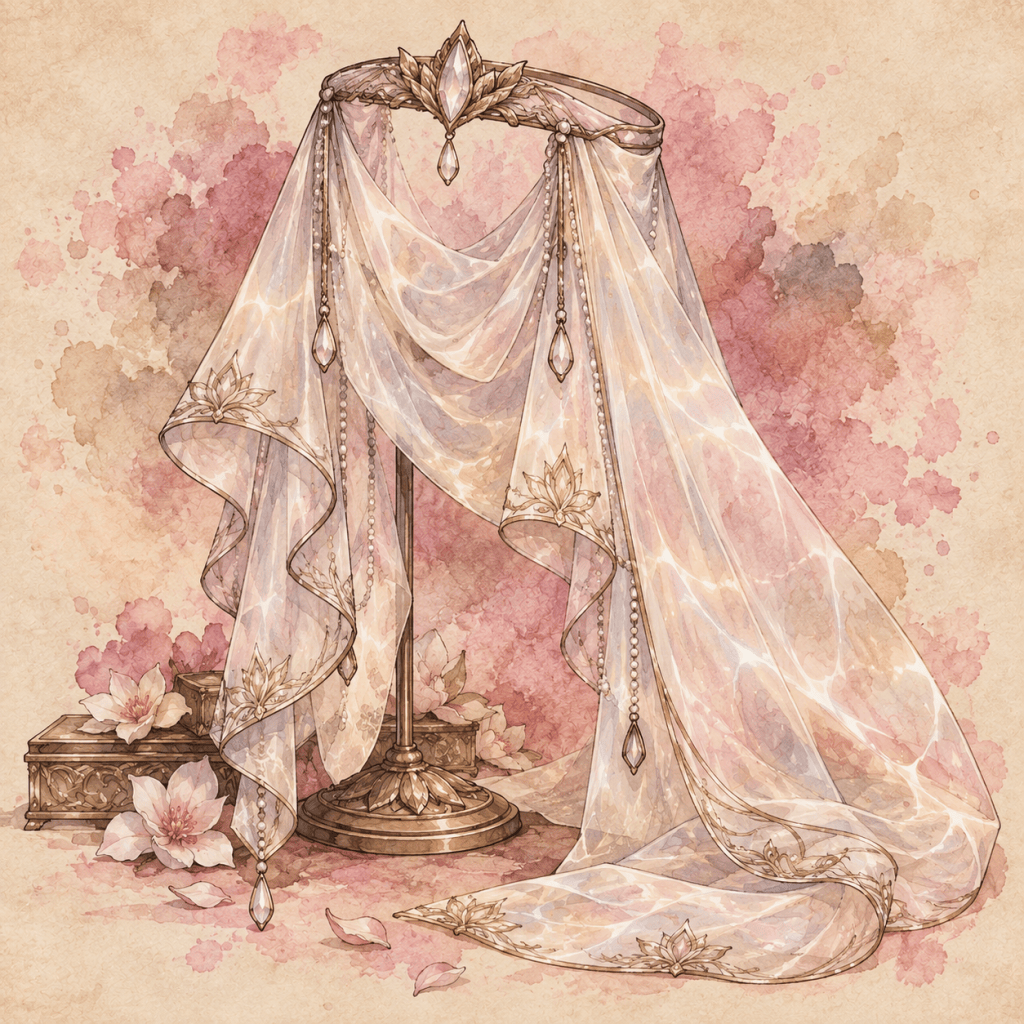
This nearly weightless pearl-white veil becomes translucent beneath strong light. Reflections travel across its wearer like water moving across polished crystal.
The archived veil combined a visible glow with a limited defensive effect.
(Needs updated mechanics.)
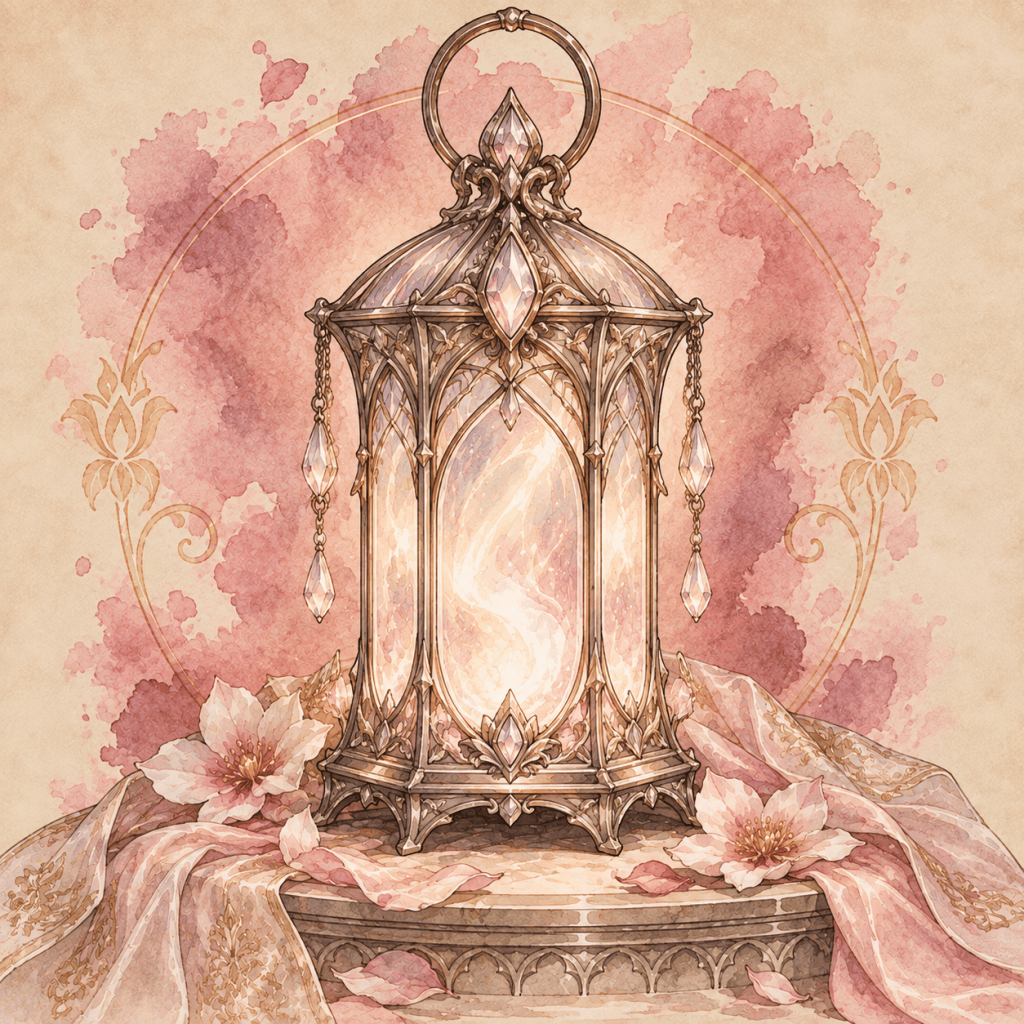
Lantern of Public Allure
Wondrous item, very rare
This platinum lantern contains no visible flame. When opened, it produces an immaculate pool of theatrical light that seems to understand how its willing subject wishes to be seen.
Its older form compelled or mechanically intensified attention. That element should be replaced with a consent-compatible presentation effect rather than preserved literally.
(Needs updated mechanics.)
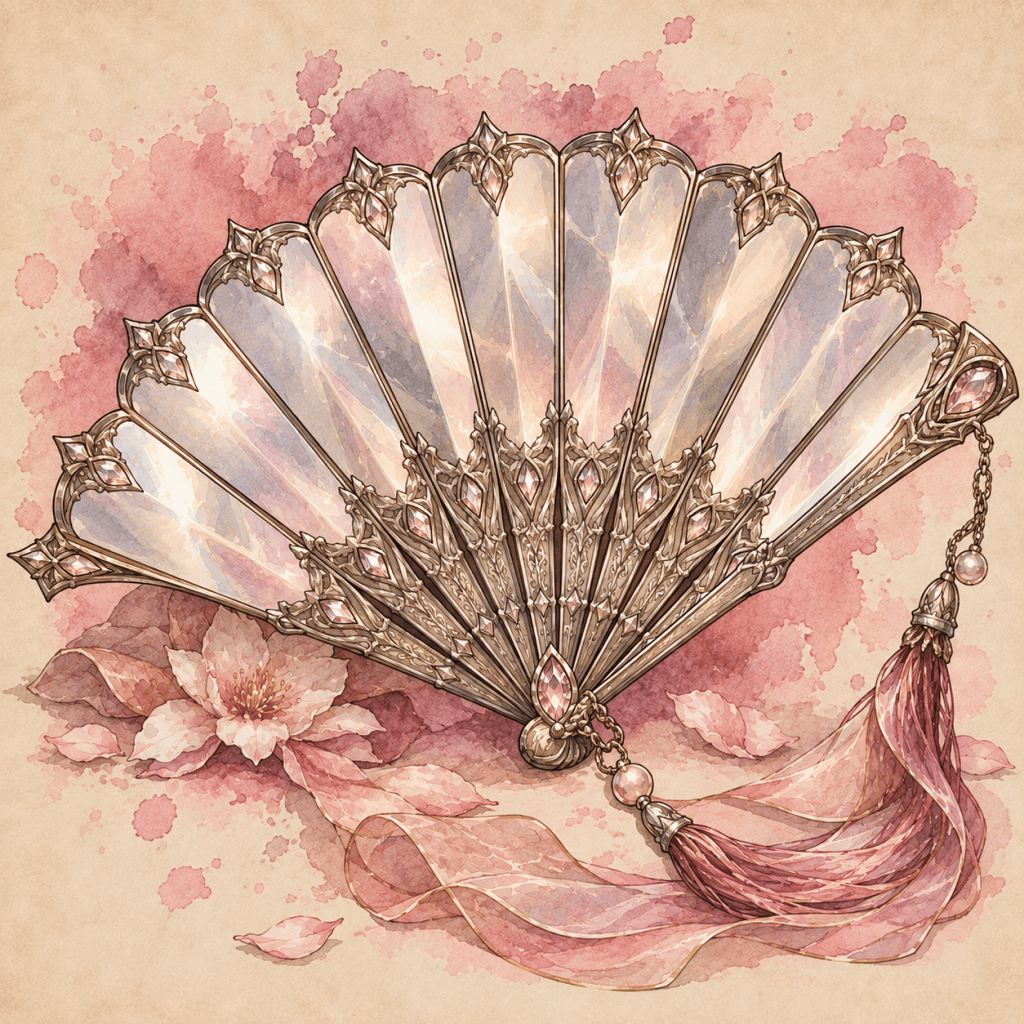
Silver Fan of the Mirrored Stage
Wondrous item, rare
Each polished segment of this folding fan reflects its bearer from a slightly different angle. When flourished, overlapping reflections create bursts of light and brief phantom images.
The archive version could blind or entrance onlookers.
(Needs updated mechanics.)
Adventure Hooks
The Darkened Mirror
Every consecrated mirror within a major Hall of Reflection turns black overnight. Ordinary mirrors still function, but performers across the city begin reporting something stranger: audiences continue to watch them and then forget what they saw. The clergy fear that visibility itself is somehow becoming detached from recognition.
The Uninvited Gallery
A wealthy collector unveils enchanted portraits depicting famous Erosians during private moments they never agreed to share. The paintings are breathtaking. Several subjects demand their destruction, while patrons argue that beauty of such importance belongs to history. Velzharian clergy reject that defense immediately. The harder problem is discovering how the portraits were created when no observer was present.
The Faceted Bride Awakens
Excavators uncover an enormous diamond statue of Velzhari beneath a ruined Illuminari sanctuary. Its pose changes every night. Soon mirrors throughout the region begin reflecting the statue standing behind people who are actually alone. Several inhabitants develop tiny crystalline facets beneath their skin. One person awakens entirely transformed into living diamond. They insist they never asked for it.
The Perfect Audience
A young performer receives Velzhari’s blessing during a public rite and becomes almost impossible to ignore on stage. There is no detectable compulsion. People simply find the performance extraordinary and tell others. Within weeks, thousands arrive. The performer loves the attention. The city cannot feed the audience. Velzharian theologians disagree over whether the blessing is malfunctioning or whether everyone simply assumed Divine Vanity could scale without consequence.
The Envious Mirror
A noble acquires a mirror that reveals whoever the viewer envies most. At first, it becomes fashionable entertainment. Then people begin seeing spouses, siblings, teachers and closest friends. Relationships collapse because viewers assume envy proves secret hatred. A Bride of Reflection insists the artifact is showing something true. The problem is that nobody understands what the truth means.
The Procession of a Thousand Veils
A forgotten Velzharian festival is reconstructed from ancient archives. The liturgy instructs the faithful to carry a veiled figure through the city and remove one layer at every crossroads. No surviving text identifies what waits beneath the final veil. The priests assume it is a statue. The thing inside breathes.
Scents for Gameplay
Velzhari’s fragrances feel deliberately composed. Even in wilderness or ruins, her scent manifestations arrive in layers, as though the air itself has chosen what should be noticed first.
| d12 | Scent | Suggested Use |
|---|---|---|
| 1 | White rose resting on warm silk | Velzhari’s attention is near. |
| 2 | Iris, clean linen and pearl powder | Dressing or presentation has become spiritually significant. |
| 3 | Champagne and ripe pear | Celebration, admiration or a successful unveiling. |
| 4 | Beeswax beside polished wood | A Hall of Reflection or formal shrine is nearby. |
| 5 | Lavender carried over cold crystal | Mirror magic or introspection is active. |
| 6 | Violet powder and pale amber perfume | Cosmetics, adornment or ceremonial preparation. |
| 7 | Rain across clean marble | A reputation or public identity is about to change. |
| 8 | Ozone beside polished silver | Strong reflective magic is present. |
| 9 | Jasmine, warm skin and cosmetic powder | Intimate admiration or chosen exhibition. |
| 10 | White flowers and newly opened silk | An unveiling or ceremonial entrance is imminent. |
| 11 | Cold mineral air and freshly cut crystal | The Faceted Bride is manifesting. |
| 12 | Champagne, white rose, warm skin and cold diamond | First Reflection, associated with Velzhari’s direct presence. |
Velzhari’s scent should rarely feel accidental. It should arrive with the precision of a chosen entrance: polished, layered, luminous and impossible to mistake for background. Her miracles do not merely sweeten the air. They make the space feel staged for witness, as though every note of perfume, every glint of crystal and every breath of champagne-bright fragrance has conspired to say the same thing before she ever appears: someone magnificent is about to be seen.
 Whispers of Erosia
You must be logged in to post a comment.