
Talyss
The Root Mother • The First Bloom • Bringer of Bloom
Goddess of Fertility, Flora and Abundant Life
Fertility • Growth • Gestation
Fertility, pregnancy, conception, swelling, fullness, breeding fantasy, germination, pollination, flowering, seed, fruit, harvest, botanical sexuality, living growth and the sacred promise of what is becoming.
“Life swells under my touch. Let what lies within you bloom.”
Talyss is the goddess of life becoming more than it was: the seed breaking its shell beneath dark soil, the first green shoot pushing toward sunlight, the body carrying a future not yet visible to the world and the orchard bending beneath fruit because one season of flowering has finally become abundance. She is called the Root Mother because Erosian tradition recognizes her as the oldest divine Orchidian and primordial origin of flora. Velyssara created life itself. Talyss was among the first great differentiations of that gift — the moment living creation learned root, leaf, flower, pollen, fruit and seed. Every forest, grassland, vineyard, cultivated field and flowering garden therefore carries some distant echo of her first body.
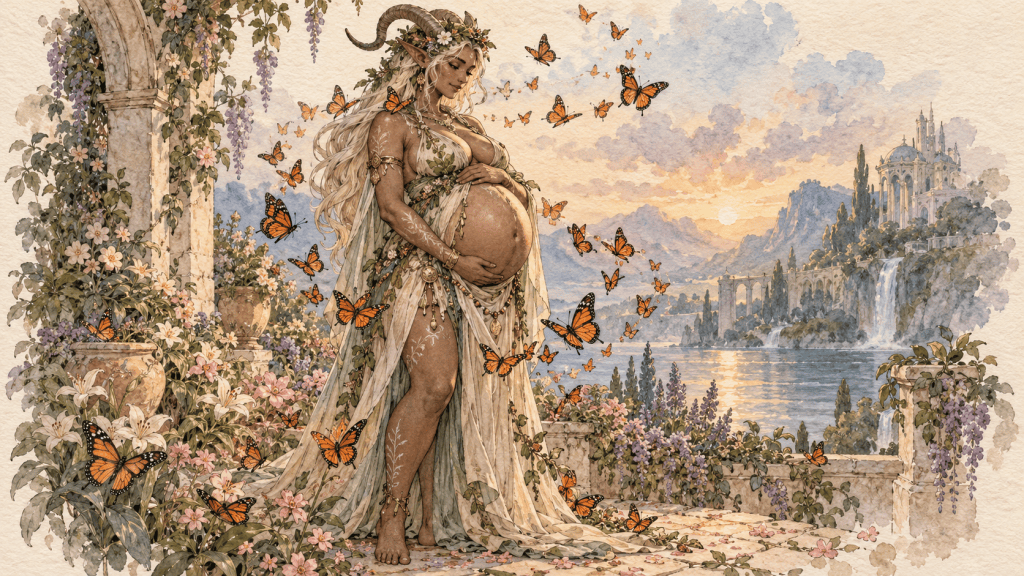
Mortals know another side of her more intimately. Talyss governs fertility, conception, pregnancy, gestation, bodily fullness and the erotic fascination of reproductive possibility. Older traditions centered these mysteries so strongly that sacred art often portrayed her as an eternally pregnant woman crowned in flowers. Those traditions remain legitimate expressions of her faith, but they describe Talyss through mortal anatomy rather than revealing her primordial nature. The oldest surviving archives associate her directly with swelling bellies, quickened wombs, fertile bodies, breeding fantasy, plant-blooming eroticism and the awe of being “filled with tomorrow.”
Second Bloom theology places those mysteries within something older. Before there were mortal wombs, there were seeds. Before anyone called a pregnancy sacred, Talyss had already taught creation what it meant to carry tomorrow inside itself. Her faithful therefore preserve three teachings above all others:
What is hidden may still be growing.
Abundance must leave something for tomorrow.
Life wants to continue, but continuation is never owed another person’s body.
Lore & Mythos
The Second Pulse
The oldest Talyssan creation hymns begin with Velyssara. The world already possessed life. Creatures breathed, moved, desired and died. Yet creation remained strangely immediate. Life existed in the present moment but had not fully learned how to carry itself into another season. Nothing rooted deeply. Nothing flowered. Nothing wrapped a future inside a seed and trusted that future to darkness.
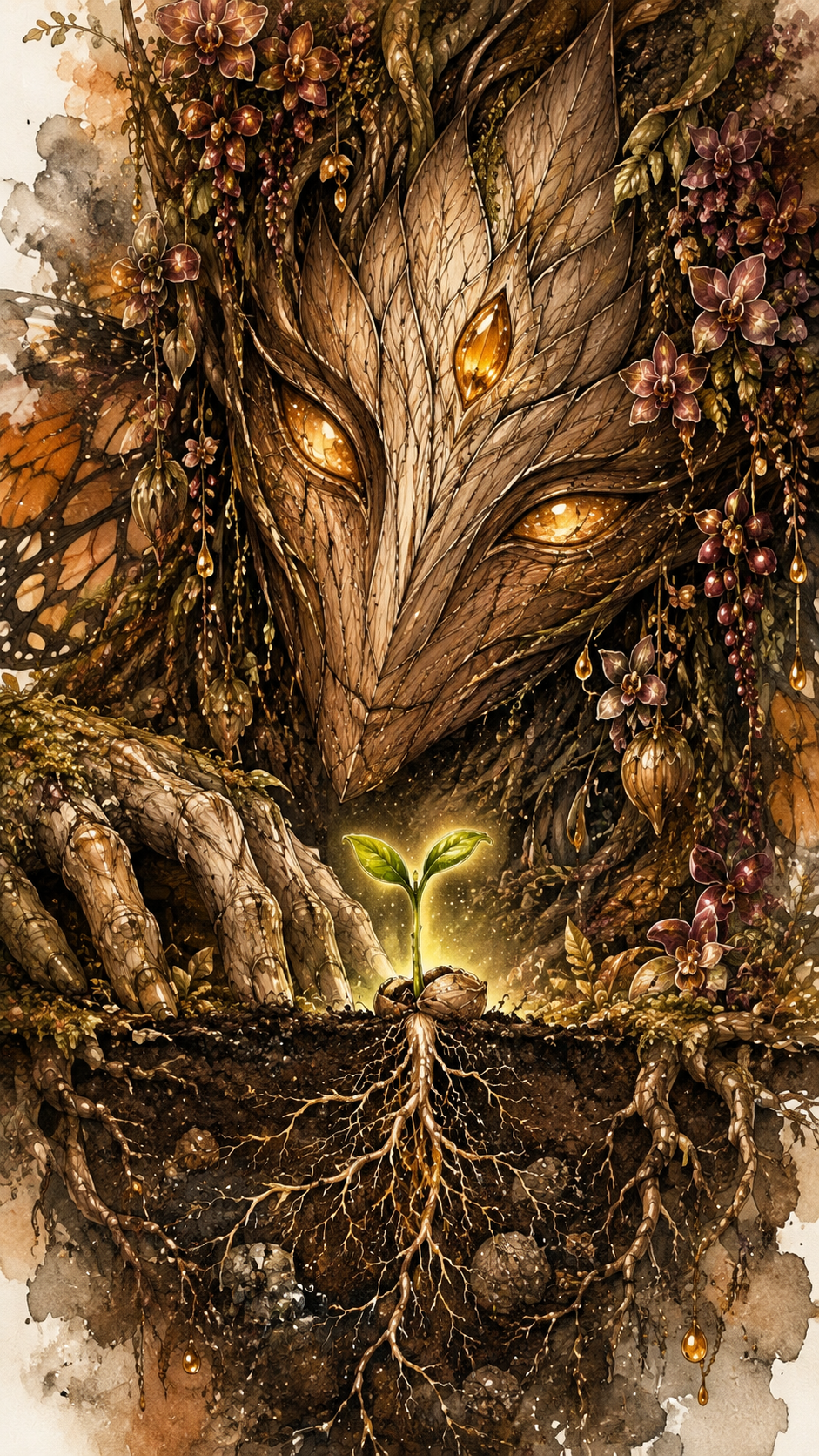
Then came what Talyssan scripture calls the Second Pulse. Velyssara breathed across the newborn earth, and this time life did not merely awaken. It prepared to continue. Something beneath the soil divided.
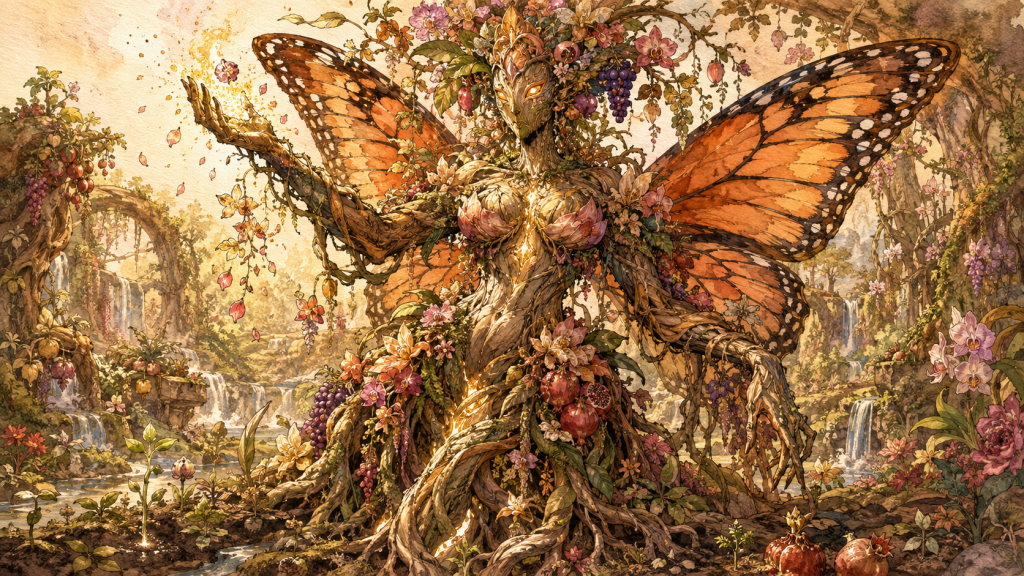
A root entered darkness while a green shoot reached toward light. Leaves opened. A bud gathered itself tightly around possibility. When that bud finally unfolded, pollen lifted into the air for the first time. At the center stood Talyss. The oldest hymns do not describe her as a woman. They describe a vast living figure formed from bark, cambium, root, petal, fruit and golden sap, her countenance hidden behind a smooth botanical face and her body flowering faster than mortal eyes could follow.
She touched the earth. The first garden began. From this story comes one of the oldest distinctions in Talyssan theology: Velyssara made life possible. Talyss taught life how to bloom.
The First Seed
A second creation tradition asks an apparently simple question: Why does a seed close? The first plants, according to the tale, produced beautiful flowers but nothing survived them. Each blossom opened, lived magnificently and disappeared. The world knew beauty but not continuation. Talyss mourned each flower.
She attempted to preserve them by refusing to let the petals fall. The first garden became crowded with blossoms that would neither fade nor change. Eventually no sunlight reached the soil beneath them. For the first time, the Root Mother understood that preservation and continuation were not the same thing. She allowed one flower to close. Its petals folded inward around a tiny fragment of possibility. Talyss hardened a shell around that possibility and placed it in the soil.
Nothing happened.
A day passed. Then another. Rain came. Winter followed. Talyss nearly opened the earth to retrieve what she believed she had lost. Then spring arrived.A shoot appeared. The faithful call this the First Seed, and its lesson shapes much of Talyssan religion. Life does not continue by refusing change. Sometimes the future must disappear from sight before it can become itself.
This is why Talyssans are often unexpectedly patient people. A thing may be buried without being dead.
The First Fruit
Flowers solved one problem and created another.Plants could reproduce, but the seed remained vulnerable. Wind scattered some into barren stone. Birds destroyed others. Rain carried entire generations into rivers. Talyss therefore surrounded seed with nourishment. She wrapped tomorrow in sweetness.
The first fruit appeared heavy upon a branch. Its color brightened as it ripened. Its scent carried farther than the flower that had preceded it. Animals approached, ate and carried the seeds elsewhere. Talyss laughed.Several schools of theology consider this moment nearly as important as the First Seed because it introduced a particularly Erosian principle into nature: Continuation learned attraction.
Color invited attention. Fragrance invited approach. Sweetness made participation pleasurable. The future survived not despite desire, but partly because life discovered how to make continuation desirable. Talyssan erotic theology returns constantly to this myth.Pleasure and creation are not enemies. Sometimes the fruit is sweet because life wants someone to reach for it.
The First Autumn
Not every Talyssan creation story concerns beginnings. The Circle of the Petal preserves a considerably harsher tradition known as the First Autumn. Talyss had learned flowering, fruiting and seed, but she had not yet accepted dormancy. She loved growth too much. Every leaf remained green. Every vine continued climbing. Every root spread farther. Fruit ripened faster than it could be eaten, while new seedlings emerged beneath trees already blocking the sun.
The first garden began strangling itself. Talyss responded by giving it more. More rain. More sunlight. More fertility. The crisis worsened.
Then an unknown power — some traditions name the Earth Sovereign, while others intentionally refuse to identify the visitor — placed one dead leaf in Talyss’ hand. She rejected it. The visitor asked whether she loved the tree from which it had fallen. Talyss answered yes. “Then allow it to rest.” The Root Mother released the leaf. Others followed. Thus came the first autumn.
This story stands behind the Circle of the Petal’s doctrine that life is sacred because it moves through rightful cycles, not because it expands forever. Existing Talyssan traditions explicitly reject both sterility that denies growth and abundance that consumes itself, teaching that every bloom must feed root and every feast must leave seed.
Talyss is therefore not endless spring. She is life’s determination to continue through seasons.
The Desire She Embodies
Talyss embodies the desire to become fertile with possibility. Her sacred current begins whenever something currently hidden gathers enough nourishment to take form. A seed becomes a plant. A flower becomes fruit. A pregnancy becomes a child. An idea becomes a craft. Attraction becomes intimacy. A recovering community becomes capable of imagining another generation. Talyssan theology describes this movement through four mysteries:
Root. Swell. Bloom. Seed.
- The Root establishes what can sustain growth.
- The Swelling is potential becoming difficult to conceal.
- The Bloom is emergence, visibility and invitation.
- The Seed carries what has been created toward another future.
None is complete alone.
Fertility &
the Generative Body
Talyss’ oldest mortal mysteries concern fertility because the reproductive body offers one of the clearest expressions of her theology. Something begins invisibly. The body changes around it. Time becomes physical. The future occupies space. Pregnancy therefore holds enormous devotional importance within her faith. Expectant parents ask for her blessing, fertility specialists maintain shrines in her name and communities often decorate birthing spaces with unopened buds beside fully opened flowers. Yet Talyssan theology does not reduce fertility to biological reproduction.
A body capable of conception is not spiritually superior to one that is not. Infertility is not evidence of divine rejection. Choosing never to reproduce does not distance someone from Talyss. Her priests teach that fertility is capacity for generative transformation, while reproduction is one possible expression of that capacity. A sterile orchard may become fertile again. A person who cannot conceive may raise children, gardens, communities, traditions or works that outlive them. A person who could reproduce may consciously decide that their body will carry no pregnancy at all. Talyss claims none of these futures without invitation.
Pregnancy & Gestational Awe
Pregnancy remains among her most intimate sacred symbols because it makes time visible upon the body. The faithful speak of gestational awe: the strange emotional and erotic power of witnessing a body reorganize itself around something still becoming. For some worshippers, this fascination is devotional without being sexual. For others, pregnancy, changing curves, bodily heaviness, fullness, lactation, conception imagery or the knowledge of reproductive possibility can become intensely erotic.
Talyssan temples do not assume one interpretation from the other. A pregnant worshipper may enjoy their changing body sexually or not at all. A lover may find pregnancy erotically powerful while having no desire for parenthood. Someone may enjoy breeding fantasy while actively preventing conception. The religion’s position is unusually straightforward: Fantasy may imitate fertility without becoming an obligation to reproduce.
Breeding Fantasy &
the Imagined Seed
Breeding fantasy occupies an acknowledged place within Talyss’ intimate traditions. Its appeal varies widely. Some participants are drawn toward the symbolism of being chosen for fertility. Others enjoy the imagined danger of conception while using reliable means to prevent it. Some eroticize insemination, reproductive language, fullness or possession of generative potential. Others focus upon the emotional intensity of imagining that intimacy could produce something permanent.
Talyssan clergy generally treat these fantasies through the doctrine of the Imagined Seed. An imagined seed may carry powerful meaning without ever becoming flesh. The ritual truth belongs to the fantasy consciously shared between participants. No invocation of Talyss converts sexual roleplay into reproductive permission, and no breeding-themed rite suspends ordinary agreements concerning contraception, fertility magic or pregnancy. This distinction is central because Talyss’ gravest prohibition is reproductive coercion. The goddess of fertility does not teach that anyone is entitled to another person’s fertility.
Swelling & Fullness
The archives repeatedly place swelling and fullness within Talyss’ domain. Modern theology retains both but understands them more broadly. A seed swells before germination. A bud swells before opening. Fruit swells around seed. A pregnant body swells around life. A granary swells after harvest. A table swells with guests.
Talyssan teachers therefore use fullness to describe visible evidence that something has received enough nourishment to become more than it was. This gives bodily fullness particular significance within the faith. Softness, roundness, weight gain, pregnancy and other forms of bodily change may be honored when they are genuinely part of a person’s flourishing. They are not compulsory ideals. A starving person requires nourishment, but someone healthy does not owe the goddess a larger body. Talyss celebrates abundance without establishing one universal shape for abundance.
Blooming & Erotic Botany
Talyss’ erotic symbolism does not need metaphor to make plants sexual. Flowers are already reproductive structures. Pollen already moves between living bodies. Fruit already swells around seed. Nectar already invites approach. Talyssans find the embarrassment of outsiders somewhat amusing. Their gardens frequently incorporate flowers whose shapes, scents and reproductive behaviors invite sensual interpretation. Blossoms may be worn against the body. Fruit appears in intimate ritual. Lovers may trace temporary pollen patterns upon one another, sleep beneath flowering vines or incorporate seeds and floral imagery into private devotion.
The purpose is not to pretend that human reproduction and plant reproduction are biologically identical. Their resemblance is theological. Both participate in life’s refusal to end with itself.
Abundance & Responsibility
Abundance is often pleasurable. That does not make all abundance wise. The Gathered Hand and Circle of the Petal both emphasize that Talyss’ blessings create obligations. A harvest that exceeds local need should be preserved, transported, traded or shared. Seed grain must not be consumed simply because the feast is joyful. A garden requires pruning. Fertility magic can damage an ecosystem when used without restraint.
This introduces one of Talyss’ most important mature doctrines: If your blessing leaves nothing capable of surviving tomorrow, it was consumption, not abundance.
Holy Symbol & Iconography
The Vessel of First Bloom
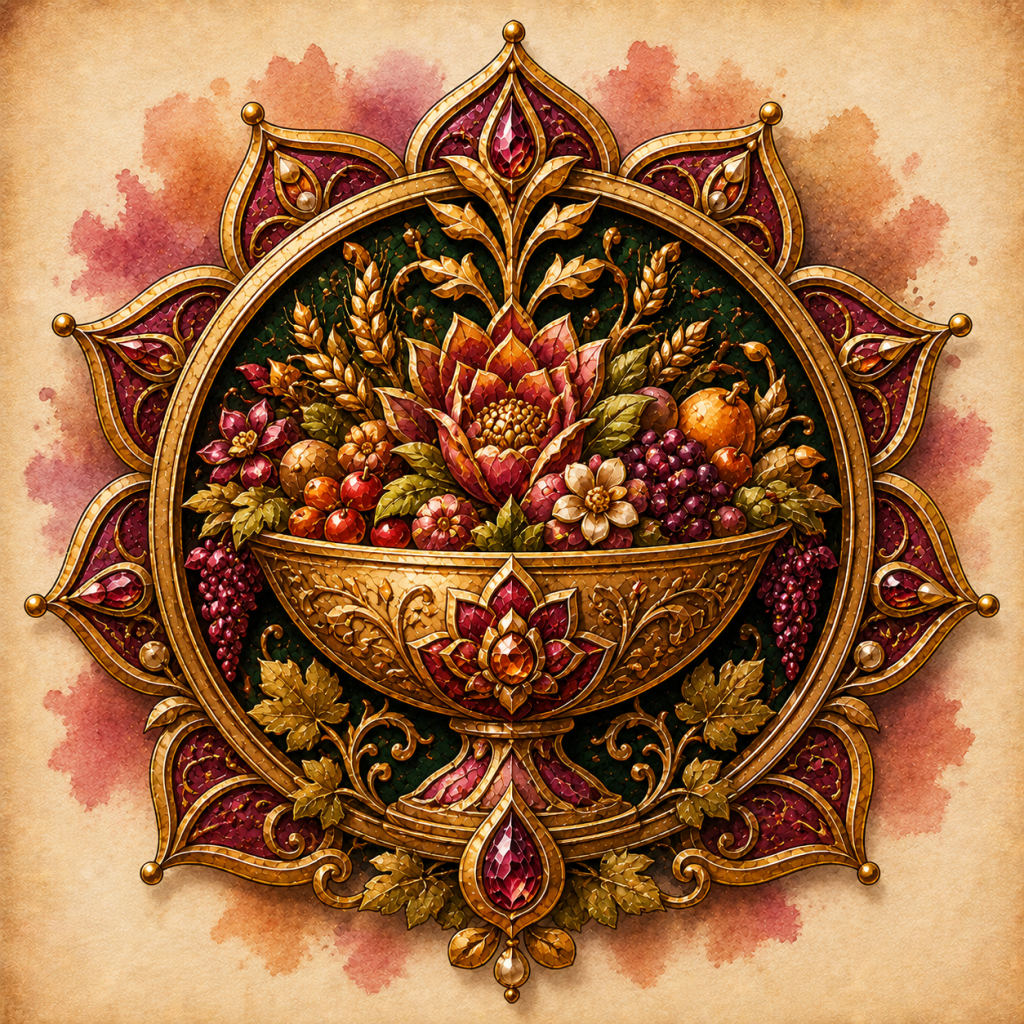
Talyss’ canonical holy symbol is an ornate abundance vessel overflowing with flowers, fruit, grain, vines and seed, surrounded by layered floral geometry.
Older symbols depicted a swollen blossom encircled by vines, subtly resembling a pregnant abdomen surrounding a radiant core. That form remains common among fertility temples and is preserved in the archives as an image of hidden life, sacred fullness and creation preparing to emerge.
The newer symbol expands the meaning.
- The vessel represents the protected conditions in which possibility may grow.
- The flower represents invitation and visible becoming.
- The fruit represents fullness made nourishing.
- The grain represents multiplication sufficient to sustain community.
- The seed represents tomorrow.
No single element is considered complete without the others.
Sacred Colors and Materials
Talyssan sanctuaries favor fertile earth brown, warm mahogany, deep leaf green, spring green, cream, rose, coral, orchid pink, ripe plum, berry red, amber, rose-gold and luminous gold. The older triad of rose-gold, spring green and warm cream remains especially common within fertility rites. Common sacred materials include living wood, clay, amber, preserved seeds, woven grass, flower paper, polished fruitwood, rose-gold, warm brass, dried gourds and naturally shed bark. Objects that have been repaired and returned to use are especially valued by the Circle of the Petal. A cracked planting bowl mended and used for thirty years may carry greater devotional significance than a pristine golden vessel never touched by soil.
Seeds, Fruit and Root
Seeds appear everywhere in Talyssan visual language. Devotional necklaces may carry a single seed sealed in amber. Doors are carved with spiraling root systems. Temple floors often contain mosaics showing roots beneath the visible garden rather than only flowers above it. Fruit represents abundance made tangible. Split fruit often appears in intimate sacred art because it simultaneously suggests ripeness, interior richness and exposed seed. Roots carry a quieter meaning. Flowers attract attention. Roots make flowering possible. Talyssan elders often remind young celebrants that a religion interested only in blossoms has forgotten half its goddess.
Sacred Creatures
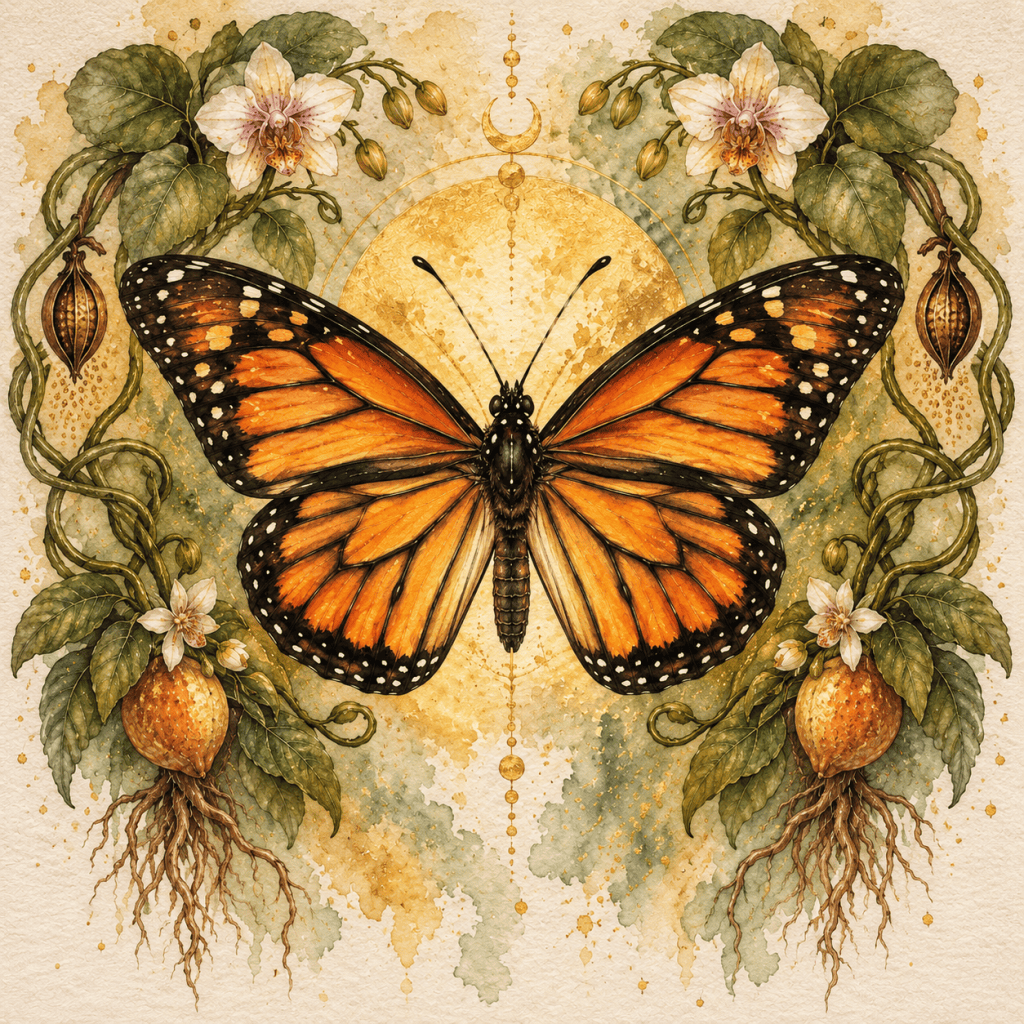
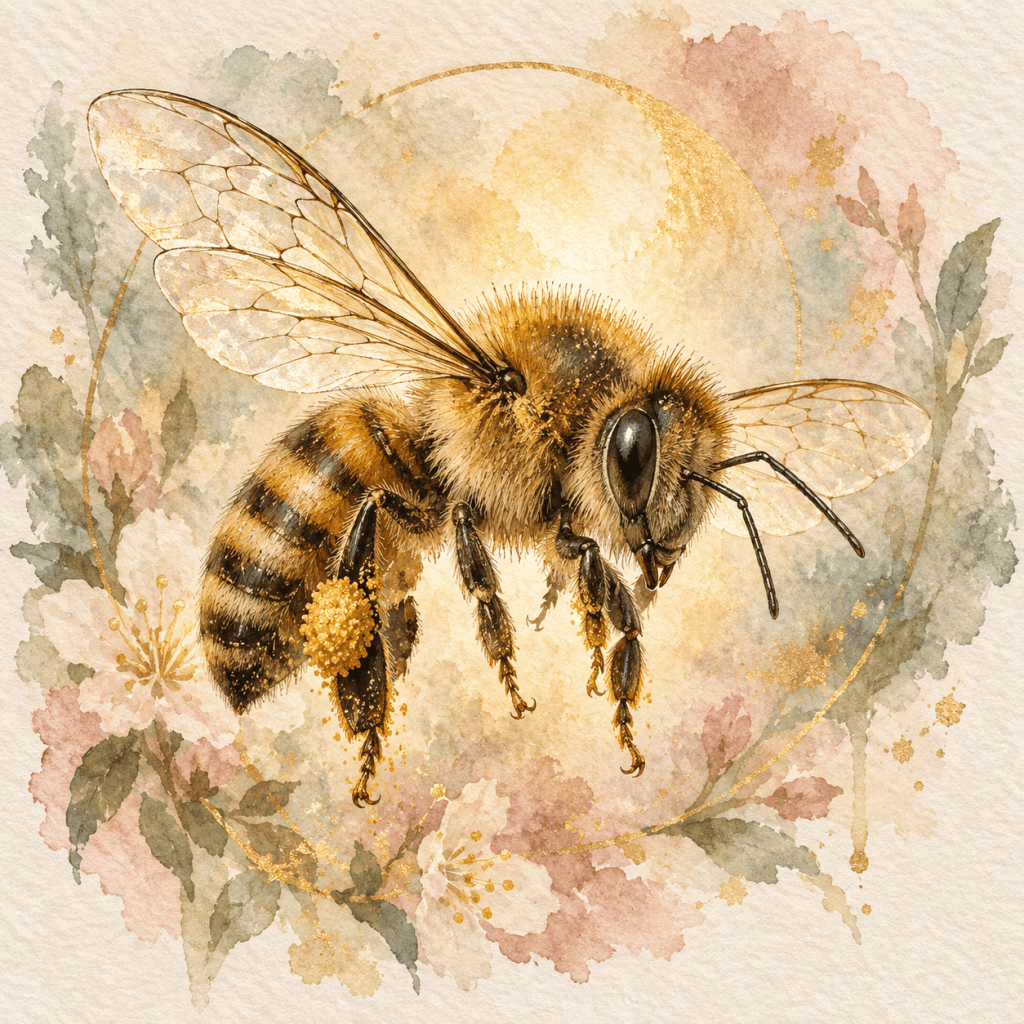
The monarch butterfly has become Talyss’ foremost sacred creature. Its transformation through hidden chrysalis, emergence into brilliant winged form and movement among flowers make it a natural symbol of becoming. Monarch migrations are sometimes interpreted as divine pilgrimages, particularly when unusual numbers gather around orchards or fertility sanctuaries. Butterflies more broadly symbolize pollination, transition and the mobility of life between rooted places.
Honeybees are likewise honored, especially among orchard communities, because their labor makes abundance possible through movement rarely noticed by those enjoying the fruit afterward. Earthworms possess a surprisingly respected place within agrarian traditions. They receive none of the aesthetic grandeur of butterflies, but Talyssan farmers call them the Quiet Gardeners, reminders that fertility depends upon work occurring beneath admiration.
Depictions of Talyss
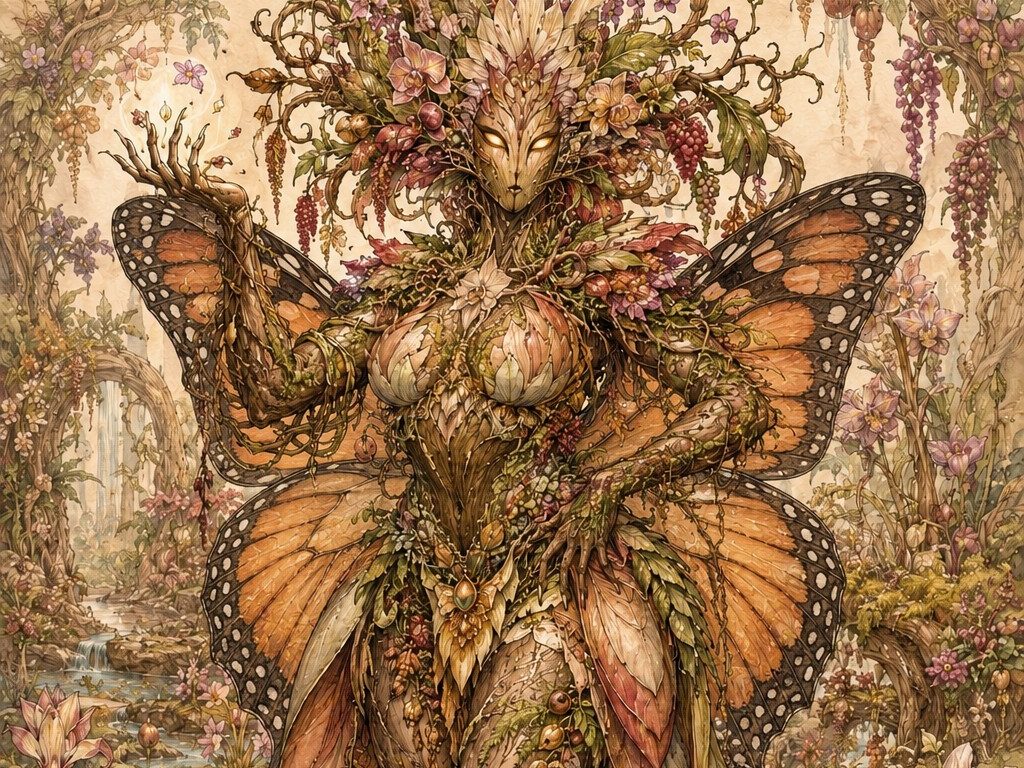
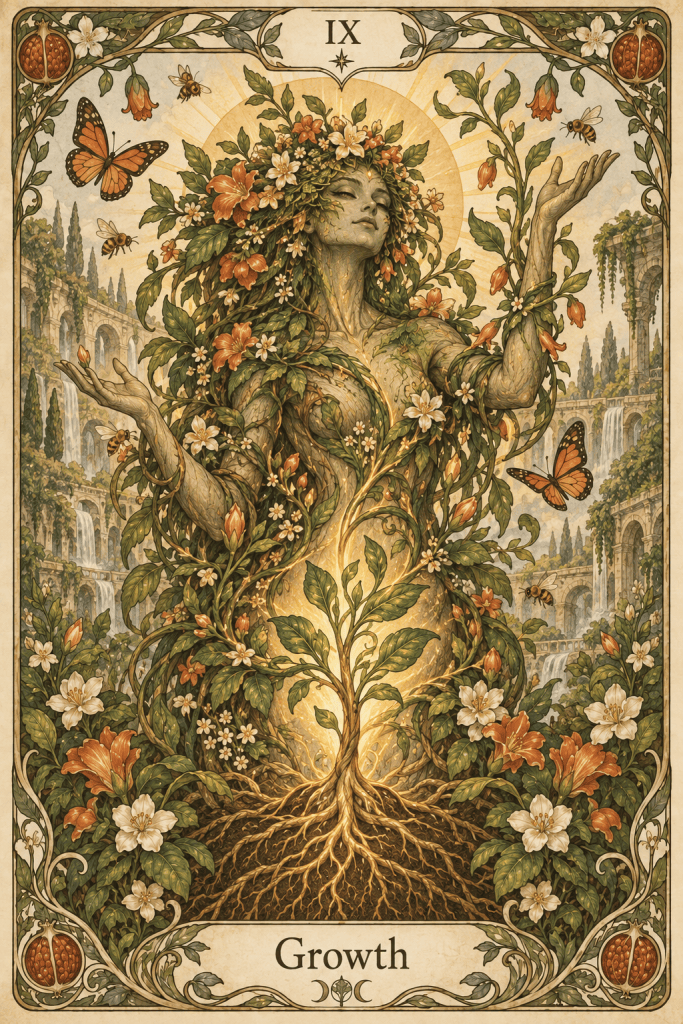
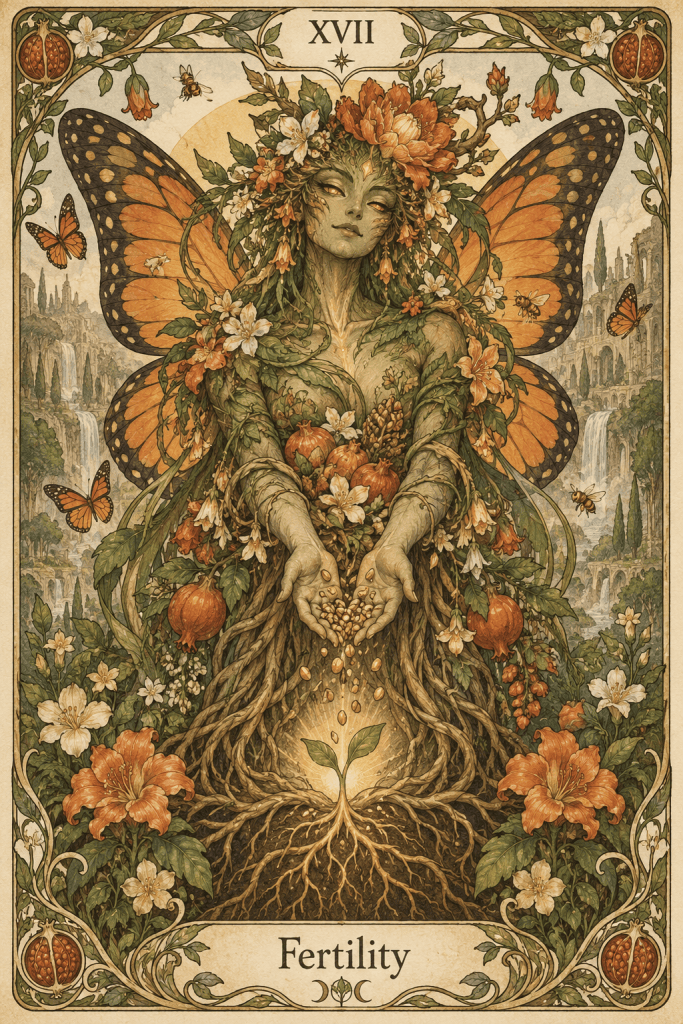
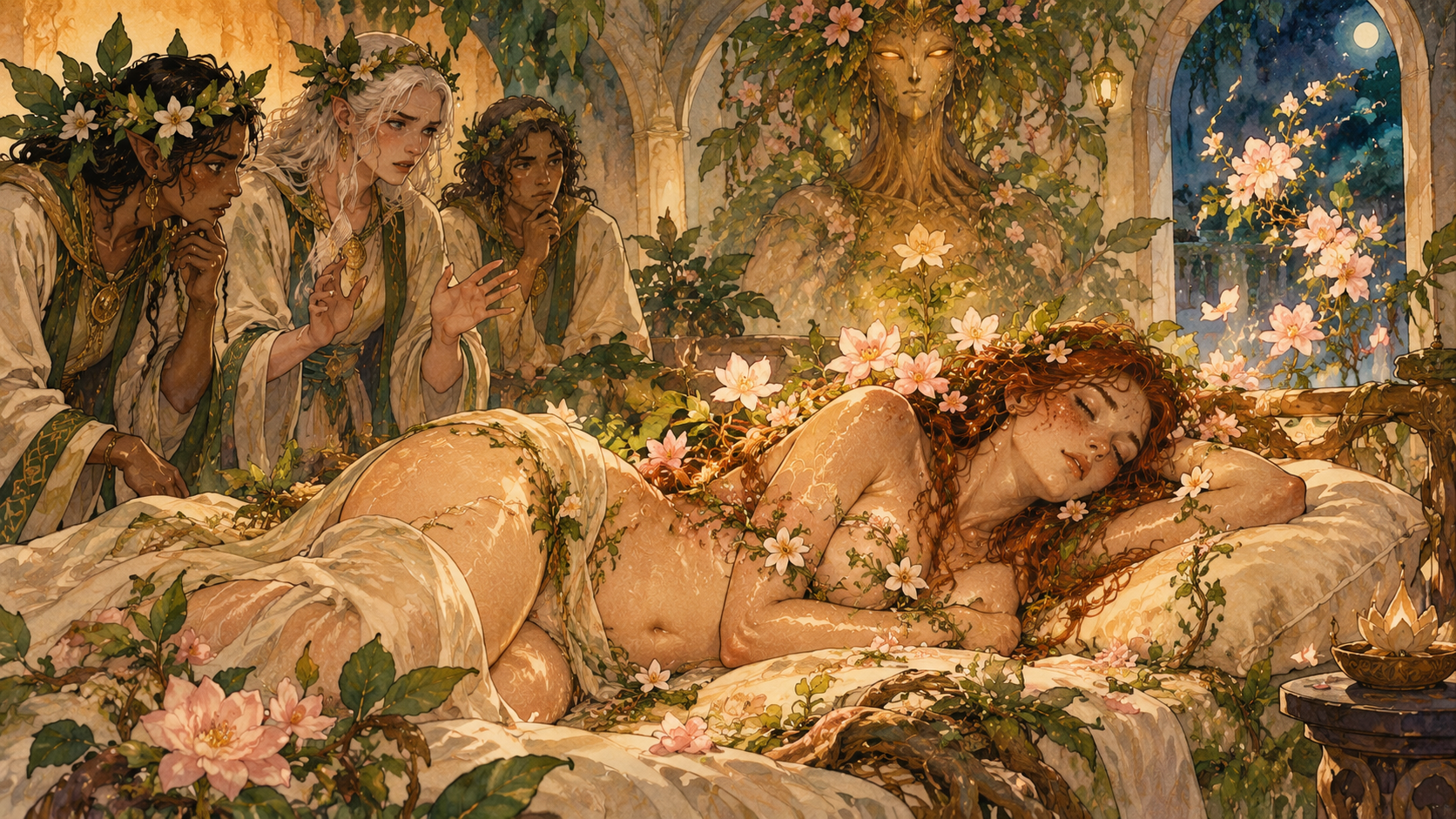
Canonical Second Bloom art portrays Talyss as the oldest divine Orchidian, a true primordial plant-divinity rather than a human woman altered by vegetation. Her face is a sacred living botanical mask formed from bark, seed-shell and layered petal structures. Luminous almond-shaped eyes shine from within. She possesses no ordinary human facial anatomy. A vast crown of branches, flowers, fruit, leaves, seed clusters and vines grows directly from her head. Her body remains mature, broad, voluptuous and unmistakably feminine in silhouette, but its structures are botanical. Petal formations create the visual rhythm of a chest, cambium and bark flow through a curving torso, and powerful trunklike legs descend into roots. Enormous monarch butterfly wings grow naturally from her back.
Talyss is no longer depicted with a permanent pregnancy belly in definitive sacred art. Pregnancy remains central to mortal worship and older iconography, but divine Talyss expresses fertility through her entire organism: fruit, pollen, seed, sap, flowers and continuous growth. The visual truth should be immediate: She is not a woman wearing the garden. She is the reason the garden knows how to live.
Worship & Daily Devotion
Talyss is among the easiest deities to worship outside formal temples because living things require care almost everywhere. Planting can be prayer. Watering can be prayer. Saving seed can be prayer. Preparing a body for pregnancy can be prayer. Choosing contraception because pregnancy is not desired can also be prayer, because responsible fertility includes deciding whether a seed should be invited to take root. Her worship attracts farmers, gardeners, herbalists, midwives, healers, brewers, vintners, orchard keepers, cooks, parents, fertility specialists, sex workers, druids, lovers exploring reproductive fantasy and communities concerned with maintaining life across generations.
The First Seed
Many households keep one seed from the first fruit or crop harvested each season. It is not eaten. The seed is dried, labeled and either planted the following year or placed into a communal seed store. The practice teaches continuity through restraint. The harvest is not complete until something has been preserved from consuming it.
Blossom Anointing
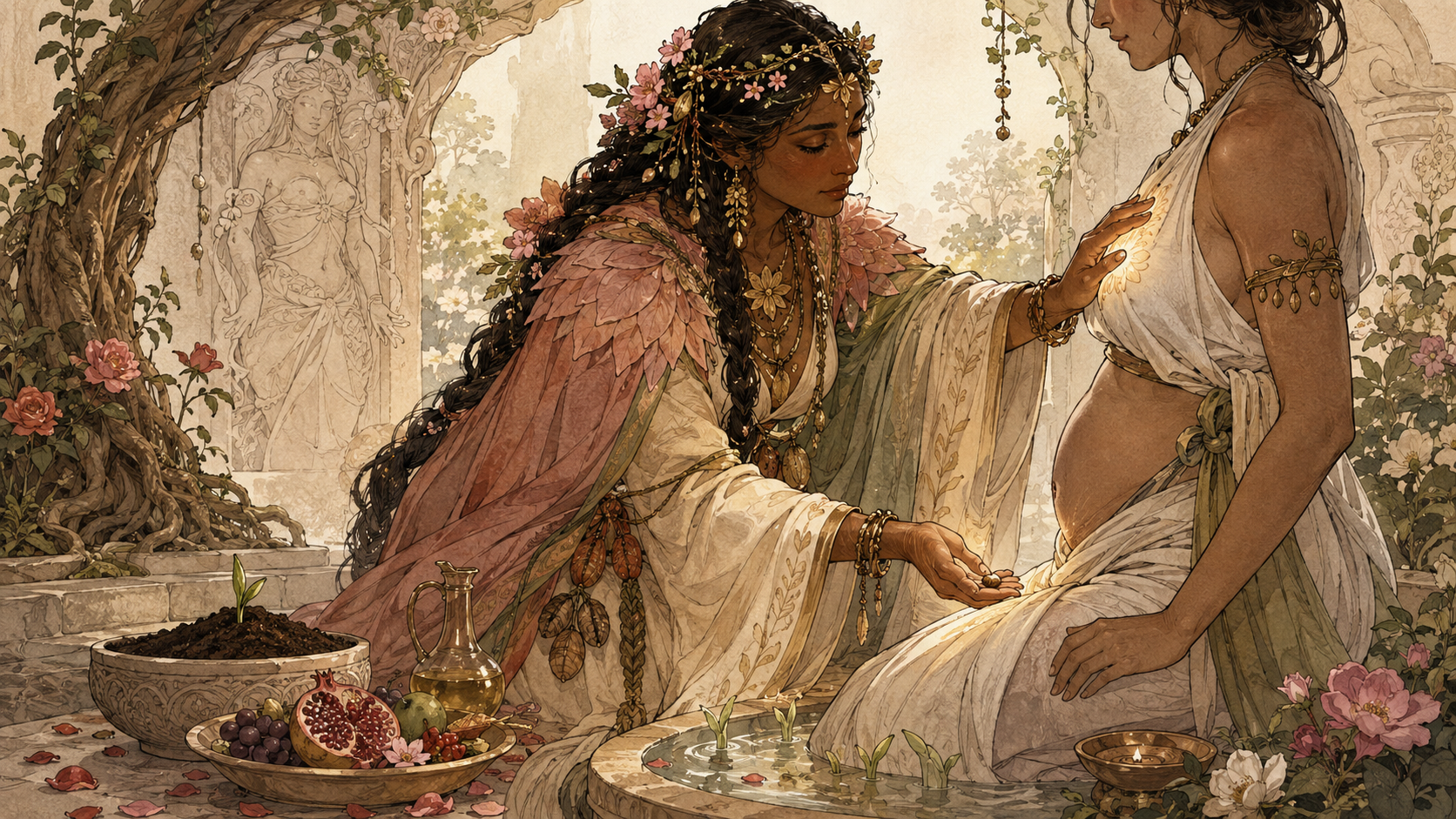
Blossom Anointing survives directly from older Talyssan practice. Warm oil infused with flower, herb or fruit fragrance is rubbed onto the body according to the devotee’s intention. Gardeners commonly anoint their hands. Expectant parents may anoint the abdomen. Dancers anoint their feet. Lovers may anoint one another’s hips, chest, abdomen or other mutually chosen areas during intimate rites. The act asks a simple question: What are you asking to flourish?
Fullness Meditation
A worshipper sits somewhere living things can be seen or smelled, places their hands upon the body and breathes slowly while contemplating something unfinished. Older fertility traditions specifically place the hands upon the lower abdomen. Modern practice allows whatever location feels appropriate. Participants are encouraged to distinguish fullness from overload. What is receiving nourishment? What is becoming too crowded? What needs more? What needs pruning? The practice has become particularly important within the Circle of the Petal.
The Garden Portion
Talyssan households often maintain some small piece of cultivated life whose produce is not reserved solely for themselves. This may be a public herb bed, fruit tree beside a road, planter of medicinal flowers or a portion of a larger garden whose harvest is given away. A household too poor to maintain land may keep a few seeds or cuttings for neighbors. The theological principle matters more than scale: Abundance should escape ownership somewhere.
Favored Offerings
Traditional offerings include viable seed, ripe fruit, grain, flowers, honey, preserved food, compostable floral garlands, fertile soil, cuttings from beloved plants and records of successful grafts or cultivars. Fruit and grain offered at temples are normally eaten or preserved rather than allowed to rot ceremonially. Seeds are planted whenever practical. Talyss already knows how decay works. Her altar is for continuation.
Clergy & Temples
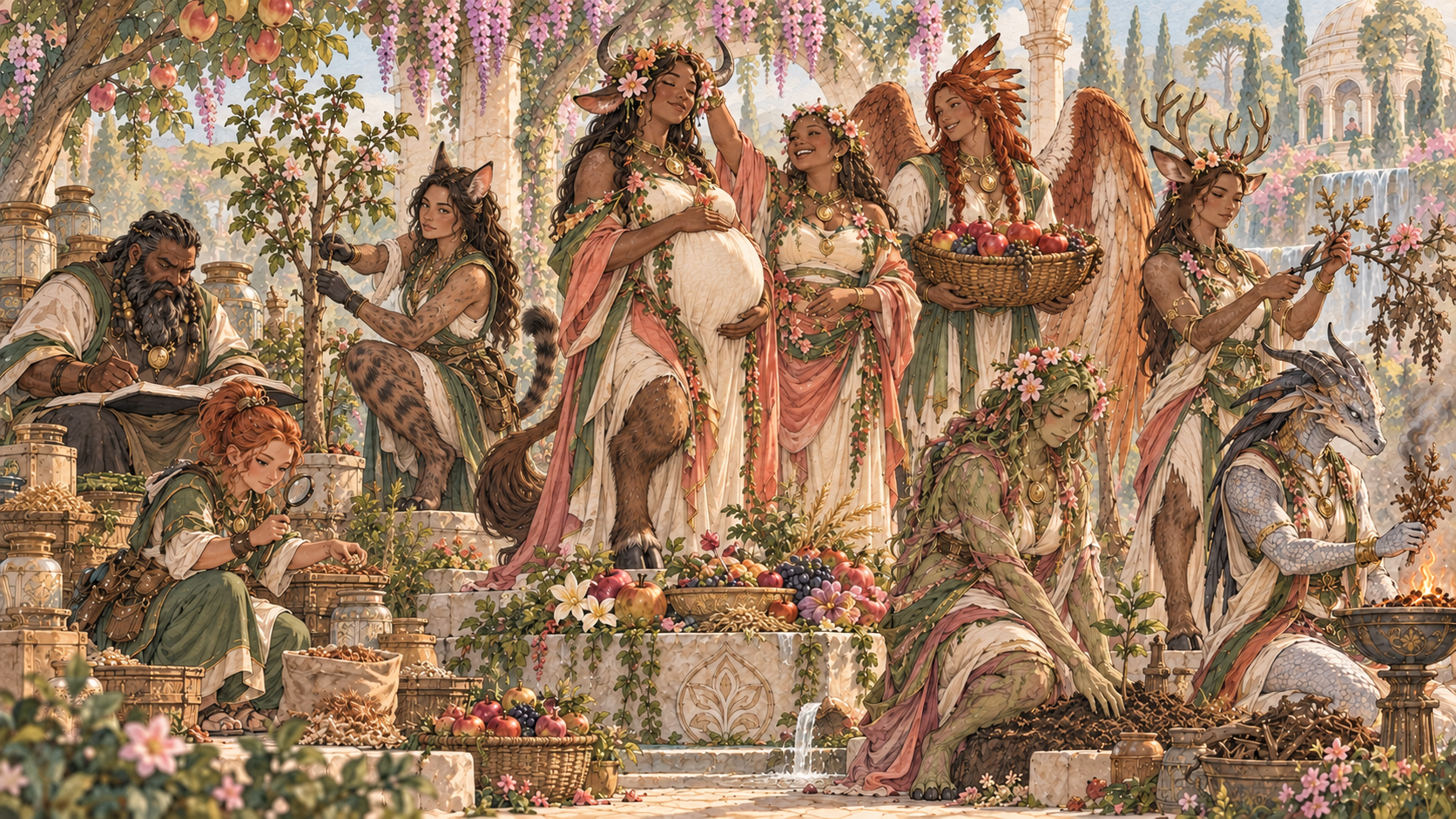
Talyss’ worship is unusually diverse, and established material recognizes three major devotional currents: the Bloomward Houses, the Gathered Hand and the Circle of the Petal. They are not rival religions. They are three answers to the same question: What does abundance require from us?
Bloomward Houses
The Bloomward Houses are the most visible expression of Talyss’ faith. They preside over fertility blessings, pregnancies, births, weddings, seasonal festivals, orchard celebrations, communal feasts, pleasure gardens and rites of reunion. Their theology emphasizes joy, sensuality, flowering and abundance experienced in the present. To many ordinary Erosians, the Bloomward Houses simply are Talyssan religion. Their clergy include inherited titles such as Bloom-Mothers, Quickened Priestesses, Verdant Fathers, Swellmaidens and Harvest-Priests. The titles describe traditions and offices rather than a universal hierarchy, and many regions use only some of them.
Bloomward vestments favor flowing cream, rose and green garments covered in living flowers, fruit charms, seed jewelry and vine embroidery. Festival attire can become deliberately sensual. Talyss does not consider a body inappropriate merely because it is fertile, soft, pregnant, full or visibly desired.
The Gathered Hand
Where the Bloomward Houses celebrate abundance, the Gathered Hand ensures abundance survives. They maintain seed vaults, granaries, preserving kitchens, herbaries, pilgrim orchards and agricultural records. Existing Talyssan material describes them perfectly: If the Bloomward Houses feed the present, the Gathered Hand protects the future. Members study weather cycles, crop disease, distribution, grafting, storage, irrigation and the political dangers surrounding scarcity. A Gathered Hand priest may spend an entire season without performing a visually spectacular ritual. They may also prevent ten thousand people from starving. No Talyssan theologian considers this lesser priesthood.
The Circle of the Petal
The Circle of the Petal governs restoration, pruning, dormancy and the boundary between flourishing and excess. They are summoned when fertility magic becomes unstable, when forests consume farmland unnaturally, when crops refuse seasonal decline, when ecosystems collapse or when healing magic repeatedly restores something that should be allowed to end. Their doctrine explicitly rejects two extremes:
Sterility that denies growth.
Abundance that consumes itself.
Members of the Circle often make uncomfortable decisions. They burn infected orchards. They prohibit planting during exhausted seasons. They destroy invasive magical growth. They may even refuse resurrection magic when repeated return has begun creating spiritual or ecological imbalance. Talyss is beloved because she says grow. The Circle is respected because sometimes someone must say enough in her name.
Gardens of First Bloom
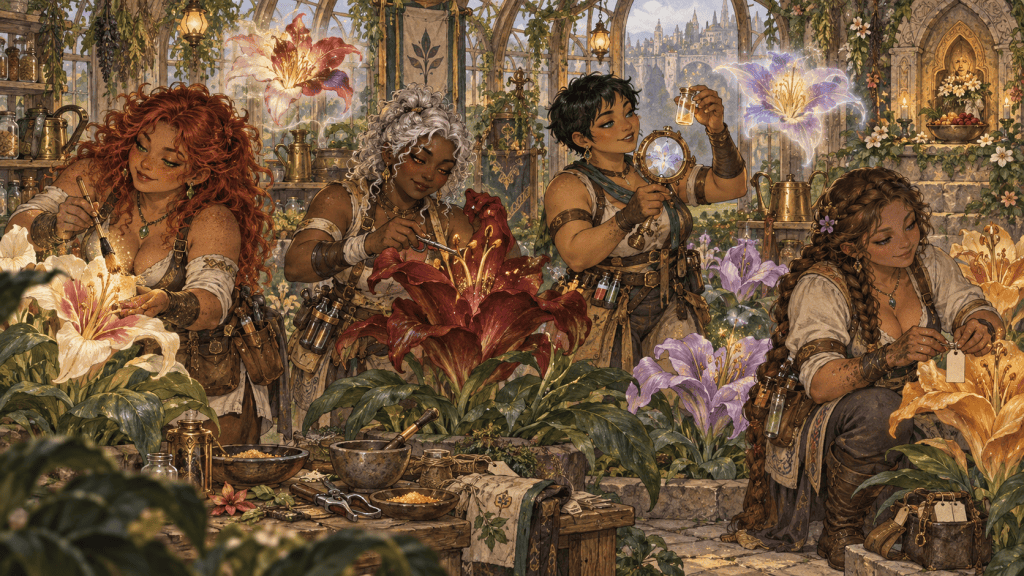
Talyssan temples are commonly called Gardens of First Bloom, though Bloomward Houses, Root Sanctuaries and Seed Halls are also common regional names. They are cultivated ecosystems more than buildings decorated with vegetation. Living root arches support roofs. Fruit vines climb stone walls. Warm pools serve ritual bathing, irrigation and recovery. Greenhouses protect rare species. Kitchens sit beside storehouses. Seed vaults are often more heavily guarded than treasuries. Beds and private chambers are common because temples frequently host pregnancies, healers, gardeners, pilgrims and lovers undertaking fertility rites. The most important architectural feature is usually the Root Hall. A living tree or enormous interlocking root system grows through the sanctuary. Worshippers touch the exposed roots when making vows concerning continuation, family, recovery or long-term work. Some Root Halls are centuries older than the cities surrounding them.
Rites, Taboos & Divine Signs
Rite of the First Quickening
The First Quickening survives from Talyss’ oldest fertility tradition. A worshipper enters warm water carrying a seed, flower bud or small fruit. Someone seeking pregnancy may place both hands upon the abdomen while a priest hums a low rhythmic tone associated with gestation. Someone beginning another form of creation may name the thing they hope will grow. The seed is then planted.
The rite does not promise conception, success or divine intervention. It marks the moment potential was consciously welcomed.
Rite of Swelling Grace
The Rite of Swelling Grace honors bodies undergoing change. Warm oils are applied slowly while the participant names what has changed and what they are still learning to inhabit. Pregnancy is the rite’s oldest context, and pregnant participants remain common. Other temples perform it for recovery from starvation, healthy weight change, magical bodily transformation, aging or other transitions that alter familiar proportions. No particular body size is treated as its intended destination. The rite sanctifies becoming comfortable in a body that did not remain static.
Rite of the Blooming Union
Two or more willing partners enter a flowered sanctuary or private garden and name what kind of fertility they wish the union to symbolize. Some seek conception. Some seek erotic breeding fantasy without conception. Some wish to bless a shared household, artistic project or relationship. Flowers are tied loosely around the participants’ wrists or placed beneath their hands. The binding is intentionally fragile. At the conclusion, each person breaks their own floral loop. The union may create possibility. It does not erase autonomy.
Rite of Abundant Fruit
Ripe fruit is placed upon a communal table and opened ceremonially. Participants eat slowly, paying attention to texture, juice, scent and seed. The first portion is given away. The final viable seed is saved. This simple structure expresses the entire Talyssan cycle:
During major spring festivals, participants wear powdered flower pigments and move between designated circles representing different gardens.
- Receive abundance.
- Experience abundance.
- Share abundance.
- Preserve tomorrow.
The Pollination Dance
Touch, dance, embraces and exchanged ribbons transfer the colors between bodies. By the end, no participant wears only the color with which they began. The rite represents pollination, exchange and the way creation often depends upon something crossing a boundary without destroying either side. More intimate adult variations exist, but public versions remain entirely communal and celebratory.
Womb Breathing
Womb Breathing remains one of Talyss’ most recognizable private fertility practices. A devotee breathes slowly while focusing upon the lower abdomen and imagining a bud opening with each cycle of breath. Some use the practice while trying to conceive. Others use it during pregnancy. Still others use it as part of erotic reproductive fantasy or simply as meditation upon the body as a place where possibility can be imagined. No biological womb is required. The name survives because religious language does not always need to become anatomically universal to remain available symbolically.
The Great Prohibition
Talyss possesses many taboos, but one stands above the rest:
No one may claim another person’s fertility as their right.
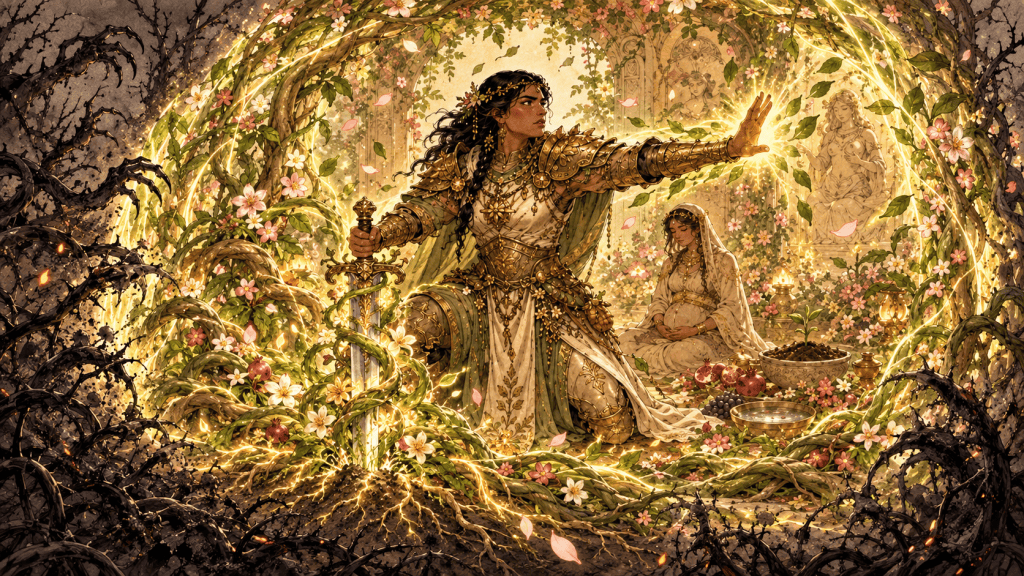
Forced conception, reproductive coercion, sabotaging contraception, magical impregnation without permission and pressuring someone to carry or terminate a pregnancy against their will are profound violations of the Root Mother’s faith. This prohibition is not a modern revision invented to soften older fertility worship. The archives already condemn forced fertility and conception. The principle is theological. A seed forced into hostile soil is not sacred planting. It is violation.
Other Taboos
Talyssan traditions also condemn deliberate food waste during genuine need, destruction of viable seed without purpose, mockery of pregnancy or infertility, shaming bodily softness or fullness and neglect of living things deliberately entrusted to one’s care. The Circle of the Petal adds a further prohibition: Do not preserve growth merely because ending it makes you uncomfortable. An invasive vine may need cutting. A dying tree may need felling. An exhausted field may need an empty season. Love does not always mean more.
Signs of Talyss’ Claim
Older traditions describe warmth gathering in the abdomen or hips, floral fragrance emerging from the skin, temporary bodily softness, glowing marks and plants blooming in the devotee’s presence. Contemporary temples often call these Signs of Bloom rather than Markings of Ownership. Common manifestations include seeds germinating unusually quickly when handled, faint golden-green patterns resembling leaf veins appearing across the skin, flowers turning subtly toward the devotee and cuttings rooting in water with impossible ease. Fruit may taste exceptionally ripe when shared from their hand. A monarch butterfly landing upon someone and remaining despite movement is considered particularly auspicious. Pregnancy-oriented traditions retain additional signs: warmth beneath the navel, vivid dreams of enclosed gardens, a temporary floral sigil across the abdomen or the recurring sensation of hearing a distant heartbeat beneath the sound of rain.
Talyss and the Velvet Court
Within the Velvet Court, Talyss embodies Fertility, Growth and Continuation. Where Velyssara creates life’s capacity for desire and generative possibility, Talyss gives that possibility biological persistence. She is the divine principle through which living things become capable of carrying themselves toward another season. Her relationship with Aratheia is among the Court’s most natural. Talyss brings forth. Aratheia sustains. Seed without nourishment dies; nourishment without something living to receive it has nowhere meaningful to go. Older archives already describe the two as nearly perfect divine partners.
Sylithra shares Talyss’ language of swelling, fullness and abundance, but their movements differ. Talyss gathers abundance toward becoming. Sylithra gathers until release. Water nevertheless remains essential to every root, and their priesthoods commonly cooperate around fertility gardens, bathing rites and agricultural water systems. Talyss’ relationship with the Earth Sovereign is more metaphysical than personal. The Root Mother represents life emerging from earth; deathbloom represents life returning to it. Monarch and moth, first bloom and final bloom, sap rising and root becoming soil again. Their opposition is real without requiring hatred.
The developing theology surrounding Ulvexa promises an even more profound relationship. Talyss is the primordial divine pattern of flora; Ulvexa will embody the primordial divine pattern of fauna. Talyss roots. Ulvexa runs. Together they represent two ancient answers given by life after Velyssara first awakened it.
Miracles & Divine Presence
Talyss’ miracles begin when biology behaves impossibly well. Seeds split within moments of touching soil. Withered plants push out one new green leaf. An orchard produces blossoms and mature fruit on the same branch. Roots move around buried bones rather than breaking them. A field damaged by fire grows green along the exact path of a passing devotee. More powerful manifestations alter whole landscapes. Dormant seeds from centuries past may germinate simultaneously. Rivers become bordered by flowers overnight. Fruit appears in regions where the species could not normally survive.
The Circle of the Petal regards such miracles with reverence and caution. A divine miracle can still overwhelm mortal ecology.
Monarch Omens
One monarch is fortunate. Three are often interpreted as an invitation to notice what is beginning. Hundreds gathering without migrating usually indicate direct divine influence. When monarchs land upon a barren tree and refuse to leave, Talyssan clergy prepare for transformation. They do not always assume resurrection. Sometimes the tree itself is finished. Something beneath it may be preparing to begin.
The Root Mother’s Presence
When Talyss approaches directly, the first sign is usually underground. Roots shift. Seeds tremble within soil. Flowers slowly turn toward an unseen center. The air smells of rain upon dark earth, ripe fruit and warm pollen. Golden motes drift through still air. Those who witness her divine form describe enormous monarch wings unfolding behind a botanical body rooted into the land, glowing eyes opening within the sacred mask and flowering branches spreading from her crown. The garden does not surround her. The garden remembers her.
What Her Faith Teaches
Life Wants to Continue
This is Talyss’ central revelation. Living things display an extraordinary tendency to reach beyond themselves. Roots divide. Seeds travel. Creatures reproduce. Communities teach their children. Stories outlive their tellers. Talyss does not interpret this tendency as a command that every individual must reproduce. Life’s desire to continue is larger than any single body. The sacred response is not obedience. It is stewardship.
Fertility Is Possibility,
Not Obligation
Someone can possess reproductive capacity and decline to use it. Someone can lack reproductive capacity and remain profoundly generative. Talyssan theology therefore distinguishes fertility from duty. A field may be fertile. That does not mean every season must be planted.
Fullness Is Holy
When It Sustains
Older doctrine states simply that fullness is holy. Modern priests add an important qualification. Fullness is holy when it represents something genuinely being nourished. A full granary that protects winter is holy. A full belly after needed food may be holy. A pregnant body may be holy. A warehouse of grain locked while neighbors starve is merely full. Quantity and abundance are not identical.
Creation Can Be Pleasurable
Talyss rejects the assumption that meaningful creation must arise through grim sacrifice.Planting can be joyful. Cooking can be sensual. Pregnancy can be erotic.
Sexual fantasy can celebrate reproduction without producing it. A craftsperson may love the process of making. Pleasure does not cheapen creation. Sometimes pleasure is what teaches creation to continue.
Growth Requires a Season
The Circle of the Petal has carried this teaching throughout modern Talyssan worship. Growth is not automatically evidence of health. Tumors grow. Invasive species grow. Unchecked populations grow. Magic can force a field to produce until the soil dies. The faithful therefore reject an older simplified maxim preserved in the archives — Growth is inevitable — in favor of a more mature doctrine:
Growth requires a season.
There is a time to root.
A time to bloom.
A time to fruit.
A time to seed.
And a time for the field to lie empty.
At the Table
Talyss works best when her influence makes life itself consequential. Her stories naturally involve fertility, ecology, pregnancy, agriculture, biological transformation, communities facing scarcity or excess, magical gardens, inheritance, restoration and the moral complications of making something live.
Talyssan Characters
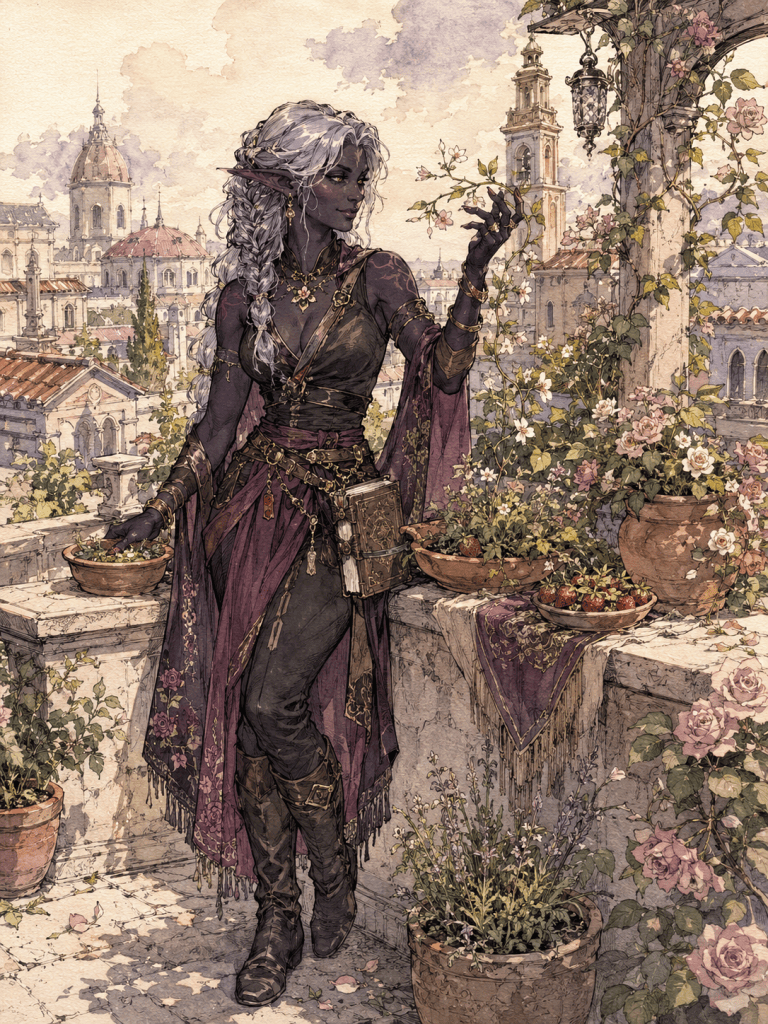
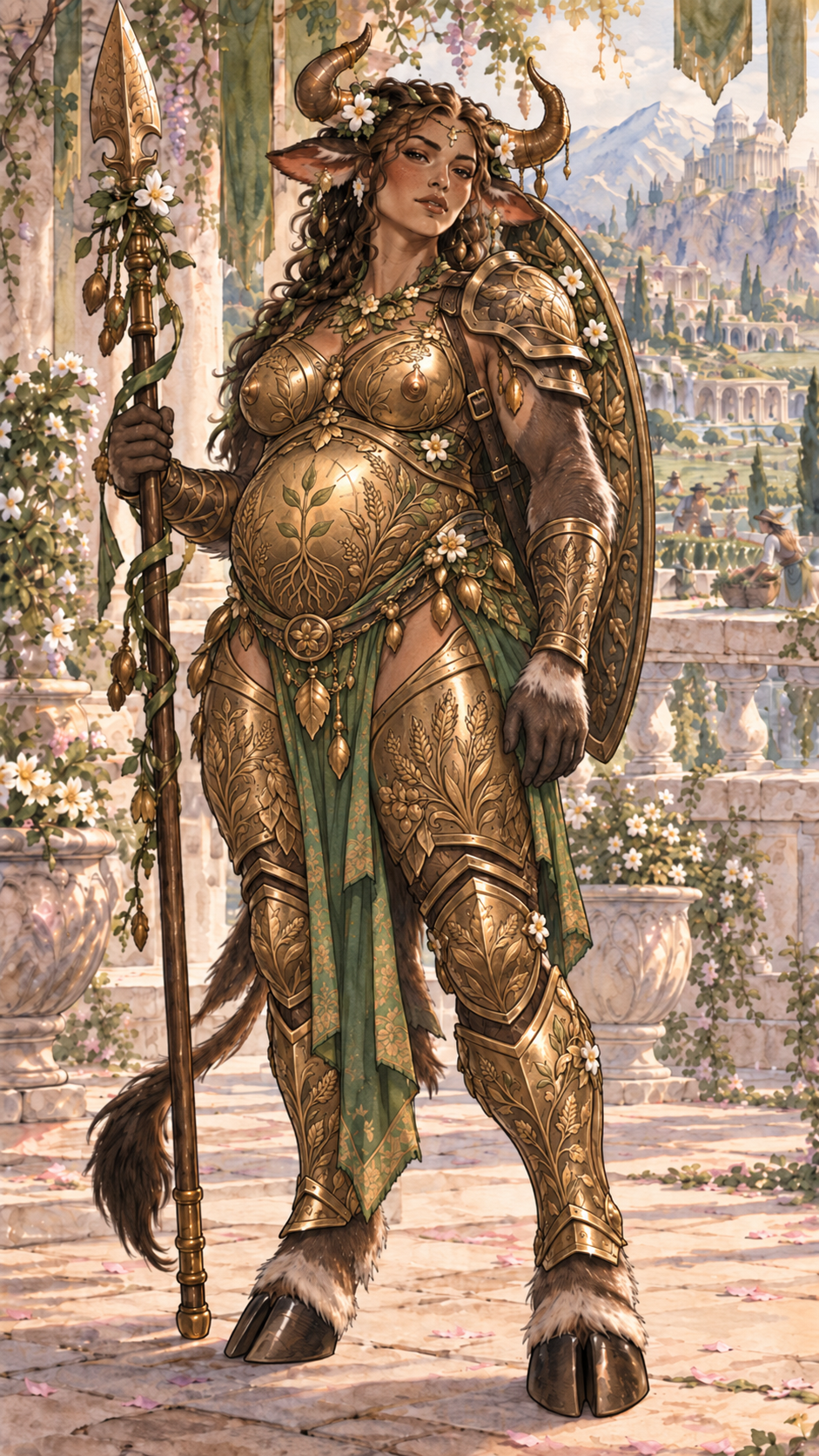
Characters devoted to Talyss commonly include druids, clerics, healers, gardeners, herbalists, midwives, cooks, farmers, alchemists and protectors of wild places. Her faith also works especially well for characters wrestling with generative questions. A warrior unexpectedly preparing for parenthood.
An infertile priest discovering that fertility was never synonymous with conception.
A druid horrified by the need to destroy an infected forest. A noble inheriting exhausted farmland instead of wealth. An adventurer accustomed to saving lives who must learn that not everything can or should be restored.
Divine Domains and Traditions
The archives associate Talyss with Life, Fertility, Nature and Bloom, alongside the Oath of Abundant Heart, Oath of the Blooming Womb, College of Blossoms, College of Quickening Song, Circle of Verdant Wombs, Pact of the Swollen Seed and Pact of Blooming Flesh. These remain excellent setting hooks but require Second Bloom mechanical review before publication as player options.
Characteristic Blessings
Older material preserves several recognizable Talyssan effects: healing enhanced through growth magic, advantages when tending living things, temporary vitality granted through touch and radiant bursts that cause plants to flower while restoring allies.
The concepts remain appropriate.
(Needs updated mechanics: Base 5e → Veiled → Unveiled.)
Future mechanics should emphasize:
- plant growth and restoration
- temporary vitality
- ecological awareness
- fertility and abundance-themed Desire interactions
- creation of safe or nourishing terrain
- transforming barren ground into living ground
- restraint against unlimited magical growth
Sacred Relics
Chalice of the First Fruit
Wondrous item, rarity to be determined
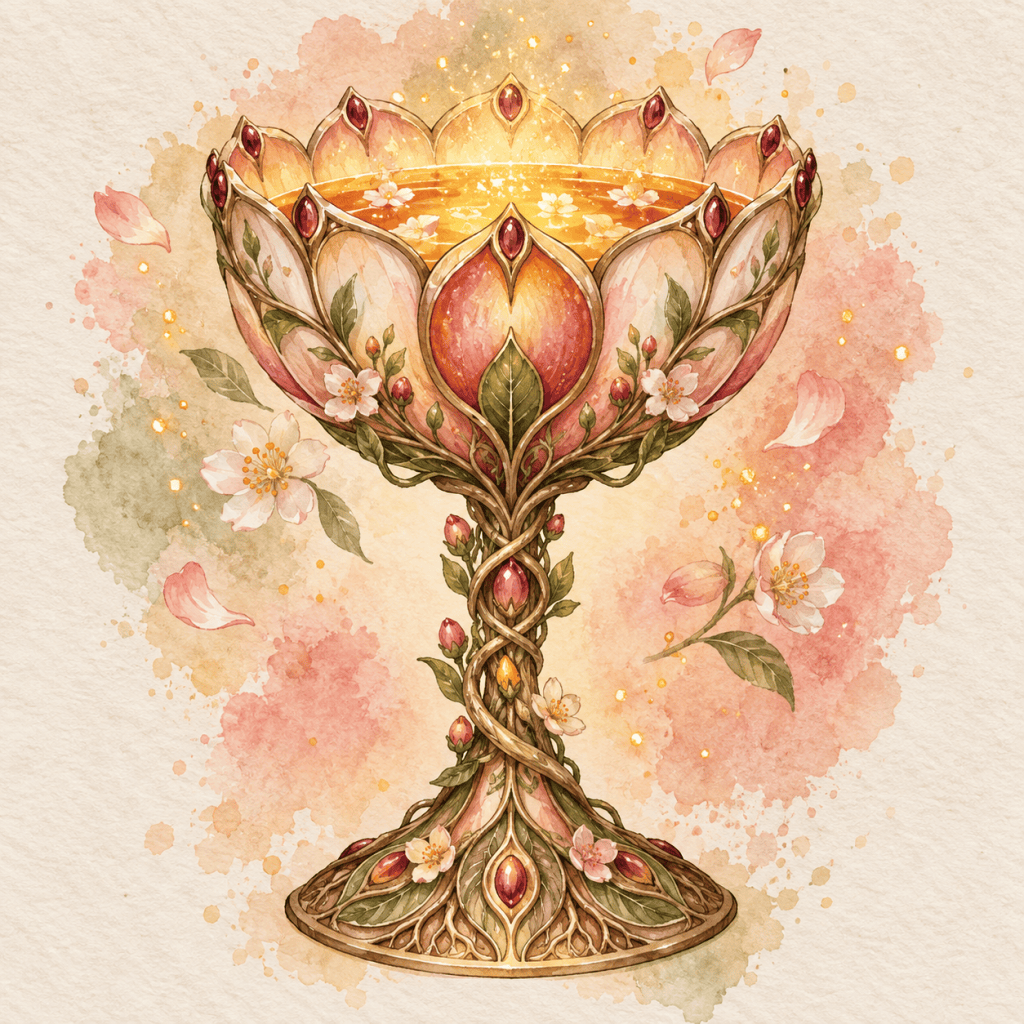
The archival Wombflower Chalice survives in Second Bloom tradition as the Chalice of the First Fruit. Its bowl resembles an opening flower whose interior gradually becomes the shape of a ripe fruit. Tiny seed-shaped gems surround its rim. Liquid placed within develops the scent of ripe fruit and faintly luminous pollen motes. Fertility temples still commonly use the older name.
(Needs updated mechanics.)
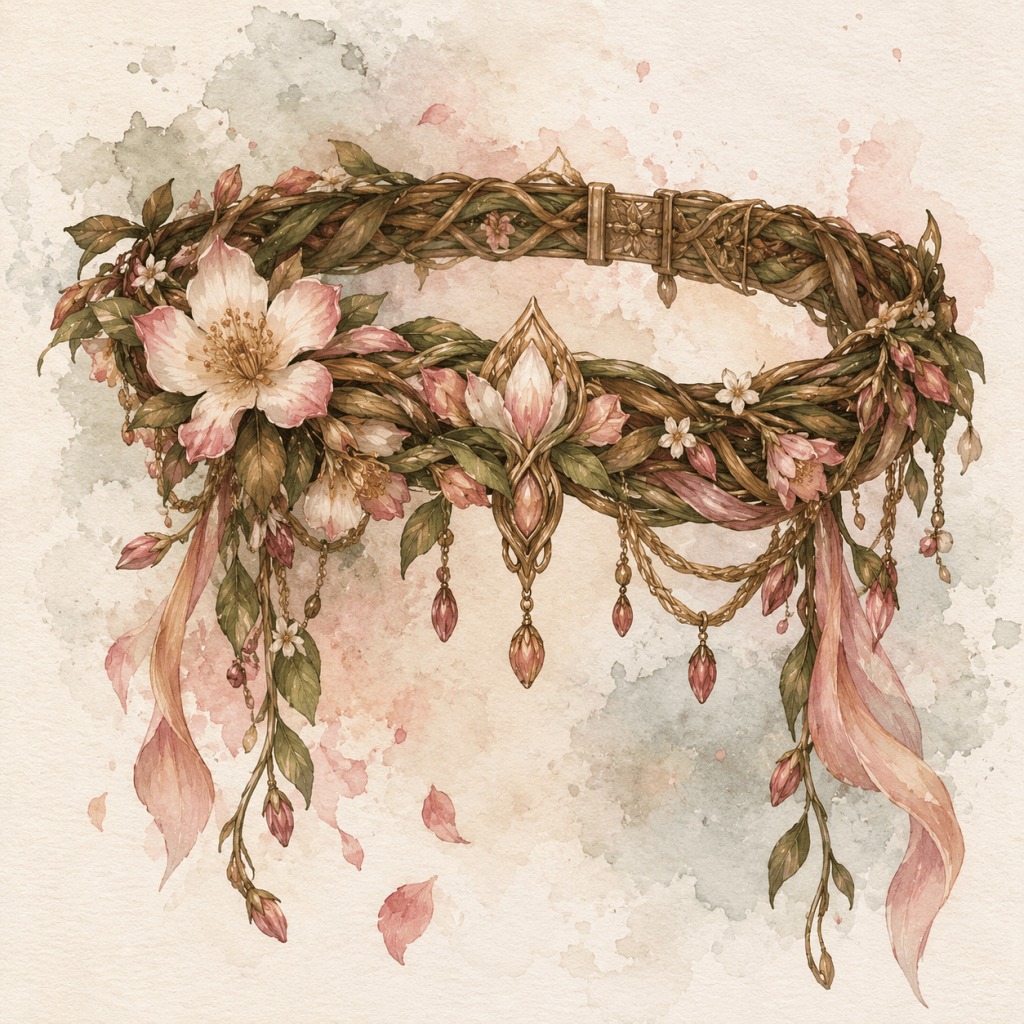
Girdle of Blooming Flesh
Wondrous item, rarity to be determined
The archival Belt of Blooming Flesh is a living girdle woven from supple vines, petal fibers and seed-thread.
Its flowers respond to the health and magical condition of the wearer. Some traditions use the girdle in pregnancy blessings or body-change rites, while the Circle of the Petal uses variants to diagnose harmful magical growth.
(Needs updated mechanics.)
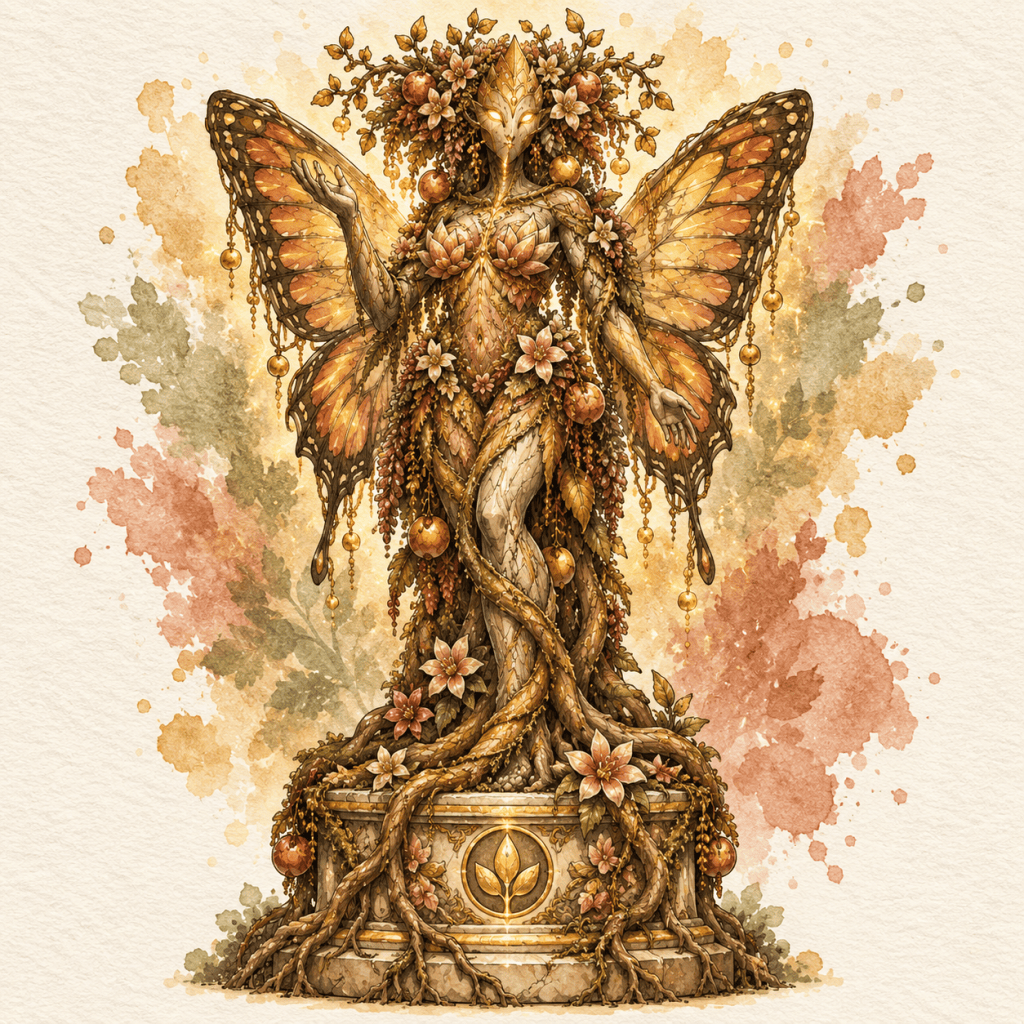
Idol of the Root Mother
Wondrous item, rarity to be determined
Older archives describe a Pregnant Idol of Talyss radiating supernatural fertility. Second Bloom temples increasingly use the Idol of the Root Mother instead. The statue depicts canonical Talyss: botanical mask lifted toward light, monarch wings partially open, roots flowing into the pedestal and fruit hanging among her living crown. Historical pregnant idols remain sacred and are not destroyed. They represent how earlier mortal cultures understood her through their own reproductive bodies.
(Needs updated mechanics.)
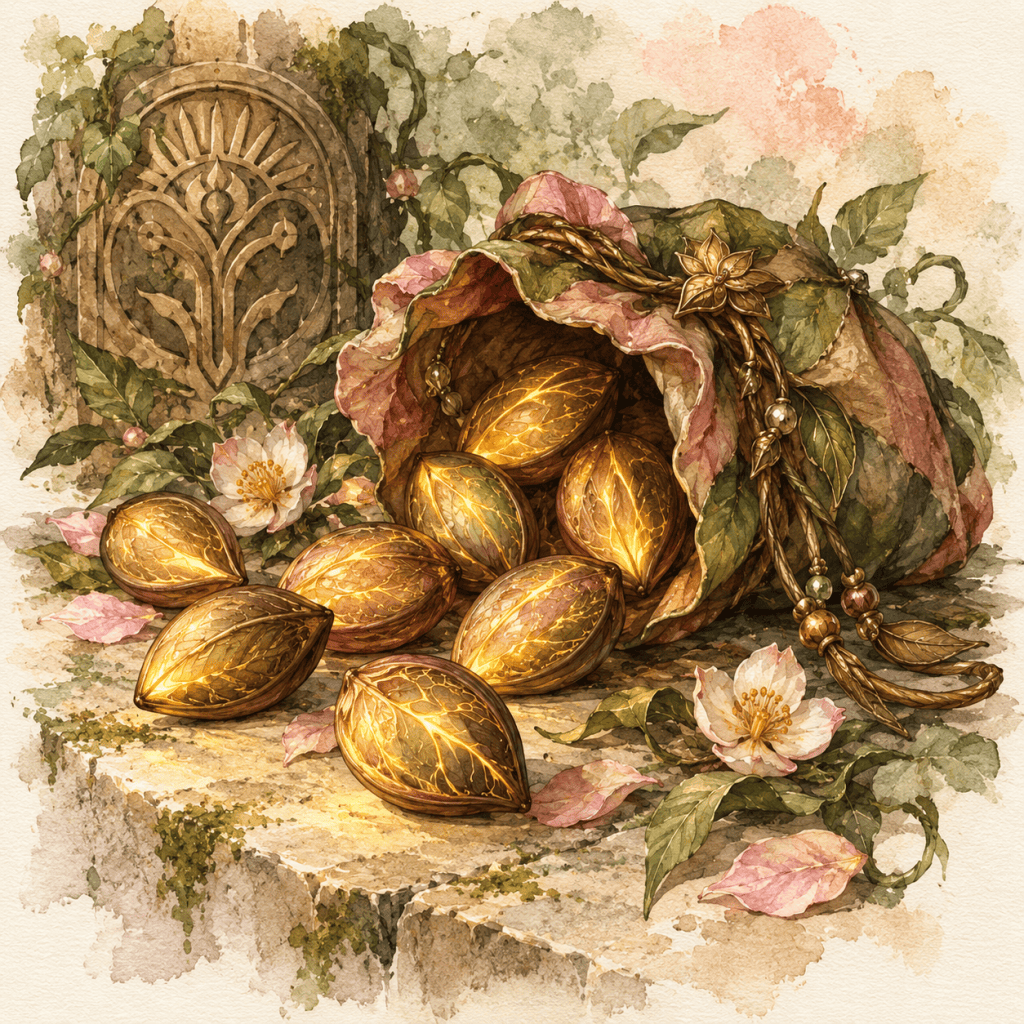
Seeds of Swelling Grace
Wondrous item, rarity to be determined
These warm, heavy seeds appear unremarkable until placed beside moisture. Fine golden veins then become visible beneath the shell. The archives associate them with rapid plant growth and amplified fullness. Modern temples strictly regulate their agricultural use after several well-documented cases of blessings becoming ecological disasters.
(Needs updated mechanics.)
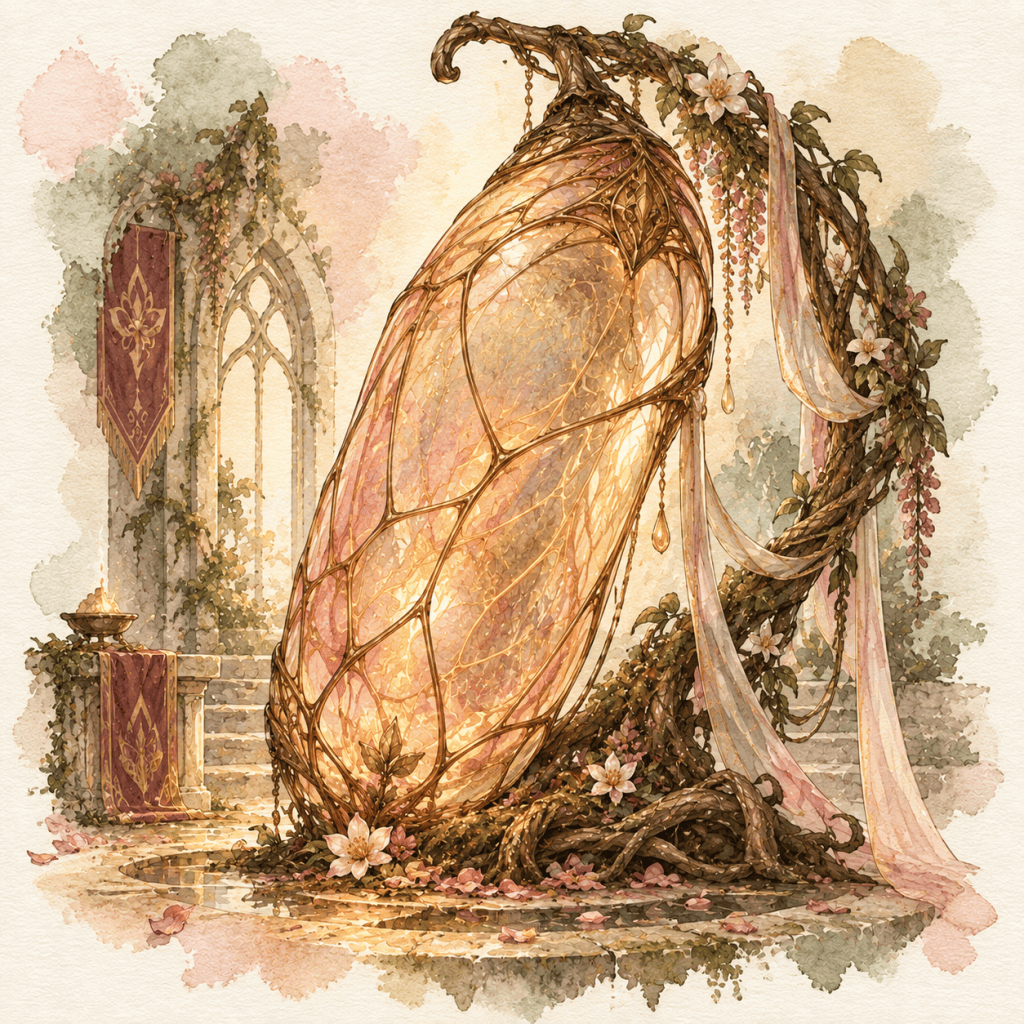
The Monarch Husk
Wondrous item, rarity to be determined
This translucent shell resembles an enormous empty chrysalis veined with rose-gold. No record agrees upon what emerged from it. A person sleeping inside reportedly dreams of becoming something they have not yet found the courage to attempt. Circle druids insist the relic does not reveal destiny. It reveals germination.
(Needs updated mechanics.)
Adventure Hooks
The Orchard That Refuses Autumn
A valley blessed by Talyss produces three harvests in a single month. Then a fourth begins. Fruit does not fall. Leaves do not brown. Seedlings emerge beneath mature trees faster than they can be removed. The inhabitants call it the greatest miracle in generations. The Circle of the Petal calls it an ecological emergency. Someone has removed autumn from the valley.
The Silent Root
Orchidians throughout an entire region suddenly lose their instinctive sense for plant life. Crops continue growing. Trees remain healthy. Nothing appears diseased. The frightening discovery is that flora has not died. It has stopped answering.
The First Seed
A Gathered Hand vault is breached and a legendary seed believed to descend from Talyss’ primordial garden disappears. Within days, crops across the surrounding province continue producing fruit but every seed within them is sterile. The thief has not stolen this year’s harvest. They have stolen next year.
The Monarch Pilgrimage
Millions of monarch butterflies abandon their ordinary migration and fly toward a barren plateau where nothing has grown for centuries. They settle around a single fissure in the stone. The next morning, a root breaks through. It is larger than a road.
The Unwanted Blessing
A devotee begins manifesting traditional fertility signs associated with Talyss after explicitly choosing never to become pregnant. Other priests insist the signs must be metaphorical. Then plants begin flowering whenever the devotee sleeps. The party must determine what Talyss is actually asking to be born.
The Bloom Beneath the City
Construction beneath an ancient city reveals an enormous living root older than every surviving structure above it. The root begins producing flowers belonging to plant species from every continent. Orchidian theologians arrive claiming it may be part of Talyss’ original divine body. Then one of the flowers opens its eyes.
Scents for Gameplay
Roll or choose whenever Talyss’ influence becomes noticeable.
| d12 | Scent |
|---|---|
| 1 | Dark soil immediately after warm rain |
| 2 | Crushed green leaves and fresh stems |
| 3 | A split pomegranate |
| 4 | Warm grain mixed with honey |
| 5 | Orchid blossoms opening at dusk |
| 6 | Apple skin warmed beneath sunlight |
| 7 | Damp moss beside clear spring water |
| 8 | Ripe fig and sweet golden sap |
| 9 | Heavy flower pollen carried on warm air |
| 10 | Grapes moments before harvest |
| 11 | Fresh roots exposed beneath turned soil |
| 12 | Blossom, fruit, rain and fertile earth together — the impossible fragrance known among her priests as First Spring |
Talyss’ scent should rarely feel like perfume placed upon the air. It should feel as though somewhere nearby the world has become unusually ready to grow.
 Whispers of Erosia
You must be logged in to post a comment.