
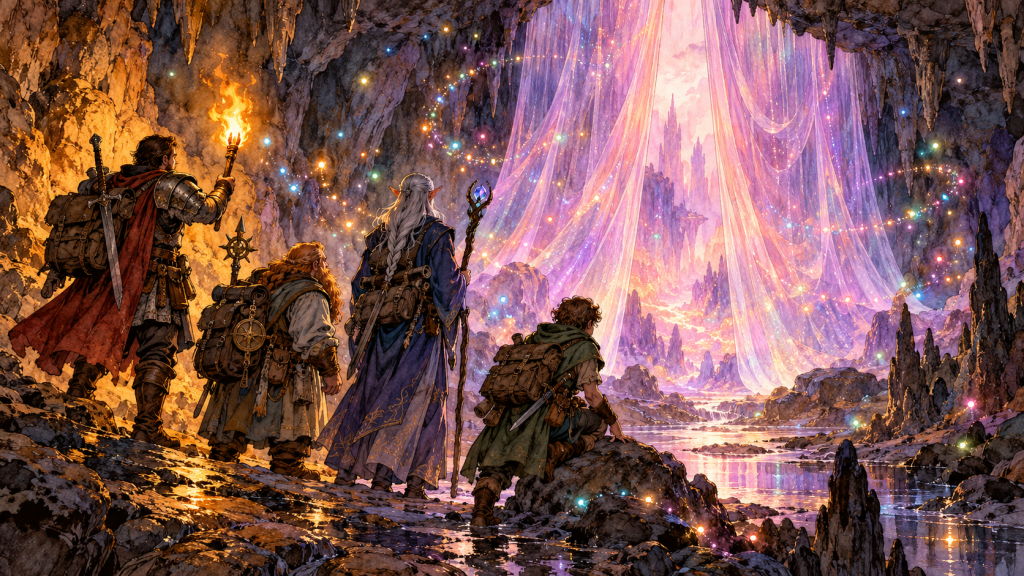
Beyond the Veil — Bringing Your Character into Erosia
Beyond the Veil lie worlds beneath unfamiliar stars. Those who cross carry their histories with them; Erosia offers another chapter.
Your character may have lived an entire life before seeing Erosia’s three moons. They may arrive bearing an oath sworn beneath another sky, a blade inherited from a distant kingdom, or memories of companions who remain beyond the Veil. Those things still matter. Bringing an existing character into Erosia begins with preserving the person you want to play.
Other Worlds, Unfinished Maps
Erosia exists within a reality larger than its mortal lands. Its cosmology recognizes other forms of existence, while leaving the full shape of creation uncertain. For a campaign welcoming travelers from other worlds, that uncertainty provides a doorway: distant realms may possess unfamiliar histories, peoples, gods, and traditions of magic.
Each table decides which worlds connect to its Erosia. Scholars need not possess a complete map of those connections. A traveler’s testimony can be compelling, disputed, incomplete, or misunderstood. The existence of a visiting hero does not require every Erosian to understand where they came from.
For the setting’s wider foundations, explore the Cosmology of Erosia.
Choose How Your Table Will Play
Bring an existing 5e character. Retain compatible ancestry, Class, Background, abilities, and equipment. Review edition differences, homebrew features, unusual magic items, and campaign-specific benefits with the GM. Agree on a level and equipment appropriate to the receiving party.
Bring a character from another game system. Rebuild that character using the rules of the Erosian campaign. Preserve their identity, defining talents, and role in the group. Levels, attributes, damage, and resources from different systems are not interchangeable; choose abilities that reproduce the character’s purpose rather than copying their numbers.
Visit Erosia using your existing system. A group can keep its familiar rules and use Erosia as its setting. The GM adapts creatures, challenges, rewards, and any desired Erosian mechanics to those rules. This approach requires preparation; this page provides a framework rather than a universal conversion formula.
What Crosses With You
Before rebuilding a character sheet, player and GM should identify the essentials: ancestry and appearance, personality, important relationships, beliefs, defining experiences, signature abilities, and treasured possessions. Choose two or three features whose loss would make the character feel unfamiliar.
An ancestral sword can keep its name, history, and appearance while receiving statistics appropriate to the new campaign. A distinctive magical talent might become a spell, feat, Class feature, or agreed narrative ability. Preserve meaningful strengths and limitations together.
A foreign ancestry does not automatically become a native Erosian people. A visiting adventurer may retain their own identity, vocabulary, and traditions. Erosian ancestries and Classes offer additional choices when the player wants them.
Five Ways Across the Veil
The CoreGuide offers five crossing origins. Choose one with the GM; the arrival itself grants no automatic mechanical benefit.
- Dreamfall Crossing. A dream becomes impossibly vivid, and the traveler awakens beneath unfamiliar moons.
- Divine Summon. A divine presence reaches through a vision, fragrance, song, or calling. Agree on why the character answers and what the invitation means.
- Ritual Slip. A spell, experiment, portal, or ceremony opens a passage to an unexpected destination.
- Moment of Climax. An emotional culmination—victory, grief, joy, revelation, or desperate resolve—coincides with the crossing.
- Chosen by the Veil. The traveler arrives without a clear explanation. Discovering the reason can become part of the campaign.
Doorways Where None Should Be
An entire adventuring party can cross together, in the middle of an otherwise ordinary expedition. The Veil might first appear as something wonderfully out of place: a curtain without a wall, a tunnel longer than the mountain containing it, or moonlight spilling from the back of a cupboard. These encounters give the crossing origins above a physical doorway. Choose one as the beginning of your party’s Erosian chapter.
The Curtain in Empty Air
In a ruined hall, a dungeon chamber, or the middle of an open field hangs a shimmering, veil-like curtain. No rod supports it. No breeze explains its movement. Beyond its translucent folds, the party glimpses trees that do not grow here and sunlight falling from the wrong direction. A hand pushed through feels warm rain. When the adventurers draw the curtain aside and pass together, their boots settle onto an Erosian road. Behind them, the last silver fold trembles in empty air.
The Mountain With Another Side
A narrow passage carves through the mountain ahead. The party enters expecting a shortcut through cold stone. As they travel, frost yields to moss, distant water begins to sing, and the air grows fragrant with flowers. The tunnel finally opens onto a lush valley beneath three moons. The mountain they entered belonged to their homeland; the mountains surrounding this valley appear on none of their maps.
The Wardrobe’s Far Door
While searching an abandoned manor or taking shelter in an unfamiliar inn, the adventurers discover that a wardrobe extends farther than its outer dimensions allow. Behind hanging coats, their fingers find a seam of cool light. A few steps between the garments become a corridor of roots and pale blossoms, opening at last into an Erosian garden. From this side, the doorway might stand within a hollow tree, a garden wall, or another wardrobe whose owner has been expecting visitors.
The Fairy Circle
A perfect ring of mushrooms waits in a forest clearing. Dew glitters along its edge even in the afternoon heat, and faint music falls silent whenever someone speaks. When the party steps inside, the surrounding trees seem to turn without moving. One step beyond the opposite edge brings them into a different woodland. Their trail is gone. Somewhere nearby, a bell sounds from an Erosian settlement. Perhaps the ring opens only at dusk, after an invitation, or when the travelers complete its circuit together.
The Door That Opened Too Far
A familiar escape spell becomes the threshold. During a wild magic disturbance, a casting of dimension door unfolds into a shimmering passage that lingers long enough for the gathered adventurers to follow. The destination is no longer the ledge, courtyard, or chamber the caster intended. They emerge beside an Erosian wayside shrine, where the candles lean toward the closing doorway as though greeting an old friend.
This is a GM-arranged story event, agreed as the campaign’s opening, rather than a new ordinary function of the spell. Decide which companions, mounts, and belongings cross with the party; the disturbance can account for the passage’s unusual capacity and duration.
Make the Threshold an Adventure
Give the party something to notice, investigate, and choose before crossing: a voice asking for help, footprints entering but never returning, an unfamiliar fragrance, or a glimpse of someone they seek. When the players have agreed to an Erosian campaign, their characters can still discover its doorway with surprise.
Decide what becomes of the passage after the last traveler crosses. It may remain open, appear only under particular conditions, travel to a different location, or fade until the party discovers how to reopen it. A misplaced doorway can begin a brief visit, a rescue expedition, or an entirely new life beneath Erosia’s moons.
Faith, Patrons, and Foreign Magic
Crossing into Erosia need not end a character’s existing faith or patron relationship. Establish how that connection functions before play, especially when abilities depend on it. The following explanations are campaign options for the GM and player to choose together.
Prayer might travel through the Veil. A sacred bond might remain within the traveler. An Erosian deity might offer hospitality to a foreign god’s servant. A patron might reach its follower only through dreams. Choose an explanation that supports the character’s agreed abilities.
Visiting priests can remain devoted to their own gods. Relationships with Erosia’s pantheon can develop through curiosity, friendship, disagreement, reverence, or rivalry. Divine attention does not require conversion.
Choose Your Engagement With Erosia
Agree on tone and mechanics before the first session. The current Mechanics of Desire and the table’s chosen rules govern how Erosian systems enter play. Do not assume that older adaptation packages or another game’s resistance rules translate automatically.
Players decide whether their characters pursue local traditions, divine relationships, or changes of form. Arrival alone does not impose a new body, allegiance, attraction, or intimate relationship. Establish boundaries and the level of mature content the group wants to explore.
A Worked Arrival
A player brings a veteran spear-wielding guardian from another fantasy game. Her defining features are protecting companions, holding a defensive line, and carrying her sister’s enchanted spear. The receiving Erosian campaign uses 5e.
Player and GM build her at the party’s agreed level, selecting abilities that support defense and interception. Her spear keeps its identity and receives an appropriate weapon profile and magic benefit within the campaign’s equipment budget. Her former numerical rank is not treated as a 5e level.
A Ritual Slip brings her into Erosia while she pursues a missing companion. Her sister, homeland, and vows remain part of her history. Whether she seeks a way home or begins building a life beneath the three moons becomes a question for play.
Before the First Session
Agree on six things: what the character must retain; their party role and power level; which abilities and possessions need adaptation; how they crossed; whether home and existing patrons remain reachable; and which Erosian themes and mechanics the table will use.
Decide whether returning home is possible, uncertain, or outside the intended campaign. A return route can become an adventure, but the player should understand the premise before committing their character.
Continue with Building Your First Erosian Character, explore Player Classes, or return to Play.
Related guides: The Veil explains the boundary between realities; Peoples of Erosia introduces native ancestries; and The Pantheon of Erosia explores the gods a visiting traveler may encounter. New readers can begin at Start Here.
You arrive with a name, a history, and a reason to keep walking. Beneath Erosia’s moons, the next step belongs to you.


