

Sylithra
The Overflowing • Mistress of Wetness, Release and Liquid Desire
Goddess of Overflow, Release and Abundance
Overflow • Wetness • Release
Watershare, bodily fluids, pressure, fullness, gushing, saturation, waterplay, emotional release, submissive release, clean and unclean reverence, abundance and the relief of finally letting go.
“Hold nothing back. Let every drop of you fall free.”
Sylithra is the goddess of fullness that becomes release: the vessel filled to its rim, the cloud finally breaking into rain, the tears that come after hours of composure and the body that can no longer pretend it has not been affected. She governs water, wetness, bodily honesty, emotional overflow, pressure, abundance and the strange relief that comes when something carefully contained is finally permitted to move.
Her worship is found anywhere mortals receive, hold and release. Innkeepers invoke her when filling another cup, bathhouse attendants when opening the morning pools, healers when fever finally breaks and mourners when tears return after grief has left them numb. Lovers call upon her when exploring wetness, bodily fluids, saturation, watershare, fullness, delayed release and the vulnerability of allowing another person to witness what the body expresses without shame.
Sylithra does not teach that restraint is meaningless. A cup must hold before it can overflow, a reservoir must gather before it can irrigate and anticipation may make release sweeter precisely because it was not immediate. Her faith instead questions the belief that holding forever is virtuous simply because nothing has yet spilled.
The faithful preserve three teachings above all others:
Receive without shame.
Hold with purpose.
When abundance overflows, let it move.
Lore & Mythos

When the First Lovers Could Hold No More
The oldest Sylithran creation traditions begin not with an ocean, storm or primordial sea, but with two lovers holding their breath. Velyssara had awakened desire throughout creation, and mortals had begun discovering what it meant to want, touch, fear, grieve and become overwhelmed by another person’s presence. According to the archives, the first lovers experienced more than either understood how to express. Breath remained trapped in their lungs. Tears gathered without falling. Desire tightened through the body while each struggled to maintain composure before the other.
They held. They continued holding until neither could.
What escaped them fell together upon the earth: tears, sweat, breath condensed upon skin and water gathered from the riverbank where they had met. The mingled drops began to shine. A ripple widened outward where no stone had fallen, then another answered it from farther away. From the center rose a woman laughing. Her skin gleamed like warm pearl beneath water. Turquoise hair streamed around her although no current moved. Droplets hung in the air beside her rather than falling, and the first lovers watched as she cupped their joined water between her hands.
Sylithra did not ask why they had lost control. She asked why they had believed losing it required shame. The story became the foundation of one of her oldest mysteries. Fullness is not failure, and the moment something exceeds containment may reveal what restraint had been hiding.
The River of First Desires
Another tradition places Sylithra’s awakening at the River of First Desires, an ancient waterway said to have carried every longing mortals were not yet able to name. The river remained calm for generations while unspoken yearning accumulated beneath its surface. No rain fell on the day it overflowed. The archives describe the water rising straight upward as though the world itself had exhaled beneath it. The river became a column, the column became a fountain and the fountain opened into the form of a woman whose long turquoise hair moved like submerged silk.
She stepped from the water carrying an empty silver chalice. The river immediately poured itself into the vessel. It filled, reached the rim and spilled across her hands, yet the chalice never became empty and the river never diminished. According to the story, Sylithra looked at the gathered mortals and said that they had misunderstood abundance. They had believed that something became precious because it could be kept.
Sylithra taught that some things become precious because they can be given. The River of First Desires remains central to her theology even among traditions that regard the story as allegorical. Its lesson is repeated in temples throughout Erosia: abundance is not merely possession; abundance is enough to continue outward.
The First Pearl
Nacrean traditions preserve a third and considerably older-sounding mystery concerning Sylithra’s form. They claim that before the Nacreans existed, the deepest waters of Erosia held a single luminous pearl unlike anything produced by shell, beast or magic. The pearl did not remain still. It absorbed moonlight, tides, rainfall, tears and the mineral memory of the sea until its surface began to move like living flesh. When pressure within it finally became greater than its perfect surface could contain, the pearl opened rather than breaking.
Sylithra stepped out. Some Nacrean theologians therefore call her the First Pearl, claiming that their people’s luminous bodies descend symbolically or literally from the same mystery. Other traditions reverse the relationship and teach that Sylithra later adopted a Nacrean form because no mortal people better expressed beauty created through water, pressure and reflection. Flowkeepers rarely attempt to settle the dispute. A traditional answer asks whether the pearl comes from the water or the water learns beauty from the pearl, and most priests consider the question more useful than certainty.
The Cup That Refused to Empty
A beloved temple story concerns a poor roadside innkeeper who encountered Sylithra without recognizing her. A drought had left the settlement’s cistern nearly empty, and the innkeeper possessed only one pitcher of clean water for the night. A traveler arrived after sunset and asked for a drink. The innkeeper hesitated. Giving away the water might leave none for the household before morning, but the stranger was visibly exhausted. Finally, the innkeeper filled a cup.
Another traveler arrived. The innkeeper filled another. A third came after midnight, followed by a wounded courier, an elderly pilgrim and two frightened children separated from their caravan. Each time the innkeeper looked into the pitcher and found enough water for one more cup. By dawn, the vessel was still not empty. The first traveler returned wearing turquoise silk, pearls and a smile the innkeeper suddenly recognized from temple paintings. Sylithra thanked the innkeeper for understanding her miracle before ever seeing it.
The sacred wonder was not that the pitcher contained endless water. It was that the innkeeper kept pouring. The story remains especially popular among hosts, healers and communities responsible for wells or public water. Sylithran clergy use it to distinguish generosity from spectacle: abundance matters because someone is willing to let it move.

The Desire She Embodies
Sylithra embodies the desire to fill, overflow and release. Her sacred current begins wherever something enters a vessel, gathers there and eventually reaches a point at which remaining contained is no longer the only meaningful possibility. The vessel may be physical. A cup fills with water, a cistern with rain, a body with sensation or a bath with warmth. The vessel may also be emotional. A person fills with grief, laughter, longing, frustration, relief or desire until expression becomes increasingly difficult to prevent. Sylithra’s theology therefore describes life through five movements:
Receive. Fill. Hold. Overflow. Share.
No single movement is inherently superior. Receiving without ever holding creates no form. Holding without ever releasing becomes stagnation. Releasing without awareness may become waste, while sharing transforms personal abundance into something capable of sustaining relationship and community.
The Sacred Vessel
The vessel is one of Sylithra’s central religious metaphors. Her faithful reject the idea that a vessel exists merely to prevent its contents from escaping. A chalice gives wine shape so that it may be carried and offered. A cistern protects water until drought makes that water necessary. A body contains sensation long enough to understand it. A heart carries emotion until the moment arrives when someone is ready to express it. Containment therefore has purpose.
The error begins when containment becomes identity. Sylithran teachers frequently ask worshippers whether they still know why they are holding something. Someone may be preserving a secret because disclosure would be dangerous, delaying pleasure because anticipation is desired or setting aside grief because immediate survival requires action. Those forms of restraint may be wise. Someone else may be refusing to cry because they were taught tears are weak, denying exhaustion because rest feels shameful or pretending not to need affection because need has become confused with failure. Sylithra views these situations differently.
The vessel is sacred because it gives form. It is not sacred because it can suffer indefinitely.
Fullness and the Sacred Pressure
Pressure occupies a complex place within Sylithran theology because fullness cannot always be understood without it. A vessel nearing capacity changes. The body notices. Attention sharpens. Small movements suddenly matter. This is why pressure appears throughout both public and intimate Sylithran ritual. A worshipper may carry a full cup carefully across a temple floor, learning how awareness changes when spilling becomes possible. Another may remain silent during guided emotional meditation until they consciously decide to speak. Lovers may incorporate consensual fullness, delayed release or controlled water rites into private devotion because the transition between still holding and no longer holding has become spiritually meaningful.
Pressure is not sacred merely because it is difficult. The faithful distinguish chosen pressure from imposed suffering. A challenge may reveal capacity, but forcing someone beyond their limit does not become holy because the person eventually breaks. Sylithran teaching summarizes the distinction through three questions:
What are you holding?
Why are you holding it?
What will tell you that it is time to release?
A worshipper who cannot answer the second or third question may have ceased practicing restraint and begun practicing denial.
Overflow and Bodily Honesty
Overflow is the instant something can no longer remain entirely hidden within the vessel.
Tears move across the face. Sweat appears after exertion. Breath becomes audible. Laughter escapes despite an attempt to remain composed. A body responds visibly to sensation or desire.
Sylithra calls these moments the body speaking plainly.
The faithful do not claim every involuntary response reveals a person’s intention. Tears do not prove agreement. Arousal does not establish consent. Fear does not necessarily mean refusal, just as laughter does not necessarily mean comfort.
Physical response is information, not authority.
Yet Sylithra teaches that bodily responses deserve neither disgust nor moral judgment merely because they reveal what composure could not conceal. A worshipper may blush, sweat, tremble, become wet, cry or lose carefully maintained dignity without having become lesser.
Some experiences are simply larger than containment.
Watershare & the Moving Gift
Watershare extends Sylithra’s theology beyond individual release. What leaves one vessel may enter another, and what one person possesses in abundance may become part of someone else’s survival, comfort, pleasure or experience. The most ordinary watershare is hospitality. A traveler receives water from another person’s cup. Bathers pour clean water over one another’s shoulders. A healer wets cloth for a fevered patient. A grieving worshipper allows tears to be wiped away by someone trusted.
More intimate traditions broaden the idea to include tears, sweat, scented oils, sensual wetness and other mutually accepted bodily fluids. The theological principle remains constant regardless of expression: something personally carried is willingly offered, and another person willingly receives it. The shared substance does not create holiness by itself. The offering does.
Submissive Release
Sylithra’s domain overlaps naturally with submission, but her understanding differs from Solynth’s devotion to yielding and Mirellune’s structured surrender. Sylithran submission centers upon relinquishing the effort to remain contained. A person may ask another to decide when a held position ends. They may ask to be told that they no longer need to maintain composure. They may allow themselves to cry while someone keeps them safe enough not to gather the tears back behind control. In erotic practice, a devotee may find pleasure in another trusted person witnessing the moment restraint gives way. The intimacy arises not merely from release but from being known at the exact moment control is voluntarily loosened.
Sylithran clergy sometimes call this the Permission to Flow. Its spiritual language is simple: I can stop holding now because I trust what happens when I do.
Clean & Unclean Reverence
Sylithra’s relationship with cleanliness is frequently misunderstood by outsiders. Her worship celebrates bodily fluids, mud, sweat, soaked clothing, shared water and forms of physical messiness, yet Sylithran temples are often among the cleanest religious institutions in Erosia. The apparent contradiction is intentional. Sylithra teaches that cleanliness is care, while shame is judgment.
Sweat can be washed away without treating labor as disgusting. Blood can be cleaned without condemning the wounded. Tears can be wiped without apologizing for grief. Sexual fluids can be handled hygienically without declaring desire filthy. A bath may be sacred precisely because bodies become dirty. A towel may be sacred because someone deserves warmth afterward. Flowkeepers are therefore meticulous about drinking water, drainage, laundering, bath maintenance and safe handling of ritual fluids. They reject the belief that something requiring cleaning must also deserve contempt. Among Sylithrans, this doctrine is known as Clean and Unclean Reverence.
Holy Symbol & Iconography
The Overflowing Chalice
Sylithra’s canonical holy symbol is the Overflowing Chalice, an ornate silver vessel surrounded by curling turquoise waves and enclosed within a graceful circular arch. Three droplets descend from a pearl-centered eight-pointed star toward the chalice, while water spills continuously across both sides of its rim. The chalice represents the sacred vessel. It receives, contains and gives form without claiming that containment must continue forever. The water represents abundance in motion. It arrives from above, gathers within the vessel and then continues beyond the vessel’s edge.
The descending droplets represent what is freely received: nourishment, emotion, affection, experience, desire and divine grace. The overflowing sides represent what can be returned to the world once enough has gathered. The surrounding waves express consequence and relationship. Release does not end simply because something has left the original vessel. It moves outward, creates ripples and enters new places.
The central pearl reflects Sylithra’s Nacrean form and the theology of beauty shaped through pressure. Its placement above the chalice also carries another meaning: what comes from pressure need not emerge damaged. A common Sylithran catechism interprets the symbol through four lines:
The vessel receives.
The water gathers.
The rim releases.
The current continues.

Older Symbols
The archives preserve a simpler emblem consisting of a single droplet surrounded by three expanding ripples. This symbol remains common on inexpensive devotional jewelry, tattoos, household shrines and waystones beside wells. Older temples occasionally combine both forms. A pilgrim may enter through a doorway bearing the ancient droplet and reach an inner sanctuary dominated by the Overflowing Chalice, visually presenting the historical development of Sylithran theology from release alone toward release as part of a larger cycle of abundance and sharing.
Sacred Colors and Materials
Sylithran sanctuaries favor turquoise, aqua, seafoam, pearl-white and silver, with prismatic accents created by light refracting through moving water. Turquoise represents living flow, aqua represents clarity, pearl-white represents pressure transformed into beauty and silver represents reflection without permanence. Rainbow color appears differently from the dominant palette. It is rarely applied directly to walls or garments. Instead, it emerges when light passes through droplets, mist, crystal or water, making color itself appear to be a temporary consequence of movement.
Common sacred materials include mother-of-pearl, polished silver, translucent glass, river stone, smooth pale marble, aquamarine, ceramic vessels, woven towels, fine gauze, silk and enchanted fabrics that behave like water. An expensive vessel carries no automatic spiritual superiority. A clay cup that has served travelers for decades may be more revered than a jeweled chalice never used to give anyone a drink.
Droplets, Ripples and Flowing Vessels
Droplets are Sylithra’s most common secondary symbol. They appear on jewelry, temple mosaics, clothing hems, bath tiles, piercings, devotional markings and ceremonial utensils. Ripples represent consequence. The faithful use concentric circles in floor mosaics, pools and architecture to remind worshippers that even small acts travel farther than the point where they began. Jugs, pitchers, fountains, overflowing bowls and basins appear throughout the faith. Containers are rarely depicted sealed. Sylithra’s visual language constantly returns to the same image: something full enough that its abundance has somewhere else to go.

Sacred Creatures
Otters, river dolphins, rain frogs and pearl-backed koi are strongly associated with Sylithra. Otters symbolize play within water and the ability to move between work, rest and delight without treating joy as wasteful. River dolphins represent social exchange, communication and the way movement becomes easier when performed together. Rain frogs symbolize release after pressure. Their calls frequently begin before or during storms, and many Sylithran communities interpret the first chorus after a dry season as a natural hymn to the goddess.
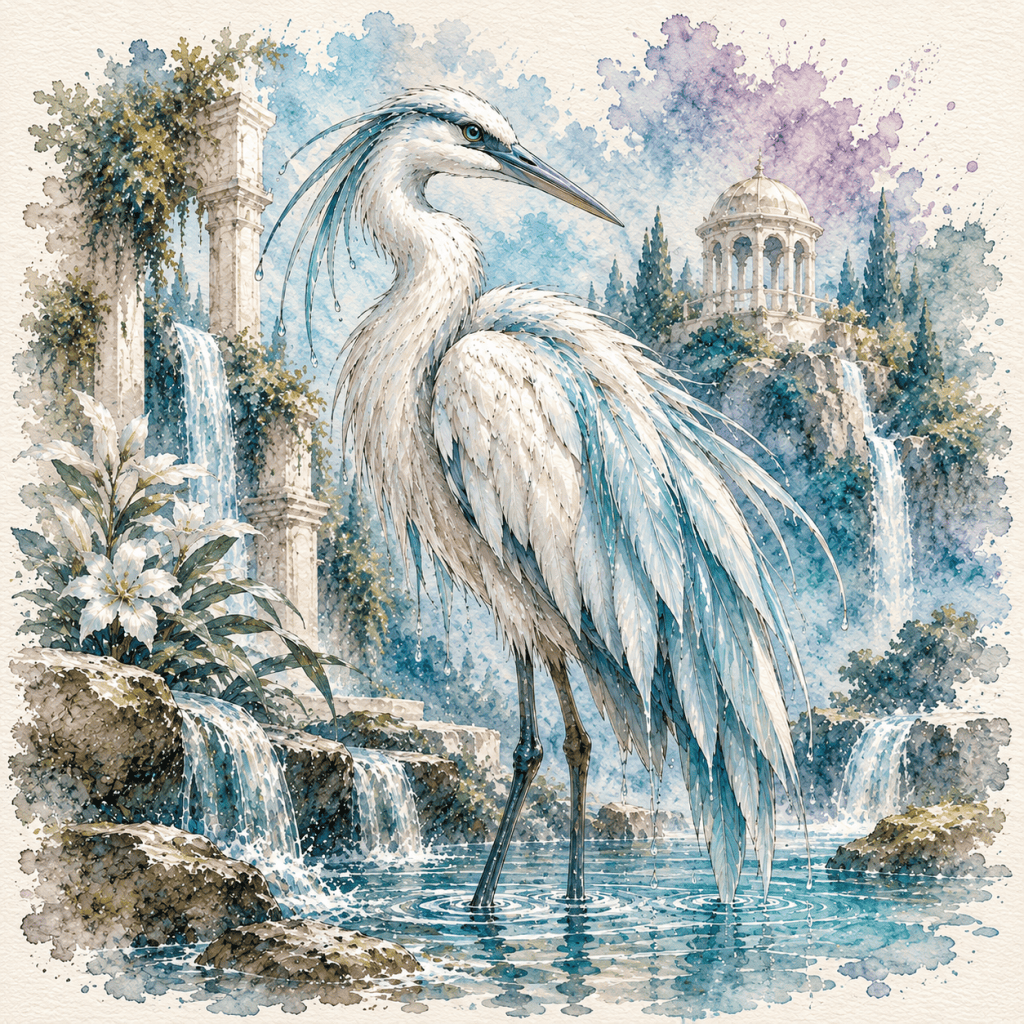
Pearl-backed koi represent fullness transformed rather than discarded. Temple pools often contain varieties bred for luminous nacreous scales that catch turquoise and silver light. Stories also describe Overflowing Herons, pale celestial birds whose feathers appear perpetually wet. They are said to appear near communities where water has been shared generously during drought or where someone has finally released grief carried far too long.
Depictions of Sylithra
Sacred art portrays Sylithra as a mature, voluptuous goddess whose divine body takes a distinctly Nacrean form. Her skin appears warm champagne-pearl rather than ordinary mortal flesh, carrying nacreous reflections of aqua, rose, pale violet, silver and soft gold as light moves across it. Her hair is unmistakable. Extremely long turquoise locks drift continuously as though submerged, even when she stands in open air. Individual strands may curl against gravity, become translucent at the tips or briefly dissolve into droplets before reforming. Her eyes are luminous aqua and often appear deeper than ordinary irises, as though clear water extends behind them. Pearls, silver teardrops, aquamarine ornaments and graceful flowing jewelry decorate her body without overwhelming its natural luminosity.
Sylithra’s ceremonial raiment consists primarily of liquid silk, translucent pearl-white and aqua fabrics that behave partly like cloth and partly like water. They cling, drift, separate into ribbons and sometimes dissolve at the edges into streams or suspended droplets. She is frequently depicted barefoot in shallow water, holding an overflowing chalice or silver vessel. Water may curl around her ankles, float beside her hands or move upward rather than falling. Her expression matters as much as the supernatural effects. Sylithra is rarely stern.
She is affectionate, knowing, playful and remarkably difficult to embarrass. The viewer should feel that the goddess has already noticed whatever they are trying desperately to conceal and has no intention of shaming them for it. The canonical visual truth remains: Nothing is scarce. Nothing is stagnant. Nothing is entirely contained.

Worship & Daily Devotion
Sylithra can be worshipped almost anywhere liquid moves from one place to another. Pouring water for someone can be prayer, cleaning a shared bath can be prayer and finally allowing oneself to cry after a difficult day can be prayer when the act is approached with intention. Her worship attracts bathhouse attendants, brewers, vintners, cooks, innkeepers, sailors, irrigators, healers, midwives, well-keepers, laundry workers, canal builders, performers, lovers and people whose lives have taught them to confuse composure with worth.
The First Pour
Before opening a new cask, pitcher, well or cistern, many devotees pour a small amount into a secondary vessel rather than consuming the first measure themselves. The water or drink is then given to another person, poured into a communal basin or returned to soil.
The rite teaches that abundance begins to reveal itself when the first instinct is not possession. In taverns with strong Sylithran traditions, the first cup drawn from a new barrel is sometimes called the Goddess’ Cup, although the goddess is understood to receive it only when someone else drinks.
The Full Cup
A simple household devotion involves filling a cup almost exactly to its rim. The worshipper carries it slowly from one place to another while paying close attention to the surface of the water.
The exercise is deliberately ordinary. It teaches awareness of pressure, balance and capacity without demanding suffering or spectacle.
After reaching the destination, the worshipper drinks what they need and gives the remainder to another person, an animal or growing plant. The rite joins containment and generosity within a single act.
The Open Basin
Many Sylithran households keep a small bowl or basin near the entrance filled with clean water. Guests may wash their hands, cool their face or simply touch the surface after a long journey. The practice is both hospitality and blessing. A home declaring that clean water is available without negotiation places itself deliberately within Sylithra’s current.
Wet-Feasting
Wet-Feasting is among the most cheerful expressions of Sylithran worship. Meals favor ripe fruit, soups, sauces, cider, wine, sweet drinks and foods that burst, drip or spill when eaten.
Formal etiquette relaxes deliberately. Guests laugh at stains. Cups are filled close to overflowing. Fruit juice runs over fingers. Napkins and washing basins remain readily available because Sylithran celebration rejects shame, not cleanliness.
A person who spills a drink during a Wet-Feast is commonly told, “Sylithra wanted a taste.” The phrase is usually followed by someone handing them a cloth.
The Rain Welcome
In regions where droughts are common, the first significant rain after a dry season may bring entire communities into the streets. People place bowls, cups and basins outdoors while children and adults alike dance, laugh or simply stand beneath the falling water.
Temples ring silver bells and open their courtyards. Not every Rain Welcome is exuberant. Farmers who feared losing a season may simply stand in silence while rain reaches the soil, and that quiet relief is considered no less devotional than celebration.
Favored Offerings
Traditional offerings include clean water, aquamarine, pearls, ripe fruit, wine, juice, scented bathing oils, handmade cups, silver bowls, towels, soaps, rainwater collected during meaningful storms and vessels repaired rather than discarded. The most respected offerings usually continue to serve someone after they reach the temple. Drinking water is given away, fruit is eaten, towels enter public baths and useful vessels become part of temple kitchens or sanctuaries. Wasting something useful solely to prove that one possessed enough to waste is considered a misunderstanding of abundance.

Clergy & Temples
Flowkeepers
Flowkeepers form Sylithra’s primary priesthood. They tend sacred pools, public baths, wells, cisterns, kitchens, emotional sanctuaries and rites of release. Their ministry is both spiritual and practical.
A Flowkeeper may spend one morning counseling a grieving worshipper, the afternoon inspecting drainage beneath a temple bath and the evening officiating an intimate watershare rite. None of these responsibilities is regarded as less priestly than another.
Flowkeepers typically wear loose turquoise, pearl-white and seafoam garments designed to tolerate water without becoming cumbersome. Silver droplet jewelry, pearl ornaments and small chalices mark formal office, while working clergy often favor simpler wraps, robes and practical sandals.
A common Flowkeeper saying expresses their responsibility: “Every flow must have somewhere to go.” The phrase applies equally to temple plumbing, grief, desire and divine power.
Wellwardens
Wellwardens protect clean water and the infrastructure that carries it. They inspect wells, cisterns, aqueducts, canals and irrigation systems while organizing emergency distribution during drought, flood or contamination. Many possess training as engineers, healers, druids or local officials.
Their religious authority becomes particularly important during scarcity. Sylithran doctrine celebrates abundance, but precisely because water is sacred, hoarding or poisoning it becomes an especially serious offense.
Wellwardens often carry a silver ladle or measuring cup as their sign of office. The tool represents both generosity and accountability: one cannot share responsibly without first understanding what is actually available.
Mistkeepers
Mistkeepers specialize in emotional release, private confession, grief work and rites for those who struggle to express what they feel. Their chambers frequently contain running water, warm pools, towels, cushions and quiet alcoves where visitors may speak without being observed by the wider congregation.
Their title derives from the mist that forms when warm water meets cool air.
Mistkeepers teach that emotion can become visible without becoming public property. Crying before a priest does not grant the priest ownership over the story behind those tears.
Cupbearers
Cupbearers preserve Sylithra’s traditions of hospitality, feasting, drink and shared abundance. They oversee temple kitchens, festival tables, guest houses, brewing halls and the distribution of food and water to travelers. Many become respected hosts, tavern keepers, cooks or vintners outside formal temple life. The office carries a simple responsibility: no one should leave a Sylithran table thirsty because the host was too concerned with preserving appearances to notice an empty cup.
Houses of the Overflow
Sylithra’s temples are commonly called Houses of the Overflow, though regional names include Flowing Houses, Chalice Sanctuaries, Houses of Rain, Pearl Baths and Temples of the Open Basin. Water defines the architecture. Reflecting pools occupy courtyards. Narrow channels run beneath polished walkways. Waterfall veils divide chambers where walls or doors might otherwise stand. Steam rooms, bathing chambers, kitchens, laundries, gardens and public cisterns often surround the central sanctuary.
The most sacred chamber usually contains a large version of the Overflowing Chalice above a pool fed by several separate streams. Water enters from different directions, gathers briefly and then leaves through channels carrying it elsewhere in the temple. Every major pool has visible drainage. This is deliberate theology rather than merely good engineering.
A basin designed only to receive eventually stagnates. Sylithran temples also contain private spaces. Public bathing is common in cultures comfortable with it, but no religious principle requires communal exposure. Private baths, curtained pools and quiet washing rooms are equally legitimate expressions of the faith. A visitor chooses how visible they wish to become.

Rites, Taboos & Divine Signs
The Rite of First Flow
The Rite of First Flow is one of Sylithra’s oldest ceremonies. A participant enters warm water carrying something they have struggled to contain: grief, anger, fear, exhaustion, shame, desire or an unspoken truth. A Flowkeeper guides breathing and conversation without demanding a particular outcome.
The worshipper may cry. They may laugh. They may finally speak. They may discover that what they thought needed to be released actually needs more time. The rite is successful when the participant becomes more honest about what they are carrying, not when a priest produces a dramatic emotional response. At the conclusion, the worshipper pours a cup of water into the pool. The existing water receives it without asking where it came from.
The Cleansing Cascade
The Cleansing Cascade is a bathing rite devoted to the distinction between care and shame. Participants wash themselves or willing companions while naming something about their bodies, emotions or desires they have been taught to consider dirty merely because it required management, cleaning or privacy. Water is poured slowly rather than dramatically. The ritual teaches that washing is an act of respect for the body, not an apology for possessing one. Public versions may be performed in light ceremonial garments or bathing wraps. Private versions range from solitary washing to intimate rites between lovers.
The Rite of Saturation
During the Rite of Saturation, participants enter a sacred pool wearing lightweight ceremonial clothing and remain until the garments become completely soaked. The transformation carries the symbolism. Dry cloth initially floats and resists the water. Gradually it absorbs, changes weight, clings differently and becomes visibly altered by its environment. The devotee does not remain untouched. Neither are they diminished because experience has left a visible mark. Some temples conclude the rite by wrapping each participant in a warm dry robe. The change back matters because Sylithra does not teach that one must remain permanently saturated to prove that the water was real.
The Rite of the Shared Cup
The Rite of the Shared Cup is the most widespread public expression of watershare. Two or more participants pour water from separate vessels into one larger chalice, then receive portions of the mingled water. Each contribution becomes part of something shared without ceasing to have originated somewhere specific. The rite appears in friendships, partnerships, adventuring companies, marriages, reconciliation ceremonies and communities joining water rights or irrigation systems. Intimate traditions may substitute or incorporate other mutually accepted fluids, but the public rite traditionally uses clean water or sacramental drink.
The Rite of the Open Stream
The Rite of the Open Stream is practiced between willing partners using water, oils or other mutually accepted fluids traced or poured across the body according to established boundaries. Its meaning is exchange. One person gives. Another receives. Roles may then reverse. The rite may remain gentle and nonsexual, or it may become part of a more intimate experience according to the participants’ wishes. Sylithran clergy treat neither version as spiritually superior.
The Rite of the Gushing Heart
The Rite of the Gushing Heart belongs primarily to Sylithra’s erotic mysteries. It explores the progression from fullness through deliberate restraint toward freely chosen release. Participants establish what kind of pressure is desired, what constitutes a limit and how the rite will end before beginning. The sacred element is not simply intensity. It is the transition between I am holding and I no longer need to hold. Older traditions frequently combine the rite with soaked fabric, warm water, vessels, fountains or ceremonial chalices. Contemporary Flowkeepers preserve the symbolism while remaining explicit that involuntary bodily reaction never replaces the participant’s continuing agency.
The Broken Hold
The Broken Hold is an unusual Sylithran rite because its purpose is compassionate rather than celebratory. It is offered to someone who did not intend to release when they did and feels embarrassment, grief or humiliation afterward. A Flowkeeper helps clean the space, replaces wet or stained clothing if necessary and treats the event without ridicule. The rite exists because Sylithran theology recognizes an uncomfortable truth: not every overflow is chosen. Bodies fail to maintain control. Grief arrives at inconvenient moments. Fear, exhaustion, illness and overwhelming sensation may exceed intention. Sylithra does not demand that the person call the event pleasurable or sacred. The sacred act is the compassionate response.
The Great Prohibition
Sylithra possesses many customs, but one prohibition stands above them: No one may force another person’s overflow and call it release.
Deliberately pushing someone beyond an agreed bodily, emotional or erotic limit is not sanctified because fluid, tears or visible response eventually appeared. Coerced watershare, forced exposure, deliberate contamination, humiliation imposed as truth and denying necessary relief to exercise power over another person are serious violations of the faith. The same principle applies to emotional life. A person may not demand confession merely because they believe another is “holding too much.” They may offer safety, invitation and time. The vessel still belongs to the person carrying it.
Sylithran teaching preserves the distinction clearly: Release offered is sacred because it was offered. What is forced has already ceased to belong to Sylithra.

Signs of Sylithra
Sylithra’s favor often arrives as moisture where none should exist. Condensation gathers upon one cup while the surrounding vessels remain dry, bathwater warms when a favored person enters and small droplets appear on skin despite dry air. Water may respond visibly to strong emotion. A basin ripples when someone finally speaks the truth. Tears briefly catch aqua or pearl light. Spilled water curves toward rather than away from a favored person before resuming its natural path.
Hair may drift for several heartbeats as though submerged. Those strongly marked by Sylithra sometimes develop temporary droplet-shaped markings at the sternum, hip or thigh. The marks resemble luminous nacre beneath the skin and brighten during moments of profound emotional honesty or chosen release.
The rarest sign is called the Rising Drop. Several droplets lift from a nearby surface and remain suspended around the favored person. They fall only when something long contained has finally been expressed.
Sylithra and the Velvet Court

Within the Velvet Court, Sylithra embodies Overflow, Release and Abundance in Motion. Where Velyssara affirms desire as a sacred current of life, Sylithra governs what happens when that current fills the vessels through which mortals experience it. Her place within the Court often marks a transition. Other gods teach longing, discipline, endurance, pursuit, surrender or nourishment. Sylithra asks what becomes of what has accumulated when the point of containment has finally passed.
Her relationship with Aratheia is especially close because both govern abundance, but they understand it through different sacred motions. Aratheia nourishes by providing what another life needs. Sylithra circulates by allowing what has gathered to move onward. Aratheia asks, Who needs to be fed? Sylithra asks, What is full enough to share?
With Solynth, Sylithra shares the relief of relinquished control. Solynth teaches that someone may safely choose not to lead. Sylithra teaches that someone may safely choose not to hold. Their worship overlaps in rites of emotional surrender, permission, comfort and intimate release. Her relationship with Delavira is more playfully contradictory. Delavira governs the exquisite power of not yet. Sylithra governs the moment not yet becomes now.
Their priesthoods collaborate frequently in rituals of anticipation and release while arguing good-naturedly over which moment contains the greater pleasure.
Sylithra also respects Nyzun’s understanding of limits. Nyzun asks what sensation reveals at the Edge, while Sylithra asks what should happen once the vessel reaches capacity. Neither deity considers a limit shameful. They simply attend to different sides of it.

Miracles & Divine Presence
Sylithra’s miracles often resemble the world briefly becoming more generous than it should be. A nearly empty pitcher fills one additional cup, a dry well produces enough water for the travelers standing beside it or a bath remains warm long after the fire has gone cold. Small manifestations frequently involve emotion. Someone unable to cry for months suddenly discovers tears moving freely. A frightened person who has been unable to speak takes one breath and finds the words. A room filled with tension may hear the distant sound of water although no fountain stands nearby.
Stronger manifestations alter the behavior of water itself. Droplets rise from pools. Streams arc upward before falling. Rain pauses several feet above the ground and hangs glittering beneath moonlight. Hair and loose fabric begin moving as though submerged. Refractions appear on walls where no prism should exist.
When Sylithra’s presence becomes overwhelming, every open vessel nearby may slowly fill to its rim. None overflows immediately. The room waits. Someone speaks what everyone has been avoiding. Then every vessel spills at once.

The Impossible Extra Cup
One of Sylithra’s most common minor miracles is known as the Impossible Extra Cup. A nearly empty vessel unexpectedly contains enough for one more person who genuinely needs it. The miracle never creates lavish abundance. It creates enough. Flowkeepers regard that distinction as important because Sylithra’s generosity is not spectacle for its own sake. The miracle exists to prevent someone from being excluded when sharing was still possible.
Tears of Clear Water
During moments of extraordinary emotional release, a person’s tears may become perfectly clear and catch turquoise light. Those touched by the tears sometimes experience sudden calm or an intuitive understanding that the emotion being expressed no longer needs to remain hidden. The effect does not erase grief. Sylithra rarely removes what a person feels. She allows it to move.
The Overflowing Threshold
Some temples report a more unusual manifestation in which water begins flowing beneath a closed door from a completely dry room. When the door is opened, no flood is found inside. Instead, someone within is usually experiencing an emotional or divine crisis they believed no one else had noticed. Flowkeepers interpret the omen carefully. It is an invitation to check. It is not permission to intrude.
What Her Faith Teaches
Sylithrans believe that having a limit is not a moral defect. Bodies become tired, hearts become overwhelmed, cups become full and even strong people eventually reach places where continued containment accomplishes nothing except proving that suffering can continue. This does not make endurance worthless. A person may need to hold. A healer may postpone grief until the wounded are safe. A traveler may ration water. A lover may deliberately delay release because anticipation is desired. A leader may set aside fear long enough to guide others through danger. Sylithra’s question is whether the holding still serves its original purpose. If it does, the vessel remains useful. If it does not, the faithful ask why the person believes cracking would be more honorable than pouring.
Need Is Not Failure
Sylithran theology rejects the idea that mature or capable people should become free of need. Thirst, rest, touch, privacy, release, affection and emotional expression remain part of embodied existence. A worshipper does not prove strength by never needing another person. They prove self-knowledge by recognizing when need has become real enough to name. The faith therefore treats requests for water, rest, comfort or private relief with unusual seriousness. A person who asks before reaching collapse has not failed to endure. They have learned to read the vessel.
Restraint Is a Tool
Restraint has value because it can create timing, form and intention. Without any containment, much of what Sylithra governs would simply disperse before becoming meaningful. The faithful therefore reject the caricature that their goddess teaches impulsiveness. Sylithra does not demand immediate confession, constant indulgence or the abandonment of privacy. She asks whether restraint remains chosen and useful. One temple teaching summarizes this through the chalice:
The vessel gives water shape. The water gives the vessel purpose. The overflow gives abundance away.
Release Does Not Need to Be Beautiful
One of the faith’s gentlest teachings concerns dignity. Release is not always graceful. People cry badly. They laugh at funerals because tension finally breaks. They spill drinks. They sweat. They stain clothing. They become flushed, wet, breathless or embarrassed. Sylithra does not require mortals to transform every vulnerable bodily moment into elegant sacred theater. Sometimes the floor gets wet. The floor can be washed. The person matters more.
Enough Becomes Abundance When It Moves
Sylithra distinguishes fullness from abundance. Fullness means the vessel has enough. Abundance begins when there is enough for something to continue beyond the vessel. This is why sharing occupies such an important place within her worship. A full cistern during drought is potential abundance. It becomes holy when someone opens the channel. A person possessing comfort may offer it.
A household with spare water may fill a traveler’s cup. A worshipper whose own tears have finally fallen may one day become the person who sits quietly beside someone else waiting for theirs. In Sylithran theology, generosity is not a separate virtue added onto overflow. It is overflow given direction.
At the Table
Sylithra works particularly well as a patron for characters concerned with water, healing, hospitality, emotional honesty, bodily autonomy, release, abundance or learning when endurance has ceased to serve them. Her presence belongs naturally in bathhouses, ports, river settlements, breweries, healing halls, inns, irrigation communities, pleasure sanctuaries and adventuring parties repeatedly forced to decide how limited resources should be shared. A Sylithran NPC does not need to be an erotic ritualist. They might be the innkeeper who fills a traveler’s cup before asking for coin, the engineer obsessed with keeping a city’s aqueducts flowing or the veteran who sits beside a young soldier having their first uncontrollable cry after battle and simply hands them a cloth.
A distinctly Sylithran question might be: “Are you still holding because it serves you, or because you are afraid of what happens if anyone sees you let go?”
That question can apply to grief, magic, responsibility, anger, exhaustion, desire or a literal full vessel.

Sylithran Characters
Characters drawn toward Sylithra commonly include healers, hosts, sailors, brewers, cooks, druids, water mages, bathhouse attendants, performers, caregivers, courtesans and adventurers whose lives repeatedly confront pressure, scarcity or emotional restraint.
Her faith also suits characters whose relationship with control is unhealthy. A warrior may refuse to cry because composure became inseparable from identity. A healer may continue helping others long after exhaustion makes them unsafe. A noble may possess immense wealth yet be incapable of sharing anything without calculating return.
Conversely, an impulsive character may misunderstand Sylithra and need to learn that release without awareness is not freedom. The vessel matters too. These are Sylithran conflicts.
Divine Domains and Traditions
The archives associate Sylithra with themes of Water, Passion, Cleansing and Emotion, along with the Oath of the First Flow, Oath of Unrestrained Devotion, College of Cascades, College of Liquid Song, Circle of Rivers, Pact of the Wet Veil and Pact of Overflow.
These names remain useful expressions of her religious traditions, though their original mechanics predate current Second Bloom standards. Future Sylithran options should emphasize water in motion, relief, overflow, redistribution, emotional expression, movement through restraint and the transformation of accumulated pressure into useful effect.
They should not reduce Sylithra to “the deity who makes people wet.” Her mechanical identity should be something gathers, reaches capacity and then changes what happens when it is released.
Boons of Sylithra
Older Sylithran material supports blessings involving easier movement through water, escape from restraint, healing through release, the creation or purification of limited amounts of water and the ability to redirect a gathered force instead of simply enduring it. Future mechanics should preserve that identity. A Sylithran blessing ought to feel different before and after a threshold is reached. The character gathers, holds, redirects or releases rather than receiving a passive numerical bonus with no relationship to her theology.
(Needs updated mechanics: Base 5e → Veiled → Unveiled.)
The Overflow
The strongest mechanical concept for Sylithra is Overflow: a divine effect that becomes available after a character has accumulated pressure, endured a condition, stored healing, received damage or otherwise reached a clearly defined threshold. The release might restore an ally, create movement, cleanse a condition, produce water or convert accumulated strain into another effect. In Veiled and Unveiled play, the same structure can interact naturally with Arousal, Libido and Climax without making physical response equivalent to consent. The underlying rule should remain recognizable even when Desire mechanics are not being used.
(Needs updated mechanics: Base 5e → Veiled → Unveiled.)
Sacred Relics

Bowl of the Overflowing Heart
Wondrous item, rarity to be determined
The Bowl of the Overflowing Heart is a wide silver basin engraved with concentric ripples and set with a single luminous pearl beneath its rim. Clean liquid poured into it develops a faint turquoise glow and remains unusually fresh. The oldest stories claim the bowl cannot be emptied while its contents are being freely given to someone in genuine need. Attempts to exploit the miracle for commercial storage, hoarding or endless production cause the vessel to become perfectly ordinary until returned to a shrine.
Some temples insist there is only one authentic bowl. Others claim Sylithra has made several because insisting abundance can possess only one vessel would be an unusually foolish doctrine for her worshippers to defend.
(Needs updated mechanics: Base 5e → Veiled → Unveiled.)

Tearstone Amulet
Wondrous item, rarity to be determined
A Tearstone Amulet consists of a polished aquamarine droplet suspended from a silver chain. The stone becomes warm when its wearer suppresses intense emotion and gradually cools once that emotion has been safely acknowledged or expressed. Older accounts claim tears shed willingly upon the stone may carry restorative power. Several famous Tearstones have belonged to battlefield healers, grief counselors and rulers known for remaining composed during crisis while refusing to confuse postponed emotion with absent emotion.
(Needs updated mechanics: Base 5e → Veiled → Unveiled.)

Sylithra’s Gushing Veil
Wondrous item, rarity to be determined
Sylithra’s Gushing Veil is a length of translucent pearl-white fabric that remains perpetually wet without becoming cold, heavy or damaged. Clear water gathers along its edges and falls in continuous fine streams, yet neither the veil nor the source ever appears diminished. Some versions of the relic are worn as ceremonial clothing.
Others hang permanently across temple entrances, creating a flowing threshold through which worshippers pass before entering the most sacred bathing chambers. The archives disagree whether every reported veil is the same object appearing in different places or whether Sylithra has produced many. Flowkeepers generally consider both explanations sufficiently inconvenient to be plausible.
(Needs updated mechanics: Base 5e → Veiled → Unveiled.)

Mist-Caller’s Vessel
Wondrous item, rarity to be determined
The Mist-Caller’s Vessel resembles a miniature version of Sylithra’s Overflowing Chalice. When opened, it releases warm fragrant mist that spreads gently through the surrounding chamber. Those within often report loosened muscles, easier breathing and an increased awareness of emotions or physical strain they have been ignoring. The vessel does not compel confession or intimacy. Its oldest inscriptions describe it instead as creating “a room in which holding becomes unnecessary.”
(Needs updated mechanics: Base 5e → Veiled → Unveiled.)

Adventure Hooks
The Empty Pool
A major House of the Overflow wakes to discover its central sacred pool completely dry. Every nearby well, cistern and river remains full, making ordinary drought impossible as an explanation. Even stranger, water carried into the sanctuary refuses to spill. A cup can be turned upside down and its contents remain suspended inside. The Flowkeepers believe something has stolen the temple’s capacity for overflow itself.
The Village That Cannot Cry
Residents of a remote settlement lose the ability to cry, laugh uncontrollably or experience meaningful emotional release. They still feel grief, joy, fear and desire, but each sensation accumulates without producing expression. Arguments become increasingly dangerous as pressure builds. A hidden shrine beneath the village contains an ancient sealed vessel that grows warmer every day.
The Seeking Flood
Water begins escaping a city temple and flowing uphill through streets toward an unidentified person. The phenomenon causes almost no property damage, changing direction around sleeping animals, market stalls and children. Every attempt to divert it fails. The water stops only when the chosen person enters a room whose door has remained locked for twenty years.
The First Pearl
Nacrean pilgrims arrive carrying a newly discovered pearl large enough to require four people to move. Its surface pulses softly like living tissue, and turquoise water appears beneath it every night despite the object remaining dry. One faction believes it is an egg. Another believes it is a fragment of Sylithra’s original body. A third insists the pearl should be opened. No one knows what opening means.
The Thirst That Leaks
During a devastating drought, townspeople begin inexplicably producing clean water across their skin while remaining desperately thirsty themselves. The water can be collected and drunk by others, but doing so appears to worsen the afflicted person’s condition. The settlement rapidly divides over whether the phenomenon represents blessing, sacrifice or curse. A Sylithran priest warns that abundance taken without regard for the vessel producing it may be the entire reason the miracle has become dangerous.
The Closed Chalice
A relic known for producing an endless trickle of water suddenly seals itself. No spell opens it, and even divine magic reveals no curse. The previous keeper recently died. Investigation reveals that the keeper spent decades giving from the chalice while quietly refusing every attempt by others to care for them. The relic may not be waiting for a new owner. It may be waiting for someone willing to receive.
Scents for Gameplay
Sylithra’s presence is often perceived through water, mineral freshness and the subtle warmth of living bodies rather than heavy perfume. Repetition can turn these scents into recognizable omens long before the characters know whether a miracle, temple or divine manifestation is nearby.
| d12 | Scent | Suggested Moment |
|---|---|---|
| 1 | Fresh rain on warm stone | Sylithra’s attention is near. |
| 2 | Mineral spring water and pale flowers | A shrine, blessing or sacred pool is nearby. |
| 3 | Sea mist, salt and clean linen | Travel, bathing or watershare. |
| 4 | Lotus, warm water and smooth stone | Temple worship or restorative ritual. |
| 5 | Ripe pear and rain | Celebration, hospitality or Wet-Feasting. |
| 6 | Wet silk and faint skin-warm musk | Intimate ritual or chosen vulnerability. |
| 7 | Cool aquamarine incense and steam | Emotional release or guided meditation. |
| 8 | Salt tears and lavender water | Grief finally becoming expressible. |
| 9 | River reeds, silver polish and rain | A Flowkeeper or sacred vessel is nearby. |
| 10 | Clean soap, warm towels and mineral water | Cleansing, recovery or compassionate care. |
| 11 | Ozone followed by a sudden scent of rain | A major overflow or divine manifestation is imminent. |
| 12 | Whatever scent the character most associates with relief after finally being able to let go | An intensely personal manifestation of Sylithra’s attention. |
Using Scent as Foreshadowing
Sylithra’s scents work best when the GM establishes patterns before explaining them. If fresh rain on warm stone repeatedly precedes moments when pressure finally breaks, players may begin recognizing the scent as a warning or invitation before any visible miracle occurs. Her sensory signs should usually feel wet, warm and alive rather than antiseptic. The smell of a Sylithran sanctuary is not that of an empty marble bath after servants have scrubbed it sterile. It is clean water moving through a place where people actually live: steam, soap, skin, wet stone, fruit, flowers, linen and the faint mineral scent left behind after something has flowed through and continued onward. A particularly powerful manifestation may carry one impossible contradiction. The characters smell rain several heartbeats before the first drop falls.
 Whispers of Erosia
You must be logged in to post a comment.