
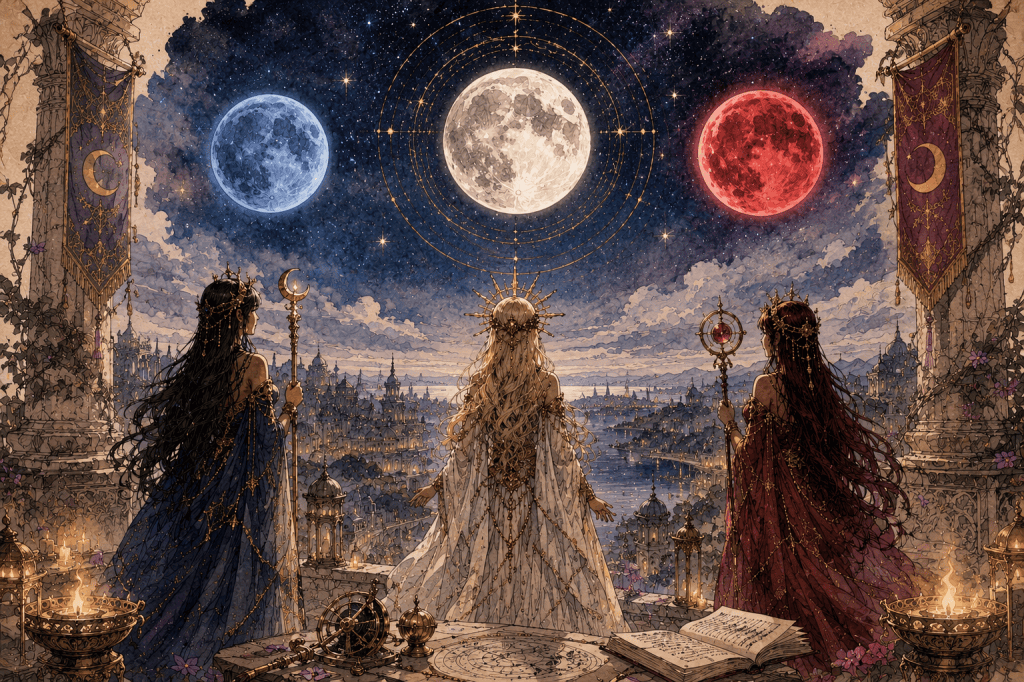
The Celestial Legacy of the Three Mothers
The Three Moons are among the most recognizable and influential features of the Erosian night sky. Every civilization, regardless of its culture, religion, or history, has observed their movements and woven them into its understanding of the world. Farmers use them to mark the changing seasons, sailors navigate by their light, scholars dedicate their lives to recording their movements, and priests look to them when determining the proper time for sacred observances. While many aspects of the moons remain shrouded in mystery, no one disputes their importance to the history, culture, and magical traditions of Erosia.
Although countless myths attempt to explain their origins, nearly every tradition agrees that the Three Moons are inseparably linked to the Three Mothers. Some faiths teach that each moon reflects one of the Mothers, allowing mortals to witness a fragment of powers that exist beyond mortal understanding. Others believe the moons were created as eternal reminders of creation’s earliest moments, while some scholars argue that they are physical manifestations of the same cosmic principles that shaped reality itself. None of these interpretations has ever been universally accepted, and the relationship between the Three Mothers and the Three Moons remains one of the oldest debates in Erosian philosophy.
The Three Moons are rarely considered as independent celestial bodies. Their significance lies in the relationship they share with one another. Each follows its own celestial path, each progresses through its own lunar cycle, and each contributes to an ever-changing pattern that has fascinated astronomers and spellcasters for thousands of years. The combination of their movements creates an endless variety of nights, ensuring that the heavens above Erosia are never truly the same from one evening to the next.
The influence of the Three Moons extends well beyond the passage of time. Throughout history, spellcasters have observed subtle changes in magical phenomena that appear to coincide with the moons’ shifting positions. Certain rituals are traditionally performed beneath specific lunar phases, while magical academies maintain centuries of astronomical records in the hope of identifying patterns that explain these recurring events. Priests often schedule important ceremonies according to the lunar calendar, believing that the heavens reflect deeper truths established at the dawn of creation.
Despite generations of observation, scholars continue to disagree about why the moons influence magic. Some believe the moons strengthen the connection between the mortal world and the Veil, making certain forms of spellcasting more harmonious with reality. Others argue that the moons do not create magical change at all, but instead reveal cycles that already exist within the Veil itself. Many theologians reject both theories, maintaining that the moons neither cause nor reveal these changes but simply reflect the eternal order established by the Three Mothers. No explanation has yet gained universal acceptance, and the question remains one of the great mysteries of magical scholarship.
The Three Moons also serve as one of the few experiences shared by every culture across Erosia. Kingdoms have risen and fallen beneath their light, religions have interpreted their meaning in different ways, and civilizations have measured time according to countless calendars, yet every people looks upon the same three celestial companions. Their presence has inspired festivals, works of art, navigation, architecture, poetry, prophecy, and countless legends that continue to shape Erosian culture.
Although much has been learned about the movements of the Three Moons, they continue to resist complete understanding. Their cycles never repeat with perfect precision, their connection to the Three Mothers remains unresolved, and certain rare alignments have coincided with extraordinary events that historians and scholars still struggle to explain. Each new generation expands humanity’s knowledge of the heavens, yet every discovery seems to uncover new questions waiting to be explored.
For the people of Erosia, the Three Moons are more than celestial bodies suspended in the night sky. They are enduring symbols of a universe whose greatest truths are still unfolding, reminding every scholar, priest, and adventurer that even the oldest mysteries continue to invite discovery.
 Whispers of Erosia