

Delavira
The Gilded Temptress • Lady of the Lingering Gaze
Goddess of Anticipation, Indulgence and Sacred Distance
“To desire is not to possess.”

Delavira is the goddess of the exquisite interval between wanting and having: the gaze allowed to linger, the hand that approaches without immediately touching, the pleasure deliberately prolonged because fulfillment is not the only part of desire worth savoring. She governs voyeurism and exhibition, luxury and indulgence, tease and denial, soft dominance, opulent touch, privacy and the erotic power of remaining just beyond reach.
Lovers invoke Delavira when they wish an evening to unfold slowly. Courtesans wear her amethysts when cultivating anticipation. Artisans dedicate perfumes, jewelry and beautiful garments to her. Nobles ask her blessing over intimate feasts and private salons. Those who enjoy watching or being watched whisper her name across deliberate distances, while those protecting desires they are not prepared to reveal sometimes wear her eye beneath their clothing.
Older traditions call her the Gilded Temptress, the Lady of Luxury and Lingering Touch, the Veiled Eye, She Who Waits, the Mistress Beyond the Curtain and the Keeper of the Unanswered Want. Each title approaches the same divine mystery from a different direction. Delavira teaches that desire need not immediately become action to be meaningful. A longing may be enjoyed, examined, cultivated, shared, withheld or simply allowed to exist. Sometimes the distance between two people is not an obstacle to pleasure. Sometimes it is where pleasure lives.
Lore & Mythos

When Mortals First Lingered
No single account of Delavira’s beginning is accepted throughout Erosia. One of the oldest traditions claims she awakened when a mortal first discovered that pleasure could be prolonged deliberately. The story describes two lovers beside a moonlit pool. One reached toward the other and then stopped. Nothing prevented the touch. Neither fear nor prohibition stood between them. The waiting was chosen.
The second lover watched the approaching hand. Their breath changed. The first noticed and allowed another heartbeat to pass before moving closer. Then another. What might have been an instant became an experience. Delaviran theologians describe this as the First Lingering. Before that moment, desire sought fulfillment as hunger seeks food. Afterward, mortals understood that anticipation could possess its own pleasure. Want could be cultivated rather than merely extinguished.
The oldest hymns claim Delavira awakened somewhere between the reaching hand and the waiting skin. She has lingered there ever since.
The Goddess Behind the Curtain
Another tradition places Delavira’s revelation within one of Erosia’s earliest pleasure houses. A celebrated courtesan had become renowned for satisfying every desire brought before her. Wealthy admirers crossed kingdoms seeking her company. They brought jewels, perfumes, rare wines and extravagant promises. She became surrounded by luxury yet increasingly unable to enjoy any of it. Every pleasure had become expected.
Every admirer wanted access. Every gift carried an assumption that something would be returned. One evening, the courtesan closed the curtains around her chamber and refused everyone. Outside gathered admirers who had never imagined she might prefer to remain unseen. Some became angry. Others bargained. A few simply sat beyond the curtain and waited. The story says that one person eventually asked, “May I remain here?”
The courtesan answered yes. Nothing else was requested. Hours passed with one person behind the curtain and another beyond it. They spoke occasionally. Sometimes neither spoke at all. Neither crossed the boundary. Near dawn, violet-gold light appeared beneath the curtain. When the courtesan finally drew it aside, Delavira was sitting beside her.
From this story comes one of the faith’s oldest teachings: intimacy is not measured by how completely access is granted. A boundary respected may become part of intimacy rather than its opposite.
The Banquet of the Unfinished Cup
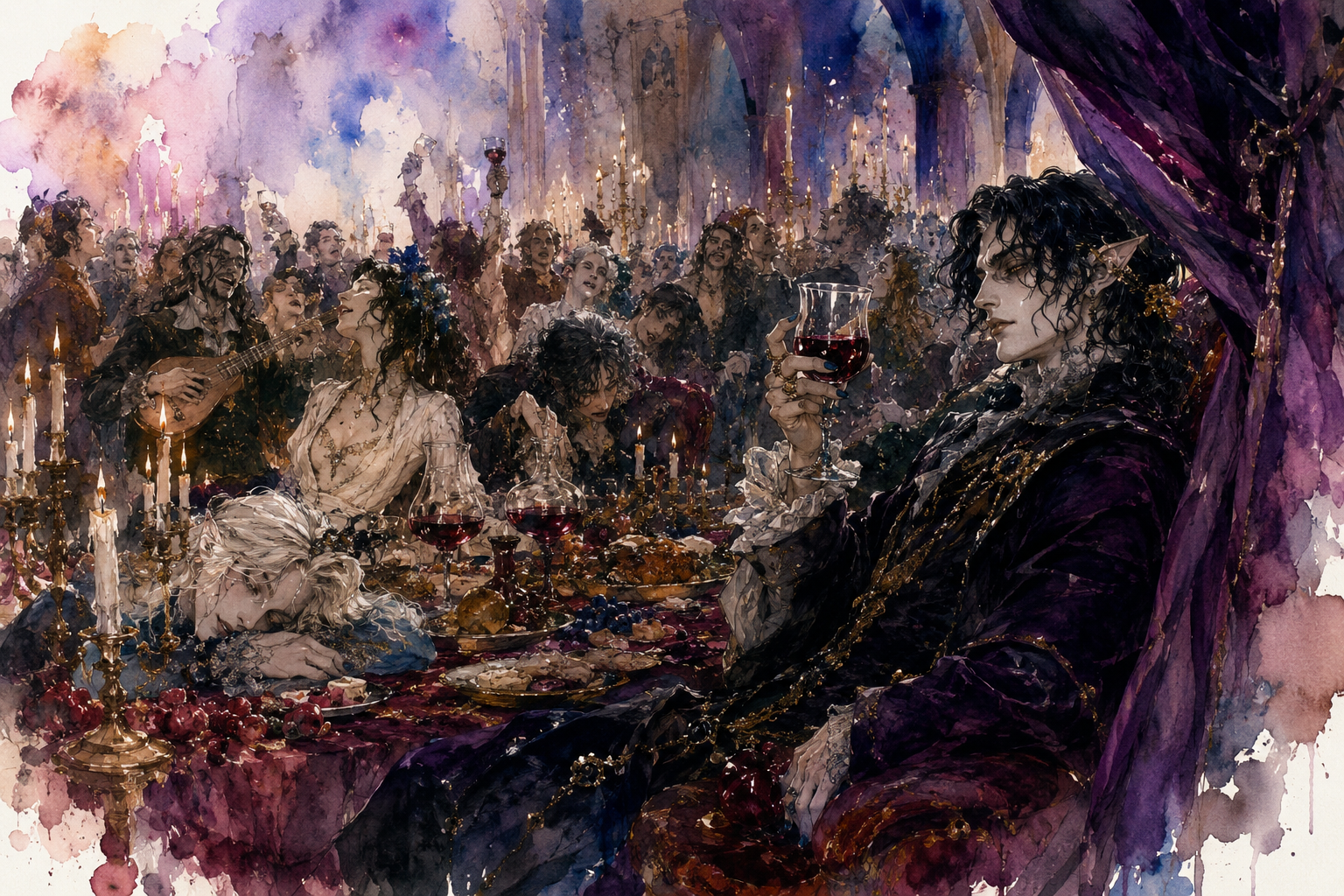
A third tradition tells of a sovereign who invited Delavira to the most extravagant banquet ever prepared. Every table overflowed. Wines from forgotten vineyards filled crystal decanters. Musicians played behind curtains of silver thread. Perfumed fountains cooled the air. Lovers, dancers and courtiers moved among cushions beneath thousands of golden lamps.
The sovereign proudly told Delavira that nothing had been withheld. Delavira looked around the banquet and asked why that was considered admirable. She took a single jeweled cup and poured only enough wine to cover its bottom. She smelled it before tasting. She allowed the first sip to remain upon her tongue. She waited before taking another. The sovereign grew impatient.
Delavira continued. By the time she finished the small measure, the sovereign had consumed several cups and could barely remember their flavor. “Which of us possessed more?” Delavira asked. The story became foundational to Delaviran attitudes toward luxury. Abundance is not measured solely by quantity. A person surrounded by pleasures they no longer notice may be poorer than someone capable of giving complete attention to a single beautiful thing. The cup in Delaviran art therefore frequently remains partly full.
Pleasure does not become sacred because there is more of it. It becomes sacred because someone is present enough to savor it.
The Desire She Embodies
Delavira embodies the desire to linger.
Her domain begins in anticipation but extends far beyond sexual teasing. A person may pause before opening a long-awaited letter because possibility remains alive for another heartbeat. A lover may watch someone dressing across a room and enjoy not approaching. A collector may turn a beautiful object slowly beneath lamplight before deciding whether to purchase it. A diner may allow wine to breathe, perfume to unfold and conversation to stretch late into the night.
Delavira teaches that mortals often hurry through experiences they claim to value. They rush toward conclusions. They consume rather than savor. They confuse access with intimacy, acquisition with appreciation and fulfillment with pleasure. Her faith asks a different question: What happens if you do not take the next thing immediately?
Sometimes frustration grows. Sometimes attention sharpens. Sometimes desire reveals what it actually wants.
Anticipation and the Lingering Moment
Anticipation is one of Delavira’s central mysteries because it transforms absence into sensation. The unopened door matters because someone may be behind it. The approaching hand matters because it has not yet touched. The covered dish gathers meaning through fragrance. A kiss delayed by a breath may occupy more of the imagination than one immediately given.
Delaviran practice deliberately cultivates these intervals. This does not mean fulfillment is considered spiritually inferior. Delavira is an intensely indulgent goddess. She delights in exquisite meals, beautiful bodies, fine fabrics, perfume, touch, jewelry, baths, wine and carefully prepared pleasure.
She simply refuses to treat the destination as the only meaningful part of the journey. Her priests sometimes describe anticipation as the pleasure before pleasure.
Watching and Being Watched
Voyeurism occupies a central place within Delavira’s intimate mysteries. The faith distinguishes sharply, however, between witnessing and violation.
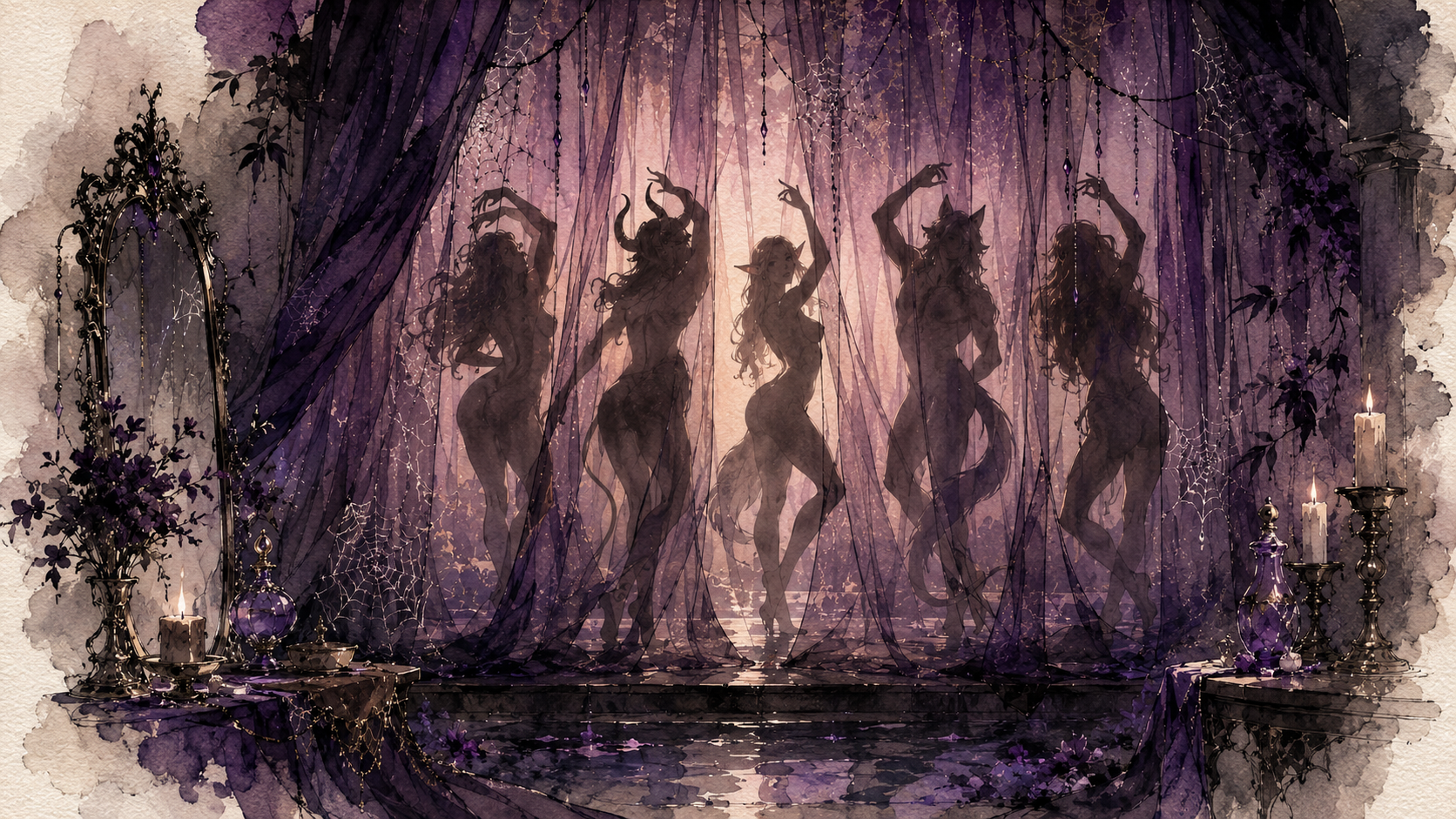
Watching may become sacred when someone knowingly allows themselves to be seen, when boundaries make observation part of the experience or when distance itself creates the desired tension. Some devotees enjoy performing for an unseen or partially concealed observer. Others prefer to watch from an agreed place without joining what they witness.
Delavira teaches that observation can become its own form of participation. The watcher notices. The watched knows they are noticed. Nothing else must necessarily happen.
This produces one of the faith’s most important theological distinctions: visibility does not equal availability. Someone may choose to be admired without inviting touch. They may reveal one part of themselves while withholding another. They may enjoy another person’s desire without becoming responsible for satisfying it.
Likewise, a person may possess desires they prefer to keep private. Delavira does not demand confession merely because secrecy creates curiosity. Her eye sees. Her veils remain.
Luxury and Indulgence
Delavira’s luxury is frequently misunderstood by outsiders as simple extravagance. Her faithful disagree. True luxury is the possession of enough time, safety and attention to experience something fully.
A humble bath may become luxurious if prepared carefully for someone exhausted. A single piece of ripe fruit may become indulgent when shared slowly between lovers. An inexpensive fabric may become precious because of the sensation it creates against the skin. Conversely, a palace filled with objects no one appreciates is merely expensive.
Delaviran temples certainly possess wealth. Gold, amethyst, velvet, perfumes, oils, polished stone and beautiful furnishings are common. Yet clergy are taught that luxury without attention becomes clutter. The purpose of beauty is not accumulation.
It is experience.
Dominance, Denial and the Sacred Pace
Delavira’s dominance is rarely expressed through force. It is expressed through pace. A Delaviran dominant may decide when another person approaches, when a curtain opens, when a touch continues, when it stops and when an anticipated pleasure is finally permitted. The authority lies in controlling progression rather than overwhelming resistance.
Tease and denial emerge naturally from this principle. A desired experience may be approached and withdrawn from repeatedly, allowing anticipation to accumulate until waiting itself becomes intensely pleasurable. The recipient’s willingness remains essential. Delavira does not sanctify frustration imposed upon someone who has not chosen it. Nor does she teach that a dominant gains ownership of another person’s desire merely because they have been entrusted with guiding it.
The sacred authority is borrowed. The trust is real. The pace may be controlled. The person never becomes property.
Holy Symbol & Iconography
The Veiled Eye
Delavira’s holy symbol is the Veiled Eye, an ornate amethyst eye with a narrow vertical pupil held within layered silver-white crescents, black featherlike veils and delicate blackened-gold filigree. The eye is visible but never completely exposed. Its surrounding crescents represent sacred distance: the space between observer and observed, desire and fulfillment, invitation and approach. They form thresholds rather than barriers. Each may be crossed, but none should be assumed open merely because another has been crossed before it.
The dark feathered forms symbolize concealment without shame. They evoke curtains, veils, shadowed chambers and the privacy surrounding desires a person has chosen not to reveal. At the center, the amethyst eye represents witness without possession. It observes completely without claiming what it sees. Delaviran priests often use the symbol when teaching that attention can be intimate without becoming ownership. Faceted amethysts ornament the cardinal points and hanging elements of the symbol. These represent desires consciously acknowledged but not necessarily fulfilled.
Suspended crescents and jewels beneath the central eye are traditionally called the Lingering Tears. They symbolize wants allowed to remain unanswered long enough to become understood. Gold frames the entire design without overwhelming it. In Delaviran theology, gold represents luxury as adornment rather than possession: beauty deliberately placed around experience so that attention may remain upon what matters. The complete symbol expresses one of Delavira’s central teachings: To see is not to possess. To desire is not to take.

Sacred Colors and Materials
Delaviran sanctuaries favor midnight violet, plum, amethyst, onyx, silver-white and blackened gold. Violet represents longing made contemplative. Amethyst represents desire acknowledged without demanding fulfillment. Onyx represents privacy and the dignity of what remains hidden. Silver-white represents moonlight, distance and observation. Gold represents cultivated luxury and attention deliberately bestowed. Velvet, satin, polished stone, smoked glass, mirrors, fine chain, lacquered wood, perfume crystal, silk cord and carefully worked metal appear throughout Delaviran worship. Texture matters enormously. A Delaviran object is meant to reward the hand and eye for lingering.
Veils, Mirrors and Thresholds
Veils are Delavira’s most common secondary symbol. They do not merely hide. They determine how something is revealed. Curtains, screens, lattices, half-open doors, balconies and translucent fabrics recur throughout temple architecture. The viewer is constantly reminded that seeing can occur through boundaries rather than only after their removal. Mirrors carry a related meaning. They allow sight without direct approach and reveal perspectives otherwise unavailable. Delaviran mirrors are often positioned deliberately so that a person may see someone who cannot be reached directly from where they stand.
Doorways and thresholds are likewise sacred. A closed door means no. An open door means passage is possible. A half-open door means nothing until someone asks.
Sacred Creatures

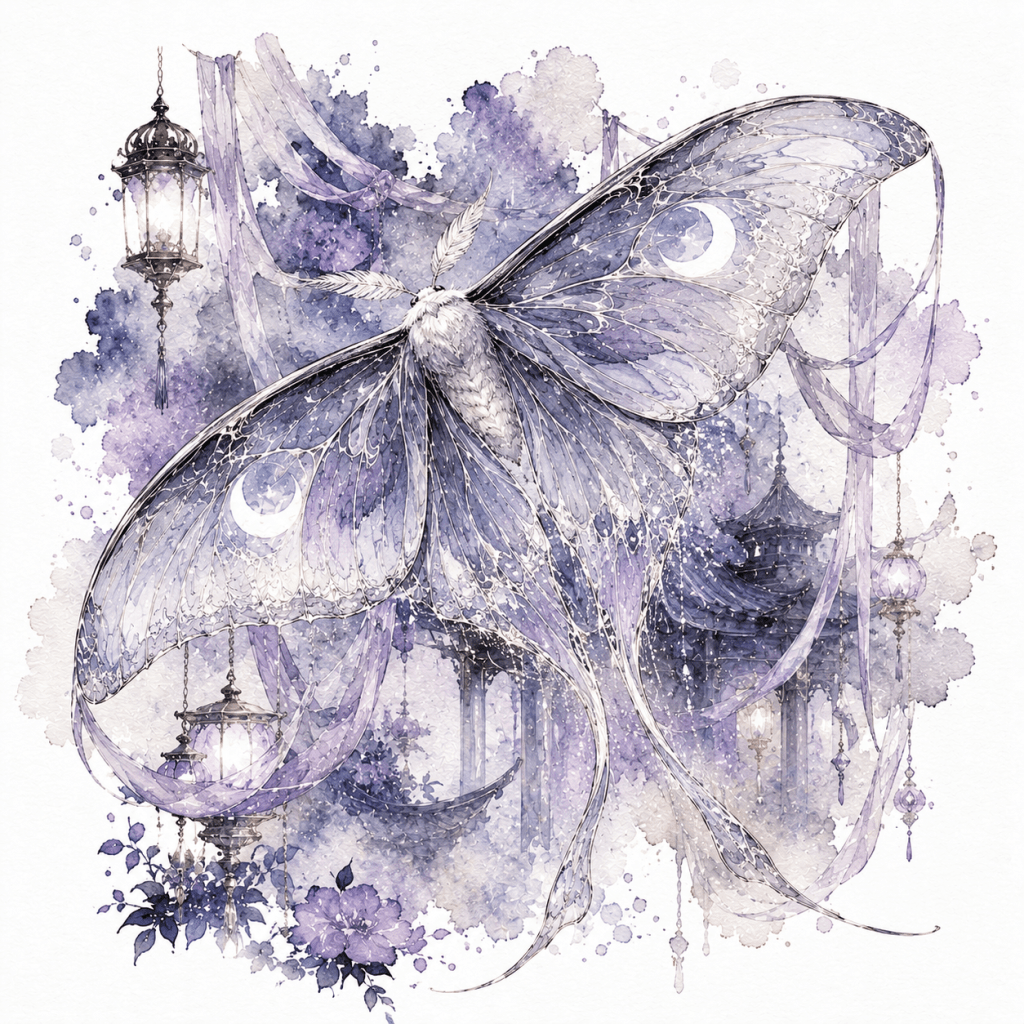
Velvet spiders, black swans, nocturnal moths and sleek serpents remain strongly associated with Delavira. Velvet spiders symbolize patient attention and carefully constructed spaces. Their webs become metaphors for deliberate arrangement rather than predation in orthodox Delaviran teaching. Black swans represent elegance, controlled display and beauty that does not need to approach its admirer. Nocturnal moths symbolize attraction across distance, particularly desire awakened by something glimpsed rather than possessed. Serpents represent sensual patience, tactile awareness and the ability to remain perfectly still until movement becomes meaningful.
Stories also speak of Amethyst Watchers, small divine mothlike spirits whose wings resemble half-lidded violet eyes. They are said to appear in places where an important boundary has been honored despite powerful temptation to cross it.
Depictions of Delavira
Sacred art portrays Delavira as a mature adult goddess of extraordinary composure and cultivated sensuality. She is rarely shown reaching urgently toward anything. Her posture remains controlled, her gaze attentive and her expression quietly aware of being watched. Her garments favor structured silks, velvet, fitted ornamental pieces, elegant drapery and gilded filigree arranged deliberately around the body. Chains may appear as jewelry or symbols of controlled anticipation rather than crude imprisonment. Amethysts, blackened gold and polished violet stones ornament her clothing and hair.
Delavira may be depicted reclining, standing behind a partially opened curtain, observing from a balcony, holding a perfume vessel or extending one hand without quite making contact with another figure. Her sensuality should communicate control before availability. She does not chase attention. She permits it to approach.

Worship & Daily Devotion

Delavira can be worshipped anywhere someone chooses to experience something more deliberately. Preparing a bath can be prayer. Selecting perfume can be prayer. Dressing slowly because one enjoys the transformation can be prayer. Sitting across a room from someone desirable and simply appreciating them can be prayer when the circumstances permit that gaze. Saving a favorite wine for an evening when there is time to taste it can be prayer.
Her worship therefore attracts courtesans, perfumers, jewelers, clothiers, masseurs, dancers, hosts, aesthetes, lovers, merchants of luxury and anyone fascinated by the rituals surrounding anticipation.
The Velvet Pace
The Velvet Pace is among Delavira’s simplest daily disciplines. A worshipper deliberately slows an ordinary pleasurable act. Tea is smelled before being tasted. Jewelry is selected rather than grabbed. Oil is warmed between the palms. A garment is appreciated for its texture while being fastened. The practice is not intended to make every activity cumbersome. Its purpose is to recover attention from habit.
The Lingering Gaze
The Lingering Gaze is practiced between willing participants who wish to explore the pleasure of observation. One person presents themselves according to whatever boundaries have been established. Another watches without approaching. The rite may last only minutes. No touch is required. The discipline lies precisely in allowing attention to remain sufficient.
The Unopened Gift
Some devotees keep a beautiful object wrapped or enclosed for a predetermined period before opening it. The object may be jewelry, perfume, wine, a letter, a garment or something personally meaningful. The waiting is not punishment. Each encounter with the unopened gift renews possibility. When the agreed time arrives, opening it becomes part of the devotion.
Favored Offerings
Traditional offerings include perfume, scented oils, jewelry, mirrors, velvet ribbons, amethysts, wine, preserved fruits, fine sweets, handwritten invitations and beautiful objects created specifically for another person’s enjoyment. Offerings are frequently displayed before being used. A perfume may remain uncorked upon an altar for a night. Wine may wait beneath moonlight. Jewelry may hang before Delavira’s eye before being presented to its intended wearer. The interval between offering and enjoyment belongs to the goddess.
Clergy & Temples
Velvet Hands
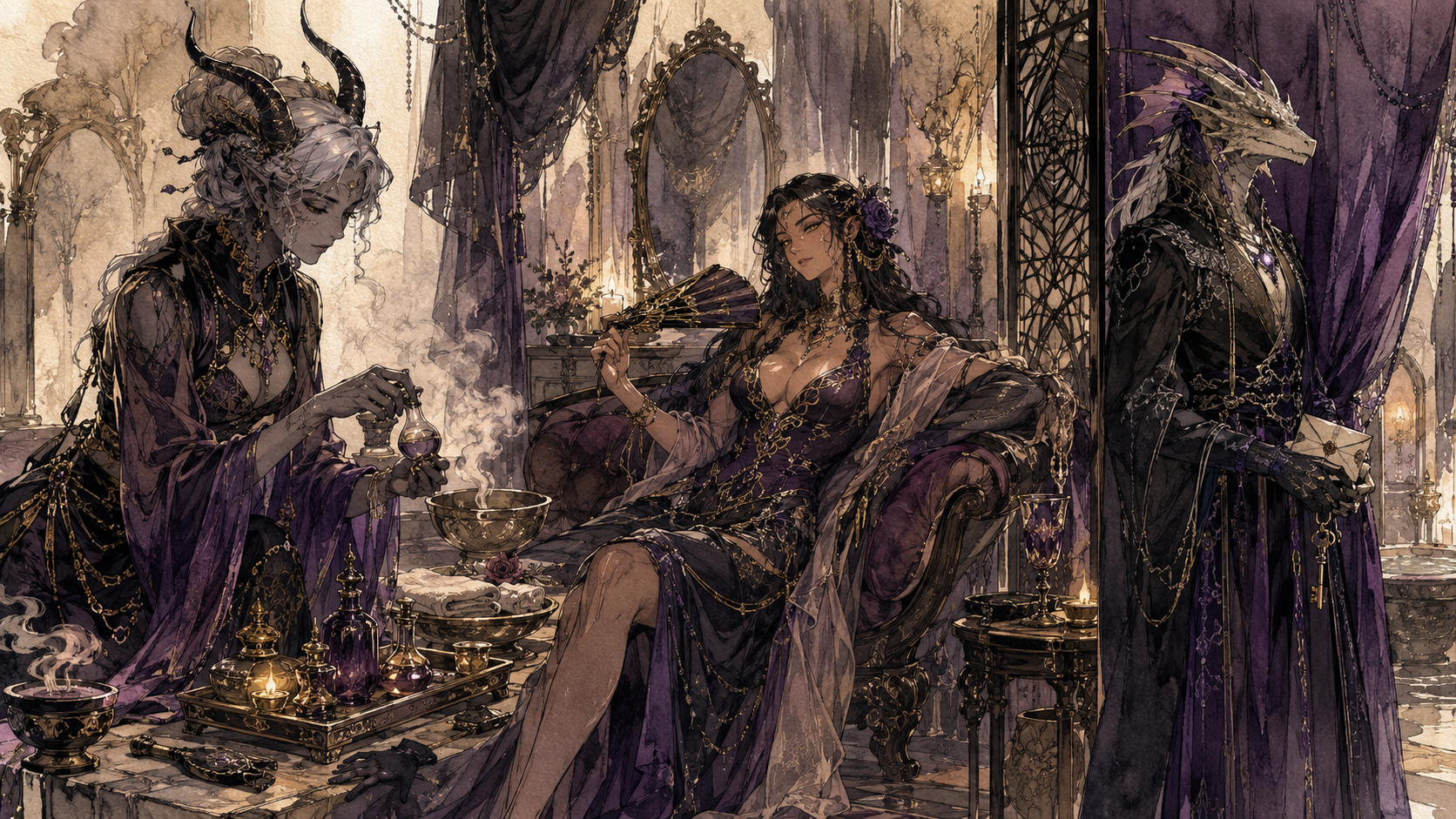
The Velvet Hands form Delavira’s primary priesthood. They are attendants of pleasure, ritual hosts, perfumers, masseurs, counselors and experts in the deliberate cultivation of atmosphere.
Their ministry frequently appears secular to outsiders. A Velvet Hand may spend hours preparing baths, arranging a chamber, selecting music, blending fragrance or helping someone articulate precisely what they want from an intimate encounter.
This preparation is itself priestly work.
Their vestments favor plum, midnight violet and black fabrics ornamented with blackened gold, amethyst jewelry and delicate chains. Gloves are common but frequently removed as part of ritual.
Gilded Courtesans
The Gilded Courtesans preserve Delavira’s traditions of erotic performance, observation, companionship and cultivated desire.
They are not defined simply by sexual availability. Many specialize in conversation, dance, flirtation, exhibition, intimate hosting or the art of creating desire without necessarily fulfilling it.
A celebrated Gilded Courtesan may become famous precisely because access to them cannot simply be purchased.
Their traditional teaching is: “Attention is offered. Access is negotiated.”
Keepers of the Veil
The Keepers of the Veil guard Delavira’s traditions concerning privacy, discretion and sacred boundaries.
They maintain private chambers, witness confidential agreements, protect identities and oversee rites in which participants wish to be observed without becoming publicly known.
Some serve as trusted intermediaries between powerful lovers, nobles, courtesans or devotees whose desires would become dangerous if exposed.
Their religious obligation is severe.
A secret freely entrusted to the Veil does not become theirs to spend.
Houses of the Lingering Veil
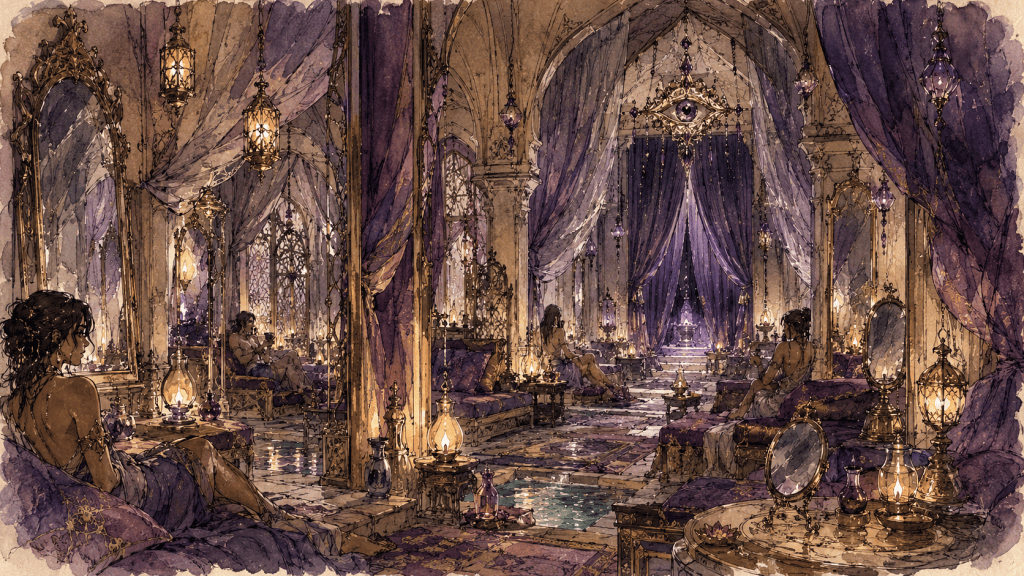
Delavira’s temples are commonly called Houses of the Lingering Veil, though smaller sanctuaries may be known as Gilded Chambers, Amethyst Houses or Velvet Salons. They are deliberately beautiful but rarely cavernous. Architecture favors layered spaces: vestibules leading into salons, salons into curtained chambers, chambers into gardens, baths and private sanctuaries. Movement through the temple is gradual. Perfumed oil lamps provide warm pools of light. Curtains soften doorways. Polished mirrors create indirect sightlines. Fountains murmur behind screens. Cushioned alcoves allow worshippers to observe communal spaces without entering them. The central sanctuary traditionally contains Delavira’s Veiled Eye above a curtain that is never completely opened. No one agrees what lies behind it. Most priests consider finding out beside the point.
Rites, Taboos & Divine Signs
The Rite of the Golden Caress
A willing participant is anointed slowly with warm, gold-flecked scented oil. The officiant does not hurry toward intimate areas or treat the body as territory to be completed. Hands move according to a deliberate progression agreed upon beforehand. Pauses are as important as contact. The rite teaches that attention itself may become a form of pleasure.
The Lingering Breath
Two or more participants synchronize their breathing while remaining close enough to feel one another’s presence without necessarily touching. Exhalations gradually lengthen. Movement slows. The practice is used for meditation, intimate preparation and the cultivation of anticipation before more elaborate rites.
The Velvet Hold
The Velvet Hold incorporates soft fabrics, silk cords or other comfortable restraints between willing participants. Its sacred meaning lies not in helplessness but in chosen limitation. Someone temporarily agrees that certain movements, touches or forms of fulfillment will remain unavailable. The resulting desire is not treated as a problem requiring immediate relief. It is the substance of the rite.
The Delayed Kiss
Two participants approach a kiss according to a predetermined ritual pace. Either may stop the rite at any point. The kiss may eventually occur. It may not. Both conclusions are valid. The rite teaches that anticipation does not become wasted merely because what was anticipated remains unfinished.
The Gilded Touch
The Gilded Touch is one of Delavira’s significant solitary devotions. A worshipper prepares a private space with oil, perfume, soft fabric, music or whatever luxuries are available and then gives deliberate attention to their own body. The purpose is neither speed nor performance for an imagined observer. The worshipper becomes the one who gives attention and the one who receives it.
Delaviran clergy often prescribe the rite to people who have become so accustomed to performing desirability for others that they have forgotten how to experience pleasure without an audience.
The Great Prohibition
Delavira possesses many customs but one overriding taboo: No boundary may be crossed merely because desire exists on the other side.
Secret observation where privacy has been reasonably expected, coercive denial, unwanted restraint, treating purchased companionship as ownership, exposing another person’s private desires and deliberately ignoring a withdrawn invitation are profound violations of her faith.
Delavira understands curiosity. She understands temptation. She understands wanting desperately to know what lies behind the curtain. The curtain remains.
Her faithful preserve the principle in ritual teaching: To desire is not to possess.
Signs of Delavira
Delavira’s favor often manifests through sensation rather than spectacle. Perfume lingers after its wearer has departed. Candlelight takes on a violet-gold cast. A mirror briefly reflects someone who is standing beyond the viewer’s direct line of sight. Gold dust appears along collarbones, fingertips or tears. Warm oil remains at perfect temperature far longer than it should. A person under Delavira’s particular favor may discover that their presence naturally alters pace. Conversations become quieter around them. People pause before touching them. Their gaze feels unusually attentive without becoming invasive.
Amethysts occasionally develop narrow eye-like inclusions. Curtains move despite still air. A closed door may click softly when someone reaches toward it without permission. Delaviran priests consider that last sign particularly clear.
Delavira and the Velvet Court

Within the Velvet Court, Delavira embodies Anticipation, Indulgence and Sacred Distance. Where Velyssara awakens desire, Delavira teaches mortals how to remain within it without immediately consuming what they want. She gives longing duration. Her relationship with Velzhari is famously playful. Both understand seduction and display, but their instincts differ. Velzhari delights in the electricity of being seen. Delavira is fascinated by what happens when seeing is all that is permitted. Their myths frequently cast them as friendly rivals attempting to outmaneuver one another through increasingly elaborate acts of temptation.
Mirellune shares Delavira’s understanding of authority and controlled surrender, though Delavira’s dominance is typically softer and more concerned with pace than command. Solynth appears frequently within Delaviran theology because willing yielding requires someone trustworthy enough to receive it. Their traditions overlap wherever anticipation becomes an act of chosen vulnerability. Delavira’s relationship with Nyzun is more complicated. She respects discipline and intentional sensation but recoils from suffering pursued without attentiveness to the person experiencing it. Delaviran theologians sometimes describe the two as artisans using very different instruments.
Cyrillith shares her fascination with spectatorship. The Divine Bard asks what occurs between performer and audience. Delavira asks what happens when the audience wants to approach and chooses not to. Above them all remains Velyssara. Delavira does not create desire. She takes the First Bloom’s spark between jeweled fingers and whispers: Not yet.

Miracles & Divine Presence
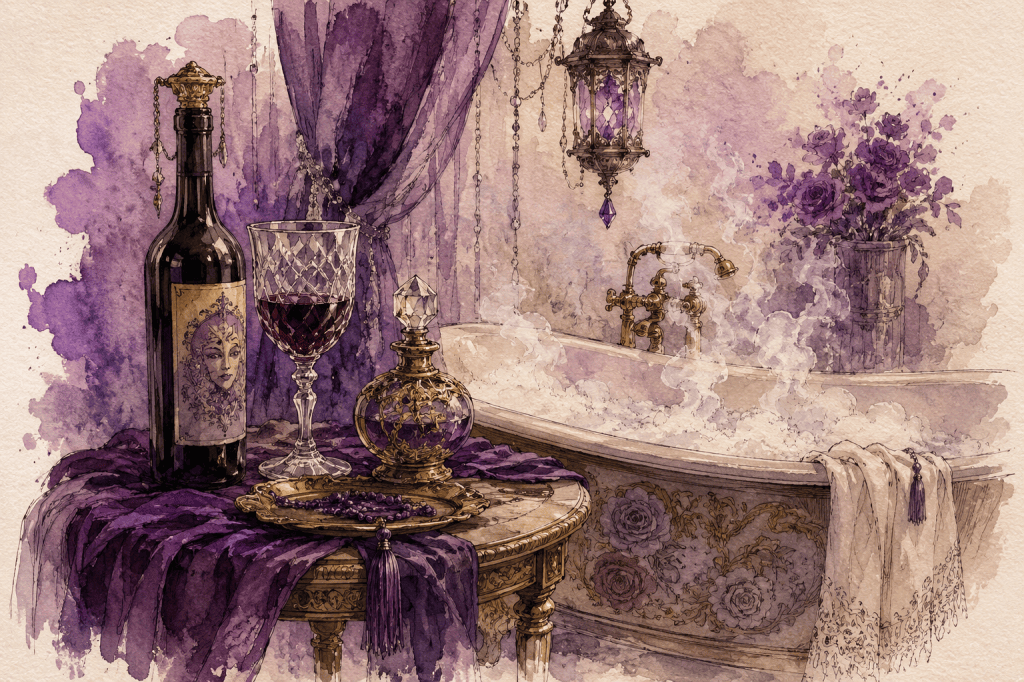
Delavira’s miracles frequently resemble the world becoming unwilling to hurry. A falling drop of perfume hangs for several heartbeats before reaching skin. Wine poured into a glass releases fragrances impossible for the vintage. A bath remains perfectly warm throughout an entire night. A locked jewelry box opens only after its recipient has stopped trying to force it. During intimate miracles, sensation may seem to stretch beyond ordinary time. A brief touch feels remembered in exquisite detail. A lover across a crowded chamber becomes impossible to ignore despite making no movement toward the observer. A curtain becomes translucent enough to reveal a silhouette but never enough to expose what lies behind it.
The archives describe entire banquets during which no food cooled, salons where dawn refused to arrive until the final guest chose to leave and mirrors that allowed separated lovers to watch one another across impossible distances. When Delavira manifests unmistakably, the air becomes warm and fragrant. Violet shadows deepen. Gold catches light where no gold was visible before. Amethysts gleam like half-lidded eyes. And everything seems to wait.
What Her Faith Teaches
Delavira teaches that desire possesses value before fulfillment. Mortals frequently treat longing as an uncomfortable condition to solve. Hunger should be fed. Curiosity should be answered. Attraction should progress. A closed thing should be opened. Delavira disputes the inevitability of that progression. Wanting can be pleasurable. Waiting can be chosen. A boundary can intensify intimacy rather than diminish it.
Her faithful repeat several principles:
- Attention is a luxury. To give something complete attention is one of the most extravagant gifts a mortal can offer.
- Anticipation is part of pleasure. Fulfillment does not retroactively make everything before it meaningless.
- Visibility is not availability. Being seen does not create an obligation to provide access.
- Privacy is not shame. Something may remain hidden simply because its owner prefers it there.
- Luxury should be experienced, not merely accumulated. Possessing beautiful things without noticing them is another form of poverty.
- Control entrusted is not ownership granted. Dominance remains sacred only while the authority underlying it remains willingly given.
- Desire may remain unanswered. Not every want requires satisfaction to have meaning.
And above all: To desire is not to possess.
At the Table

Delavira works best in campaigns concerned with temptation, secrets, luxury, courtly intrigue, social boundaries, delayed gratification and the difference between wanting something and having a right to it.
Her presence belongs naturally in pleasure houses and noble estates, but equally in auction halls, diplomatic salons, masquerades, bathhouses, private galleries, expensive inns and treasure vaults where adventurers encounter things designed to awaken desire.
A Delaviran NPC does not need to seduce the party. They might simply place a locked box on the table and say: “You may look at it all evening.”
Then refuse to explain what is inside.
Delaviran Characters
Characters drawn toward Delavira commonly include courtesans, spies, diplomats, merchants, perfumers, jewelers, aesthetes, entertainers, nobles and characters whose professions require careful attention to what others want.
Her faith also suits characters wrestling with possession. A thief may need to learn that wanting something beautiful does not make taking it justified. A noble accustomed to purchasing access may encounter someone whose attention cannot be bought. A character terrified of their own desires may learn that acknowledging a want does not obligate them to act upon it.
A voyeuristic character may be forced to confront the difference between curiosity and entitlement. A dominant character may discover that genuine authority requires restraint. Someone accustomed to giving others pleasure may learn to receive attention without performing for it.
These are Delaviran conflicts.
Divine Domains and Traditions
The archives associate Delavira with Charm, Lust, Pleasure and Beauty, alongside traditions such as the Oath of Indulgence, Oath of the Velvet Hand, College of Caress, College of Glamour, Circle of Oils and Pact of the Velvet Whisper. These remain useful historical associations where corresponding player options have not yet received Second Bloom conversion.
Future Delaviran design should emphasize anticipation, controlled pace, attention, boundaries and delayed fulfillment above generic charm magic.
Boons of Delavira
Older accounts preserve blessings associated with the Gilded Touch, supernatural control over another creature’s pace, heightened persuasive grace and the ability to make anticipation itself magically distracting. These concepts remain appropriate expressions of Delavira, but their archived mechanics predate the current framework.
(Needs updated mechanics: Base 5e → Veiled → Unveiled.)
The Lingering Hand
The archives also preserve the concept of the Lingering Hand, through which Delavira’s favor allows a devotee to interrupt momentum through touch or command, leaving another creature distracted by sensation and anticipation. Future Second Bloom mechanics should preserve the central fantasy without reducing Delavira to simple incapacitation: she changes tempo. In Veiled and Unveiled play, this provides a natural foundation for interaction with Arousal and delayed release.
(Needs updated mechanics: Base 5e → Veiled → Unveiled.)
Sacred Relics

The Mirror of the Lingering Gaze
This tall amethyst-framed mirror is polished so perfectly that viewers initially believe they are looking through an open doorway. Tradition claims the mirror never reveals anything its subject has not permitted someone to see. Instead, it preserves chosen moments of presentation: a garment deliberately displayed, a dance knowingly performed, an expression offered to a trusted witness. Some reflections remain within the glass for centuries. The disturbing question is not how the mirror remembers. It is whether the person being reflected knew who would eventually be watching.
(Needs updated mechanics: Base 5e → Veiled → Unveiled.)

Golden Caress Oil
This heavy crystal vessel contains warm violet-gold oil that never seems to diminish when used with deliberate care. A single drop spreads impossibly far across skin while releasing a fragrance unique to the person receiving the anointing.
Stories claim hurried hands cause the oil to become ordinary.
(Needs updated mechanics: Base 5e → Veiled → Unveiled.)
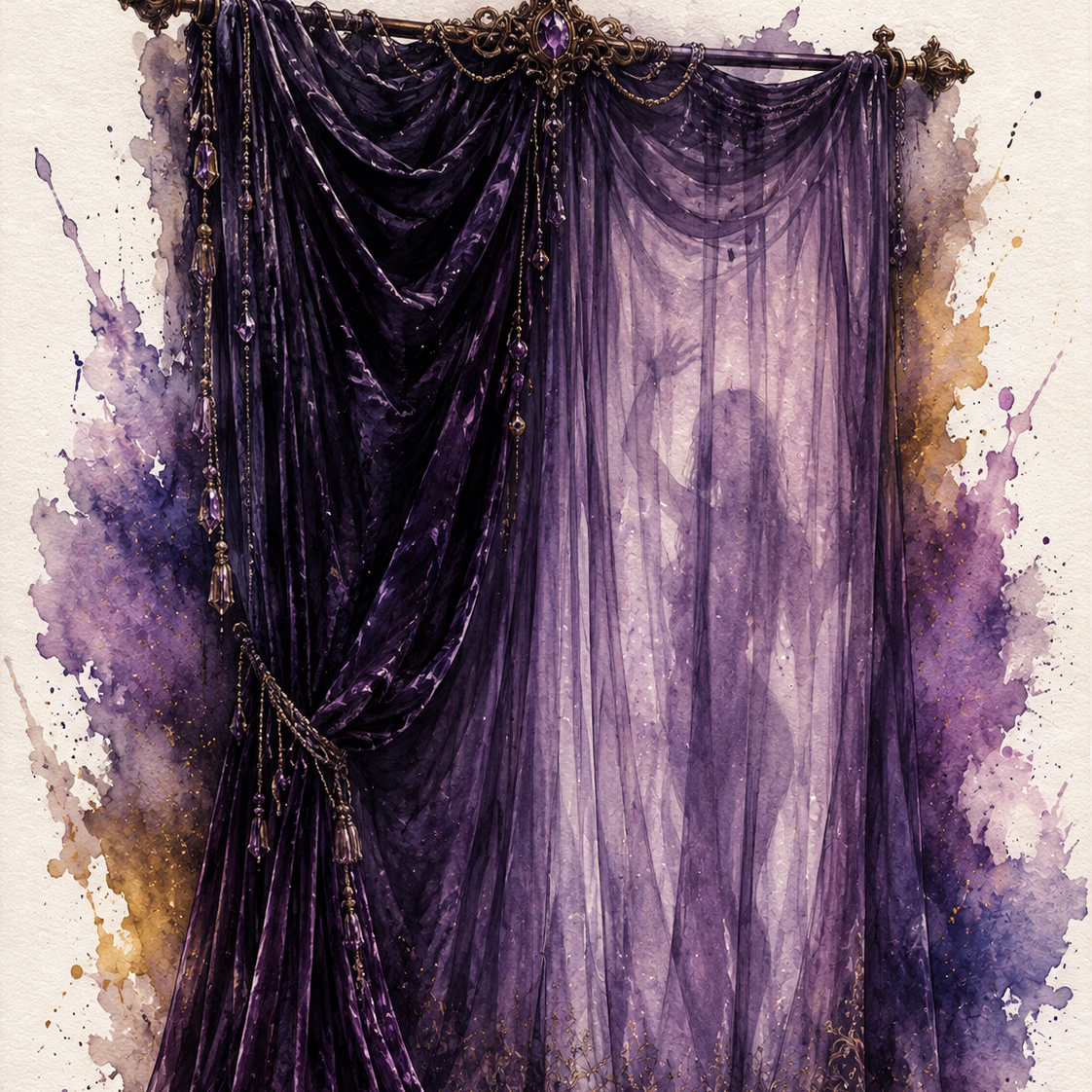
The Curtain of One More Breath
This length of midnight-violet velvet appears opaque from one side and faintly translucent from the other. Delaviran traditions use it in rites of chosen observation and concealment. Legends claim that someone standing behind the true Curtain may decide precisely how much of themselves those beyond it are permitted to perceive. Nothing crosses the veil without invitation.
(Needs updated mechanics: Base 5e → Veiled → Unveiled.)
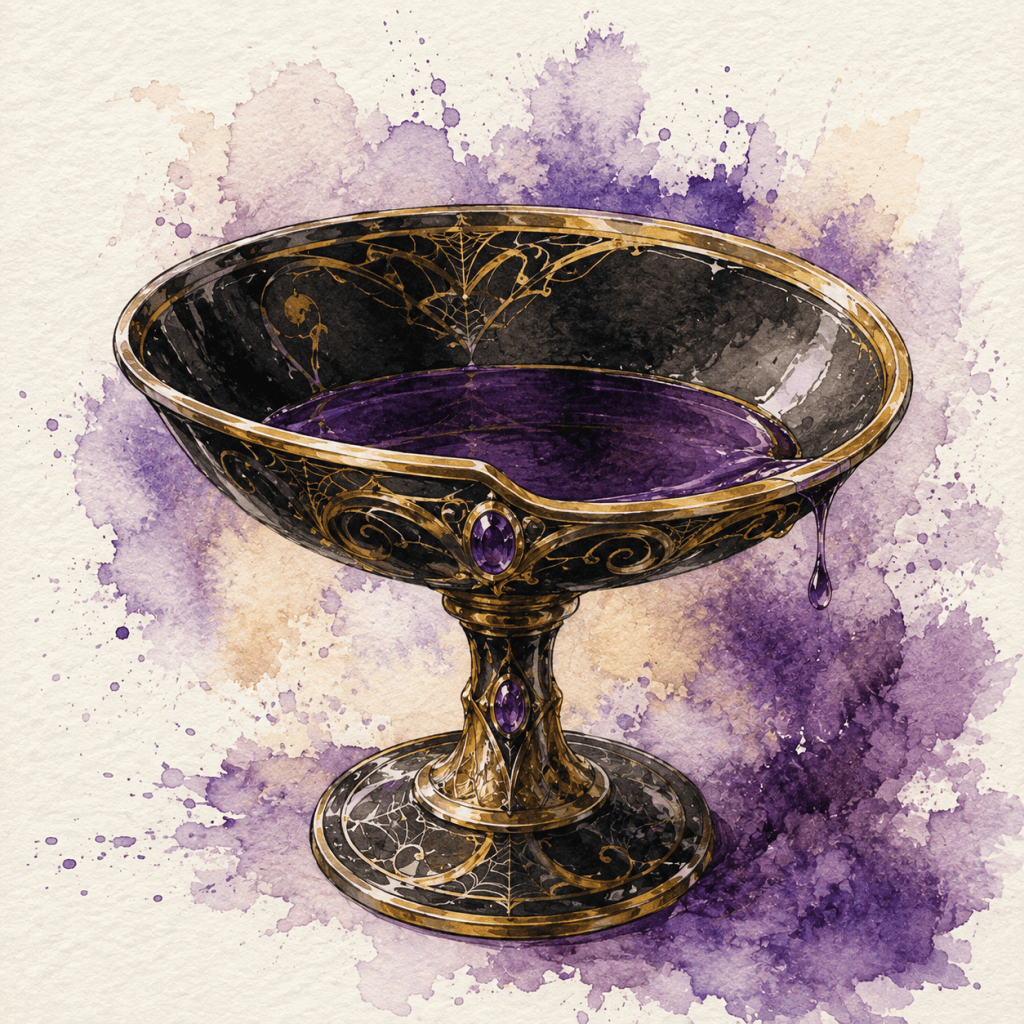
The Unfinished Cup
This shallow black-and-gold wine cup is traditionally identified with the Banquet of the Unfinished Cup. Regardless of what is poured into it, the final sip cannot be consumed until the drinker pauses long enough to identify something about the experience they genuinely appreciated. Attempts to gulp the contents simply leave the final measure behind. Delaviran priests consider this hilarious.
(Needs updated mechanics: Base 5e → Veiled → Unveiled.)
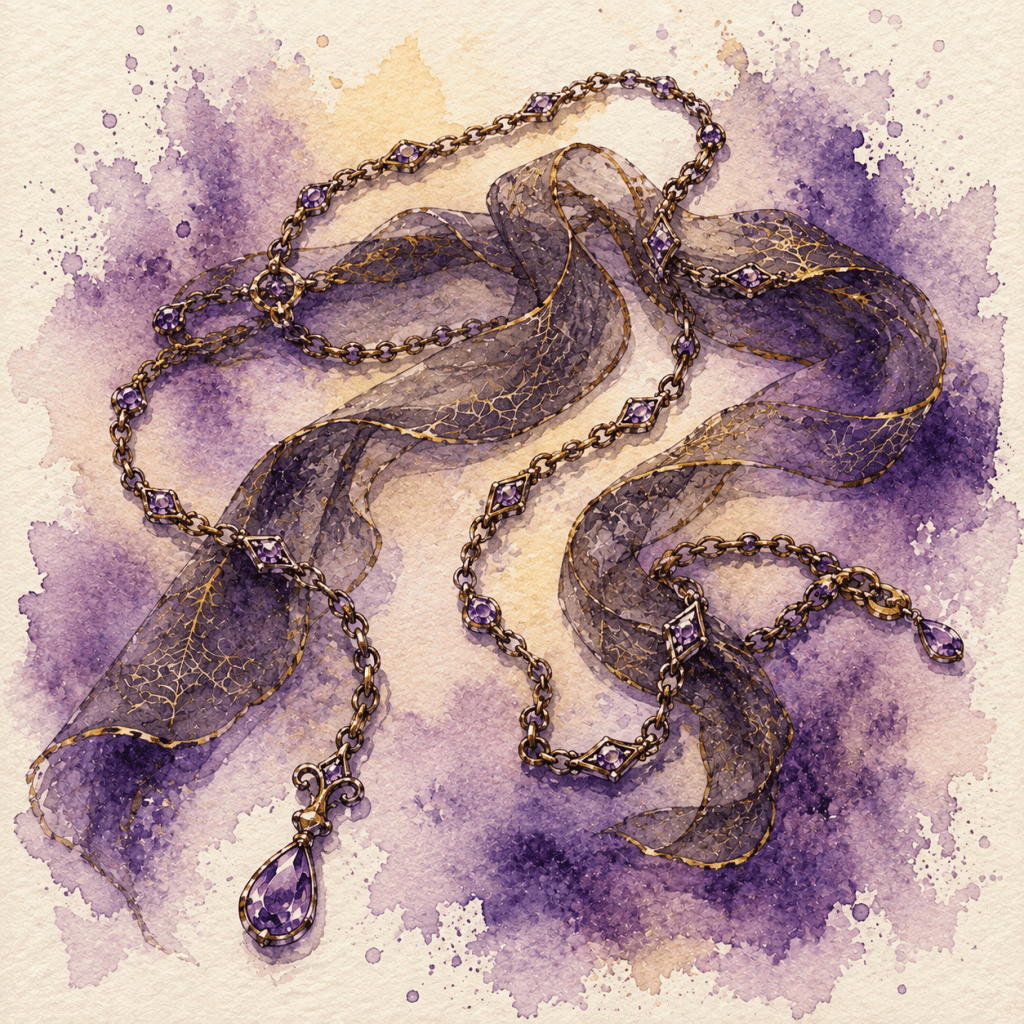
The Amethyst Chain
This extraordinarily delicate chain consists of blackened-gold links interrupted by tiny amethysts. It can be worn as jewelry, wrapped around the wrist or incorporated into ceremonial restraint. Older stories claim the chain cannot hold anyone who genuinely wishes to leave it. Its power begins only when someone chooses to remain.
(Needs updated mechanics: Base 5e → Veiled → Unveiled.)
Adventure Hooks
The Room Behind the Curtain
A famous House of the Lingering Veil has maintained one sealed chamber for more than three centuries. No priest claims to know what lies inside, and temple doctrine explicitly forbids opening it merely to satisfy curiosity. Then something inside knocks. Once. Every midnight.
The Stolen Gaze
A noble acquires an enchanted mirror capable of observing private rooms throughout the city. They insist the artifact is sacred to Delavira. The Keepers of the Veil disagree violently. Destroying the mirror may be easy. Discovering how many people have already purchased its secrets is not.
The Banquet That Never Ends
Guests at an extravagant Delaviran feast discover that dawn will not arrive. Wine never empties. Candles never burn down. Music continues without tiring its musicians. At first, everyone celebrates. Days later, the guests begin begging for morning. Someone at the banquet possesses a desire they refuse either to acknowledge or relinquish.
The Missing Courtesan
A celebrated Gilded Courtesan disappears after refusing the patronage of one of the wealthiest people in Erosia. Rumors claim she was abducted. The patron insists she left willingly. Her private chamber contains Delavira’s Veiled Eye drawn in gold across a mirror and a single message: Do not follow unless invited. Three nights later, an invitation arrives.
The Golden Oil
A vial believed to contain oil blessed directly by Delavira is stolen from a temple. Anyone touched by it becomes acutely aware of something they deeply desire but have refused to acknowledge. The effect does not compel anyone to pursue that desire. The resulting choices are causing considerably more trouble.
The Eye Opens
Across Erosia, representations of Delavira’s holy symbol begin changing. The central amethyst eyes are opening wider. Keepers of the Veil insist this has never happened before. Then every mirror in one temple turns toward the same locked door.
Scents for Gameplay
Delavira’s presence is often smelled before it is seen. Fragrance is particularly important within her worship because scent creates intimacy without requiring proximity. Perfume may announce someone before they enter, remain after they depart or awaken longing for something no longer present.
Use these scents as atmospheric cues rather than automatic proof of Delavira’s involvement.
| d12 | Scent | Suggested Moment |
|---|---|---|
| 1 | Warm amber and violet perfume | Delavira’s presence may be near. |
| 2 | Plum wine and polished gold | Luxury, invitation or deliberate indulgence. |
| 3 | Warm sandalwood and amethyst incense | Formal worship or a Delaviran sanctuary. |
| 4 | Rose oil on warm skin | Touch, massage, anointing or intimate attention. |
| 5 | Black vanilla and velvet warmed beside a fire | Privacy, comfort or anticipation beginning to deepen. |
| 6 | Night-blooming flowers and cool stone | Watching from a distance or being knowingly observed. |
| 7 | Spiced honey and dark wine | Feasting, temptation or pleasure deliberately prolonged. |
| 8 | Lavender oil and clean silk | Restraint, trust or a carefully negotiated surrender of control. |
| 9 | Violet smoke and rain against glass | Hidden longing, secrecy or desire that will remain unspoken. |
| 10 | Warm wax, perfume and polished mirror glass | A boundary, revelation or moment of chosen display. |
| 11 | Amethyst incense accompanied by an impossible trace of someone’s perfume | A powerful moment of Delaviran resonance centered upon a particular person. |
| 12 | The fragrance of something deeply desired but currently beyond reach | A direct omen or unmistakable manifestation of Delavira’s attention. |
Using Scent as Foreshadowing
Repetition gives Delavira’s fragrances meaning. If night-blooming flowers and cool stone repeatedly accompany moments of observation, players may eventually begin looking for the unseen witness when the fragrance returns. If lavender oil and clean silk precede situations involving chosen restraint or surrendered control, the scent alone can signal the nature of what is approaching.
A locked room may smell faintly of someone’s favorite perfume despite having been empty for decades. An adventurer reaching toward an object that does not belong to them may suddenly smell warm wax and polished mirror glass. A character keeping an important desire secret may wake to violet smoke and rain despite every window being closed.
Sometimes the scent disappears when the character acts. Sometimes it grows stronger when they choose to wait. Nothing needs to be explained. Let the players linger.
 Whispers of Erosia
You must be logged in to post a comment.