
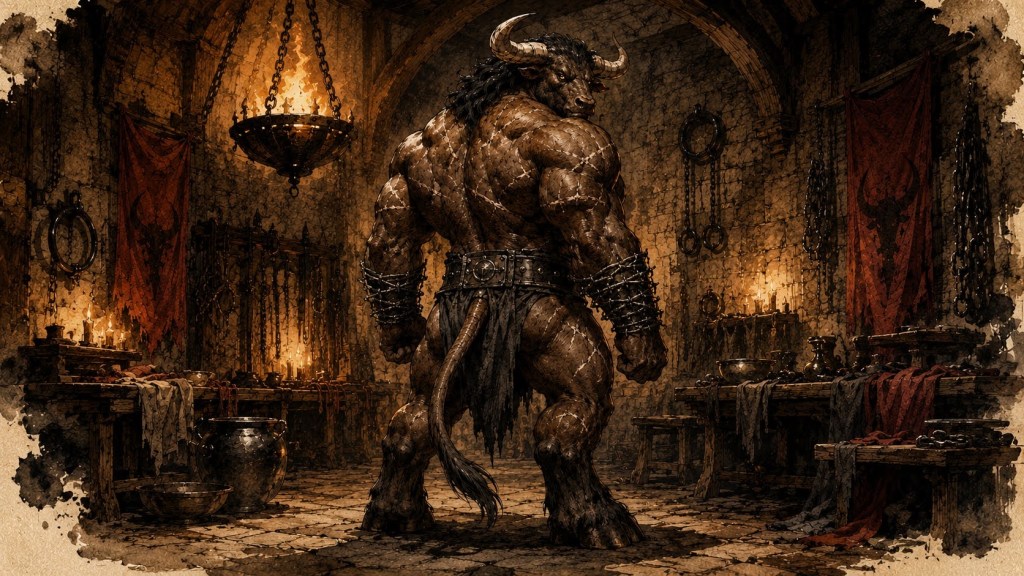
Nyzun
The Chainsinger • Lord of the Sacred Edge
God of Pain, Sensation and Endurance
“The edge belongs to the one who feels it.”
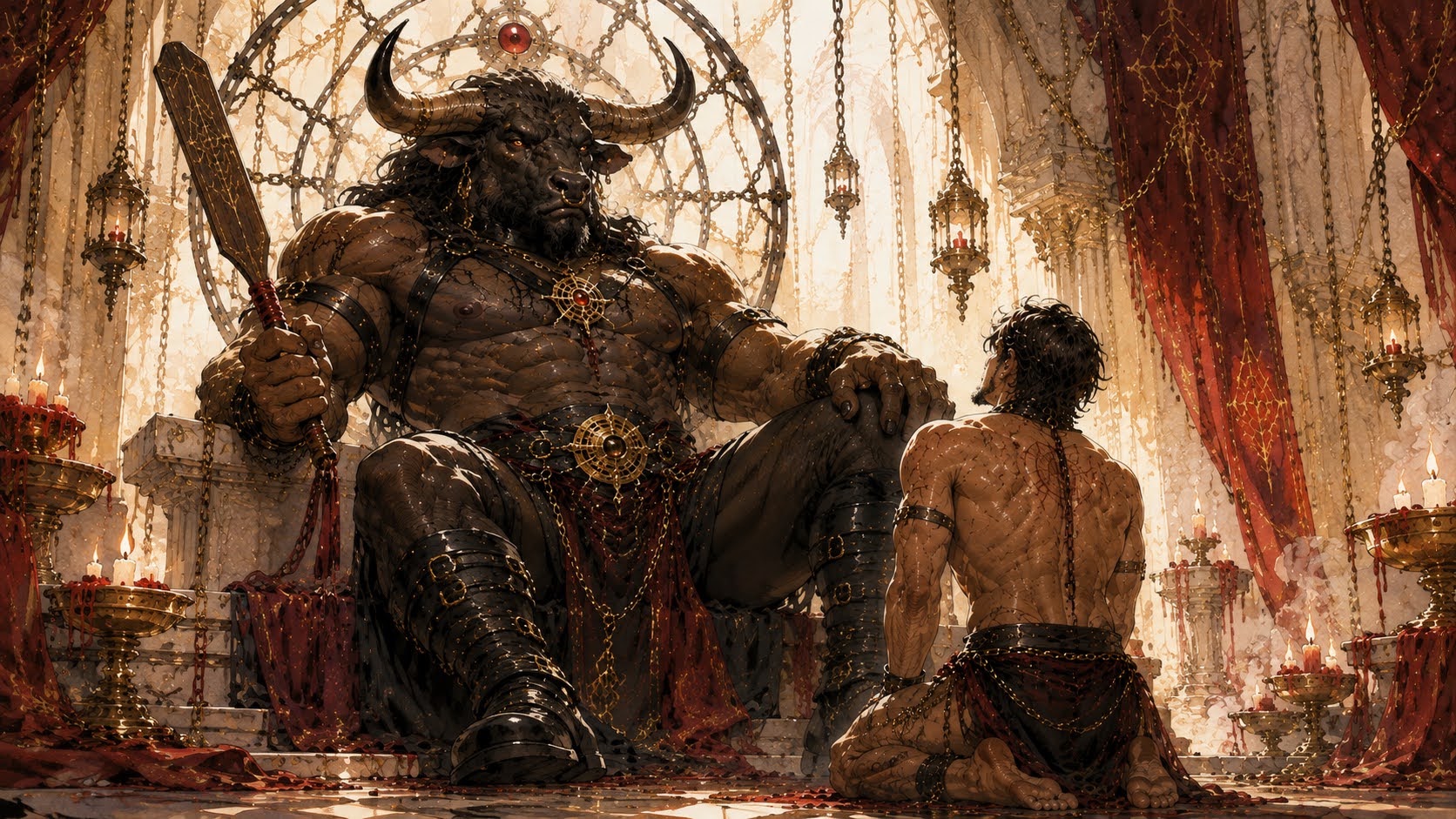
Nyzun is the god of pain deliberately encountered, sensation carefully understood and endurance that never requires a person to surrender judgment merely to prove their strength. He governs pressure, intensity, discipline, limits, ordeal, painful pleasure and the strange clarity that can emerge when sensation becomes impossible to ignore.
Warriors invoke Nyzun when learning to function through injury without mistaking recklessness for courage. Healers study his teachings because pain can reveal what the body cannot otherwise explain. Athletes, laborers and adventurers seek his discipline when testing endurance. Lovers and ritual practitioners call upon the Chainsinger when exploring intense sensation, restraint and consensual pain. Those recovering from an ordeal may invoke him for another reason entirely: Nyzun is the god who remains when the instrument has been lowered.
His mysteries are sometimes mistaken for the worship of suffering. His faithful consider this a profound misunderstanding.
Nyzun does not teach that pain is good. He teaches that pain is information. To flee every painful sensation without understanding it is to refuse one of the body’s oldest languages. To pursue suffering merely because suffering appears impressive is equally foolish. Pain may warn, challenge, awaken, overwhelm, injure, arouse or reveal. Wisdom lies in knowing which is occurring.
For this reason, Nyzun’s worship returns constantly to three principles: Pain is information. Intensity is communion. Choice remains sovereign.
Lore & Mythos
When Pain First Spoke
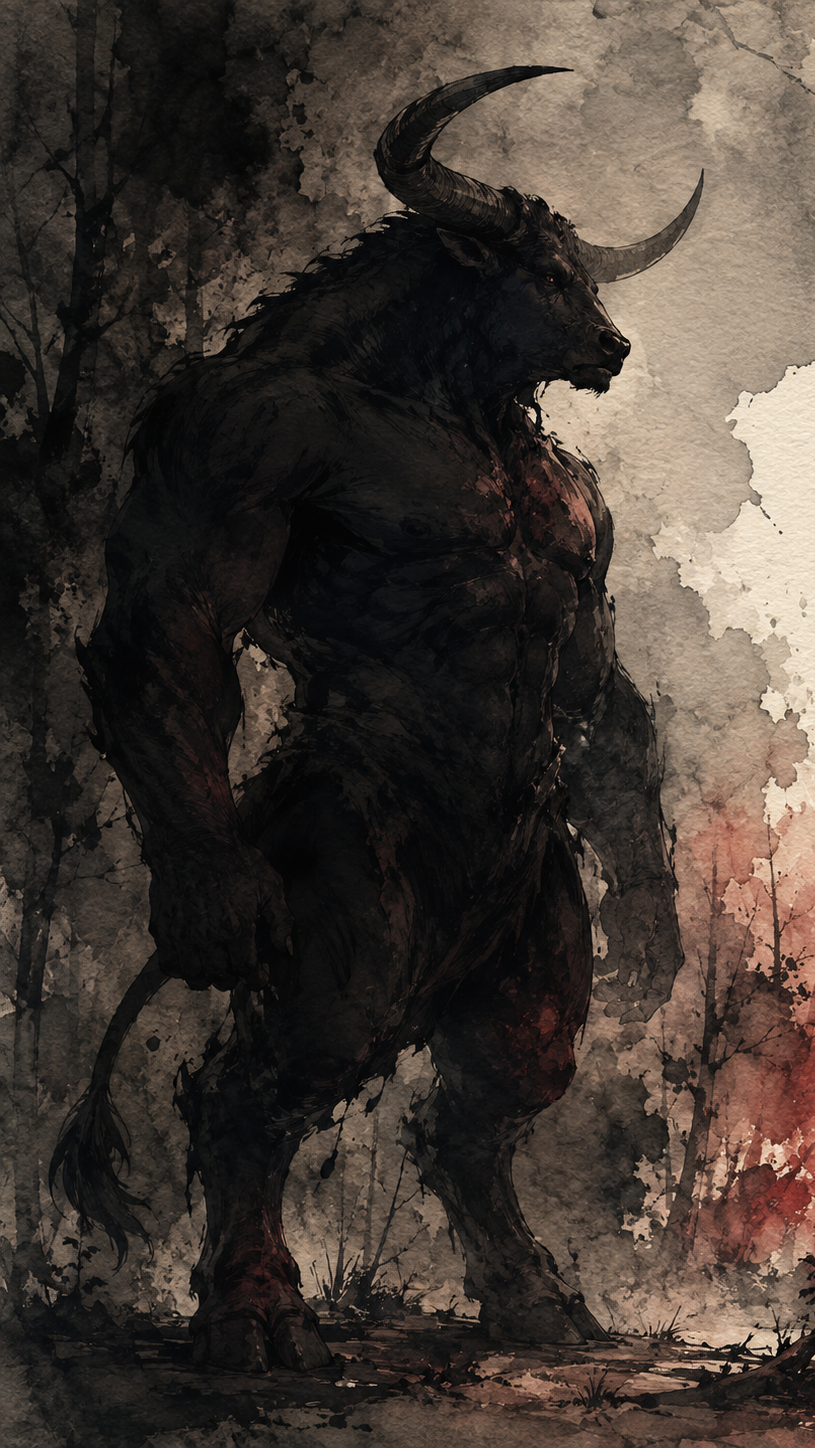
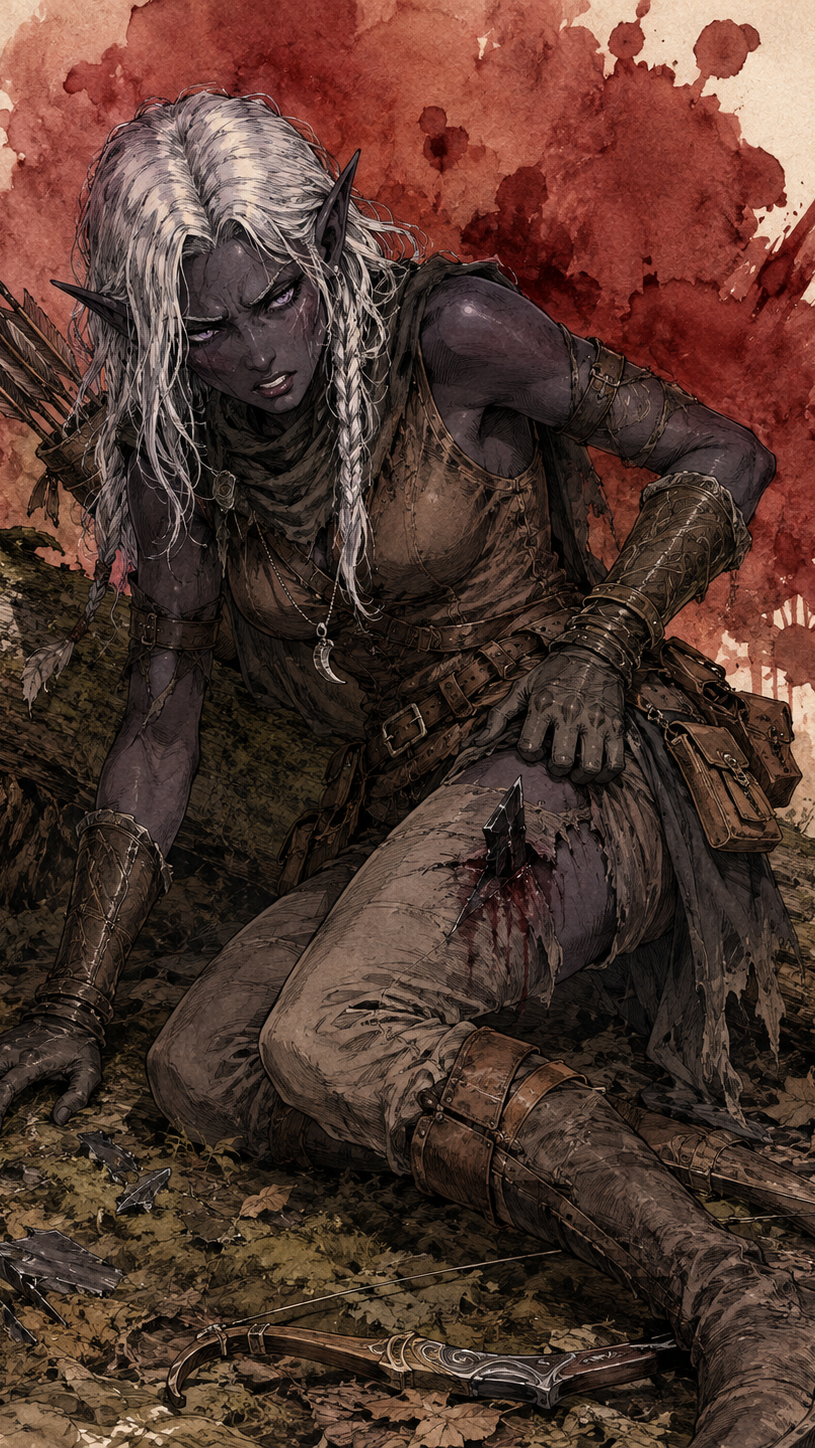
No single account of Nyzun’s beginning is accepted throughout Erosia. One of the oldest traditions claims he awakened when the first mortal deliberately listened to pain instead of merely fleeing from it. The story concerns a hunter wounded far from home. An iron shard had entered his thigh. Every movement hurt. Fear urged him to run before predators found the scent of blood, but the wounded hunter stopped.
She touched the injury. Pain answered. SHe moved the leg one way. Pain sharpened. Another way. It changed. He placed weight upon it and nearly collapsed. He removed the weight and discovered that he could still crawl.
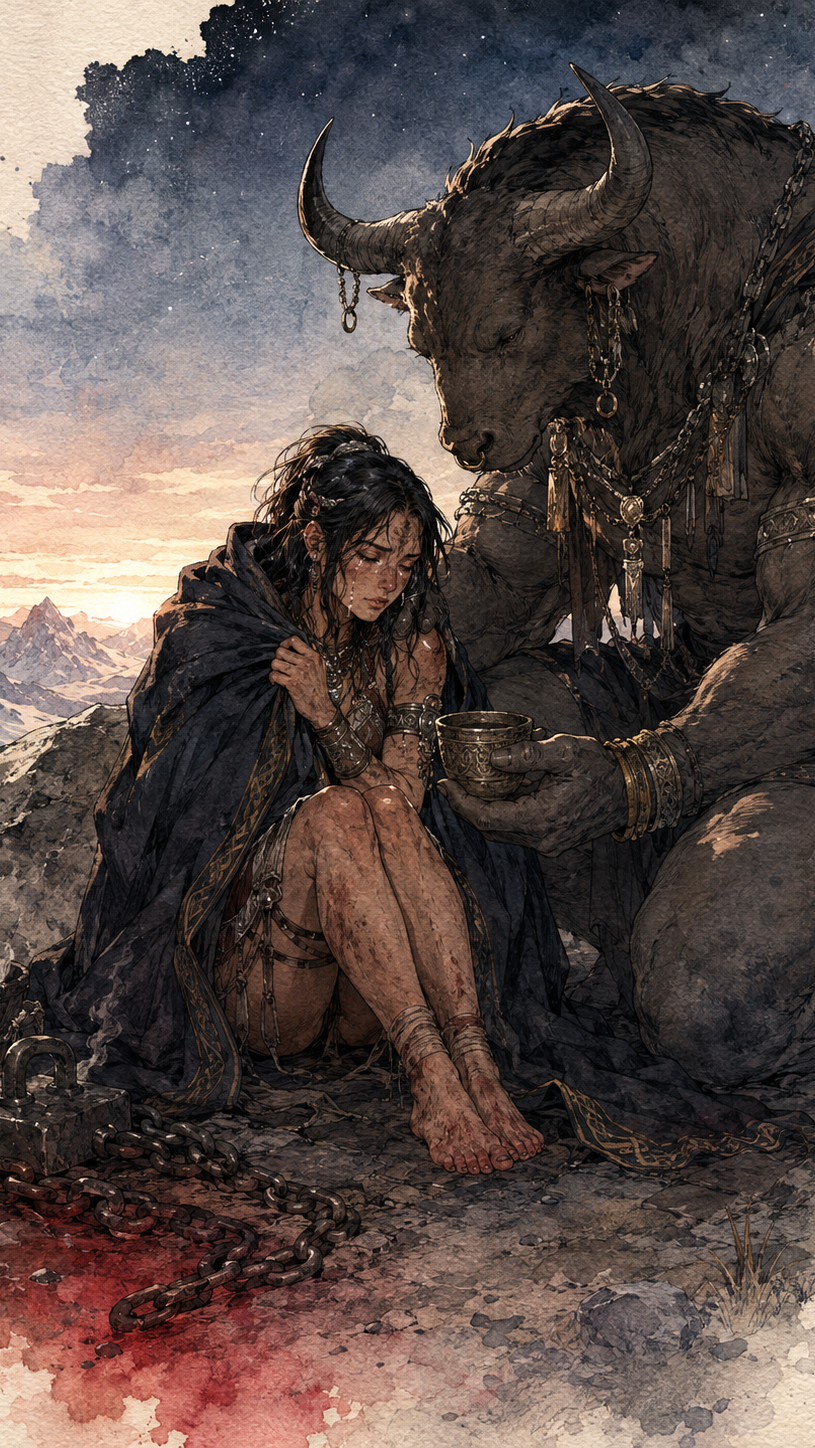
For the first time, a mortal did not hear pain merely as a command to stop. She heard information. The hunter bound the wound, fashioned a crude support and returned home slowly. Later traditions claim that a massive horned stranger walked beside her through the darkness, never carrying her and never demanding that she continue.
Whenever the hunter stumbled, the stranger asked only: “What does it tell you?”
By dawn, the stranger was gone. The hunter survived. Nyzunian theologians call this the First Listening. Pain existed before Nyzun. What changed was the mortal understanding of it. Pain had learned to speak because someone had finally learned to listen.
The Chain That Did Not Break
Another tradition tells of a great chain forged for an ancient sovereign. Its smith boasted that no force in Erosia could break it. Nyzun, appearing as an enormous bull-headed traveler, asked permission to test the claim. The sovereign agreed, expecting a spectacle.
Nyzun took the chain in both hands. He pulled. The links tightened. The smith smiled. Nyzun pulled harder. The metal began to sing.
The gathered court marveled at the sound, but the smith suddenly raised one hand. “Enough.”
Nyzun stopped immediately. The sovereign laughed. The chain had not broken. Surely the test had failed. Nyzun disagreed. He placed the chain into the smith’s hands and pointed toward one link where the metal had begun to deform.
“One more measure,” he said, “and your masterpiece would have become scrap.” The smith had known the chain better than the sovereign who owned it and better than the god who tested it.
Therefore the smith alone had known its Edge. From this myth comes the sacred metaphor of the Chainsong. A chain without tension cannot sing. Too much tension breaks it. Mastery exists between those conditions.
So too with flesh. So too with courage. So too with trust.
The Ordeal of the Unbowed
A third tradition concerns a warrior who came to Nyzun demanding the greatest ordeal any mortal had survived. She wished to prove that nothing could break her. Nyzun refused.
The warrior accused him of cowardice. He refused again. She demanded pain, and finally the Chainsinger agreed to test her. The ordeal lasted through the night. Its details vary wildly between traditions. Some describe chains and weights. Others speak of heat, exhaustion, cold water or a mountain ascent made barefoot beneath winter stars.
All agree upon what happened near dawn. The warrior collapsed. Nyzun asked whether she wished to continue. She answered yes. He asked again.
She became angry. “Yes.” The god knelt until their eyes were level. “Do you wish to continue,” he asked, “or do you wish not to be the woman who stopped?” The warrior began to weep. After a long silence, she whispered:
“Enough.” Nyzun ended the ordeal. He wrapped her in his own cloak, brought her water and remained beside her until she slept. When she awakened, he called her victorious. From this story comes one of the Chainsinger’s most beloved paradoxes: The strongest word spoken at the Edge may be enough.
The Desire He Embodies
Nyzun embodies the desire to feel intensely without surrendering oneself to sensation. His domain includes pain, but pain is only one note within a much larger composition. Pressure, fatigue, heat, cold, exertion, fear, anticipation, pleasure, arousal and exhaustion can all become forms of intense sensation through which mortals discover something about themselves. A runner discovers the difference between fatigue and injury. A warrior learns whether fear has actually made action impossible. A lover discovers that pain experienced within trust feels profoundly different from pain imposed without it. A wounded adventurer learns to remain functional without pretending their injury does not matter.
Nyzun does not ask mortals to become numb. He asks them to become accurate. The perfected Nyzunian does not say, It does not hurt. They say: It hurts. I know exactly how much it hurts. Then they choose what happens next.
The Sacred Edge
Nyzunian theology describes every sentient being as possessing countless Edges.
There is an Edge of endurance. An Edge of fear. An Edge of pleasure. An Edge of pain. An Edge of exhaustion. An Edge of arousal. An Edge of surrender. There are Edges beyond which sensation ceases to reveal and begins merely to overwhelm or damage.
These boundaries are not regarded as weaknesses. They are knowledge. A worshipper may approach an Edge deliberately, retreat from it, train themselves near it, discover that it has changed or decide never to approach it again.
All are valid. The theological error lies in assuming another person’s Edge belongs to you. Thus the faithful repeat:
The edge belongs to the one who feels it.
Pain Is Information
Perhaps Nyzun’s most important teaching is deceptively simple:
Pain speaks before flesh breaks.
Pain may signal injury. It may communicate strain, pressure, heat, fatigue or danger. It may also exist without serious harm. Fear may amplify it. Anticipation may transform it. Trust may alter how the same sensation is experienced.
Nyzun therefore opposes both mindless avoidance and mindless endurance. The novice hears pain and thinks: Stop. The fool hears pain and thinks: Ignore it. The Chainsinger hears pain and asks:
What are you telling me?
This makes Nyzunian healers, trainers and ritual specialists unusually attentive to physical response. Bruised flesh differs from strained muscle. Fatigue differs from incapacity. Discomfort differs from injury. The body is an instrument. Pain is one of its notes.
Endurance and the Measure
Nyzunian endurance does not mean becoming insensitive. Deliberately destroying one’s ability to perceive pain merely so that pain can no longer interfere is considered by many traditions the opposite of mastery.
There is no wisdom in breaking the instrument so that it can no longer warn you. True endurance means experiencing sensation while retaining enough awareness to decide what follows.
Nyzunian traditions call this discernment the Measure.
Practitioners learn to distinguish pain from injury, fear from danger, fatigue from incapacity, pleasure from compulsion, arousal from consent, surrender from helplessness and endurance from self-destruction.
The last distinction is particularly sacred. Someone who continues because stopping would make them feel weak may demonstrate less discipline than someone who recognizes their true boundary and ends the ordeal.
Endurance proves that you can continue. Wisdom determines whether you should.
Pain, Pleasure and Arousal
Nyzun’s intimate mysteries do not pretend that pain, pleasure and erotic arousal are unrelated. For some worshippers, they are profoundly intertwined. For others, painful sensation carries no erotic significance whatsoever.
Neither condition is considered spiritually superior. Advanced devotional practices may deliberately explore circumstances where pain, pleasure, anticipation, fear, fatigue and arousal compete for attention. The purpose is not necessarily to suppress any of them.
It is to remain capable of choosing while experiencing them. A person may tremble, cry, gasp, laugh, sweat or become aroused. None of these reactions automatically determines what they want. Nyzun therefore teaches:
Nothing I feel may make my choice for me.
Reaction is not decision. Sensation may be overwhelming. Choice remains sovereign.
Holy Symbol & Iconography
The Singing Chain
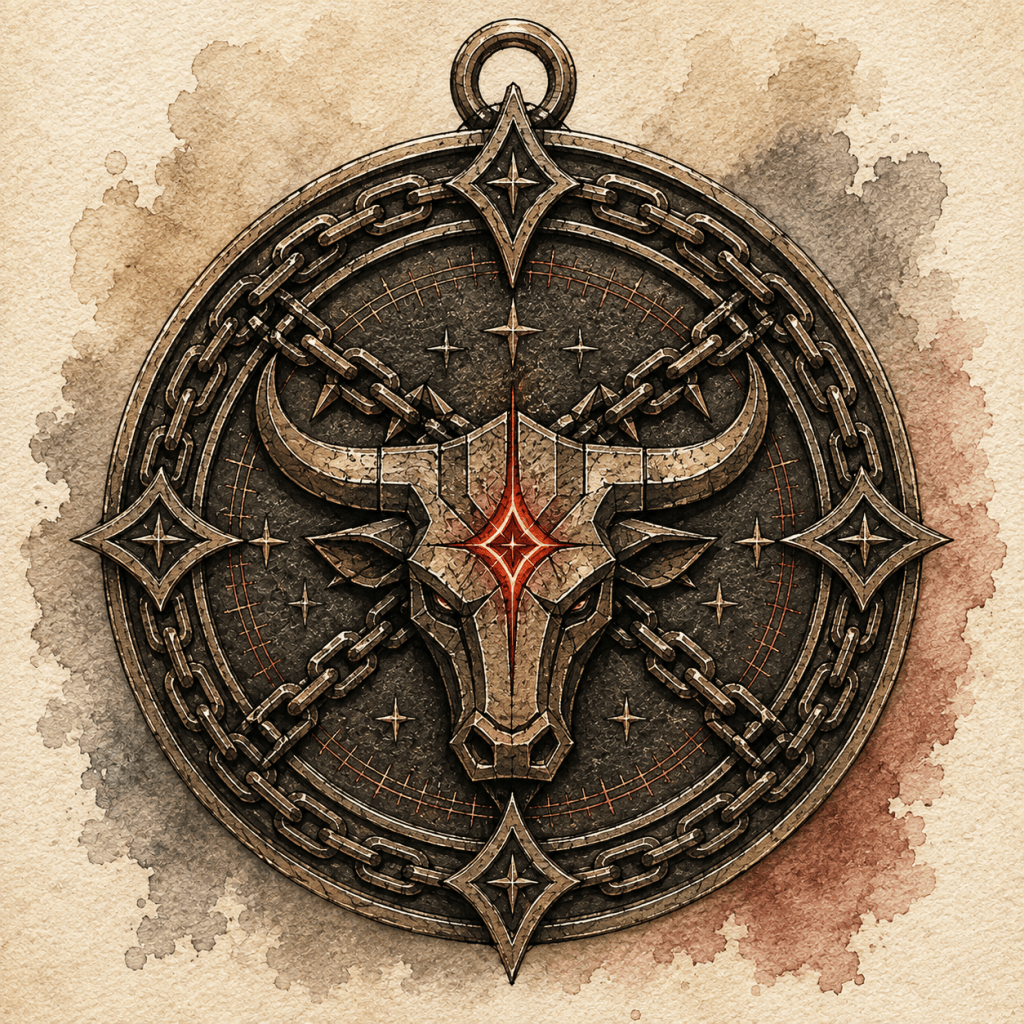
Nyzun’s holy symbol depicts a heavy ceremonial chain arranged around the stylized countenance or horns of the Divine Bull, usually rendered in blackened iron, silver and antique gold. The individual links are essential.
Each represents another increment of sensation: another breath, another moment, another decision, another opportunity to continue or stop.
The chain is never depicted broken. Neither is it pulled completely slack. It exists beneath deliberate tension. This represents the Chainsong, Nyzun’s central sacred metaphor. A chain without tension cannot sing. A chain subjected to excessive tension breaks. The master understands the difference.
Many versions incorporate a central ring, tuning element or suspended link representing the Measure: the point from which tension is observed and understood. Crimson accents occasionally appear in intimate devotional symbols, representing living sensation rather than bloodshed.
The complete emblem carries Nyzun’s warning: Do not break what entrusted you with its tension.
Sacred Colors and Materials
Nyzunian sanctuaries favor blackened iron, dark steel, silver, charcoal, deep crimson and antique gold. Iron represents endurance. Silver represents precision and perception. Black represents discipline without spectacle. Crimson represents sensation made impossible to ignore. Antique gold represents mastery: knowledge earned through experience rather than domination claimed through force. Leather, forged chain, polished stone, dark wood, warm cloth, medicinal oils, wax, brass bowls and carefully maintained ritual implements are common.
Nothing should appear neglected. A damaged chain is repaired. A cracked handle is replaced. An unsafe restraint is discarded. Precision is sacred.
Chains, Implements and Resonance
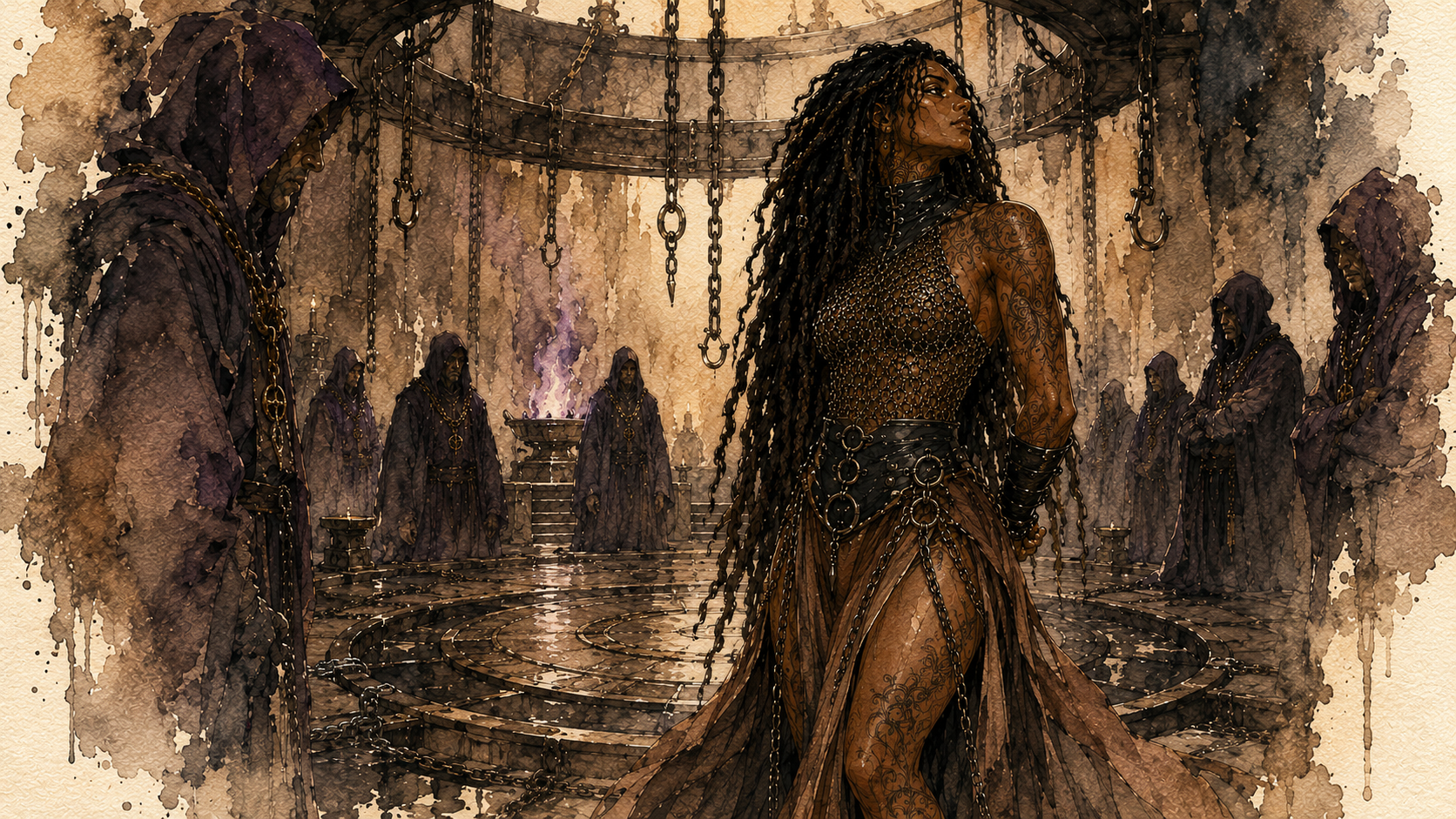
Chains dominate Nyzunian visual language, but they symbolize calibrated tension more often than imprisonment. Many temples suspend chains of different weights throughout ritual chambers. When struck, plucked or placed under carefully controlled tension, one begins to vibrate. Others answer. Soon the entire chamber hums. This is the Chainsong.
Ritual implements may include weighted chains, leather straps, paddles, pressure tools, wax vessels, cuffs and instruments used for controlled heat, cold or muscular strain. Their presence is neither hidden nor treated as shameful. Neither are they fetishized as objects of cruelty. A Nyzunian implement is a tool. Its holiness depends upon how accurately it is used.
Sacred Creatures
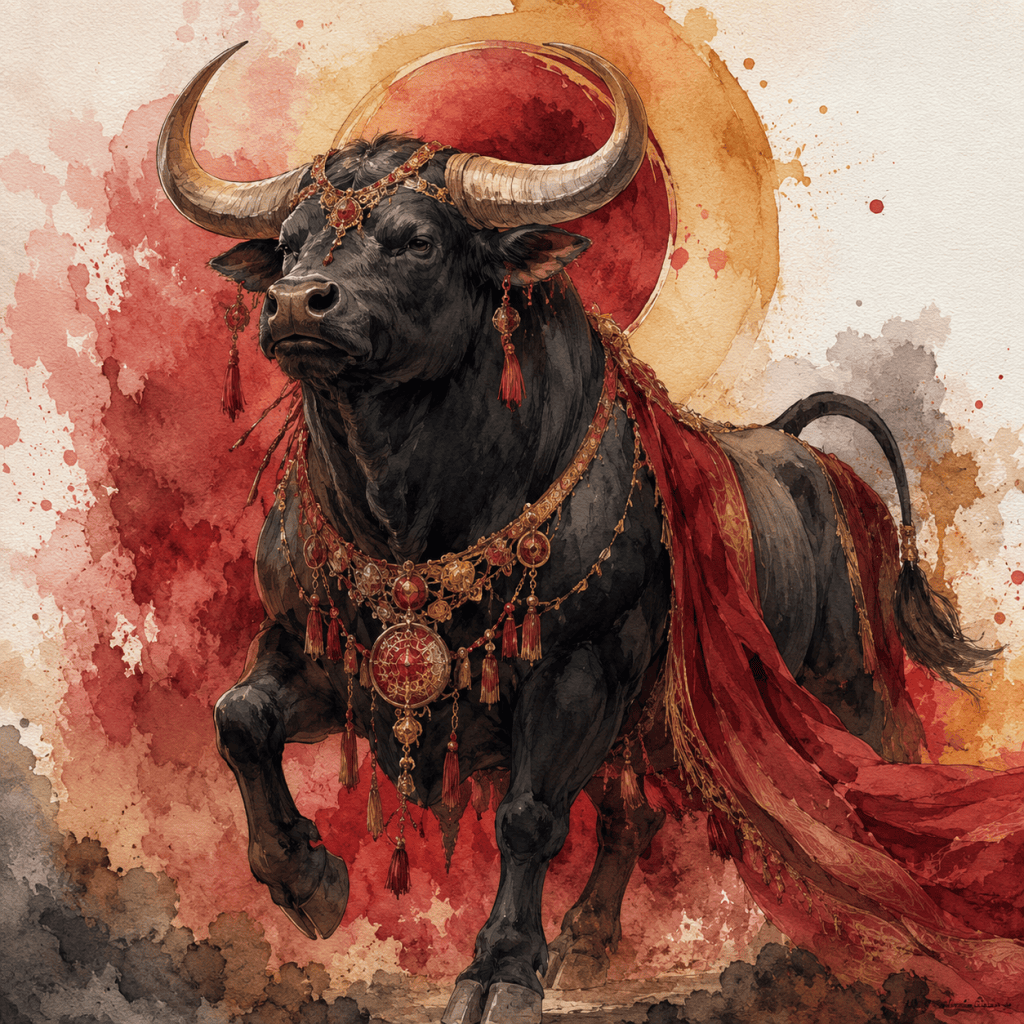
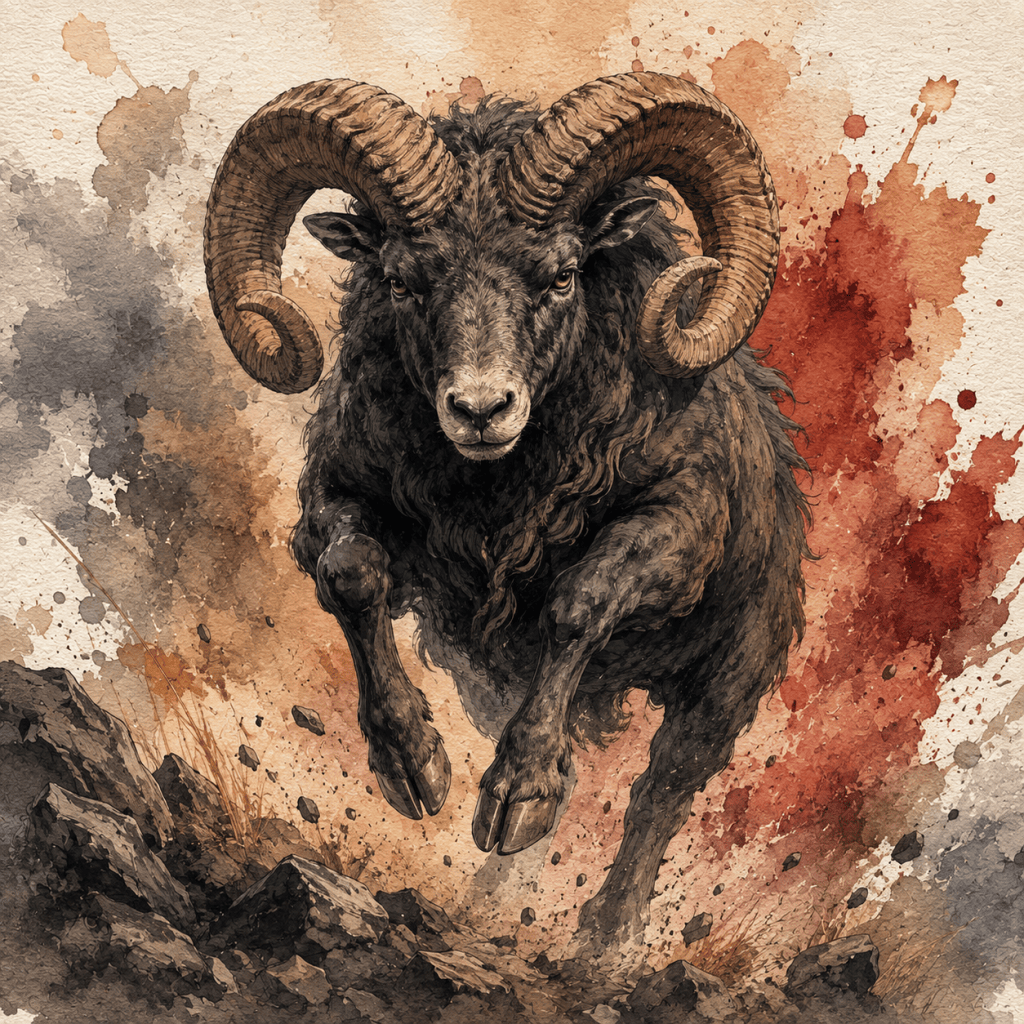
Bulls are Nyzun’s foremost sacred creatures, particularly massive dark-coated breeds known for strength and extraordinary calm. They represent power that does not need to spend itself merely because it exists. Rams are associated with pressure, impact and determination. Ironhorn beetles symbolize endurance beneath burdens disproportionate to their size. Certain deep-cavern crickets are sacred because their songs change according to tension within the surrounding stone.
Stories also speak of Chainhorn Bulls, enormous celestial cattle whose horns appear wrapped in freely moving links of antique-gold chain. Their arrival is traditionally interpreted not as a warning of violence but as an omen that someone nearby is approaching an important limit.
Depictions of Nyzun
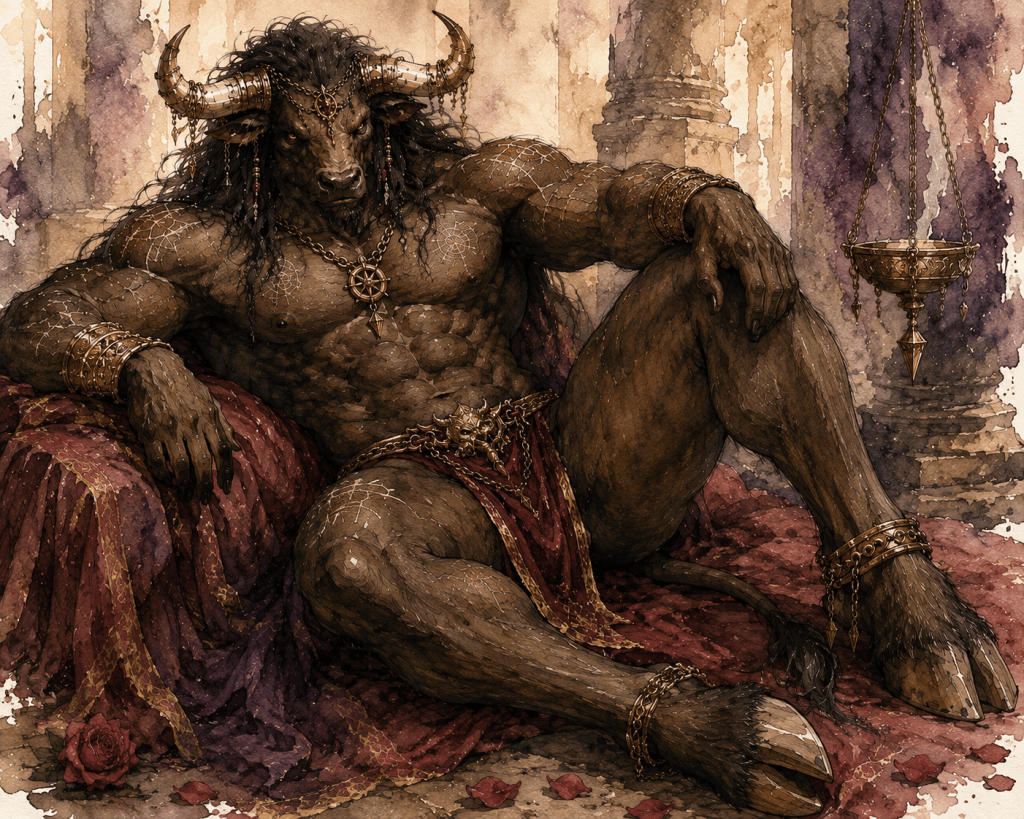
Sacred art portrays Nyzun as a mature adult Minotaur deity of immense physical presence: broad-shouldered, powerfully muscled and unmistakably masculine. His bull-like head bears enormous dark horns frequently ornamented with iron rings, gold fittings or suspended chains. His eyes are intense but attentive. The distinction matters. Nyzun watches the person before him, not the instrument in his hand.
His regalia favors black leather, iron, silver and restrained antique-gold ornamentation. Chains may cross the torso or hang from belts, cuffs and ceremonial fittings. Crimson appears sparingly as a visual note of living sensation. Nyzun should appear intimidating without becoming cruel.
His strength is obvious. His restraint is more important. Some of the faith’s most beloved images do not depict an ordeal at all. They show the Divine Bull kneeling beside an exhausted devotee, offering water, wrapping them in a blanket or resting one enormous hand gently against their back.
The chains lie silent nearby. And Nyzun remains.
Worship & Daily Devotion
Nyzun can be worshipped anywhere someone deliberately encounters difficulty without lying to themselves about what it costs. Training can be prayer. Physical therapy can be prayer. Holding steady while a wound is cleaned can be prayer. Completing difficult labor without ignoring signs of injury can be prayer. Resting when pride demands another repetition can also be prayer. His worship therefore attracts warriors, healers, athletes, laborers, dancers, adventurers, professional dominants, endurance practitioners and anyone fascinated by the relationship between sensation and choice.
The Listening Breath
One of Nyzun’s simplest disciplines begins with discomfort. A worshipper holds a demanding posture, carries a measured weight or performs another controlled physical exercise while breathing deliberately.
Rather than distracting themselves from discomfort, they observe it. Where is it?
Is it increasing? Is the sensation muscular, skeletal, emotional or uncertain? What changes when the breath changes? The exercise ends before injury.
Its purpose is not toughness. It is literacy.
The Measure
Before a difficult undertaking, devotees sometimes speak three statements aloud:
What I expect.
What I fear.
What will make me stop.
The practice is common before athletic contests, dangerous journeys, healing procedures and intimate rites alike. A declared boundary may later change. The sacred act is not predicting the future perfectly. It is beginning with attention.
The Silent Link
Some worshippers carry a single iron chain link as a devotional object. During moments of pain, fear, anger or overwhelming desire, they hold it and ask themselves one question:
What am I choosing?
The practice is particularly common among adventurers.
Favored Offerings
Traditional offerings include forged chain links, medicinal oils, repaired tools, black candles, crimson cord, leatherwork, weights used during training, bowls of clean water and objects that have endured difficult use without failing. A particularly respected offering is a broken implement that has been responsibly retired. The worshipper does not pretend it could have endured forever. Neither should they.
Clergy & Temples
Hands of the Chainsinger
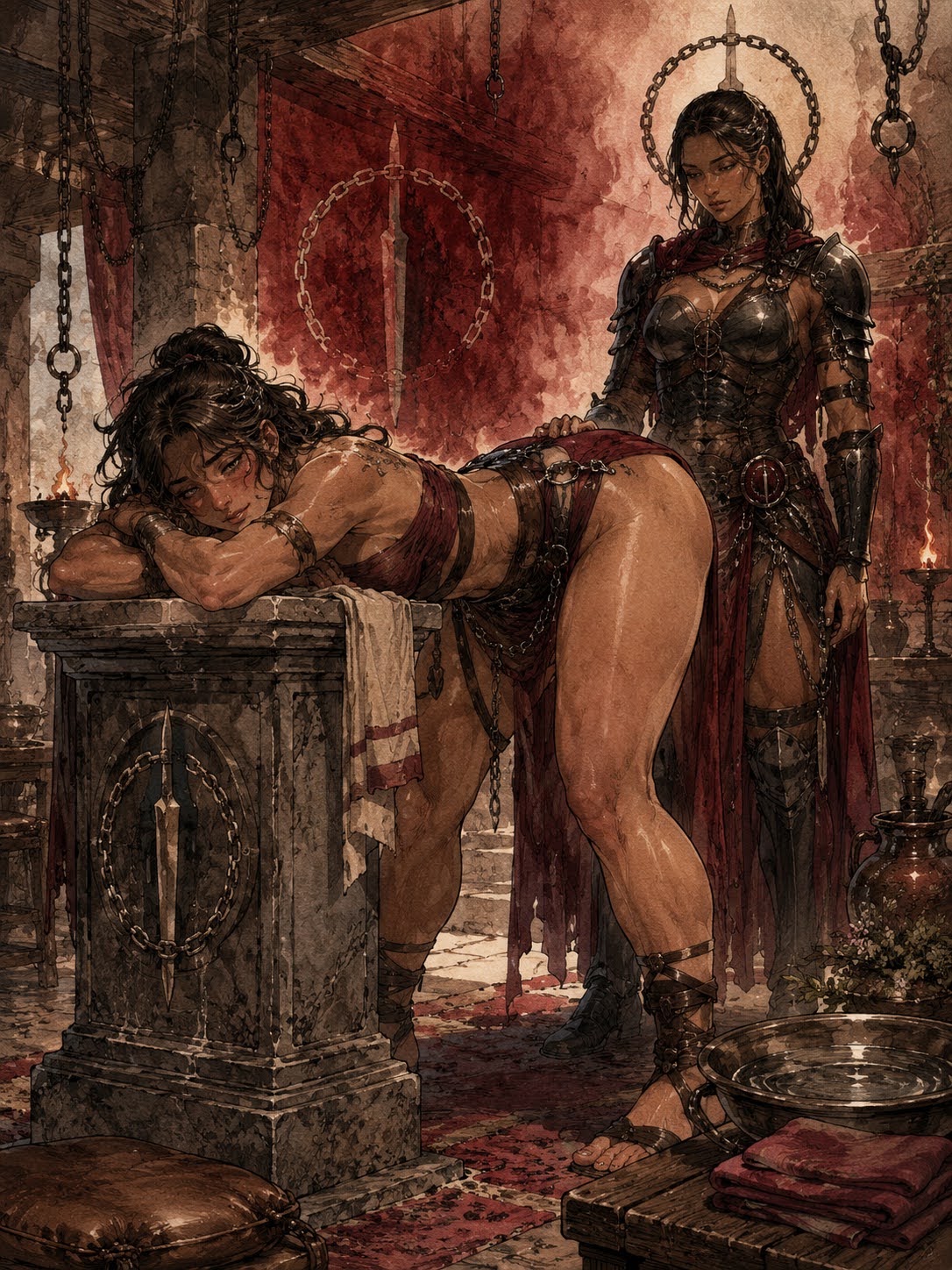
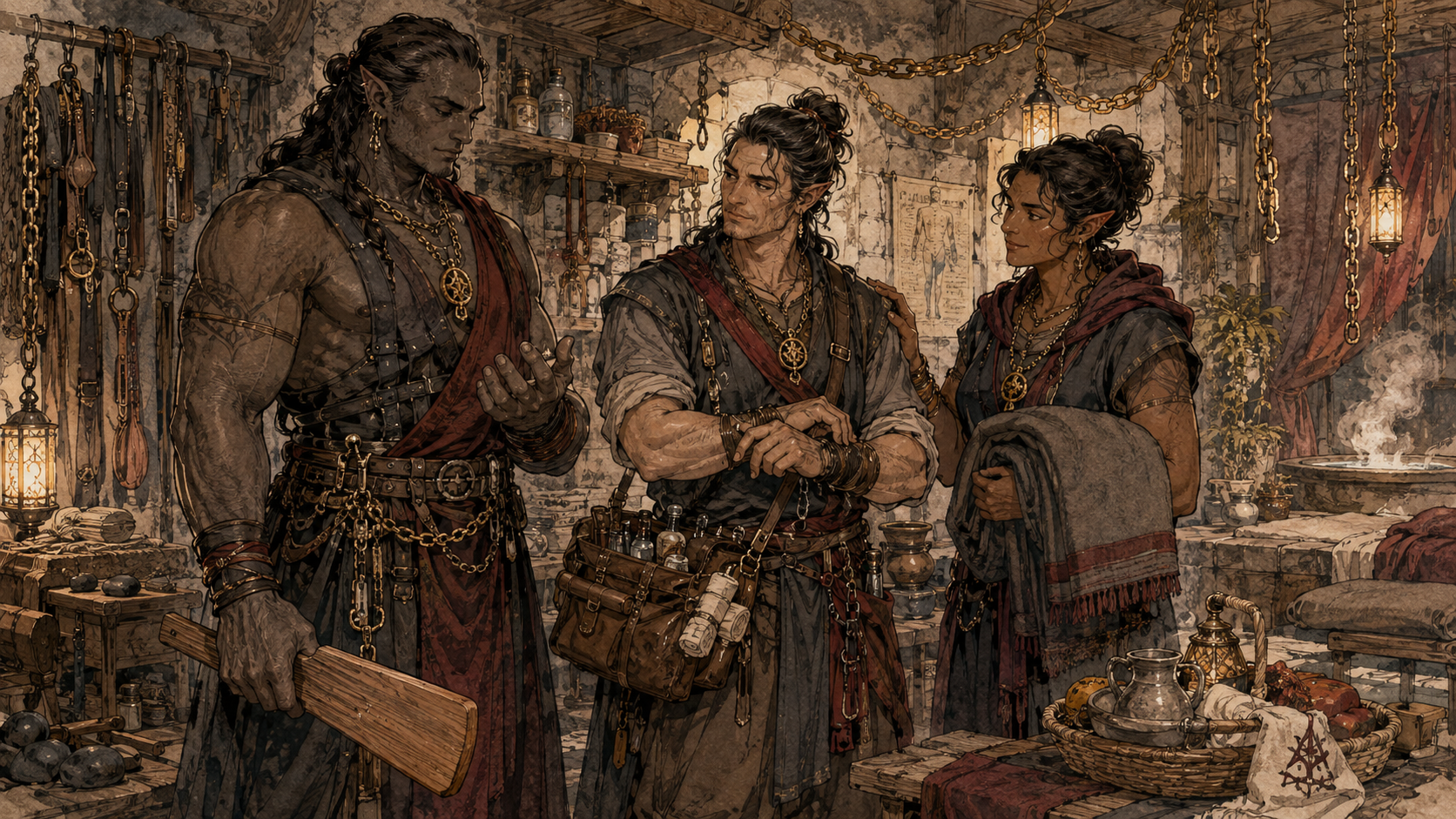
The Hands are Nyzun’s principal ritual specialists and masters of Inflection, the disciplined administration of sensation. They study anatomy, breathing, pulse, muscular tension, posture, fatigue, involuntary response and the physical signs that distinguish manageable intensity from dangerous distress. Their training may include massage, controlled impact, heat and cold, restraint, pressure and other calibrated sensations.
Their objective is never simply to cause as much pain as possible. Any brute can accomplish that. A Hand seeks to create exactly the intended experience and no more.
Their traditional teaching is:
“Strength determines whether you can strike. Mastery determines whether you should.”
Keepers of the Measure
Keepers preserve Nyzun’s disciplines of endurance, assessment and limits. Many serve as healers, trainers, athletic instructors, battlefield medics or advisers to people whose professions require functioning under extreme physical stress.
They are particularly skilled at recognizing the dangerous point where determination becomes self-destruction. Keepers frequently become the irritating voice telling heroic adventurers that no, the ability to walk on the ankle does not mean the ankle is fine. Their irritation has saved many lives.
Those Who Remain
Those Who Remain preserve Nyzun’s sacred traditions of recovery and aftercare. They tend the exhausted after ordeals, battles, ritual experiences and periods of extraordinary physical strain. Their chambers contain blankets, water, food, warm pools, medicinal oils, cushions and quiet places where no one is required to speak.
They are not lesser priests because their work begins after the dramatic moment has ended. Nyzunian theology teaches precisely the opposite.
Anyone may deliver the blow. Remain for the trembling.
Halls of the Singing Chain
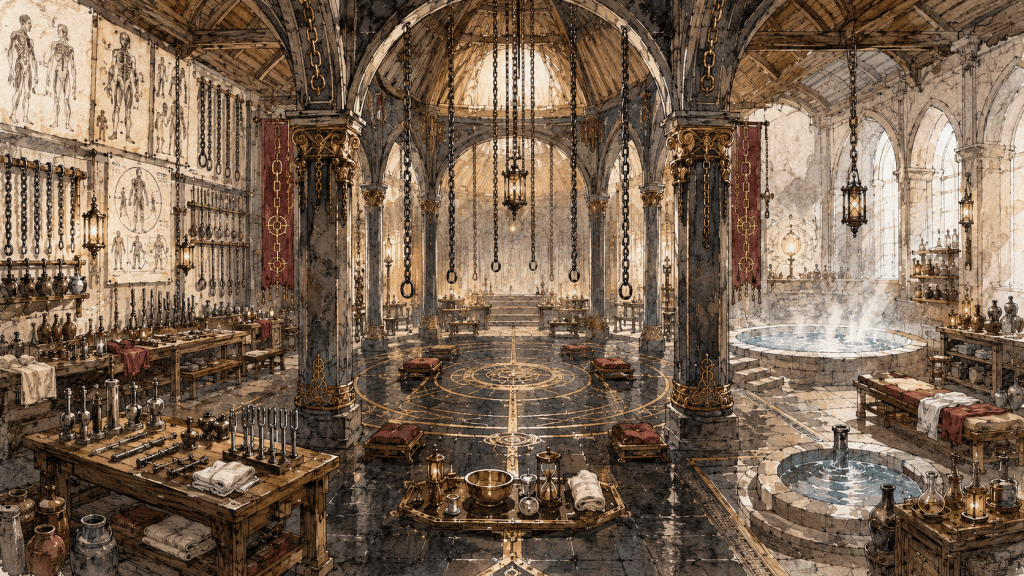
Nyzun’s temples are commonly called Halls of the Singing Chain, though regional names include Houses of Measure, Iron Sanctums and Chambers of the Sacred Edge. Many resemble an unusual combination of temple, academy, clinic, training hall and bathhouse. Training floors stand beside treatment rooms. Anatomical diagrams hang near ritual chambers. Chains are organized according to weight and resonance. Wax is maintained at measured temperatures. Implements are cleaned and inspected. Warm pools and cold basins support recovery.
The recovery chambers are as important as the ritual spaces. This architecture expresses the entire Nyzunian mystery. Prepare carefully. Experience fully. Recover deliberately.
Rites, Taboos & Divine Signs
The Three Measures
Before a significant ordeal, participants establish three Measures. The First Measure describes what is desired. The Second Measure establishes boundaries and methods of communication. The Final Measure establishes what happens afterward. Nothing begins until all three are understood.
The Chainsong
Chains of different weights are suspended throughout a sanctuary and placed under carefully measured tension. One is sounded. Others answer. Participants breathe according to the developing resonance while meditating upon their own limits. The rite teaches that tension creates information. Too little produces silence. Too much produces breaking.
The Sacred Edge
A participant deliberately approaches a previously established threshold of exertion or sensation under observation. The objective is not necessarily to cross it. Indeed, many rites end at precisely the point where the participant recognizes the Edge clearly enough to name it. Discovery is the accomplishment.
The Ordeal of Equal Hands
Two participants undergo the same difficult experience together without either holding ritual authority over the other. They may carry weight, endure cold, maintain demanding postures or experience another controlled challenge. The rite demonstrates that Nyzunian surrender does not require hierarchy. Two equals may meet the Edge together.
The Word Enough
Some rites deliberately conclude when the participant says enough. No failure has occurred. The officiant immediately stops, acknowledges the word and transitions into recovery. The ritual exists specifically to teach worshippers who struggle to stop that ending something deliberately can require more discipline than continuing it automatically.
The Final Movement
The rite does not end when the pain ends. After an ordeal, the instruments are lowered. Water is offered. Warmth is restored. Breathing slows. Marks and injuries are examined. Food may be provided. The participant may desire touch, conversation, silence, solitude, laughter, tears or sleep. The Hand listens. Again. This is the Final Movement, and many Nyzunians consider it the moment when the Chainsinger’s love becomes most visible. Before the rite, Nyzun asks. Within the rite, Nyzun listens. After the rite, Nyzun remains.
The Great Prohibition
Nyzun possesses many disciplines but one prohibition stands above them: No one may claim another person’s Edge.
Pain inflicted without meaningful choice is not sanctified merely because someone endured it. Torture, coercive ordeal, ignoring withdrawal, deliberately disguising injury as discipline, using shame to force continuation and abandoning someone after accepting responsibility for their vulnerability are grave violations of Nyzun’s faith.
His clergy reserve particular contempt for those who make another person’s refusal into evidence of weakness. A person’s reaction does not erase their decision. A person’s arousal does not grant permission. A person’s endurance does not obligate continuation. A person’s previous willingness does not make the next moment inevitable. The faithful preserve the principle simply: The edge belongs to the one who feels it.
Signs of Nyzun
Nyzun’s presence frequently manifests through resonance.
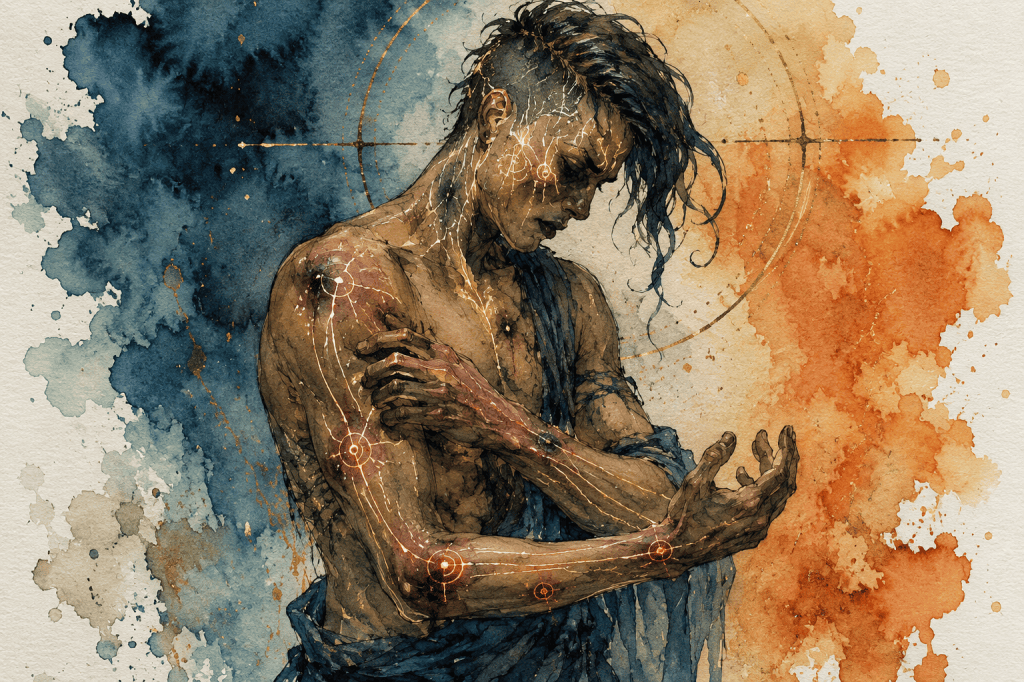
A loose chain hums despite remaining untouched. Metal vibrates faintly beneath the hand. A heartbeat becomes audible for several breaths. Old bruises warm without aching. A person suddenly becomes extraordinarily aware of exactly where tension resides within their body.
Iron may develop thin lines of antique-gold light.
Crimson illumination sometimes pulses through chain links in time with nearby breathing. When a limit is reached, the light stops immediately and fades toward warm gold.
Those particularly favored by Nyzun may find that pain becomes unusually clear rather than diminished. They know where they hurt and, more importantly, whether the sensation feels dangerous.
The Chainsinger rarely silences the body’s warning. He makes it easier to understand.
Nyzun and the Velvet Court
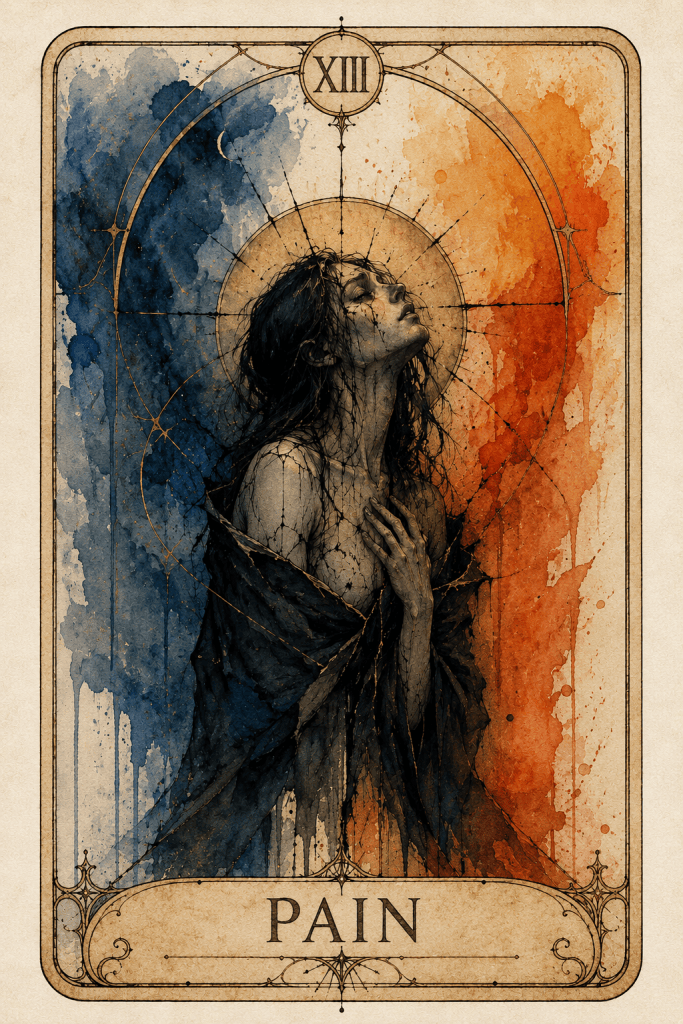
Within the Velvet Court, Nyzun embodies Sensation, Endurance and the Sacred Edge.
Where Velyssara awakens desire, Nyzun asks what happens when desire becomes intense enough to challenge certainty. He governs neither suffering for its own sake nor the simple conquest of pain. His concern is what mortals learn when sensation demands their complete attention.
His relationship with Mirellune requires particular distinction. Both deities value discipline, limits and deliberate surrender, but their central questions differ. Mirellune governs authority, structure and the responsibility created when control is entrusted to another. Nyzun governs sensation, intensity, endurance and the boundary discovered through response.
A Mirellunean rite may contain no pain whatsoever. A Nyzunian rite may contain no hierarchy whatsoever.
Mirellune asks:
Whom do you trust with authority?
Nyzun asks:
How deeply are you willing to feel?
Where their mysteries intersect, some of Erosia’s most elaborate traditions of consensual dominance and painful sensation emerge. Neither deity is subordinate to the other. Mirellune’s own traditions similarly distinguish her trust and power exchange from Nyzun’s endurance and challenge.
Delavira respects Nyzun’s understanding of deliberate intensity while constantly reminding his faithful that anticipation may sometimes produce more sensation than escalation. Her theologians describe the two gods as artisans using different instruments.
Aratheia represents one of Nyzun’s most important theological complements. She asks what happens after endurance has spent itself. Nyzunian aftercare and Aratheian nourishment therefore overlap frequently. The Chainsinger may teach someone to endure the ordeal. The Harvest Mother reminds them that endurance creates no obligation to recover alone.
Eshthara offers another productive tension. Nyzun tests boundaries through sensation; Eshthara questions whether the boundary was drawn in the correct place to begin with.
Above them all remains Velyssara, whose First Bloom gives desire permission to exist. Nyzun does not tell that desire what it must withstand. He listens while it discovers the answer.
Miracles & Divine Presence
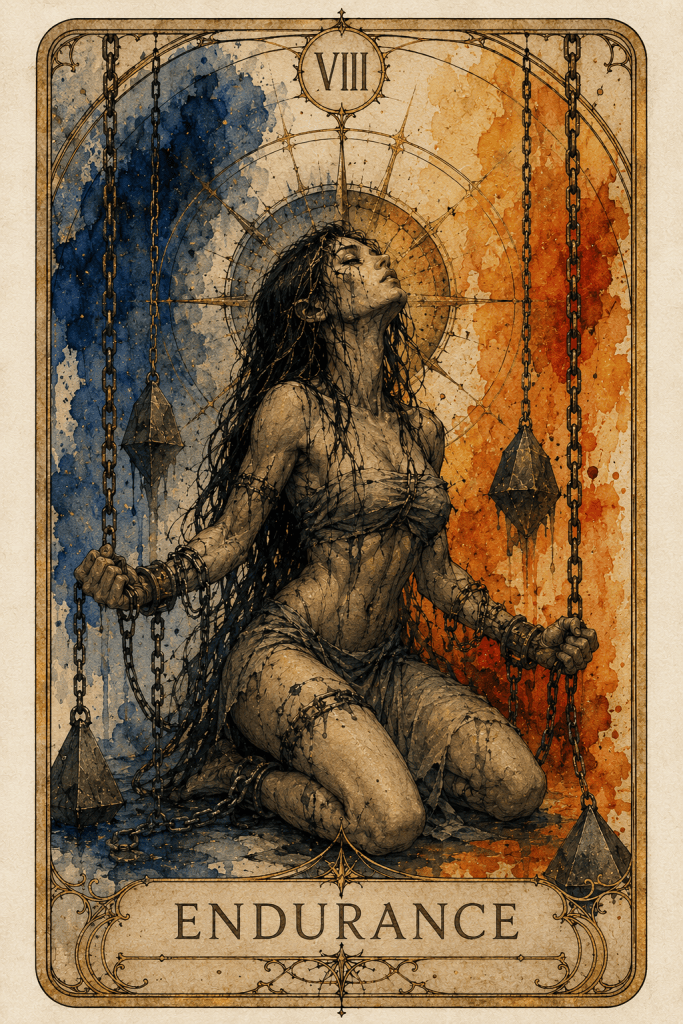
Nyzun’s miracles often resemble impossible precision. A warrior knows exactly which wound can wait and which cannot. A climber’s exhausted hand holds for one final heartbeat—long enough to choose the next grip. A healer touches an injured shoulder and immediately understands where the damage lies. A ritual chain begins singing at precisely the moment a participant reaches their declared Edge.
Pain itself may change beneath Nyzun’s influence, though it rarely disappears.
Instead, sensation becomes clear. Burning separates from pressure. Fear separates from injury. Exhaustion separates from collapse. A person who moments earlier could perceive only hurt suddenly understands what their body is saying. Greater manifestations awaken the Chainsong.
Every chain within a sanctuary begins resonating without being touched. Iron fittings hum. Crimson light travels from link to link like a heartbeat before settling into antique gold.
When Nyzun himself manifests, witnesses often notice his attention before his size. The enormous Divine Bull looks directly at whoever stands before him.
He watches their breathing. Their posture. Their hands. Their eyes. If the ordeal continues, the chains sing. When the ordeal ends, they fall silent. And Nyzun remains.
What His Faith Teaches
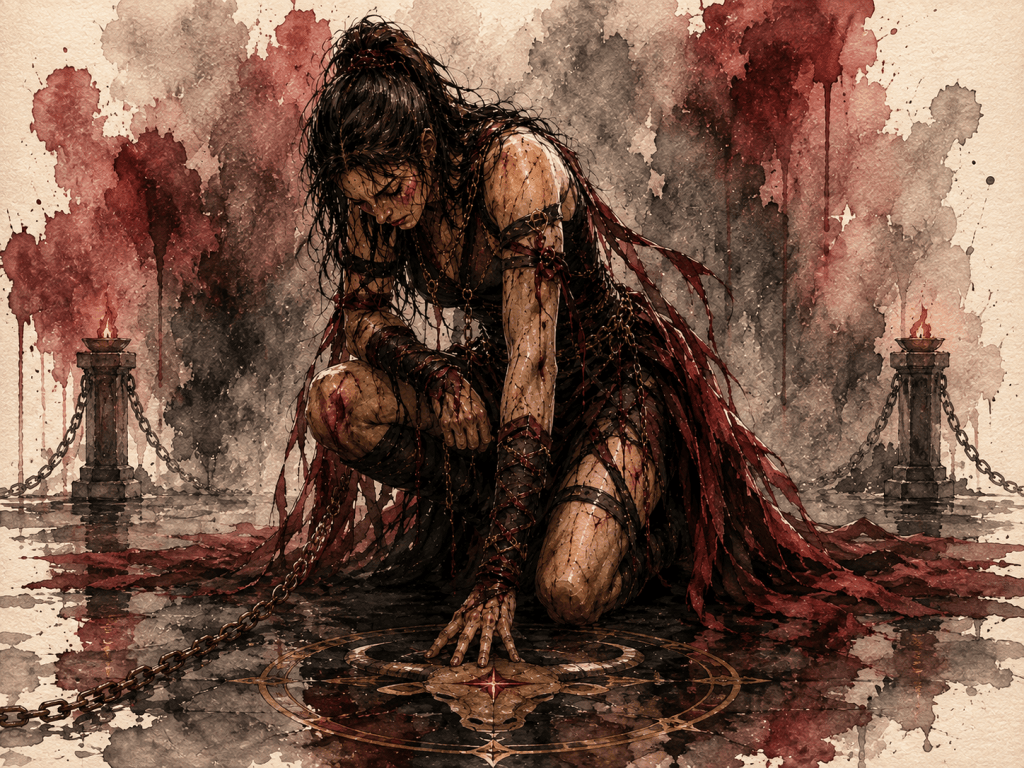
Nyzun teaches that sensation is neither enemy nor master.
The body speaks constantly. Pain, pleasure, fatigue, fear, arousal and relief carry information. Wisdom does not require obeying every sensation, nor does discipline require silencing them.
The faithful therefore preserve several principles:
- Pain is information. Listen before deciding what it means.
- A boundary is knowledge. Discovering a limit is not the same as failing.
- Endurance is not numbness. Mastery requires remaining capable of feeling.
- Reaction is not decision. Fear, pleasure, pain and arousal may influence choice without replacing it.
- The Hand bears greater responsibility. The person entrusted with another’s vulnerability gains obligations, not entitlement.
- Enough is a complete answer. Stopping deliberately may demonstrate greater discipline than continuing blindly.
- Recovery belongs to the ordeal. Responsibility does not end when the dramatic moment does.
- Precision is sacred. More is not automatically better.
And above all:
The edge belongs to the one who feels it.
At the Table
Nyzun works best in campaigns concerned with endurance, physical challenge, dangerous training, survival, pain, trust and the difference between courage and self-destruction. His presence belongs naturally in gladiatorial schools, military camps, healing halls, athletic competitions, adventuring guilds, mountain monasteries and intimate ritual sanctuaries.
A Nyzunian NPC does not need to be carrying a whip. They might be the battlefield medic who looks at the blood-covered fighter insisting they are fine and asks:
“Are you continuing because you can, or because you are afraid to stop?”
That is a Nyzunian question.
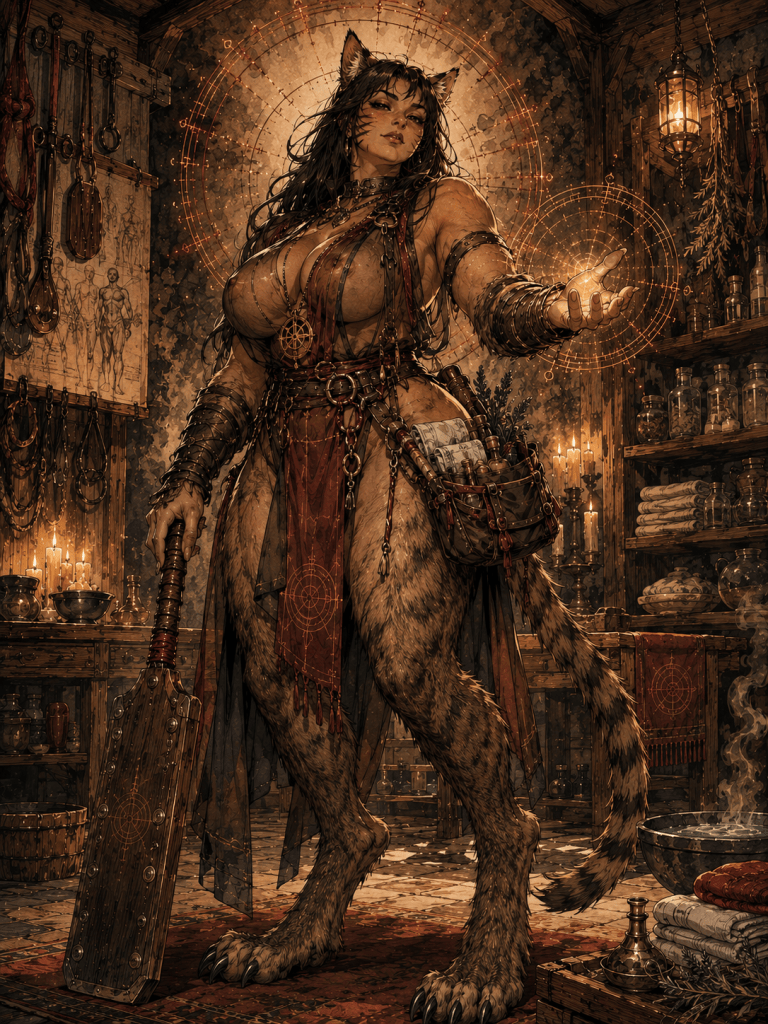
Nyzunian Characters
Characters drawn toward Nyzun commonly include warriors, healers, athletes, monks, laborers, adventurers, professional dominants, bodyworkers, survivalists and people whose lives repeatedly require them to distinguish discomfort from genuine danger.
His faith also suits characters whose relationship with endurance is unhealthy.
A warrior may believe stopping means weakness. A healer may ignore their own exhaustion because others still need them. An adventurer may discover that surviving terrible things has made suffering part of their identity. A dominant may need to learn that another person’s endurance is not proof of their own mastery.
Conversely, someone terrified of pain may discover that understanding sensation makes it less absolute.
These are Nyzunian conflicts.
Divine Domains and Traditions
The archives preserve Nyzun primarily through themes of discipline, trust, commitment, living chains, rhythm and controlled structure.
Future Second Bloom traditions should emphasize pain, sensation, endurance, pressure, discernment and limits rather than generic cruelty or damage.
Martial, healing and devotional options associated with Nyzun should reward characters for accurately judging risk, enduring controlled hardship, responding to changing conditions and protecting another creature whose vulnerability has been entrusted to them.
Boons of Nyzun
Older Nyzunian concepts support blessings involving resistance to overwhelming sensation, extraordinary awareness of physical condition, controlled endurance and supernatural precision when administering or alleviating pain.
Future mechanics should avoid making Nyzun simply “the god who gives resistance to damage.”
His mechanical identity should be knowing what pain means and choosing what happens because of it.
(Needs updated mechanics: Base 5e → Veiled → Unveiled.)
The Measure
The strongest mechanical concept for Nyzun is the Measure: divine awareness that allows a devotee to assess mounting strain and decide whether to endure, withdraw or transform that strain into another advantage.
In Veiled and Unveiled play, the same concept can naturally interact with Arousal and intense sensation without making involuntary physical response equivalent to consent.
(Needs updated mechanics: Base 5e → Veiled → Unveiled.)
Sacred Relics
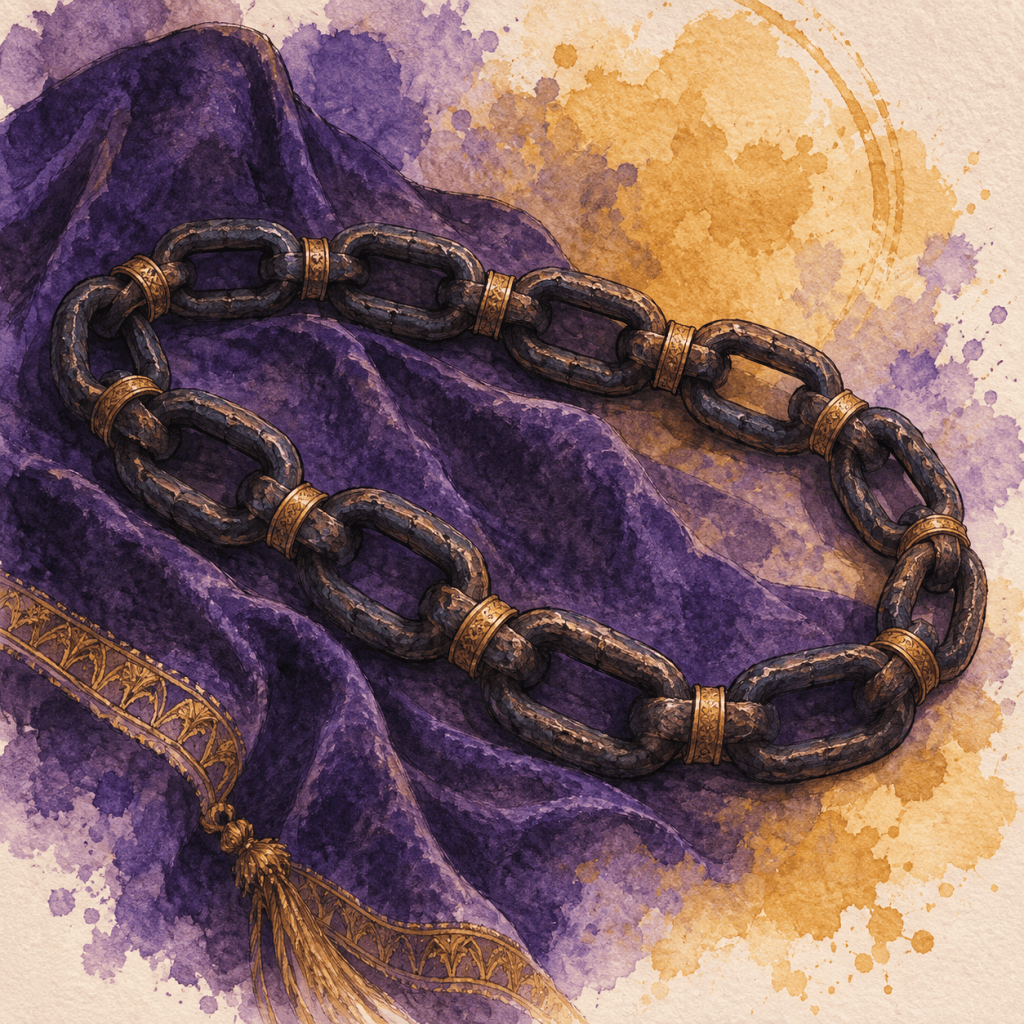
The First Singing Chain
This heavy blackened-iron chain contains thirteen links separated by tiny bands of antique gold. When placed under tension, each link produces a subtly different note. Legends claim the final link has never sounded. Nyzunian theologians disagree whether this means no mortal has discovered its true limit or whether the chain itself knows better than to cross it.
(Needs updated mechanics: Base 5e → Veiled → Unveiled.)
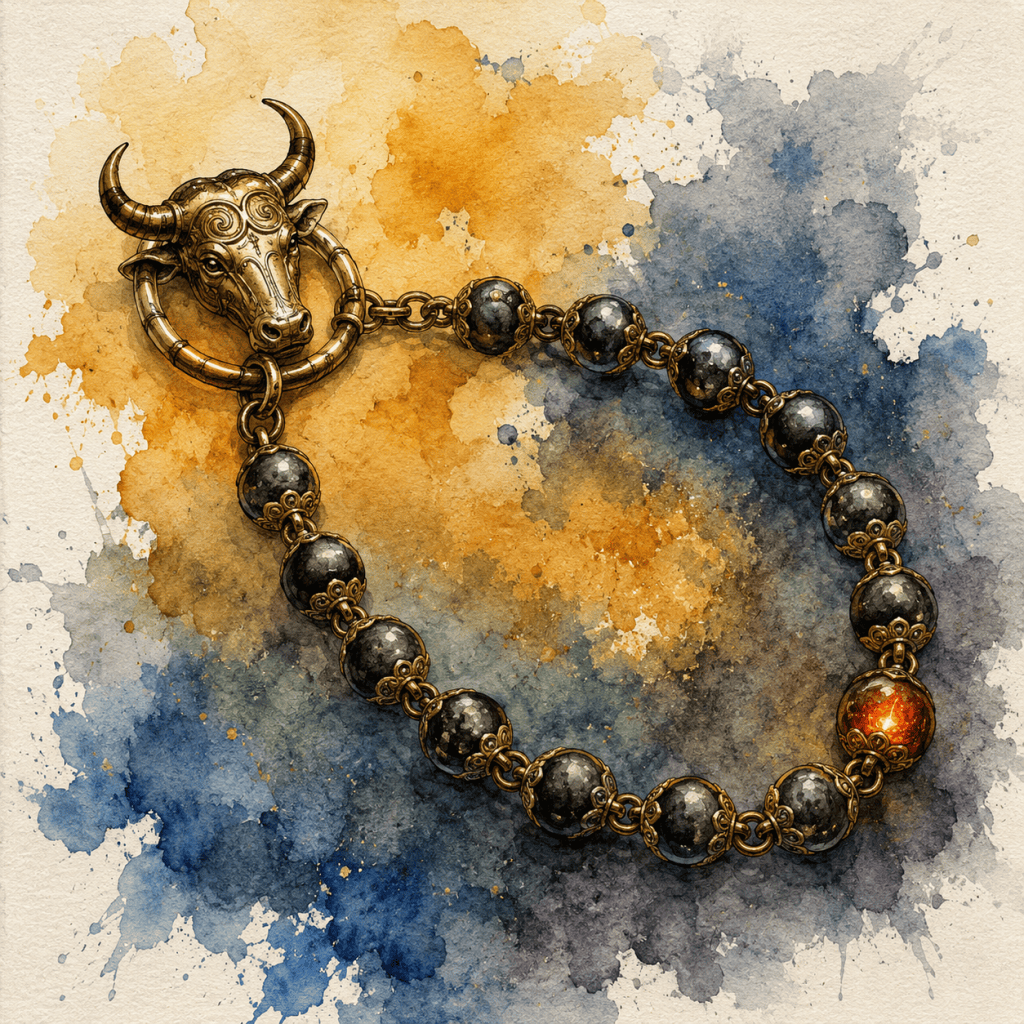
The Measure of the Divine Bull
This short antique-gold measuring chain is marked with thirteen black iron beads. When held against an injured creature, the beads become warm in sequence according to the severity of its physical strain. The relic does not diagnose illness in words. It tells the bearer how urgently they should listen. Stories claim the final bead becomes painfully hot only when continuing without care would invite catastrophe.
(Needs updated mechanics: Base 5e → Veiled → Unveiled.)
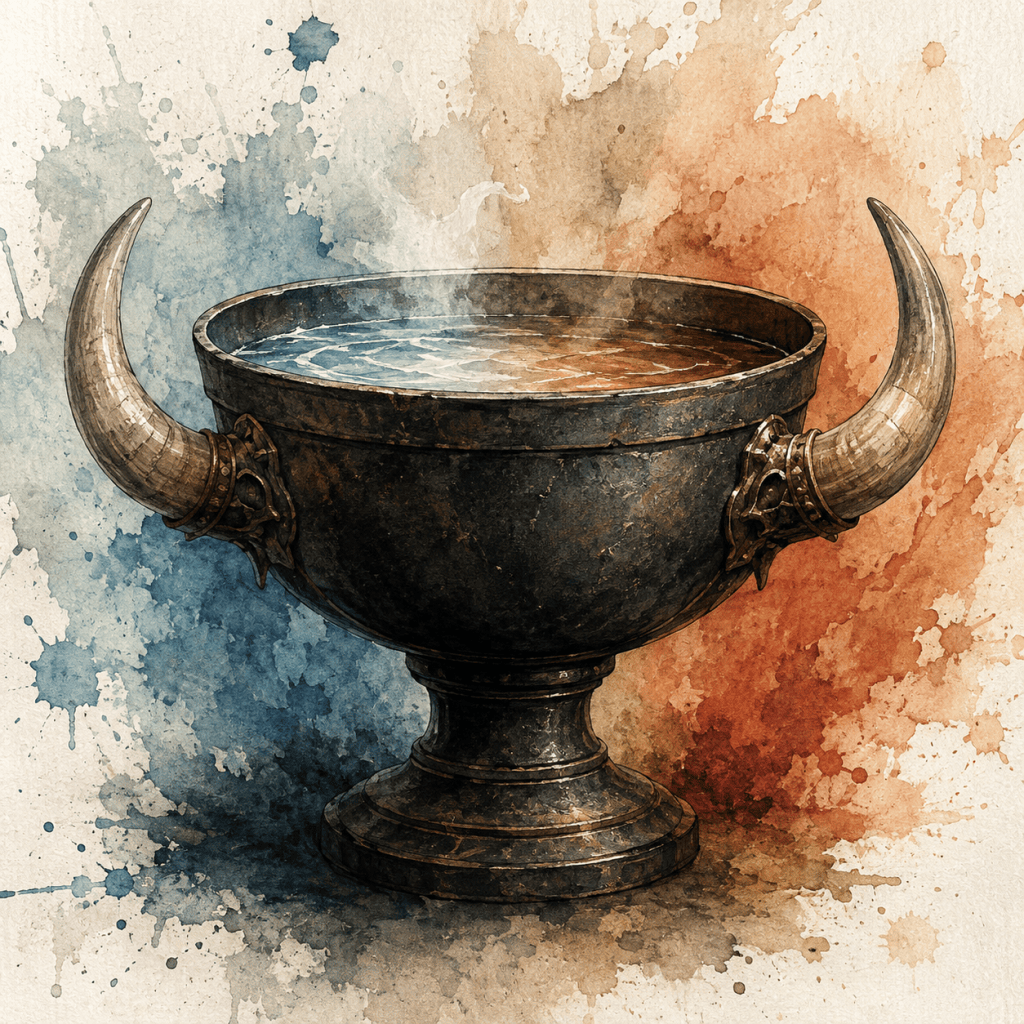
The Cup After the Ordeal
A broad, dark-metal cup with a heavy base and two bull-horn handles. Water poured into it becomes pleasantly cool. Broth remains warm. Bitter medicine loses enough of its taste to be swallowed without losing its potency. The cup produces nothing by itself. Someone must fill it. Those Who Remain consider this the point.
(Needs updated mechanics: Base 5e → Veiled → Unveiled.)
The Chainmaster’s Gauntlet
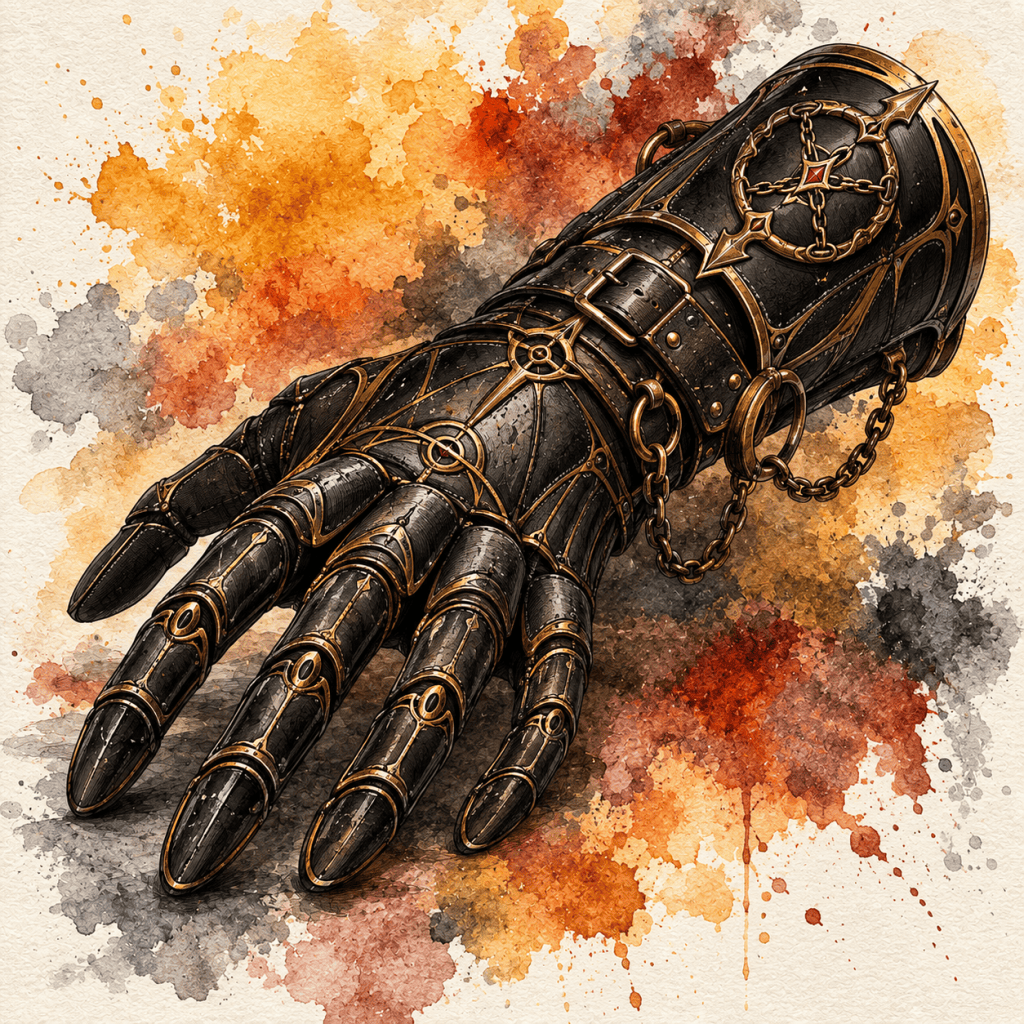
This black leather-and-steel gauntlet is articulated with extraordinary precision. Fine antique-gold lines run along the fingers and palm. Legends claim its wearer can perceive minute changes in pressure through the glove as clearly as another person perceives temperature against bare skin. The gauntlet is therefore associated equally with healers, smiths and masters of ritual sensation. The oldest inscriptions upon it translate approximately as:
No more than intended. No less than promised.
(Needs updated mechanics: Base 5e → Veiled → Unveiled.)
The Blanket of the Final Movement
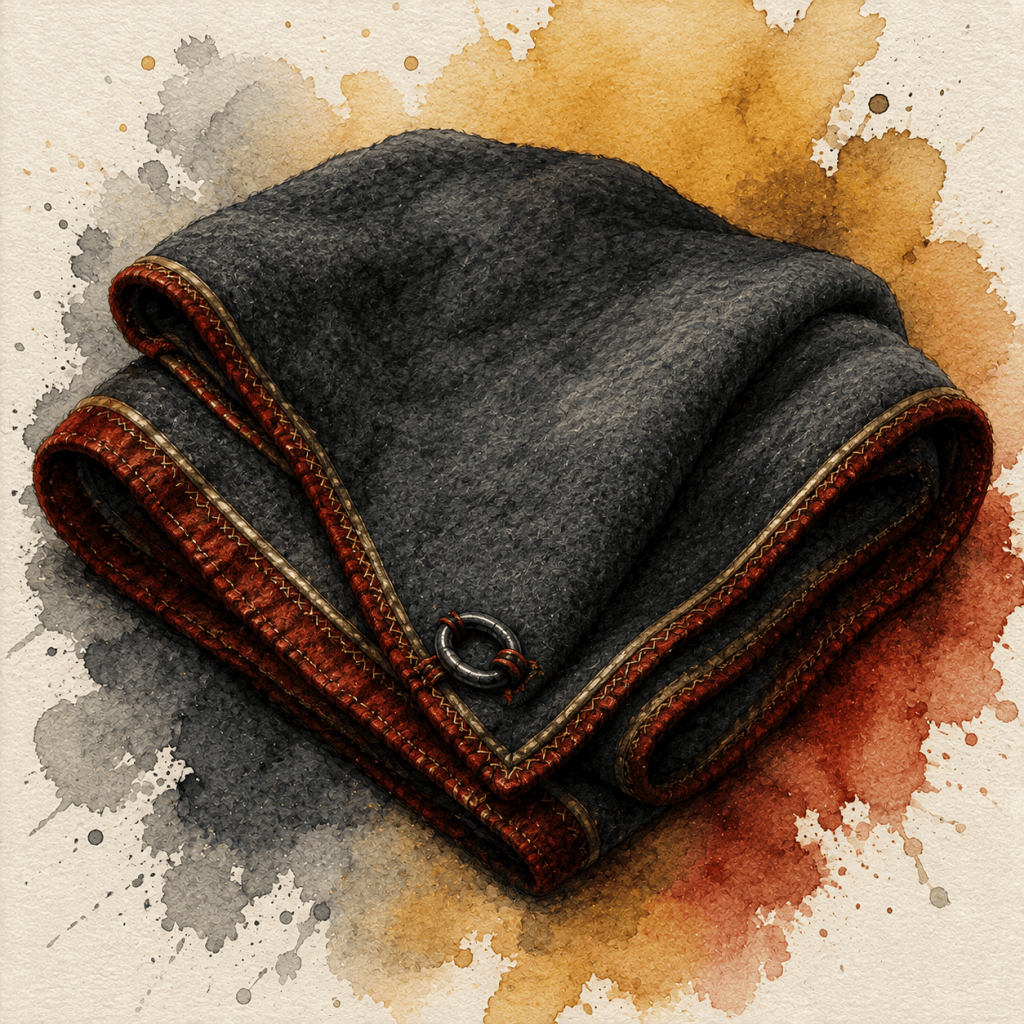
This surprisingly humble relic is a thick charcoal-gray wool blanket edged in crimson and antique-gold thread. No temple agrees upon its origin. Stories claim that when wrapped around someone after an ordeal, the blanket grows exactly as warm and heavy as they find comforting. It possesses no chains.
No blades. No elaborate divine iconography beyond a single small iron link sewn into one corner. Many Nyzunian priests consider it the holiest relic on this list.
(Needs updated mechanics: Base 5e → Veiled → Unveiled.)
Adventure Hooks
The Chain That Will Not Stop Singing
A sacred chain begins resonating continuously within a remote Nyzunian sanctuary. Every examination shows that it is under almost no tension. The priests believe someone nearby is approaching an Edge they cannot recognize. The chain grows louder every night.
The Champion Who Cannot Say Enough
Erosia’s most celebrated endurance champion has survived every ordeal placed before her. Now she intends to attempt one that will almost certainly kill her. She insists that stopping would destroy everything she has become. Her Nyzunian trainers refuse to participate. Someone else has offered to conduct the ordeal.
The Silent Hall
A famous Hall of the Singing Chain has gone completely silent. No chain resonates. No bell rings. Even struck metal produces only a dull impact. The silence began after a ritual participant disappeared. The temple insists the missing person left voluntarily. Their family does not believe them.
Thirteen Links
Fragments of what may be the First Singing Chain begin appearing across Erosia. Each resonates when brought near another fragment. Collectors, priests and rulers race to assemble the relic. A Keeper of the Measure warns that nobody has asked what happens when the thirteenth link finally sings.
The Ordeal Below
Miners discover an ancient Nyzunian sanctuary deep beneath a mountain. Its final chamber contains no treasure. Only a door requiring someone to endure increasingly intense pressure while another person operates the mechanism controlling it. The inscription reads: One must trust. One must listen. Neither may prove themselves alone.
Remain for the Trembling
After a brutal battle, soldiers from both armies report encountering the same enormous horned stranger. He carried no weapon. He gave water to the wounded regardless of uniform. Several dying soldiers survived. Others died with his hand resting gently upon them. Now both kingdoms claim the apparition proves Nyzun favored their side. The Chainsinger’s priests are furious.
Scents for Gameplay
Nyzun’s presence is often perceived through metal, warmth and the strange sensory clarity preceding an important limit. Use these scents as atmospheric cues rather than automatic confirmation of divine intervention.
| d12 | Scent | Suggested Moment |
|---|---|---|
| 1 | Clean iron warmed by the hand | Nyzun’s presence is near. |
| 2 | Leather, steel and faint cedar oil | Training, preparation or disciplined ritual. |
| 3 | Rain striking hot stone | Physical challenge or an approaching Edge. |
| 4 | Beeswax, iron and warm skin | Controlled intimate ritual or deliberate sensation. |
| 5 | Cold mineral water and dark stone | Recovery, clarity or the aftermath of exertion. |
| 6 | Leather, clove and faint smoke | Intensity deliberately increasing. |
| 7 | Salt, iron and clean linen | Injury being assessed or tended. |
| 8 | Cedar, wool and warm water | Aftercare, safety and the Final Movement. |
| 9 | Black pepper, metal and storm air | Adrenaline, fear or imminent physical challenge. |
| 10 | Antique incense, iron and myrrh | Formal worship or the Chainsong beginning. |
| 11 | Hot iron followed suddenly by cool rain | A true Edge has been reached. |
| 12 | Whatever scent the character most associates with relief after enduring something difficult | An intensely personal manifestation of Nyzun’s attention. |
Using Scent as Foreshadowing
Repetition gives Nyzun’s sensory signs meaning. If characters repeatedly smell clean iron before a dangerous physical limit becomes apparent, the fragrance itself may eventually warn them. If cedar, wool and warm water accompany moments of recovery, those scents can signal safety before the party understands why. The transition between scents can be even more useful. A ritual chamber smells of leather, wax and iron while an ordeal continues. The instant the participant says enough, those fragrances disappear.
- Warm cedar.
- Clean water.
- Wool.
The chains stop singing. The party has just witnessed Nyzun’s theology without anyone needing to explain it.
Before the rite, Nyzun asks.
Within the rite, Nyzun listens.
After the rite, Nyzun remains.
 Whispers of Erosia
You must be logged in to post a comment.