
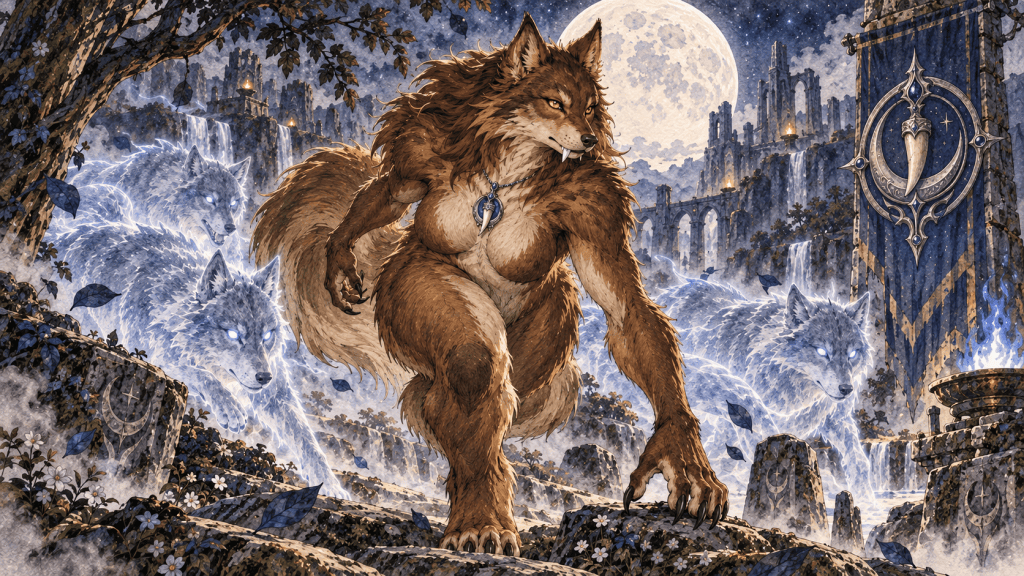
Ulvexa
The Wild Heat • The Wolf-Mother • She Who Bares the Beast
Goddess of Primal Lust, Ferality and Breeding
Primal Lust • Ferality • Breeding
Rutting, animalistic passion, beast-role devotion, mating instinct, breeding fantasy, scent, heat, chase, wrestling, dominance, submission, shapeshifting, consensual bestial embodiment, primal ecstasy and the sacred truth of the body before refinement.
“Bare the beast within.”
Ulvexa is the goddess of desire before polish: the pulse that quickens before thought has formed a sentence, the scent that turns a head, the growl that rises before courtesy can catch it and the sudden certainty that the body has already understood something the mind is still trying to name. She governs primal lust, ferality, mating instinct, breeding desire, animalistic passion and the exhilaration of choosing to become less civilized without becoming less sovereign.
Her worship is found among Beastkin, Avarin, shapeshifters, lycanthropes, druids, hunters, wrestlers, lovers, dancers and anyone who has ever felt that some part of desire becomes clearer when posture, scent, breath and instinct are allowed to speak. Some devotees express this through animal roleplay, bestial postures, scenting, growling, wrestling, mating displays or shapeshifted intimacy. Others simply seek permission to inhabit their bodies without apology.
Ulvexa does not teach that civilization is false. She teaches that civilization becomes dishonest when it demands that embodiment disappear. Clothing, language, etiquette, titles and law may all have value, but none of them erase the animal beneath them. The body still hungers, tires, responds, recoils, desires, competes, seeks touch, recognizes threat and sometimes wants with a force that does not feel polite.
Her faith therefore preserves three teachings above all others: instinct deserves honesty, hunger does not create entitlement and the beast may be bared without surrendering choice.
Lore & Mythos
Before the First Word for Want
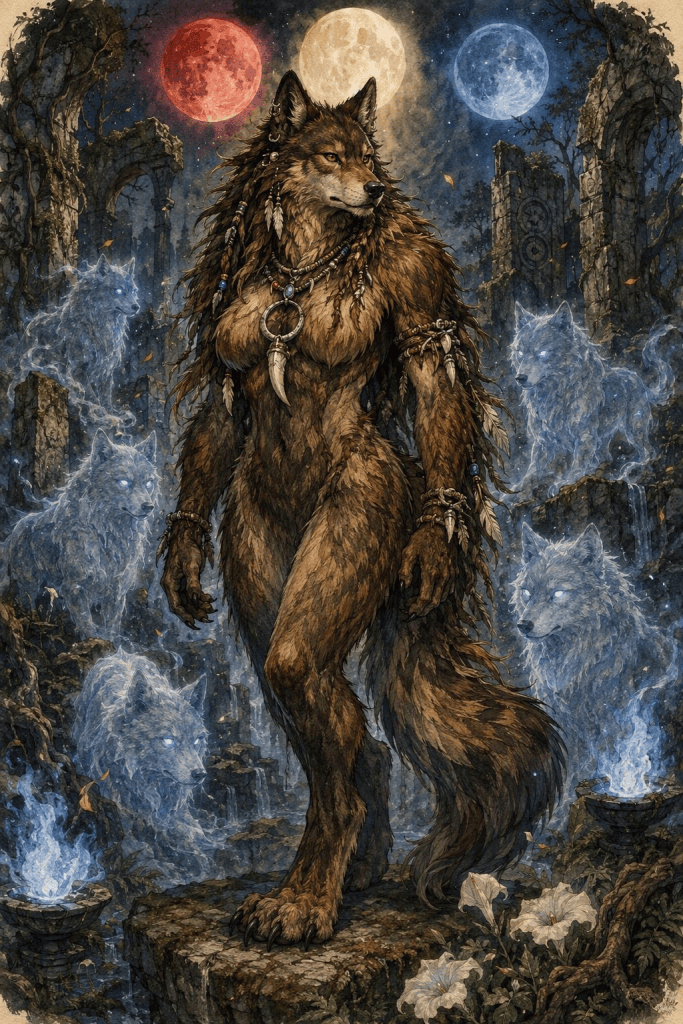
The oldest Ulvexan traditions do not begin with a temple, court or mortal lover. They begin with an animal lifting its head. The world already possessed life. Velyssara had awakened desire within creation, and Talyss had taught living things how to bloom, seed and continue. Creatures fed, slept, fled danger, protected young and gathered in herds, flights, dens and packs. Yet the archives describe one moment in which life discovered another urgency. A beast caught the scent of another upon the wind and stopped.
The old hymns disagree about the creature. Wolf traditions insist it was a she-wolf moving through winter pine. Feline traditions describe a striped hunter in high grass. Ursari communities say the first creature was a great bear rising from hibernation into spring. Avarin hymns claim the moment happened in the sky when one radiant bird began a mating display and another answered.
All versions preserve the same detail. The body recognized desire before language existed to explain it. Heart rate changed. Breath deepened. Muscles gathered beneath fur or feather. Attention narrowed. The creature moved toward what it wanted. The earth warmed beneath its feet. From that movement came Ulvexa.
She did not arrive speaking. The oldest versions claim she ran beside the creature first, indistinguishable from instinct except for the amber light in her eyes. Only later, when mortals developed names for hunger, lust, mating and heat, did they realize that something ancient had been present before those words. Ulvexan theology therefore rejects the claim that desire becomes legitimate only after it can be explained eloquently. Thought may clarify desire. It does not create it. The body may know first.
The First Pack
The myth that gives Ulvexa her most beloved title begins after her first awakening. According to Wolf-Mother traditions, Ulvexa wandered alone through a wilderness untouched by roads. She was strong enough to hunt alone, sleep alone and defend herself alone. The early stories emphasize that she lacked nothing necessary for survival.
Then she heard another wolf howl. Ulvexa answered. A second voice joined. Then a third. By moonrise, a pack had gathered around her. Some were living wolves. Others were spirits of creatures that had died before anyone learned to mourn them properly. A few stories say the pack also contained mortals whose souls temporarily wore lupine forms because they had spent their lives denying a need for companionship.
The wolves did not kneel. They circled her. Some approached closely. Others remained at the edge of the firelight. One lay against her side. Another slept beyond arm’s reach. Ulvexa allowed each to choose distance for themselves. When dawn came, none had been commanded to stay.
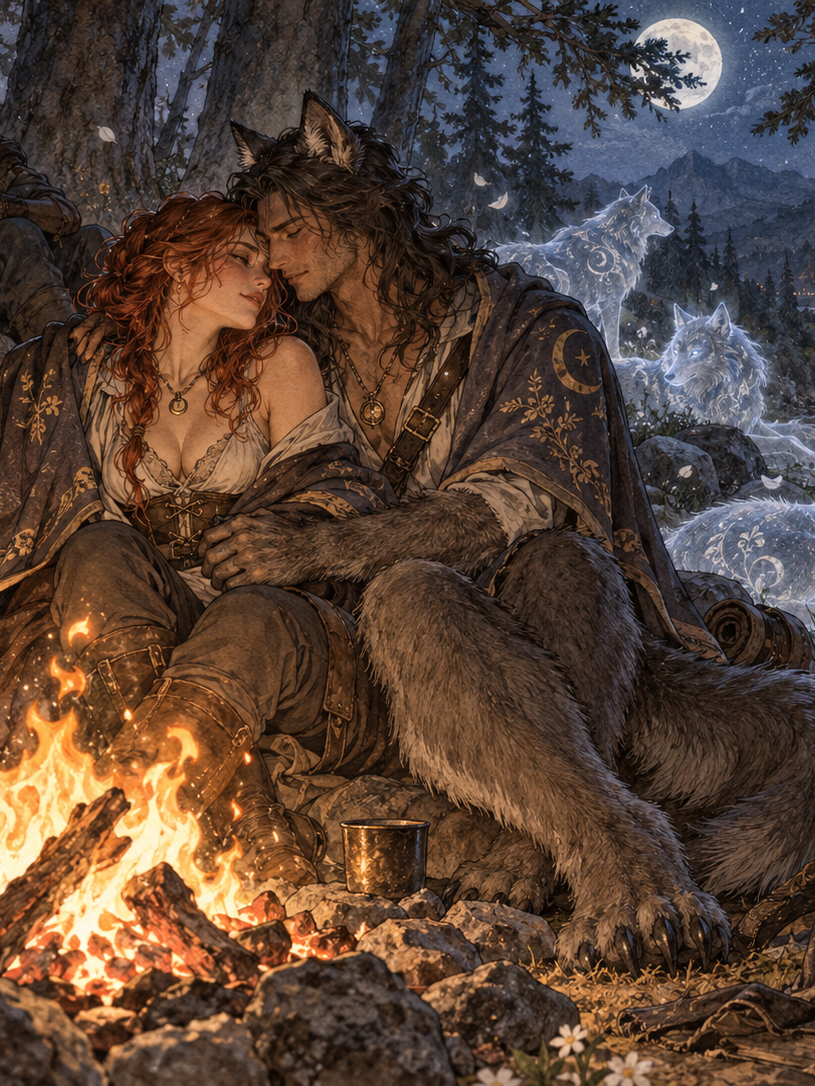
Most did. From this story comes her title Wolf-Mother. The name does not mean that every follower is her child in a submissive or dependent sense. It means she is the first divine teacher of the truth that instinct does not always move toward mating, dominance or pursuit. Sometimes instinct moves toward pack. The spectral wolves that surround Ulvexa in sacred art are often interpreted as descendants of that First Pack. Some theologians believe they are independent spirits. Others claim each is a fragment of Ulvexa’s own instinct, given form so that no manifestation of the Wolf-Mother is ever truly solitary.
The First Rut
A more explicitly erotic myth concerns the first season in which desire became strong enough to disrupt ordinary behavior. The archives describe a great valley filled with beasts entering heat at once. Calls echoed through the night. Mating displays became more elaborate. Territorial disputes sharpened. Creatures traveled farther in search of partners. The entire valley seemed to vibrate with urgency. Ulvexa watched and delighted in the honesty of it.
Then violence began. Some beasts fought past exhaustion. Others pursued companions who had already fled. Hunger became confusion. Urgency became injury. The oldest tale says Ulvexa stepped into the valley and howled until every creature stopped. She then performed what later theologians call the First Turning Away.
A powerful mate approached her. Ulvexa scented them, desired them and allowed the desire to remain visible. Then she turned her head aside and stepped away. The creature stopped. Ulvexa turned back. The creature approached again only when invited. From this story comes one of the oldest principles in her faith: hunger may be sacred without becoming authority over another body.
The lesson is not that instinct should be suppressed. Ulvexa did not deny her own desire. She displayed it openly. She simply proved that wanting and taking were not the same act. Modern clergy often summarize the myth with a teaching repeated before feral rites: The heat is yours. The choice remains shared.
The Beast That Knew Its Name
A later myth concerns a shapeshifter who became famous for assuming powerful animal forms. They could become stag, wolf, eagle, boar, lion and bear. Crowds gathered to watch the transformations, and nobles paid lavishly for demonstrations. The shapeshifter eventually stopped enjoying any of them. Every transformation had become performance. The wolf was chosen because crowds liked the howl. The lion was chosen because warriors admired strength. The eagle was chosen because poets loved the wings. The bear was chosen because children cheered.
One night, the shapeshifter entered the wilderness and asked Ulvexa which form was truly theirs. The Wolf-Mother appeared as a werewolf and asked why the answer had to be one form. The shapeshifter insisted that a true self should have a true shape. Ulvexa changed into a weretiger. Then a werebear. Then an enormous winged beast with avian talons and lupine eyes. Finally, she returned to the werewolf form and asked whether any of the others had been lies. The shapeshifter said no.
Ulvexa answered that a body may become a language without becoming a prison. The story became central among druids, lycanthropes and other shapechanging devotees. A transformed body may express something genuine even when it is temporary. Returning to another form does not make the previous one false.
The Hunt Beneath Three Moons
One of the most famous myths shared between Ulvexan and Rhazielian traditions concerns a mortal hunter who asked both deities for the perfect chase. Rhaziel offered the trail. Ulvexa offered the heat. The hunter entered a moonlit forest where the quarry had already agreed to run. Rhaziel sharpened every broken branch, track and shift of shadow into irresistible invitation. Ulvexa sharpened breath, scent, muscle and the primitive thrill of closing distance.
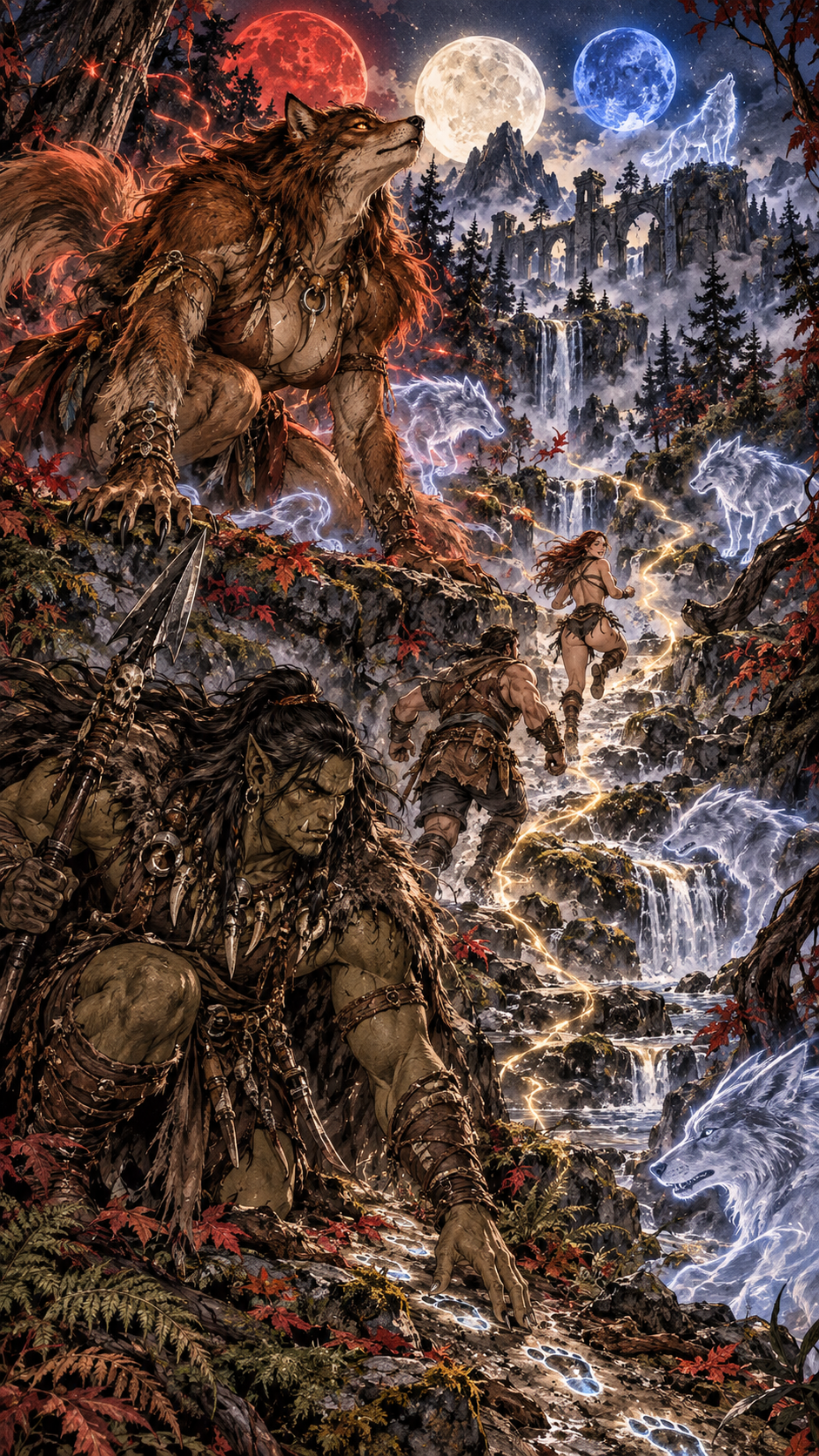
The chase lasted until dawn. When the hunter finally caught the quarry, the mortal expected the gods to declare a winner. Rhaziel instead asked whether the pursuit had been worthy. Ulvexa asked whether the body still wanted what it had wanted when the chase began. The hunter answered yes.
The quarry answered yes. Only then did the ritual continue. The story remains the clearest theological distinction between the two faiths. Rhaziel sanctifies pursuit, capture and release. Ulvexa sanctifies the primal desire that makes pursuit feel urgent in the first place. Rhaziel gives the hunt its shape.
Ulvexa gives it heat.
The Desire She Embodies
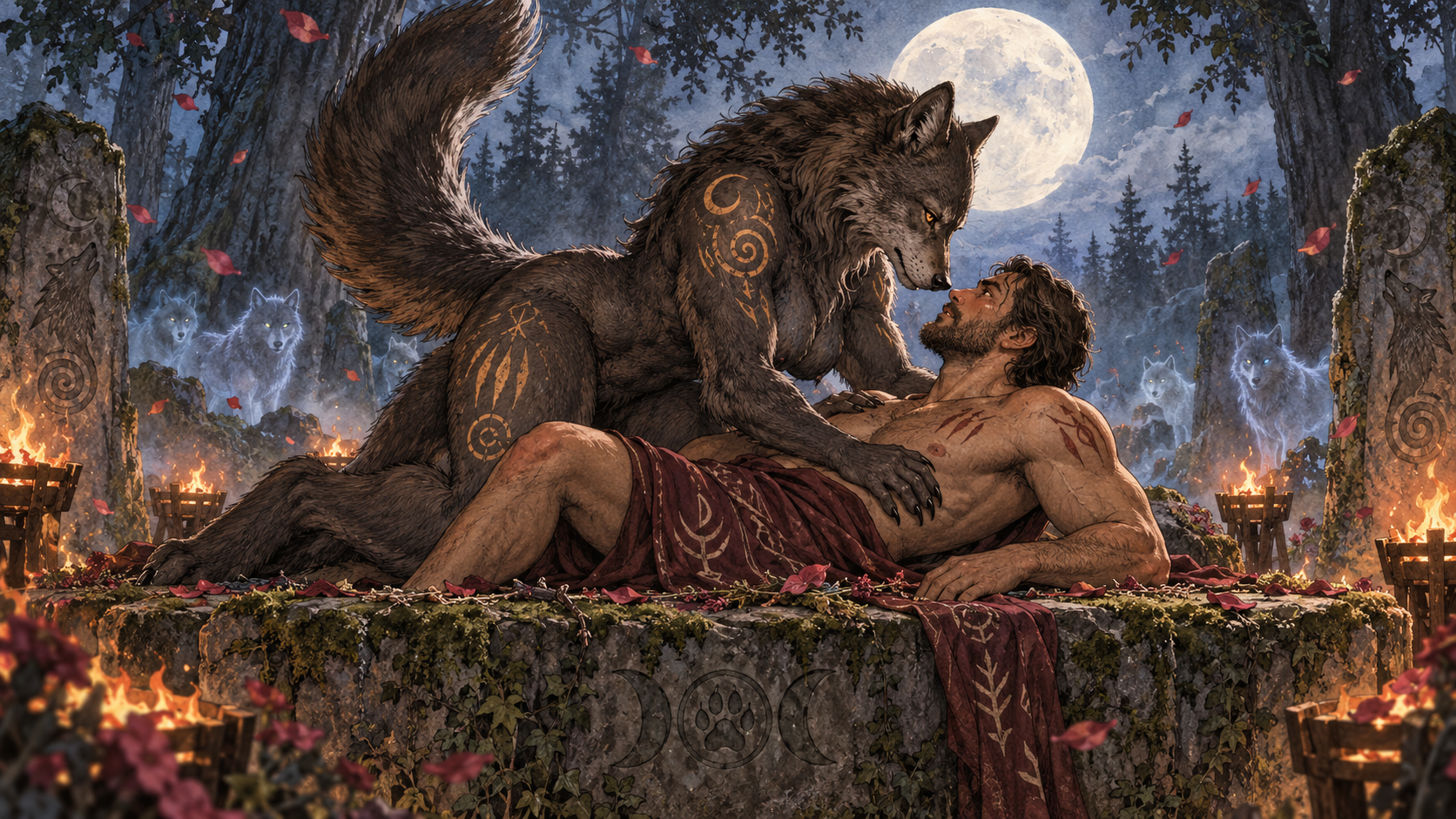
Ulvexa embodies the desire to become fully present within the animal body. Her sacred current begins when instinct becomes impossible to ignore: breath deepening before a confrontation, attraction becoming physical before anyone speaks, the urge to chase, wrestle, scent, display, mount, yield, flee, pounce, howl or simply move because remaining still suddenly feels dishonest.
Her theology does not divide the body into civilized parts that deserve respect and animal parts that deserve embarrassment. Hunger, arousal, aggression, softness, scent, territoriality, mating desire and the need for physical contact all belong to embodiment. The sacred question is not whether such impulses exist. The sacred question is what a person chooses to do with them.
Primal Lust & the Body Before Language
Primal lust is Ulvexa’s first mystery because it describes attraction before refinement transforms it into narrative. A person may be drawn to someone’s voice, scent, build, movement, fur, feathers, claws, posture, strength or the way they occupy physical space. The attraction may arrive before any elaborate emotional explanation exists. Ulvexa does not consider this shallowness. Bodies notice bodies. Her worship therefore gives unusual respect to sensory awareness. Scent matters. Breath matters. Distance matters. Sound matters. Skin, fur, feathers, heat and movement matter. A lover may know they are attracted before they know why.
Ulvexan clergy do not insist that the first bodily response is the final truth. Instinct provides information, not command. Attraction can deepen, change or disappear once the person behind the body becomes known. The body is allowed to speak first. It is not required to speak last.
Ferality & Chosen Uncivilizing
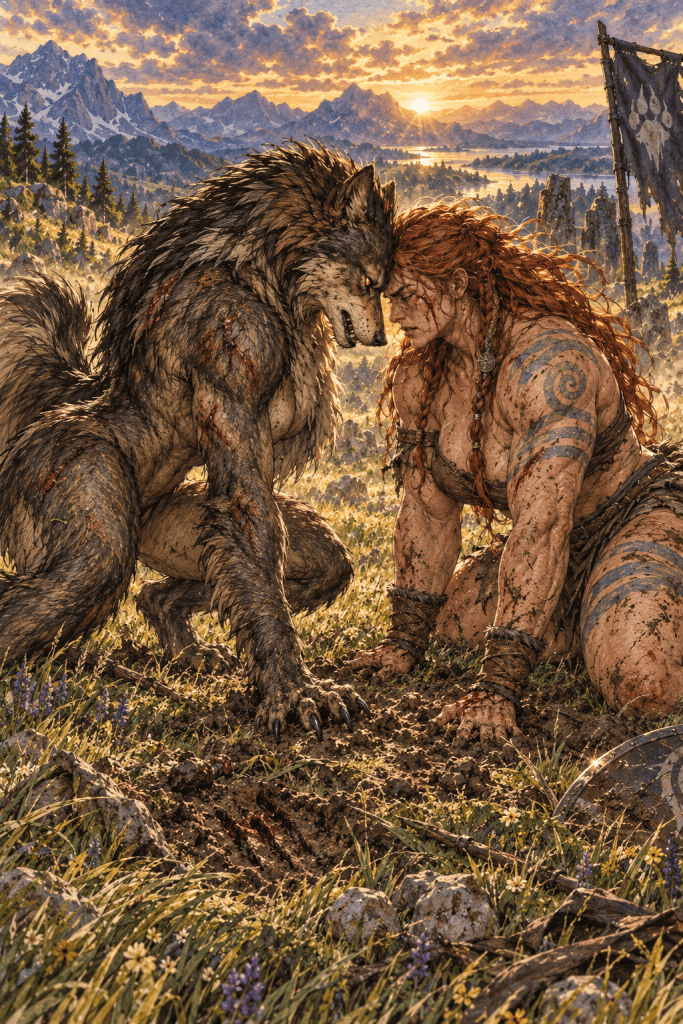
Ferality is often misunderstood by outsiders as uncontrolled behavior. Ulvexans use the word differently. To become feral is to strip away forms of self-presentation that are no longer useful and allow instinctive behavior more room. A devotee may crouch rather than sit, growl rather than answer immediately, scent a willing partner, run barefoot or on all fours where anatomy permits, wrestle, howl, bite during agreed play, roll in grass, sleep in a pile of trusted bodies or move according to impulse rather than etiquette.
The practice can be intensely erotic, entirely nonsexual or somewhere between. Ulvexa does not teach that a feral state suspends responsibility. Quite the opposite. Chosen ferality requires enough self-awareness to know what is being loosened and what remains absolute. A person may abandon elegance. They do not abandon accountability.
Breeding & the Mating Urge
Breeding is Ulvexa’s most controversial domain and one her clergy rarely disguises with gentler vocabulary. She governs the urge to mate. Her mysteries include rutting, heat, mating displays, reproductive symbolism, breeding fantasy, possessive or receptive roleplay, mounting imagery, physical competition and the primal erotic charge of bodies behaving as though reproduction were possible or imminent.
This does not make her a second fertility goddess. Talyss governs conception, gestation, fertility, pregnancy and life carried forward. Ulvexa governs the animal desire that may precede those things. A person may participate in Ulvexan breeding rites while sterile, infertile, using contraception, unable to reproduce with a particular partner or having no desire whatsoever for parenthood. The erotic symbolism belongs to the participants’ shared fantasy rather than biological outcome. Ulvexan clergy summarize the distinction simply: Talyss carries tomorrow. Ulvexa wants tonight.
Scent & Recognition
Scent occupies a place in Ulvexan theology that few other Erosian faiths share. Animals recognize territory, kin, threat, readiness, familiarity and change through scent. Ulvexa’s faithful do not pretend mortal peoples experience scent identically, but they preserve the underlying idea that smell communicates aspects of embodiment often hidden beneath perfume, clothing and social distance.
Some devotees intentionally avoid strong fragrance during private rites. Others exchange scented cloth, fur, feathers, bedding or ritual oils. Beastkin traditions may possess especially elaborate scent practices, depending upon ancestry and physiology. The point is not to romanticize poor hygiene. Ulvexan temples wash, bathe and maintain their spaces. The distinction resembles Sylithra’s teaching regarding cleanliness and shame. A natural bodily scent is not morally impure because it requires washing. Scent can be intimate because it is difficult to separate entirely from the body that produced it.
Wrestling, Pinning & the Contest of Bodies
Physical contest belongs naturally to Ulvexa because many forms of animal courtship involve strength, display, pursuit or controlled confrontation. Wrestling is among the most widespread Ulvexan practices. Public forms may resemble ordinary athletic grappling. Private forms may incorporate dominance, submission, pinning, straddling, restraint or mating-role symbolism according to established boundaries.
The outcome does not automatically determine any erotic role afterward. Winning a wrestling match does not grant sexual access. Losing does not obligate surrender. This distinction is taught so consistently that many Ulvexan temples post the rule beside their training grounds. The contest proves strength, skill or endurance. Anything beyond the contest must be chosen separately.
Beast-Role Devotion
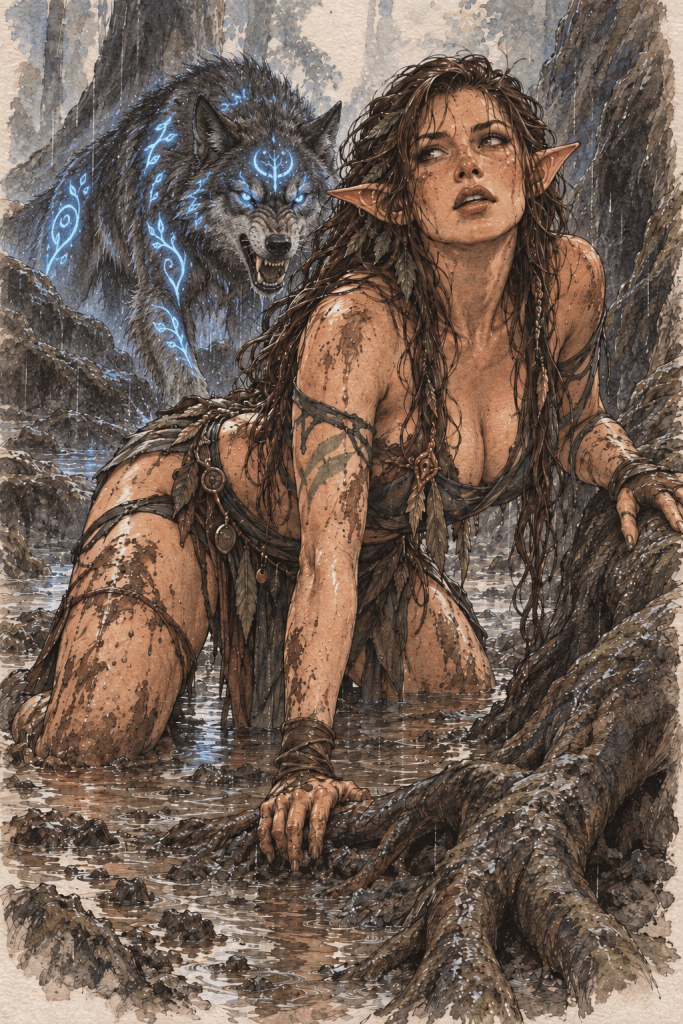
Many mortals drawn to Ulvexa experience desire through deliberate animal roleplay. They may imitate posture, movement, vocalization, dominance displays, submissive gestures, nesting behavior, scenting, grooming or pack dynamics associated with a chosen beast. The role may correspond to ancestry. A Lupinari may emphasize lupine behavior, while Avarin courtship traditions may focus on feathers, display, preening, territorial dance or nest-building. Other worshippers choose animals unrelated to their ancestry because the symbolic behavior expresses something they enjoy. Ulvexan clergy do not treat such practices as childish imitation.
They call them Beast-Roles. A Beast-Role may be devotional, theatrical, erotic or all three. What matters is that the participant knows they are choosing a form of expression rather than surrendering their personhood.
Shaping and the Mating Form
Shapeshifters occupy an especially sacred place within Ulvexa’s faith because they can cross the boundary between humanoid and bestial embodiment directly. Druids, lycanthropes, polymorph practitioners and other shapechanging mortals sometimes adopt what Ulvexans call a Mating Form. The form may be fully bestial, hybrid or otherwise altered according to the magic available. Ulvexan doctrine places one absolute requirement upon these rites: the mind that consented must remain present enough to continue choosing.
A transformed participant must retain adult sapience, self-awareness and meaningful capacity to communicate or withdraw consent. A form that destroys those capacities is not considered a valid erotic ritual state, regardless of how powerful or beautiful the transformation appears. Ordinary non-sapient animals are never recognized as erotic ritual partners. The distinction is theological rather than cosmetic. Ulvexa sanctifies the beast within a person. She does not erase the person in order to produce the beast.
Holy Symbol & Iconography
The Fang Within the Crescent
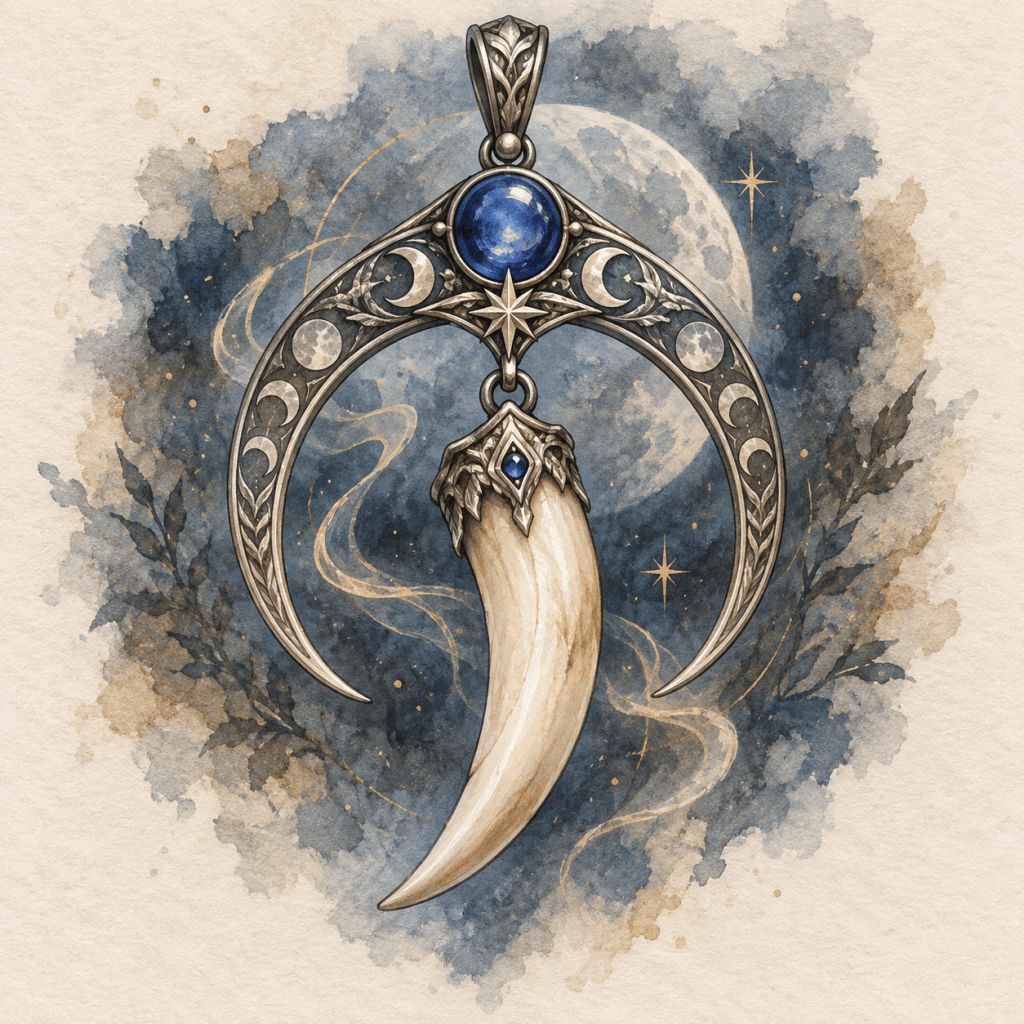
Ulvexa’s canonical holy symbol is an ivory fang suspended within a great moon-silver crescent and surrounded by a dark indigo celestial field. Sapphire or deep blue stones mark the outer frame, while ornate silver points extend from the circle like directional claws.
The fang represents hunger made physical. It is tooth, weapon, warning, mating display and instrument of survival. Ulvexan theology does not assign it one fixed meaning because instinct itself rarely serves only one purpose.
The crescent represents recurring heat, transformation, nocturnal activity and the bodily rhythms that existed long before mortals invented calendars. Some traditions interpret the crescent as a jaw opened around the fang. Others see the curve of a protective body surrounding something dangerous without dulling it.
The indigo field represents the wilderness at night, where vision weakens and other senses become more important. The sapphire stones symbolize moments of focused awareness within instinctive states.
A common Ulvexan catechism interprets the symbol through four statements: the fang hungers, the moon returns, the body remembers and the will remains awake.

Sacred Colors and Materials
Ulvexan sanctuaries favor midnight indigo, moon-silver, chestnut, ember amber, black, deep forest green and controlled blood-red. Amber represents heat, vigilance and the glow of eyes caught in darkness. Chestnut represents fur, earth and animal embodiment. Blood-red symbolizes living urgency rather than injury alone. Common sacred materials include bone, horn, naturally shed antler, teeth, silver, sapphire, obsidian, leather, fur from natural shedding or ethical sources, dark wood, braided cord, stone, feathers and claws recovered without desecrating the creature from which they came.
Ulvexan artisans frequently leave sacred objects partially rough. A polished silver fang may hang from an unworked leather cord. A beautifully carved altar may retain bark along one edge. The faith prefers craftsmanship that remembers where its material came from.
Claws, Tracks and the Open Trail
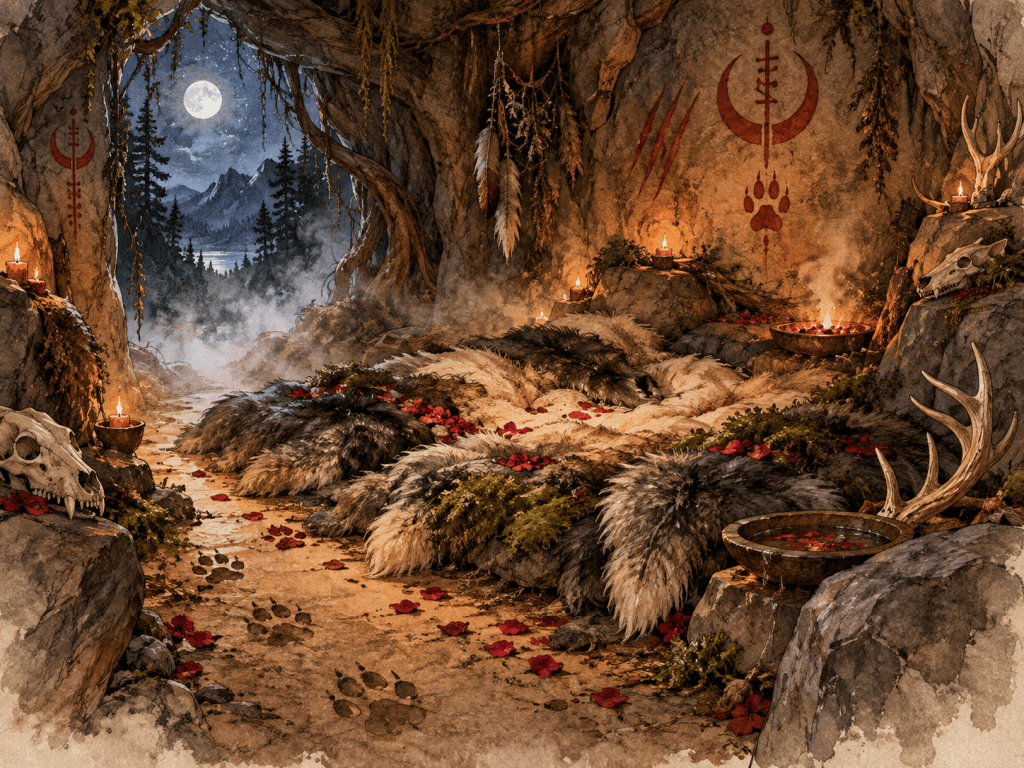
Claw marks appear throughout Ulvexan sacred art, but unlike Rhazielian tracks, which usually emphasize pursuit and direction, Ulvexan marks often emphasize presence. A clawed stone says something powerful stood here. Tracks symbolize embodiment moving through the world. Temples sometimes preserve actual footprints from respected clergy, shapeshifters or sacred beasts in clay floors. A set of tracks leading into a sanctuary may change from humanlike feet to paws, hooves or talons, visually expressing the shedding of ordinary form. Open trails carry another meaning. A path that ends at a wall is captivity. A path disappearing into wilderness remains possibility.
Sacred Creatures
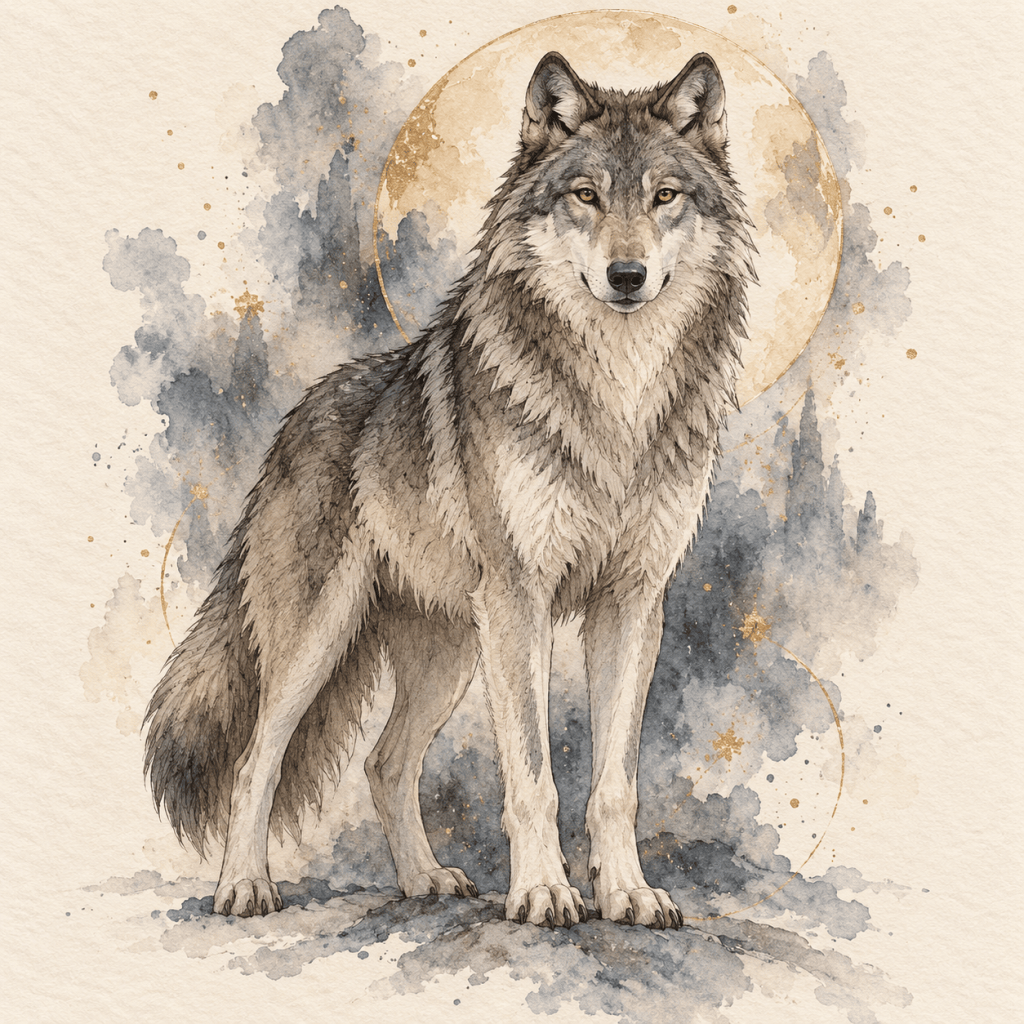
Wolves are Ulvexa’s foremost sacred creatures because of the Wolf-Mother tradition and the enduring symbolism of pack, scent, pursuit, mating behavior and communal survival. They appear constantly in sacred art, temple banners and divine manifestations.
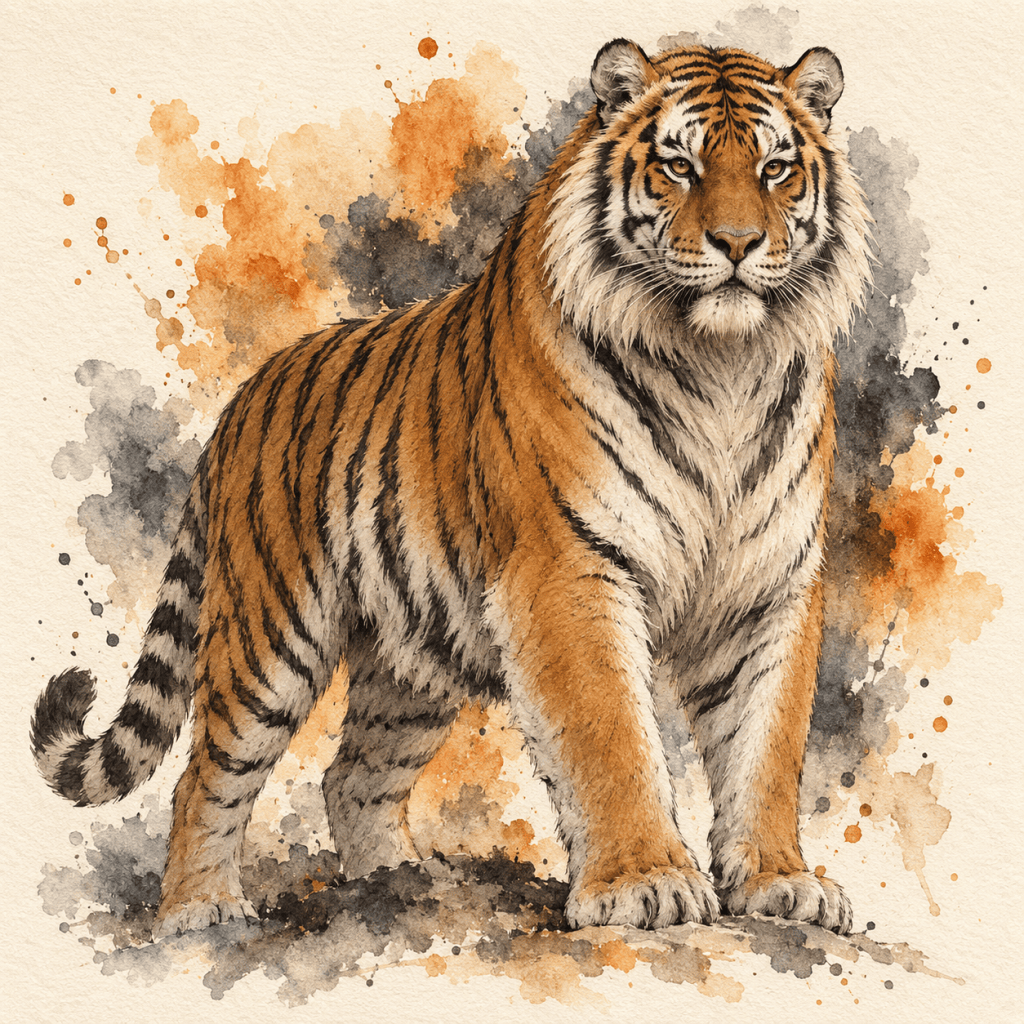
Tigers represent solitary intensity, bodily confidence and predatory beauty. Bears represent strength, seasonal hunger, protection and the immense physicality of bodies that can appear still until they suddenly are not. Great cats, boars and certain predatory birds also appear regionally.
No sacred creature is worshipped as Ulvexa herself. The animal matters because something about its behavior reveals a language of instinct.
Depictions of Ulvexa
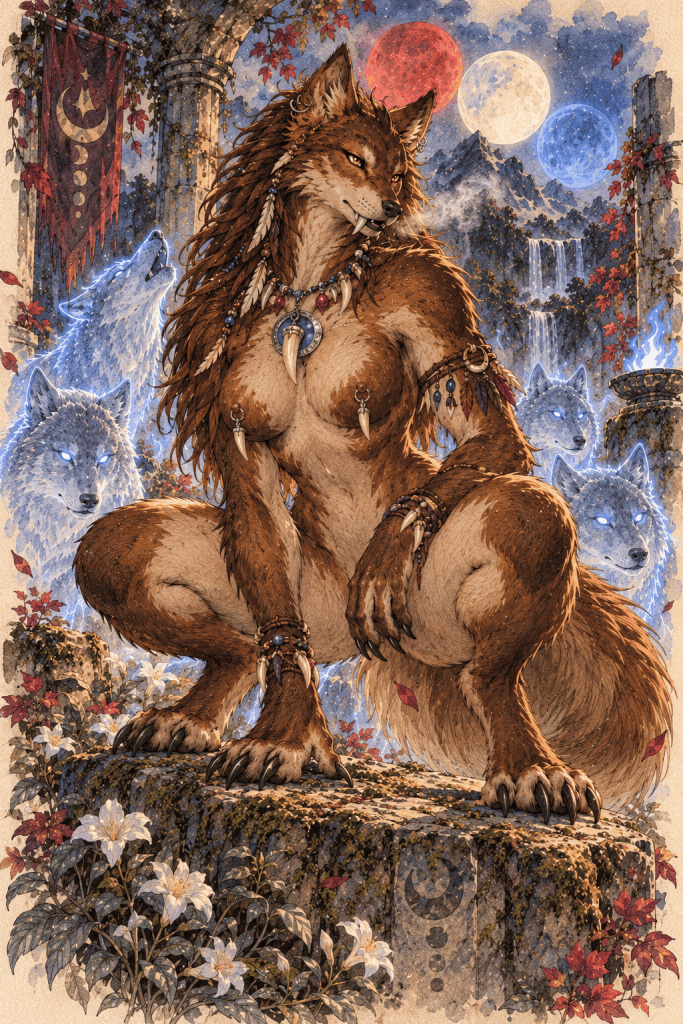
Canonical Second Bloom art portrays Ulvexa primarily as the Wolf-Mother, a mature adult female deity in full lycanthropic werewolf form. She is not a human woman with wolf ears and is not merely a Beastkin with additional fur. Her divine body is fully lupine and humanoid at once: a true wolf’s head and muzzle, amber-gold eyes, prominent fangs, powerful clawed hands and feet, digitigrade legs, thick chestnut fur and a large natural tail attached at the base of the spine.
Her body is tall, muscular, voluptuous and built for explosive movement. Broad shoulders, a powerful back, strong arms, full hips and thick thighs emphasize physical capability rather than decorative anatomy. Lighter fur commonly runs across the throat, chest, abdomen and inner limbs, while darker ember-brown tones concentrate along the back, forearms, shoulders and outer thighs.
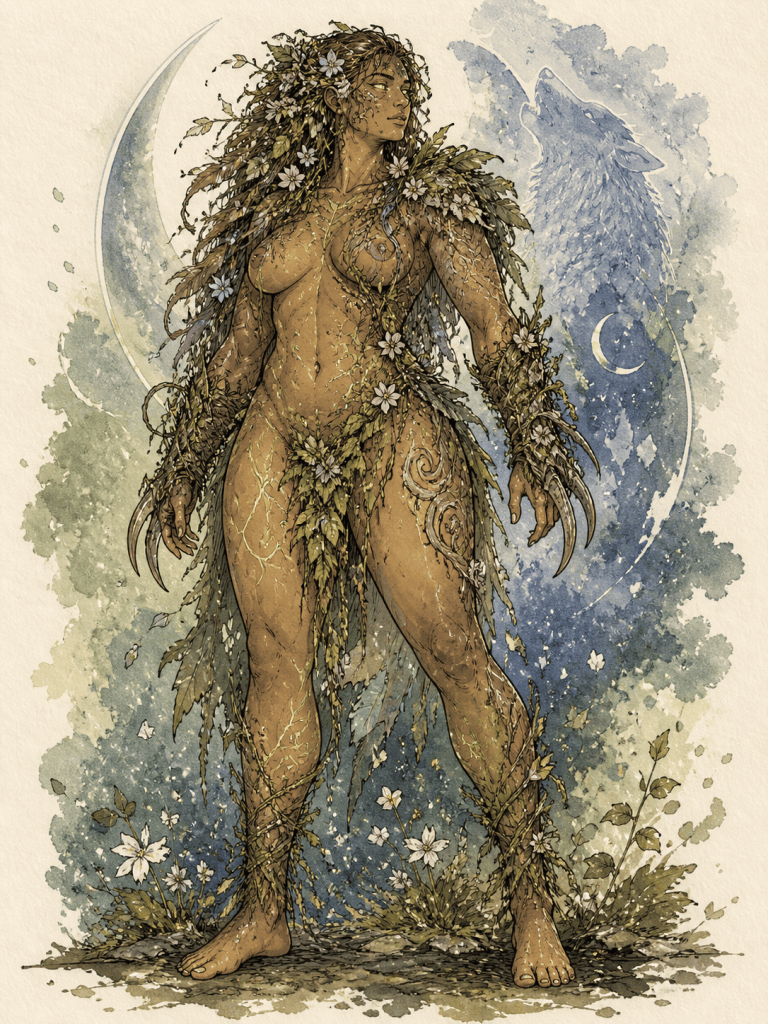
Ulvexa is traditionally depicted ungarmented. Her nudity is naturalistic rather than ornamental. Fur is her body and her covering, just as feathers belong to Avarin or scales to Dracari. Sacred artists may add a fang pendant, bone charm, silver crescent, ritual paint or minimal cords, but clothing should never make her appear domesticated.
Her spiritual wolf pack is nearly as important as her own silhouette. Major depictions should show spectral wolves pacing beside her, emerging through mist, circling a ritual fire or running in formation during the hunt.
Ulvexa may also appear as a weretiger, werebear or another divine therianthropic form. These manifestations are considered authentic but secondary.
The visual truth remains immediate: She is the Wolf-Mother first, but the beast within her has many shapes.
Worship & Daily Devotion
Ulvexa can be worshipped wherever a person becomes more conscious of embodiment. Running can be prayer. Wrestling can be prayer. Grooming fur or feathers can be prayer. Stretching after waking, eating after hunger, noticing scent on the wind or allowing oneself to growl in frustration rather than pretending calm can all become devotional acts.
Her faith attracts Beastkin, Avarin, hunters, athletes, dancers, druids, barbarians, shapeshifters, lycanthropes, courtesans, animal handlers, wilderness guides and lovers drawn toward primal or bestial expression.
The Bare Minute
One of Ulvexa’s simplest daily devotions is called the Bare Minute. The worshipper spends a short period abandoning formal posture and expected expression. They may stretch, crouch, shake tension from the limbs, breathe deeply, vocalize, pace, roll the shoulders, flex claws or simply sit in whatever posture feels natural.
The practice is deliberately brief. Its purpose is not to become permanently feral. It reminds the devotee that civilized presentation is something they are doing rather than the totality of what they are.
Scenting the Morning
Some devotees begin the day outdoors and take several deliberate breaths before applying perfume, oils or strong incense. They identify what the environment smells like without deciding whether those scents are pleasant. Rain, dust, fur, sweat, smoke, soil, food, leather, stone and another person’s presence may all become part of the exercise. The practice trains sensory honesty.
Ground Contact
Ulvexans frequently touch bare earth before beginning difficult work. A hand, paw, claw, talon or bare foot is placed against soil, stone or wood while the worshipper notices weight and balance. Athletes often perform the practice before competition. Hunters use it before entering unfamiliar wilderness. Lovers may perform it together before a feral rite, reminding themselves that bodies are physical before they are symbolic.
Pack Meals
Communal eating holds strong devotional importance. Ulvexan meals favor food shared from common platters: roasted meats where culturally appropriate, root vegetables, dark bread, fruit, nuts, hearty stews and anything satisfying after exertion.
Meals need not imitate animals. The purpose is appetite acknowledged without embarrassment.
Hosts pay close attention to who has eaten and who has not. Hunger may be holy, but allowing a packmate to remain hungry through neglect is poor worship.
Grooming & Preening
Beastkin and Avarin communities often adapt ordinary grooming into devotion. Fur may be brushed, feathers cleaned, claws maintained, braids loosened or skin oiled.
Partners may groom one another where welcomed. The intimacy can be familial, communal or erotic depending upon relationship and context.
Ulvexa’s faithful regard grooming as an important counterbalance to the faith’s more aggressive imagery. The same claws that wrestle may also untangle fur carefully.
Favored Offerings
Traditional offerings include shed fur, molted feathers, naturally lost teeth, claw sheaths, carved fang tokens, bones from animals consumed for food, dark berries, roasted meat, red fruit, strong wine, animal-shaped bread, braided leather, silver crescents and scented oils. Hunters sometimes leave the first useful portion of a successful hunt for community consumption rather than placing edible food upon an altar to rot. One of the most respected offerings is a piece of something associated with false restraint. A ceremonial glove, stiff collar, court shoe, mask, tightly bound braid or written rule may be left at a shrine when a devotee decides that the object no longer serves them.
Clergy & Temples
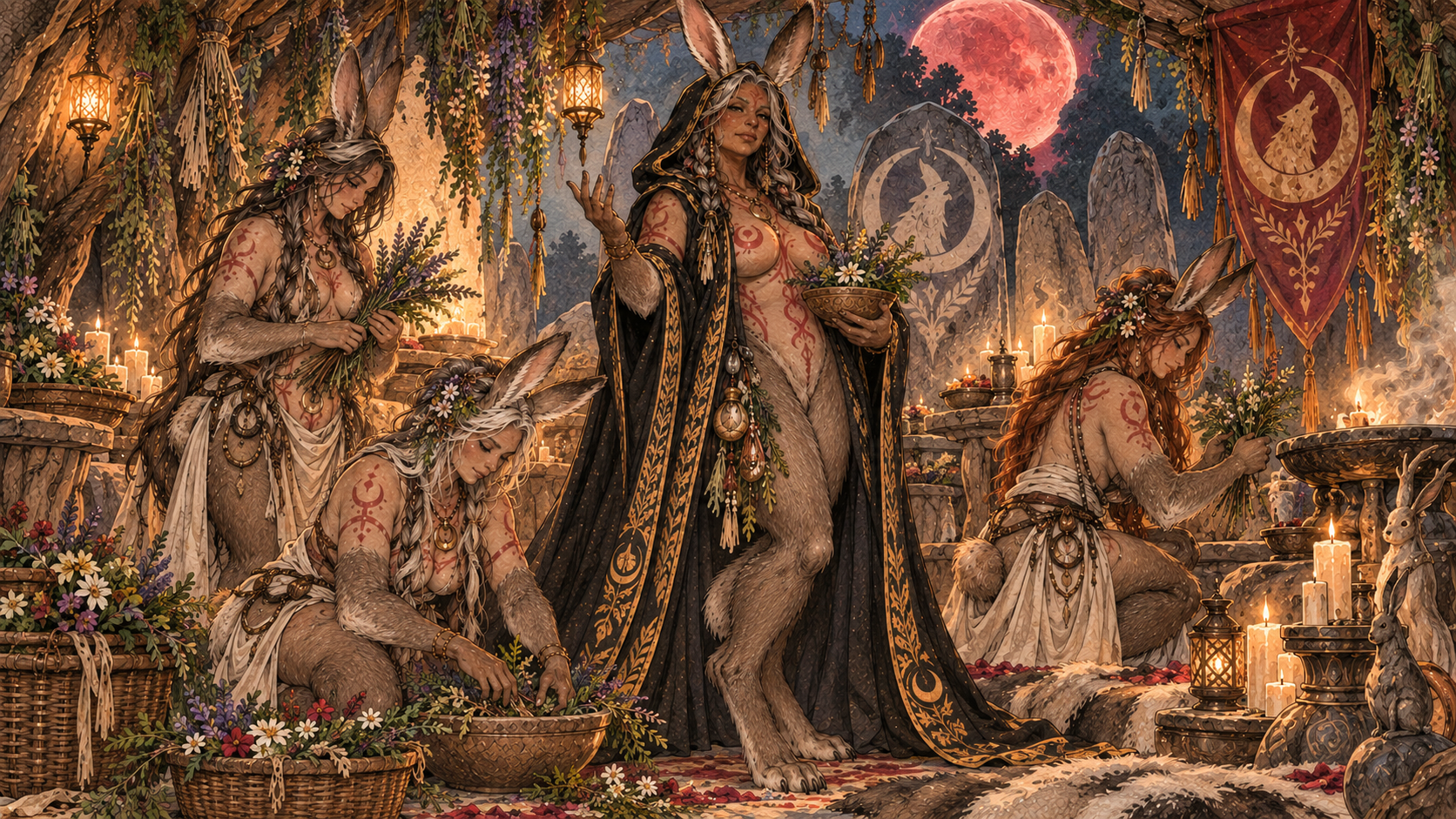
Ulvexa’s priesthood is decentralized and often organized around packs, hunting lodges, groves, dens and regional beast traditions rather than a single hierarchy. Titles vary widely, but several survive across most major traditions.
Fang-Bearers
Fang-Bearers form the broadest body of Ulvexa’s clergy. They tend shrines, lead ordinary devotions, teach feral practice, counsel Beastkin and officiate pack rituals.
Many are skilled trackers, athletes, wrestlers or wilderness guides. A Fang-Bearer is expected to understand bodily limits as well as instinctive expression. The faith considers someone who encourages ferality without teaching responsibility poorly trained.
Their common teaching is: Hunger may speak. It does not get the only voice.
Wolf-Mothers
Wolf-Mothers preserve Ulvexa’s traditions of pack, communal care, lycanthropy and transformation. The title is strongly associated with women in some regions but functions as a religious office rather than a universal statement of gender in others.
They oversee pack adoption, reconciliation, communal sleeping customs, transformation rites and the care of worshippers whose beast forms create social difficulty.
A Wolf-Mother may help a newly transformed lycanthrope learn to live without fearing their own body. Another may negotiate sleeping arrangements in a crowded Beastkin household. A third may preside over intimate mating rites between shapeshifters.
All three duties arise from the same theology: the beast belongs somewhere.
Heat-Priests
Heat-Priests specialize in sexual and mating mysteries. They teach breeding fantasy, feral roleplay, scent rites, wrestling boundaries, mating displays, rutting ceremonies and other adult expressions of Ulvexa’s domain. Their work requires unusual clarity because primal themes can create the illusion that boundaries have become less important precisely when they have become more important.
A skilled Heat-Priest knows how to create a ritual that feels dangerous, instinctive and barely civilized while remaining deeply structured beneath the surface. The art lies in making the participant feel wild without making them unsafe.
Beastcallers
Beastcallers specialize in shapeshifting, lycanthropy and therianthropic spirituality. Many are druids, primal spellcasters or people capable of partial transformation. They help devotees explore Beast-Roles and Mating Forms while preserving identity and agency across bodily change. Some also serve as mediators between settlements and intelligent beast peoples or shapechanging communities.
Their theology insists that transformation should clarify embodiment rather than erase the person inside it.
Rutshamans
Rutshaman is an old archival title still used in several Ulvexan traditions. Contemporary temples usually reserve it for clergy who specialize in cyclical heat, mating festivals, breeding symbolism and forms of erotic ritual connected to seasons, migration or ancestry. The office is highly respected but not universal.
Many Rutshamans also possess training in reproductive health, contraception, fertility magic and the distinction between breeding fantasy and reproductive intention. They frequently work beside Talyssan clergy when a ritual concerns both mating desire and actual conception.
Dens of the Wild Heat
Ulvexa’s temples are commonly called Dens of the Wild Heat, though Pack Groves, Moon Dens, Fang Sanctuaries and Houses of the Wolf-Mother are also common. They are rarely sealed completely from the natural world. Open courtyards, forest groves, cliffside caves, hot springs, running water, firepits and broad training grounds dominate the architecture. Even urban temples attempt to preserve exposed stone, living trees or packed earth.
The central sanctuary often contains a large crescent-and-fang emblem overlooking a communal fire. Sleeping spaces are intentionally varied. Some worshippers prefer private rooms. Others sleep in family or pack chambers with cushions, blankets and low platforms arranged for communal rest. No theological virtue attaches automatically to either arrangement.
Training grounds usually sit close to recovery spaces. Wrestling pits may be only a short walk from bathing pools, kitchens and rooms filled with blankets.
This proximity is deliberate. Ulvexa teaches intensity. Her temples teach what happens afterward.
Rites, Taboos & Divine Signs
Rite of the Rutting Moon
The Rite of the Rutting Moon is Ulvexa’s most famous adult ceremony. Participants gather in a designated wilderness, temple grove or constructed hunting ground after establishing roles, boundaries and the conditions under which the rite ends. Some participants take the role of hunter. Others become quarry. Shapeshifters may assume Beast-Roles or Mating Forms. Scent, pursuit, wrestling, capture, pinning and mating symbolism may all appear according to the agreements made beforehand.
Capture does not create consent. The chase begins because consent already exists. The rite may conclude through erotic union, symbolic surrender, exhaustion, shared howling, grooming or simply the moment both participants decide the hunt is finished.
Rite of the Howling Heat
During the Howling Heat, participants gather around a fire while drums establish a gradually intensifying rhythm. The congregation begins with breath. Sound follows. Growls, howls, cries, roars, trills, avian calls and other vocalizations gradually replace ordinary speech. The rite often feels awkward at first, particularly for worshippers trained to remain quiet or composed. That discomfort is part of its purpose. By the end, the voices cease to belong to individuals alone and become what the faithful call the Pack-Song.
Rite of Scent and Recognition
The Rite of Scent and Recognition is performed between willing companions who wish to become more familiar with one another’s natural presence. Participants may exchange cloth, feathers, fur, oils or personal objects carrying scent. Some simply sit close without strong perfume or incense. The rite is common among lovers, hunting parties, new pack members and shapeshifters learning unfamiliar bodies. Its lesson is not that scent reveals secret truth automatically. Recognition grows through attention.
Rite of the First Pounce
The First Pounce is a physical rite commonly used with adolescents entering adulthood, new athletes, novice shapeshifters and devotees who have spent much of their lives frightened of bodily strength. The participant leaps across a marked distance toward a padded target or willing training partner. They are expected to commit fully enough that hesitation becomes visible. The rite teaches controlled decisiveness. A person can move with force without becoming violent.
Rite of the Beast-Shaping
The Beast-Shaping accompanies deliberate transformation into an animalistic or therianthropic form. Before changing, the participant states their name, intention and the conditions under which the form will end. Witnesses repeat the name back after the transformation. The practice ensures continuity. If the participant cannot respond meaningfully or otherwise demonstrate retained agency after changing, the erotic or intimate portion of the rite does not proceed. Shape may change. Choice remains.
Rite of Thigh and Fang
The Rite of Thigh and Fang survives from older intimate Ulvexan practice. Warm scented oil is applied to the neck, shoulders, hips, thighs or other mutually chosen locations before partners engage in controlled biting, scenting, wrestling or feral roleplay. The ritual name is deliberately physical. Its theology concerns the meeting of vulnerability and restraint. Teeth are capable of harm. The sacred act lies in choosing how much pressure belongs to the moment.
The Grounding Fire
The Grounding Fire follows intense Ulvexan rites, long hunts, wrestling tournaments and major transformation ceremonies. Participants gather around low heat and receive water, food, blankets, bathing supplies and whatever degree of touch they desire. Some talk immediately. Others remain quiet. No one is expected to continue acting feral once the rite has ended. Returning is part of the ritual. The beast may come forward. The person must still be welcomed home.
The Great Prohibition
Ulvexa possesses many taboos, but one stands above the rest: Instinct may never be used as an excuse to erase another creature’s will. Forced mating, coercive rutting, pursuing someone who has withdrawn agreement, using shapeshifting to bypass another person’s boundaries, deliberately inducing a feral state to exploit diminished judgment and treating bodily response as permission are profound violations of the Wolf-Mother’s faith. The prohibition extends to beast-form ritual. Ordinary non-sapient animals are not valid erotic partners. A transformed participant must remain adult, sapient, self-aware and capable of meaningful consent.
The theology is not embarrassed by the taboo edge of Ulvexan practice. It simply draws the line in the only place that matters. The form may be beast. The will must remain sovereign.
Other Taboos
Ulvexans also condemn cruelty performed merely for pleasure without consensual context, killing animals solely to acquire devotional trophies, wasting meat from a necessary hunt, mocking Beastkin or Avarin traits as signs of inferiority, forcing someone to suppress harmless animalistic behaviors and lying about desire because a pack expects a particular answer. One especially serious offense is called False Heat: pretending to want a mating, dominance or submissive role because a partner, pack or priest expects enthusiasm. Ulvexa prefers an honest refusal to a performed hunger.
Signs of Ulvexa
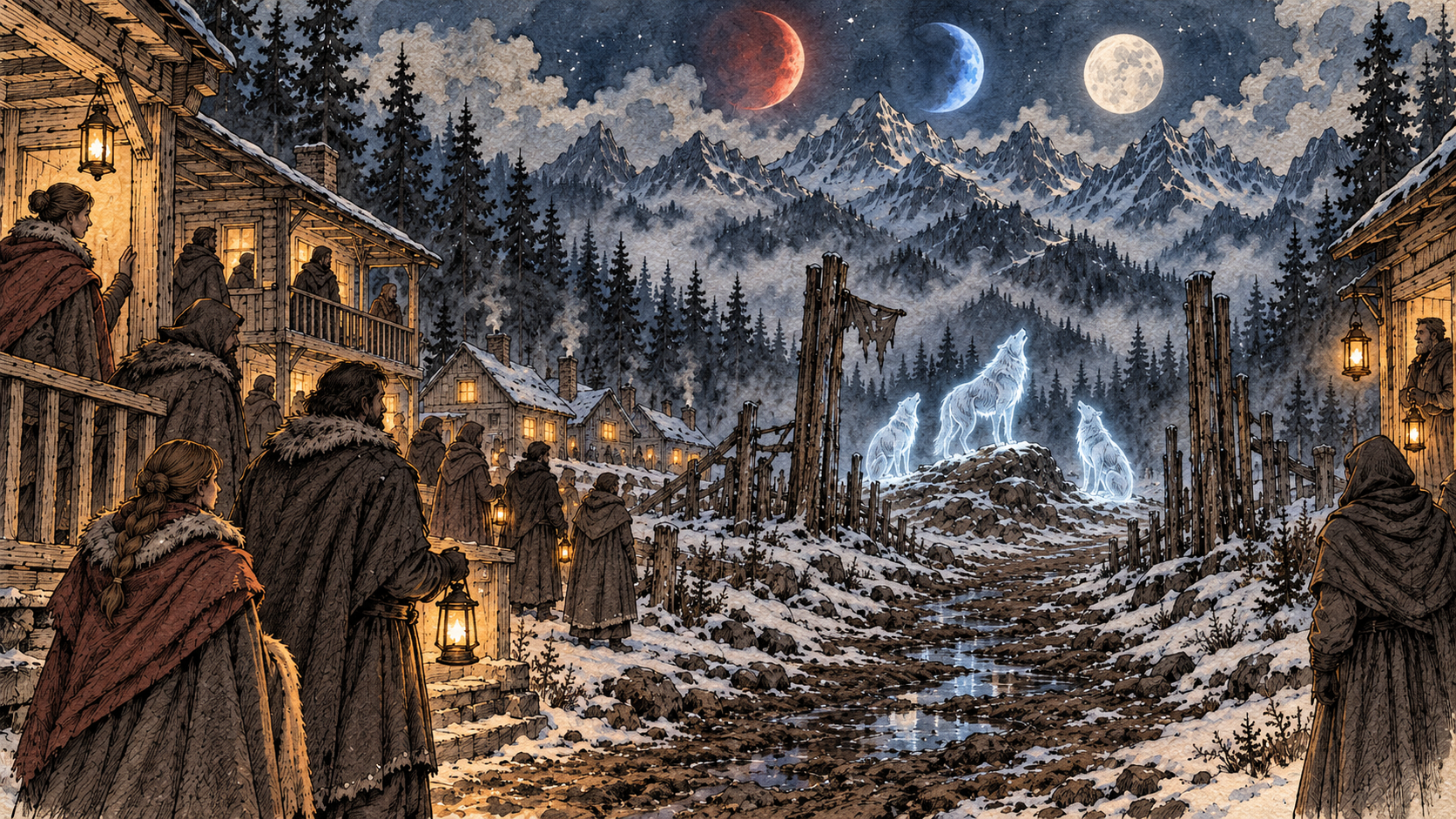
Ulvexa’s favor often manifests as intensified embodiment. Eyes may flash amber or gold. Breath may steam in warm air. Fingernails or claws sharpen temporarily. Fur or feathers may lift as though touched by wind. A person’s scent may become unusually distinct for several moments. Some devotees develop brief physical traits unrelated to their ancestry: a stripe of fur, temporary fangs, luminous eyes, clawlike nails or spectral ears. The rarest sign is known as the Pack Behind. Several translucent wolves, great cats, bears or other spirit beasts appear briefly around a favored person. They do not obey commands. They simply move with the devotee before dissolving into mist.
Ulvexa and the Velvet Court
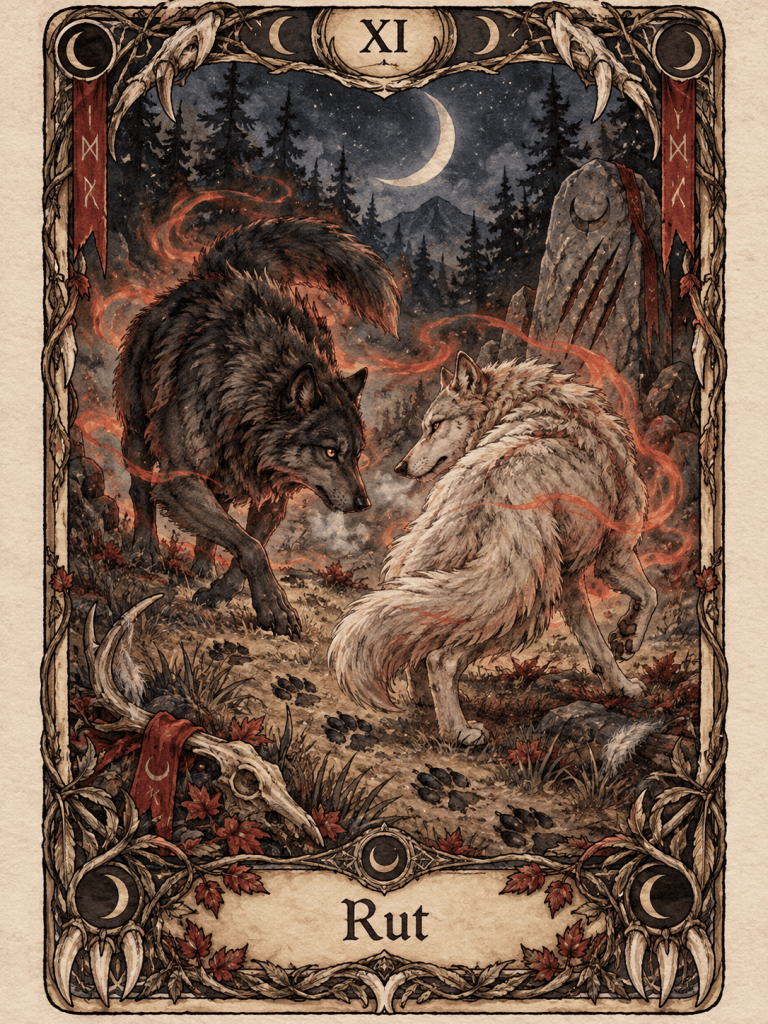
Within the Velvet Court, Ulvexa embodies Primal Lust, Ferality and Breeding. Where Velyssara sanctifies desire as a divine force, Ulvexa reminds mortals that desire is also physical. It lives in breath, scent, posture, heat, appetite and the body’s ancient capacity to react before reflection catches up.
Her closest theological relationship is with Rhaziel. Their domains overlap through hunt, chase, capture and the excitement of closing distance, but they govern different parts of the experience. Rhaziel concerns himself with pursuit as structure. He asks where the quarry runs, how the hunter follows and what capture means. Ulvexa concerns herself with the body inside the chase.
Rhaziel asks: Will you run?
Ulvexa asks: What does your body want?
Their priesthoods cooperate frequently in ceremonial hunts, but neither is an extension of the other. Talyss shares Ulvexa’s association with reproduction but approaches it from the opposite side. Talyss governs fertility, pregnancy, growth and the biological or symbolic continuation of life. Ulvexa governs mating drive and breeding desire. Talyss roots. Ulvexa runs.
Threxia shares Ulvexa’s interest in bodily transformation. A Threxian may alter the body deliberately because a chosen form feels more truthful or beautiful. An Ulvexan may then inhabit that form through movement, scent, behavior and instinct. Their communities overlap strongly among Beastkin, lycanthropes and shapeshifters.
Nyzun shares her respect for bodily intensity and limits. Ulvexa asks what the body wants to do. Nyzun asks what sensation reveals as intensity approaches the Edge. Their wrestling and endurance traditions sometimes intersect, especially where controlled aggression becomes devotional.
Across these relationships, Ulvexa remains distinct. She is not the hunt. She is not fertility. She is not transformation. She is the heat inside the transformed body that suddenly wants to move.
Miracles & Divine Presence
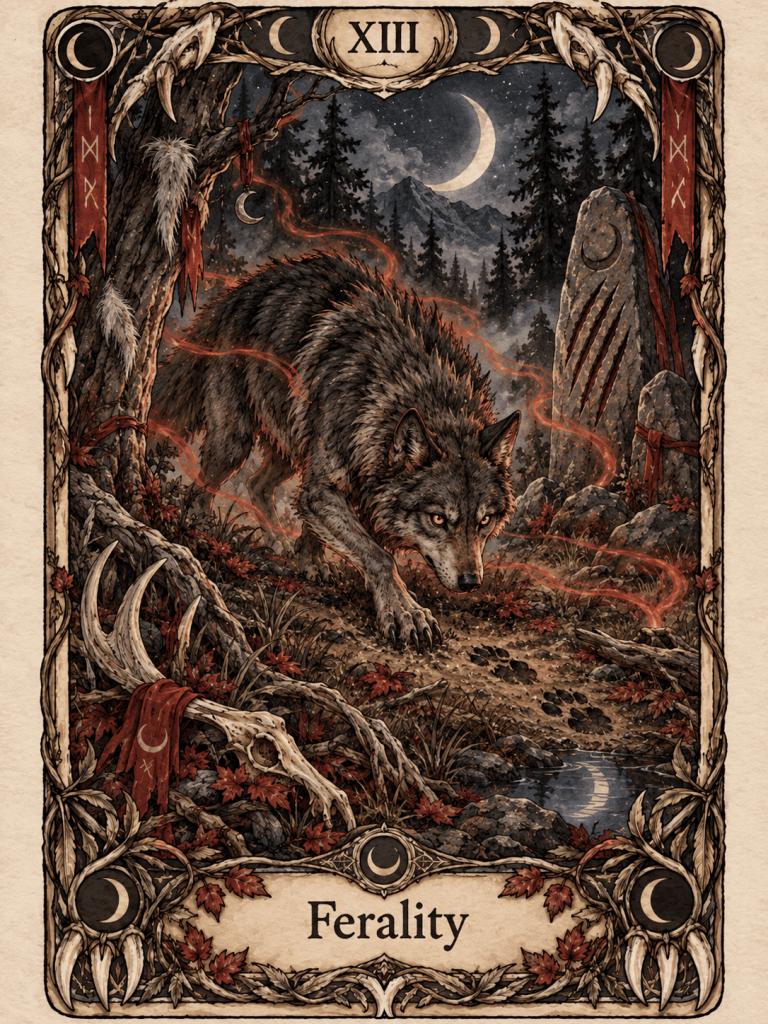
Ulvexa’s miracles often begin with awareness. A hunter notices a track they should have missed. A Beastkin smells rain hours before clouds appear. A frightened traveler hears wolves in the distance and realizes the sound is moving beside them rather than toward them. Someone frozen by indecision suddenly knows which direction their body wants to run. Small manifestations affect animals and senses. Wolves may appear at the edge of torchlight without behaving aggressively. Birds stop calling for several heartbeats. Fur rises along the arms or spine. A campfire burns hotter without consuming additional wood.
Stronger miracles become physical. A devotee leaps farther than their body should permit. A grappler finds impossible footing. A shapeshifter holds a difficult form without losing themselves inside it. Spectral wolves race along both sides of an adventuring party through darkness, vanishing when danger has passed.
The Sudden Trail
Fresh tracks sometimes appear across bare stone where no ordinary creature could leave them. The prints may be wolf, tiger, bear, avian talon or something unrecognizable. They often lead toward danger, shelter or a person whose body has begun changing unexpectedly. Ulvexan clergy treat such trails as invitations to follow carefully, not commands.
The Pack at the Fire
Travelers lost in wilderness occasionally report seeing spectral wolves resting just beyond their campfire. The animals do not approach. They simply watch. If the travelers remain calm, the wolves disappear before dawn and leave behind no tracks. Those who follow the direction of their final gaze often find water, road or safe shelter.
The Heat Beneath Snow
In cold regions, Ulvexa’s presence sometimes appears as warmth spreading through the feet and legs while the surrounding air remains freezing. Snow melts beneath paw prints that belong to nobody visible. Fang-Bearers interpret the omen as a reminder that life does not become less animal simply because winter demands stillness.
The Wolf-Mother’s Presence
When Ulvexa manifests directly, silence often arrives first. Then scent. Wet earth. Fur. pine resin. smoke. sweat. blood carried faintly from somewhere distant. Cold night air and impossible body heat coexist at once. Spectral wolves emerge around the edges of vision. When the goddess herself steps forward, the surrounding world seems to remember that every living thing possesses muscles capable of movement. Then something runs.
What Her Faith Teaches
Ulvexans believe the body is not an embarrassing vehicle transporting a more respectable mind. Embodiment is part of personhood. The faith therefore refuses both extremes commonly projected upon it. Ulvexa does not teach that every impulse deserves satisfaction, and she does not teach that civilized restraint is inherently false. She teaches discernment through honesty.
Instinct Is Information
The body speaks through hunger, fear, attraction, tension, fatigue, arousal, pain, comfort and the urge to move. These reactions matter. They are not always wise. A frightened person may be safe. An aroused person may not want sex. An angry person may not want violence. An attracted person may discover incompatibility after conversation. Ulvexa’s teaching is not to obey instinct blindly. It is to stop pretending instinct said nothing.
Hunger Does Not Create Debt
Wanting another person does not create an obligation in them. This principle appears so frequently in Ulvexan theology because primal lust can feel persuasive precisely when it is strongest. The faithful are taught to distinguish the legitimacy of hunger from any supposed entitlement to satisfaction. A desire may be real. Another person may still say no. Both truths can coexist without diminishing either.
The Beast Is Not the Monster
Many cultures use animal language when describing uncontrolled cruelty: beast, brute, predator, animal. Ulvexans challenge that habit. Animals kill to survive, defend territory, protect young, compete and mate. They also groom, play, rest, cooperate, warn, flee, nurture and seek companionship.
The faith teaches that cruelty is not made more understandable by calling it animal. Sometimes cruelty is very civilized. Ferality should not be blamed for choices people make knowingly.
Pack Is Chosen Through Presence
A pack is not automatically family, ancestry or hierarchy. It is the network of creatures who repeatedly choose to remain near one another and act with mutual recognition. Some packs are lovers. Some are adventuring companies. Some are households, hunting groups, wrestling circles or Beastkin communities. Pack belonging does not erase individuality. The First Pack stayed because they wished to. That remains the model.
Shape Does Not Erase Choice
This doctrine governs shapeshifters and lycanthropes throughout the faith. A body may become animalistic without making the mind meaningless. A transformed person may still negotiate, accept, refuse, change intention and return to another shape. Ulvexa does not sanctify loss of personhood as an erotic ideal. She sanctifies the choice to explore what personhood feels like inside another form.
At the Table
Ulvexa works particularly well when her presence makes embodiment, instinct and transformation consequential. Her stories naturally involve Beastkin identity, lycanthropy, shapeshifting, wilderness, pack conflict, mating rites, physical competition, pursuit, feral magic and characters learning the difference between honoring instinct and being ruled by it. An Ulvexan NPC does not need to be sexually expressive. They might be a Wolf-Mother helping a frightened new lycanthrope through their first controlled transformation, a wilderness priest teaching city children how to read animal tracks, a wrestler who treats every match as devotional practice or an Avarin matchmaker who interprets courtship display through Ulvexa’s theology.
Ulvexan Characters
Characters drawn toward Ulvexa commonly include barbarians, druids, rangers, monks, fighters, clerics, Beastkin, Avarin, lycanthropes and other shapeshifters. Her faith also suits characters whose relationship with instinct creates conflict.
A courtier may discover that years of perfect manners have made their own body feel distant. A Beastkin may have spent childhood hiding ears, tail or scent to appear more acceptable in a human-dominated institution. A druid may feel more comfortable in animal form than humanoid form and wonder what that means about identity. A powerful warrior may confuse aggression with honesty until Ulvexan teaching forces them to recognize that restraint can also be chosen honestly. These are Ulvexan stories.
Divine Domains and Traditions
The archives associate Ulvexa with Passion, Nature, Fury and Strength, along with the Oath of Wild Heat, Oath of the Crimson Fang, College of Beastsong, College of the Howling Heart, Circle of Rutt, Circle of Beastshape, Pact of Primal Heat and Pact of the Rut-Maddened Fang.
These names remain useful expressions of her religious traditions, though their mechanics predate current Second Bloom standards.
Future Ulvexan player options should emphasize movement, scent, grappling, pursuit, transformation, pack coordination, controlled bursts of primal power and the transition between composed and feral states.
They should not reduce Ulvexa to a generic Strength bonus.
(Needs updated mechanics: Base 5e → Veiled → Unveiled.)
Boons of Ulvexa
Older mechanics preserve several recognizable ideas: improved Athletics during moments of heightened physicality, bonuses while grappling or pinning, intimidation through growls or snarls, pouncing movement and brief surges of primal strength.
The themes remain appropriate.
The implementation should be rebuilt.
A modern Ulvexan boon should feel as though the character becomes more physically present when instinct is engaged. Movement should matter. Position should matter. Grappling, tracking and pack support should matter.
In Veiled and Unveiled play, Arousal may interact with feral or pursuit scenes, but baseline functionality must remain complete without Desire mechanics.
(Needs updated mechanics: Base 5e → Veiled → Unveiled.)
Wild Pounce
Wild Pounce remains one of the strongest archival mechanical concepts for Ulvexa. A future version should allow a character to close distance rapidly and transition directly into a grapple, shove or other clearly defined physical action. The effect should feel explosive without becoming a generic teleport. The body moves. That distinction matters.
(Needs updated mechanics: Base 5e → Veiled → Unveiled.)
The Pack Behind
The Pack Behind offers a second strong mechanical identity. A devotee might briefly manifest spectral wolves or other spirit beasts that assist with movement, tracking, positioning or ally support. The spirits should not function merely as extra damage. Their role should express pack instinct. One spirit might mark a safe route. Another could grant advantage on a pursuit check. Another might allow an ally to reposition. This would give Ulvexa a mechanical language distinct from Rhaziel’s focused pursuit and Talyss’ growth-based support.
(Needs updated mechanics: Base 5e → Veiled → Unveiled.)
Sacred Relics
Fang of the Rutting Moon
Wondrous item, rarity to be determined
The Fang of the Rutting Moon is a polished ivory fang suspended within an ornate moon-silver crescent set with a deep blue stone. The relic becomes warm when its bearer enters a chase, wrestling contest, mating rite or other moment in which instinct becomes unusually difficult to ignore. Older accounts claim the Fang sharpened senses and granted extraordinary physical confidence during pursuit or grappling. Several traditions insist the relic cannot be activated by forced participation. If the bearer enters an encounter they did not willingly choose, the stone becomes cold and dark.
(Needs updated mechanics: Base 5e → Veiled → Unveiled.)
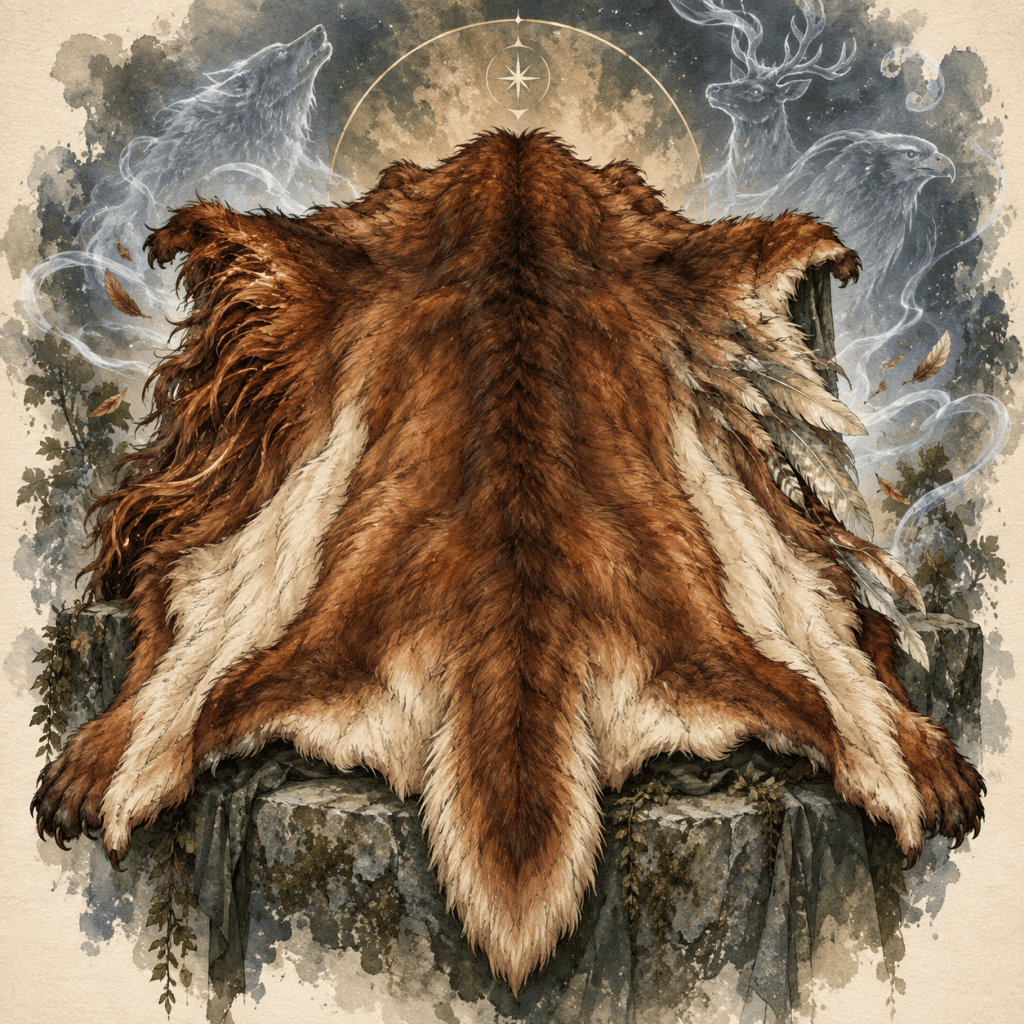
Pelt of Wild Heat
Wondrous item, rarity to be determined
The Pelt of Wild Heat resembles an enormous chestnut hide with darker ember-brown along its shoulders and a pale underside. No credible account identifies the creature from which it came, and many Wolf-Mothers insist the object was never cut from any mortal beast.
When wrapped around a wearer, the pelt adjusts subtly to their idealized beast-self. A Lupinari may see richer fur. An Avarin may perceive spectral feathers along the edge. A shapeshifter may briefly smell or hear the creature they most strongly associate with their own ferality.
The pelt is especially important in Beast-Shaping rites.
(Needs updated mechanics: Base 5e → Veiled → Unveiled.)
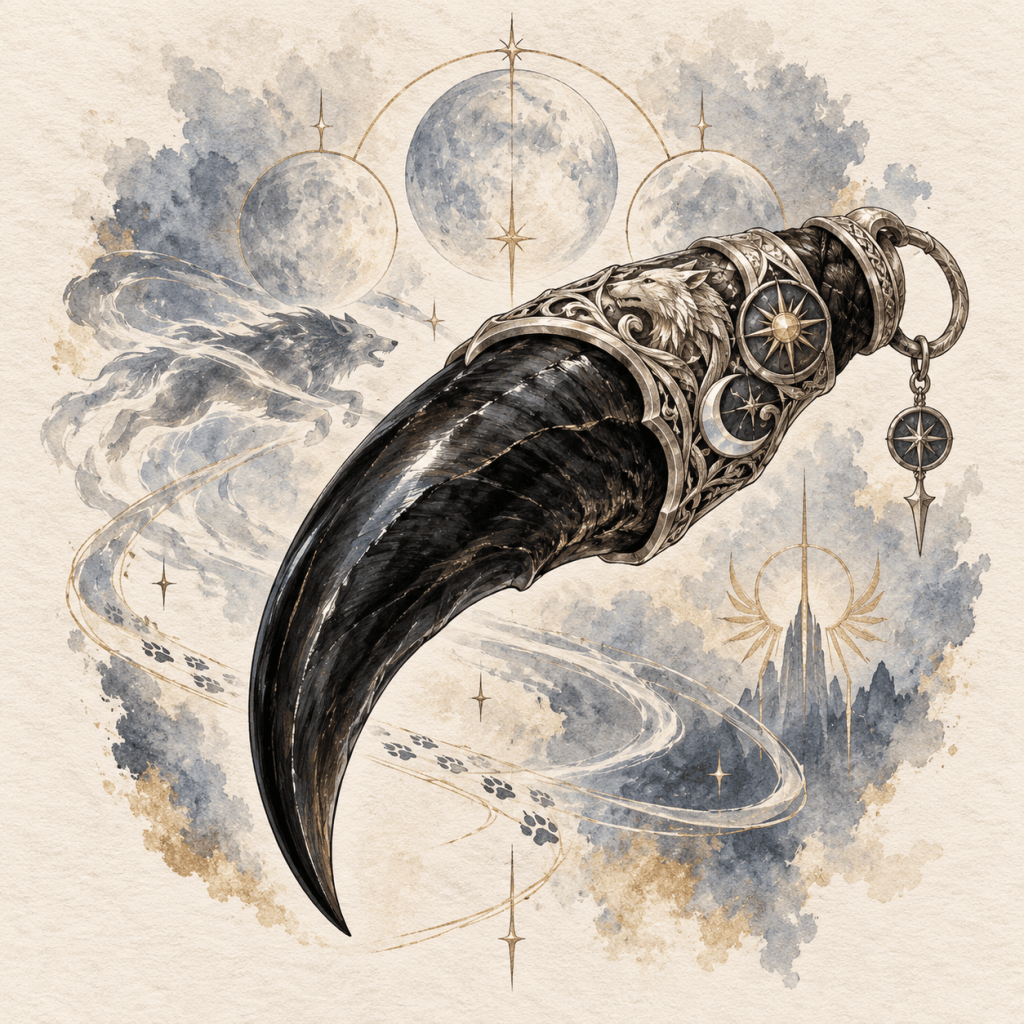
Claw of the First Chase
Wondrous item, very rare
This immense black claw is said to have been shed during the Hunt Beneath Three Moons. The surface remains impossibly sharp but never cuts its bearer accidentally. Hunters traditionally mount the relic within a silver grip or carry smaller fragments as charms. Older stories attribute extraordinary leaps and sudden bursts of speed to the Claw, along with the ability to catch the scent of a quarry across impossible distances. Rhazielian clergy also claim partial ownership of its history. Ulvexans find the argument entertaining.
(Needs updated mechanics: Base 5e → Veiled → Unveiled.)
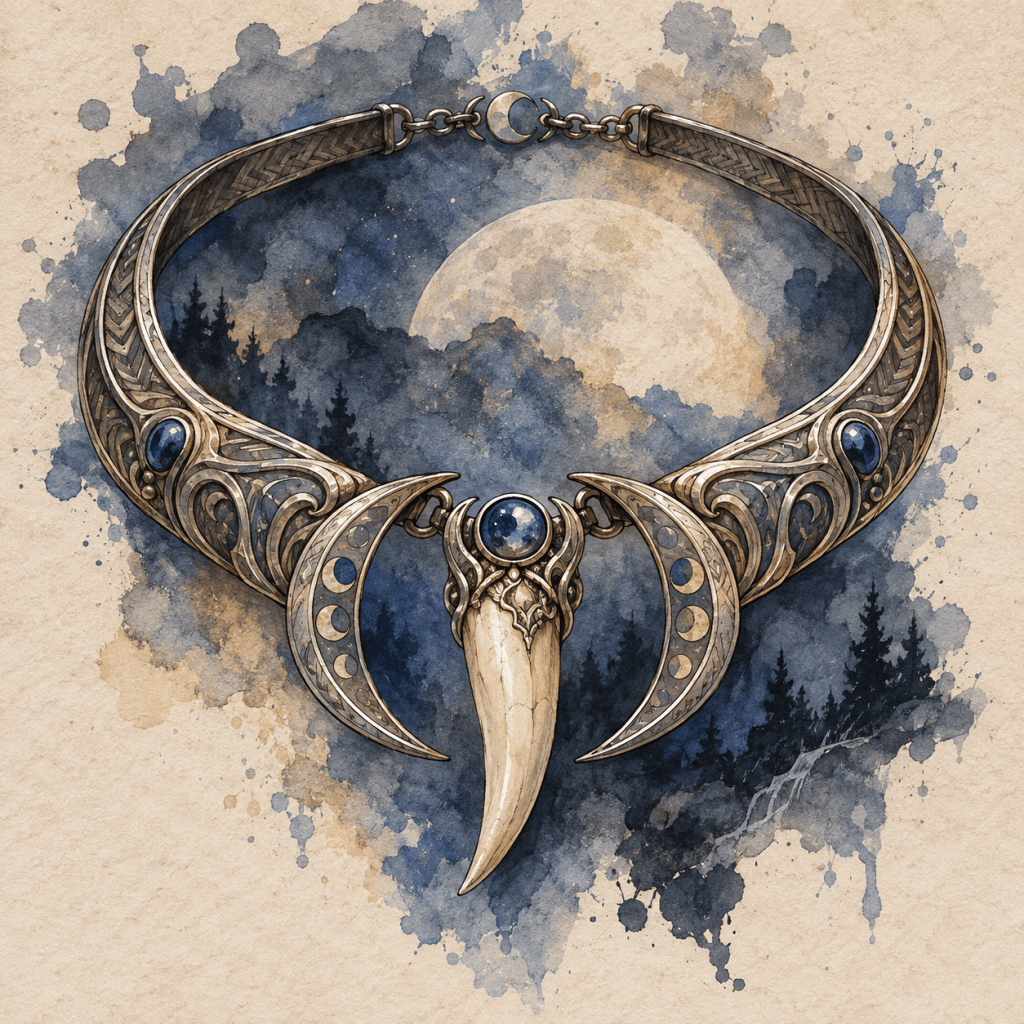
Moonfang Torc
Wondrous item, rare
The Moonfang Torc is a heavy moon-silver collar terminating in two crescent shapes surrounding a central fang. Despite its intimidating appearance, the relic is associated primarily with controlled transformation. Lycanthropes and shapeshifters wear it while entering forms that once frightened them. Stories claim the torc anchors memory and self-recognition during intense bestial transformation, allowing instinct to intensify without dissolving identity.
(Needs updated mechanics: Base 5e → Veiled → Unveiled.)
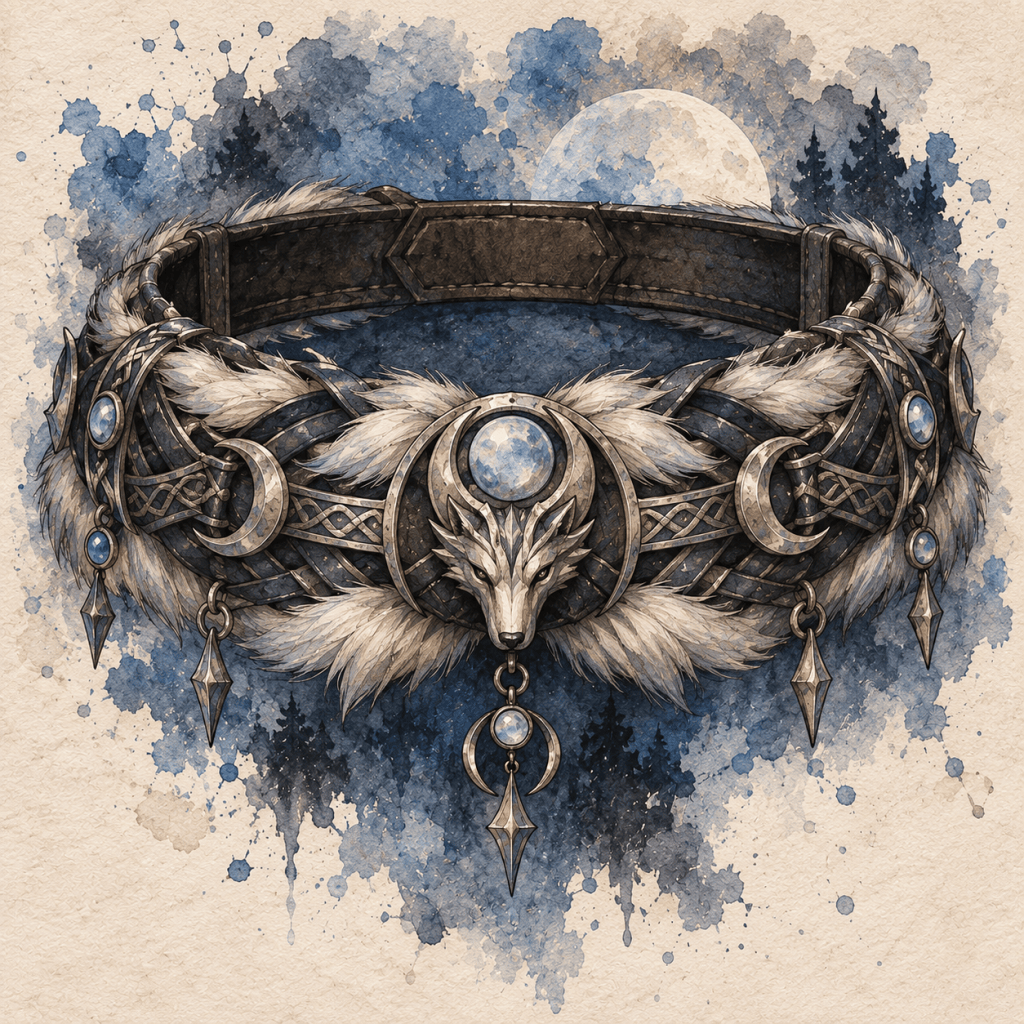
Collar of the First Pack
Wondrous item, rarity to be determined
This broad braided collar is woven from silver thread, dark leather and pale spectral fur that remains cool to the touch. No clasp is visible. The collar opens only when the wearer chooses to remove it. When several members of the same pack wear linked versions, they report subtle awareness of one another’s direction, distress and distance. The oldest collars are said to contain individual strands from Ulvexa’s spectral wolves.
(Needs updated mechanics: Base 5e → Veiled → Unveiled.)
Adventure Hooks
The Pack Without a Mother
Spectral wolves begin appearing throughout a frontier settlement. They attack no one, but every night they gather at the same abandoned trail and stare toward the mountains. Local Fang-Bearers believe the spirits are searching for someone who never returned from a sacred hunt. The trail they guard has been unused for 30 years. Fresh footprints begin appearing anyway.
The False Rut
A famous Den of the Wild Heat descends into uncontrolled aggression during what should have been a carefully structured Rutting Moon ceremony. Participants report feeling compelled rather than invited. The clergy insist immediately that the phenomenon cannot represent Ulvexa’s blessing. Something has taken the outward signs of heat and removed the element that makes them sacred. The characters must discover what entered the grove before the next moonrise.
The Beast That Stayed
A respected druid completes an Ulvexan Beast-Shaping and chooses not to return to humanoid form. Their intelligence, memory and personality remain intact. Their family nevertheless insists something has gone wrong because the druid now prefers to speak through magic, sleep in the forest and inhabit a form most relatives consider animal. The characters are asked to determine whether a curse exists. The more difficult question is whether anyone has the right to call the transformation a problem.
The Wolf-Mother’s Empty Place
One spectral wolf has vanished from every major Ulvexan shrine at the same time. Temple art changes overnight. Statues that once depicted five wolves now show four. Old tapestries have physically rewoven themselves. Only a handful of archivists remember that another wolf ever existed. Something has happened to the First Pack.
The Fang Across the Border
Two Beastkin communities claim ownership of an ancient Fang of the Rutting Moon. Both possess legitimate historical evidence. Neither will surrender the relic because its return coincides with a once-in-a-generation migration and mating festival. What begins as a religious dispute becomes dangerous when the relic starts pulling physically toward a third location claimed by neither community.
The Silent Howl
Every wolf, dog and lupine Beastkin across a large region loses the ability to howl. No physical injury is present. Other sounds remain possible. The silence spreads next to great cats, then bears, then Avarin courtship calls. Something is removing instinctive vocal expression species by species.
Rhaziel’s Trail, Ulvexa’s Heat
A ceremonial hunt jointly dedicated to Rhaziel and Ulvexa concludes successfully. The quarry reached the agreed capture point. The hunters followed every boundary. Everyone involved remembers the first several hours. No one remembers the final one. When dawn comes, enormous wolf tracks surround the entire clearing. None belong to Ulvexa.
Scents for Gameplay
Roll or choose whenever Ulvexa’s influence becomes noticeable.
| d12 | Scent |
|---|---|
| 1 | Wet fur warming beside a fire |
| 2 | Pine resin crushed beneath clawed feet |
| 3 | Clean sweat after hard exertion |
| 4 | Cold night air over warm earth |
| 5 | Leather, cedar smoke and dark berries |
| 6 | Rain striking dry stone |
| 7 | Freshly broken branches and damp bark |
| 8 | Musk carried briefly on moving air |
| 9 | Iron, woodsmoke and crushed grass |
| 10 | Animal fur after a summer storm |
| 11 | Warm skin beneath clean wool or fur |
| 12 | Moon-cold air, chestnut fur, cedar smoke and impossible body heat together — the scent Ulvexan priests call First Heat |
Ulvexa’s scent should rarely feel decorative. It should feel as though something living, alert and physically present has entered the area before anyone has seen it. Her miracles do not perfume the room. They make the room remember that bodies are animals.
 Whispers of Erosia
You must be logged in to post a comment.