

Zenthira
The Bond-Twin • The Unspoken • Keeper of the Private Heart
Twin Goddess of Uncommon Desire, Secrecy and Intimate Truth
Uncommon Desire • Secrecy • Confession
Highly specific desire, unusual fetishes, private fantasy, secret longing, intimate confidence, uncommon relationships, shared secrets, vulnerable disclosure, mirrored desire, private identity and the relief of discovering that someone else understands.
“What you whisper is no less true.”
Zenthira is the goddess of the desire someone hesitates to say aloud. She governs the intensely specific want, the private fantasy that has never needed an audience, the intimate preference someone has carried for years without knowing whether another person would understand and the breath held immediately before the words, There is something I have never told anyone.
Her worship does not concern desires that Erosia considers morally prohibited. Erosian morality does not assign moral status to an intimate desire merely because it is uncommon. Once those involved have reached their society’s Age of Bloom, possess the capacity to choose and freely consent, the unusualness of their relationship or desire does not make it wrong. That does not make disclosure easy. A person may know intellectually that nothing about their desire violates Erosian ethics and still wonder whether a lover will find it strange. They may fear being misunderstood, laughed at, treated differently or reduced forever to one private thing they admitted wanting. Zenthira inhabits that moment.
She is not the goddess who asks whether desire is permitted. She asks: Who do you trust enough to tell?
Her oldest visual tradition already presents her as two identical twin sisters whose power lies in intimacy, synchronization and mutual consent, with neither sister subordinate to the other. Second Bloom theology now understands that image more completely. Zenthira is the sacred mystery of being known without being diminished by what is known. Her faithful preserve three teachings above all others: No desire becomes wrong because it is rare. Confession is a gift, never a debt. What is shared in confidence remains yours.
Lore & Mythos
When Desire Was First Whispered
The oldest contemporary Zenthiran creation story begins after Velyssara had already awakened desire throughout living creation. Mortals learned quickly to speak about common wants. They asked for companionship, touch, beauty, courtship, affection and pleasure. Language grew around experiences many people recognized in one another. Then one mortal wanted something nobody around them had ever mentioned. The archives deliberately refuse to identify the desire.
Zenthiran theologians consider that omission essential. Perhaps it concerned a particular kind of lover. Perhaps an unusual relationship. Perhaps an elaborate fantasy, a strange sensation, a private role, a form of intimacy others would simply never have imagined. Whatever it was, the mortal carried the desire silently. Not because anyone had condemned it. Nobody knew enough to condemn it.
The mortal simply believed: No one else could possibly want this.
Years passed. Eventually they told someone they loved. The listener remained silent for several heartbeats. Then answered: “So do I.” The first mortal began to laugh. The second began crying. Neither fully understood why. Rose light appeared around one of them. Violet light appeared around the other. The colors twisted together without becoming one color, and from the space between their joined hands stepped two identical women.
Zentha smiled at the speaker. Zira smiled at the listener. Together they said: “Now neither of you is alone inside it.” Zenthiran scripture calls this the First Whisper. The miracle was not that the desire was shared. The miracle was that it had finally become speakable.


Zentha and Zira
Zenthira is the singular divine name given to Zentha and Zira, two identical mature adult twin sisters who together embody one divine mystery. Older artwork presents them mirror-posed, hand in hand or with their foreheads nearly touching. Their garments complement rather than duplicate one another, traditionally placing rose upon one sister and violet upon the other. A shared heart, paired thread or double-helix radiance frequently moves between them.
They are sisters. They are also one another’s beloved. Within Erosia, these facts are not treated as a theological contradiction requiring explanation. Their intimacy belongs to them. Their twinhood does not override their adulthood, capacity or agency, nor does it make the relationship morally exceptional merely because another observer finds it unusual.
The important theological question is different. How can two beings share nearly everything and still remain two people? Zentha and Zira know one another with impossible intimacy. Their thoughts sometimes finish one another’s sentences. Their heartbeats synchronize. Their divine aura mingles until the boundary between rose and violet becomes difficult to see. Yet neither sister speaks for the other. Neither grants permission on the other’s behalf. Neither is spiritually superior, more complete or more truly Zenthira.
This preserves one of the oldest hard rules of their visual tradition: the twins are equals and the composition must never establish hierarchy between them. Zenthiran theology therefore sees the Bond-Twin as proof that profound intimacy need not erase individuality. To be completely known is not the same thing as becoming interchangeable.
The Box Between Sisters
One of the most reproduced Zenthiran myths shows the sisters seated together before a tiny locked box. Zentha possesses the box. Zira possesses the key. Zira asks whether she may open it. Zentha says yes. No surviving version of the story reveals what was inside. Artists have spent centuries inventing possibilities. Some paint a jewel. Others a letter, ribbon, miniature mirror, flower, ring or point of divine light. Zenthiran clergy generally consider every attempt incorrect. The contents are not part of the story.
What matters is that Zentha possessed something private, Zira possessed the means of access and the key was not used until Zentha invited her to use it. Later temple versions add another scene. After looking inside, Zira closes the box. She never tells anyone what she saw. From this story come two Zenthiran teachings: Access is given. Confidence is kept.
The Lover Who Did Not Say “Me Too”
Not every sacred confession ends with shared desire. A beloved temple story concerns an artisan who had carried an intensely specific fantasy for most of her adult life. She eventually told her lover, expecting either delight or rejection. The lover listened carefully. Then said: “I don’t want that.” The artisan’s face fell. The lover continued: “But I am glad you trusted me enough to tell me.” The artisan asked whether this meant the relationship had changed. The lover answered that of course it had. They now knew one another better. That did not mean the lover had become obligated to participate.
Zenthira appeared in the reflection of a nearby window as two women seated side by side. Zentha looked toward the artisan. Zira looked toward the lover. Neither spoke. They did not need to. This story is taught throughout the faith because it prevents a dangerous misunderstanding: successful confession is not measured by receiving the answer one hoped for.
Sometimes intimacy deepens through shared desire. Sometimes it deepens because someone can say, That is not mine, but I will not make you ashamed that it is yours.
The Journal That Remained Closed
Another story concerns a famous ruler who became convinced that several members of her court were keeping intimate secrets. She did not believe they were plotting treason. That irritated her more. If the secrets were harmless, she reasoned, why should loyal subjects conceal them from their sovereign? She ordered their private journals seized. The first book appeared blank. So did the second. Then the third. Ink returned only when each journal was placed into its owner’s hands.
The ruler summoned Zenthiran clergy and accused them of concealing information from legitimate authority. A Heartstring Keeper replied that authority over a kingdom did not create ownership over every private thought within it. The ruler demanded the goddess herself answer. That night, she dreamed of Zentha and Zira sitting at the foot of her bed, passing a sealed journal between them.
The ruler asked what it contained. Both sisters smiled. Neither answered. By morning, the confiscated books had returned to their owners. From this story comes one of the faith’s most important social teachings: Not every truth asks to become public.

The Desire They Embody
Zenthira embodies the desire that feels uniquely one’s own. Her sacred current appears wherever desire becomes intensely personal: a precise fantasy, unusual relationship structure, highly specific fetish, private role, strange attraction or combination of circumstances that makes someone wonder whether anyone else experiences desire the same way. The rarity is not itself sacred. The vulnerability created by revealing it is.
The Unspoken
The Unspoken is Zenthira’s central mystery. It is not simply a secret. A secret may concern money, politics, crime or surprise. The Unspoken is something about the self that becomes difficult to express because saying it aloud changes the relationship between speaker and listener.
Before disclosure, the speaker controls the possibility. Afterward, another person knows. That transition gives confession its emotional power. Zenthiran priests therefore never assume disclosure is automatically healthier than privacy.
Some desires benefit from being spoken. Some need time. Some belong perfectly well to the person who possesses them and nobody else. The sacred act is not confession at any cost. It is recognizing that silence should remain a choice rather than a prison.
Uncommon Desire
Zenthira’s followers reject the idea that frequency determines legitimacy. A desire shared by millions is not automatically healthier than one shared by a handful of people. Likewise, rarity does not make something deeper, more sophisticated or more sacred.
It simply makes finding language and compatible partners more difficult. This distinction matters enormously in Erosia. A person may enjoy a highly specific form of roleplay, unusual arrangement of partners, uncommon body preference, elaborate ritual, unexpected relational dynamic or fantasy so particular that explaining it takes longer than performing it would.
None of these require theological defense merely because few people share them. Zenthira’s faith often becomes important when rarity produces isolation. The worshipper’s fear is rarely:
Am I allowed to want this? It is: Am I the only one?
The Echoed Answer
Among Zenthirans, one of the most emotionally powerful experiences is hearing another person answer a vulnerable confession with: “Me too.”
The phrase appears constantly in temple poetry. It does not mean that every shared desire must immediately become action. Two people may discover the same fantasy and simply enjoy knowing the similarity exists. Others may discuss it for weeks before deciding whether they wish to explore it together.
Some discover that they imagined similar things but wanted very different experiences from them. Recognition opens conversation. It does not complete it.
Being Known Without Being Joined
Zenthira also governs the equally important experience of being understood by someone who does not share the desire. A partner can know what another wants without wanting it themselves. A priest may understand a confession without personally relating to it.
A friend may receive an intimate truth without becoming part of the fantasy. This produces one of the faith’s simplest teachings: Understanding is not participation. Zenthiran clergy consider this principle essential because vulnerable disclosure can create emotional pressure even when nobody intends coercion.
Someone who has gathered extraordinary courage to confess may desperately hope the listener responds positively. That hope remains real. The listener’s answer remains theirs.
Private Desire
Privacy holds positive spiritual value within Zenthira’s faith. A person does not owe public transparency merely because their desire is healthy. Someone may tell one partner and nobody else. Another may maintain a private fantasy journal that even their spouse never reads.
Two lovers may share rituals that friends know nothing about. A person may participate openly in one part of Erosian erotic culture while keeping another part completely private. None of these circumstances inherently indicate shame.
Zenthira teaches that intimacy acquires meaning partly because access can be selective. If everyone automatically possesses every truth about you, disclosure cannot become a gift.
Uncommon Bonds
Zenthira’s temples are particularly welcoming to relationships whose structures are unusual even within Erosia. Plural partnerships, highly ritualized pairings, familial relationships that become intimate after everyone involved has reached their Age of Bloom, uncommon power arrangements, lovers whose identities or anatomies create unusual combinations and other relationships difficult to summarize through ordinary assumptions all appear within her congregations.
Zenthiran theology applies the same moral standard throughout. Have the participants reached the Age of Bloom recognized for adulthood within their peoples and societies? Do they possess the capacity to understand and choose? Is participation freely given?
Can anyone change their answer? If so, the form of the relationship does not become unethical merely because another person finds it unfamiliar. This is why Zentha and Zira require no exception within their own religion. Their relationship is not holy because they are sisters. It is not unholy because they are sisters. It is theirs.
Fantasy and the Interior World
Not every desire needs a physical expression. Some exist most beautifully within fantasy. A worshipper may imagine experiences they would never choose literally. Someone may enjoy an exaggerated scenario because imagination removes consequences that would make the same circumstances undesirable in ordinary life. Another may discover that simply telling a partner about a fantasy provides everything they wanted from it. Zenthira considers this legitimate. The interior world is part of the self. Fantasy does not become spiritually incomplete because it never becomes physical. Nor does imagining something create an obligation to seek it. The mind may visit places the body chooses never to follow.

Consent and the Age of Bloom
Erosian intimacy begins with adulthood, capacity and choice. The Age of Bloom is the culturally recognized threshold at which a member of a given race or society is considered an adult. Because Erosian peoples mature differently, the threshold is not one universal chronological age. Reaching the Age of Bloom establishes adult social standing. It does not eliminate the need for capacity or consent. Zenthiran teaching therefore distinguishes desire from participation. A person may privately possess any number of desires. The moment another person becomes involved, their choice becomes equally necessary.
No amount of similarity, love, history, kinship, curiosity, prior participation or emotional intimacy substitutes for the present ability to say yes or no.
Holy Symbol & Iconography

The Entwined Heart
Zenthira’s canonical holy symbol is the Entwined Heart, an ornate heart-shaped frame worked in antique gold, mirror-silver and pearl-white detailing. Within it coil two jewel-like strands. One is rose. The other is violet.
They wind around one another repeatedly without merging into a single color. Older Zenthiran art already used shared hearts and double-helix light to symbolize the twins’ connection. The modern symbol expands that imagery into the theology of private desire and chosen disclosure.
The rose strand represents the Spoken: desire that has been named, shared or consciously acknowledged. The violet strand represents the Unspoken: desire still held privately, unfinished or entrusted only to the self. Neither is spiritually superior.
The faith does not teach that every violet strand should eventually become rose. Some things remain private because privacy is where they belong. The outer heart represents the person’s interior life. Fine chains and hanging gemstones ornament the exterior frame but never wrap around the intertwined center. These are called Links of Confidence. Each represents a relationship through which some degree of private access has been voluntarily granted.
A person may possess many such links. They do not all open the same parts of the heart. A traditional catechism interprets the symbol through four lines:
The heart knows.
The voice chooses.
The trusted one receives.
The secret remains yours.
Sacred Colors and Materials
Zenthiran sanctuaries favor rose, wine-red, violet, plum, pearl ivory, mirror-silver and restrained antique gold. Rose represents desire spoken or consciously shared. Violet represents private thought, interior fantasy and the part of the self that remains known only selectively. Silver represents reflection between people: the moment another person’s understanding helps someone see themselves differently. Ivory represents the quiet space necessary for honest disclosure. Antique gold represents confidence that has survived time.
Common materials include amethyst, garnet, rose quartz, polished silver, antique gold, silk, velvet, fine chain, mirrored glass, carved boxes, keys, lockets, folded parchment, sealing wax and fragrant dark wood. Paired objects are especially common. Two cups. Two keys. Two matching rings. Two books containing different pages. The theological principle is not duplication. It is relationship.
Keys, Locks and Boxes
Keys are central to Zenthiran visual language, but they symbolize granted access rather than intrusion. A key given voluntarily means: You may know this. A lock means: This remains mine until I decide otherwise. A box opened for one person and closed before another enters the room is among the simplest Zenthiran devotional images. The faith does not celebrate defeating locks. It celebrates knowing who receives the key.

Letters and Journals
Sealed letters appear constantly in Zenthiran temples. Some contain romantic confession. Others describe fantasies, fears, questions, private identities or experiences that have never been spoken aloud. Writing creates a useful intermediate state. The desire is no longer entirely unformed. It has become language. Yet the writer retains control over who, if anyone, reads it. Private journals are considered spiritually important for the same reason. Zenthiran priests regard opening another person’s devotional journal without permission as a serious violation of confidence even when no magical protection exists.
Mirrors
Zenthira’s mirrors differ from those associated with Velzhara, Delavira and Solynth. Velzhara’s mirror celebrates chosen visibility. Delavira’s preserves distance and observation. Solynth’s supports private recognition. Zenthira’s mirror creates shared recognition. Paired mirrors often stand at angles where two people can see themselves and one another simultaneously. Some sacred mirrors reveal a tiny symbolic detail only when two specific viewers stand together. Others display complementary halves of one image. No single viewer sees the complete design.
Sacred Creatures
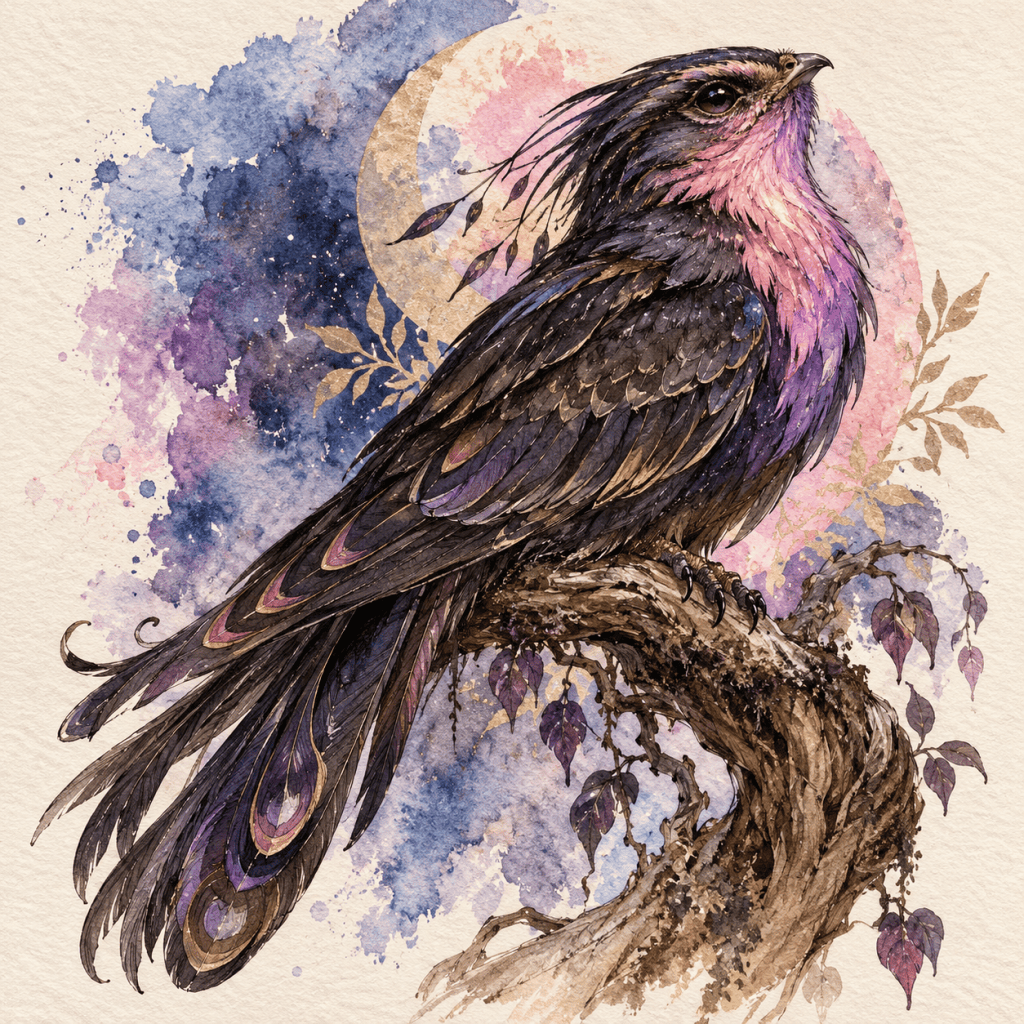
Nightjars are strongly associated with Zenthira because their patterned bodies can remain nearly invisible while their calls reveal unmistakable presence. They symbolize things that exist without demanding visibility.
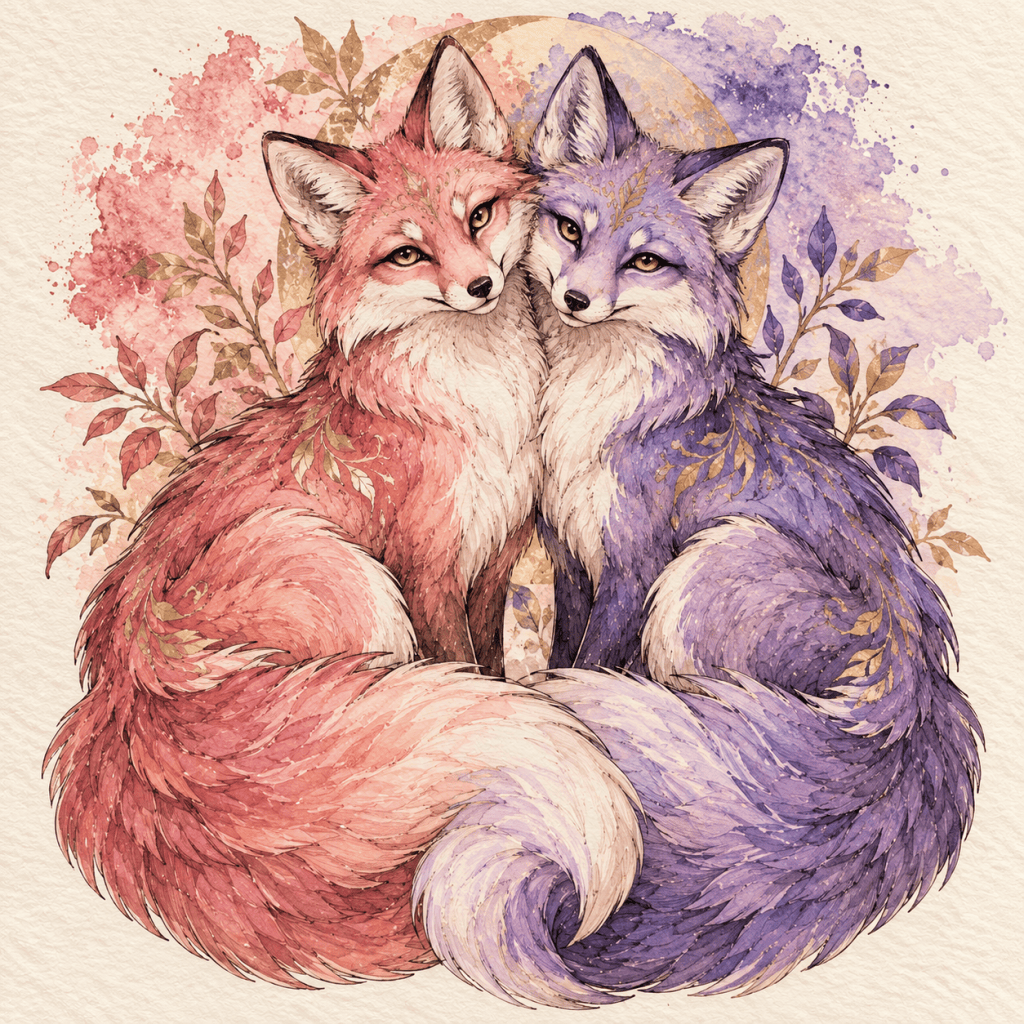
Foxes represent private pathways, curiosity and the intelligence required to approach unfamiliar experiences without assuming every opening must be entered.
A supernatural variety called the Whisperwing Nightjar appears in temple stories. Its rose-and-violet throat feathers remain dull until it chooses one listener. When it sings, only that person hears the complete melody.
Two Whisperwings may sing to one another across a crowded courtyard while everyone else hears only ordinary birdsong.
Zenthiran clergy consider them nearly perfect sacred creatures.
Depictions of Zenthira
Canonical Second Bloom art portrays Zenthira as two identical mature adult divine women, the twin sisters Zentha and Zira. The older visual canon establishes warm luminous skin, chestnut hair, voluptuous divine forms, complementary rose-and-violet garments, mirrored poses, shared-heart imagery and complete equality between the twins. Their canonical colors remain rose, violet and silver. Second Bloom depictions should preserve all of those anchors while shifting their emotional emphasis from generic synchronization toward private intimacy and shared confidence.
Their most characteristic visual language is the conspiracy of intimacy. One sister whispers into the other’s ear while the second gives a tiny smile. One opens a small locked box while only her twin looks inside. They exchange sealed journals. One holds a key while the other holds the matching lock. Their formal garments contain tiny mirrored motifs that appear unrelated from across a room but form Zenthira’s complete sacred heart when the sisters stand beside one another.
They may sit behind a translucent curtain while an enormous celebration continues outside, perfectly content that nobody else knows what they are discussing. Their clothing remains complementary rather than identical. Zentha is commonly associated with rose and wine-red; Zira with violet and plum, though traditions reverse these colors often enough that priests discourage assuming a permanent assignment. Both wear pearl ivory, mirror-silver and antique-gold ornament.
Neither is visually dominant. Neither is the public self while the other is the shameful self. Both are complete. Their body language should communicate extraordinary familiarity without collapsing them into repetitive embraces. A glance, shared joke, hand placed over another hand, exchanged object or whispered sentence can communicate their bond more effectively than constant physical passion. Their established visual truth remains: Connection creates strength. Second Bloom adds another: Some things become sacred because they are shared with exactly the right person.

Worship & Daily Devotion
Zenthira can be worshipped anywhere someone acknowledges a private desire, protects another person’s confidence or chooses to reveal something vulnerable to someone trusted. Writing in a private journal can be prayer. Listening without judgment can be prayer. Saying I don’t share that desire, but I’m glad you told me can be prayer. Closing a door before a private conversation can be prayer. Deciding not to ask a question because the answer belongs to someone else can also be prayer. Her worship attracts lovers, counselors, confidants, writers, courtiers, diplomats, archivists, performers, people exploring unusual desires, members of uncommon relationships and anyone who values the right to control access to their interior life.
The First Whisper
Many devotees begin formal worship by speaking one private truth aloud while alone. The statement need not concern sex. It may be: I want this. I don’t want this anymore. I am curious about this. I wish someone understood this.
The point is simply to give language to something previously unspoken. Afterward, the devotee decides independently whether the truth remains private.
The Paired Candles
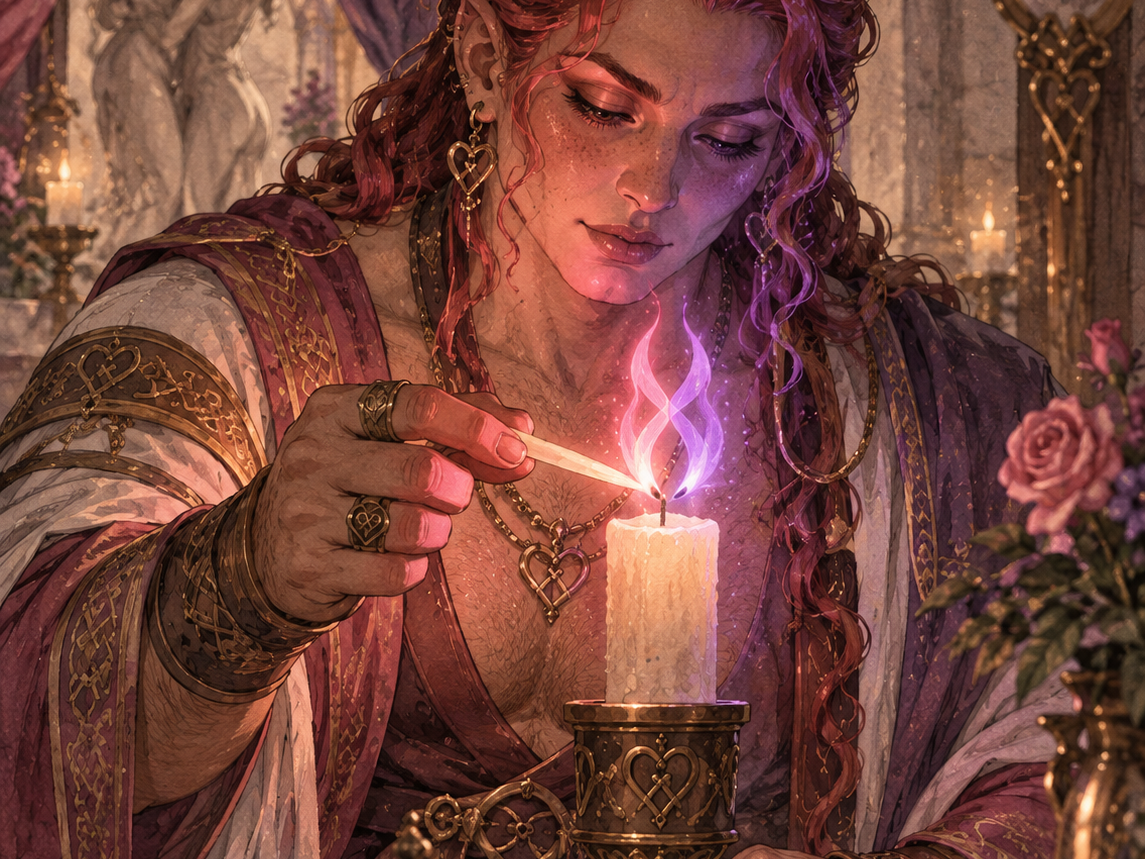
Zenthiran households often keep rose and violet candles together. The violet candle represents what remains private. The rose represents what has been shared. A devotee may light one, both or neither depending upon what they are contemplating.
Nothing requires the violet flame eventually to become rose. The pairing teaches that private and shared truth belong to the same person.
The Sealed Page
A worshipper writes something upon a single page, folds it and seals it with wax. They may then keep it, destroy it, place it in a temple archive or give it to a trusted person. Each choice carries different meaning. The ritual deliberately separates the act of knowing what one wants from the act of telling someone else.
The Matching Token
Two people who share a private understanding may carry objects that only make sense together. Half of a geometric pattern. Two keys to the same box.
Two rings whose interior engravings form a complete sentence when placed together. Matching embroidery hidden inside clothing is especially popular. The tokens need never be explained publicly. That is part of their pleasure.
Favored Offerings
Traditional offerings include sealed letters, paired keys, rose quartz, amethyst, lockets, journals, ribbons, boxes with private compartments, perfume worn only around one particular person, matched pieces of jewelry and written accounts of moments when someone responded kindly to an unexpected confession.
Temples also accept unopened letters. The clergy do not read them. The offering is the act of placing the private truth somewhere sacred.

Clergy & Temples
Heartstring Keepers
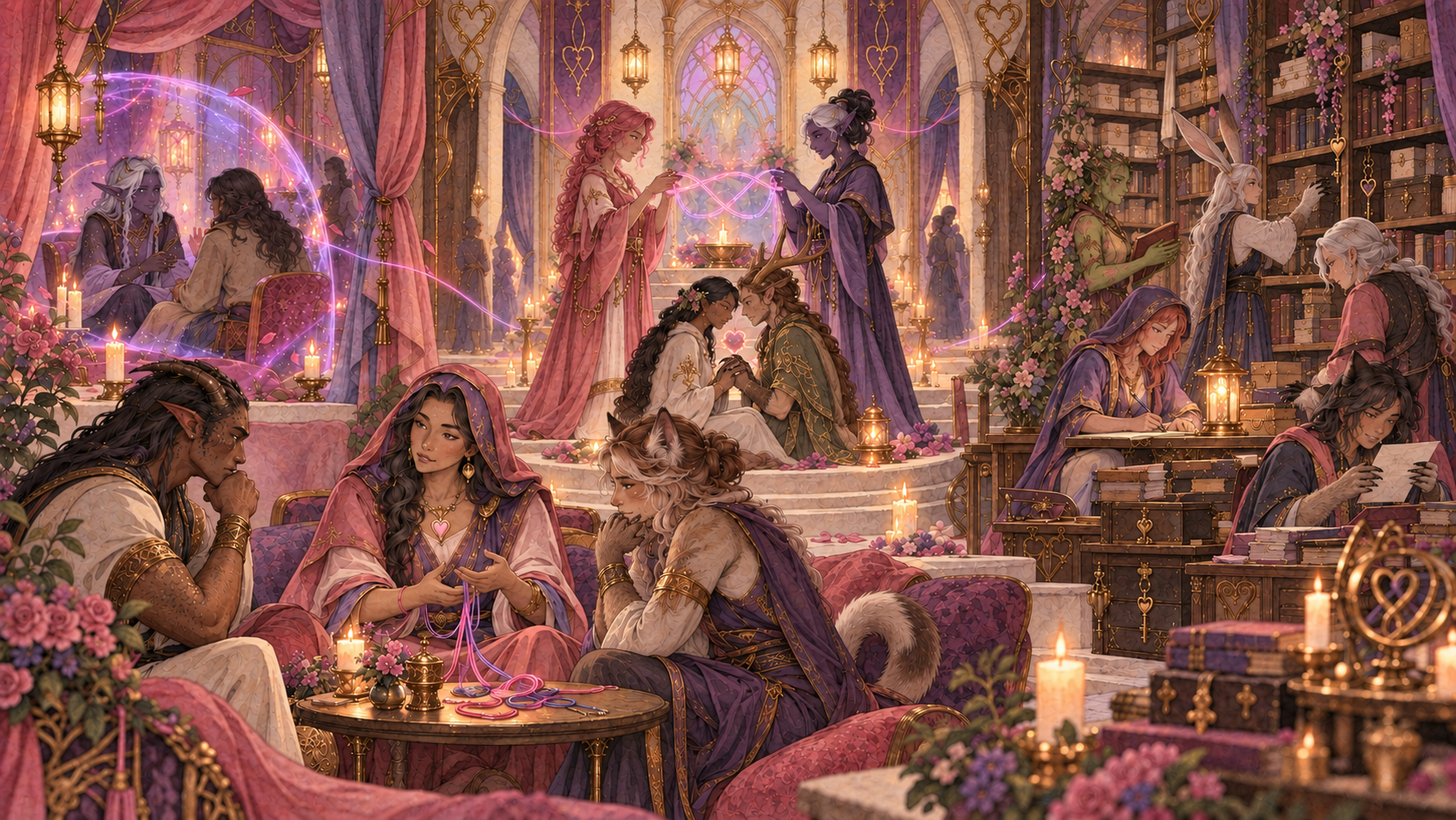
Heartstring Keepers form the broadest body of Zenthira’s clergy. They counsel people attempting to understand uncommon desires, mediate difficult conversations between partners and help worshippers decide whether, when and how they wish to disclose something intimate.
They are trained to distinguish three very different needs:
I want to understand this.
I want to tell someone.
I want to explore this with someone.
One does not automatically lead to the next. Heartstring Keepers are particularly valued by couples who discover differences in desire without wishing those differences to become resentment.
Their traditional teaching is: “To know is not to owe.”
Second Voices
Second Voices specialize in private confession and confidential counsel. Their chambers are designed so conversations cannot be overheard. Many receive magical training specifically related to privacy, memory protection and resistance to unwanted divination.
A Second Voice does not promise agreement. They promise attention. They are also trained to say when they themselves are not the correct person to receive a particular disclosure. Zenthiran ethics protect the listener as well as the speaker.
No one is required to hear intimate detail merely because another person wishes to confess it.
Bond-Sisters & Twin-Priests
These old titles survive from the earliest Bond-Twin traditions. Despite the historical name, Bond-Sister is not restricted by gender. These clergy specialize in relationships built upon exceptional mutual knowledge: marriages, lifelong partnerships, adventuring bonds, intimate friendships and other connections in which two or more people deliberately choose to know one another deeply.
Twin-Priests officiate paired rites, mirrored meditations and ceremonies involving shared secrets or mutual vows. Some serve permanently in pairs. Others rotate partners specifically to prevent the title from being mistaken for a single prescribed relationship model.
Echo-Maidens
Echo-Maidens preserve Zenthira’s literature, poetry, journals and anonymous testimonies concerning uncommon desire. The title is historical and likewise not restricted by gender. Their libraries contain descriptions of private experiences that would otherwise disappear because no one considered them common enough to record. They are especially interested in the sentence: “I thought I was the only one.” An Echo-Maiden’s work ensures that, generations later, someone else may discover that they were not.
Houses of the Whispered Heart
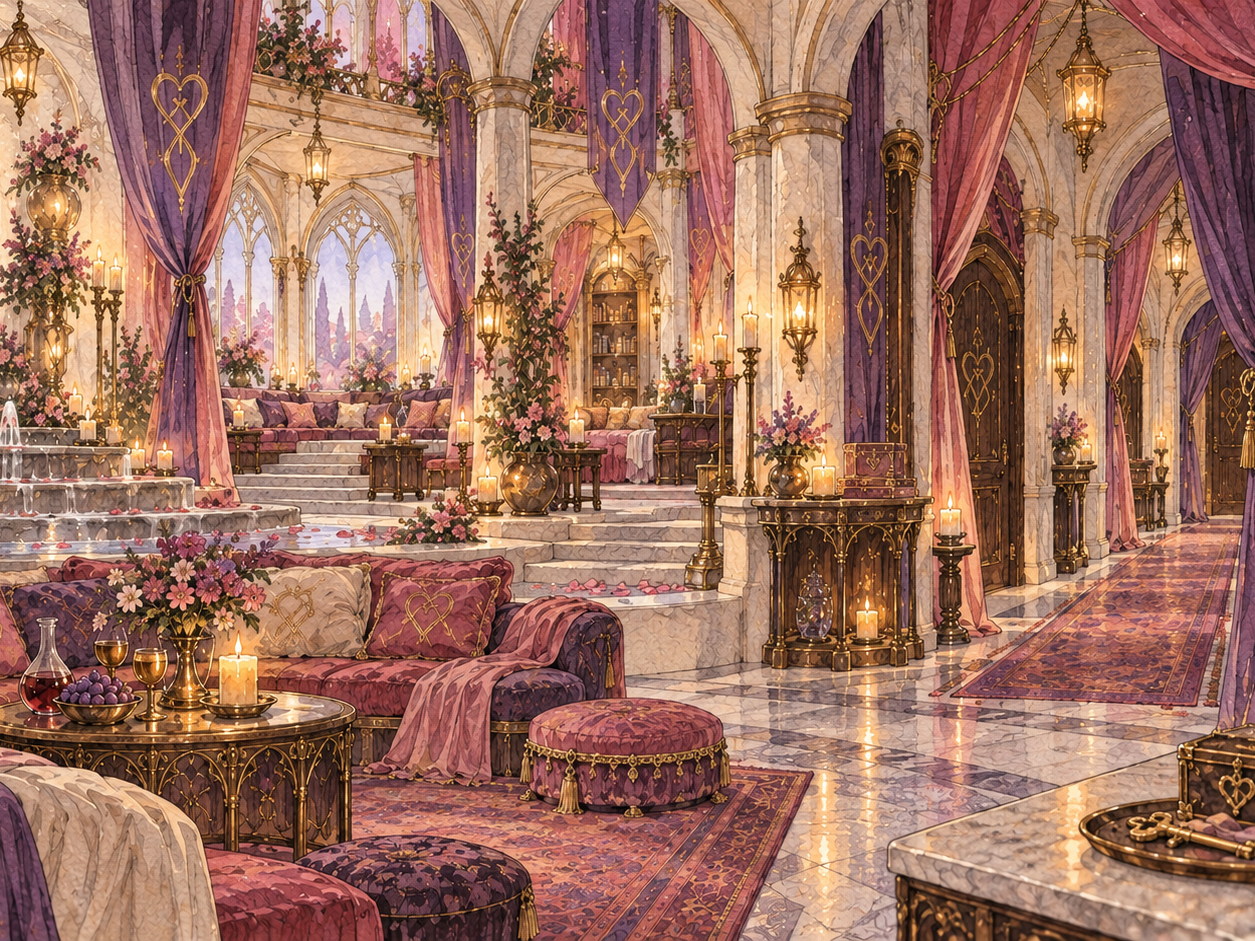
Zenthiran temples are commonly called Houses of the Whispered Heart, with regional names including Twin Houses, Rose-and-Violet Houses and Sanctuaries of the Second Voice. Their architecture is deliberately divided between social and private space. Public salons are warm, comfortable and conversational. People drink wine, exchange stories, listen to music and meet others without any expectation of disclosure. Beyond them lie smaller chambers. Curtains thicken. Acoustics soften. Doors can be locked from inside.
Paired chairs face one another rather than an altar. Writing desks contain sealing wax and blank paper. Mirrors may be covered. Many temples maintain extensive sealed archives whose records are identified by symbol rather than name. A House of the Whispered Heart should feel neither furtive nor ashamed. It should feel like a place where privacy has been deliberately designed into the architecture.
Rites, Sacred Boundaries & Divine Signs
The First Whisper
A devotee sits before two candles and speaks one private desire either to themselves or to a chosen listener. No discussion is required afterward.
The listener may simply answer: “I heard you.”
This is considered sufficient. The rite teaches that acknowledgement can exist without immediate interpretation.
The Echoed Answer
Two adults who have reached their Age of Bloom sit opposite one another. One offers a private disclosure. The other chooses one of three traditional responses:
“I share this.”
“I understand this, but it is not mine.”
“I cannot receive this.”
All three answers are ritually valid. The ceremony exists specifically to teach that trust does not require matching desire.
The Shared Thread
Two willing participants connect their wrists loosely with rose-and-violet silk. They breathe quietly until a comfortable rhythm develops between them. Each then names one thing they willingly share and one thing that remains individually theirs. The thread is loose enough for either person to remove without assistance. The rite preserves the oldest Zenthiran imagery of heartstrings and synchronization while reinforcing that connection never requires erasure of self.
The Rite of Twin Shadows
Two participants perform mirrored movements before paired lamps until their shadows overlap. Eventually one participant deliberately breaks the pattern. The other does not follow. The rite teaches both harmony and difference. Knowing someone closely does not require becoming them.
The Whispered Kiss
The Whispered Kiss is one of Zenthira’s oldest intimate rites. Two consenting adults privately exchange a confession before any physical gesture occurs. Either person may decide the confession itself was enough. If both wish to continue, they seal the moment with a kiss, joined hands, exchanged keys or another mutually chosen gesture. The physical act is not the sacred center. The sacred center is the trust required to speak first.
The Closed Journal
A worshipper places a private journal upon Zenthira’s altar and deliberately does not open it. The book remains there for several minutes before being taken home. The rite exists as a corrective to the idea that spirituality demands disclosure. Sometimes the sacred affirmation is: This belongs only to me.
The Great Confidence
Zenthira’s faith maintains several absolute boundaries around private revelation. A confidence may not be exposed merely because another person is curious. A confession does not create permission to participate in the desire described. A listener may decline to receive intimate information. A secret may not be used as leverage. A person’s previous participation does not decide their present answer.
No intimate rite involving another person is sacred unless all participants have reached their Age of Bloom, possess capacity and freely choose participation. Zenthiran clergy summarize the doctrine with two teachings: Confession is not invitation. Knowing what someone wants does not make it yours to give or take. These principles align closely with the Velvet Accord’s broader rule that erotic participation must remain consensual, opt-in and protected by agency.
Signs of Zenthira
Zenthira’s presence frequently manifests through pairing. A single candle produces two flames, one rose and one violet. Two people speaking privately realize their heartbeats have synchronized. A reflection briefly shows a second expression upon the viewer’s face. A sealed letter becomes warm when held by the person for whom it was intended. Two objects carried by people who share a confidence may emit faint matching light when brought together.
Words whispered into one side of a room may become audible only to one chosen listener. The rarest sign is known as the Perfect Echo. A person speaks something they have never told anyone. For one heartbeat, another voice answers softly: “You are not the only one.” The voice never reveals who else shares the experience. Zenthira protects their privacy too.
Zenthira and the Velvet Court
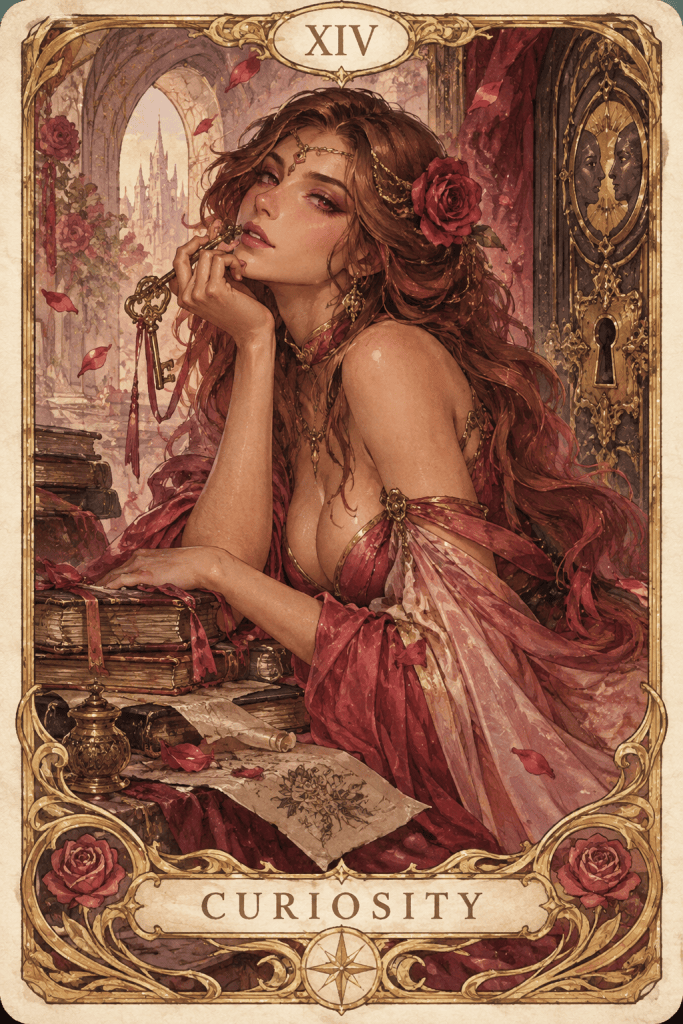
Within the Velvet Court, Zenthira embodies Uncommon Desire, Private Truth and Chosen Disclosure. Where Velyssara gives desire permission to exist, Zenthira addresses the moment desire becomes personal enough to feel difficult to share. Velyssara says that wanting belongs to life. Zenthira asks who is trusted with the details. Velzhara is her clearest complement. Velzhara sanctifies chosen visibility. Zenthira sanctifies selective visibility. Velzhara asks whether one wishes to be seen; Zenthira reminds mortals that being seen by one chosen person may matter more than being admired by a thousand.
Delavira understands privacy through distance and observation. Zenthira approaches it through access. Delavira may watch without touching. Zenthira asks who has been invited close enough to know. Solynth shares her concern with vulnerable revelation. His devotees may disclose softness they have kept private; Zenthira concerns herself less with the form that revelation takes than with the trust created when someone receives it well. Cyrillith often provides the language through which difficult desires become expressible. Performance, masks, role and fantasy can allow someone to explore a private desire before deciding whether it belongs anywhere outside imagination. Eshthara encounters the Unspoken in dreams, where desires may appear before waking language has organized them.
Across all of these relationships, Zenthira remains distinct. She is not revelation itself. She is the choice of who receives it.
Miracles & Divine Presence
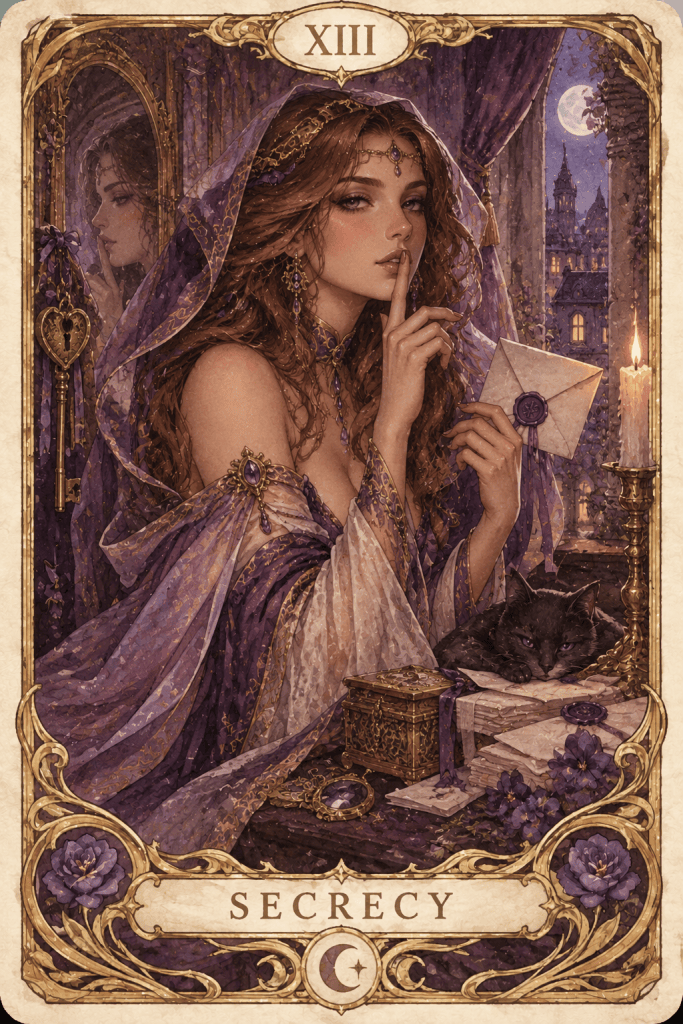
Zenthira’s miracles protect or deepen chosen confidence. A sealed letter becomes unreadable to everyone except its intended recipient. A private conversation cannot be overheard despite occurring in a crowded room. Two worshippers who independently ask Zenthira to help them find someone who shares a particular desire receive matching symbols in dreams and arrive at the same temple on the same evening. Neither is identified until both voluntarily enter the meeting chamber.
A devotional journal displays ordinary blank pages to anyone opening it without permission. A person struggling to articulate something may discover the exact words written in violet condensation across a mirror. The writing disappears before anyone else enters. A couple carrying paired keys may feel both grow warm when each independently decides they are ready for a difficult conversation. Stronger miracles involve synchronization.
Two people separated by great distance may dream the same conversation. A pair of trusted companions may briefly understand one another’s emotional state without gaining access to thoughts or memories. Two performers may improvise an entire scene with impossible precision, each knowing instinctively what the other is offering while still choosing every response. When Zenthira manifests directly, the room becomes strangely intimate regardless of its size.
Rose and violet light gather in different corners. Zentha may appear first. Zira answers from somewhere nobody was looking. One whispers. The other smiles because she already knew. Witnesses frequently report the sensation that the sisters share an entire private conversation in the space between two glances. No one else hears it.
What Their Faith Teaches
Rare Does Not Mean Wrong
Zenthira teaches that rarity has no moral authority. A desire experienced by one person in ten thousand remains that person’s desire. It need not be justified by becoming more common. Likewise, popularity does not automatically make a desire wise. Frequency describes how often something occurs.
It does not decide whether adults may choose it.
Privacy Is Not Shame
A person may keep something private while feeling completely at peace with it. Zenthiran theology strongly resists confusing secrecy with self-rejection. A couple may keep a ritual entirely to themselves because sharing it would make something intimate feel less intimate. A worshipper may never tell anyone about a fantasy because they do not need anyone else to know. A person may simply enjoy possessing an interior life. None of those choices require healing.
Confession Is a Gift
When someone shares a vulnerable truth, they have changed who possesses access to that truth. Zenthirans therefore treat confession as something offered rather than extracted. A good listener receives it carefully. They do not immediately interrogate. They do not make the revelation about themselves. They do not assume future access merely because one confidence was given. Trust is cumulative. It is not ownership.
Listening Does Not Create Obligation
The recipient of a confession retains complete agency. They may share the desire. They may understand it but not share it. They may decide they are not comfortable continuing the conversation.
They may need time. Zenthira does not require enthusiastic acceptance of every desire encountered. She requires respect for the person who possesses it and equal respect for the autonomy of whoever has been invited to hear it.
Relationship Form Does
Not Determine Morality
Zenthiran faith reflects the broader Erosian understanding that the structure of an adult relationship does not determine whether it is ethical.
Two people. Several people. Unusual roles. Familial connection. Highly specific erotic practices. Unexpected combinations of identity, anatomy or social position. None become wrong by category alone. The moral questions remain adulthood through the Age of Bloom, capacity, freely given consent and the continuing ability of every participant to choose.
Fantasy Is Allowed to Remain Fantasy
An imagined experience does not become less meaningful because it never occurs physically. Zenthira’s clergy often help worshippers separate three questions:
Do I enjoy imagining this?
Do I want to discuss this with someone?
Do I actually want to do this?
The answers may be yes, yes and no. That is coherent.
Not Every Secret Belongs to the World
Zenthira rejects the idea that authenticity requires complete public transparency. People contain rooms. Some are open. Some have invited guests. Some remain private. A person does not become dishonest merely because everyone else lacks a key.
At the Table
Zenthira works best in campaigns concerned with secrets, intimacy, unusual desire, private identities, trust, confidential information and the emotional risk of telling another person something they may not expect. Her stories do not require erotic content. A wizard may have developed a spell they fear colleagues will misunderstand. A warrior may secretly love poetry.
A noble may maintain a relationship whose structure is unusual but entirely consensual. An adventurer may discover a strange personal desire and wonder whether anyone else shares it. A party member may simply entrust another character with information they refuse to tell the rest of the group. All can become Zenthiran stories. Her strongest adventures ask: Who knows? Who has been trusted? Who has permission to tell someone else? What happens when private knowledge changes a relationship?
Zenthiran Characters
Clerics, bards, rogues, warlocks, diplomats, counselors, investigators, courtiers, spies, archivists and performers fit naturally within her faith. A Zenthiran character need not personally possess unusual erotic interests. They may simply value privacy, keep confidences well or understand what it means to carry part of themselves selectively.
A particularly Zenthiran adventurer might become the person everyone in the party eventually tells things to. The challenge is learning that being trusted with secrets does not mean solving them. Sometimes the correct response is simply keeping them.
Mechanical Direction
Zenthira’s mechanics should emphasize voluntary bonds, private communication, selective information, mirrored action and protection against unwanted intrusion. A baseline 5e feature might allow two willing creatures to establish a temporary connection that improves communication, permits a limited private message or supports coordinated action. Veiled mechanics could allow the bond to interact lightly with Desire effects.
Unveiled mechanics could develop deeper synchronization or shared emotional resonance without ever treating physical response as permission. No mechanic should automatically expose another creature’s private desire.
No class ability should make confession compulsory merely because Zenthira is invoked.
The baseline rule must function independently of Desire mechanics, following the current Base 5e → Veiled → Unveiled standard.
(Needs updated mechanics: Base 5e → Veiled → Unveiled.)

Sacred Relics
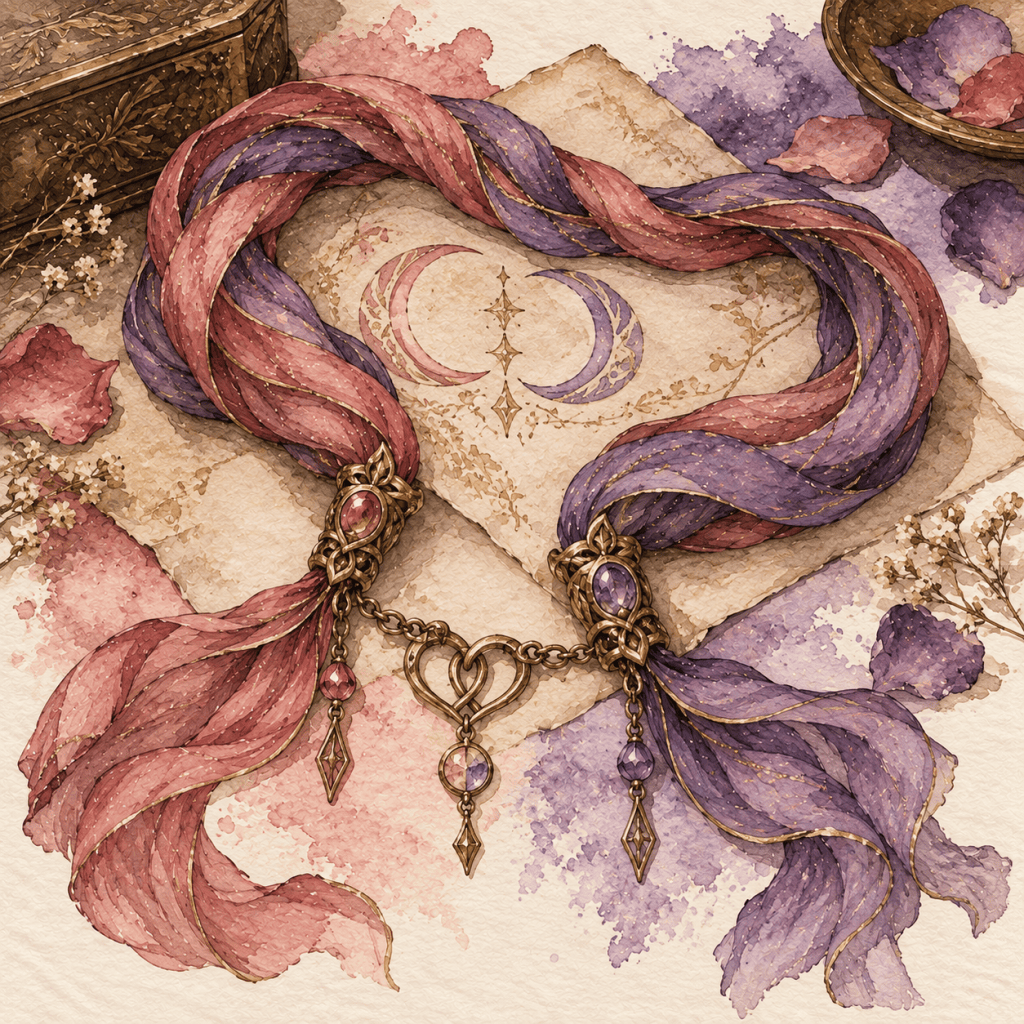
Thread of the Twin Heart
Wondrous item, rare; final attunement requirement to be determined
The Thread of the Twin Heart is a length of intertwined rose-and-violet silk that never tangles. Two willing creatures may each hold one end during a vow, difficult conversation or shared ritual. Ancient accounts claim the thread warms when both participants genuinely intend to communicate honestly. It provides no indication of what either person thinks. It reveals only that both are willingly present within the connection.
(Needs updated mechanics: Base 5e → Veiled → Unveiled.)

Mirror-Silk Veil
Wondrous item, uncommon; final attunement requirement to be determined
This fine veil appears rose from one side and violet from the other. Reflections reverse the colors.
Stories claim that while wearing it, the bearer may choose which aspects of their appearance or identity become obvious to casual observers and which remain visually unremarkable. The veil does not make the wearer someone else. It helps them decide what receives attention.
(Needs updated mechanics: Base 5e → Veiled → Unveiled.)

Heartstring Circlet
Wondrous item, very rare; final attunement requirement to be determined
Two gemstones, one rose and one violet, rest at the temples and are connected by a nearly invisible silver thread. The circlet is traditionally worn during difficult confession. Legends claim that when two willing people each wear one of a matched pair, words spoken privately between them cannot be overheard through ordinary means. The relic does not reveal concealed thoughts.
Zenthiran priests would consider such an ability a profound misunderstanding of the object.
(Needs updated mechanics: Base 5e → Veiled → Unveiled.)
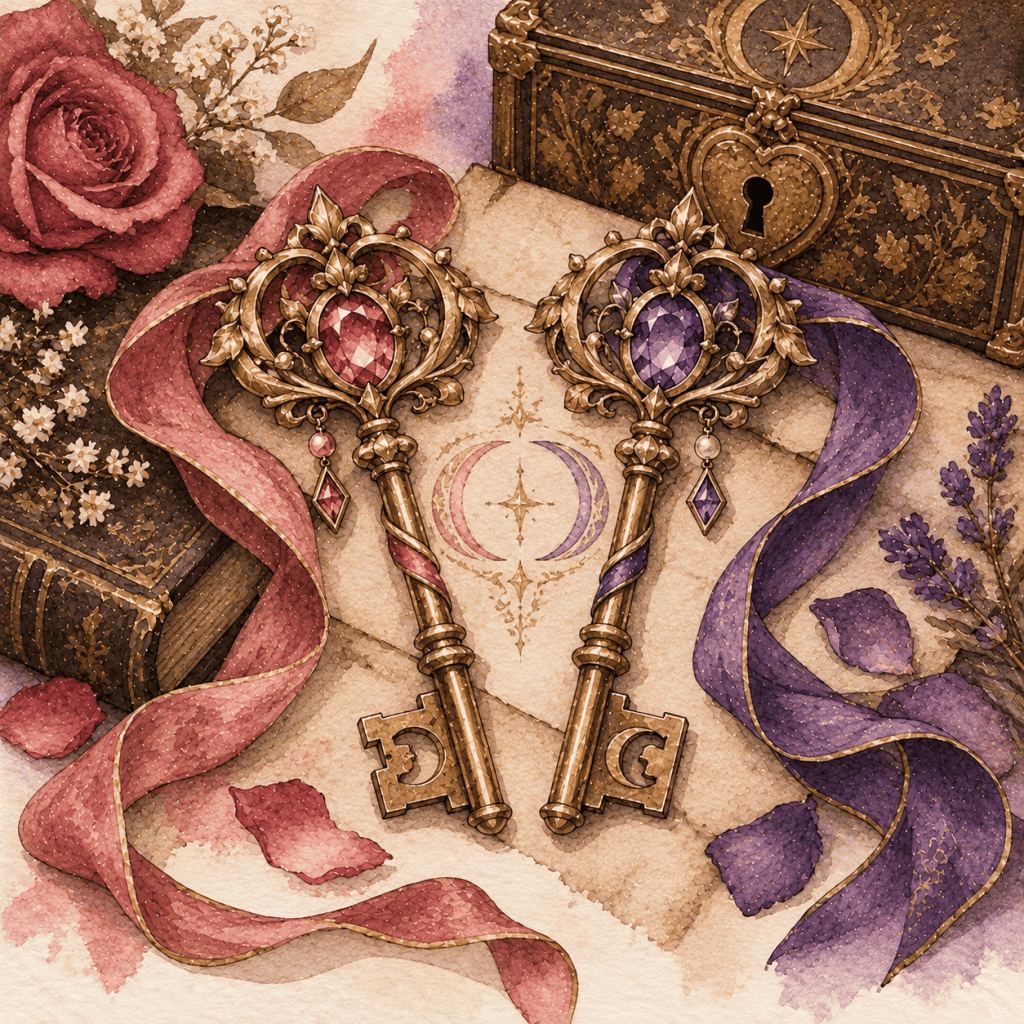
The Paired Keys
Wondrous items, rarity to be determined
Two antique-gold keys are made as a set. One bears a rose gem. The other bears violet. Neither opens anything alone. When both bearers independently choose to use their key, they may open a particular paired reliquary, chamber or magical archive. If either does not wish access granted, the lock remains perfectly ordinary. Many temples use mundane copies during relationship ceremonies.
The theology is obvious. Access exists only when both keys turn.
(Needs updated mechanics: Base 5e → Veiled → Unveiled.)

Adventure Hooks
The Confessions Have Been Stolen
Hundreds of sealed devotional letters disappear from a House of the Whispered Heart. Days later, private details begin circulating among nobles, adventurers and merchants. Some revelations are embarrassing. Others are politically dangerous. The Heartstring Keepers hire the characters to recover the archive under one unusual condition: They must solve the crime while learning as little as possible about what was actually written.
The Perfect Echo
A respected temple develops a magical rite capable of introducing worshippers who independently report matching uncommon desires. The service becomes enormously popular. Then participants begin meeting people whose compatibility seems impossibly exact. Zenthiran clergy fear someone has stopped matching existing desire and begun subtly altering it. The resulting relationships may be happy. That does not answer whether the magic was acceptable.
The Second Twin
One morning every sacred depiction of Zenthira contains only Zentha. Zira has vanished from paintings, statues, manuscripts and memory. A handful of Echo-Maidens still remember her because they were inside a magically sealed archive when the change occurred. Then a chestnut-haired woman wearing violet walks into the temple and asks why nobody recognizes her.
The Journal That Asked to Be Read
An ancient Zenthiran journal has remained sealed for centuries. It suddenly opens itself in the presence of one adventurer. The character never requested access. The priests are deeply unsettled. Is the journal’s long-dead author somehow granting permission? Is the relic malfunctioning? Or is something inside attempting to impersonate the author in order to gain a reader?
The Secret Everyone Knows
A prominent couple maintains what they believe is a completely private relationship ritual. Gradually they discover that nearly everyone in their social circle knows. Nobody has mocked them. Nobody has exposed them publicly. Nobody will admit who first told. The couple hires the adventurers not because the information is dangerous but because someone violated their confidence, and they want to know who.
One Half of the Letter
Two adventurers discover separate halves of an old love letter in distant ruins. Neither fragment makes sense alone. Placed together, the text describes a location erased from every known map and a private promise made by two members of an expedition presumed dead generations ago. Finding the site may reveal not only what happened to them, but why they wanted the truth to remain known only to one another.
Scents for Gameplay
Zenthira’s presence should feel intimate rather than ominous. Her fragrances evoke letters kept against the body, quiet rooms, familiar perfume, polished lockets and flowers discovered in drawers rather than displayed in gardens.
| d12 | Scent | Suggested Moment |
|---|---|---|
| 1 | Crushed violet petals and warm sealing wax | Zenthira’s attention is near. |
| 2 | Rose oil and old parchment | A private truth is being put into words. |
| 3 | Black cherry, silk and faint incense | An intimate confidence is about to be shared. |
| 4 | Amethyst dust and polished silver | A Zenthiran relic or paired object is nearby. |
| 5 | Cedar drawers and dried rose petals | A long-kept memory or relationship is resurfacing. |
| 6 | Violet perfume lingering inside a closed journal | Something remains deliberately private. |
| 7 | Warm wax, plum wine and clean linen | A House of the Whispered Heart is close. |
| 8 | Rosewater and skin-warmed metal | Two people have exchanged a meaningful private token. |
| 9 | Chestnut wood after rain | A difficult confession has been received gently. |
| 10 | Vanilla, dark fruit and folded paper | A private fantasy or affectionate secret is being acknowledged. |
| 11 | Rose and violet incense burning together | A powerful shared rite or divine resonance is occurring. |
| 12 | A fragrance the character associates with the first person they ever trusted with something deeply private | Zenthira’s presence has become intensely personal. |
Using Scent as Foreshadowing
Zenthiran fragrances should establish confidence rather than danger. If violet and sealing wax repeatedly appear when information is being intentionally protected, players may learn that something nearby is private rather than sinister. If rosewater appears immediately before honest disclosure, the scent itself can eventually make a scene feel intimate before anyone speaks. When the twins are very near, two distinct fragrances may coexist without blending.
Rose. Violet. Both unmistakable. Both occupying the same air. Like two people who know the same secret and have never once mistaken that knowledge for ownership.
 Whispers of Erosia
You must be logged in to post a comment.