
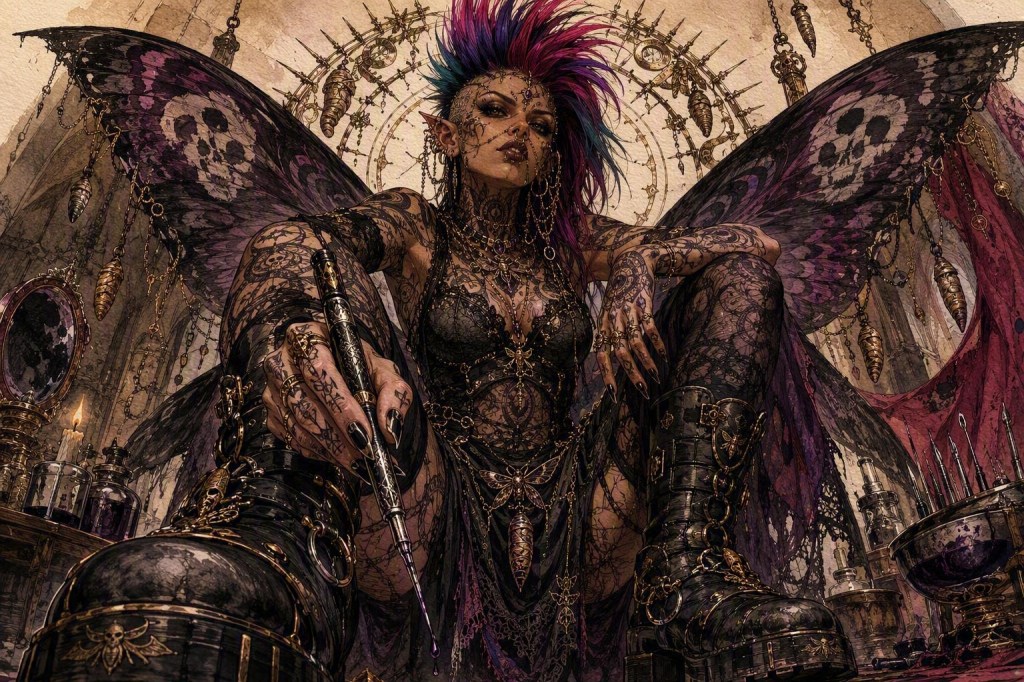
Threxia
She Who Marks • The Author of Flesh • Mistress of the Living Script
Goddess of Body Modification, Self-Authorship and Transformative Desire
Marking • Transformation • Becoming
Body modification, tattoos, piercings, scar art, consensual branding, body shaping, cosmetic alchemy, metamorphic flesh, erotic transformation, chosen pain, bodily reclamation and identity made visible.
“Your flesh remembers what shaped it. What it becomes next is yours to write.”
Threxia is the goddess of the body deliberately changed: the first line of ink placed beneath skin, the ring chosen because ordinary jewelry did not feel intimate enough, the old scar given a meaning its wound never possessed and the impossible magical transformation undertaken because someone has finally found the shape they wish to inhabit. She governs tattooing, piercing, scar art, cosmetic alchemy, flesh-shaping and metamorphic transformation, but these practices are expressions of something larger.
Threxia governs self-authorship.
Her faithful believe that birth gives mortals bodies, but birth does not necessarily write the final sentence those bodies will ever carry. Age changes them. Labor changes them. Pregnancy, illness, battle, healing, pleasure, magic and accident leave their own traces. Mortals dye hair, cut it, braid it, paint skin, shape clothing around themselves and choose adornments long before anyone calls those acts transformation. Threxia asks what becomes possible when that change is made deliberate.
Tattooists, jewelers, alchemists, healers, sculptors and body-shapers invoke her while practicing their crafts. Adventurers mark victories and companions lost. Lovers exchange designs commemorating relationships that changed them. People reclaim scars others taught them to hide, while others ask Threxian artisans to remove marks whose histories they no longer wish to carry. Those seeking a different physical embodiment often enter her sanctuaries because Threxian clergy are accustomed to hearing the words, “This is how I wish to become,” without first asking the speaker to defend the desire.
Her intimate mysteries explore another dimension of transformation. Some worshippers find tattooed, pierced, scarred or deliberately altered bodies intensely erotic. Others are drawn to the anticipation surrounding a new modification, the vulnerability of trusting another person close enough to change the body, the intimacy of having a lover study or trace every deliberate mark or the exhilaration of seeing a desired transformation revealed for the first time. Still others fantasize about impossible metamorphosis: bodies becoming larger, softer, stronger, stranger, more masculine, more feminine or something for which ordinary language has no useful category.
Threxia does not teach that body modification is inherently erotic. A tattoo may commemorate the dead. A piercing may exist because the wearer thinks it is beautiful. A scar may require no interpretation beyond survival. A magical transformation may answer a need that has nothing to do with sexuality.
The meaning belongs to the person carrying it.
Older traditions call Threxia the Living Needle, the Violet Hand, Mistress of the Second Shape and Sculptor Beneath Skin. The title Author of Flesh has become increasingly common in Second Bloom theology because it reflects a more complete interpretation of her oldest mysteries. The body is not unfinished because it is defective. It is unfinished because a living person has not yet reached the end of their story.
Her faithful preserve three principles above all others. The body belongs first to the person who inhabits it. Change gains meaning through choice. No mark possesses a meaning its bearer does not grant it.
Lore & Mythos
When Flesh First Chose a Line
The oldest surviving Threxian traditions begin after Velyssara had already awakened life and desire. Mortals possessed bodies capable of pleasure, injury, healing, aging and reproduction. They decorated themselves with flowers, pigment, jewelry and woven cloth, but these ornaments could be removed as easily as they had been applied.
One mortal looked into still water and imagined something different. The archives have lost their name, ancestry and homeland. Even their gender changes between traditions. What survives is the question they asked while studying their reflection: “Could I carry something upon myself because I chose it?”
The question did not mean Could I become better? Threxian theologians emphasize that distinction. The mortal did not condemn the reflection before them. They simply imagined another possibility and realized that imagination might be permitted to become physical.
With the help of a trusted companion, the mortal prepared a dark violet pigment and made a small permanent mark. Some traditions describe a single curved line beside the heart. Others depict a spiral at the wrist. A few insist the First Mark was not a tattoo at all but a tiny ring placed through the ear so that ornament and body became joined through intention.
The act changed almost nothing. The mortal remained recognizably themselves, with the same memories, voice and history. Yet when they returned to the water, the reflection contained something that had come from neither parentage nor accident.
It contained choice made visible.
The dark pigment moved within the reflection although the actual mark remained still. Violet light gathered beneath the water. A woman appeared behind the mortal, her skin pale beneath the moon and her long dark hair threaded with violet. Black patterns moved slowly across her body as though thought itself had learned to become ink.
The mortal asked whether the mark pleased her. Threxia answered that the question belonged to the wrong person. She asked whether it pleased the one who now carried it, then waited until they answered.
Only then did the goddess smile. Threxian theologians call this event the First Authorship. The faith does not teach that Threxia created bodily change. Bodies had always changed. She revealed that mortals could sometimes become participants in that process rather than witnesses to it.
The First Scar Given a Name
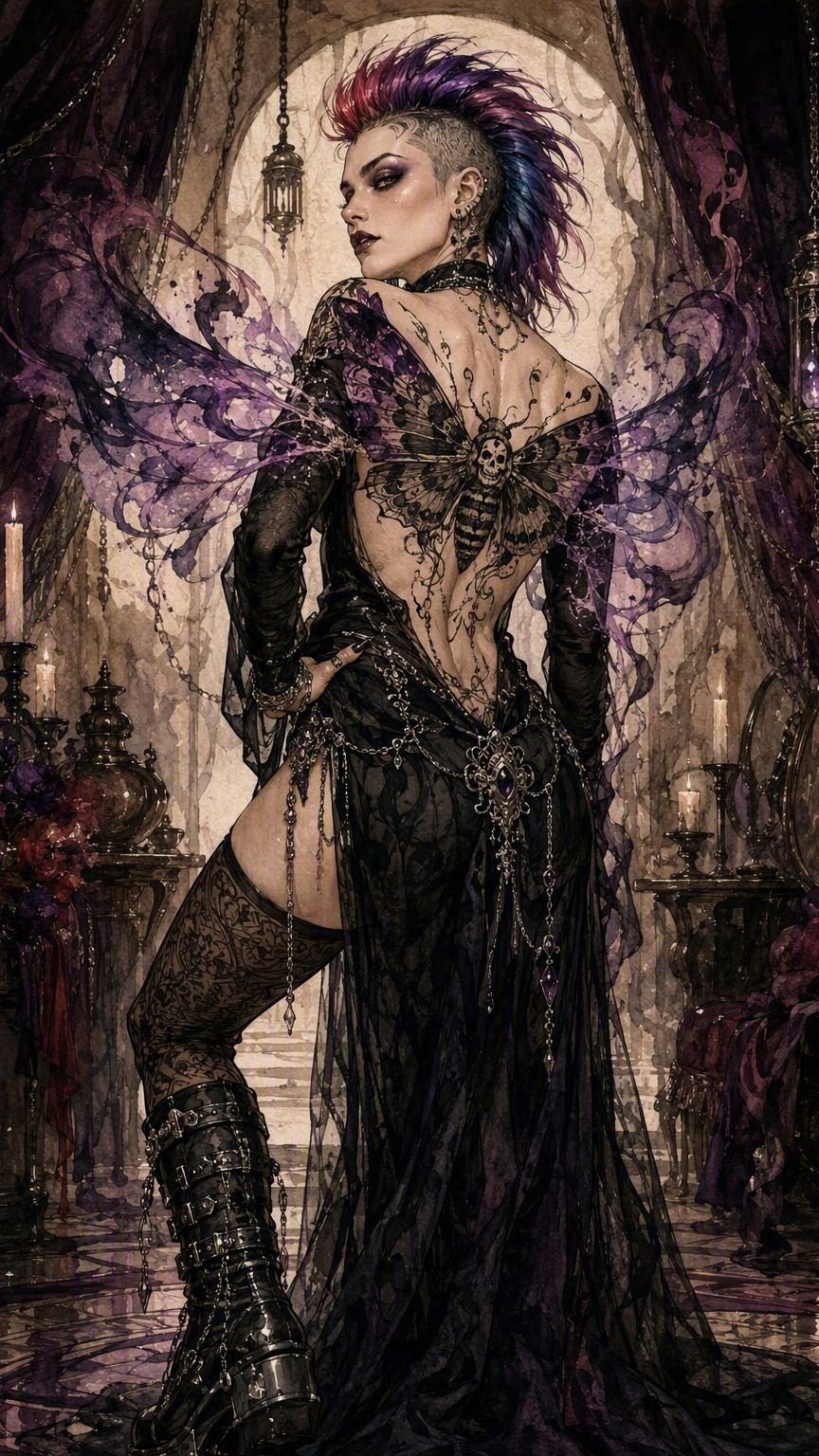
Another foundational story concerns an unwanted mark. A warrior survived a battle that killed nearly everyone beside her. A blade opened her from shoulder to ribs, and although healers saved her life, the wound left a thick scar crossing the body she remembered from before the battle. Every mirror returned her to the place where the injury had been made. People attempted kindness. Some told her the scar proved her strength. Others called it beautiful. A few insisted she should feel proud whenever she saw it. None of these statements helped because everyone seemed determined to tell her what the scar meant.
Years later, the warrior entered a Threxian sanctuary and met an Ink-Mother. The priest asked whether she wished the scar removed through magic. The warrior said no. The Ink-Mother asked whether she wished it concealed beneath pigment. Again the warrior said no. At last, the priest asked what she wanted. The warrior answered, “I want it to stop belonging to the battlefield.” For several evenings, the Ink-Mother painted temporary designs around the scar. Some were geometric. Others resembled branches, flowers, swords or rivers. None were made permanent. Each morning, the warrior decided what she disliked, what she wanted changed and what should disappear entirely.
Eventually, she selected a design of dark branches threaded with violet gold. The original scar remained visible at its center. When the work had healed, Threxia appeared in the warrior’s mirror. The goddess did not touch the scar upon the warrior’s body. She touched its reflection and asked what it meant. The warrior looked at the design for a long time before answering. “It means whatever I say it means now.”
The story became one of Threxia’s most important teachings concerning reclamation. Her faithful do not insist that scars must become beautiful, empowering or spiritually significant. A person may honor a scar, hate it, hide it, remove it, decorate it or leave it entirely alone. The sacred principle is not discovering the proper interpretation. It is recovering the authority to interpret.
The Mark That Would Not Stay
A harsher tradition tells of a king who became fascinated with Threxia’s growing temples. His soldiers returned from war carrying devotional tattoos commemorating comrades and victories, while members of several Markwright orders displayed elaborate symbols of fellowship upon their bodies. The king noticed the loyalty surrounding those marks and drew the wrong conclusion. He ordered every soldier in his personal guard branded with a copy of Threxia’s holy symbol. He reasoned that if sacred marks accompanied devotion, the mark itself might manufacture devotion.
The first brand disappeared before the implement was lifted. The second became liquid black ink that moved across the soldier’s skin, flowed down the arm and gathered upon the king’s hand. The third appeared not upon the intended bearer but across the palace wall, enormous and luminous. The king summoned Threxian priests and accused them of sorcery. The eldest Ink-Mother replied that no priest had interfered. The king had simply attempted to invoke a goddess of chosen transformation through an act that denied choice.
The king demanded that Threxia herself explain the insult. That night, every mirror in the palace darkened. When he approached his reflection, violet letters appeared across the glass. The words told him that he might command a hand, a soldier or a kingdom, but he could not command what a mark meant to the person forced to carry it. By sunrise, every imposed symbol had vanished. Later versions disagree about the king’s fate. Some claim his guards abandoned him. Others say he eventually became a patron of Threxian artisans after years spent learning the difference between allegiance and ownership. One severe temple tradition claims his portraits continued changing after death until his face disappeared beneath every mark he had attempted to place upon another.
The endings differ because the warning does not. A mark imposed may become punishment, humiliation, identification or violence. Drawing Threxia’s symbol upon it does not make the act sacred.
The Seven Mirrors
A later mystery tells of a celebrated alchemist who came to Threxia seeking the perfect body. The alchemist changed his nose and found that the new nose made his jaw seem wrong. He reshaped the jaw and became dissatisfied with his shoulders. Broader shoulders made the chest seem too narrow, while a taller body made the legs seem too short. Each successful transformation revealed another alteration that appeared necessary. He became famous for his beauty. He also became increasingly unable to look at himself without finding another flaw.
At last, the alchemist entered Threxia’s sanctuary and demanded perfection. The goddess led him into a circular chamber containing seven mirrors. Each reflected a body he had previously inhabited. The first showed the young man who had never altered himself. The others showed successive transformations until the seventh reflected the form he carried that day. The alchemist expected to feel disgust when confronted by his earlier bodies. Instead, memory returned with them.
He remembered a smile he had loved before changing his mouth. He remembered how strong an earlier pair of hands had felt while learning his craft. He remembered the lover who had once slept against a chest he later decided was inadequate. He remembered a scar he had removed because it disrupted an otherwise perfect line, then realized he could no longer remember exactly how the scar had looked.
Threxia asked which body had been false. The alchemist could not answer because each had once been sincerely his. She then asked a different question: “How will you know when you have arrived?” The archives do not record his answer. Some traditions claim he never transformed again. Others insist he changed his body dozens of additional times and became one of the greatest Flesh-Shapers in history. Both traditions consider themselves faithful to the story. The lesson is not that repeated transformation becomes vanity. It is that self-authorship can become another prison when the author is forbidden to believe any sentence may be finished.
The Desire She Embodies
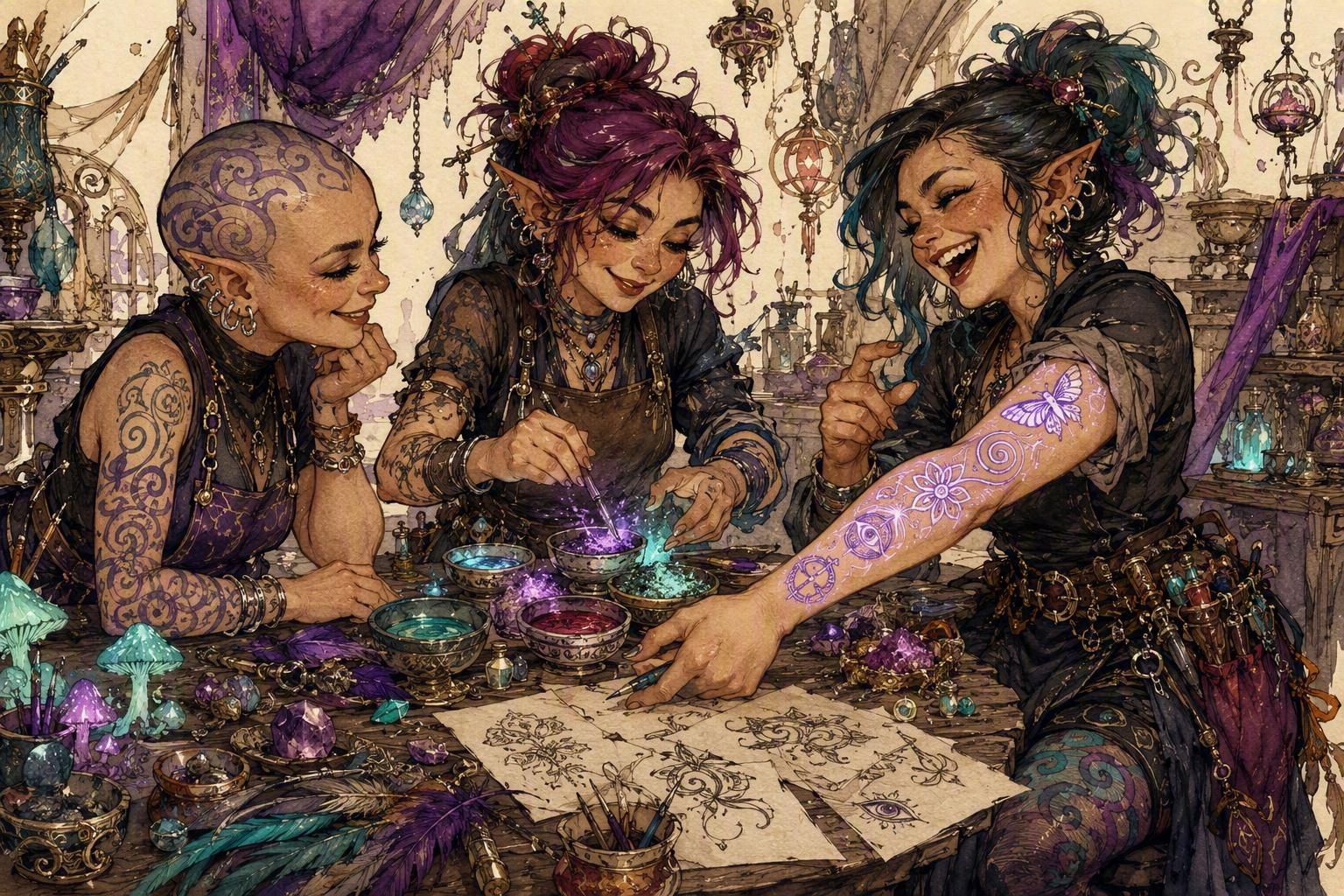
Threxia embodies the desire to become physically legible to oneself. Her sacred current begins whenever someone recognizes that embodiment need not be entirely passive. The change may be subtle. A hidden tattoo can carry greater personal significance than a spectacular magical transformation. A new ring may alter nothing about a person’s abilities yet change the way they experience their own reflection. A different body may transform how someone moves through the world without altering the memories, relationships or ambitions that made them recognizable in the first place.
Threxia does not rank these changes by scale. A transformation matters because it matters to the person undergoing it.
The Living Manuscript
Older Threxian scripture frequently calls the body a canvas. The metaphor remains common among artists and appears throughout temple murals. Many contemporary theologians prefer another image: the Living Manuscript.
A blank canvas possesses no history before the artist approaches it. A body does. Ancestry has already written upon it. Growth, age, climate, labor, hormones, nourishment, injury, healing, pregnancy, pleasure, disease, habit and magic may all add lines of their own. Even a person who has never deliberately modified their body does not inhabit something blank.
Self-authorship therefore does not mean beginning from nothing. Threxia offers no promise that mortals may erase every influence that shaped them. She offers the right to continue writing.
The Living Manuscript may contain passages its bearer loves, passages they barely notice and passages they would remove if given the chance. Some can be revised. Others cannot. Some can be concealed, decorated or reframed. Still others acquire meanings that change repeatedly across a lifetime.
This is why Threxian counselors rarely begin by asking whether someone should change. They ask what the person wants changed, why that change matters and what they hope becomes possible afterward.
The answer does not need to be profound. “I think it would look beautiful” is enough.
Tattooing & the Written Flesh
Tattooing remains Threxia’s most recognizable devotional art because it turns image into embodiment. A tattoo may commemorate a person, journey, oath, triumph, grief, relationship or spiritual revelation. It may contain a private joke meaningful to three friends and nobody else. It may exist because its bearer saw the design and wanted it upon their skin. Threxian theology does not require permanence to justify itself through solemnity.
Devotional tattooing often becomes more elaborate. Adventuring companies may share a symbol after surviving a campaign together. Parents incorporate images associated with children or chosen family. A grieving devotee may add another element to a memorial tattoo each year. Lovers may carry paired designs that make sense independently and reveal another pattern when placed together.
Some marks are magical. A Threxian tattoo may change color while its bearer casts a spell, brighten beneath moonlight or accumulate new details when specific promises are fulfilled. One design may bloom when the bearer enters a place they once feared. Another may close like an eye during sleep. Legendary marks have continued developing for decades, adding lines as though the design itself were keeping a record.
Such tattoos are called Living Scripts.
Their magic does not freeze their meaning. A memorial design may begin in grief and become a symbol of gratitude years later. A devotional mark may outlast the faith that inspired it. A lover’s symbol may survive the relationship and acquire another meaning entirely. The ink can remain permanent while interpretation continues to live.
Piercing & Incorporated Adornment
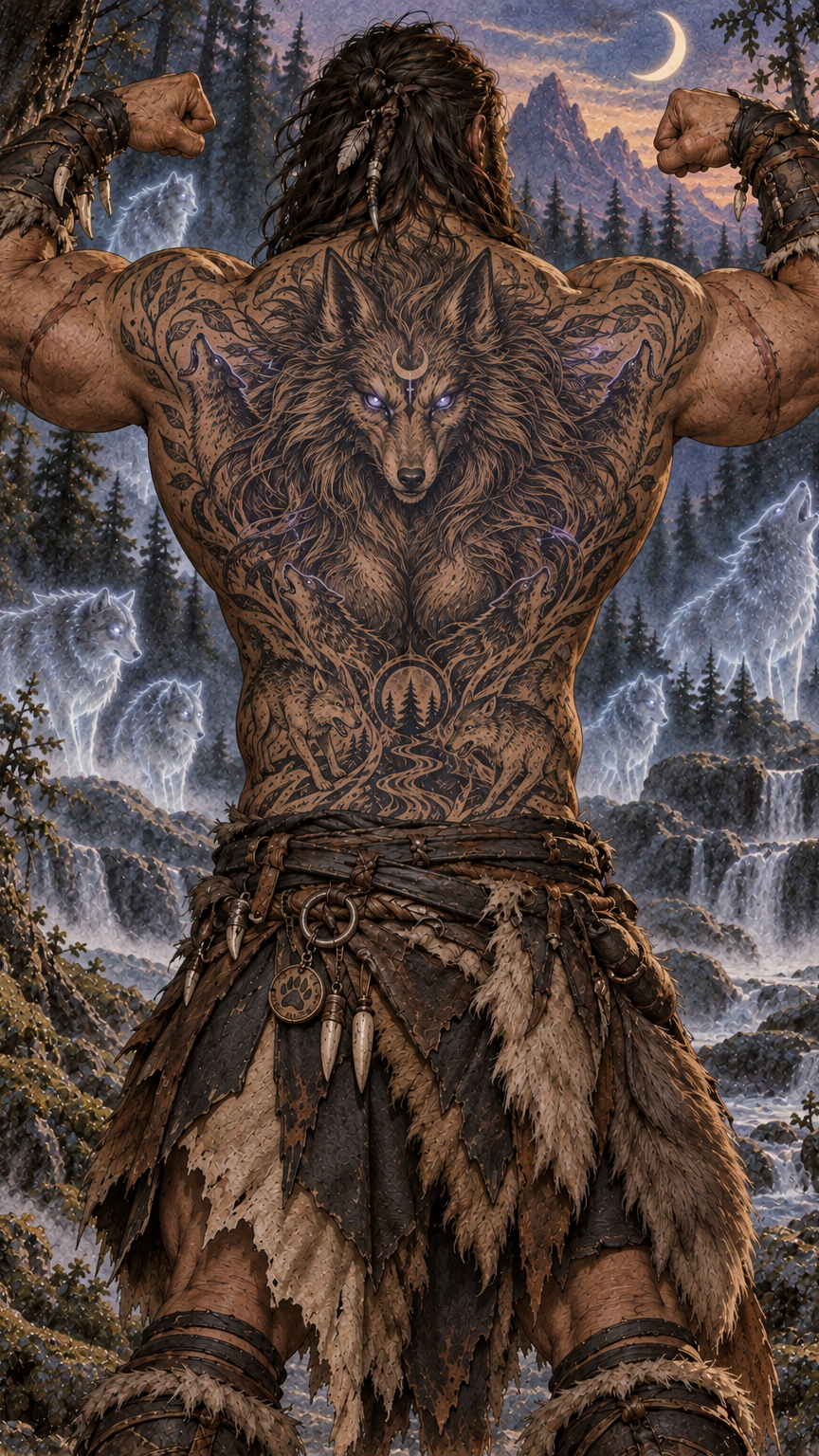
Piercing occupies another important place within Threxian worship because it crosses the boundary between wearing decoration and allowing decoration to become physically incorporated into the body.
A necklace rests upon the skin. A ring placed through flesh requires the body to change enough to receive it. Threxian theologians find the distinction endlessly fascinating.
Ear, brow, nose, lip, tongue and navel piercings appear throughout the faith. More intimate placements belong primarily to private and adult devotional traditions. Jewelry ranges from simple rings and studs to elaborate arrangements of linked metal, gems and chainwork designed to transform the body into sacred geometry.
Some devotees alter established piercings gradually over years. They value the patience of the process as much as the finished appearance, allowing the body to adapt rather than forcing an immediate result.
Piercings can also mark religious office. A newly recognized Markwright may receive a violet-gemmed ring from their teacher. A pilgrim may add a small gold hoop after visiting each major Threxian sanctuary. Lovers sometimes exchange paired ornaments, though the faith strongly rejects assuming that matching jewelry indicates ownership or availability.
The metal may be visible to everyone. Its meaning remains private until the wearer chooses otherwise.
Scar Art, Branding & the Chosen Threshold
Scar art and consensual branding belong to some of Threxia’s oldest and most serious traditions.
The archives describe ritual scarification, carving and branding as permanent forms of transformation. Contemporary temples preserve those traditions unevenly. Some communities continue them under highly trained practitioners, while others have replaced them with tattooing, enchanted pigment or symbolic rites that carry similar theological meaning without reproducing the older physical practice.
No orthodox Threxian school teaches that a more painful modification is therefore more sacred. The theology concerns permanence, vulnerability and deliberate consequence. One devotee may choose healed scar tissue as the artwork itself. Another may incorporate an old injury into a larger design. A third may use magic to soften or remove a scar because they no longer want the history written so visibly.
Consensual branding remains rarer and more culturally specific. Where it survives, it is treated as a serious rite rather than casual ornament, and communities maintaining the practice place unusual emphasis upon craft, preparation, healing and aftercare.
Pain may accompany these transformations, but pain is not the offering Threxia demands. This distinction separates her from Nyzun.
Nyzun asks what sensation communicates and where an individual’s Edge lies. Threxia asks what change has made approaching that sensation meaningful. A difficult threshold can matter because the person knows they will emerge from it altered, but a painless magical transformation is no less sacred merely because nothing hurt.
Threxia does not require suffering as payment for beauty.
Shaping, Cosmetic Alchemy & Embodiment
Threxia’s domain extends far beyond the surface of the skin. Cosmetic alchemy can alter hair, complexion, nails, eyes and other visible traits. Enchanted preparations may subtly change musculature, body composition or secondary characteristics. Skilled Flesh-Shapers use more powerful magic to alter voice, facial structure, proportions, sensory experience and other aspects of embodiment ordinary artisans cannot safely reach.
Some changes are temporary.
A performer may assume an altered body for a single season. A diplomat may change their voice while serving abroad. A worshipper exploring an unfamiliar physical presentation may inhabit that shape for several weeks before deciding whether they want anything similar made permanent.
Other transformations become lasting.
A warrior may add decorative ridges along the forearms. A Nacrean may reshape the pattern of their pearlescent sheen. A Beastkin may change the coloration of fur or the shape of ceremonial horn growth where anatomy permits. Someone may seek a narrower jaw, broader hips, different musculature, a deeper voice or features unlike those their body first developed.
Threxia does not restrict shaping to conventional ideals of beauty.
She delights in deliberate strangeness.
Some devotees request luminous freckles, ornamental scales, unusual eyes, ritual horns or other transformations chosen precisely because they do not make the bearer easier to categorize. The question is not whether everyone else finds the result attractive.
The question is whether the person who asked for it recognizes themselves more clearly afterward.
Gender and the Shape of the Self
Threxia holds an important place among Erosians whose physical embodiment does not presently reflect the person they understand themselves to be. She is not the sole deity associated with gender. Cyrillith governs identity through role, performance and expression. Solynth sanctifies softness, feminine presentation, androgyny and the discovery of possibilities that rigid social roles may conceal. Mirellune’s mysteries of duality and the Second Skin explore chosen embodiment through structure.
Threxia’s concern is where identity becomes physical. A person may experiment with clothing and discover that presentation provides everything they wanted. Another may seek a new voice, facial structure, distribution of body hair, breasts, musculature, sexual characteristics or another physical configuration. A third may desire a body that does not fit neatly into masculine or feminine categories at all.
Some transform once and regard the matter as settled. Others shift repeatedly throughout life. Threxia does not insist that uncertainty must lead to bodily change, nor does she demand that someone remain uncertain simply because transformation carries consequence. Her clergy are trained to recognize that exploration can end in transformation, in temporary experimentation or in a renewed affection for the body already present.
The sacred question is not, “What should you become?”
It is, “What form allows you to inhabit yourself more willingly?”
Marked Desire and Erotic Transformation
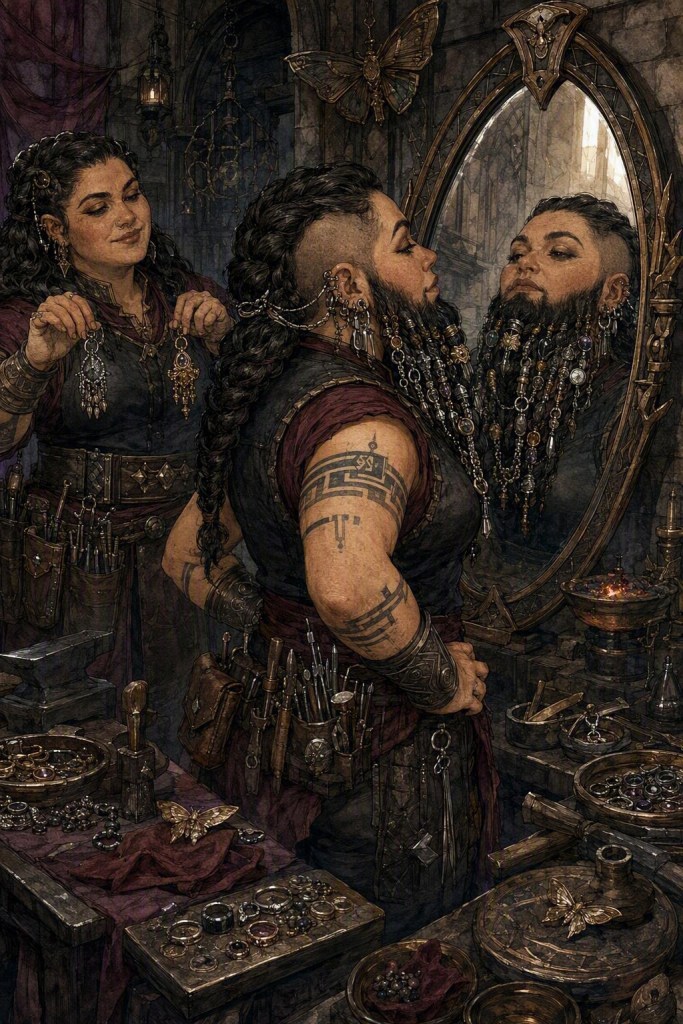
Threxia’s intimate mysteries begin with a simple truth: some people find deliberately modified bodies intensely desirable. The reasons vary. A worshipper may be drawn to the contrast of black ink against pale skin, bright pigment against dark skin or metallic jewelry catching light against the body. Another may enjoy the tactile difference between smooth skin and the raised texture of an old scar. Someone else may be fascinated by the density of a full tattoo suit, where nearly every visible inch of the body has become part of a single evolving work.
For some, the mark itself carries erotic power because it represents intention. A tattoo reveals that the wearer made a choice and carried it into permanence. A piercing turns ornament into something the body has learned to accommodate. A scar design records a threshold crossed deliberately. None of these meanings must be sexual, but those who eroticize body modification often find the knowledge of choice as compelling as the appearance.
Others are drawn to the process of becoming. Preparation creates anticipation. Designs are discussed. Jewelry is selected. A person decides what will change and what will remain untouched. Allowing a trusted artisan to study the body closely enough to alter it can carry its own intimacy, particularly when that trust exists between lovers. The reveal afterward can become a private rite.
A partner may trace healed tattoo lines with a fingertip, follow the arrangement of jewelry, kiss around a new mark after it has safely healed or simply spend time looking at a body they know their lover deliberately chose to change. Threxian intimate traditions place unusual emphasis upon attention. The erotic charge often lies not in treating the modified body as an object, but in noticing every decision its bearer made.
Transformation fantasy carries the principle further. A participant may imagine becoming taller, heavier, softer, more muscular, more voluptuous, more masculine, more feminine, dual-sexed, horned, scaled, furred or otherwise impossible. A lover may take the role of witness, guide, artist or magical catalyst while the transformation unfolds in shared fantasy.
The imagined change does not create an obligation to pursue it physically. A person may eroticize irreversible transformation while preferring their ordinary body remain unchanged. Another may fantasize about dramatic metamorphosis yet choose only a small tattoo in waking life. Threxia recognizes both experiences. Fantasy allows a possible body to be inhabited without claiming the physical one.
Revision, Removal and the Right to Remain
Permanence holds enormous symbolic weight in Threxian worship, but permanence does not make revision sacrilegious. A mark intended for life says something important at the moment it is chosen. It does not require the person carrying it to remain identical forever. A tattoo may cease to represent someone accurately. A piercing may be retired. A scar treatment may remove something once deliberately preserved. A transformation once experienced as liberating may later feel limiting. A mark associated with a former lover, order or faith may be covered rather than destroyed.
Threxian teachers compare these changes to editing the Living Manuscript. Removing a sentence does not mean it was never written. Some temples preserve sketches of covered tattoos, molds of altered body forms, retired jewelry and written descriptions of earlier appearances. These records are kept only when their former bearer wants them preserved. They are not evidence of failure but testimony that a person may sincerely inhabit one form and later choose another.
The same theology protects those who want no modification at all. An unmodified body is not an unused canvas. No one owes Threxia tattoos because tattooing can be sacred. No one owes her piercings because incorporation can be beautiful. No one owes magical alteration simply because transformation is possible. A person may enter a Gallery of Becoming, study every possibility offered there and decide that the body they already inhabit is the one they want.
Threxian clergy regard that conclusion as fully compatible with their goddess. Self-authorship includes the right to leave a passage unchanged.
Holy Symbol & Iconography
The Needle and the Living Seal
Threxia’s canonical holy symbol is an elaborate circular emblem centered upon a deep violet field of living ink. A long ritual needle or marking stylus crosses the circle diagonally, while blackened metal, antique gold and faceted violet stones form an ornate framework around it.
Within the central field, luminous symbols float beneath the violet surface as though the ink possesses impossible depth. Some resemble magical script. Others suggest scars, constellations, geometric diagrams or symbols that nearly become recognizable before changing again.
The needle represents deliberate intervention. Bodies change without permission throughout life, but the needle symbolizes the moment someone chooses to participate in what comes next.
The living violet field represents identity that can remain continuous while its expression changes. The ink moves because permanence and stillness are not the same thing.
The outer circle represents bodily sovereignty. A Threxian instrument crosses that boundary only because the person within the circle has invited the act.
The blackened metal represents consequence. Transformation should not be treated as imaginary merely because desire inspired it.
The antique gold represents craft, knowledge and the responsibility carried by the hand performing a change. Wanting to create beauty does not excuse carelessness.
The violet stones represent possibility viewed from different angles. The same gem reveals another color as the light moves, just as the same person may reveal another aspect of themselves without becoming fraudulent.
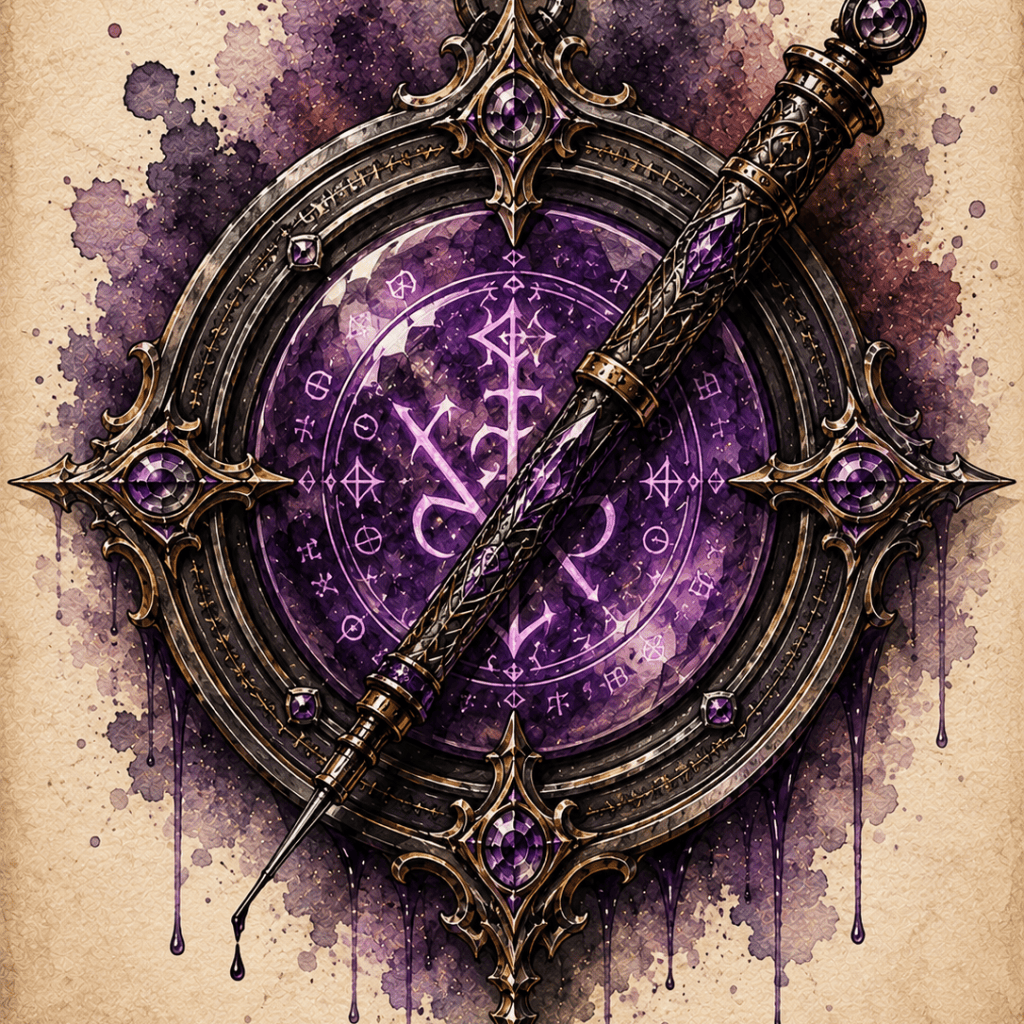
Older archival emblems depict a simpler needle crossing a spiral of ink surrounded by three rings. That form remains common on small devotional jewelry and inexpensive shrine tokens. Contemporary theologians interpret the three rings as the Bearer, Maker and Body: the person choosing the change, the person trusted to perform it and the living flesh that must carry what both decide.
The symbol is sometimes summarized through four statements used during initiation: The body remembers what shaped it. The hand may choose what comes next. The mark may change its meaning. The self remains its own.
Sacred Colors and Materials
Threxian sanctuaries favor black, violet, crimson and antique gold, with cobalt surviving strongly in older alchemical traditions. Black represents ink, possibility and the decisive line. Violet represents transformation, imagination entering flesh and the supernatural motion of Threxia’s living marks. Crimson represents the living body beneath every work. Gold represents mastery of craft and the responsibility required to alter what another person has entrusted.
Cobalt traditionally represents transformation that remains visible even in shadow. Older Flesh-Shaper laboratories frequently use cobalt glass for vessels containing appearance-altering reagents, and some regional Markwrights reserve cobalt pigment for marks associated with major changes of identity.
Common sacred materials include pigment, ink, blackened steel, gold, silver, obsidian, violet glass, polished stone, leather, ceramic pigment bowls, mirrors and precisely maintained ritual tools. Jewelry carries particular significance because metal may become physically incorporated into the body without ceasing to remain ornament.
Nothing used upon another person’s body should appear neglected. A beautiful tool maintained carelessly is considered an insult to both craft and trust.
Needles, Rings, Mirrors and Revision Lines
Needles and marking styluses dominate Threxian visual language. Enlarged versions appear as decorative columns, lintels and altar pieces, with the point representing the transition from possibility into consequence rather than violence. Rings represent openings deliberately created and then adorned. Circular doorways, suspended hoops and concentric mosaics appear throughout Threxian architecture. Some temples require visitors to pass through three circular thresholds before entering the central sanctuary, echoing the Bearer, Maker and Body represented in older versions of the holy symbol.
Mirrors represent the relationship between imagined form and inhabited form. Threxian mirrors are rarely simple. Some are surrounded by removable frames that change with the owner. Others display temporary magical possibilities when touched. A mirror used for Flesh-Shaping may show three or four potential bodies at once without claiming any of them is the correct choice. Revision Lines are among the faith’s most distinctive modern motifs. These thin violet or gold lines resemble a craftsperson’s preparatory marks drawn across a design before alteration begins. In sacred art, Revision Lines may float briefly across skin, clothing, statues or architecture before disappearing. They symbolize the possibility of change before change becomes permanent.
Sacred Creatures
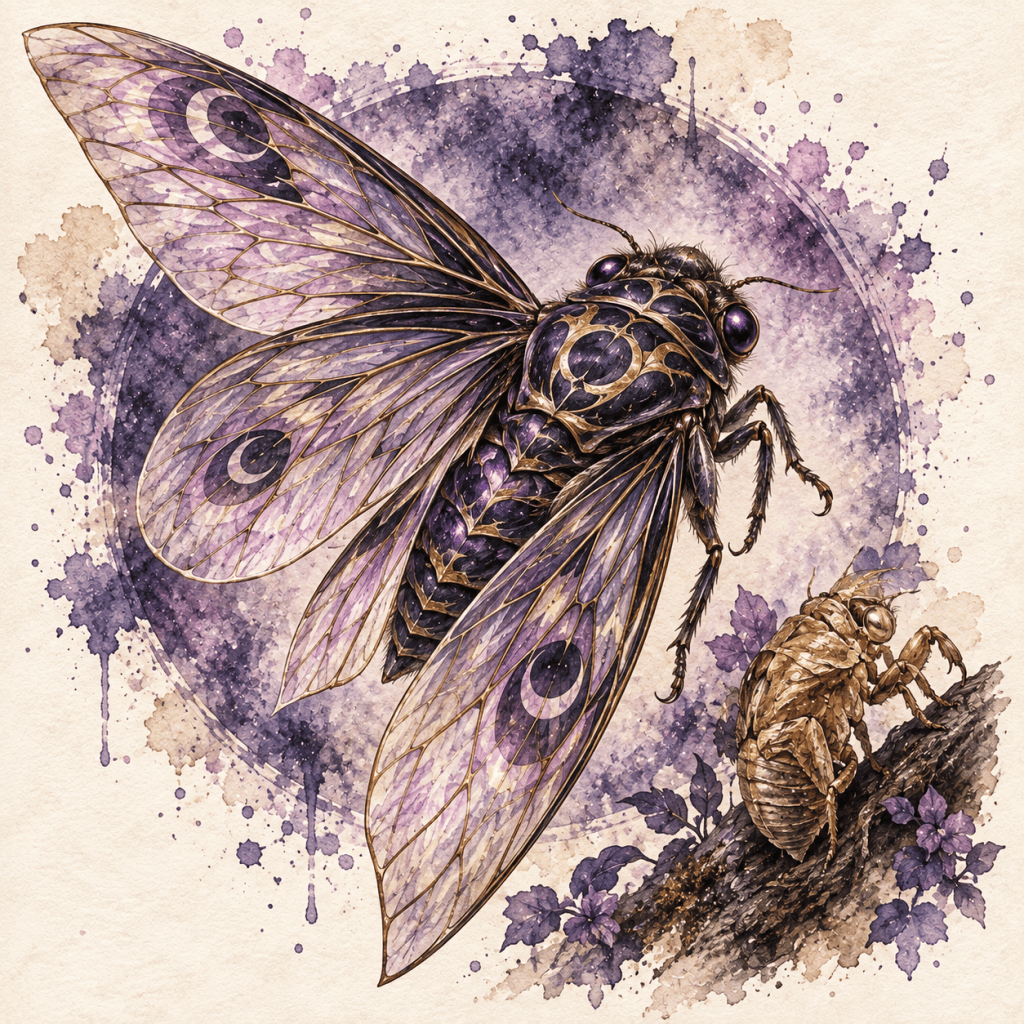
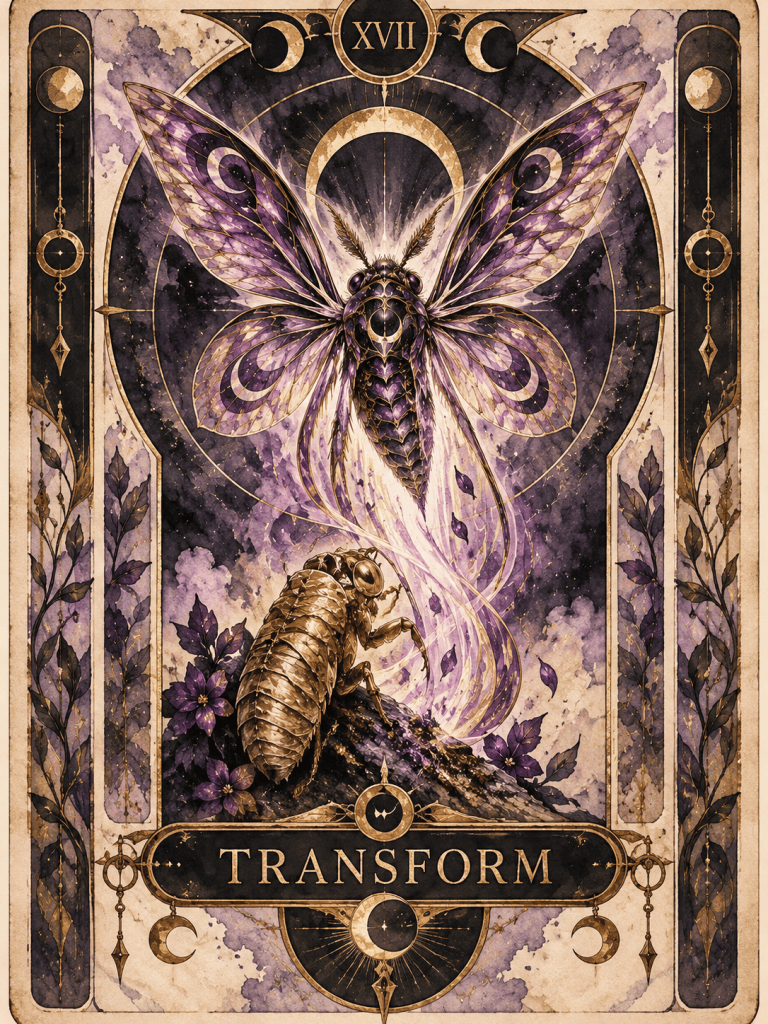
Cicadas are among Threxia’s most familiar sacred creatures because they leave behind a body-shaped shell after emerging into another stage of life. Empty husks are preserved in small reliquaries, not as symbols that an earlier form was false, but as reminders that something may once have fit perfectly and later be outgrown. Jewel beetles represent ornament that appears almost deliberately crafted despite being natural. Their iridescent shells delight Threxian theologians because they complicate the supposed division between natural beauty and designed beauty.
Chameleons appear frequently in Flesh-Shaper imagery. Their changes of coloration represent adaptation and presentation without loss of continuity. Serpents are associated with revision because they shed an old surface without becoming different creatures. Threxian imagery usually emphasizes the abandoned skin as much as the serpent, allowing both former form and living continuation to remain visible in the same composition.
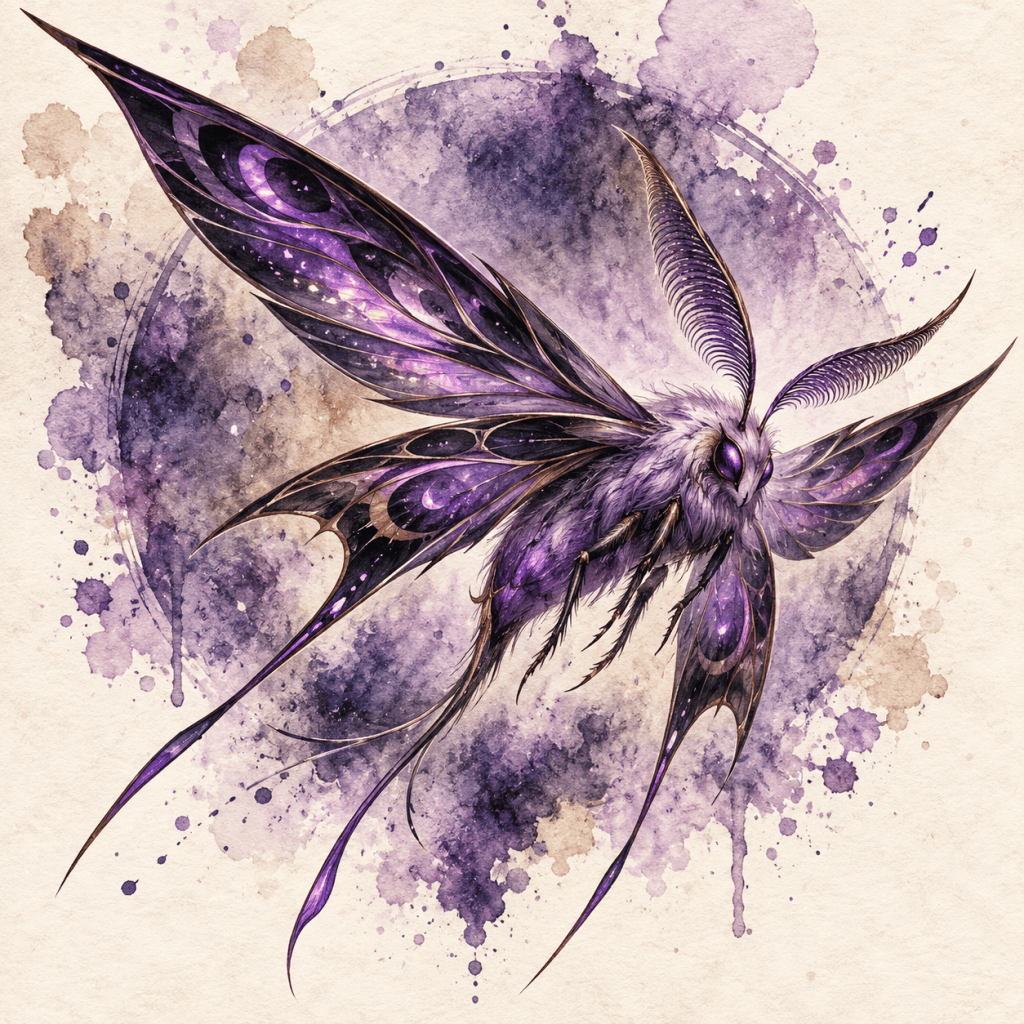
Stories also describe Violet Needlewings, tiny supernatural creatures resembling moths whose narrow wings carry luminous black-violet markings. They are said to gather near people considering a bodily choice that will matter far longer than they currently understand. Their presence is not interpreted as approval. It means the choice deserves attention.
Depictions of Threxia
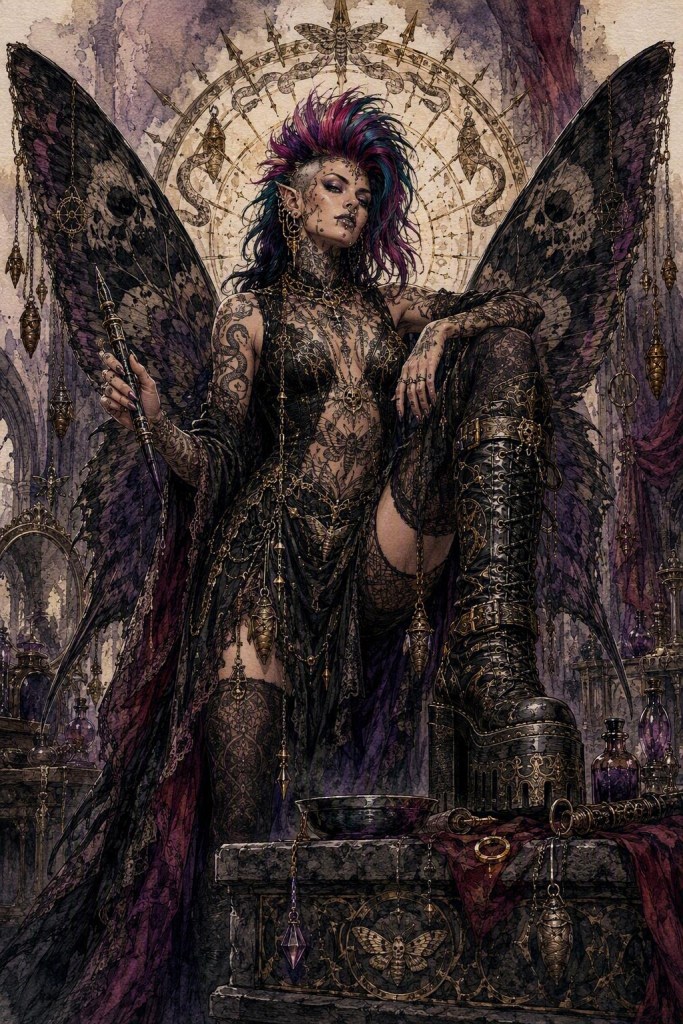
Sacred art portrays Threxia as a mature adult goddess with pale skin, a voluptuous, powerful feminine silhouette and long dark hair streaked with deep violet. Her eyes are intense and focused, usually rendered in violet, wine-red or nearly black tones illuminated from within. Her defining feature is a living full-body tattoo suit.
Dense black, violet and controlled crimson ink covers nearly her entire body in an elaborate continuous composition. The design runs across her throat, shoulders, arms, hands, chest, ribs, abdomen, back, hips, thighs and legs, creating the impression that she wears a second divine skin made entirely from sacred markings. Deliberate areas of pale negative space remain within the design so that the body beneath is never completely lost.
The tattoos do not remain fixed. Geometric lines become flowers, flowers become script and script becomes abstract sigils. A pattern across one shoulder may travel slowly down the arm during a conversation. Symbols along the spine may open like eyes when Threxia performs transformation magic. Portions of the full-body suit sometimes redraw themselves along faint violet Revision Lines, allowing viewers to watch one visual identity become another without the entire design dissolving into chaos.
Her face remains comparatively open so that her expression is readable and recognizable. Small marks may cross the temples, jaw or brow in some depictions, but the face should not disappear beneath the full tattoo suit.
Piercings form her second major visual signature. Blackened gold, silver and violet gemstones ornament her ears, brows, nose, lips, navel and other areas appropriate to the form of the artwork. Sacred depictions may vary the arrangement because Threxia herself does not treat one configuration as permanent.
Her attire blends fantasy goth and punk aesthetics with ceremonial craftsmanship. Black leather, asymmetrical ritual panels, dark silk, studs, small spikes, gold fittings, chains and pigment vessels create an appearance that feels rebellious without becoming modern. Every garment looks personally altered. Seams have been changed, panels replaced, straps repositioned and ornaments added over time.
Nothing about her looks mass-produced. In more intimate sacred art, the living tattoo suit and body jewelry become her primary adornment, allowing the divine markings themselves to define her silhouette. Black-violet sigils may float around her hands, while trails of ink-smoke curl from her fingertips or write brief symbols in the air. Threxia should never look like an ordinary attractive woman who happens to have tattoos.
She should look as though the concept of bodily self-authorship became a goddess and then continued redesigning herself.
The visual truth remains: Choose who you become.
Worship & Daily Devotion
Threxia can be worshipped anywhere someone makes a deliberate decision about how they inhabit or present their body. Dyeing hair can be prayer. Caring for an old tattoo can be prayer. Selecting jewelry can be prayer. Sketching a design one may never make permanent can be prayer, as can deciding against a transformation that seemed appealing yesterday.
Her worship attracts tattooists, jewelers, alchemists, healers, sculptors, bodyworkers, performers, adventurers, rebels and people exploring forms of embodiment they have not yet decided whether to keep. It also attracts those whose bodies were changed by circumstances they did not choose and who are searching for a way to decide what those changes mean now.
The First Line
Many Threxian devotees begin important creative work by drawing a single line. A tattooist may place it upon practice material. A painter adds it to a blank page. A Flesh-Shaper draws it in chalk beside a transformation circle. Someone preparing to change their appearance may trace a temporary line against their own skin while looking into a mirror.
The line need not become part of the finished design. Its purpose is to end the tyranny of the blank surface. Threxian teaching holds that possibility can become paralyzing when every direction remains equally available. The First Line creates something to keep, alter or reject.
Once something exists,
revision becomes possible.
Ink Offerings
Ink Offerings remain among the faith’s simplest devotional practices. A worshipper places several drops of pigment into a shallow bowl at a shrine. The color may correspond to an existing tattoo, a hoped-for transformation or simply the emotional tone of the day.
The pigment is rarely left to dry unused. Temple artists incorporate offerings into illuminated manuscripts, living murals, temporary ritual designs and instructional sketches. An Ink-Mother may mix dozens of small offerings into the background of a large community painting, allowing private intentions to become part of something collectively visible.
Threxian theology considers unused possibility somewhat melancholy. A drop given to the goddess should eventually meet a surface.
The Mirror Question
Many devotees keep a small mirror near the place where they dress or prepare for the day. They do not ask whether they look attractive.
They ask, “What belongs to me today?”
The answer may concern clothing, hair, jewelry, makeup, a visible scar, an exposed tattoo or the decision to conceal something that was visible yesterday. It may concern nothing outward at all. The practice exists to make presentation conscious without turning consciousness into obligation.
Tomorrow’s answer is allowed to differ.
Care of the Work
Body modification does not end when the ritual or procedure ends. Threxian temples place unusual importance upon healing, maintenance and aftercare. A mark that requires care must receive care. Jewelry must be cleaned. Healing tissue must be protected. Magical alterations must be observed until the practitioner knows the body has accepted them safely.
The same discipline governs tools. Pigments are labeled accurately. Instruments are cleaned and inspected. Damaged implements are repaired or retired. Alchemical reagents are dated and stored properly. A sentimental attachment to a dangerous tool does not make using it honorable.
A common Threxian saying holds that anyone can admire finished art. Devotion begins when someone is willing to care for what beauty requires afterward.
Temporary Marks
Temporary body art occupies a respected place in Threxian worship. Some devotees draw a different symbol upon themselves every morning. Others wear intricate pigment designs for festivals, experimentation or courtship. Flesh-Shapers may create temporary magical alterations so a person can inhabit a possible form before deciding whether they want something more permanent.
Threxia does not regard temporary change as lesser transformation. A form does not need to last forever to reveal something true.
Favored Offerings
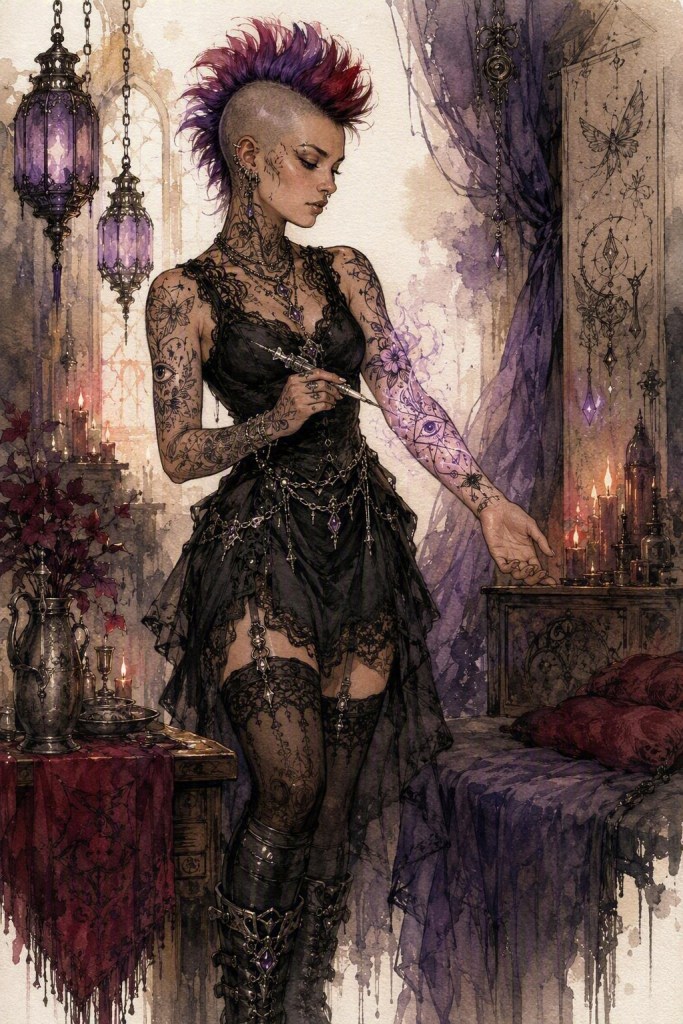
Traditional offerings include pigment, ink, handcrafted jewelry, polished rings, mirrors, cosmetic preparations, violet stones, repaired tools, sketches of unrealized designs and ornaments retired from previous modifications. Healed pieces of temporary ritual art are sometimes copied into temple books before they fade. One of the most respected offerings is a design someone considered carefully and chose not to receive. Such drawings are occasionally placed in temple archives with a short explanation of why the person changed their mind. Threxia honors the decision that stopped the hand as readily as the decision that guided it forward.
Clergy & Temples
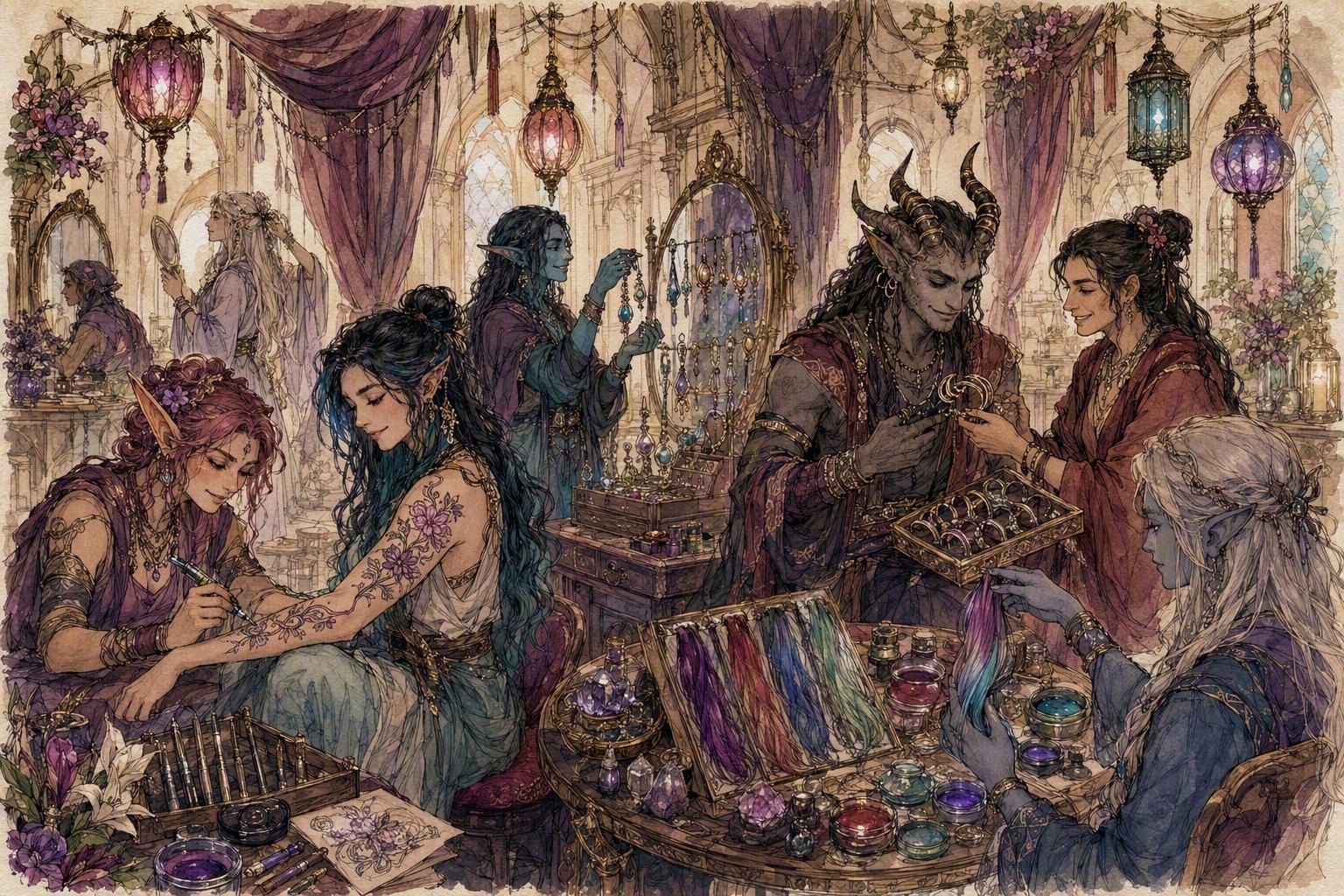
Threxia’s priesthood resembles a network of workshops, studios, galleries, healing chambers and magical laboratories more than a centralized church. Authority depends heavily upon demonstrated craft. A priest may possess great theological knowledge and still defer immediately to another practitioner whose technical expertise better matches the transformation being considered. The archival titles Ink-Mother, Markwright, Flesh-Shaper, Pain-Priest and Sigil Carver all remain in use. Regional traditions overlap considerably, and no universal hierarchy has successfully replaced the older craft-based orders.
Ink-Mothers
Ink-Mothers are senior guides in Threxia’s most established devotional traditions. Their title predates many modern temple structures and survives regardless of the bearer’s gender in several regions. Other traditions reserve the title for women and use Ink-Father, Ink-Parent or simply Elder Markwright elsewhere.
An Ink-Mother’s responsibility extends beyond technical mastery. They are expected to recognize when someone needs an artist and when they need time. They guide initiations, advise worshippers considering major transformations, preserve histories of sacred designs and mediate disputes concerning marks whose meanings have changed.
The most respected Ink-Mothers are not those who have transformed the greatest number of bodies. They are those whose clients still believe years later that they were heard accurately.
Markwrights
Markwrights form the most visible body of Threxia’s clergy. They practice tattooing, piercing, jewelry design, temporary body art and the creation of magical sigils upon the body. Many begin as ordinary artisans before entering religious training, while others learn craft and theology together within temple workshops.
Markwrights are expected to understand design as well as symbolism. A devotional mark should suit the body that carries it. A piercing should belong to the person rather than merely repeat whatever style currently dominates a region. A magical sigil must account for the wearer’s ancestry, existing enchantments and ordinary movement.
Technical excellence is treated as a form of reverence. Good intentions do not excuse poor craft.
Flesh-Shapers
Flesh-Shapers practice Threxia’s most transformative magical arts. They study cosmetic alchemy, controlled metamorphosis, magical prosthetics, changes to voice and physical characteristics, alterations to sensory experience and other forms of bodily revision beyond the reach of ordinary artistry.
Their work frequently overlaps with healing, but the two traditions ask different questions. A healer often asks how the body can be restored. Flesh-Shaper must ask what the person considers restoration to mean.
Someone wounded in battle may want their original appearance returned exactly. Another may wish to preserve the scars. A third may decide that healing presents an opportunity to become different from either the wounded or unwounded body they carried before. Flesh-Shapers are trained not to assume that “before” automatically means “correct.”
Pain-Priests
Pain-Priests oversee transformations where difficult sensation forms part of the anticipated experience. The title leads outsiders to confuse them with Nyzunian practitioners, but their responsibilities differ. A Pain-Priest does not attempt to maximize endurance or elevate suffering into proof of devotion. They help ensure that sensation remains subordinate to the transformation the participant chose.
Many train alongside Nyzunian healers or Keepers of the Measure. They study breathing, posture, stress responses and signs that a participant’s enthusiasm no longer matches what their body is communicating. The title survives because pain remains part of some Threxian traditions, not because pain sits at the center of Threxian theology.
A skilled Pain-Priest knows when a threshold has meaning. A better one knows when it has stopped having meaning.
Sigil Carvers
Sigil Carvers preserve several of the faith’s oldest magical practices. They specialize in complex ritual tattoos, scar designs, permanent magical inscriptions and markings that interact with spells, oaths or other supernatural forces. Their work can transform a body into a functional magical diagram.
Because their creations may outlast ordinary fashion by decades or continue functioning after the original purpose has changed, Sigil Carvers are among the most conservative practitioners regarding consent and documentation. Many insist upon a period of temporary wear before creating a permanent magical mark.
A person should know how a sigil feels in their life before allowing it to become part of that life.
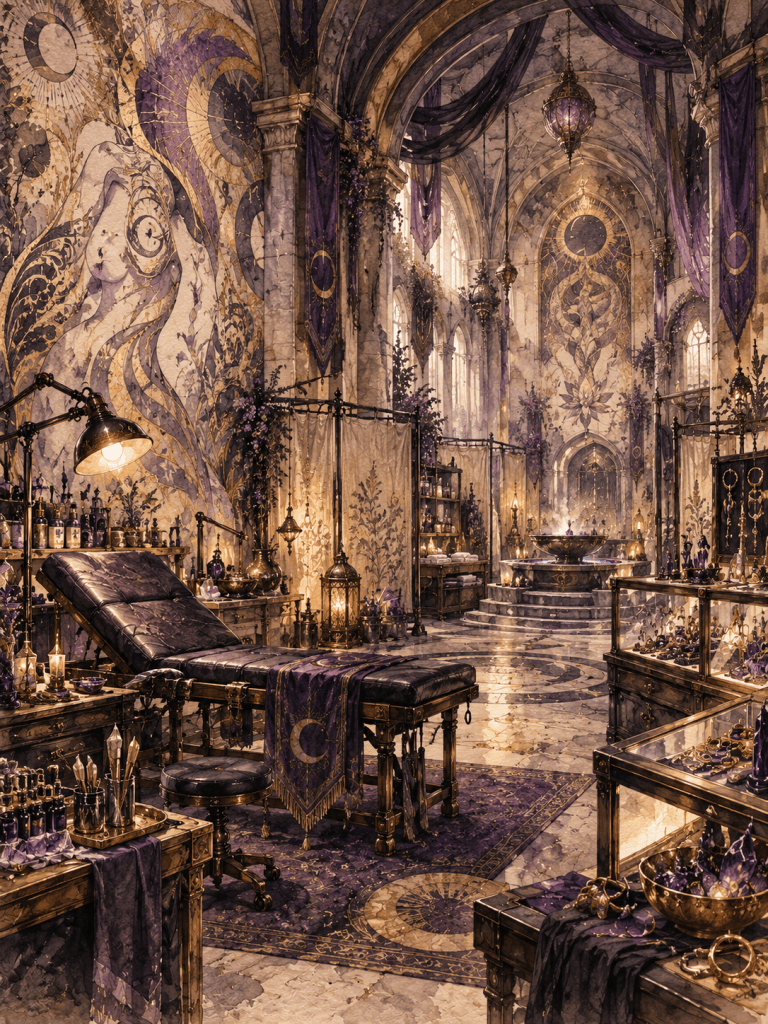
Houses of the Living Script
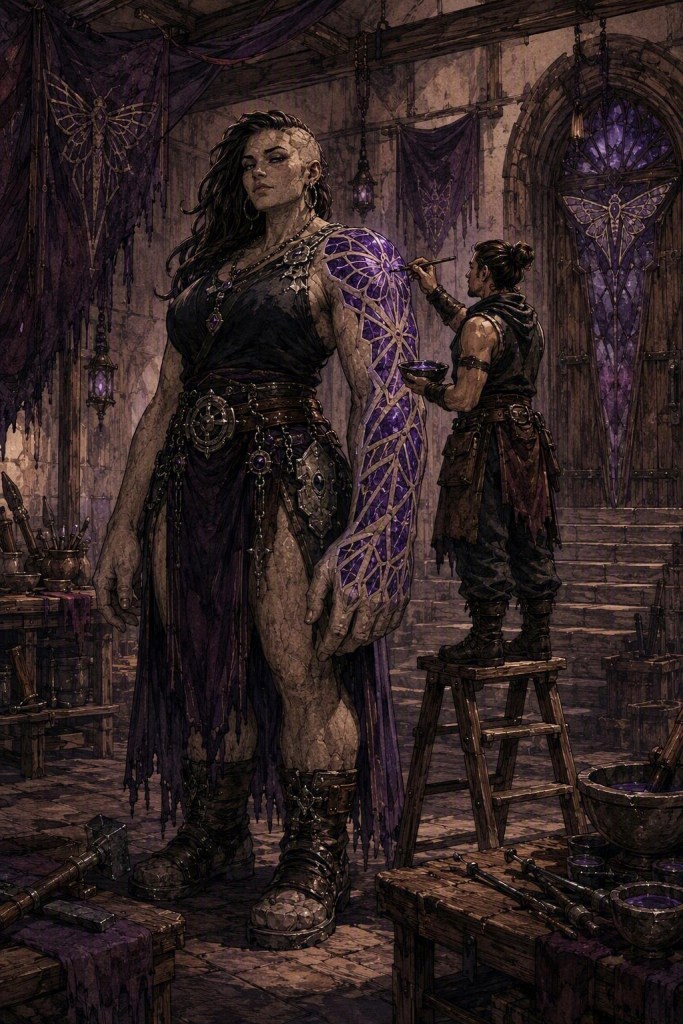
Threxian temples are commonly called Houses of the Living Script, though Markhouses, Ink Sanctums and Galleries of Becoming remain popular regional names.
They are among the most visually varied religious institutions in Erosia.
Tattoo chambers contain adjustable couches, low stools, brilliant lamps, mirrors and carefully organized shelves of pigment. Piercing galleries display jewelry beneath glass, from simple steel rings to elaborate sacred ornaments set with enchanted gems. Flesh-Shaping halls contain alchemical basins, transformation circles, privacy screens and mirrors capable of displaying possible forms.
Healing chambers occupy nearly as much space as ritual studios. Clean linens, warm water, medicinal preparations and quiet recovery rooms reinforce the belief that transformation does not become sacred by ignoring the body afterward.
Temple walls rarely remain unchanged. Living murals shift subtly as generations add new work. Figures acquire tattoos that were not present the previous season. Painted clothing changes. A background figure may gradually become central while an old central figure retreats into the crowd. Some murals contain sections deliberately painted over while allowing faint traces of earlier images to remain visible beneath them.
The temple itself becomes a Living Manuscript.
Galleries of Former Forms
Many larger Houses of the Living Script maintain a Gallery of Former Forms, one of the most distinctive institutions in Threxian religion.
These galleries preserve voluntarily donated records of bodies and appearances people once inhabited. The collections may contain portrait sketches, body casts, discarded jewelry, retired prosthetics, drawings of covered tattoos, locks of hair, written descriptions of former voices or clothing fitted to shapes the owner no longer possesses.
Nothing enters the gallery automatically. The person whose former form is represented chooses whether it should be remembered publicly, privately or not at all. Some donate elaborate records. Others leave a single ring or small page bearing two words: I changed. The galleries are not mausoleums for false selves.
Threxian clergy describe them as libraries of sincere former editions. Visitors may feel grief, amusement, embarrassment, tenderness or relief while looking at their own former form. All responses are permitted. The Gallery teaches that becoming someone new does not require declaring hatred for everyone one used to be.
Rites, Taboos & Divine Signs
Rite of the First Mark
The Rite of the First Mark recognizes a deliberate new chapter in a worshipper’s life. The mark may be a tattoo, piercing or another permanent alteration appropriate to the local tradition. Some participants choose temporary pigment instead, particularly when the rite represents entering Threxia’s faith rather than committing to a specific bodily change.
Older versions of the rite occur at midnight while assembled worshippers chant the participant’s chosen name or a phrase associated with the transformation. Contemporary temples emphasize a period of silence immediately before the work begins. The participant states what will be done, then confirms that they still want it done. The artisan repeats the description back. Only after both understand the same transformation does the First Mark begin.
Rite of the Living Canvas
The Rite of the Living Canvas begins entirely with temporary pigment. Participants paint themselves or one another under boundaries established beforehand. The designs may be devotional, playful, beautiful, erotic or deliberately strange. The goal is exploration rather than permanent commitment. Participants live with the marks for a period determined at the beginning of the rite.
When that period ends, each major element receives one of three judgments: keep, change or release.
A kept design may later become permanent. A changed design returns to experimentation. A released design is washed away and may never be used again. The rite expresses one of Threxia’s most practical teachings. Exploration does not owe permanence.
Rite of Flesh-Rebirth
The Rite of Flesh-Rebirth accompanies major physical transformation. Older archival forms include scarification, ritual carving and other permanent body modification. Contemporary practice varies widely and may instead use tattooing, cosmetic alchemy, magical reshaping, hair removal, new jewelry or another change selected by the participant.
The rite does not describe the earlier body as false. That distinction is essential. A former body may have been beloved, endured, disliked or simply completed. Threxian theology does not require a person to condemn an earlier form before they are allowed to leave it.
Participants frequently preserve one object from before the transformation. A sketch, ring, lock of hair, garment or written description may enter a private collection or Gallery of Former Forms. Rebirth remembers that someone existed before arrival.
Rite of Metamorphic Union
The Rite of Metamorphic Union is practiced between lovers, spouses or other adults who wish to recognize the ways their relationship has changed them. Older rites involved partners applying ink or paint to one another. Contemporary versions may include paired tattoos, exchanged piercings, matching jewelry, cosmetic transformation or magical sigils that react when the other participant is nearby.
The marks need not match. Many Threxian priests actively discourage perfect symmetry. Two people affected by the same relationship do not need to become visually interchangeable. The rite celebrates reciprocal influence without converting influence into ownership. Both participants acknowledge that they have been changed. Neither claims authorship over the other.
Ink Tracing
Ink Tracing is one of Threxia’s most common private rites. One participant follows existing tattoos, scars, piercings or other chosen features using temporary pigment, scented oil or touch within whatever boundaries have been established. The practice can be contemplative, affectionate or erotic.
No new permanent mark is created. The purpose is attention. A lover may discover details in a familiar tattoo they have never previously noticed. Someone may tell the story behind each mark while another traces it. A worshipper uncomfortable with being touched may perform the rite alone in a mirror. Ink Tracing treats the body already present as worthy of being read carefully.
Mirror Sculpting
Mirror Sculpting is a visualization rite associated strongly with Flesh-Shapers. A participant studies their reflection while magical mirrors or controlled illusions display possible alterations. One reflection may show changed hair, another altered proportions and another a much more dramatic metamorphosis.
The ritual does not ask participants only whether the reflection appears attractive. They are encouraged to imagine living within it. How would the body move? What would clothing feel like? What would change when strangers looked at them? What would remain exactly the same when the mirror was gone?
Excitement matters. Relief matters. Discomfort matters. So does the unexpected realization that the current reflection is the one the participant most wants to keep.
Taboos
Threxia’s gravest taboo is forced bodily modification. No artistic skill, religious symbolism, romantic relationship, social tradition, punishment or magical authority grants one person the right to permanently alter another against their will. Orthodox Threxians are particularly hostile toward magic that removes the possibility of refusal and then excuses the violation because the resulting form is beautiful, powerful or socially desirable.
Defacing another person’s consensual body art without permission is likewise serious. So is removing piercings, marks or transformations because an outside authority has decided the bearer should return to a more acceptable form. Mocking scars, transformed bodies or unmodified bodies violates the faith’s broader principles. Threxia offers possibilities rather than a compulsory aesthetic. Tool neglect is treated as a lesser but genuine religious fault.
A careless artisan risks turning another person’s body into the cost of their own pride. Destroying art is not universally forbidden. Removal may be sacred. Covering an old tattoo can become ritual revision. Melting jewelry may mark the end of a relationship or office. The theological question is not whether something was destroyed.
It is who possessed the right to decide its ending.
Signs of Threxia’s Claim
Older archives describe divine manifestations upon worshippers as Markings of Ownership. Many contemporary temples prefer Signs of Resonance or Marks of Becoming, arguing that possessive language sits uneasily beside Threxia’s theology of self-authorship.
Other traditions preserve the older phrase intentionally. They argue that the paradox is the point: A devotee may freely choose to describe themselves as marked by Threxia without granting another mortal authority to make the same claim.
Common signs include skin warming pleasantly before a desired modification and existing tattoos shimmering or moving slightly during moments of strong emotion. Piercings may develop a thin violet halo. Pigment-dark smoke sometimes trails from the fingertips after intense prayer.
Some devotees repeatedly dream of a mark before seeing the design while awake. Those deeply touched by Threxia may develop a divine tattoo along the ribs, spine, hip or another personally significant location. The design changes slowly over months or years. A metallic sheen may appear across the skin in moonlight, or tiny symbols may seem to move beneath unbroken flesh before disappearing.
The rarest sign is called the Unwritten Line.
A thin violet line appears somewhere upon the body without forming a recognizable design. It may remain for days, months or years before finally becoming something else. Most Threxian priests believe the mark precedes an important transformation. They disagree about whether Threxia knows the final form any better than the person carrying it.
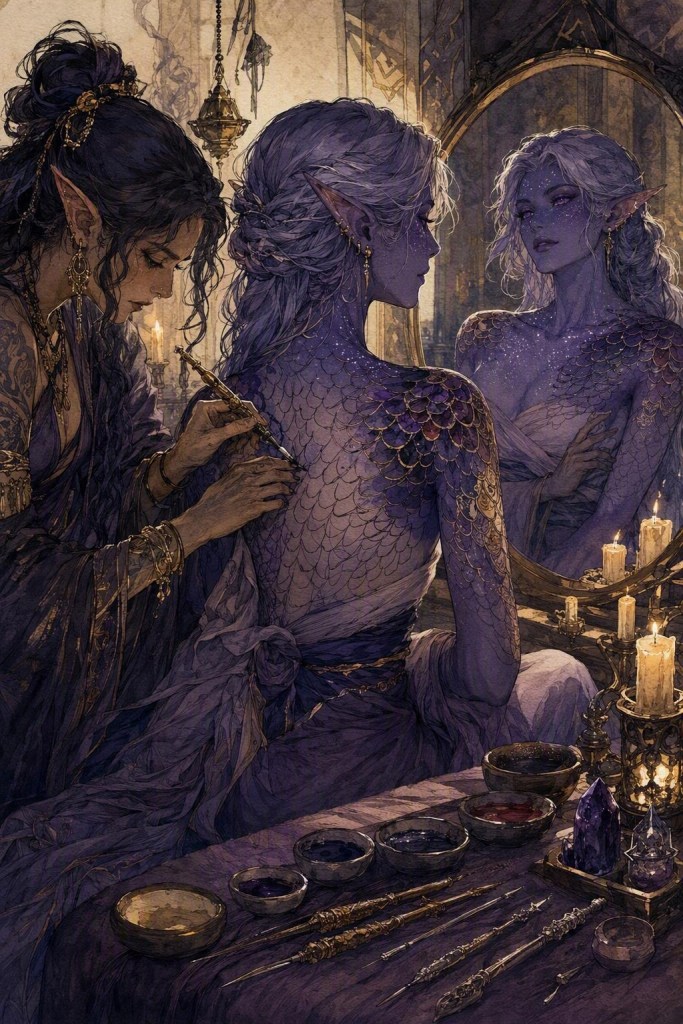
Threxia and the Velvet Court
Within the Velvet Court, Threxia embodies transformation made physical.
Where Velyssara awakens desire, Threxia asks what happens when desire becomes visible upon the body. Her concern is not every possible form of change. It is the strange spiritual power of deliberately allowing the body to carry evidence of choice.
Cyrillith is her closest theological counterpart. Cyrillith explores identity through performance, role, costume and story. A person may discover an unexpected self by becoming someone else for an evening. Threxia governs the moment someone decides that part of that discovery should remain after the costume comes off.
The two faiths collaborate frequently. Cyrillithian theaters provide safe places for experimentation. Threxian Flesh-Shapers help some discoveries cross from performance into embodiment. Neither assumes every role should become permanent.
Nyzun shares Threxia’s relationship with pain and intense sensation. Nyzun is concerned with what sensation communicates, how limits are understood and whether someone remains capable of choosing at the Edge. Threxia is concerned with the transformation for which that threshold was approached.
Their clergy often work together because the distinction matters. Pain does not prove devotion to Threxia. A transformation can matter deeply without hurting at all. Mirellune shares Threxia’s fascination with deliberately constructed embodiment. Mirellune’s Second Skin shapes the surface through structure, regalia and chosen containment. Threxia more often alters or adorns the body itself. Their temples collaborate on ritual harnesses, tattooed vow geometry, ceremonial collars and transformations associated with committed roles.
Velzhari offers another important point of overlap. Threxia asks, “What body or mark do you want?” Velzhari asks, “How do you want it seen?”
A person may transform entirely for themselves, never seeking admiration. Another may pursue transformation partly because the reveal, gaze and public reaction are integral to the pleasure. Both possibilities fit easily within the Court.
Solynth’s traditions intersect with Threxia through feminine presentation, androgyny and permission to explore forms of embodiment outside expected roles. Solynth often begins with softness, dress and role. Threxia begins when someone wants the body itself to participate in the change.
Across all these relationships, Threxia remains distinct. The Court offers countless ways to discover desire. She asks which discoveries you intend to carry upon the flesh.
Miracles & Divine Presence
Threxia’s miracles usually begin with lines behaving incorrectly. Ink climbs the inside of a sealed bottle. A tattoo shifts several inches while its bearer sleeps. A scar catches violet light despite the absence of any violet flame. Decorative script upon a wall rearranges itself around a visitor’s silhouette. These signs are rarely accompanied by thunder or spectacle. Threxia’s divinity prefers revision to destruction.
Living Ink
Living Ink is her most recognizable miracle. A tattoo may move beneath the skin without causing pain, transforming one design into another as its bearer’s relationship with the mark changes. A memorial flower opens when the dead person’s name is spoken. A protective sigil closes like an eye when danger passes. An unfinished line acquires its final curve when the bearer makes a long-delayed decision. Markwrights warn worshippers not to interpret every magical tattoo as prophecy. Sometimes living ink is simply alive.
Revision Lines
Faint violet lines sometimes appear across a person, object or wall shortly before an important transformation. They resemble an artist’s construction marks. One may curve beside the jaw. Another traces an old tattoo without touching it. Several can surround a damaged statue as if an unseen sculptor is considering where to begin.
The lines disappear unless acted upon. Threxian theologians disagree about whether they reveal what the goddess wants changed. Most prefer a safer interpretation. They reveal that change is possible.
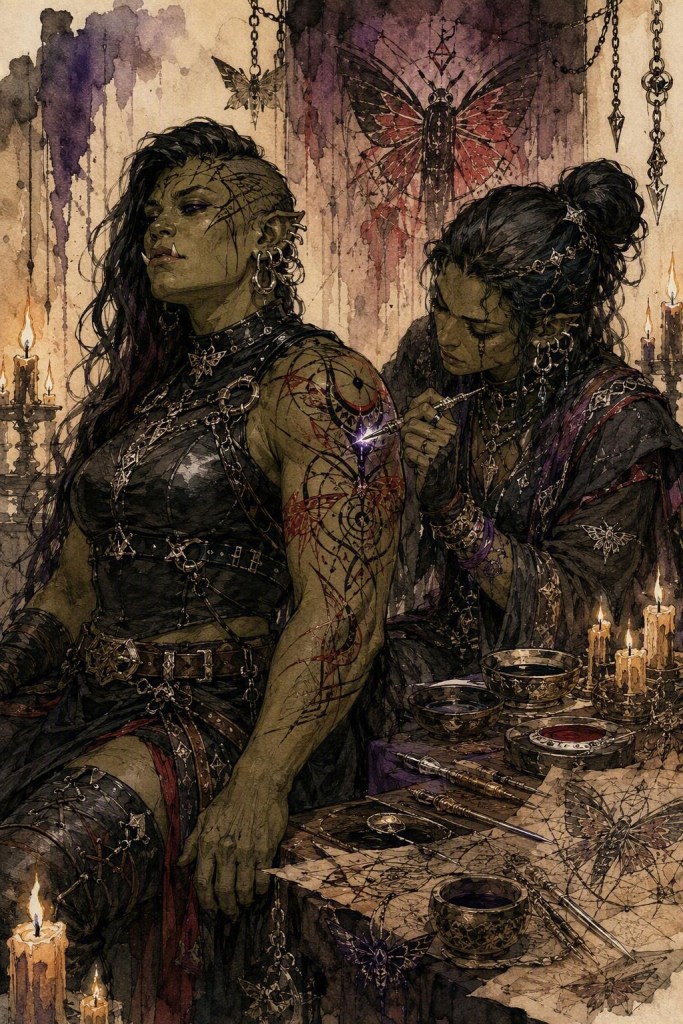
The True Mirror
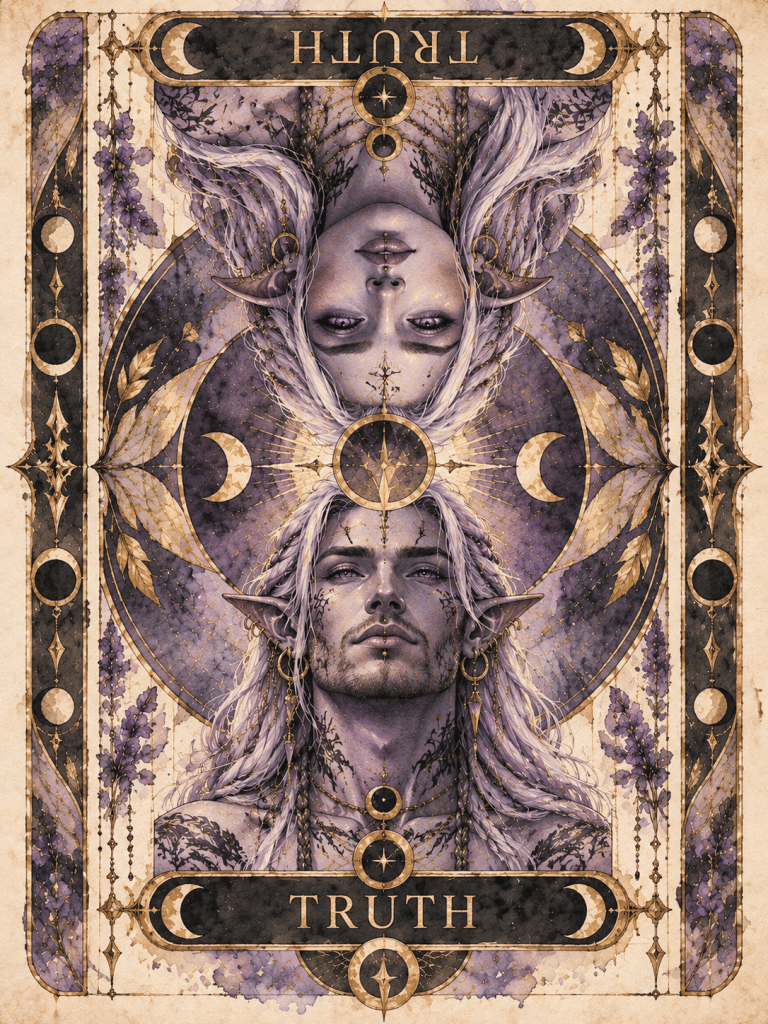
A mirror blessed by Threxia may show a person differently without becoming an illusion of perfection. One worshipper sees an imagined tattoo covering the shoulder. Another sees themselves older. Someone else encounters a body changed in ways they have privately considered but never spoken aloud. The reflection never forces transformation. It may not even reveal desire accurately. Threxian priests treat these mirrors as questions rather than prophecy. A reflection can suggest. The person looking must still answer.
Beautiful Scars
Threxia occasionally alters healed scars into patterns resembling branches, script, constellations or sacred geometry. Orthodox priests do not automatically declare such miracles blessings. They first ask whether the bearer wants the change to remain. Stories claim that unwanted divine scar patterns have faded after a simple spoken refusal. Whether Threxia herself removed them or the original manifestation was intended as an invitation remains a favorite theological argument.
Metamorphic Grace
In rare manifestations, Threxia alters flesh directly. Hair changes color in a breath. Facial features soften or sharpen. Old wounds disappear. Scales, fur, musculature or other physical characteristics shift according to the nature of the person affected. The most dramatic accounts describe complete bodily transformation. Permanent divine changes are treated differently from temporary miracles. Dreams repeat. Mirrors display possibilities. A strange new sensation may appear and vanish several times before any lasting change occurs.
Then the decision arrives. Threxian scripture is remarkably consistent on this point. When the permanent transformation finally occurs, the person has already said yes.
When She Who Marks Approaches
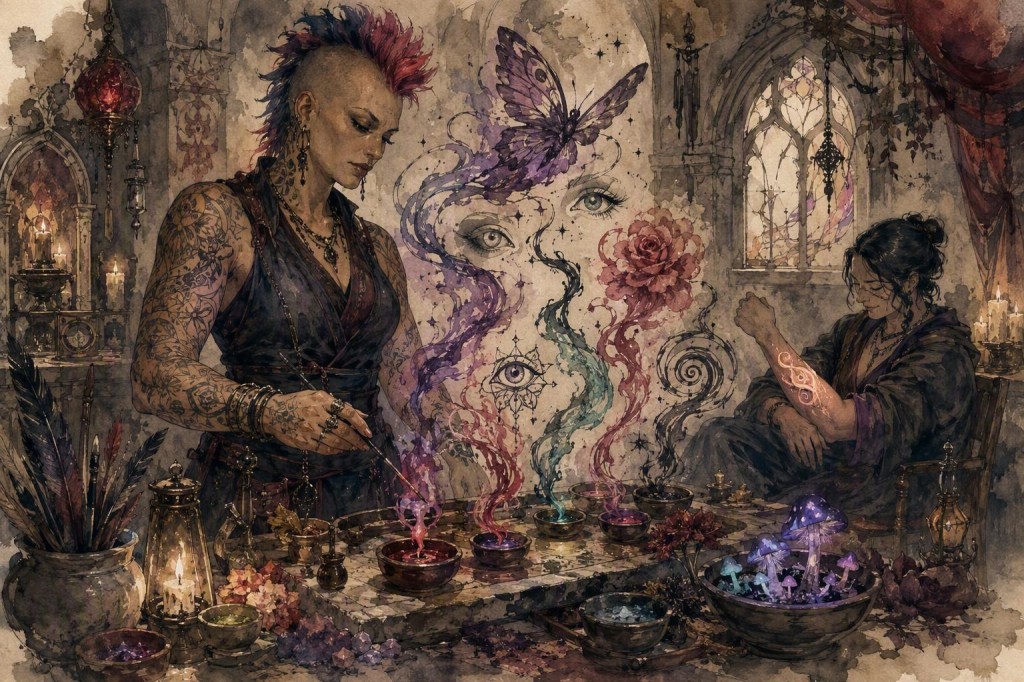
When Threxia manifests directly, pigments darken throughout the room. Metal jewelry becomes pleasantly warm. Violet reflections appear in mirrors, polished blades and glass. Existing tattoos seem to breathe with the movement of the wearer’s body. The air carries the scent of ink, polished metal, warm skin and dark incense. Her own form does not remain visually static. The full-body tattoo suit changes continuously without losing its overall coherence. Piercings appear in different arrangements. Violet Revision Lines briefly redraw sections of the design before new motifs settle into place. Witnesses frequently remember one peculiar detail after everything else fades. Threxia rarely studies what someone was born with first. Her gaze moves toward what they chose.
What Her Faith Teaches
The Body Is a Living Story
Threxia teaches that every body contains history whether anyone decorates it or not. Age writes upon flesh. Labor writes. Healing writes. Desire, chance and magic write as well. Self-authorship does not erase these influences, nor does it require pretending they never mattered. It means the person carrying the story remains among its authors.
Change Is Holy When Chosen
Transformation is not inherently virtuous. A forced tattoo does not become sacred because the design is beautiful. An unwanted magical reshaping does not become a blessing because observers prefer the result. Choice changes the spiritual nature of transformation. Without meaningful choice, Threxia is absent from the act.
Pain Is Not Proof
Pain may accompany significant transformation, and some worshippers find that threshold spiritually or erotically meaningful. It does not prove sincerity. A person who suffers more has not automatically demonstrated greater devotion. A painless method is not spiritually inferior. Stopping because a body or mind no longer wants to continue is not failure. The mark was never made sacred by agony.
Beauty Has No Final Shape
Threxia does not teach one ideal body. A broad body may be beautiful. A thin one may be beautiful. A scar may be treasured or hated. Tattoos may cover nearly every inch of skin or none of it. Masculine, feminine, androgynous and difficult-to-categorize forms all appear throughout her temples. The faith does not abolish personal taste. It rejects the idea that taste becomes divine law merely because many people share it.
Permanence Deserves Deliberation
Threxia does not fear permanent choices. She respects them. A mark intended to last for decades deserves more consideration than an ornament worn for an evening. A dramatic magical reshaping deserves time enough for the person choosing it to imagine not only the transformation, but the life that follows afterward. This is why temporary forms hold such an honored place in her worship. Uncertainty is not weakness. Sometimes it is information.
Revision Is Not Failure
Changing an old choice does not automatically mean that choice was a mistake. People change. Relationships change. Bodies change. A design that fit perfectly at 20 may no longer fit at 50. A form that once brought relief may eventually become constraining. Threxia does not demand loyalty to a former self at the expense of the person still living. The old edition may have been sincere. The new one can be sincere too.
The Unchanged Body Is Still Chosen
A person may understand everything Threxia offers and desire none of it. That answer is allowed. No one must become tattooed because tattooing can be sacred. No one must accept a piercing because incorporation can be beautiful. No one must pursue bodily transformation to prove courage or self-knowledge. A body kept exactly as its inhabitant wishes remains an expression of bodily authority. Threxian priests sometimes reassure nervous visitors with one of the faith’s gentlest teachings: She Who Marks does not need your body to become proof of her existence.
At the Table
Threxia works best in campaigns concerned with identity, transformation, body autonomy, art, magical alteration, scars, beauty, curses and the consequences of changing something that may not be easily changed back. Her stories do not require erotic content. A Threxian adventure can revolve around a magical tattoo revealing a map, a warrior deciding whether magical healing should remove an old scar, a Flesh-Shaper developing a safe method of transformation or a character altered by a curse who discovers that returning to their former body is no longer the obvious answer.
The strongest Threxian conflicts rarely ask whether transformation is good or bad. They ask who gets to decide. A useful Threxian question for an NPC, temple or adventure is: “If nobody else would ever see the result, would you still want the change?” Another cuts in the opposite direction: “If everyone else adored the result, would that make it yours?”
Threxian Characters
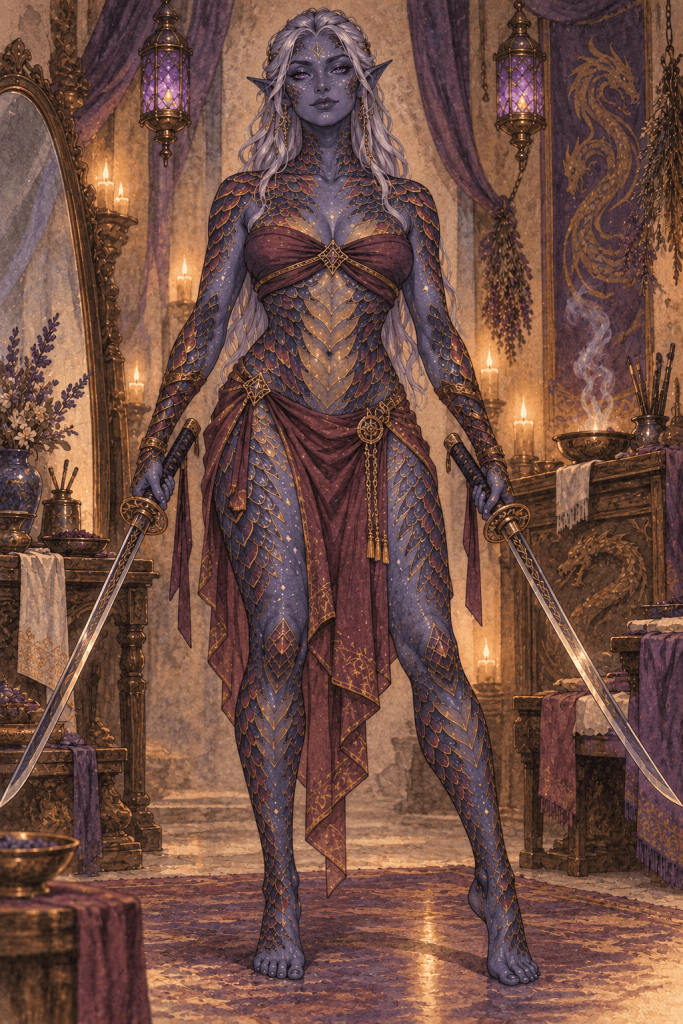
Characters drawn toward Threxia commonly include tattooists, jewelers, artificers, alchemists, healers, performers, rebels, bodyworkers, sculptors, magical researchers and adventurers whose bodies carry visible histories.
Her faith also suits characters whose relationship with change is complicated. A warrior may preserve every scar except one. A noble may conceal a devotional tattoo forbidden by family tradition. A changeling capable of assuming countless forms may discover that infinite possibility has made choosing a favored one unexpectedly difficult. A person who spent years pursuing magical transformation may finally achieve it and discover that arrival creates questions rather than ending them.
Conversely, a heavily modified character may be tired of everyone assuming every tattoo represents tragedy or revelation. Sometimes they simply liked the design. These are Threxian conflicts.
Divine Domains and Traditions
The archives associate Threxia with clerical traditions of Change, Artifice, Passion and Fleshcraft. They also preserve the Oath of the Sacred Sigil and Oath of the Shifting Form, the bardic College of Ink & Echo and College of Flesh-Story, the druidic Circle of Living Skin, and warlock traditions called the Pact of the Marked Flesh and Pact of the Shifting Body.
These concepts remain appropriate to Threxia, but their existing mechanics predate the current Second Bloom framework.
(Needs updated mechanics: Base 5e → Veiled → Unveiled.)
Future Threxian options should emphasize customization, adaptation, bodily transformation, living sigils and meaningful choice rather than treating modification as a universal combat advantage.
Boons of Threxia
Older Threxian mechanics preserve several recognizable concepts. Marked Flesh rewarded visible devotional tattoos or piercings during social interaction. Inkguard allowed tattoos to harden temporarily against attack. Pain-for-Art linked injury with rising desire. Sigil Lash projected a burning magical symbol toward another creature, while Carver’s Blessing placed temporary protective or destabilizing marks upon flesh.
The concepts remain useful. The old implementation should not be restored unchanged. In particular, archival rules suggesting tattooed or pierced creatures become easier to affect with unwanted transformation conflict with Threxia’s modern theology. Choosing body modification should never make a character mechanically less capable of resisting another creature’s attempt to control their body. Future boons should reward deliberate marks, voluntary adaptation and the protection of chosen form.
(Needs updated mechanics: Base 5e → Veiled → Unveiled.)
Living Sigils
The strongest mechanical identity for Threxia is the Living Sigil. A character marked by Threxia could choose from a limited set of supernatural tattoos or body sigils, each tied to a clear 5e function. One might harden temporarily against attack. Another could aid disguise or appearance change. Another might enhance movement, skill use or a particular magical expression. The important design principle is customization. Threxia should feel like the deity who allows a character to decide which marks they carry and what those marks do.
Veiled rules can express that identity through simple, limited activations. Unveiled rules can allow certain sigils to interact with Arousal, sensation or chosen transformation without making those systems necessary for the mark’s baseline usefulness. Permanent narrative transformation remains a character decision rather than a mechanical punishment.
(Needs updated mechanics: Base 5e → Veiled → Unveiled.)
Sacred Relics
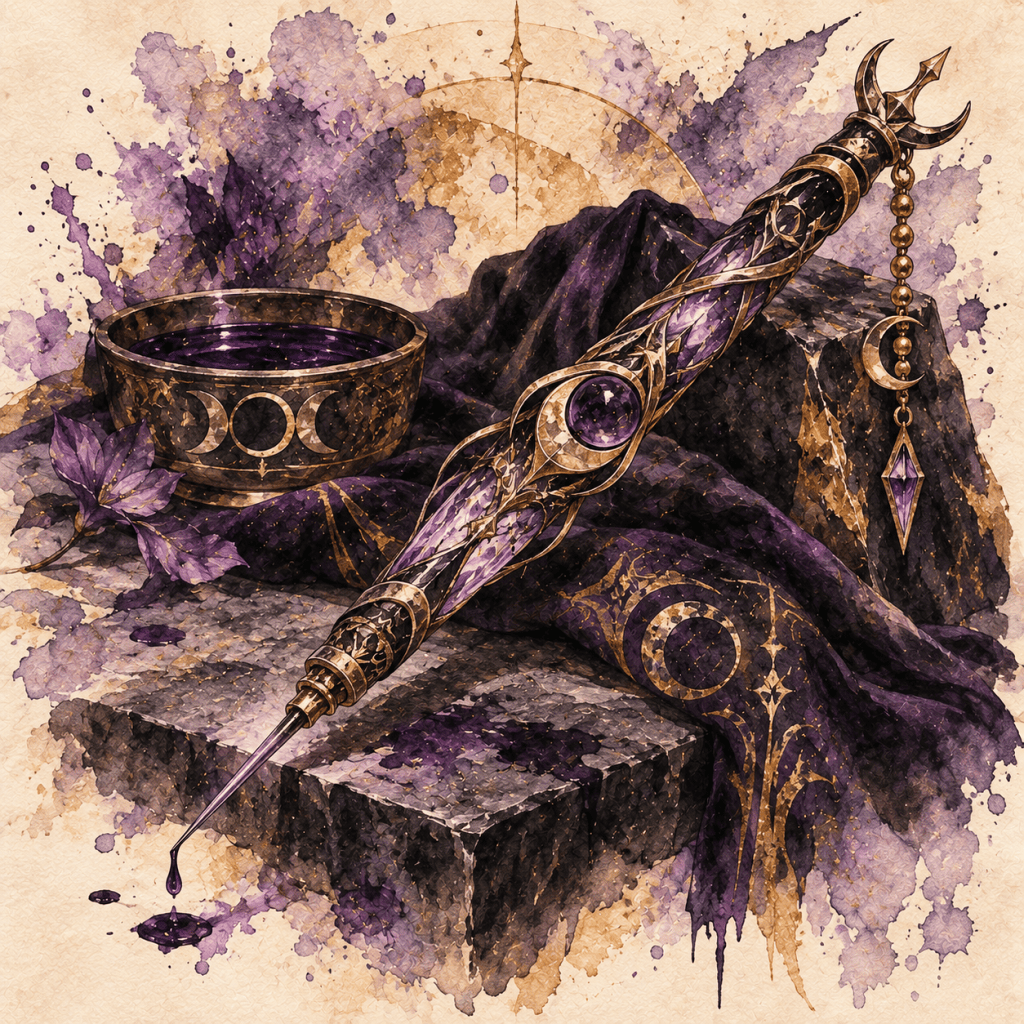
Needle of the First Cut
Wondrous item, rare; final attunement requirement to be determined
The Needle of the First Cut is said to descend from the instrument used during Threxia’s first mortal revelation. Surviving descriptions disagree about its substance. Some call it blackened gold, while others describe violet crystal so fine that light passes through the point. The relic creates magical tattoos whose effects vary according to the mark applied. The oldest accounts describe small supernatural benefits and designs capable of responding to their bearers through light, movement or altered symbolism.
A persistent legend claims the Needle cannot create a permanent mark upon someone who does not truly want it. Pigment beads harmlessly upon unwilling skin and refuses to settle. Whether that property comes from Threxia herself or from the craftsmanship of the original relic remains unknown.
(Needs updated mechanics: Base 5e → Veiled → Unveiled.)
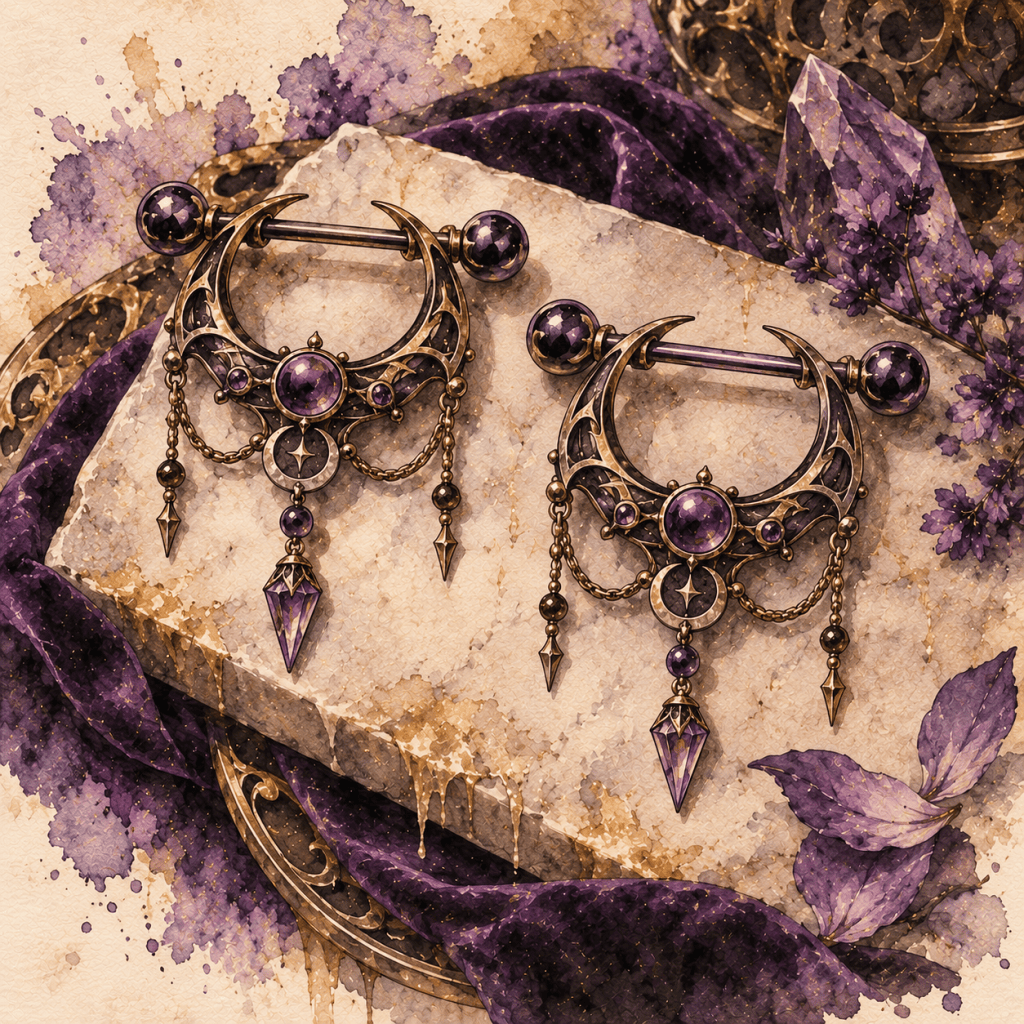
Rings of Shifting Flesh
Wondrous item, uncommon; final attunement requirement to be determined
These delicate pieces of body jewelry are made from blackened gold and small violet stones. Once worn as intended, the metal warms and establishes a subtle magical relationship with the wearer’s body. The archives describe the rings as allowing modest alterations to appearance. Hair, skin coloration, facial detail, contour and similar characteristics may shift while ancestry and fundamental body plan remain intact.
Temple versions are frequently used during Mirror Sculpting. They allow a worshipper to experience a possible appearance before deciding whether a more permanent change is desirable. The Rings of Shifting Flesh never describe one form as original and another as false. Both are bodies the wearer may choose to inhabit.
(Needs updated mechanics: Base 5e → Veiled → Unveiled.)
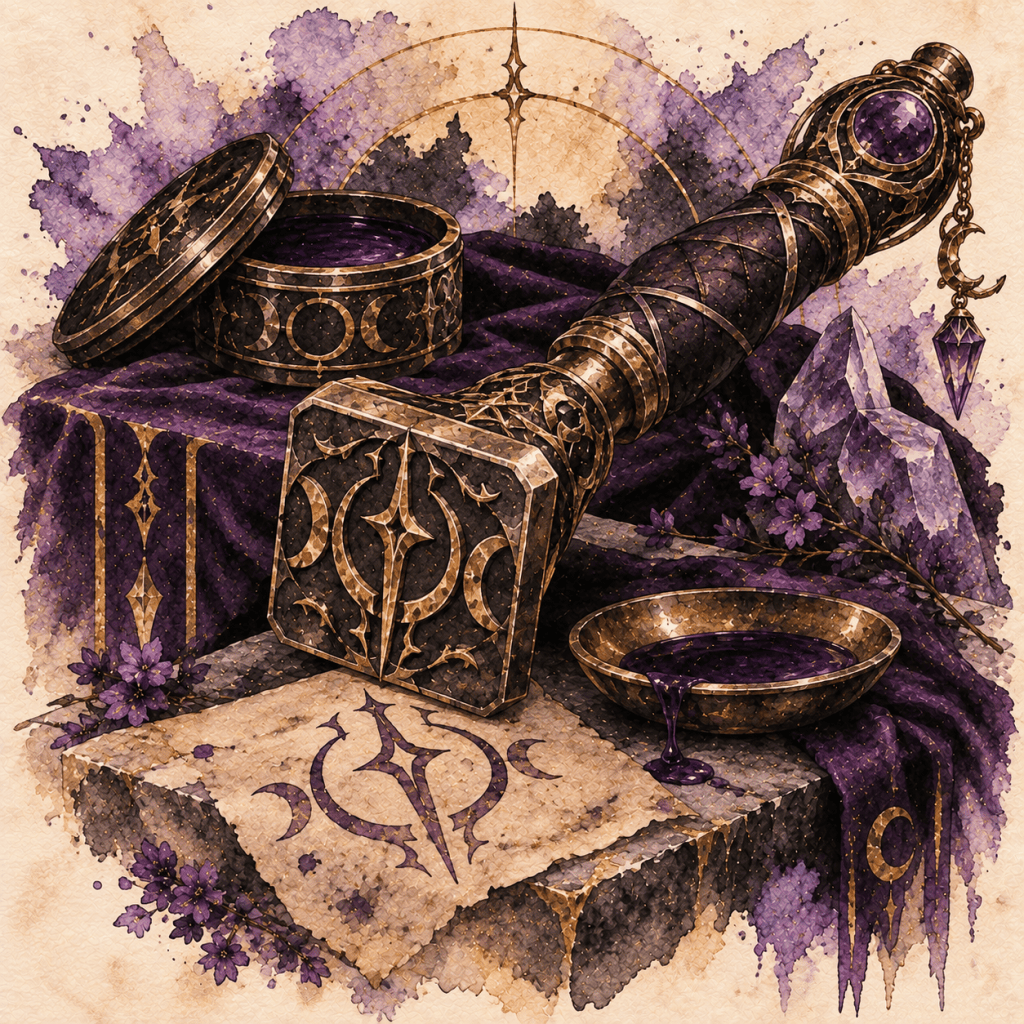
Brand of the Reborn
Wondrous item, very rare; final attunement requirement to be determined
Despite its name, the Brand of the Reborn does not always resemble a branding implement. Surviving examples include engraved sigil plates, enchanted stones, ceremonial stamps and ancient magical marking tools. The relic is associated with profound bodily revision.
Archival accounts claim it can rewrite one significant physical trait of a willing creature. The limits differ sharply between sources, and some stories attribute transformations to the Brand that would rival powerful transmutation magic. Orthodox Threxian temples agree upon only one principle. The Brand does not decide what rebirth means. The bearer must.
(Needs updated mechanics: Base 5e → Veiled → Unveiled.)
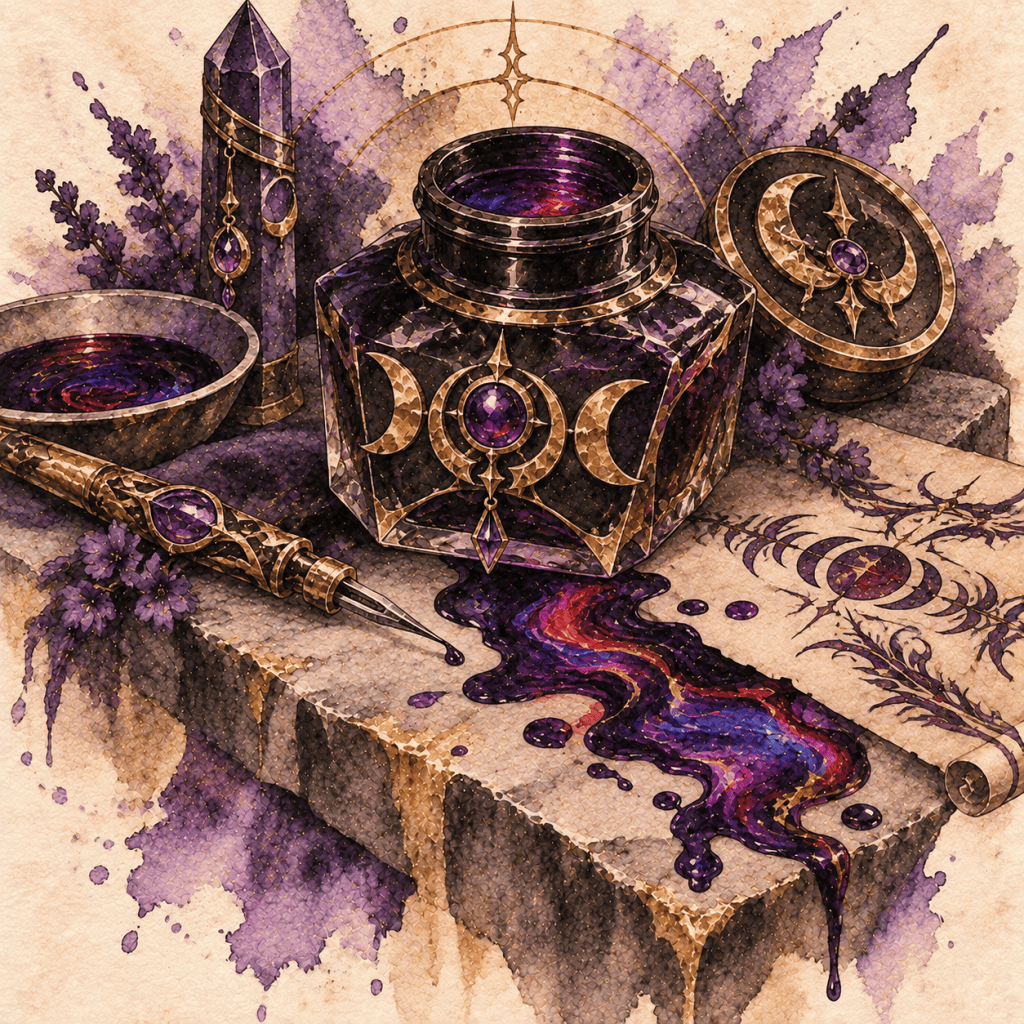
Ink of Living Desire
Wondrous item, rare
Ink of Living Desire appears black while sealed, but violet, crimson, cobalt and gold separate within it when the pigment touches skin or parchment. The colors continue moving slowly even after the ink dries. A tattoo created with the pigment can animate, glow or alter itself in response to emotion, magic or desire. Some marks warm to crimson during arousal. Others brighten violet when their bearer fulfills an intention named during the original ritual.
The rarest designs continue developing across many years. New lines emerge without destroying the old composition, allowing the tattoo to become an evolving record rather than a frozen image. Threxian artisans describe the effect simply. The mark changes because the story continued.
(Needs updated mechanics: Base 5e → Veiled → Unveiled.)
Adventure Hooks
The Tattoo Seeking Its Bearer
A sacred tattoo begins moving across the body of its current bearer, with another section disappearing every night. Identical lines appear temporarily upon strangers throughout the city, suggesting that the design is not fading but traveling. The mystery becomes more troubling when a Markwright determines that the tattoo was originally accepted willingly and has never shown signs of corruption. If a consensual divine mark is searching for a new bearer, the characters must discover whether the tattoo has changed its meaning, its original bearer has changed or someone else has begun calling it home.
The Stolen Markwright
A celebrated Markwright disappears after refusing a wealthy noble’s request for an extreme transformation. The noble insists the artisan accepted a private commission and left voluntarily, but the Markwright’s apprentices know their teacher would never abandon an unfinished piece without securing the pigments first. Investigation reveals that the noble wants a form of Flesh-Shaping the Markwright repeatedly refused to perform. The more difficult question is why the noble believes the transformation must be completed before the next full moon.
The Living Mural
A temple mural begins changing far more rapidly than living Threxian art normally should. Painted figures acquire new tattoos overnight, old figures disappear and others point toward sections of architecture that were previously empty. Eventually, one figure turns outward toward the room. Its face belongs to one of the adventurers. The painted figure appears to be trying to communicate, but nobody can determine whether the mural predicts a transformation, remembers one that has not yet happened or is attempting to warn the character away from a future someone else has already chosen for them.
The Forged Sigils
People throughout a city awaken carrying luminous Threxian marks they never requested. The sigils grant minor beneficial magic, leading some victims to defend whoever created them, while others demand immediate removal. Threxian clergy are horrified. Someone has either learned to counterfeit divine sigils with extraordinary precision or uncovered an older school of Threxian magic that did not share the modern faith’s understanding of bodily authority. The investigation becomes politically dangerous when several influential citizens insist that a beneficial transformation cannot reasonably be called a violation.
The Cursed Brand
An ancient mark begins transforming its bearer into a succession of unfamiliar bodies. The changes initially appear random until someone realizes that each form resembles a body the bearer remembers wishing for during a different period of life. Some of those desires remain welcome. Others belonged to someone they no longer are. Breaking the curse may be easier than determining whether every transformation should be reversed. The relic has somehow learned the bearer’s history of desire and is treating every former wish as an unfinished command.
The Gallery of Perfect Forms
A famous Flesh-Shaper opens a sanctuary where every client emerges breathtakingly transformed. Demand becomes enormous, and patrons travel from distant kingdoms for the chance to be remade. Months later, observers notice that former clients increasingly resemble one another. The Flesh-Shaper produces clear testimony that every client requested their transformation. No obvious coercion occurred. Threxian investigators suspect something subtler. Someone may have learned how to reshape what a person wants before asking what body they wish to choose.
The Former Self at the Door
A powerful transformation ritual succeeds exactly as intended. Several nights later, the recipient begins dreaming of their previous body walking independently through the city. Witnesses eventually report seeing the figure while awake. The double does not claim to be a monster, stolen identity or discarded soul. It remembers agreeing to the transformation and insists it is simply the part that was left behind when the new body continued forward. Destroying it may be possible. Determining whether anyone has the right to do so is considerably harder.
Scents for Gameplay
Threxia’s presence is usually perceived through pigment, metal, incense and warm bodily scents rather than flowers or perfume. Use these fragrances as atmospheric cues rather than automatic confirmation that the goddess has intervened.
| d12 | Scent | Suggested Moment |
|---|---|---|
| 1 | Fresh black pigment with faint violet incense | Threxia’s attention has turned toward a choice of embodiment. |
| 2 | Polished metal warmed between the fingers | A sacred piercing, marking tool or relic is nearby. |
| 3 | Charcoal, myrrh and dark plum oil | A Markwright has recently completed ritual work. |
| 4 | Ground mineral pigment and old parchment | A Gallery of Former Forms, forgotten design or hidden record is nearby. |
| 5 | Clean leather, clove and warm brass | An artisan is preparing for an important transformation. |
| 6 | Ozone mingled with liquid ink | Metamorphic magic is active or about to begin. |
| 7 | Cobalt pigment and bitter citrus | Cosmetic alchemy or Flesh-Shaping is being performed nearby. |
| 8 | Amber resin and warm gold | A devotional piercing, exchanged ornament or sacred relationship mark is involved. |
| 9 | Violet smoke and rain on black stone | A Living Sigil has awakened. |
| 10 | Rosewood, clean skin and polished steel | A Rite of the First Mark is approaching or has recently concluded. |
| 11 | Charred cedar fading into sweet resin | An old mark, identity or transformation is being deliberately released. |
| 12 | Pigment and metal beneath one intensely personal remembered scent | Threxia herself is near. The remembered fragrance differs for every witness. |
Using Scent as Foreshadowing
Repeated sensory cues can teach players Threxia’s visual language before her influence becomes explicit. Violet incense and fresh pigment may begin appearing before important choices about transformation, while charred cedar can accompany moments when someone finally decides to release an old form or mark.
The most personal manifestation should remain rare. When a character smells a private memory beneath the familiar ink and metal of Threxia’s presence, the moment should suggest that the goddess is not merely observing a body. She is paying attention to the person who has been living inside it.
 Whispers of Erosia
You must be logged in to post a comment.