
Eshthara
The Dreamweaver’s Tongue • Mistress of Trance • Whispered Will
Influence • Dream • Suggestion
Dreams, inspiration, meditation, persuasion, prophecy, imagination and the subtle shaping of thought.
“The mind follows the path it believes it chose.”

Eshthara is the goddess of dreams, suggestion, hypnosis, trance, imagination and the surrender of certainty. She governs the hidden routes by which thought becomes belief, possibility becomes inspiration and an idea placed gently into the mind takes root as though it had always been waiting there. Her power is not domination. It is influence.
Artists seek Eshthara when inspiration refuses to come. Teachers invoke her before difficult lessons, diplomats before delicate negotiations and prophets before surrendering themselves to sleep. Those plagued by nightmares pray for her quiet voice, while lovers and ritual partners call upon her when exploring the intimacy of guided attention, trance and consensual mental surrender.
Eshthara does not ask mortals to stop thinking. She asks them to notice how strange thinking already is. Dreams make the impossible ordinary every night. Memories change each time they are recalled. Stories teach people to grieve for strangers who never existed. A whispered sentence can alter the course of a life while a shouted command changes nothing.
To Eshthara, these are not weaknesses in the mind. They are doors. Her faith gathers around one revelation above all others:
Reality is negotiable.
Lore & Mythos
Born in the Hush Between Heartbeats
The archives preserve several accounts of Eshthara’s beginning, but the oldest and most widely repeated claims she was born from the hush between heartbeats — the silent instant when longing slips beneath conscious thought and becomes dream.
Velyssara had awakened desire in mortal hearts, giving living things the capacity to want, seek, love and reach beyond themselves. Yet mortals quickly discovered desires they could not explain, admit or even consciously recognize. Some became secrets. Some became fantasies. Others sank so deeply beneath waking thought that they survived only in dreams.
One mortal, whose name is deliberately absent from every surviving telling, carried such a desire for years. They could speak it neither to lover nor priest, neither to family nor mirror. Each waking day they denied it, until one night the wish escaped in sleep as a single whispered sentence.
The words entered the Dreamweave. They traveled farther than any voice should travel. Across sleeping minds the whisper gathered fragments of unfinished stories, childhood wonder, forgotten grief, secret longing, imagined futures and fears too strange for waking language. Thousands of dreams touched it without knowing they had done so, each leaving behind some small piece of itself.
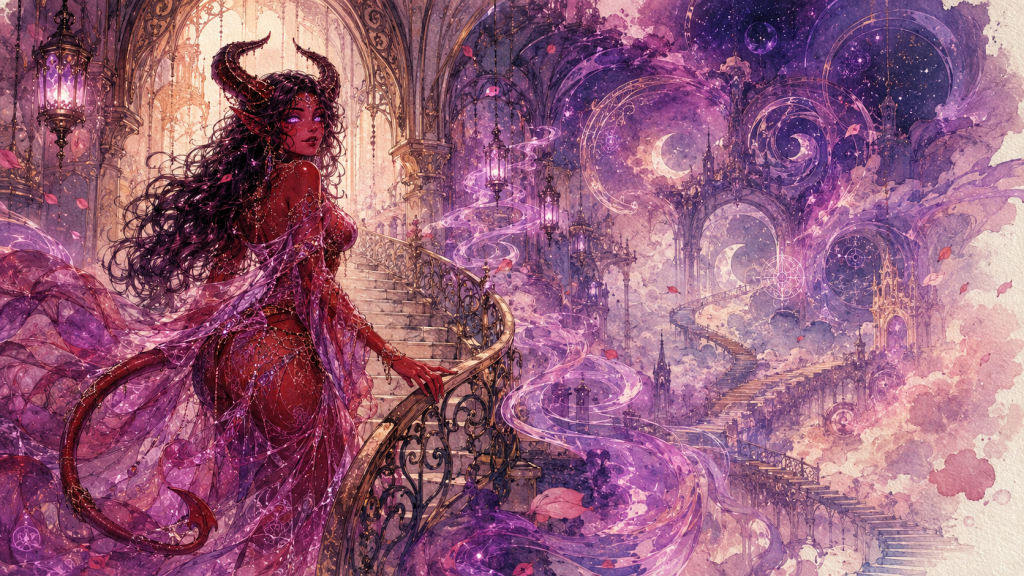
The whisper became a current. The current became mist. Then the mist answered. Eshthara opened her eyes. The first dreamers to behold her described crimson skin illuminated as though by sunset beneath closed eyelids, dark horns sweeping backward through violet haze and eyes turning with slow spirals of impossible light. Her voice carried no thunder. It was soft enough that listeners leaned closer without realizing they had moved.
The archives claim that on the night of her awakening, countless sleepers throughout Erosia dreamed of the same woman. None remembered what she said. All awoke convinced they had nearly understood something important.
The First Door
A later parable tells of Eshthara’s first miracle. A mortal dreamed each night of being pursued through an endless corridor. They ran until exhaustion claimed them, only to awaken and repeat the nightmare the following night. Priests blessed the sleeper. Mages warded the room. Nothing changed.
Then Eshthara appeared inside the dream. She did not destroy the pursuing creature. She did not stop the dreamer. She merely asked why the corridor required them to keep running forward. The dreamer stopped for the first time.
A door appeared in the wall. Beyond it was morning. Eshtharan teachers still tell this story to initiates because it contains the essential character of their goddess. Eshthara does not promise that every prison is imaginary or that every danger can be reasoned away. She teaches that the shape one first perceives is not always the only shape available.
A corridor may contain a door that certainty prevented the dreamer from noticing.
The Dreamweave
Eshthara is intimately associated with the Dreamweave, the liminal current through which dreams, memories, symbols and subconscious impressions sometimes touch one another. The Dreamweave is not a single realm with stable borders. Some scholars describe it as a divine domain. Others believe it is an emergent psychic landscape formed wherever mortal dreams overlap. Eshtharan theologians generally consider both explanations too tidy.
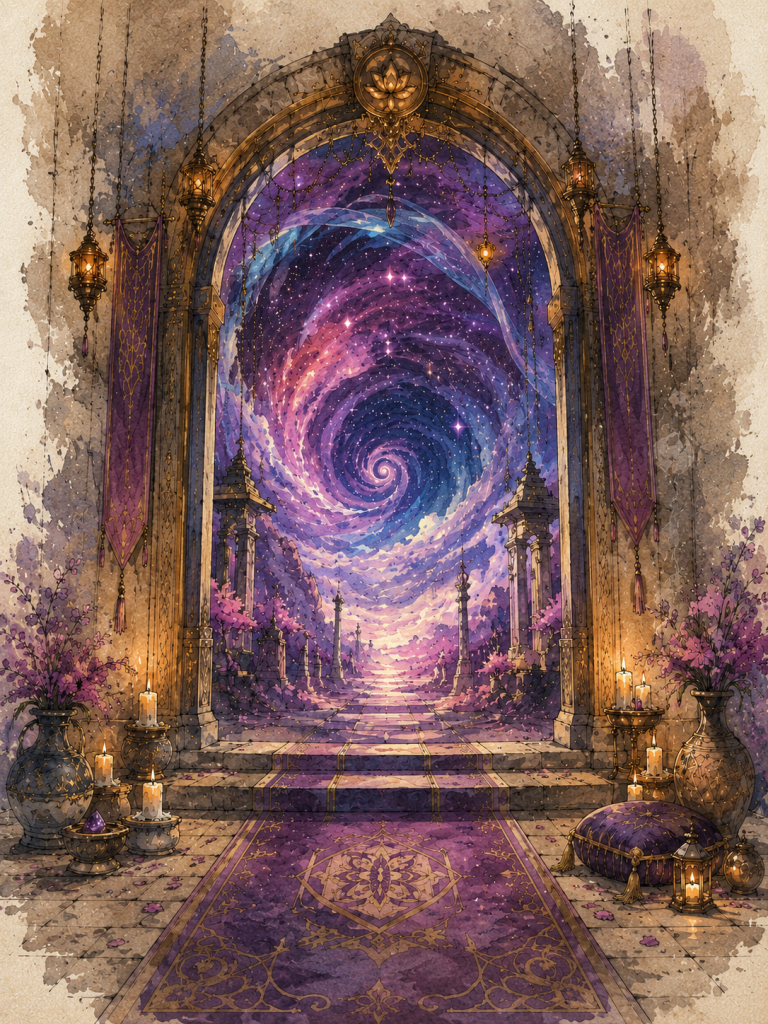
Within the Dreamweave, geography obeys association rather than distance. A childhood bedroom may open into an emperor’s nightmare. A forgotten lullaby can become a road. A staircase may ascend into yesterday. A person may encounter a memory as though meeting another living being.
Dream-Speakers warn that symbolism within the Dreamweave is rarely universal. A serpent means what that serpent means to the dreamer. A locked door may represent fear to one person and safety to another.
Eshthara’s clergy therefore distrust anyone who claims to possess a perfect dictionary of dreams.
The Desire She Embodies
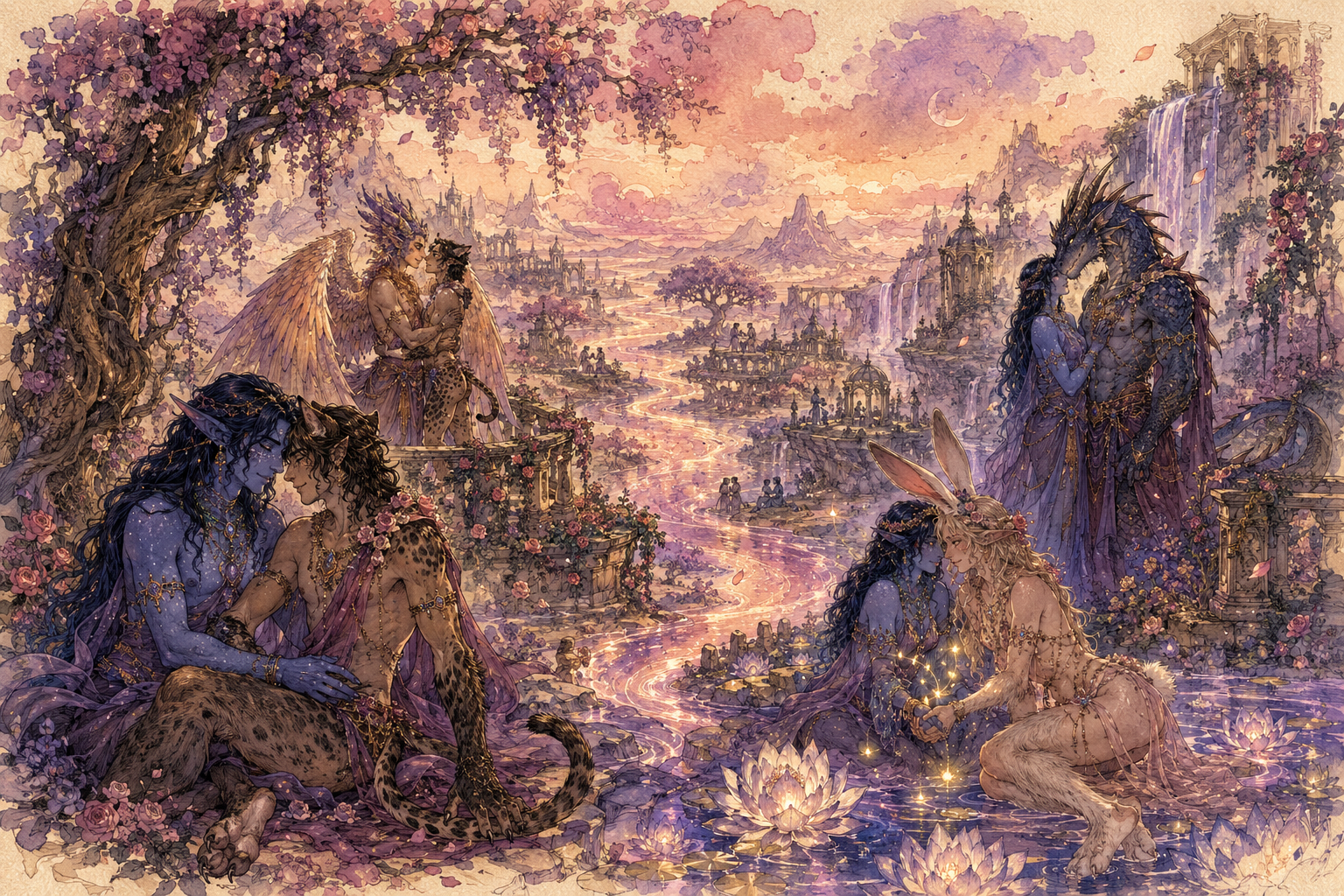
Eshthara embodies the desire to loosen certainty without surrendering the self. Her sacred current includes influence, imagination, inspiration, persuasion, altered perception and the vulnerability of allowing one’s attention to be guided. Her erotic mysteries grow naturally from that broader domain, but they are only one expression of it. The student who needs confidence before an examination stands within Eshthara’s current. So does the author who dreams the ending of a story, the diplomat searching for words that might avert war and the grieving widow who longs to see a lost beloved one more time in sleep. Her worshippers include artists, counselors, teachers, negotiators, storytellers, illusionists, prophets, performers and anyone whose craft depends upon helping another mind imagine something differently.
Sacred Expressions
Eshtharan traditions commonly include dream rituals, meditation, hypnosis, storytelling, teaching, prophecy and guided visualization. More intimate traditions explore trance, ritual whisper, dream play, entrancement and consensual mental surrender between people who have deliberately chosen the experience.
Older Eshtharan writings use stronger language, including obedience, enthrallment and surrender of will. Contemporary theologians generally interpret these ideas through the principle of chosen vulnerability rather than compulsory control.
To willingly follow another person’s voice can be intimate.
To make refusal impossible is something else entirely.
The Interior Door
Eshtharan theologians often describe every mind as a temple filled with doors.
Some doors stand open to the public. Others open only for friends, lovers, teachers or trusted guides. Some remain locked because the person who owns them is not yet ready to discover what lies beyond.
Influence is knocking.
Trust is opening.
Violation is entering without invitation.
This distinction underlies much of Eshthara’s modern theology. Suggestion offers a direction in which thought may travel. Possession eliminates every other direction.
Eshthara governs the first.
Her faithful regard the second as a corruption of her mysteries.

Holy Symbol & Iconography

The Dreamweaver’s Eye
Eshthara’s canonical holy symbol is the Dreamweaver’s Eye, an ornate crimson-and-gold eye centered upon a deep hypnotic spiral. The eye is framed by four elegant curving points that resemble both an opening flower and the architecture of an impossible dream. Fine golden borders trace the entire shape, while small golden beads and four-pointed stars ornament its vertical axis.
At the center, a crimson spiral turns inward through pale negative space. Its curve appears simple at first glance, but prolonged observation can create the impression that it is turning outward instead. A golden suspension ring crowns the symbol. Beneath it hangs a faceted crimson teardrop.
The complete emblem may appear as a pendant, shrine ornament, temple seal, mosaic, stained-glass design or architectural motif.
Meaning of the Symbol
The eye represents awareness: the mind observing the world while simultaneously observing itself. The spiral represents suggestion, trance and the journey beneath surface thought. The open center represents possibility, the instant before an idea has decided what shape it will take.
The golden frame represents the boundary of the self. It may open by invitation, but it does not disappear. The crimson teardrop represents what returns from dream: an inspiration, memory, fear, desire or revelation carried back into waking life. Eshtharan priests sometimes summarize the symbol with a teaching:
“First you see. Then you wonder whether seeing was ever passive.”
Older Symbols
The archives preserve an earlier Eshtharan emblem: a closed eye surrounded by spiraling mist, with a silver tongue curling from its center.
The symbol remains visible in ancient manuscripts, old temple carvings and some regional traditions. Contemporary theologians interpret the closed eye as dream, the spiral as trance and the silver tongue as influence through language.
It is no longer her primary holy symbol, but neither is it regarded as heretical. Many Eshtharan sanctuaries deliberately preserve both designs to illustrate how religious symbols themselves evolve when people learn to see their gods differently.
Sacred Colors and Materials
Crimson, magenta and violet dominate depictions of Eshthara herself. Lavender, fog-white and muted silver appear heavily within temples and ritual spaces, while gold distinguishes sacred instruments and the Dreamweaver’s Eye. Common materials include dream-glass, polished gold, silver, translucent silk, reflective stone, incense smoke and still water.
Sacred Motifs

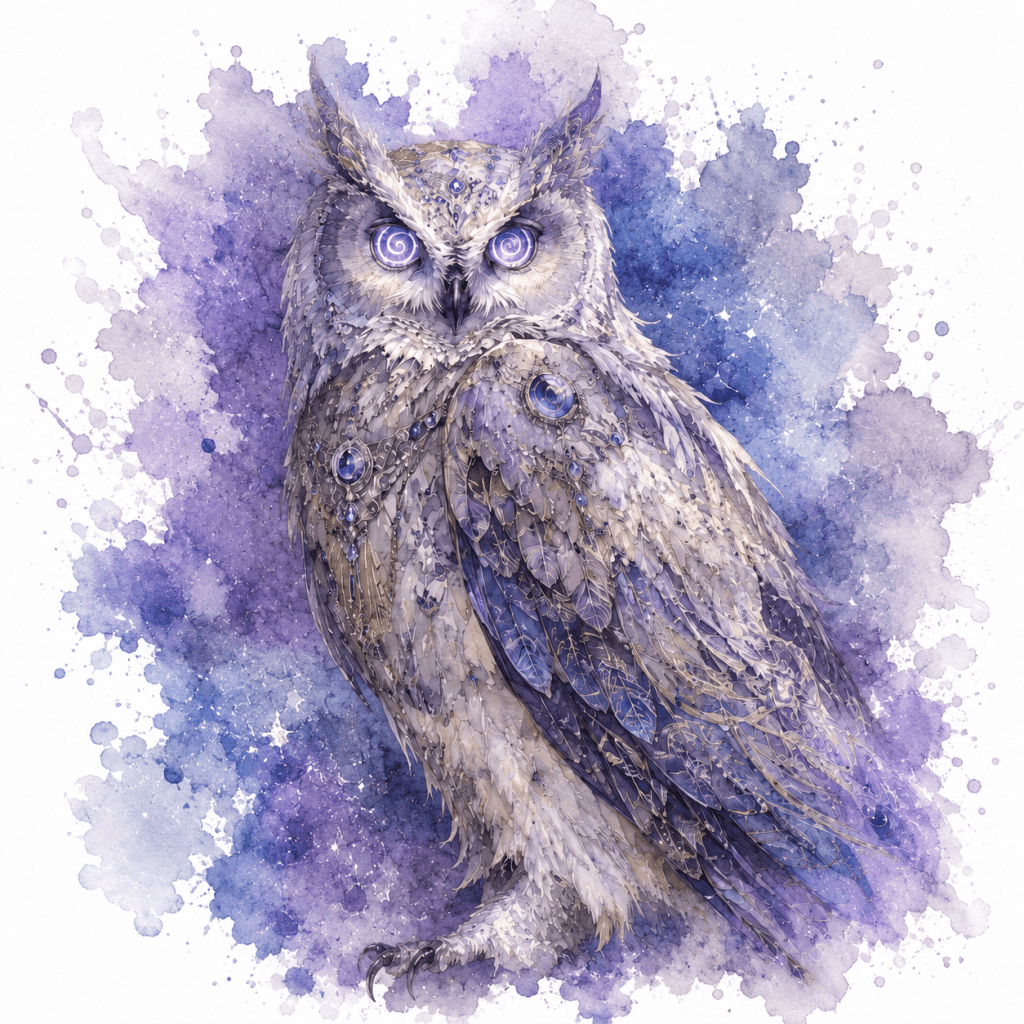
Spirals are ubiquitous, but Eshtharan art also favors open eyes, closed eyes, drifting petals, impossible stars, floating sigils, staircases, reflections and architecture that does not quite obey perspective.
Moths symbolize attraction toward the unknown. Pale owls represent awareness in darkness. Serpents represent thoughts circling toward hidden truths.
Some temples also depict creatures remembered from dreams but found nowhere in waking Erosia.
Depictions of Eshthara
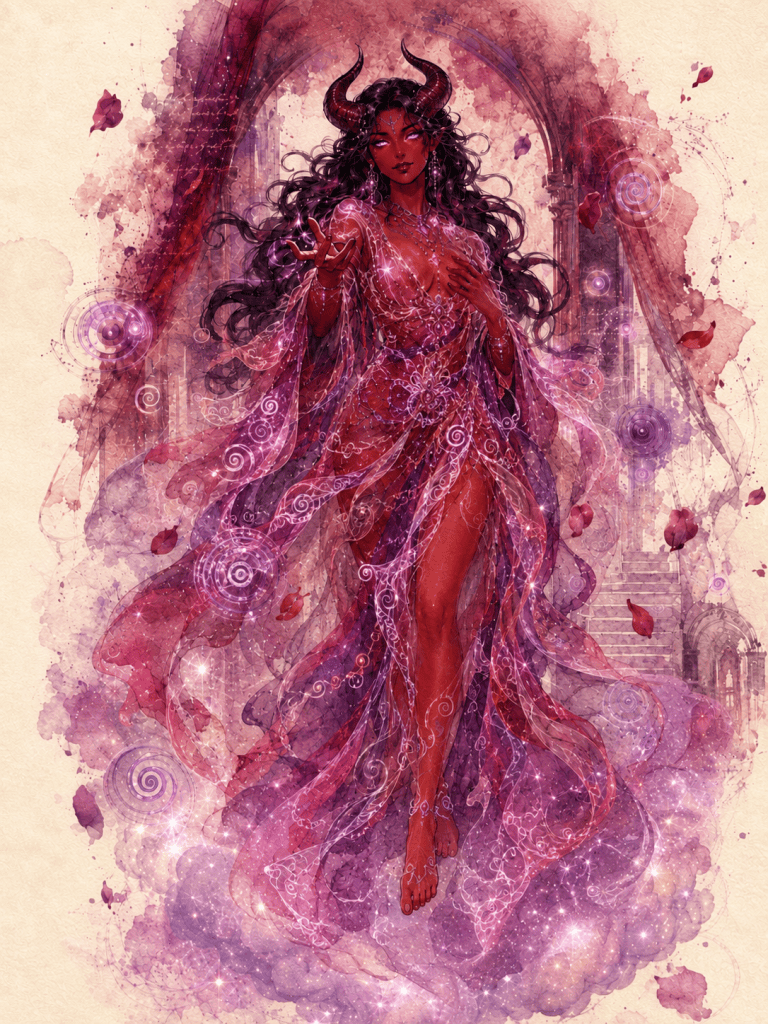
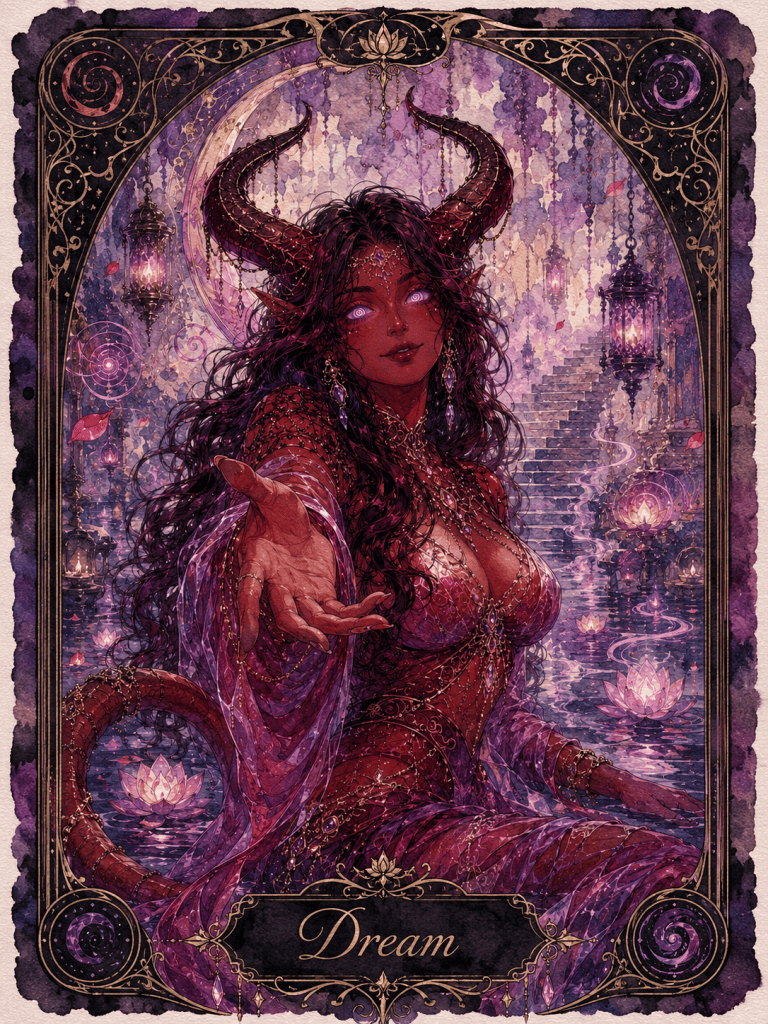
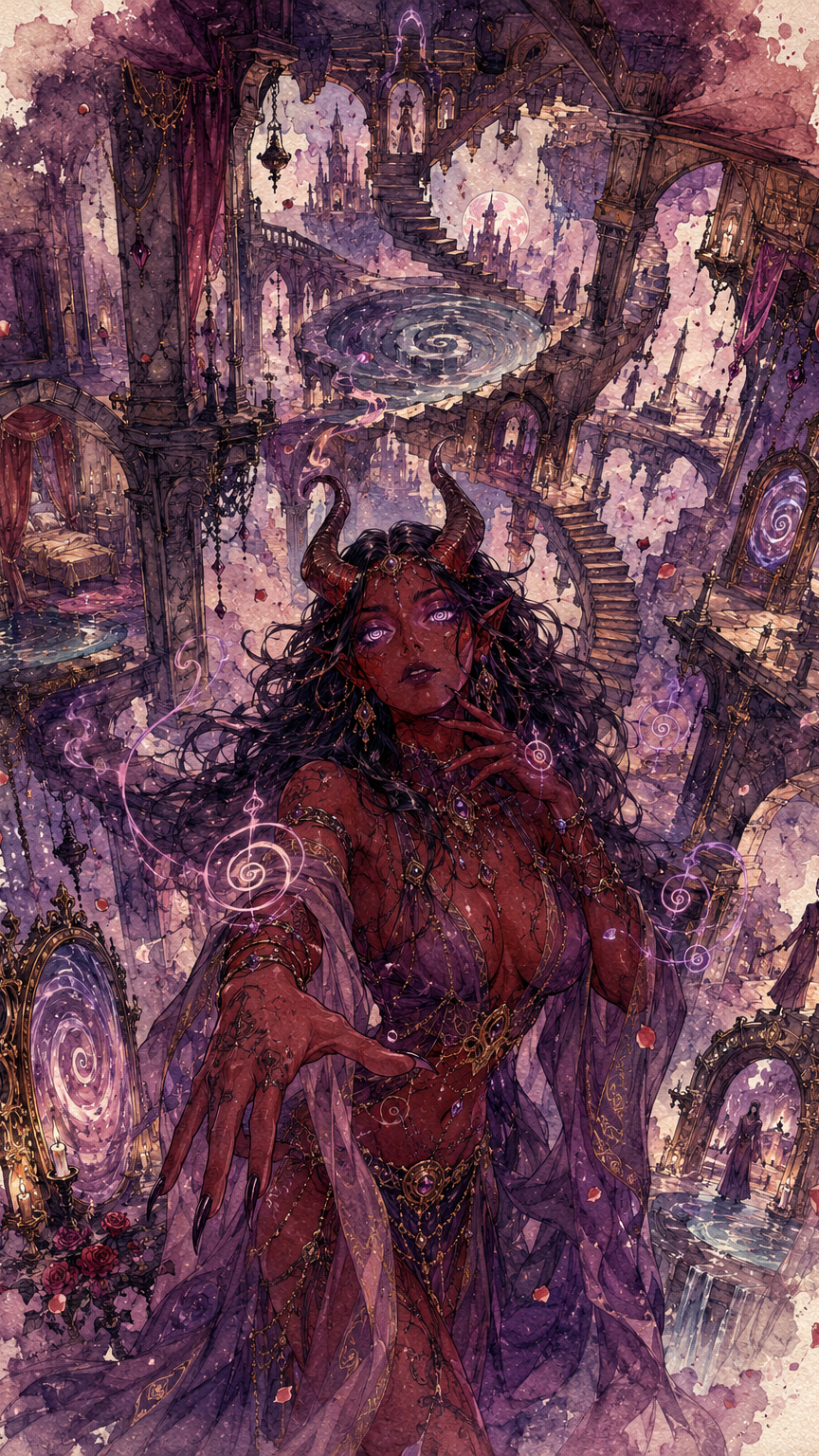
Eshthara appears as a mature Hollow-Souled goddess with rich ceremonial crimson skin, a voluptuous and elegant humanoid form, backward-sweeping dark garnet or blackened-crimson horns and long dark hair carrying wine-red, violet and magenta reflections.
Her eyes are unmistakable. Violet, lavender and magenta spirals seem to turn within them, becoming more luminous when she exerts divine influence.
A tiefling-like tail extends naturally from the base of her spine and moves with slow expressive grace.
Her robes appear less sewn than dreamed. Flowing translucent fabrics, mist and drifting sigils gather around her as though the Dreamweave has temporarily agreed to behave like clothing.
In definitive depictions, reality itself responds to her presence. Stairs continue beyond architecture. Reflections disagree with their subjects. Petals drift upward. The horizon becomes uncertain.
The emotional truth of every Eshtharan image should remain the same:
Reality is negotiable.
Worship & Daily Devotion
Eshtharan devotion begins with attention. Her faithful believe that people spend much of their lives being influenced without noticing it. Mood alters judgment. Architecture shapes behavior. Repetition makes strange ideas familiar. A trusted voice can calm fear while an old memory can turn an ordinary room into somewhere unbearable. The purpose of Eshtharan practice is not to eliminate influence. It is to notice it.
Dream Journaling
Many worshippers keep paper, charcoal or ink beside their beds. Upon waking, they record whatever remains of the night’s dreams before conversation or daily routine erodes the memory. Images, emotional impressions and fragments of dialogue are considered as valuable as complete narratives.
Priests discourage worshippers from declaring every dream prophetic. Most dreams, they teach, are the mind speaking to itself in an undisciplined language.
That does not make them meaningless. It simply means the speaker and listener are the same person.
The Whispered Descent
A guide leads another willing participant into relaxation or light trance through slow speech, repetition and controlled pauses.
Traditional versions repeat certain phrases several times with subtle variations. The participant is encouraged to notice how expectation and rhythm alter the apparent meaning of identical words.
The practice is commonly used before meditation, sleep or difficult emotional work.
Mist-Chanting
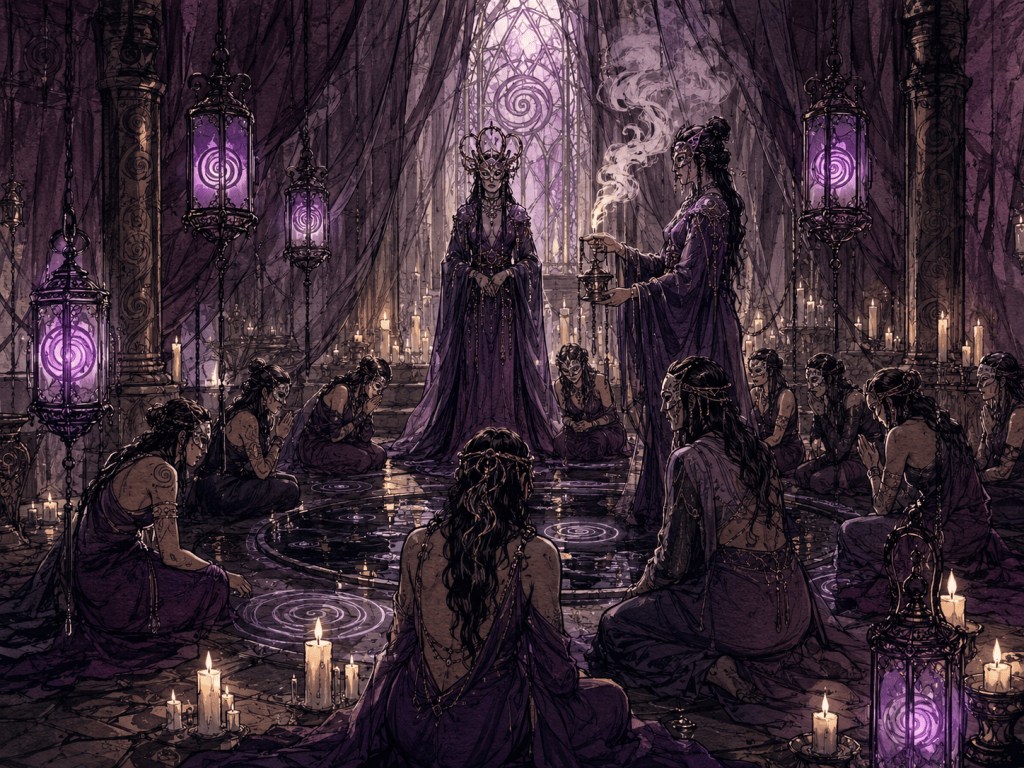
Devotees gather within a dim chamber while incense accumulates in pale layers close to the floor.
Voices begin separately and gradually overlap in quiet repeating patterns. No single melody dominates. Instead, listeners discover different rhythms depending upon where they choose to place their attention.
Mist-Chanting teaches one of Eshthara’s simplest lessons: Perception selects from abundance.
Breath-Sync
Two or more participants gradually match their breathing until a shared rhythm emerges.
Older traditions describe the participants’ minds as softening and merging. Contemporary clergy generally treat this language symbolically, emphasizing empathy, awareness and deliberate coordination rather than literal fusion.
Companions sometimes practice Breath-Sync before difficult conversations, journeys or rituals requiring mutual trust.
The Spiral Focus
A worshipper studies a spiral etched into glass, painted on parchment, reflected upon water or traced onto the body with temporary pigment.
The purpose is not to empty the mind.
It is to observe attention moving.
Afterward, an Eshtharan teacher may ask the initiate a deceptively simple question:
“When did you decide where to look next?”
Somnus Feasts
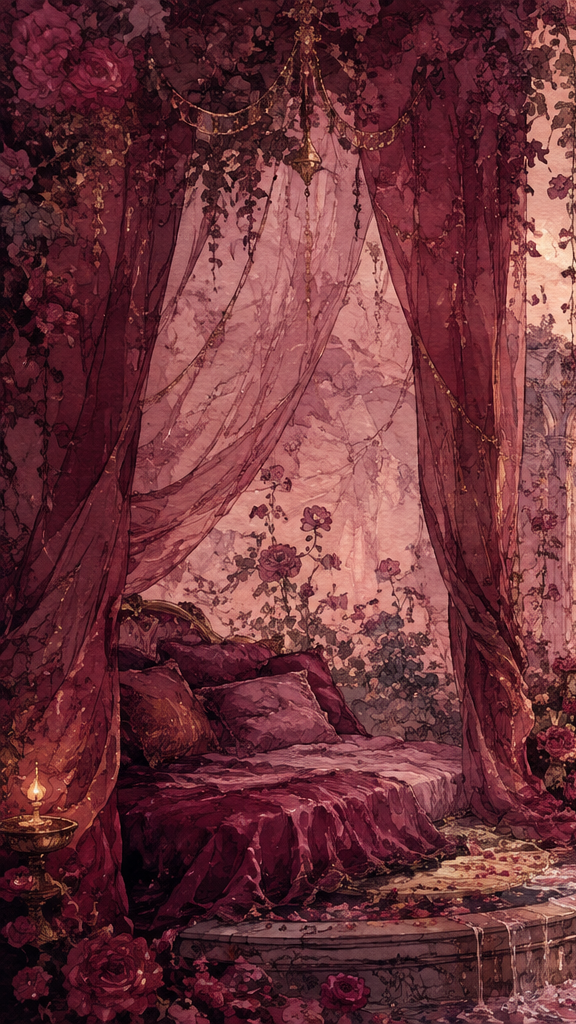
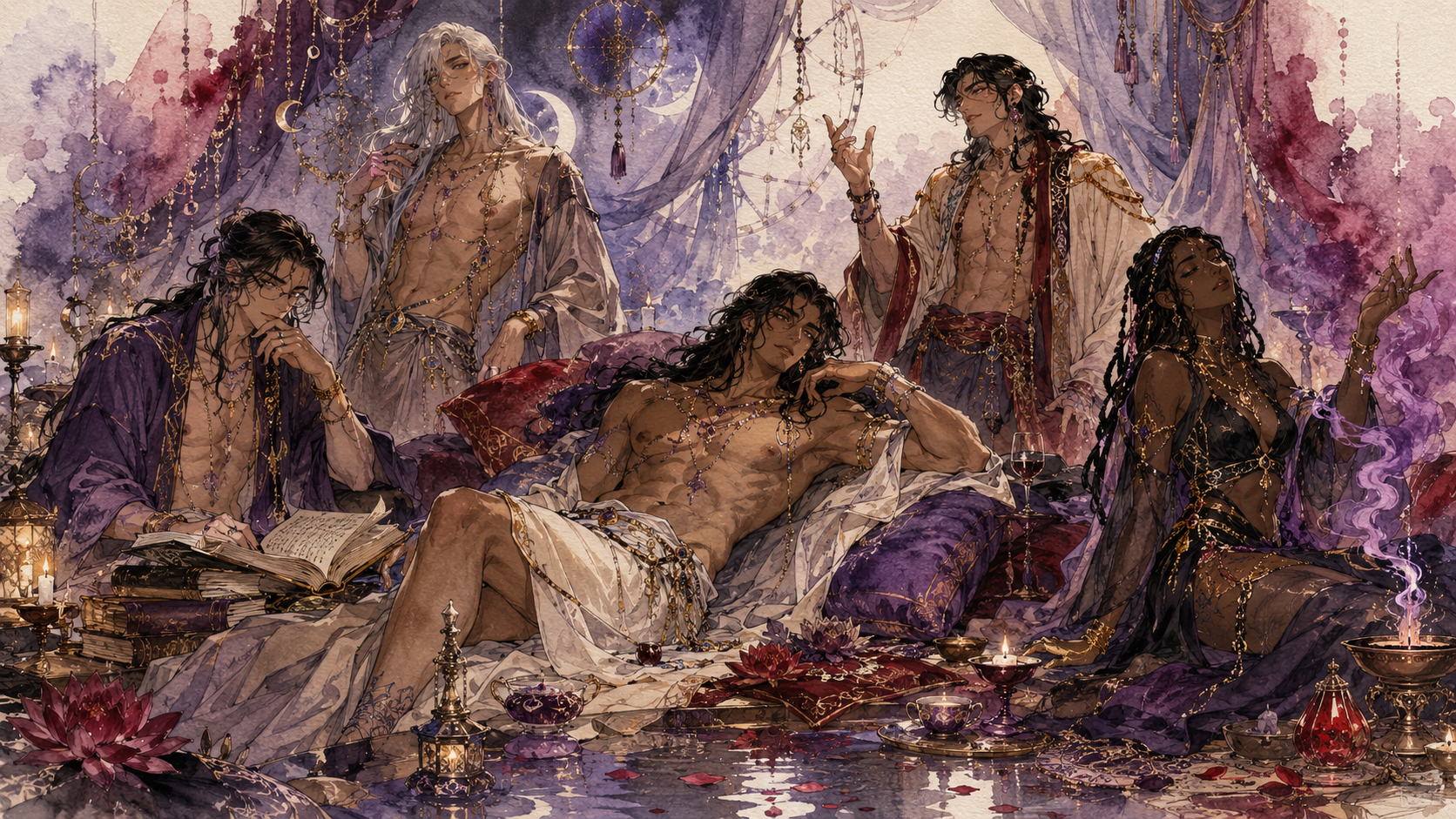
Somnus Feasts are communal celebrations of rest and dreaming. Temples spread cushions, mattresses, low couches and blankets through warm chambers. Food appears slowly rather than as a formal banquet. Music remains soft, conversations are unhurried and no guest is expected to remain awake simply because others are still speaking.
People nap. They wake. They eat again. Some return to sleep. At dawn, those who wish to share gather around tea, fruit or wine and exchange fragments of dreams. No one interprets another person’s dream without being asked.
Clergy & Temples
Eshthara’s clergy rarely organize themselves through rigid hierarchy. Authority comes primarily from trust, experience and specialization. A priest capable of guiding profound trance may defer without hesitation to a younger Dream-Speaker who understands recurring nightmares better. Common titles survive from several different traditions.
Dream-Speakers
Dream-Speakers interpret dreams, investigate supernatural sleep phenomena and guide rituals involving shared dreaming. Their work often resembles scholarship as much as priesthood. Many maintain libraries of dream journals, regional symbols, recurring prophetic patterns and records of known Dreamweave phenomena.
Mistresses of Quiet
Mistresses of Quiet maintain sleeping sanctuaries, meditation chambers and places of refuge for people unable to rest. Despite the feminine title, the office is not restricted by gender. The name survives from an early Eshtharan monastic tradition.
Whisper-Priests
Whisper-Priests specialize in guided trance, spiritual counseling and private ritual. Their most important skill is not induction. It is listening.
Silver-Tongued Ones
Silver-Tongued Ones study persuasion, rhetoric, counseling and the sacred responsibilities of influential speech. They often serve as diplomats, mediators and teachers. Many temples require anyone seeking advanced training in hypnotic rites to study under a Silver-Tongued One first.
Entrancers
Entrancers preserve the oldest traditions of hypnosis, dreamwalking and altered consciousness. The title carries both prestige and scrutiny because some archival Entrancer practices came uncomfortably close to treating obedience as an end in itself. Modern Entrancers often understand their vocation as reclaiming those techniques through explicit trust and agency.
The Work of Eshthara’s Clergy
Most days in an Eshtharan temple are considerably less mysterious than outsiders imagine. Clergy help people sleep. They listen to nightmares. They teach breathing exercises. They offer quiet rooms to the overstimulated. They counsel people who cannot easily name what they are feeling.
Artists arrive desperate for inspiration. Parents bring frightened children. Adventurers seek interpretation of recurring visions. Officials ask whether a troubling dream is prophecy or anxiety. Then, occasionally, someone dreams of a place that exists. Or several strangers describe the same impossible staircase. That is when the Dream-Speakers close the doors.
Temples of the Dreamweaver
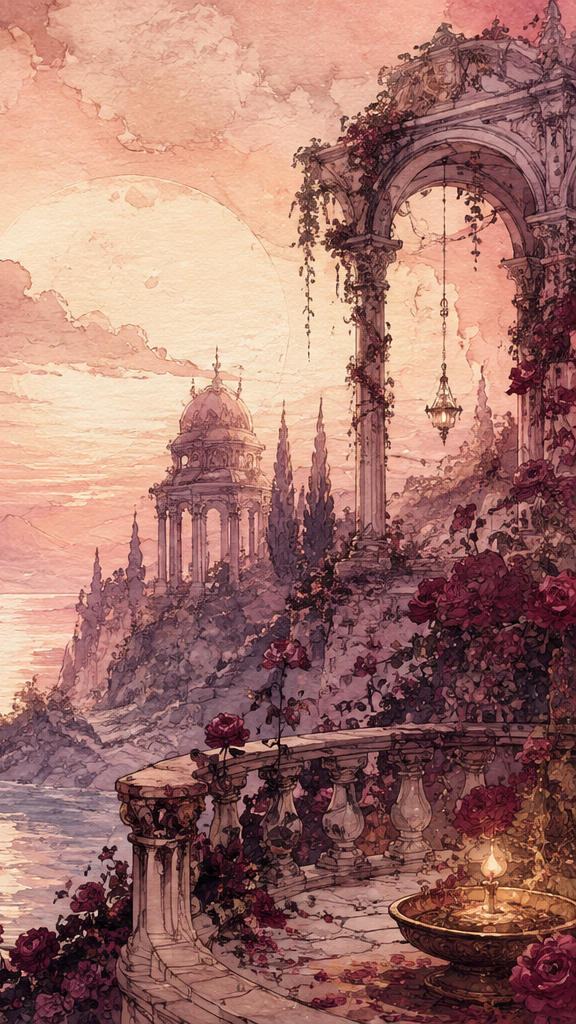
Eshtharan temples are designed to make certainty unreliable without making visitors feel unsafe. Corridors curve where straight passageways would have sufficed. Sheer veils divide spaces without fully hiding them. Still pools reflect ceilings that differ slightly from those overhead. Whisper chambers are engineered so that soft speech travels farther than loud speech. A phrase spoken gently in one corner may arrive clearly at the opposite wall while a shout seems to vanish after several feet.
Temple windows frequently incorporate the Dreamweaver’s Eye. The central spiral catches daylight and casts slowly shifting crimson and violet patterns across floors and walls. Sleeping sanctuaries are among the most sacred chambers. They are also comfortable.
Eshtharan theology sees little spiritual value in unnecessary discomfort. Beds, pillows, blankets and clean water are devotional necessities rather than luxuries. A mind exhausted by preventable misery, priests teach, has not become holier. It has merely become tired.
Rites, Taboos & Divine Signs
Rite of the Velvet Drift
The Rite of the Velvet Drift brings willing participants into synchronized states of calm through breath, whisper and controlled sensory focus. Some traditions incorporate consensual touch, while others use only voice, music, incense or shared breathing. The rite’s purpose is not identical thought but shared rhythm.
Participants who sleep afterward occasionally report fragments of the same dream. Such experiences are recorded carefully, but Eshtharan clergy resist treating every similarity as proof of supernatural contact.
Sometimes two people dream of the same garden because they spent an hour discussing gardens beforehand. Sometimes neither has ever seen the black tree waiting at its center.
Rite of Somnus Binding
Somnus Binding traditionally joins two willing participants for a night of ritual dreaming. Each prepares a matching token, often a small spiral of thread, glass or painted wood. The pair then sleeps within the same consecrated chamber after speaking aloud what kinds of dream contact they welcome. Older rites describe lovers sharing visions “as one mind.” Modern temples use the language more carefully. Participants may encounter shared locations, recurring symbols, overlapping emotions or another person’s apparent dream-presence. The rite is now practiced by lovers, close friends, family members and companions facing separation.
Rite of the Silver Spiral
A spiral is painted upon the participant’s skin using temporary ritual pigment. Beginning at the outermost curve, the participant slowly traces the design while naming assumptions, fears or certainties they are willing to examine. Older accounts say the tracing continues until “surrender overtakes will.” Modern Eshtharan teaching reframes the rite around the willing suspension of certainty. Before beginning, the participant decides what may be questioned. They may end the rite whenever they choose. At dawn, the spiral is washed away. The washing is as important as the painting. One returns from the spiral.
Rite of the Echoed Desire
A worshipper whispers a confession, hope, fear or desire into consecrated mist. Then the chamber becomes silent. Sometimes nothing returns. Sometimes the worshipper hears their own words repeated with an unexpected emphasis. Rare accounts describe an answer spoken in Eshthara’s voice. Priests refuse to declare such answers unquestionably divine. The voice may belong to Eshthara. It may belong to the Dreamweave. It may belong to the worshipper finally hearing themselves clearly. Eshtharan theology considers all three possibilities worth examining.
Whisper-Kneeling
Whisper-Kneeling is a private rite performed alone. A devotee kneels or sits in darkness and speaks softly to Eshthara until ordinary self-consciousness begins to fade. They may confess, complain, fantasize, question or simply describe whatever thoughts arise. No priest listens. The rite teaches that a thought does not require an audience to become worthy of attention.
Dream-Offering
A worshipper writes a fantasy, fear, question or impossible hope onto thin parchment. The parchment is burned with dream incense before sleep. The purpose is not to destroy the thought. It is to surrender control over how the thought must return.
Taboos
Eshthara’s strongest taboo is the theft of the interior self. Her temples condemn forcing trance upon the unwilling, entering another person’s dreams without invitation when such intrusion can be avoided, exploiting revelations made during trance and disguising coercive manipulation as spiritual guidance. Consent to trance is not consent to everything that might occur during trance. Consent to dream-sharing is not consent to every memory.
Consent given yesterday is not automatically consent tonight. Eshtharan clergy also condemn deliberately creating nightmares to punish, humiliate or control another person. Dream magic can reveal frightening truths, but fear used merely to break resistance is regarded as desecration. Older traditions forbid violently breaking trance. Modern priests interpret this as a principle of care rather than supernatural law: a vulnerable mind should be returned gently whenever circumstances allow.
Signs of Eshthara’s Claim
The archives describe several marks historically called Markings of Ownership. Many contemporary temples instead call them Signs of Resonance, arguing that divine favor should not imply possession of the worshipper.
Eshthara has never resolved the terminology dispute.
Common signs include a silver tongue-shaped sigil appearing behind one ear, temporary spiral markings upon the wrists or hips, breath becoming pale mist in warm rooms, closed eyelids glowing faintly during trance and a subtle echo beneath a devotee’s whisper.
Other traditions report rose-violet spirals briefly appearing within the iris, impossible clarity in dream memory, petals drifting upward around the marked or dreams continuing for several heartbeats after the dreamer has opened their eyes.
Signs usually fade.
Permanent certainty would be an unusual gift from Eshthara.

Eshthara and the Velvet Court
Eshthara occupies a necessary place within the Velvet Court because desire cannot change without imagination. Velyssara gives desire permission to exist. Eshthara gives it somewhere impossible to go next. Every divine current can become stagnant when mortals assume they already understand what it means, and Eshthara’s function within the Court is to place uncertainty back into certainty.
Her question to every god is essentially the same: “What else could this become?”
Cyrillith remains her closest creative counterpart in surviving traditions. Cyrillith gives possibility a role, costume and story through which to be explored; Eshthara allows the imagined role to become psychologically real enough to reveal something genuine.
An old shared saying claims: “Cyrillith writes the dream. Eshthara persuades you it was always yours.”
Delavira’s distance creates spaces that imagination instinctively fills. Their priesthoods therefore overlap in rites of anticipation, fantasy and longing, although Delavira preserves separation where Eshthara often dissolves certainty around it. Nyzun represents structure, discipline and tested limits, making him a productive theological counterweight. Nyzun asks whether a boundary can withstand pressure. Eshthara asks whether the boundary was drawn in the right place.
Solynth’s modern theology emphasizes service, purpose and belonging rather than the older shared identity of generalized submission. Their remaining affinity lies in chosen trust: Solynth teaches fulfillment through willingly placing one’s effort in service to something meaningful, while Eshthara examines what may be discovered when one willingly allows another perspective to guide attention.
These relationships are theological currents rather than fixed personal alliances. Myths disagree about whether the gods behave toward one another as collaborators, rivals, lovers or abstractions wearing personalities for mortal benefit. Eshthara’s faithful consider the disagreement appropriate.
Miracles & Divine Presence
Eshthara’s miracles rarely begin with spectacle. They begin with something being slightly wrong. A reflection blinks half a heartbeat late. A staircase reaches a floor the building does not possess. A locked door opens onto the dreamer’s childhood bedroom. A nightmare monster sits down and quietly apologizes. A whispered sentence crosses an enormous chamber without becoming louder. A harsh command reaches the listener as a gentle question.
Everyone involved in an argument suddenly remembers the same lullaby. Mist spills from a devotee’s lips during prayer. Written words rearrange when read twice. Petals rise instead of falling. A familiar corridor becomes longer every time someone insists they know exactly where it leads. Sleepers sometimes speak truths they cannot remember saying. Prophetic dreams may leave behind physical traces: damp footprints from an ocean never visited, unfamiliar petals on a pillow or ink stains shaped like constellations that do not exist.
Eshthara herself rarely arrives by simply appearing in front of someone. Dreamers more often notice that she was already there. She may be seated at the far end of a room that did not exist a moment earlier. She may stand in a reflection while the space behind the dreamer remains empty. She may be climbing a staircase through a dissolving dreamscape before pausing to look back over one shoulder. Her expression seldom suggests surprise. It suggests recognition. As though the dreamer has finally arrived where she expected them.
What Her Faith Teaches
The Subconscious Is a Temple
One of Eshthara’s oldest surviving teachings declares that the subconscious is a temple. Modern theologians are careful with the phrase. A temple may contain beauty and revelation, but it may also contain abandoned chambers, inherited fears and things placed there by people who had no right to enter. A hidden thought is not automatically true merely because it is hidden.
The sacred responsibility is attention. Listen beneath thought. Discover what is yours. Discover what was given to you. Decide what you still wish to carry.
Trance Is Trust Made Manifest
The archives preserve another central doctrine: Trance is trust made manifest.
The teaching remains important, particularly within Eshthara’s intimate traditions. To deliberately narrow one’s attention while another person guides the process is an act of vulnerability. That vulnerability creates responsibility for the guide. Authority within trance is temporary. Consent remains active. Emergence remains possible.
Nothing confessed in a ritual grants automatic permission outside it. Eshtharan clergy often say that anyone capable of inducing deep trance but incapable of accepting the word stop understands technique but not the goddess.
Desire Speaks When the Mind Grows Quiet
Eshthara teaches that people can become remarkably skilled at arguing themselves away from what they want. Some desires should be refused. Some should be questioned. Some need merely to be named before their power diminishes. Others reveal futures worth pursuing.
Silence creates room in which those distinctions may become clearer. This is why Eshtharan worship values sleep, meditation, slow breath and repetition. These practices do not manufacture desire. They reduce enough noise that desire can finally be heard.
Influence Is Inevitable
No person lives without influence. Language influences. Stories influence. Parents influence children. Students influence teachers. Architecture influences movement. Friends influence values.
Lovers influence one another. Memory influences the present. A god influences mortals simply by being believed in. Eshthara’s faithful therefore consider complete independence from influence an illusion. The meaningful questions are different:
- Who is influencing you?
- Toward what?
- Do you understand what is being asked?
- May you still refuse?
When the answer to the final question is no, sacred influence has become something else.
Reality Is Negotiable
This is perhaps Eshthara’s most famous and most frequently misunderstood teaching. She does not claim that desire makes facts disappear. A blade remains sharp. A promise still matters. Consequences survive reinterpretation. Death cannot be made unreal merely because grief rejects it. What may be negotiated is the meaning placed around reality, the expectations through which it is encountered and the range of possibilities one allows oneself to perceive. A wall remains a wall. It is not proof that there is no door.
At the Table
Eshthara naturally supports campaigns involving dreams, prophecy, enchantment, illusion, unreliable perception, shared dreamscapes, political persuasion, supernatural mysteries, inspiration, memory and the unstable boundary between imagination and reality. She can serve as a comforting household deity, patron of artists and teachers, mysterious source of prophecy or divine force behind increasingly strange dream adventures. Nothing about using Eshthara requires erotic mechanics. She remains a complete deity of dreams, persuasion, meditation, prophecy, imagination and altered perception in a standard 5e-compatible campaign.

Divine Traditions
The archives associate Eshthara with several divine and magical traditions. Clerical traditions include Dream, Enchantment and Charm, with minor associations to Shadow. Paladin traditions include the Oath of the Velvet Mind and Oath of the Whispered Will. Bardic traditions include the College of Trance, College of Whispers and College of Echoes. Druids associated with Eshthara may follow the Circle of Mists, while warlocks appear in the archives under the Pact of the Dreamweaver and Pact of the Silver Whisper.
These names remain valuable setting concepts, but bespoke mechanics require conversion to the current Second Bloom rules.
(Needs updated mechanics)
Boons of Eshthara
The archives preserve three particularly useful blessing concepts.
Silver Whisper enhances persuasion delivered through calm or whispered speech.
Dream-Slip grants limited access to magical sleep or emotional calming without normal preparation.
Trance Bond enhances Eshtharan effects when supernatural influence is established through deliberate whisper or trance.
The concepts remain appropriate, but final mechanics should be rebuilt in the current Base 5e → Veiled → Unveiled structure.
(Needs updated mechanics)
Velvet Enthrallment
Older Eshtharan traditions describe a once-per-rest ability called Velvet Enthrallment, allowing a whispered phrase to place a creature into light hypnosis after a successful magical effect.
The concept is worth preserving, but its modern version should represent narrowed supernatural attention rather than automatic obedience. A creature must retain clearly defined mechanical and narrative avenues for resistance.
(Needs updated mechanics)
Dreamweaver’s Voice
The archives also preserve Dreamweaver’s Voice, a divine manifestation in which the cleric’s speech becomes dream-mist and nearby creatures enter altered states of attention.
The concept remains strong for a Channel Divinity option or comparable divine feature. Its final form requires explicit range, duration, saving throw, conditions and alternatives under current mechanics.
(Needs updated mechanics)
Eshthara and Desire Mechanics
When the optional Desire system is active, Eshthara is naturally associated with EROS Saves, temporary Arousal generated through dream or suggestion effects and voluntary trance states.
Her mechanics should never assume sexual consent or convert a failed save into narrative permission. Mechanical pressure represents supernatural influence, emotional tension or altered concentration; players retain control over how that pressure appears in the fiction.
(Needs updated mechanics)
Sacred Relics
The Silver Tongue Charm
Wondrous item, rare
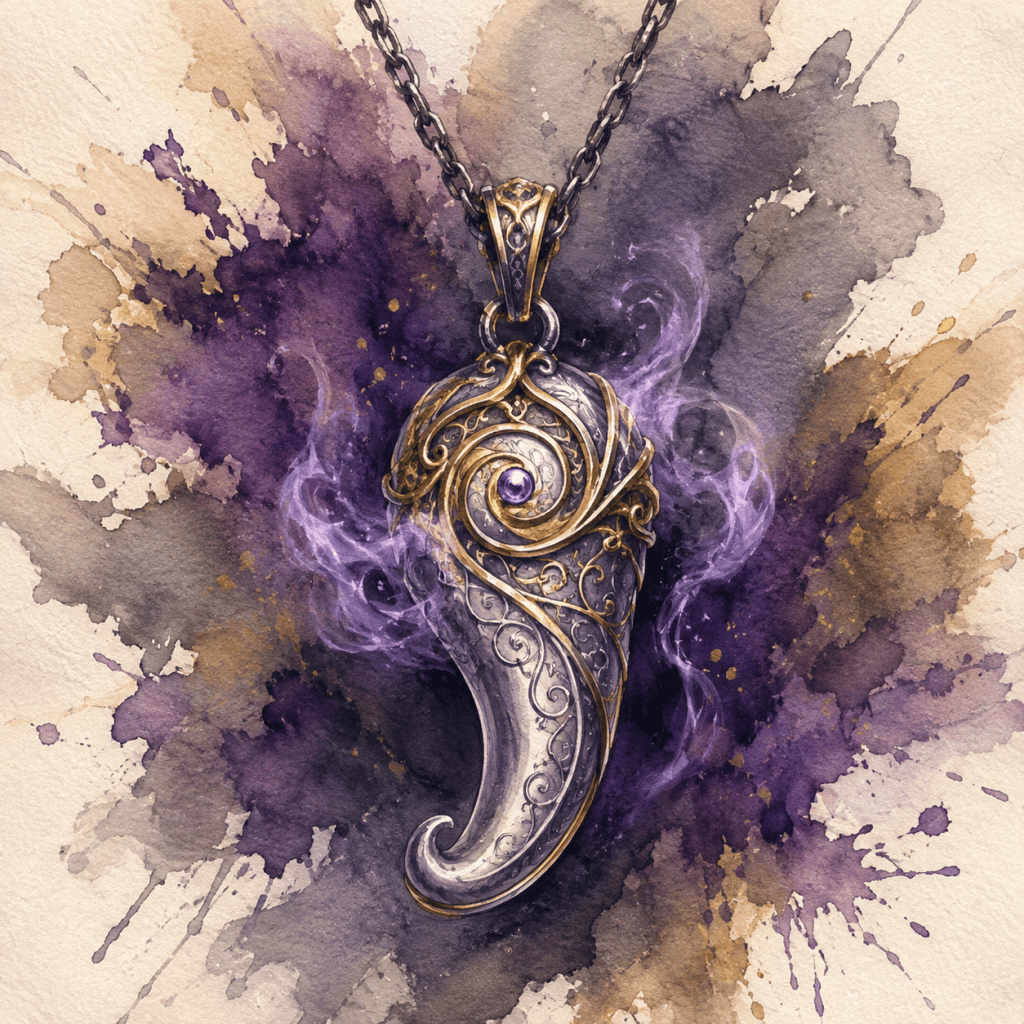
A small silver-and-gold charm traditionally worn at the throat. Some are shaped like a narrow curled tongue, while newer examples echo the central spiral of the Dreamweaver’s Eye. When the wearer whispers, silver-violet mist occasionally gathers around their lips. The archival version strengthens enchantment magic delivered through whispered speech. The concept remains suitable for Eshthara but requires conversion to the current item framework.
(Needs updated mechanics)

Dreamweaver’s Mist Phial
Wondrous item, uncommon
This slender vial of violet dream-glass contains pale mist that never condenses into liquid. When uncorked, the mist spreads slowly rather than dispersing. Those who breathe it describe quiet thoughts, softened tension and the sensation of standing at the threshold of sleep. Older traditions describe the phial as inducing trance-like calm.
(Needs updated mechanics)
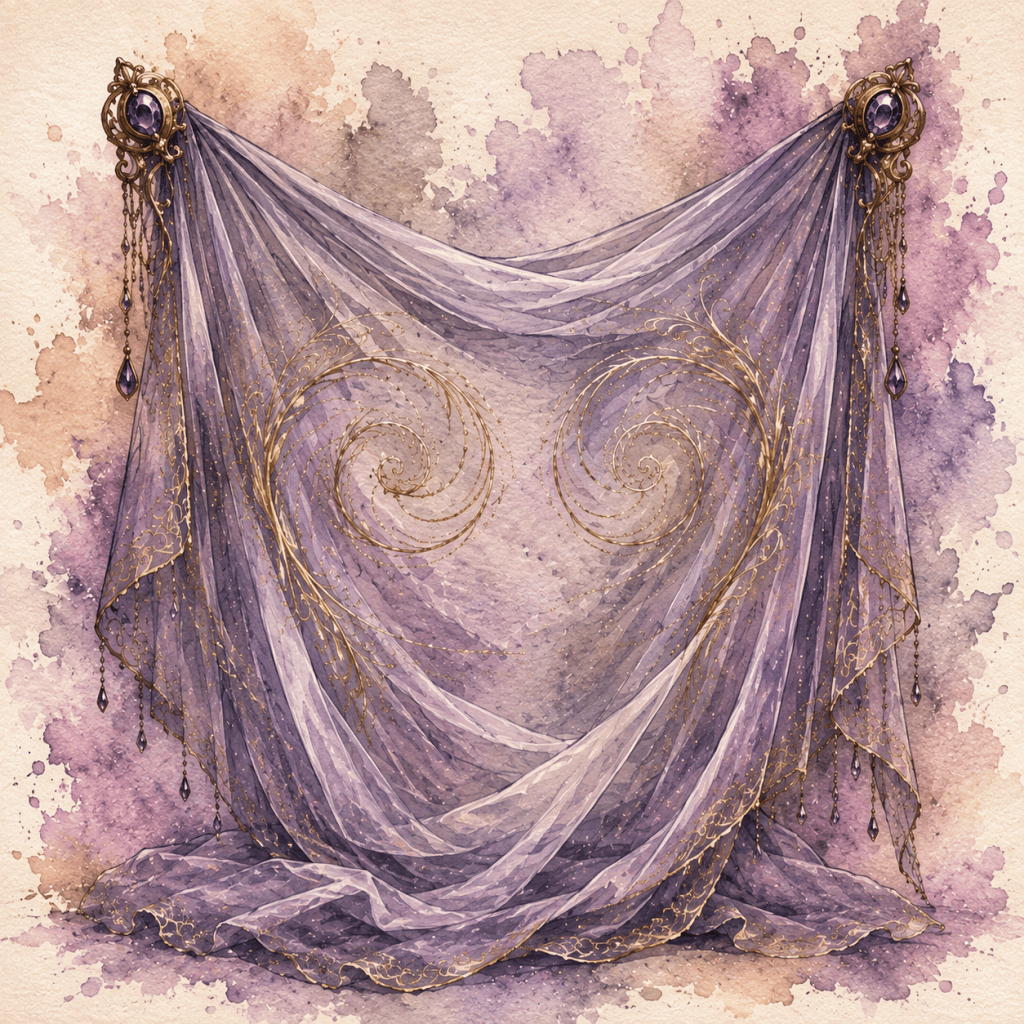
Veil of Echoed Desire
Wondrous item, rare
A nearly weightless veil of lavender-gray fabric embroidered with two golden spirals whose curves repeatedly approach one another without fully merging. The archives claim that two willing creatures beneath the veil may share thoughts, fantasies or fragments of imagination for several minutes. The veil appears frequently in rites involving lovers, trusted companions and reconciliation after conflict.
(Needs updated mechanics)
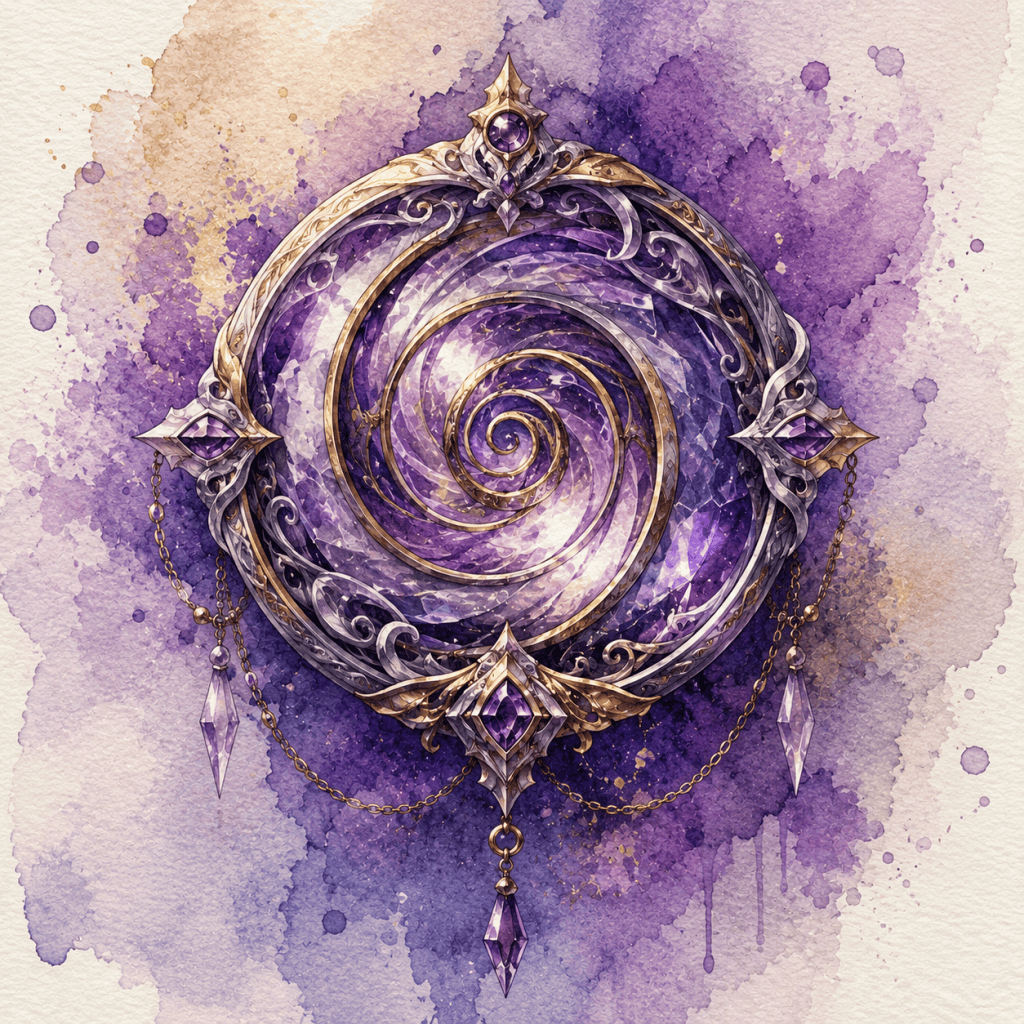
The Whispering Spiral
Wondrous item, very rare
A circular relic of silver, gold and violet crystal bearing a spiral whose center never appears in precisely the same place twice. The Whispering Spiral is traditionally used in consensual trance and prophetic dream rites. Those who meditate while touching it sometimes experience visions attributed to Eshthara. The archives disagree about the source of those visions. Some claim the goddess speaks through the relic.
Some attribute them to the Dreamweave. Others insist the Spiral merely allows the mind to hear itself without interruption. Eshtharan priests consider uncertainty part of the relic’s sacred function.
(Needs updated mechanics)

Adventure Hooks
The Town That Dreams Together
Every resident of an isolated town begins sharing the same dream each night. At first the phenomenon feels miraculous. People speak with dead relatives, revisit lost homes and explore impossible landscapes together. Then sleepers begin remaining unconscious longer, and several announce that they have no intention of returning permanently to waking life. The characters must discover whether Eshthara blessed the settlement, whether something else has entered the shared dream or whether the townspeople themselves have unconsciously built a world too beautiful to abandon.
The Stolen Silver Tongue
A sacred Eshtharan relic disappears shortly before negotiations between rival powers. Witnesses on both sides begin repeating phrases they do not remember hearing. Each faction accuses the other of supernatural manipulation, and peace negotiations rapidly deteriorate. The characters must recover the relic while determining whether anyone is truly controlling the speakers or whether suspicion itself has become the more dangerous influence.
Mist From the Dreamweave
Lavender mist begins appearing inside homes throughout a major city. Anyone entering it experiences memories belonging to strangers. As the phenomenon spreads, identities begin bleeding together and people wake with knowledge they could not possess. Something within the Dreamweave appears to be remembering itself through thousands of mortal minds.
The Missing Dream-Speaker
A respected Dream-Speaker enters a recurring nightmare to help a child and never returns. The child awakens normally. The priest does not. Each night, the child dreams of seeing the missing cleric walking deeper into an impossible palace. Rescuing her requires entering a dream where every door opens onto what the adventurers expect to find. The maze becomes most dangerous when someone becomes certain.
The Dream That Comes Home
A young artist discovers that objects dreamed during the night appear physically beside the bed each morning. At first they are harmless: flowers from nonexistent gardens, unfamiliar coins and pages torn from books no one has written. Then a person appears. They remember an entire childhood, friendships, heartbreaks and years of life. They insist they are real. More troublingly, they insist the waking world is the dream.
The Fourth Moon
Unrelated sleepers across Erosia begin dreaming of a fourth moon hanging beside Azure, Pearl and Crimson. Priests initially dismiss the image as a contagious symbol until the fourth moon begins appearing in mirrors and still water. No one can see it by looking directly into the sky. Several of Eshthara’s oldest Dream-Speakers recognize it. None wish to explain why.
Scents for Gameplay
Eshthara’s manifestations are often recognized by scent before sight. Her aromas should feel familiar enough to comfort while containing one detail that makes the familiarity uncertain.
| d12 | Scent |
|---|---|
| 1 | Lavender warmed beneath blankets |
| 2 | Crushed violet petals upon cool stone |
| 3 | Night-blooming jasmine drifting through mist |
| 4 | Incense extinguished moments ago |
| 5 | Rain falling beyond an unseen window |
| 6 | Old parchment beside freshly spilled ink |
| 7 | Dark wine touched with clove |
| 8 | Clean linen from a half-remembered childhood room |
| 9 | Rose petals floating upon cold water |
| 10 | Sweet smoke with no visible source |
| 11 | A perfume the observer is certain they should recognize |
| 12 | Whatever scent the observer most strongly associates with sleep, safety or dreaming |
The strongest manifestations rarely smell entirely strange. They smell like something remembered incorrectly: a childhood room filled with the wrong flowers, a lover’s perfume remembered years before meeting them or rain from a country the dreamer has never visited. Eshtharan priests regard that contradiction as one of the clearest signs of her approach.
Something familiar has shifted. Certainty has loosened. And somewhere beyond waking thought, another possibility has opened its eye.
 Whispers of Erosia
You must be logged in to post a comment.