
Building Your First Erosian Character
Creating a character in Whispers of Erosia begins with the familiar foundations of Fifth Edition fantasy roleplaying: choose who your character is, determine where they came from, select the path they follow as an adventurer, and turn those choices into abilities you can use at the table.
Erosia adds another question. What shaped this person before the adventure began?
Race, culture, Background, Class, faith, desire and personal history do not need to exist as separate boxes on a character sheet. The most memorable Erosian characters emerge when those choices begin explaining one another.
You do not need to know the entire world before you begin. Start with one idea, make one choice at a time, and allow the character to become clearer as you go.
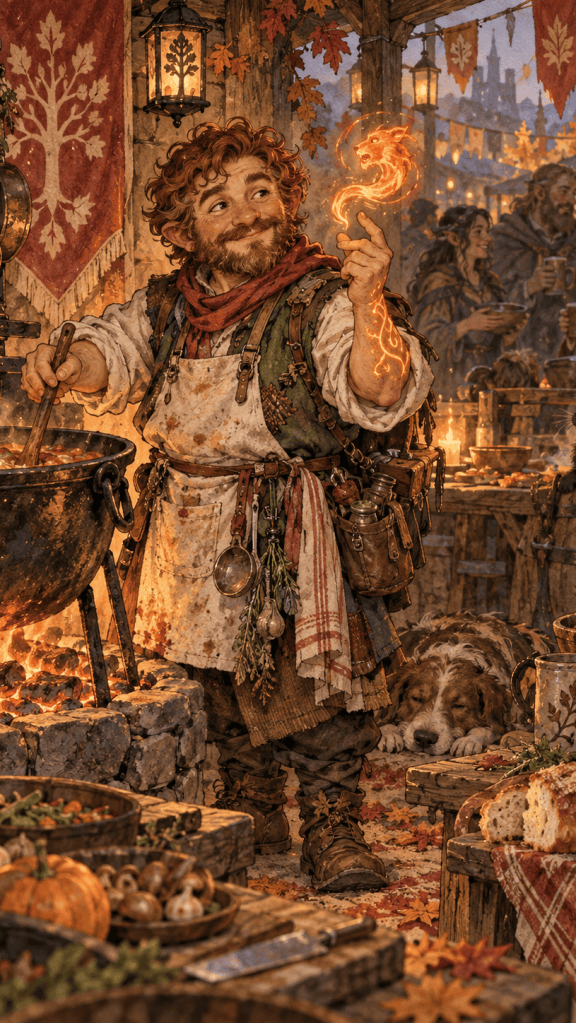
Example: Pip Emberkettle
Pip began with a very simple idea: a middle-aged Hearthkin cook who believes nobody should have to face a cold night on an empty stomach.
By the end of character creation, that idea became a Scentstruck Hearthkin Summoner whose relationship with memory, food, hospitality and fire shapes nearly everything he does.
1. Begin With a Person
Before choosing mechanics, imagine the person you want to play.
You do not need a complete history. A profession, personality, visual image, contradiction or simple fantasy is enough.
You might begin with:
- a traveling healer who hates being touched
- a knight who wants desperately to be admired
- a scholar fascinated by forbidden transformations
- a thief who treats clothing and disguise as an art form
- a wandering cook who remembers people by the smells of their kitchens
- a devoted priest questioning what devotion actually means
- a mercenary who discovers they enjoy protecting people far more than fighting
At this stage, avoid worrying about optimization. You are establishing a direction, not completing the character.
Ask yourself three questions:
What did this person do before becoming an adventurer?
What do they want now?
What makes them interesting to you?
Those answers will help guide every choice that follows.
Pip Emberkettle
Pip begins as a Hearthkin cook and hearthkeeper from Brindleburrow. He loves good food, warm kitchens, familiar smells and the moment strangers stop behaving like strangers because someone finally put dinner on the table.
Nothing about that concept requires a Class yet.
2. Choose Your Race and Lineage
Your Race establishes more than appearance. It connects your character to one of the peoples of Erosia and provides traits reflecting anatomy, culture, inherited abilities and the ways that people move through the world.
Some races also offer optional lineages that represent different communities, environments or traditions within the same people.
When choosing a Race, consider both mechanics and identity.
Ask:
- Where did this character grow up?
- Which parts of their culture do they embrace?
- Which parts do they reject?
- How has their ancestry affected the life they lived before adventuring?
A character does not need to embody every cultural tendency associated with their people. Culture provides context, not a personality requirement.
What Changed?
Choosing a Race gives the character their first mechanical foundation: size, speed, languages, racial abilities and possibly lineage traits. It also gives you a place from which to begin thinking about family, community and culture.
Pip Emberkettle
Pip becomes a Hearthkin, a people strongly associated with hospitality, curiosity, shared meals, communal kitchens and belonging.
His Burrowkin lineage gives him proficiency with cook’s utensils.
The character concept and racial mechanics are already beginning to reinforce one another.
→ Explore the Peoples of Erosia
3. Choose Your Background
Your Background describes the experiences that shaped your character before they became an adventurer.
A Background is not the same thing as a Class.
A soldier may eventually become an Anointed. A scholar might become a Warbound. A merchant could become a Veilwalker. A bathhouse attendant might discover arcane talent. The skills learned during ordinary life often remain important long after an adventuring career begins.
Erosia supports both conventional and Desire-Shaped Backgrounds.
Conventional Backgrounds
Conventional Backgrounds (Traditional 5e Backgrounds) describe professions, social roles, education, hardship and other formative experiences. Examples might include a soldier, scholar, merchant, pilgrim, servant, steward, herbalist or survivor. Choose one when the most important question about your character’s past is:
What did they spend their life doing?
Desire-Shaped Backgrounds
A Desire-Shaped Background begins from a different question:
What were they drawn toward strongly enough that it caused them to learn something?
Desire does not replace experience. It creates it. A fascination with scent might lead someone toward perfume making, herbalism, tracking or cooking. A fascination with touch might lead toward massage, healing or anatomical study. A need to be seen could produce skills in performance, presentation or social observation.
The important question is not simply “What are they into?”
The useful character-building question is: “What did being into that cause them to learn?”
That experience becomes the Background.
Desire-Shaped Backgrounds may provide context for EROS Saves, Arousal and other Mechanics of Desire when appropriate, but they do not automatically cause Arousal, compel behavior or override consent.
What Changed?
Your Background gives your character evidence of a life already lived. Skills, tools, languages, contacts and special features should tell the table something about who this person was before initiative was ever rolled.
Pip Emberkettle
Pip chooses Scentstruck.
His fascination with scent explains why he learned to distinguish spices, smoke, herbs, oils, kitchens and familiar places through smell. Scent becomes connected to memory, comfort and belonging.
Scentstruck gives Pip competencies that make sense for the person we already imagined rather than changing him into someone else.
4. Choose Your Class
Your Class describes how your character acts as an adventurer.
It establishes the major mechanical systems through which you fight, protect, explore, cast magic, influence others, support companions and interact with the Mechanics of Desire. Classes in Whispers of Erosia are not simply familiar Fifth Edition archetypes with Erosian terminology placed over them. Each Class approaches desire, emotional pressure, restraint, devotion, passion, temptation or release according to its own fantasy.
A martial character should experience those systems differently from a divine character. An arcane specialist should interact with them differently from a performer or primordial conduit. Choose the Class that best expresses how you want to play, not merely what profession your character once held.
Ask:
- What does this character do when trouble begins?
- Where does their power come from?
- What resource or rhythm makes this Class distinct?
- How does the Class express the character you have already begun creating?
Pip Emberkettle
Pip becomes a Summoner.
That does not mean every cook should become a Summoner. It means Pip’s particular story develops in that direction.
His lifelong relationship with fire becomes connected to primordial power, while the Summoner’s Sublimation and Manifestation mechanics give his relationship with that power an actual gameplay rhythm.
5. Make Your Class-Specific Choices
Every Class asks different questions. Some choices may occur immediately. Others appear when you reach a particular level or choose a subclass. A divine character may make decisions concerning devotion. A martial character may choose a fighting discipline. A magical character may choose a tradition. Other Classes may establish bonds, practices, patrons, oaths, manifestations, techniques or other defining relationships.
Follow the character-creation instructions presented by your chosen Class. These decisions are intentionally not universal. There is no single Erosian equivalent of an oath, patron, awakening, discipline or divine calling that every adventurer experiences.
Pip Emberkettle
Pip’s Summoner Class introduces choices unique to Summoners, including his connection to the Primordial Titans.
Those details belong to Pip’s Class, not to the universal character-creation process.
6. Determine Your Ability Scores and Proficiencies
Once Race, Background and Class are established, complete the familiar mechanical foundations of your character. Determine your ability scores using the method approved by your table, then apply the proficiencies and features granted by your choices.
Record:
- Strength
- Dexterity
- Constitution
- Intelligence
- Wisdom
- Charisma
- Armor Class
- Hit Points
- Saving Throws
- Skill Proficiencies
- Tool Proficiencies
- Languages
- Weapon and Armor Proficiencies
- Racial Features
- Background Features
- Class Features
Do not look only at the highest numbers. Look at the pattern they create. A character with high Constitution, Insight, cook’s utensils and Persuasion already communicates something very different from one built around Dexterity, Investigation, disguise and Stealth.
The character sheet is beginning to describe a person.
7. Consider Faith, Philosophy and the Divine
The gods are deeply woven into Erosian culture, but not every character is a priest and not every character must worship the source of their Class abilities.
A character may:
- actively worship a deity
- participate in the religious traditions of their community
- feel especially aligned with one deity’s teachings
- honor several gods in different circumstances
- follow a personal philosophy
- reject organized worship
- remain uncertain
- have a supernatural relationship unrelated to the gods entirely
Faith can influence personality, ethics, rituals, relationships and worldview without becoming a mechanical power source.
Likewise, the source of a character’s supernatural abilities does not automatically determine their religion.
Pip Emberkettle
Pip’s supernatural relationship centers on Pyraxis through his Summoner Class.
That does not prevent him from appreciating religious traditions concerned with food, nourishment, harvest or hospitality. His magical source and personal spirituality do not need to be identical.
→ Explore the Pantheon of Erosia
8. Choose Your Level of Desire Integration
The Mechanics of Desire are part of what distinguishes play in Erosia, but groups may choose how deeply those systems enter the game. Character creation should follow the mode chosen by your table.
Veiled Play
Veiled Play preserves the emotional and mechanical rhythm of desire while keeping its presentation lighter and its bookkeeping streamlined.
Choose Veiled Play when the table wants desire, attraction, temptation, passion and emotional pressure to matter mechanically without making them a major tactical subsystem.
Unveiled Play
Unveiled Play uses the complete Mechanics of Desire.
Characters interact directly with systems such as:
- Arousal
- Libido
- EROS Saves
- Climax
- class-specific expressions of desire
- abilities that build, spend, redirect or benefit from those resources
Different Classes may interpret these universal mechanics differently.
A Class may rename or contextualize Arousal according to its fantasy, but that does not necessarily create a separate resource.
Always follow the Mechanics of Desire and your Class description when determining how those systems interact.
Remember
The Mechanics of Desire represent emotional, sensual, spiritual and ecstatic pressure within the rules. They never replace player agency and never imply consent to an action.
What Changed?
Choosing Veiled or Unveiled Play determines how much mechanical detail your table wants to track. The character remains the same person either way.
→ Explore the Mechanics of Desire
9. Choose Equipment, Spells and Other Options
Now begin filling the remaining spaces on the character sheet.
Choose equipment, spells, techniques and other available options according to your Race, Background, Class and level.
Mechanical effectiveness matters, but this is also an opportunity to strengthen the character concept you have been building.
Ask:
- Would this character actually carry this?
- Why did they learn this spell?
- Which ability would they rely upon first?
- What equipment survived from their old life?
- What item would they refuse to leave home without?
A perfectly optimized list is not required for a strong character.
A coherent list often produces more memorable play.
Pip Emberkettle
Pip carries cook’s utensils and a blackened kettle because those objects belonged to his life before adventuring.
When choosing magic, abilities concerned with flame, warmth, courage, protection and recovery reinforce his existing identity. His spell list therefore tells the same story as his Background and Race.
10. Connect the Pieces
This is the final step that makes an Erosian character feel complete. Look across the entire character sheet. Consider the relationships between: Race → Background → Class → Desire → Faith → Abilities
Then ask: Why do these things belong to the same person?
You do not need every choice to match perfectly. Contradictions can be just as interesting. A peaceful person may possess terrifying power. A devoted character may struggle with temptation. Someone raised within a strong cultural tradition may reject it completely. The goal is not uniformity. The goal is connection.
When one choice creates questions answered by another choice, a character begins to feel alive.
11. Find Your Character’s Gameplay Rhythm
Before the first session, imagine what your character is likely to do repeatedly during play. This is not a combat rotation. It is the pattern through which their personality and mechanics meet. A character might: observe → manipulate → escape or: protect → endure → retaliate or: tempt → build pressure → release or: investigate → prepare → exploit weakness
Knowing that rhythm makes unfamiliar Classes easier to learn because the player understands not only what individual abilities do, but why this character wants to use them.
Pip Emberkettle
Pip’s emerging rhythm looks something like:
notice → nurture → gather → protect → build pressure → release → recover
His Scentstruck Background encourages observation. Hearthkin abilities encourage hospitality. His Summoner abilities turn protection, elemental power and rising Sublimation into a mechanical cycle.
None of those pieces were chosen in isolation.
Pip Emberkettle: What the Process Produced
Pip began as one sentence: A middle-aged Hearthkin cook who believes nobody should face a cold night hungry.
Character creation transformed that idea into:
Race: Hearthkin
Lineage: Burrowkin
Background: Scentstruck
Class: Summoner
Former Calling: Cook and hearthkeeper
Primary Themes: Warmth, scent, memory, nourishment, belonging and fire
Mechanics of Desire: Sublimation expressed through the Summoner’s interaction with Arousal and Climax
Signature Identity: A traveling cook whose primordial magic feels as natural beside a stewpot as it does on a battlefield
No single choice created Pip. The character emerged from the relationship between all of them. That is the goal of Erosian character creation.
Your Character at a Glance
Before beginning play, you should be able to answer the following questions:
- Who was I before becoming an adventurer?
- What people and culture shaped me?
- What experiences became my Background?
- What desire, fascination or personal truth has influenced what I learned?
- What Class describes how I adventure now?
- What Class-specific choices define my path?
- What do I believe about gods, devotion or the world around me?
- How does my character interact with the Mechanics of Desire?
- What abilities, equipment or spells best express who I am?
- What pattern of behavior will other players begin recognizing as uniquely mine?
If you can answer those questions, your character is ready for Erosia.
Begin Your Journey
There is no single correct kind of Erosian adventurer. Your character may be heroic, selfish, romantic, devout, curious, frightened, ambitious, sensual, restrained, reckless, compassionate or some complicated mixture of all of them. Begin with a person. Let Race give them a people. Let Background give them a past. Let Desire explain what fascinated or changed them. Let Class determine how they face the extraordinary. Then see what happens when all those choices finally meet at the table.
Your story in Erosia begins there.
 Whispers of Erosia
You must be logged in to post a comment.