
Balcony Garden
Above the Lanterns
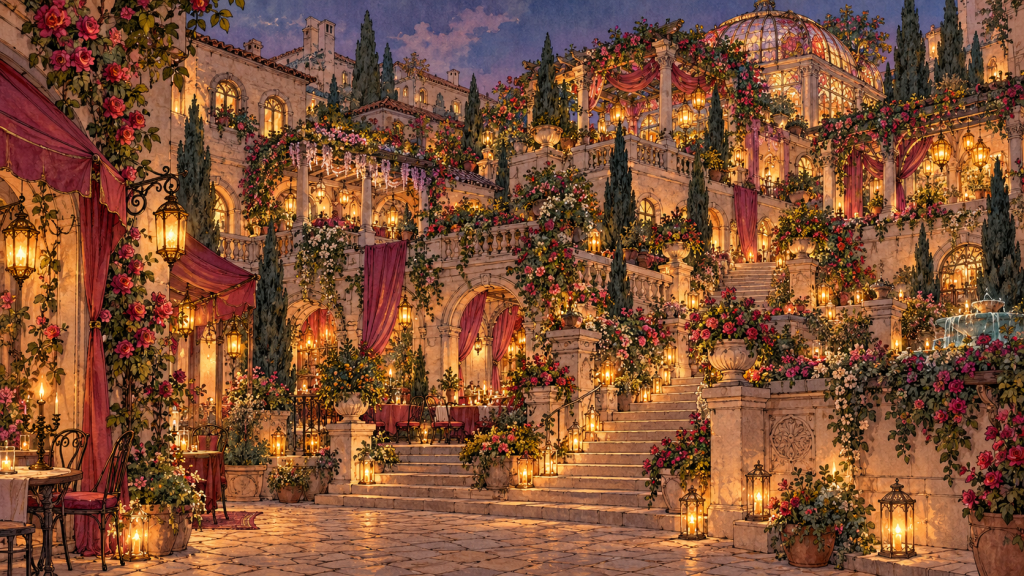
Above the lantern-bright streets of Roseglass Ward rises a garden with no single ground floor.
The Balcony Garden occupies a sprawling collection of interconnected terraces, rooftop courtyards, old stone balconies and suspended walkways built across several adjoining structures. Flowering vines spill from carved balustrades. Fruit trees grow from enormous ceramic planters. Silk awnings stretch between rooftops, while narrow bridges cross above streets glowing with theater lamps and festival lanterns.
It is neither tavern nor pleasure house, though elements of both brush against it. Visitors come to drink, flirt, gossip, court, negotiate, recover from performances, watch festivals from above or simply disappear into a quieter corner with someone whose company they are not yet ready to leave.
During the Embrace of Delight, every railing blooms with ribbons and flowers, and reservations for the upper terraces can be claimed weeks in advance.
Balcony Garden at a Glance
District: Roseglass Ward, Amarosa
Type: Rooftop garden, wine terrace and seasonal conservatory
Known For: Layered terraces, private balconies, moonvine, Three-Moon Wine, promise ribbons and the Turning Bloom
Atmosphere: Botanical, intimate, quietly social and softer than the streets below
Primary Role in Play: Courtship, conversation, downtime, rumor exchange, herbal sourcing and social intrigue
Daytime Rhythm: Garden work, herb drying, seed exchange and neighborhood deliveries
Nighttime Rhythm: Wine, conversation, private meetings and views across Roseglass
Faith Connection: Honors Talyss through seasonal cultivation without functioning as a formal temple
The Character of the Garden
The Balcony Garden is deliberately softer than much of Roseglass Ward. Music reaches it from neighboring streets rather than dominating the space. Laughter rises from below. Performers sometimes wander through with a lute or hand drum, but there is no central stage and no expectation that guests become an audience. Instead, the garden is arranged around conversation. Tables are small. Benches curve inward. Planters create natural screens without fully closing anyone away, and narrow pathways occasionally force two approaching visitors to decide which of them will step aside. At night, suspended glass lanterns illuminate the foliage in muted rose, amber and violet. Their light is intentionally low enough that Amarosa beyond the railings remains visible. The city is part of the decor.
The Terraces
The Lower Terrace
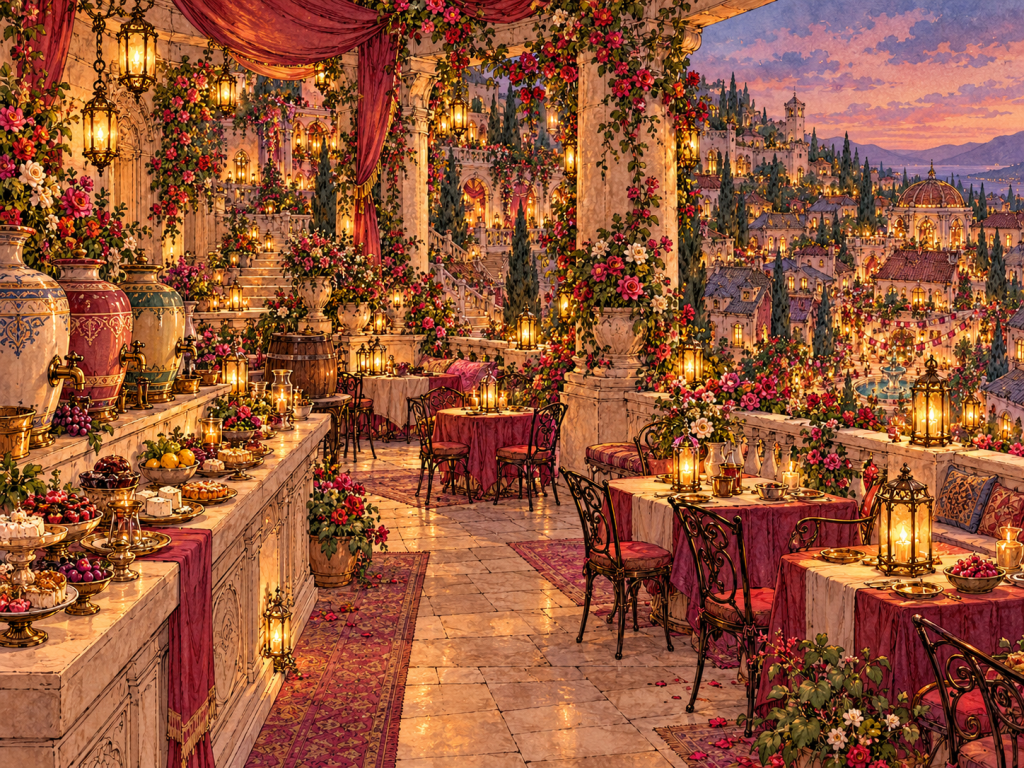
The largest and most public level contains the principal wine bar, communal seating and broad balconies overlooking Roseglass Ward. This is where strangers meet.
Long stone counters support ceramic amphorae of wine, chilled fruit, citrus water and small plates of cheeses, olives, pastries and preserved sweets. During festivals, it becomes one of the district’s best places to watch processions moving through the streets below.
The Hanging Walk
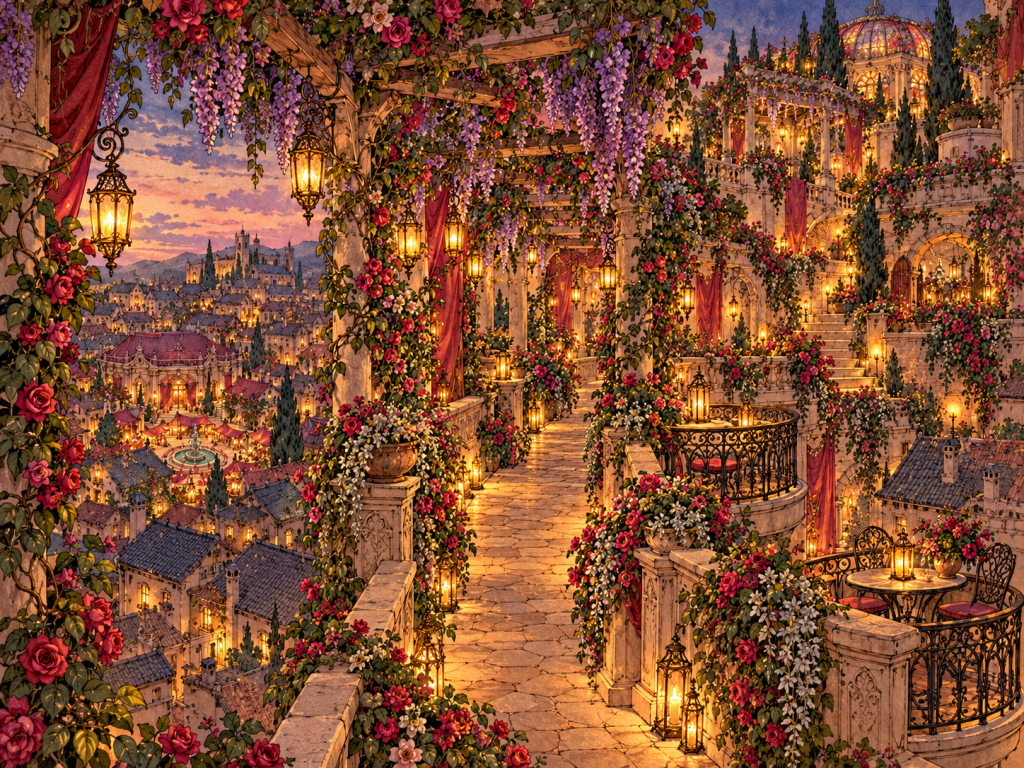
A narrow open-air bridge connects the lower gardens to the higher terraces. Wisteria, roses and trailing silverleaf grow from trellises overhead, leaving portions of the walkway partially concealed from neighboring rooftops.
Small standing balconies project outward at irregular intervals, each large enough for only two or three people. Locals joke that it takes considerably longer to cross the Hanging Walk with someone attractive than it does alone.
The Moonvine Terrace
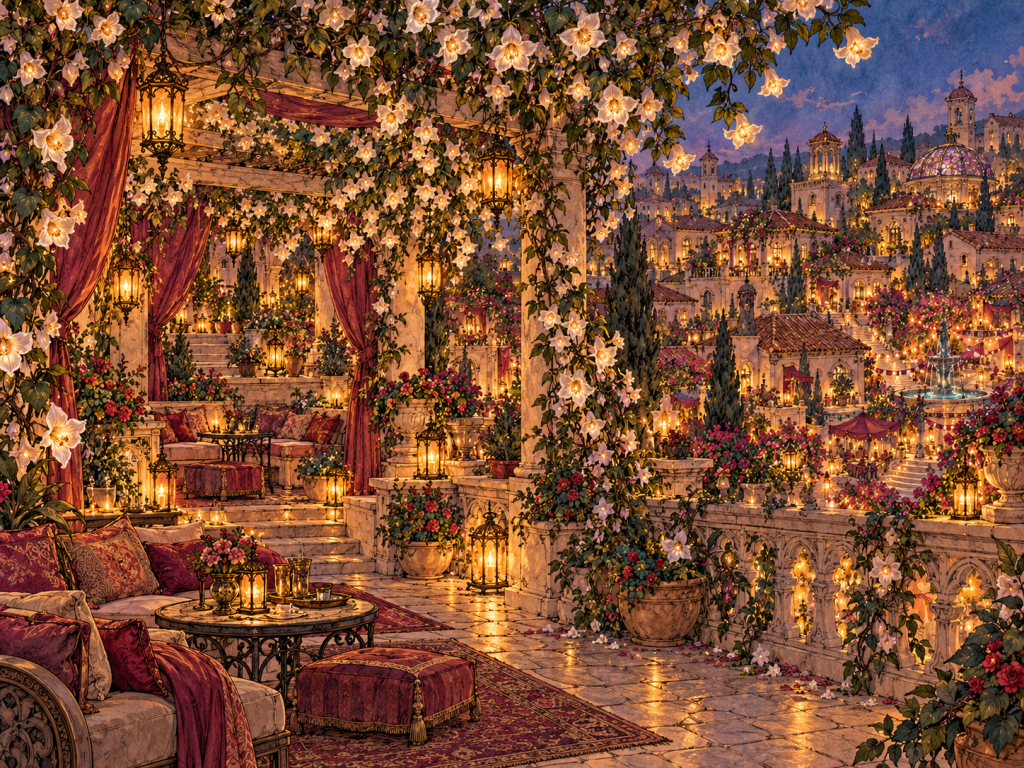
The quieter middle level is dominated by pale flowering vines that open after sunset. Low couches, cushioned benches and small tables rest beneath pergolas, and conversation is kept deliberately soft.
The Moonvine Terrace is popular for courtship, reconciliations, private celebrations and meetings where the participants wish to speak honestly without disappearing entirely from public view.
The Seven Balconies
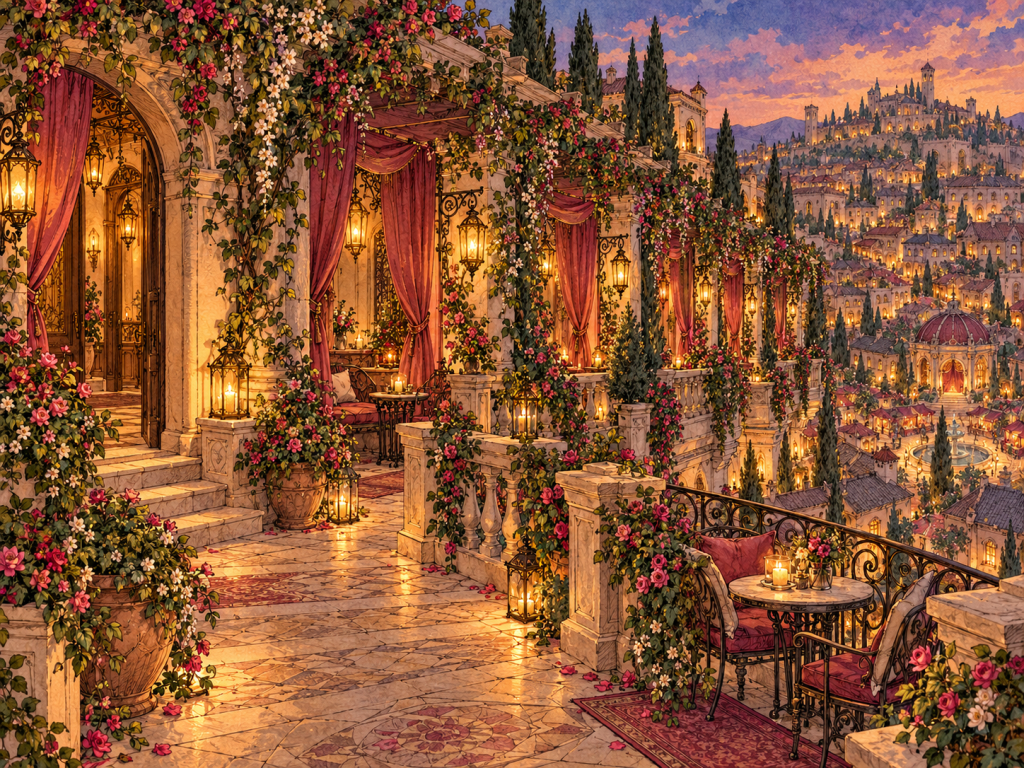
Seven individual balconies line one side of the garden, screened by stonework, vines and hanging curtains. Each overlooks a different portion of Amarosa.
They are not bedrooms and are not rented for sexual services. Their purpose is privacy without complete isolation: conversation, confession, kissing, quiet companionship or simply watching the city with someone important. Guests may reserve one for an hour.
The curtains may be closed, but the Garden maintains a simple rule: the door is never locked from the outside.
The High Garden
The uppermost terrace is smaller than visitors expect. A circular reflecting pool occupies its center, surrounded by herbs, flowering shrubs and three old fruit trees growing from beds of surprisingly deep soil. No bar operates here. Drinks must be carried up from below.
This is where Amarosa becomes quiet. The Azure, Pearl and Crimson moons are visible whenever cloud cover permits, and the pool reflects their light among drifting petals. Marriage proposals happen here. So do breakups. The Garden’s staff treats both with equal discretion.
Food and Drink
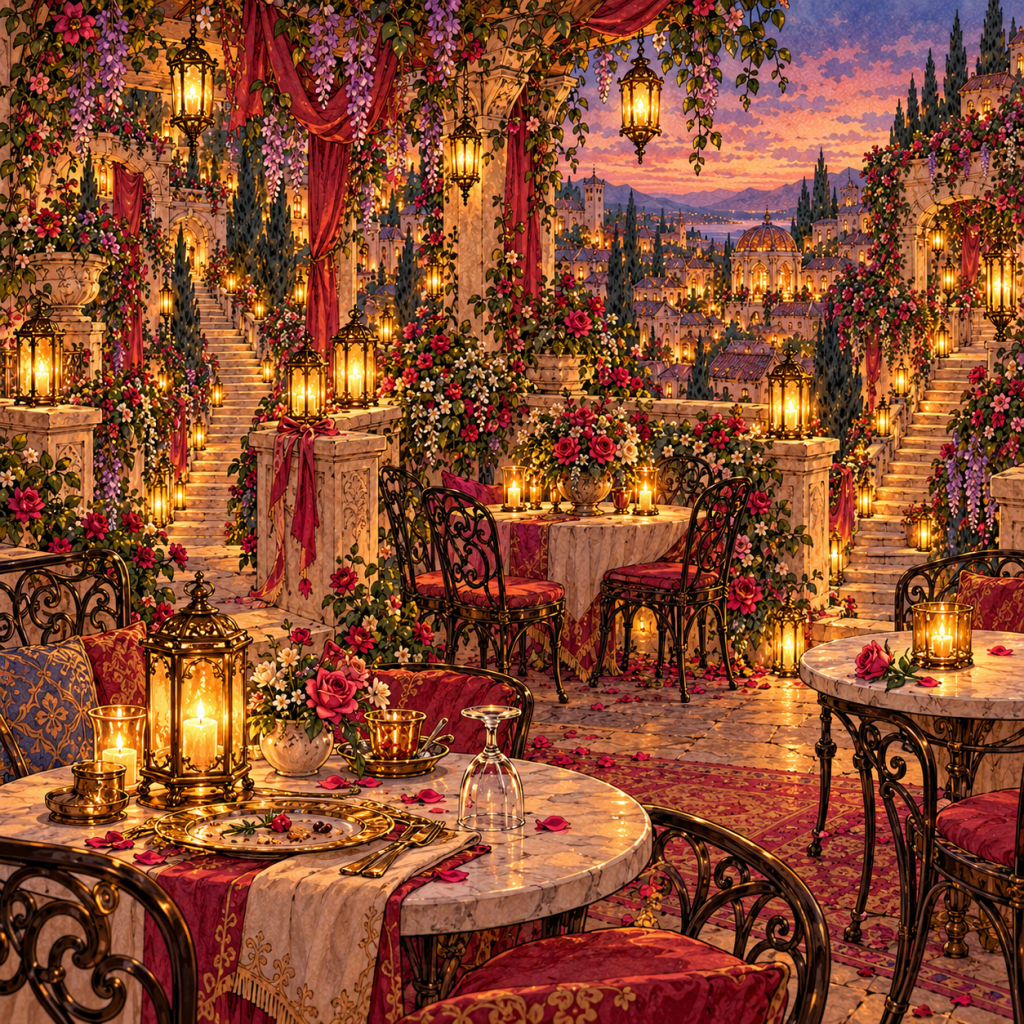
The Balcony Garden specializes in things meant to be consumed slowly. Rosewine, chilled white wines, herb-infused spirits, sparkling fruit drinks and floral teas form the heart of the menu. Food arrives in small shared plates rather than heavy meals. Common offerings include honeyed figs, spiced nuts, soft cheeses, sliced pears, stuffed vine leaves, roasted vegetables, sugared petals and small almond cakes soaked in citrus syrup. The house specialty is Three-Moon Wine, served as three small pours rather than one full glass. Each is blended differently and traditionally tasted in the order chosen by the guest. Amarosans insist the chosen order reveals something about the drinker. No two Amarosans agree on what.
Customs of the Garden
- A flower placed on the outer edge of a table means additional company is welcome.
- A flower placed in the center means the table prefers privacy.
- An empty glass placed upside down means the guest wishes to settle their account without interrupting the conversation.
- A ribbon tied to the railing of the Hanging Walk commemorates a promise. Garden staff never remove one intentionally. Wind, rain and time are permitted to decide how long promises remain.
- Visitors leaving together traditionally descend by a different staircase than the one by which they arrived.
No one remembers why. Everyone does it anyway.
The Conservatory of the Turning Bloom
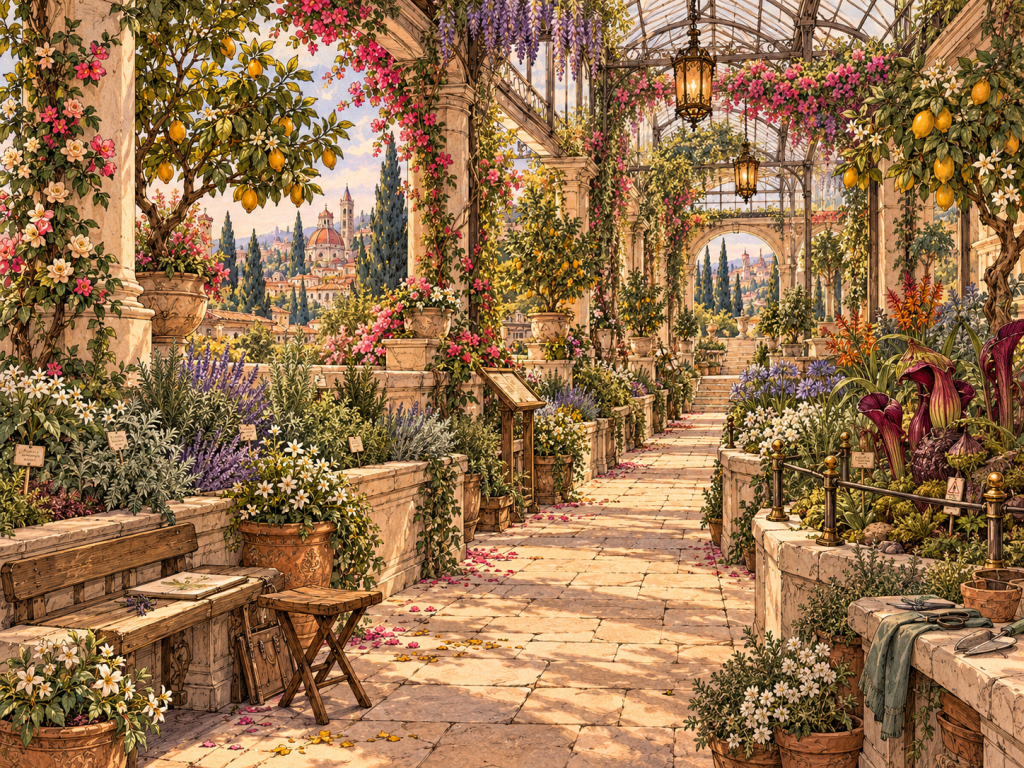
The Balcony Garden is more than a place to sit among flowers. Behind the public terraces lies a working seasonal conservatory where Roseglass gardeners cultivate culinary herbs, medicinal plants, fragrant vines, festival flowers and unusual botanical specimens gathered from across Erosia. Tall panes of rose-tinted glass capture the morning sun while vented roof panels can be opened to rain, sea air and moonlight. The interior is warm without being oppressive, threaded by narrow stone paths, raised beds and shallow channels that carry clean water between growing tables.
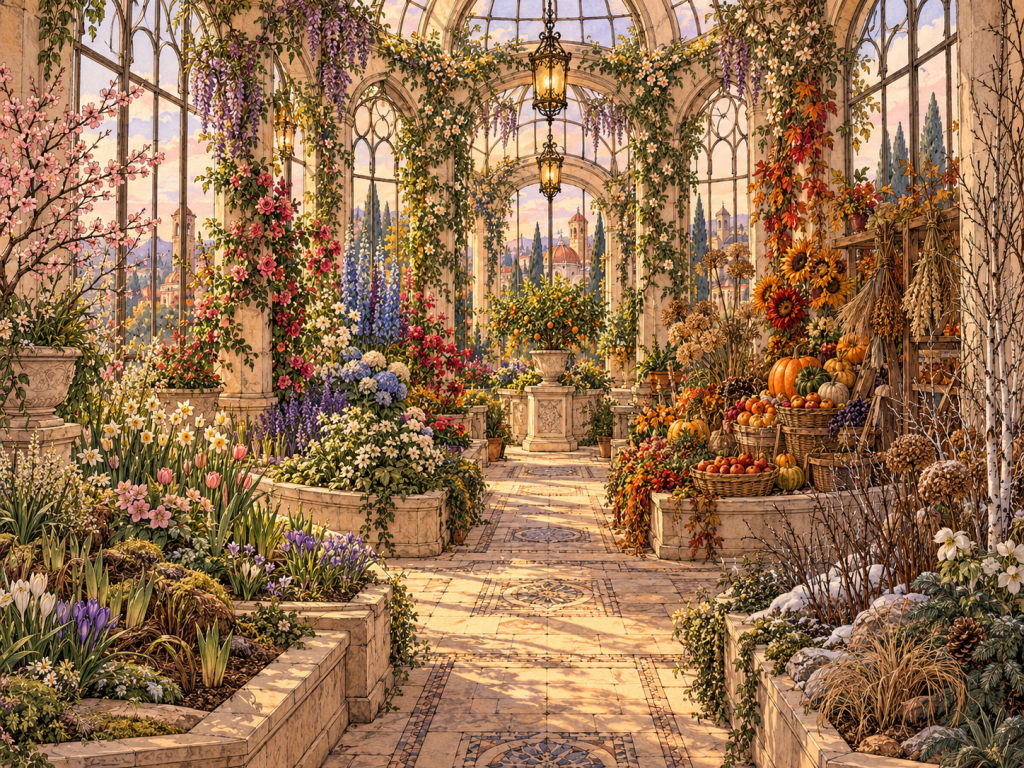
Locals call it the Turning Bloom because the conservatory is never arranged to pretend that every plant should flower at once. Its beds change with the season. Spring emphasizes shoots, tender leaves and first blossoms. Summer becomes lush with climbing herbs, fruiting vines and heavy fragrance. Autumn brings seed heads, orchard fruit, drying racks and roots lifted for storage. Winter leaves portions of the house deliberately sparse, preserving dormant bulbs, cuttings and sleeping beds beneath protective mulch.
This seasonal discipline reflects the teachings of Talyss, the Root Mother. The conservatory is not a temple, and no visitor is expected to worship her, but its gardeners openly honor the Talyssan understanding that life continues through cycles rather than endless expansion. Four small beds near the central cistern are traditionally marked Root, Swell, Bloom and Seed. Gardeners use them as a living calendar: what can sustain growth, what is gathering potential, what has become visible and what must be carried forward.
Abundance must leave something for tomorrow.
A common Talyssan saying among the Balcony gardeners
The Drying Gallery
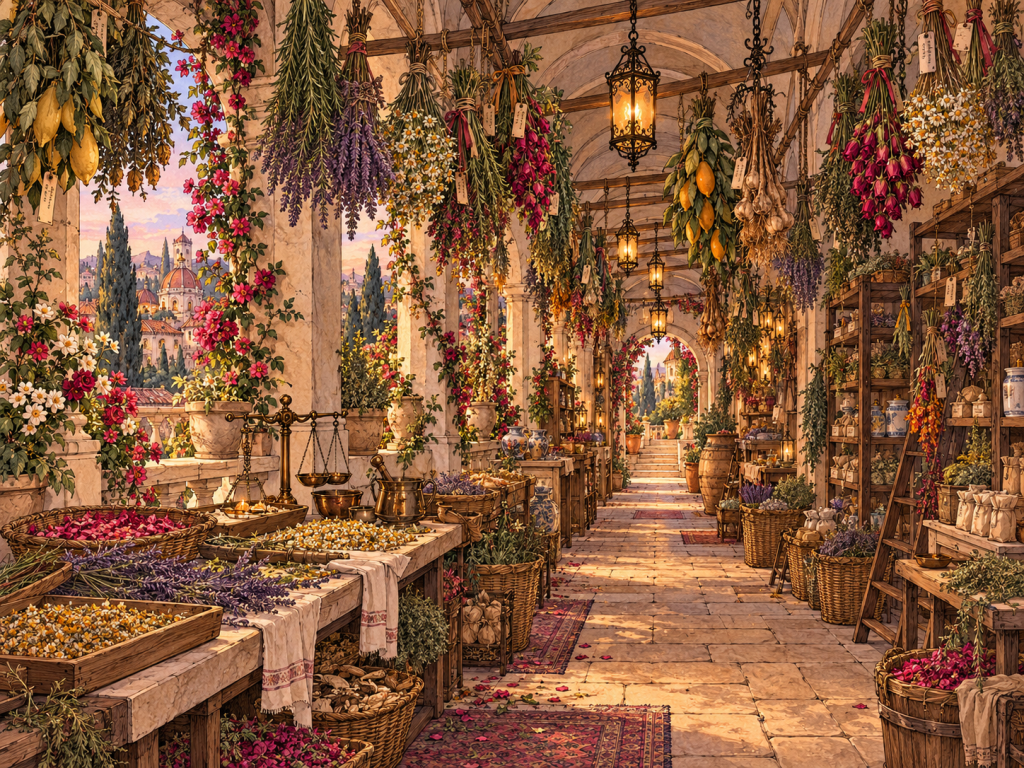
A long, shaded gallery runs beneath the eastern terrace where herbs and flowers dry in moving air rather than direct sun. Bundles hang from wooden rails with handwritten tags noting the plant, harvest date and intended use. Nothing magical is concealed behind an ordinary label. Plants reserved for medicine, enchantment or ritual are marked separately from culinary stock.
Most of the dried herbs are sold to neighborhood kitchens, perfumers, bath attendants and tea sellers. Smaller quantities remain available to adventurers with an herbalism kit, cooks looking for unusual flavor, or travelers seeking ingredients that would otherwise require a morning crossing several Amarosan markets.
The Seed Shelves
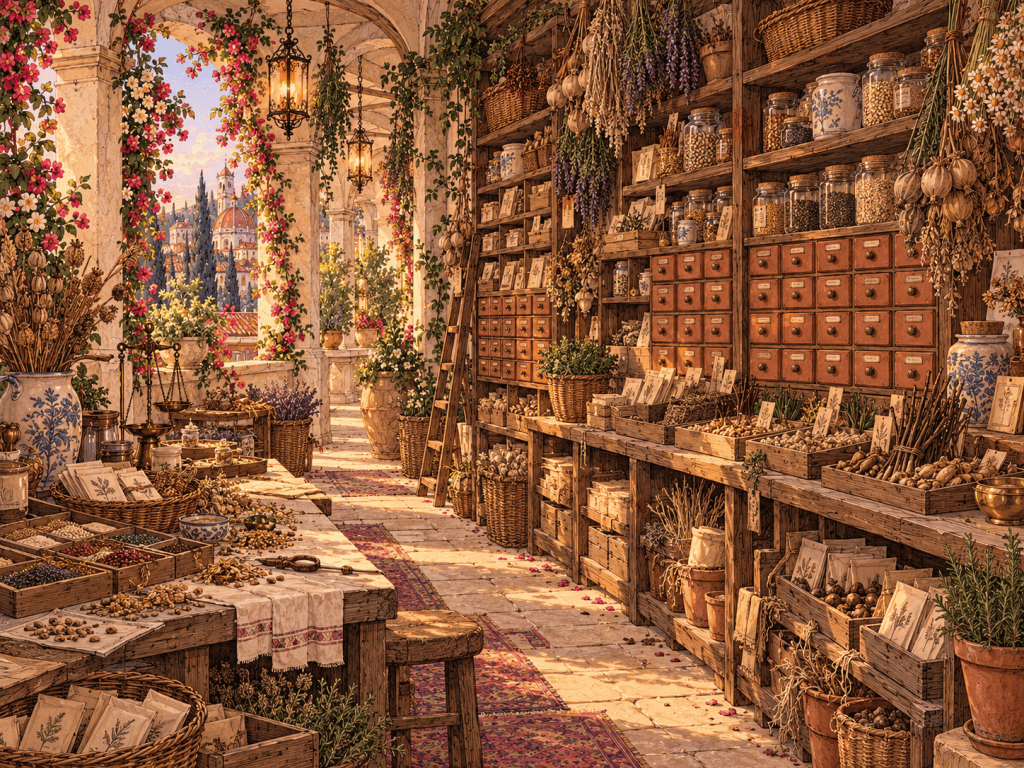
Along the coolest wall, clay drawers hold labeled seeds and dormant cuttings. Roseglass residents may trade viable local seed for another common variety rather than paying coin. The practice began as a practical way to keep rooftop gardens alive after storms and poor harvests, but it has become one of the Ward’s quietest customs of mutual aid.
The Public Botanical Walk
One path through the conservatory is always kept open to ordinary visitors. Labels give common names, growing conditions and mundane uses rather than hiding botanical knowledge behind guild membership. Children sketch leaves here. Performers rehearse lines while walking the warm paths. Bathhouse attendants inspect new aromatic herbs. Visiting gardeners argue cheerfully about pruning methods beneath the citrus trees.
Rare, dangerous or strongly enchanted specimens remain behind waist-high stone borders and clear signage. The Balcony Garden treats curiosity as welcome, not as permission to touch everything that grows.
The Seasonal House
The innermost glasshouse changes completely four times each year. Rather than presenting a permanent collection, the Garden chooses one seasonal question and builds the planting around it: what is waking, what is abundant, what must be gathered, or what deserves rest. During festivals, the Seasonal House often becomes one of Roseglass Ward’s quieter attractions, offering an alternative to crowded stages and processions.
Thyssara Among the Drying Racks
Thyssara Bloombound is a familiar sight in the conservatory. The ancient deep-forest giantkin and Verdant Keeper does not depend upon the Balcony Garden for everything served at Thyssara’s Tea; her own private garden remains central to her work. She comes here because the Turning Bloom cultivates varieties, orchard stock and seasonal herbs that would be impractical to maintain in one tea-house garden.
She favors the Drying Gallery in the quieter hours, inspecting bundles by scent, texture and stem rather than choosing whatever looks prettiest. Chamomile, roseleaf, mint, young green herbs, toasted roots, violets and bitter seasonal botanicals all pass through her hands at different times of year. Gardeners know that a conversation with Thyssara may become an impromptu lesson in when a leaf should be harvested, how long a root should rest before roasting, or why a perfectly healthy plant should sometimes be left entirely alone.
Her regular visits create a visible relationship between two Amarosan locations. A guest who enjoys Meadow Chamomile, Roseleaf Quiet, Garden Wake, Root & Hearth or one of Thyssara’s seasonal cups may later recognize the same fragrance growing here. Conversely, a character who becomes interested in an unusual conservatory plant may be directed toward Thyssara when the question concerns brewing, medicine, emotional recovery or safe botanical enchantment.
Thyssara is especially respected for refusing to treat abundance as a reason to overharvest. If a crop is weak, a seasonal blend changes. If a plant needs another week, the kettle waits. The Balcony gardeners consider this thoroughly Talyssan: the purpose of cultivation is not to make the garden obey demand, but to understand what can be taken without stealing the next season.
How Roseglass Uses the Garden
The conservatory makes the Balcony Garden part of Roseglass Ward’s daily economy rather than a destination that exists only after dark. Its plants move outward through the neighborhood in small, recognizable ways:
- Performers and theaters purchase durable flowers, greenery and scent-light garlands for costumes, dressing rooms and small productions.
- Bathhouses buy bundles of mint, rosemary-like herbs, petals and other aromatics for steam rooms, rinses and seasonal bathing preparations.
- Wine houses and kitchens take culinary herbs, citrus, edible flowers and small fruit harvests that are too irregular for larger merchants.
- Mask-makers and dyers purchase pressed petals, seed husks and plant pigments for decorative work.
- Festival crews reserve cut flowers and living vines for the Embrace of Delight and other Roseglass celebrations, with the Garden limiting harvests so decorations never strip the conservatory bare.
- Neighborhood residents use the Seed Shelves to replace failed rooftop crops, exchange common varieties and keep small household gardens resilient.
This trade explains why workers from across the Ward recognize one another here. A stagehand collecting garlands may share a bench with a bath attendant picking up mint. A vintner may arrive for citrus leaves while a performer waits for a bouquet. The conservatory turns the Balcony Garden into one of those places where Roseglass overlaps with itself before the lanterns are even lit.
People of the Balcony Garden
Liora Vensari
Keeper of the Garden
Liora is a mature Amarosan woman with dark curling hair usually pinned beneath fresh flowers and an extraordinary memory for faces. She owns the Balcony Garden but rarely behaves like an innkeeper. Most evenings find her pruning a vine, moving between tables or quietly directing attendants while appearing to do nothing at all.
She is determined to preserve the Garden as neutral ground where people can meet without being claimed by another institution.
Saren Pell
Balcony Steward
Saren manages reservations for the Seven Balconies and possesses the unnerving ability to remember exactly who occupied which balcony, with whom and on what evening.
They reveal none of it. For a price, Saren will arrange flowers, food, musicians, messages or carefully timed privacy. For no price whatsoever will they sell information about a guest.
Ilyra Mosswine
Cellar Keeper
Ilyra maintains the Garden’s wines and cultivates several herbs used nowhere else in Roseglass Ward. She is opinionated, cheerful and prone to recommending drinks based on what she believes a person actually needs rather than what they ordered.
Adventurers quickly discover that Ilyra hears an astonishing amount of information while refilling glasses. She insists she never gossips. She merely answers interesting questions.
Using the Balcony Garden in Play
The Balcony Garden functions as social terrain. Characters can meet contacts here without committing to a tavern scene. A romantic encounter can remain suggestive and atmospheric rather than becoming explicit. Rival NPCs can occupy nearby balconies. A festival can be observed from above. A conversation can begin publicly and gradually migrate upward as trust develops.
- Lower Terrace: Public.
- Hanging Walk: Transitional.
- Moonvine Terrace: Personal.
- Seven Balconies: Private.
- High Garden: Intimate or consequential.
Moving physically upward can mirror a conversation becoming more important.
Whispers Among the Vines
- Someone has tied the same crimson ribbon to the Hanging Walk every night for thirteen nights, but no one has seen who places it.
- One of the Seven Balconies occasionally overlooks a street that does not exist anywhere in Amarosa.
- Liora once refused entry to a member of the Civic Council and somehow suffered no consequences.
- A famous performer has been meeting someone here after every show, always wearing a different mask.
- The oldest fruit tree in the High Garden blossoms whenever someone tells the truth they had intended to conceal.
- Saren Pell knows enough secrets to destroy half of Roseglass Ward and has never repeated a single one.
Adventure Hooks
The Empty Balcony
A reserved balcony remains occupied according to the booking ledger, yet attendants have found it empty every evening for a week. Wine disappears. Flowers move. Someone keeps leaving fresh coins beside the untouched glasses.
A Ribbon With Your Name
One of the characters finds a promise ribbon tied to the Hanging Walk bearing their name in handwriting they recognize. The person who wrote it is either missing, dead or somewhere they could not possibly have reached Amarosa from.
The Wrong View
During a private conversation, the city beyond one balcony changes. The familiar streets of Roseglass Ward vanish. For several minutes the guests look instead upon an unfamiliar district beneath different stars. Then Amarosa returns.
Garden Neutrality
Two rival organizations independently arrange meetings at the Balcony Garden on the same night. Neither wants violence. Neither trusts the other. Liora quietly asks the party to make certain Roseglass Ward wakes the next morning with its neutrality intact.
The Moonvine Confession
A frightened patron claims the Moonvine Terrace compelled them to speak a secret they had sworn never to reveal. Liora knows the vines possess no such magic. Someone else was listening.
The Garden and Desire
The Balcony Garden can influence a character without deciding what that character feels. Nothing in the conservatory automatically creates attraction, confession, arousal or consent. Its magic is invitational and disclosed: a character chooses whether to participate, just as they choose whether to accept an enchanted cup at Thyssara’s Tea.
Optional Mechanics of Desire: Root and Bloom
A willing creature that spends at least 10 uninterrupted minutes in the Turning Bloom may choose one of the practices below. A creature can benefit from only one Garden practice between Long Rests. Simply entering the Balcony Garden grants no mechanical effect.
Root — Settle What Is Loud
Base 5e Effect. After 10 minutes of quiet attention among the Root beds, you gain advantage on the next Wisdom saving throw you make within 1 hour against being charmed or frightened. The benefit ends after that roll.
Veiled Mechanics. Retain the benefit above. You may also end the Stirred condition affecting you. This does not interrupt an Overwhelmed outcome already being resolved.
Unveiled Mechanics. Retain the Base 5e benefit. Instead of ending Stirred, you may reduce your Arousal by 1, to a minimum of 0. This does not restore Libido or end an existing charm.
Bloom — Let Something Be Seen
Base 5e Effect. After 10 minutes among the flowering beds, you gain advantage on the next Charisma (Persuasion) or Charisma (Performance) check you make within 1 hour to honestly communicate affection, attraction, longing, vulnerability or a personal intention to a willing listener. The benefit ends after that check.
Veiled Mechanics. Retain the benefit above. You may willingly become Stirred when the practice ends. If you do not wish to become Stirred, the Base 5e benefit still functions normally.
Unveiled Mechanics. Retain the Base 5e benefit. Instead of becoming Stirred, you may willingly gain 1 Arousal, to a maximum of 2. This increase cannot trigger Climax.
Invitation, Not Command. Root and Bloom are location-specific practices, not changes to the core rules. They never compel a character to reveal a secret, remain in the Garden, accept another person’s attention or participate in intimacy. A player may decline the optional Desire effect while keeping the Base 5e benefit.
Seasonal Complications
| d6 | What Changes in the Turning Bloom |
|---|---|
| 1 | A bed meant to be dormant has flowered overnight. The gardeners are less excited than the visitors. |
| 2 | Thyssara rejects an entire bundle of dried herbs because the scent tells her they were harvested too early. The tag says otherwise. |
| 3 | A rooftop gardener arrives carrying seed from a plant that should not grow anywhere near Amarosa and asks to use the Seed Shelves. |
| 4 | A festival buyer has promised more flowers than the Garden can safely cut without damaging next season’s crop. |
| 5 | One of the Talyssan beds has stopped responding to the season: Root, Swell and Seed change normally, but Bloom remains stubbornly closed. |
| 6 | A performer recognizes the scent of a supposedly rare perfume growing openly in the conservatory and realizes someone has been lying about its origin. |
These complications work best as small imbalances rather than declarations of villainy. A mislabeled harvest may be a mistake, an overcommitted festival buyer may simply be desperate, and an out-of-season bloom may be miraculous rather than dangerous. The Balcony Garden should reward attention to growth, restraint and relationship before escalating into conflict.
The result is a place that changes meaning depending on when characters arrive. At sunset, the Balcony Garden is courtship and conversation above Roseglass. In the morning, it is pruning knives, wet stone, drying herbs and neighborhood deliveries. During a festival, it becomes a reservoir of living color. In winter, portions of it rest beneath glass while the Ward continues celebrating below.
Explore Roseglass Ward
The Balcony Garden is the quieter upper breath of Roseglass Ward. Characters looking for a public meeting point can descend toward Lantern Courtyard; those following performance, masks and sacred theater can continue to Velvet Hall. The Velvet Thread serves the ward’s performers and revelers with couture and masquerade work, while Skin & Smile provides self-care, aftercare and practical advice at street level.
The Garden also reaches beyond Roseglass through its working relationships. Thyssara’s Tea draws seasonal botanicals from the Turning Bloom, while the nearby Rosewater Bathhouse and other neighborhood businesses make use of its aromatic herbs, flowers and garden stock. Together, these connections make the Balcony Garden part of Amarosa’s living economy rather than an isolated scenic retreat.
A Quiet Heart of Roseglass Ward
The Balcony Garden gives Roseglass Ward breathing room. Where theaters carry spectacle and courtyards carry celebration, the Garden carries courtship, conversation, elevated views and quiet possibility.
It is where the district lowers its voice without going to sleep. On certain nights, when music drifts upward from the streets and three moons shine between the leaves, even lifelong Amarosans stop at the railing as though seeing their city for the first time.


You must be logged in to post a comment.