
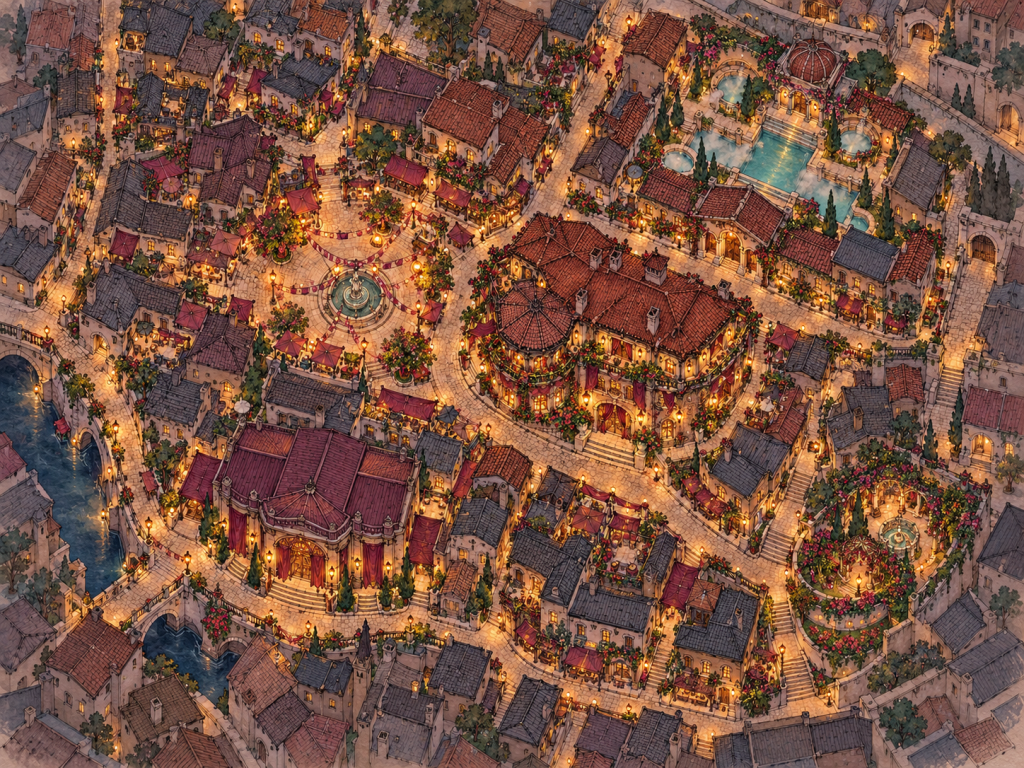
Roseglass Ward
Amarosa After Sunset
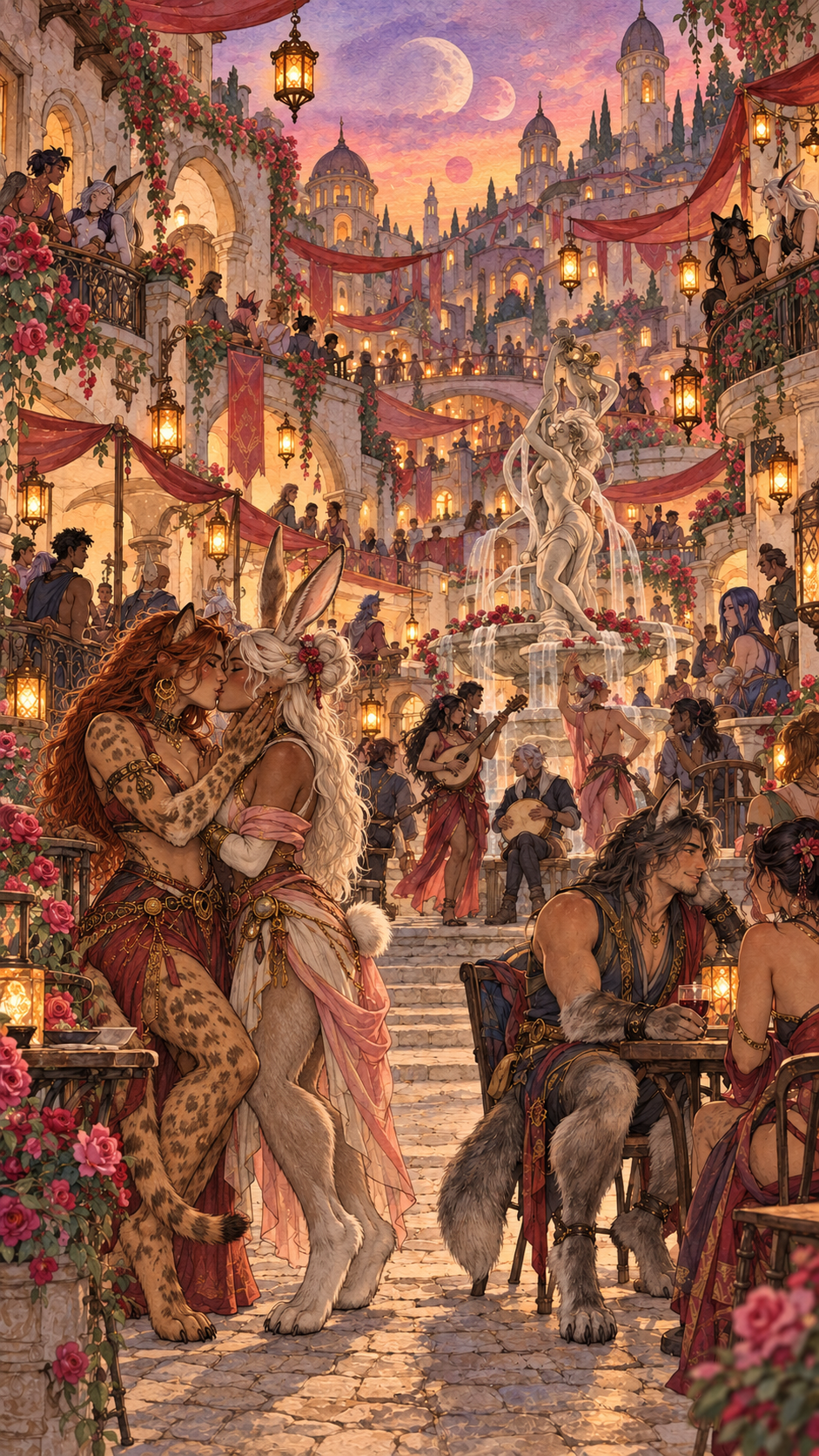
When market shutters begin to close and colored lanterns wake above the streets, Roseglass Ward comes alive. Amarosa’s nightlife, performance, pleasure, and festival district is a neighborhood of theaters and bathhouses, wine cellars and pleasure houses, rooftop gardens and crowded courtyards, all layered along the city’s steep terraces.
Roseglass is not one establishment and not one kind of desire. Public spectacle stands beside private hospitality, masked revelry beside quiet conversation, and the people who make the night possible—musicians, stagehands, mask-makers, vintners, bath attendants, cooks, couriers, florists, performers, and vendors—are as much a part of the ward as its celebrated venues.
Roseglass at a Glance
City: Amarosa
Type: Nightlife, performance, pleasure, hospitality, and festival district
Known For: Roseglass lanterns, theaters, pleasure houses, masks, music, wine, late suppers, baths, courtyards, and rooftop gardens
Public Heart: Lantern Courtyard
Major Festival: The Embrace of Delight
Atmosphere: Rose-lit, theatrical, intimate, crowded after dark, quieter as the terraces climb
Why It Is Called Roseglass
Colored glass is one of the ward’s oldest visual traditions. Lantern panes, theater windows, balcony lamps, mosaic skylights, shrine lights, tavern signs, and festival masks commonly use glass tinted in blush-pink, wine-red, violet, amber, and smoky gold.
At twilight, hundreds of those lights ignite across pale Amarosan stone. Streets and stairways break into pools of rose, crimson, violet, and gold, making the whole district appear to glow from within and giving Roseglass Ward its name.
The Shape of the Ward
Roseglass is vertical, layered, and deliberately difficult to experience in a straight line. Main streets wind through terraces and small plazas while narrow stairs disappear beneath buildings, upper stories bridge alleys, and balconies lean close enough for music and conversation to carry from one side of a lane to the other.
The district also changes as visitors climb. The lower streets hold the largest crowds and loudest stages, the middle terraces gather taverns, theaters, baths, and pleasure houses, and the upper reaches soften into gardens, balconies, intimate rooms, and overlooks where Amarosa can be heard more distantly below.
An Evening Through Roseglass
A night in the ward often follows its own emotional geography: arrival, spectacle, indulgence, intimacy, quiet. Visitors may begin beneath the lanterns, follow music toward a stage, disappear into wine houses or private rooms, seek warmth and recovery in the baths, and finally climb toward the gardens as dawn begins to silver the city.
Explore Roseglass Ward
Roseglass is a district of doors. A carved entrance beneath violet lanterns may conceal a six-seat theater, a stair beside a wine shop may rise to a rooftop dance terrace, and an alley barely wide enough for two people may open into a courtyard filled with fountains and musicians. The locations below are only the first doors presently known.
Lantern Courtyard
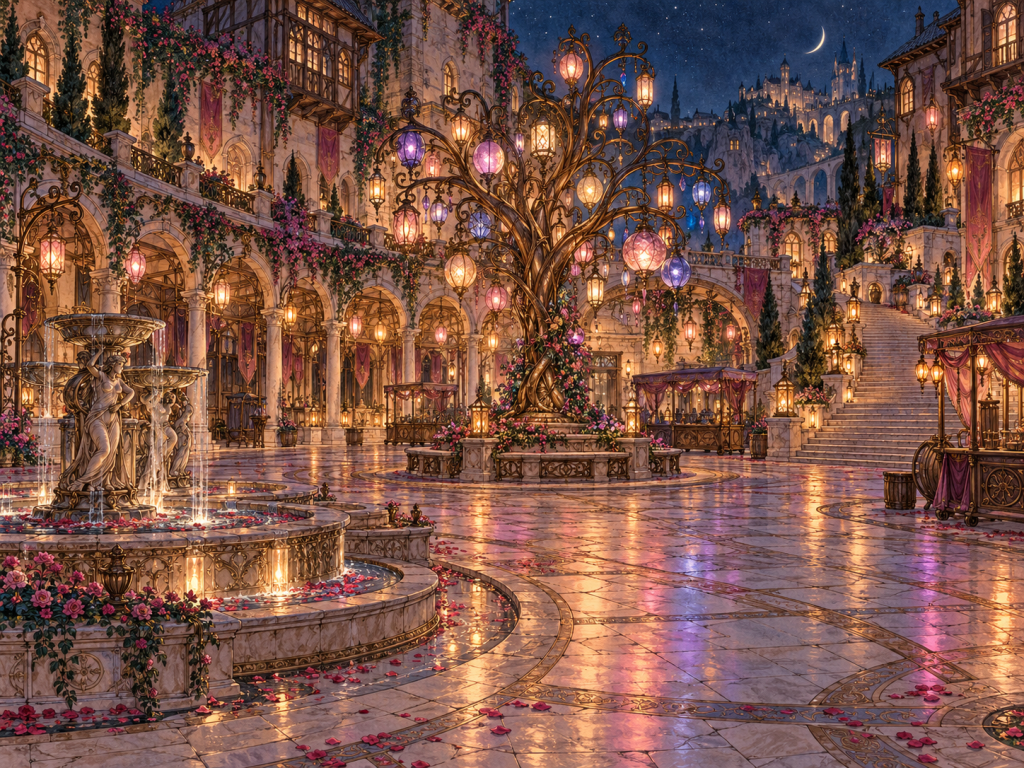
The public heart of Roseglass Ward is a broad stone court surrounded by tall buildings, galleries, balconies, and permanent fittings for festival lanterns. On ordinary nights it serves as a meeting place for musicians, dancers, vendors, and friends; during the Embrace of Delight, it becomes one of the festival’s principal gathering and processional spaces.
The Courtyard changes character several times over the course of a single evening. At dusk, vendors claim their familiar corners while musicians test strings and pipes beneath the galleries. As night deepens, tables spread outward from surrounding wine houses, dancers take advantage of whatever space the crowd leaves open, and performers appear on balconies overhead. Near dawn, the noise thins into tired laughter, breakfast carts, cooling lanterns, and the soft scrape of workers sweeping flower petals from the stones.
Locals use Lantern Courtyard as Roseglass’s unofficial compass. Directions are often given from it rather than by street name, and anyone separated from friends during a crowded night knows to return beneath the lanterns. It is also one of the easiest places in Amarosa to be noticed, overlooked, followed, approached—or relieved of an unattended purse.
Velvet Hall
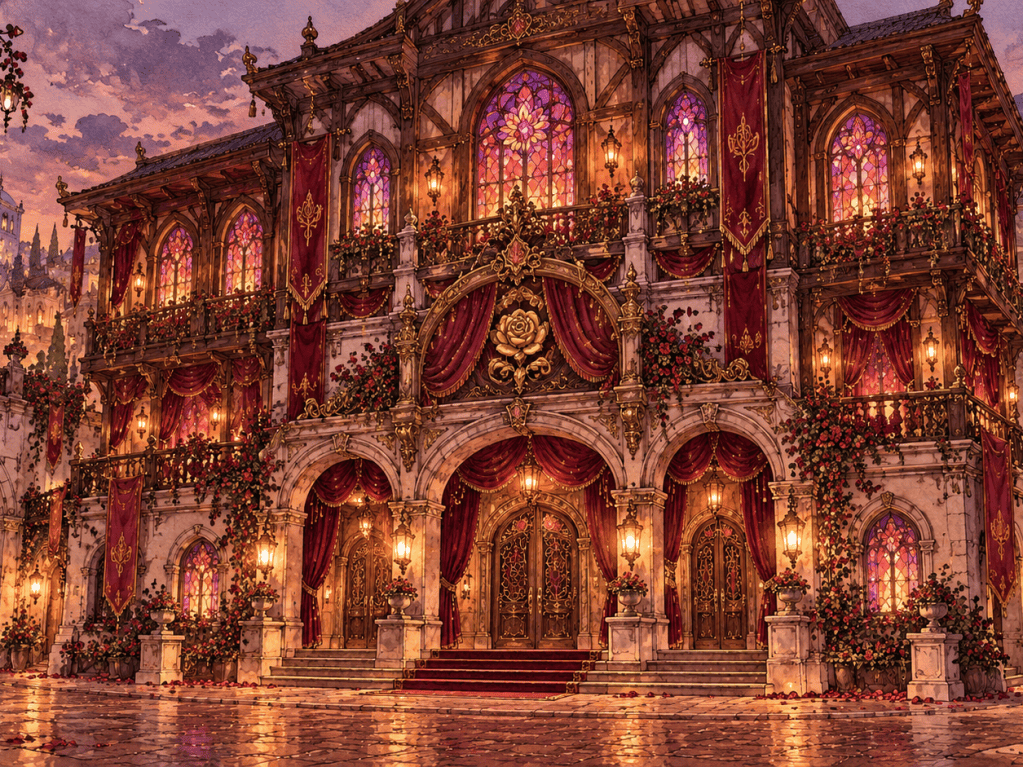
A celebrated performance venue devoted to poetry, music, intimate theater, dance, spoken confession, and works that blur the line between entertainment and devotion. Velvet Hall gives Roseglass one of its grand stages without defining the entire district around a single proprietor or company.
The Hall supports grand productions, but many of its most celebrated evenings are surprisingly small. A single singer under one lamp, a masked dramatic reading, or a dancer moving through an audience can command as much prestige as a full company. New works are regularly tested here before appearing elsewhere in Amarosa, making Velvet Hall as important to performers as it is to patrons.
Backstage is another world entirely. Rehearsal rooms, costume stores, dressing corridors, prop chambers, and narrow service stairs create a maze known far better to stagehands than wealthy guests. Performers trade gossip there, messengers arrive through side doors, favors change hands, and people who would never meet publicly sometimes find themselves sharing the same shadowed corridor between acts.
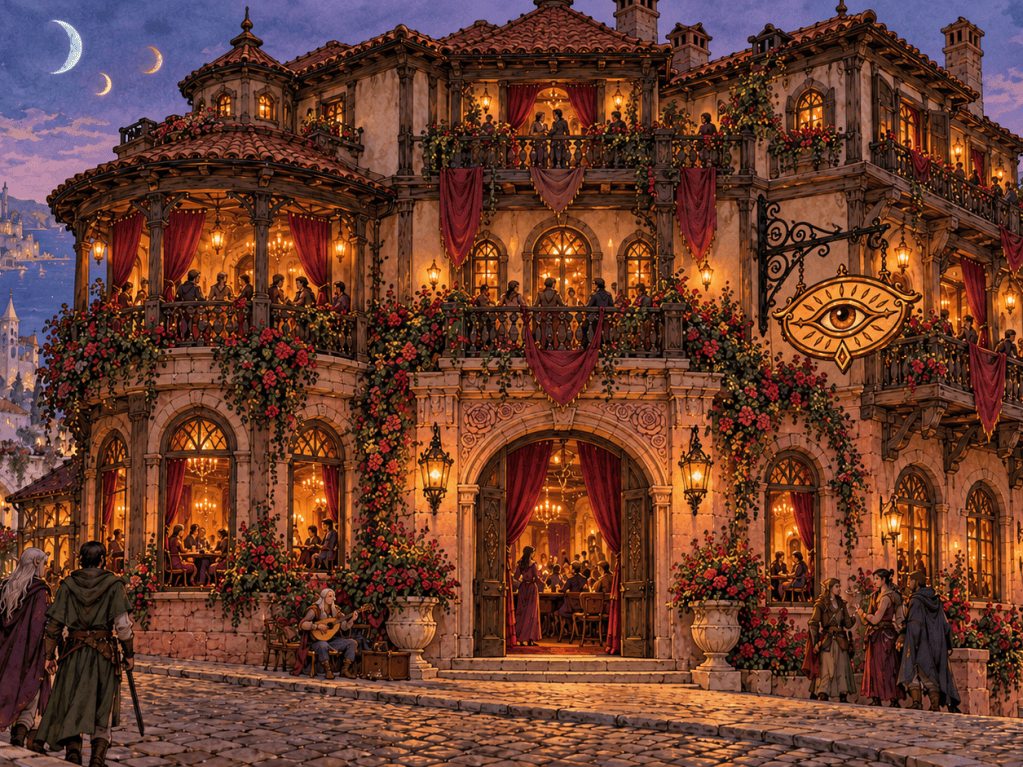
The Winking Eye
One of Roseglass Ward’s best-known taverns and pleasure houses, the Winking Eye offers public drinking rooms, performances, private chambers, late-night food, and a quieter traffic in rumors and information. It is an important destination within Roseglass, but only one among many doors in the ward.
People arrive for different reasons. Some want wine. Some want company. Some want a room where no one asks why they arrived separately and left together. Adventurers learn quickly that the Eye is an excellent place to hear about work that has not yet become an official contract, especially when the person offering it would rather not visit the House of the Sacred Bloom or speak beneath the lamps of Lantern Courtyard.
The Winking Eye also serves as a social boundary between respectable Roseglass and its quieter underside. Nothing about entering it marks a person as criminal, scandalous, or important. That anonymity is precisely why merchants, performers, couriers, gamblers, thieves, and civic officials may all pass through its doors during the same night.
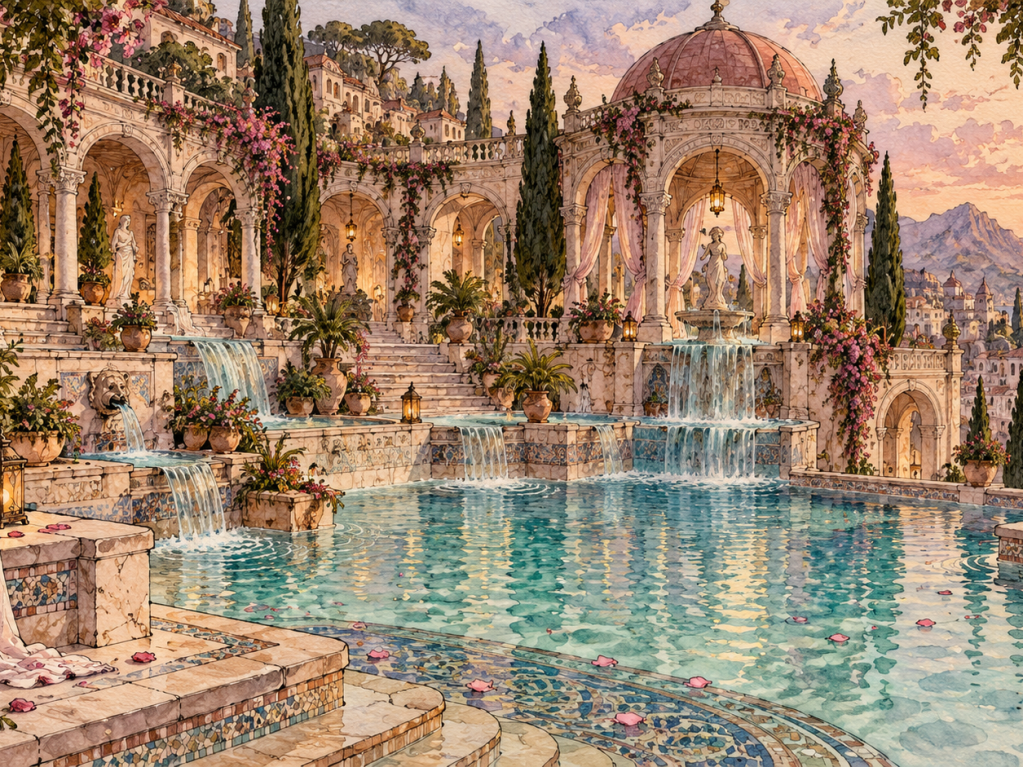
Ember Bathhouse
A warm public bathhouse where bathing, recovery, conversation, and release are given equal importance. Its pools become especially valuable during festivals, when revelers, performers, workers, and visitors come to cool down, recover, and let the night soften before continuing home.
Roseglass treats bathing as social rather than merely practical. Agreements are settled beside warm pools. Performers recover strained muscles. Musicians compare the evening’s audiences. Workers ending their shifts share water with patrons only beginning theirs. Wealth may purchase private chambers and special treatments, but the communal spaces remain one of the few places in the ward where occupation and social standing blur easily.
Steam also grants privacy of a subtler kind. Voices soften beneath vaulted ceilings, faces disappear behind drifting mist, and attendants learn quickly which conversations should not be remembered. For that reason, Ember Bathhouse has long attracted discreet negotiations. Some are romantic. Some are commercial. A few are the sort of conversations whose participants arrive through different doors and leave at different times.
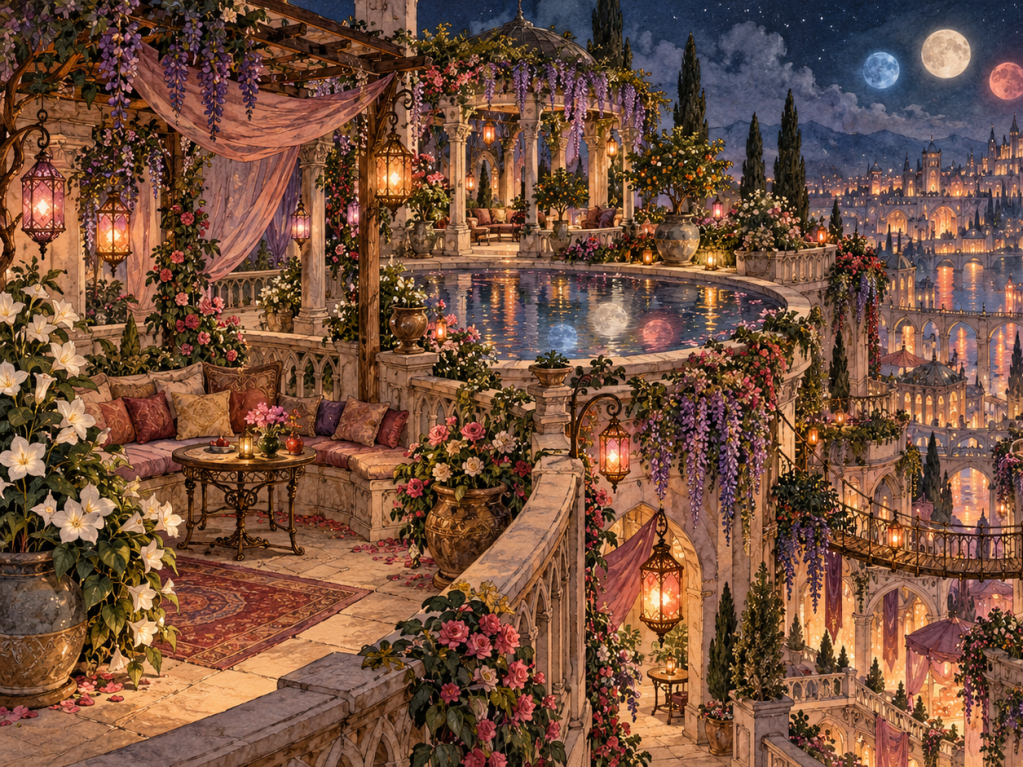
Balcony Garden
A quieter elevated garden of flowering vines, small tables, private benches, and screened overlooks. Locals favor it for conversations that need fresh air more than witnesses, and its height makes it one of the ward’s natural places to watch the lanterns dim toward morning.
The Garden is not silent, but Roseglass reaches it softened. Music rises without words. Crowds become movement rather than individuals. Those who have spent hours being watched often come here specifically to stop performing. Lovers talk, rivals negotiate, performers remove their masks, and people decide whether a night should continue or end.
Privacy here is social rather than absolute. Everyone understands that another conversation may be taking place beyond the next trellis. Good manners require pretending not to hear it. Poor manners have produced some of Roseglass Ward’s most enduring rumors. By the hour before dawn, Balcony Garden belongs largely to those unwilling to go home, watching the first kitchens begin to send up the smell of bread and coffee below.
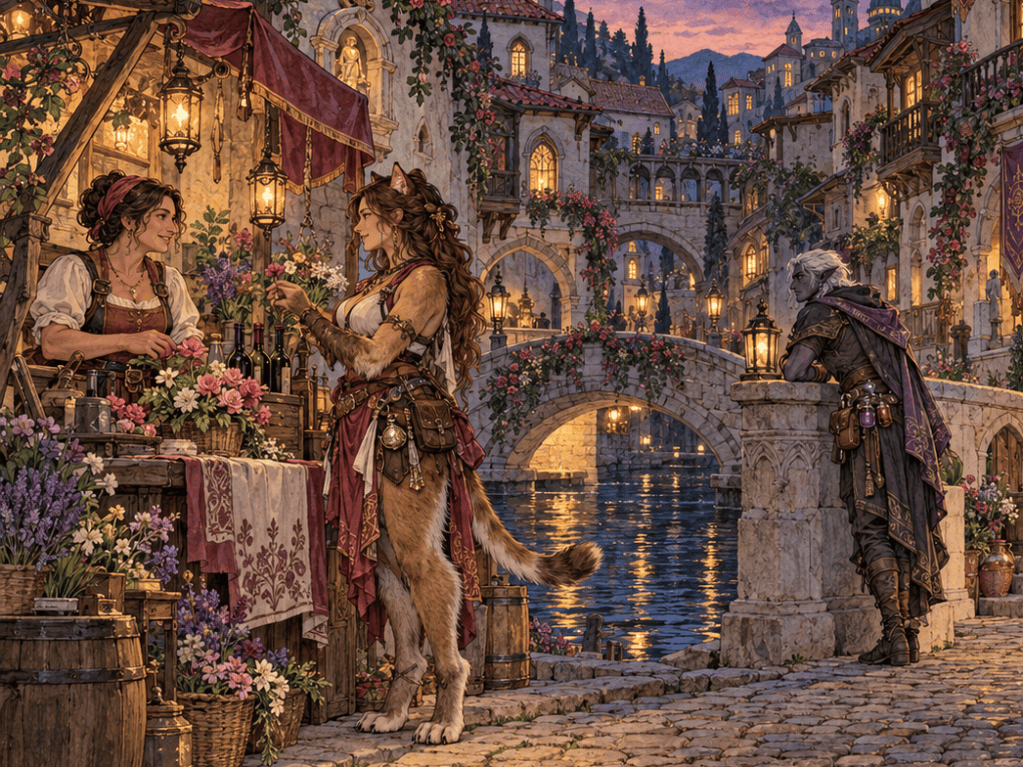
More Doors of Roseglass
Beyond the named landmarks are theaters and rehearsal rooms, pleasure houses, wine merchants, mask-makers, costume shops, inns, late-night kitchens, rooftop stages, flower sellers, bath attendants, small courtyards, and businesses that seem to exist almost entirely for people who suddenly discover they need something at two in the morning.
Some are famous enough to draw travelers across Amarosa. Others are known only by a painted door, a particular lantern, or the musician who always seems to be playing there after midnight. A building may contain a respectable shop on the street, rented rooms above it, an illicit gaming table in the cellar, and a tiny theater accessible only through the neighboring courtyard.
This is part of Roseglass Ward’s identity. Locations appear, disappear, change ownership, and acquire new reputations without changing the character of the district itself. New locations can be added to Roseglass without redefining the ward; every addition is simply another door opened.
Behind the Lanterns
Roseglass possesses another geography that never appears on civic maps. Locals sometimes call it the Underlight.
The Underlight is not a guild, gang, or faction. It has no single leader, headquarters, or uniform. It is the collective name for the hidden social economy beneath Roseglass: backstage favors, unofficial gaming rooms, discreet fences, hired guides, confidence artists, information sellers, stolen invitations, private card tables, smuggled luxuries, counterfeit masks, and rooms rented specifically because no respectable guest would admit knowing they existed.
Much of this world survives because Roseglass itself depends upon discretion. Performers need side entrances. Pleasure houses need private exits. Theaters require prop doors, storage rooms, and service corridors. Bathhouses have furnaces, cisterns, and maintenance passages. Wine merchants possess cellars. Old buildings share walls, courtyards, and foundations. Every legitimate necessity creates another place where something less legitimate might occur.
The Underlight is not automatically hostile. A stagehand hiding fugitives may also report violent thieves. A fence may refuse stolen sacred objects. A confidence artist may fleece wealthy festival visitors while fiercely protecting neighborhood performers. A thieves’ den might occupy rooms above a beloved bakery whose owner genuinely has no idea what happens upstairs.
Roseglass crime is therefore rarely announced with black cloaks and daggers. It smiles. It offers directions. It knows a cheaper table. It knows someone who can get you inside. And occasionally, before you realize you have entered the Underlight at all, it already knows exactly how much coin you arrived with.
The Streets Between
Much of Roseglass happens outside its major venues. During the day, stagehands move scenery, vintners roll casks into cellars, costumers make emergency repairs, bathhouse workers prepare pools, glassworkers replace cracked lantern panes, and musicians rehearse behind open windows.
At night, those same streets become part of the performance. Food carts appear at intersections, balcony musicians answer one another across lanes, masked revelers cross paths with workers finishing late shifts, and the smell of rosewater, warm stone, perfume, grilled fruit, wine, and bathhouse steam settles over the district.
The Embrace of Delight

Roseglass Ward hosts the Embrace of Delight, one of Amarosa’s great celebrations of performance, pleasure, hospitality, masks, music, and public joy. The festival is not confined to one plaza or stage; the ward itself becomes its infrastructure.
Permanent hooks, balcony rails, stone sockets, and lantern brackets throughout Roseglass support temporary banners, lights, ribbons, stages, and processional decorations. The evening traditionally gathers at Lantern Courtyard before spilling outward through performance streets, pleasure lanes, bathhouse terraces, wine houses, and upper gardens, with revelers free to join, leave, wander, and return.
The district performs with the procession rather than merely watching it. Theaters offer abbreviated street scenes, musicians answer one another from balconies, mask-makers sell from open workshops, pleasure houses dress their facades, vintners uncork festival blends, and dancers may join the moving crowd for three streets before disappearing into another celebration entirely.
Roseglass in Play
Roseglass Ward does not need a crisis to justify visiting it. A single evening can support a meal, a show, a masked meeting, a bath, a romantic interlude, an information exchange, a rooftop conversation, a pursuit through crowded alleys, or a whole night that becomes an adventure simply because the characters kept opening doors.
When danger does enter Roseglass, the district’s crowds, vertical streets, private rooms, public performances, hidden passages, balconies, and conflicting rhythms give the Game Master immediate tools for mysteries, chases, social encounters, festival complications, secret meetings, supernatural disturbances, and stories that begin as entertainment before becoming something stranger.
d12 — A Night in Roseglass
| d12 | Encounter |
|---|---|
| 1 | A masked street procession fills the lane. Everyone seems to know the dance except one visibly panicked participant. |
| 2 | A stagehand struggles with an enormous prop chest and offers coin for help getting it three streets uphill before curtain. |
| 3 | A balcony singer asks the party for a subject. The improvised song reveals something uncomfortably accurate about one character. |
| 4 | A wine merchant offers samples from a newly opened cask while someone nearby insists the vintage should not exist anymore. |
| 5 | Two couriers collide in Lantern Courtyard and immediately accuse each other of stealing the same sealed letter. |
| 6 | A costume maker desperately needs someone of the party’s exact build to test an unfinished ceremonial mask. |
| 7 | Steam suddenly pours from an alley beside Ember Bathhouse as attendants scramble to deal with a ruptured heat conduit. |
| 8 | A performer recognizes one character as someone they have supposedly met before—though the character has never seen them. |
| 9 | A beautifully dressed stranger offers to guide the party to “the real Roseglass” for a modest fee. |
| 10 | Every lantern along one narrow street goes dark simultaneously. Several locals immediately leave without explanation. |
| 11 | A nervous visitor asks the party to accompany them to an appointment behind an unmarked crimson door. |
| 12 | Just before dawn, a musician plays alone in an otherwise empty courtyard. A small crowd listens from windows but nobody approaches. |
d10 — Roseglass Fleeces & Schemes
| d10 | Scheme |
|---|---|
| 1 | The Festival Price. A visitor discovers that the “special celebration menu” costs several times what locals paid earlier. |
| 2 | The Helpful Guide. A charming local recommends only establishments that quietly pay them for every guest delivered. |
| 3 | The Wrong Door. Someone collects an entrance fee for an exclusive salon that is actually located two buildings away. |
| 4 | The Lucky Mask. A vendor sells supposedly enchanted masks whose only magic is excellent craftsmanship and a convincing story. |
| 5 | The Friendly Game. A private card table promises easy winnings until the stakes become considerably less friendly. |
| 6 | The Lost Invitation. A beautifully printed invitation grants entry to a prestigious gathering that either does not exist or ended last week. |
| 7 | The Roseglass Vintage. Ordinary wine is poured into an impressive old bottle and sold with an elaborate historical tale. |
| 8 | The Sudden Friend. A stranger spends half the night buying drinks, learning names, and listening carefully before asking for one seemingly harmless favor. |
| 9 | The Charity Lantern. Donations are collected for a sympathetic local cause. The cause is real. The collector is not associated with it. |
| 10 | The Genuine Bargain. Everything appears suspiciously cheap because it actually is. The seller merely needs the goods gone before someone recognizes them. |
d12 — Doors into the Underlight
| d12 | What Lies Behind It |
|---|---|
| 1 | A cramped after-hours gaming room above a mask-maker’s shop. |
| 2 | A basement tavern patronized almost entirely by stagehands, couriers, and bathhouse workers. |
| 3 | A fence operating from the back room of an otherwise respectable secondhand costume shop. |
| 4 | A tiny unlicensed theater where anonymous performers stage work banned from more prestigious halls. |
| 5 | A thieves’ den occupying several connected attic rooms reached by three different staircases. |
| 6 | A private supper club where information is traded more often than coin. |
| 7 | A locked wine cellar used as neutral ground for meetings between rival crews. |
| 8 | An old bathhouse maintenance chamber converted into a hidden lodging house for people who do not want their names recorded. |
| 9 | A workshop producing forged invitations, seals, playbills, and festival credentials. |
| 10 | A rooftop reached through a laundry stair where couriers leave messages beneath weighted flowerpots. |
| 11 | A forgotten rehearsal hall now serving as an informal refuge for performers, runaways, and people avoiding unpleasant employers. |
| 12 | A beautifully appointed private salon whose wealthy patrons believe they are merely attending an exclusive club. The staff know it as something else entirely. |
Using the Underlight
Characters do not find the Underlight by asking where the thieves live. They encounter it sideways. A bartender knows a stagehand. The stagehand knows a courier. The courier recognizes a painted symbol on a cellar door. The cellar door opens because someone inside already heard the characters were looking.
Treat access as a relationship rather than a map location. Helping workers, performers, vendors, and night staff makes hidden Roseglass easier to reach. Causing trouble makes doors close. The Underlight should reward curiosity without turning Roseglass into a crime district; most nights remain exactly what the ward promises—music, warmth, pleasure, theater, food, and beautiful excess.
The danger is simply that, beneath so many lanterns, there are still places where the light does not quite reach.
Every door in Roseglass promises a different night.


You must be logged in to post a comment.