
Lantern Courtyard
Beneath the Lanterns
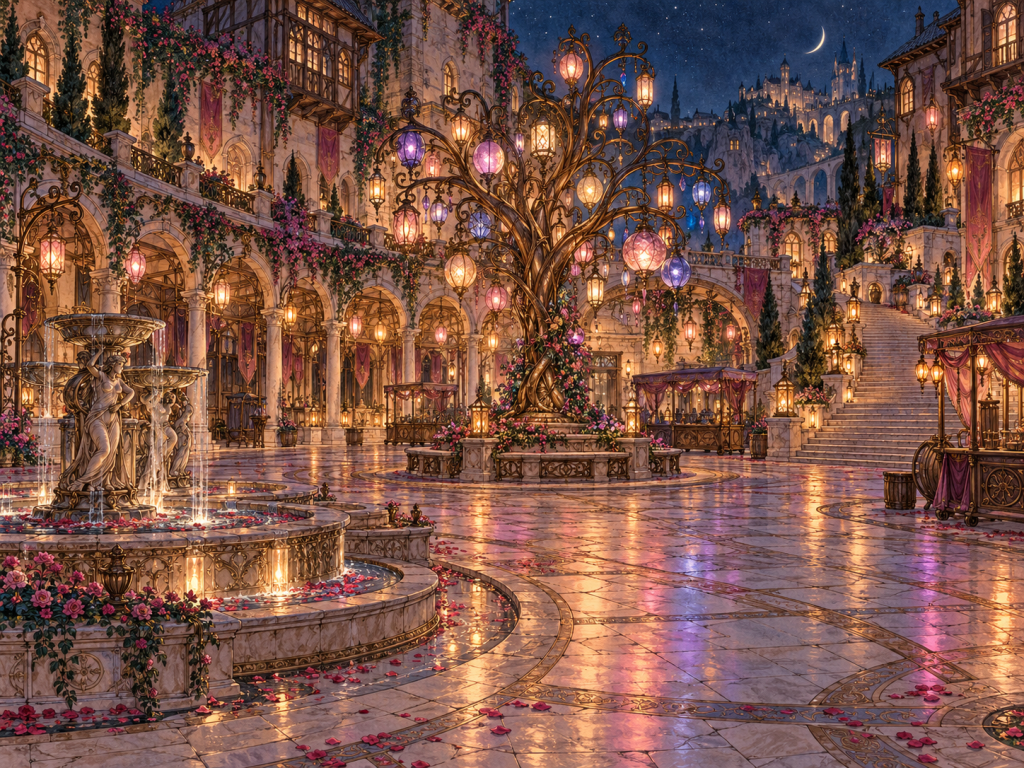
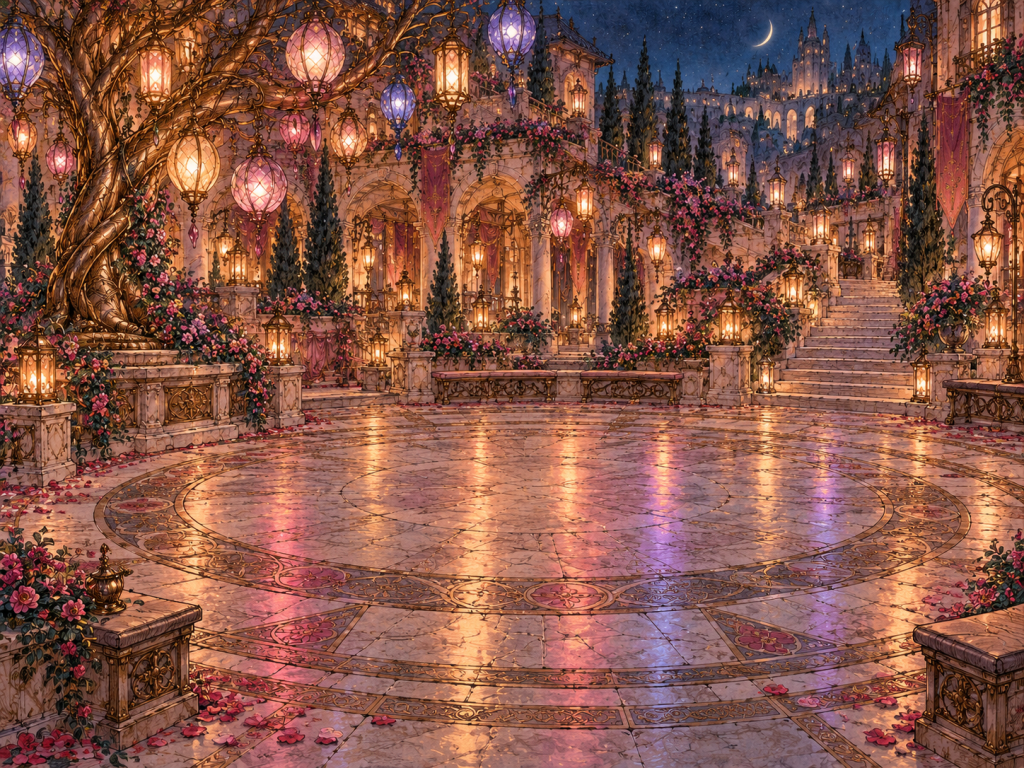
Lantern Courtyard is not somewhere Amarosa goes. It is where Amarosa meets itself. The public heart of Roseglass Ward is a broad stone court surrounded by galleries, balconies, arcades, stairs and permanent fittings for festival lanterns. It is not a tavern, theater, pleasure house or temple. It belongs to the district itself. On ordinary nights, Lantern Courtyard serves as a meeting place for musicians, dancers, vendors, friends, workers and visitors deciding where the evening should lead next. During the Embrace of Delight and other great celebrations, it becomes one of Roseglass Ward’s principal gathering and processional spaces. Locals use the Courtyard as an unofficial compass. Directions are often given from it rather than by street name, and anyone separated from friends during a crowded night knows to return beneath the lanterns. It is one of the easiest places in Amarosa to be noticed, overlooked, approached, followed—or simply absorbed into the life of the ward.
Lantern Courtyard at a Glance
District: Roseglass Ward, Amarosa
Role: Public gathering place, performance court, meeting point and festival crossroads
Known For: Colored lanterns, spontaneous performances, late-night vendors, fountains, balconies and crowds
Local Use: “Meet beneath the lanterns” is understood throughout the ward
Peak Hours: Sunset through the deep night
Major Festival Role: Processions and public celebration during the Embrace of Delight
The Courtyard Has No Proprietor
No single venue owns Lantern Courtyard. The surrounding businesses benefit from it, performers depend on it, vendors work it and residents cross it nightly, but the square remains civic space. That distinction matters in Roseglass. The Courtyard is where people who would never enter the same establishment can still occupy the same evening. Its character is maintained less by formal authority than by habit. Performers make room for vendors. Vendors leave sightlines open. Nearby staff help lost visitors find their companions. When a celebration becomes too large for one building, the Courtyard absorbs the overflow.
Keeping the Courtyard Alive
Because nobody owns Lantern Courtyard, its upkeep is shared rather than invisible. Amarosa’s civic crews maintain the paving, drains, fountain channels and public stairs, while local glasswrights and metalworkers are contracted to replace cracked panes, straighten bent hooks and inspect the Lantern Tree after hard weather. During major festivals, experienced riggers from Roseglass’s theaters join them to manage the extra weight of banners, ribbons and temporary lamps.
The smaller work belongs to the neighborhood. Vendors sweep around their usual pitches. Florists gather spoiled garlands. Nearby houses send staff with buckets after crowded nights, and apprentices sometimes earn a few coins helping scrape wax from the stones before dawn. No guild claims these duties; they are part of the practical cooperation that lets Roseglass remain beautiful while thousands of people use it.
Commemorative lanterns receive particular care. A lantern that is merely old is left in place, but one that has become unsafe is lowered, recorded and stored rather than simply discarded. When its maker, donor or family can be found, they are offered the chance to repair or replace it. Unclaimed pieces are sometimes restored by local artisans at cost. In this way, even maintenance preserves the Courtyard’s memory instead of erasing it.
The Lantern Tree
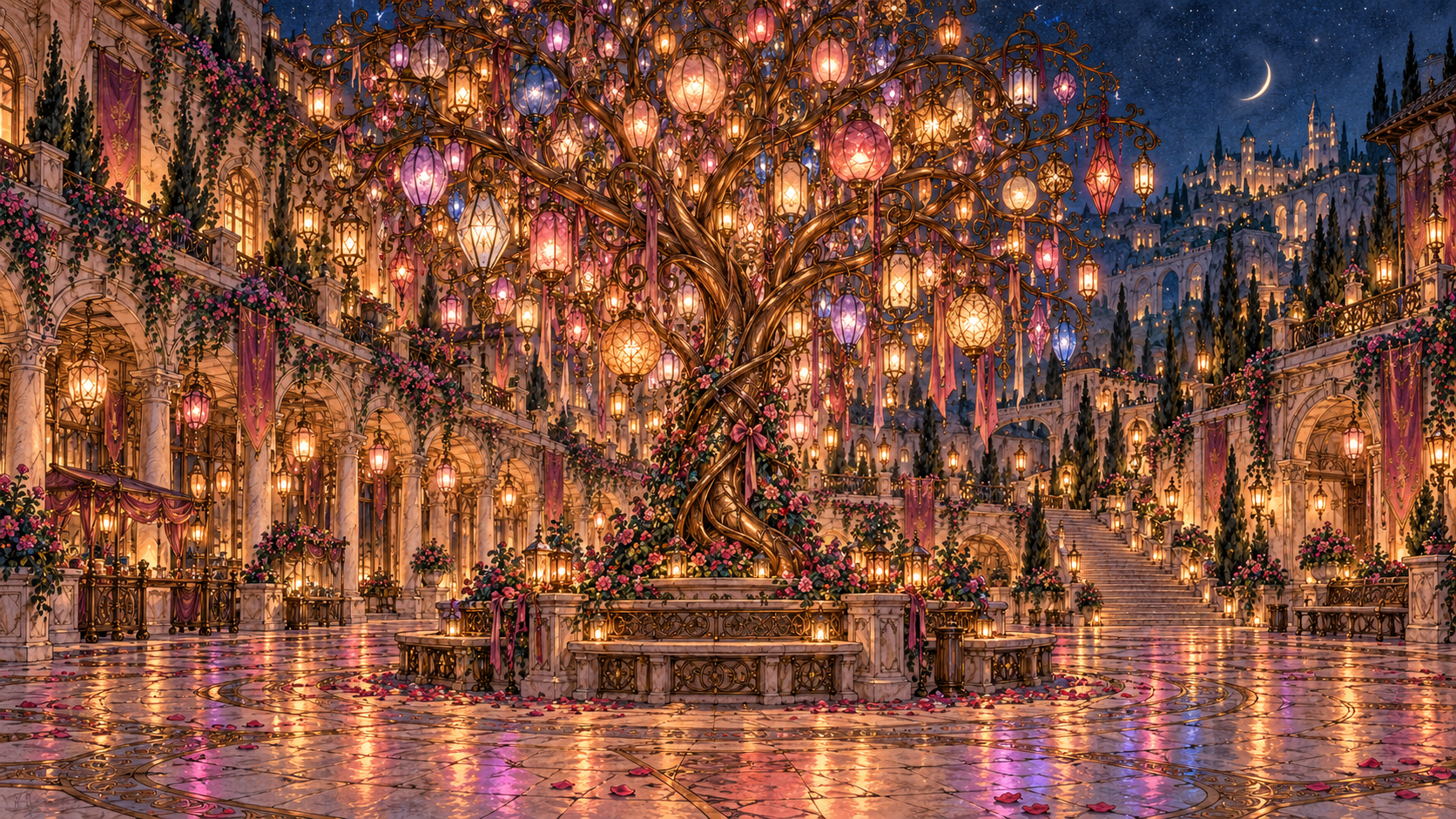
At the center of the plaza rises the structure most visitors remember: a towering wrought-bronze framework shaped like the branching crown of an enormous tree. Its limbs hold hooks, chains and curved arms for hundreds of lamps. Rose, amber, violet, pearl and blue glass overlap until the paving stones below seem washed in stained light.
The Lantern Tree is practical before it is mystical. It gives the plaza a center, marks the safest place to regroup in a crowd and carries enough light to keep the court usable long after neighboring streets have dimmed. Over generations, however, Amarosans have given the structure its own customs. A lantern may commemorate a lover, a journey begun, a performer’s first public appearance, a reconciliation, a birth, a death or simply a night someone refuses to forget.
Not every lantern carries a name. Some have hung so long that nobody remembers who placed them. Removing an old lantern without cause is considered discourteous, and during festival seasons the higher branches can disappear beneath layers of glass and ribbon.
The First Flame
Lantern Courtyard’s evening begins gradually. Workers finish deliveries. Carts settle into familiar corners. Musicians tune beneath the galleries. As the sun falls behind Amarosa, one of the central lamps of the Lantern Tree is lit and the flame spreads outward through neighboring lanterns, balconies, stalls and doorways.
No priest officiates and no bell announces the moment. The custom belongs to the ward. A server leaving a wine house may light the next lamp. A stagehand may carry flame across the court. A child accompanying a flower seller may be handed a taper. Within minutes, Roseglass changes from a district preparing for night into a district already living it.
Places Within the Court
The Fountain of Shared Cups
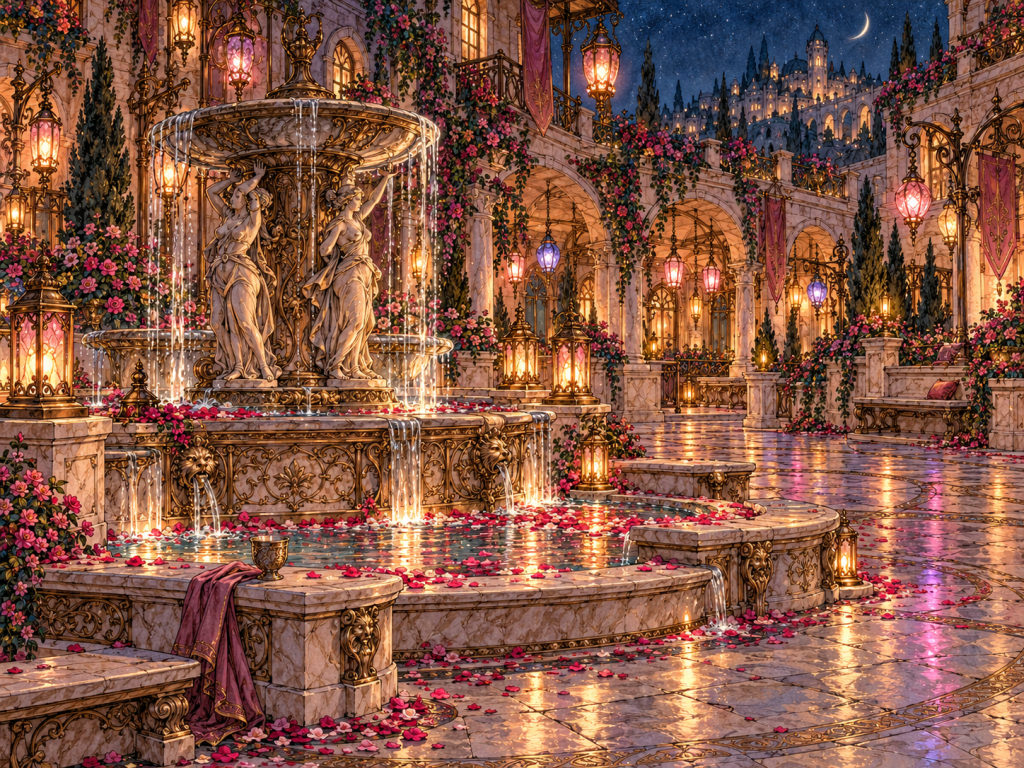
A broad fountain occupies one side of the court, its shallow basins edged by seating worn smooth from generations of waiting. Rose petals collect where the water slows, and the fountain’s surrounding ledges are rarely empty after dusk.
It is the Courtyard’s most common meeting point. “At the Cups” is enough instruction for most locals. Friends gather here before performances, messengers wait for contacts, and strangers who look lost are more likely to receive directions than suspicion.
The Lantern Steps
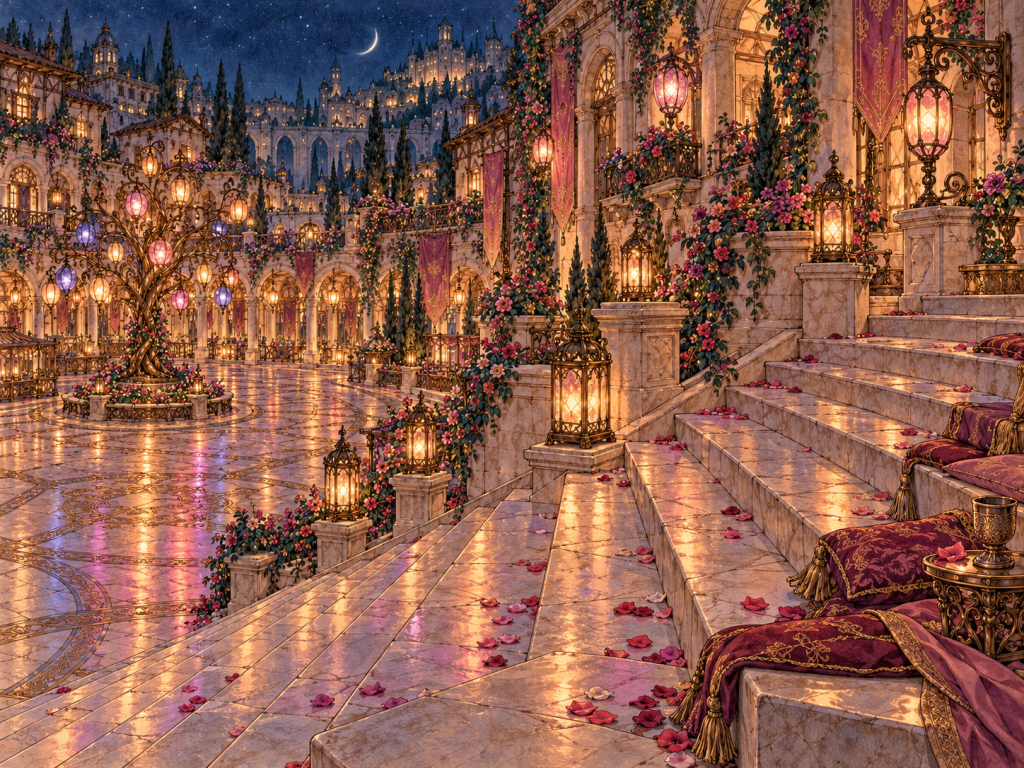
Broad shallow stairs along one edge of the plaza serve as informal seating. People eat there, rest there, watch dancers and make plans without purchasing anything from a nearby business. During crowded festivals the steps become a natural audience gallery, leaving the paving below open for processions and performance.
The Empty Circle
A circular section of paving near the Lantern Tree is kept clear whenever possible. It has no permanent stage and no schedule. A singer, dancer, storyteller, acrobat, duelist, illusionist or poet may step into the space and claim the crowd’s attention for as long as the moment holds.
The custom complements Roseglass’s formal theaters rather than competing with them. Established performers test material here. Apprentices discover whether strangers will stop walking. Visiting artists can become locally known in a single good night.
The Whispering Arcade
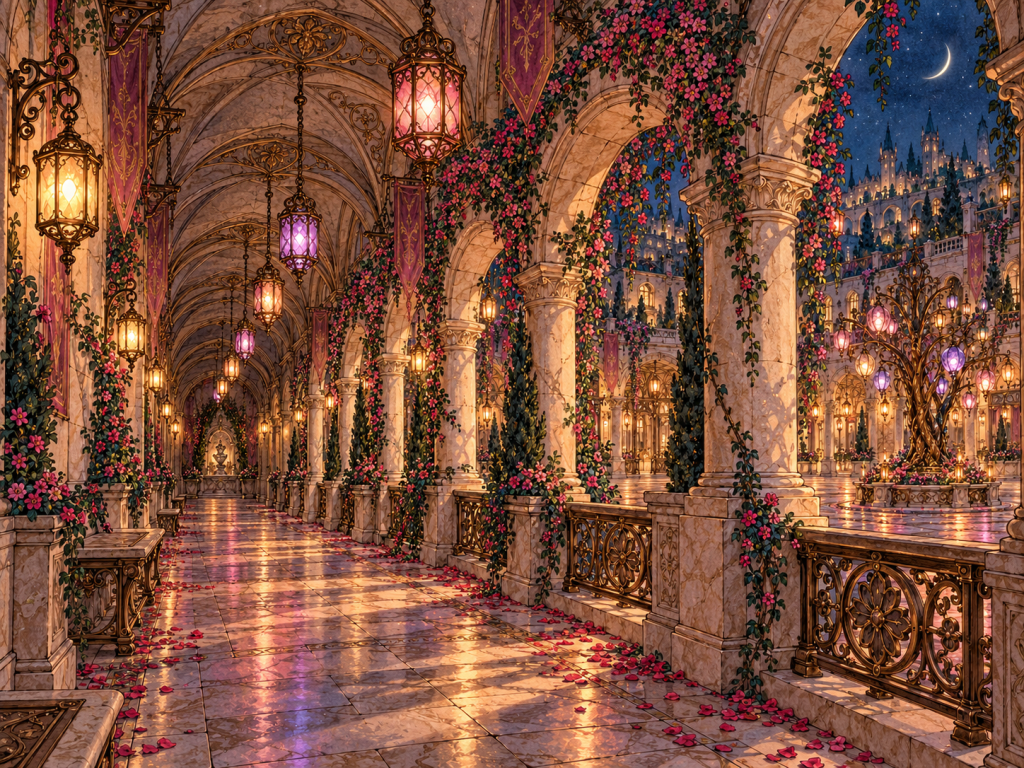
An old covered walkway borders part of the Courtyard, its repeating arches creating odd pockets of sound. A whisper spoken beneath one arch may carry farther than expected while a conversation only a few paces away dissolves into the noise of the square.
Locals use the effect for jokes, flirtation and messages. Adventurers quickly realize it is also an excellent place to hear the wrong sentence at exactly the right time.
A Night in the Courtyard
Lantern Courtyard changes character several times during the same evening. Its rhythm mirrors Roseglass Ward’s larger progression from arrival to spectacle, indulgence, intimacy and quiet.
- Late Afternoon: Deliveries cross the plaza, performers rehearse fragments, vendors arrange carts and workers hang fresh lanterns or ribbons.
- First Flame: The central lights ignite and neighboring streets begin to glow.
- Early Evening: Friends meet, audiences gather before shows, vendors do their fastest trade and the Empty Circle rarely remains empty for long.
- Deep Night: The Courtyard becomes a crossroads between performances, wine houses, pleasure houses, bathhouses and private appointments. People arrive already laughing and leave with entirely different plans.
- Near Dawn: Crowds thin into tired conversation, breakfast carts, returning performers and workers sweeping petals, paper, ribbon and spilled wax from the stones.
The Courtyard and Its Neighbors
Lantern Courtyard works because it is not isolated. It is the hinge between Roseglass Ward’s larger destinations, small businesses and ordinary nighttime labor. The Courtyard does not replace those locations; it gives them a shared public threshold.
Velvet Hall
Velvet Hall supplies the ward with formal spectacle; Lantern Courtyard supplies the spillover. Audiences meet in the square before curtain call, performers cross it in costume, and musicians sometimes continue a night outside after the Hall’s formal program has ended. The Courtyard’s Empty Circle is where unknown performers can attract the attention of people who work on Roseglass’s great stages.
The Velvet Thread
Roseglass’s couture culture is visible throughout the square. Clients leaving the Velvet Thread may cross the Courtyard in newly fitted festival attire, while performers and revelers discover precisely how a cape, mask or embroidered lining behaves under colored lanternlight. During masquerade seasons, the court becomes an unofficial moving gallery of local craftsmanship.
Skin & Smile
Oceanus usually parks their evening cart near the Winking Eye, but Skin & Smile follows Roseglass foot traffic. On especially crowded festival nights, the cart may appear at the edge of Lantern Courtyard with practical self-care goods, wrapped orders and the sort of local gossip one hears only by spending hours watching people move through a neighborhood.
The Winking Eye
The Courtyard is public; the Winking Eye offers somewhere to continue a conversation when public visibility becomes inconvenient. People who meet beneath the lanterns may drift toward the Eye for supper, a private room, a discreet negotiation or information they would rather not request in the middle of a plaza.
Balcony Garden
The Balcony Garden rises above Roseglass’s lantern-bright streets and provides the emotional opposite of the Courtyard. Below, people gather, perform and collide. Above, conversation softens and the crowd becomes distant movement. A night may begin beneath the Lantern Tree and end among vines overlooking the glow it leaves behind.
Rosewater Bathhouse
Rosewater Bathhouse is a larger sanctuary rather than a Courtyard business, but it belongs to the same nightly geography. After performance, celebration or too many hours on their feet, some visitors leave Roseglass’s loudest streets for water, rest and recovery. The movement from lanterns to baths is one of the district’s familiar late-night migrations.

The People Who Keep the Night Moving
Lantern Courtyard has no permanent cast because its people are Roseglass Ward itself. Stagehands cross with coils of rope and folded scenery. Musicians carry cases between venues. Mask-makers deliver commissions. Vintners roll casks toward wine houses. Florists replace wilted garlands. Couriers squeeze through crowds with messages. Bath attendants, cooks, performers, companions, guards, tailors and vendors all use the same paving.
This makes the Courtyard unusually useful for anyone trying to understand the ward. A wealthy patron sees a festival. A local sees who is working late, which performer has changed venues, which shop received a delivery, who returned from the baths, whose costume needed emergency repair and which familiar cart is missing from its usual corner.
Courtyard Customs
- Return beneath the lanterns. Friends separated in a crowd regroup at the Lantern Tree unless another meeting place was agreed upon.
- Do not claim the Circle forever. A performer who has finished makes room for the next voice.
- Respect the mask. Roseglass treats a chosen mask as a social boundary. Identifying a masked person publicly without invitation is considered deeply discourteous.
- Leave passage through the court. Vendors and audiences make room for workers, messengers and anyone trying to reach a neighboring street.
- Public affection is ordinary; entitlement is not. An invitation may be accepted, declined or ignored without turning the square into a dispute.
- Old lanterns are left alone. Unless damaged or dangerous, memorial and commemorative lamps remain where they were placed.
During the Embrace of Delight
During the Embrace of Delight, Lantern Courtyard becomes one of Roseglass Ward’s principal gathering and processional spaces. Temporary stages appear along surrounding streets. Balconies fill. Wine, flowers, ribbons and masks move through the crowd faster than vendors can replace them. Performers from formal houses and street companies alike use the plaza between larger events.
The Lantern Tree carries far more lights than on an ordinary night, including lamps dedicated to visitors, performers and promises made during the festival. Near midnight, portions of the court briefly dim while fresh lanterns are raised and the central branches brighten together—a local renewal commonly called the Second Bloom. The gesture is celebratory rather than devotional: Roseglass reminding itself that a night can begin again even after it is already underway.
Whispers Beneath the Lanterns
- One lantern high in the bronze branches has never been seen burning, yet nobody can remember the tree without it.
- A performer who began in the Empty Circle has been offered three different contracts in one week—and refuses to say who first paid them to perform.
- Someone has been using the Whispering Arcade to pass messages between people who insist they have never met.
- Oceanus swears a regular customer crossed the Courtyard twice on the same evening wearing two different faces and the same shoes.
- A memorial lantern was recently hung for a Roseglass resident who is still alive.
- One of the balconies overlooking the court remains lit every night, though the adjoining rooms have supposedly been vacant for months.
d12 — Beneath the Lanterns Tonight
Roll when the characters enter Lantern Courtyard without a specific appointment, or choose an entry that fits the hour. Most nights are not crises. These moments are meant to make Roseglass feel inhabited and give the party something immediate to notice, join, question or simply remember.
| d12 | What Is Happening |
|---|---|
| 1 | An apprentice dancer finishes an uneven routine in the Empty Circle. A Velvet Hall stagehand applauds anyway and quietly offers one piece of practical advice. |
| 2 | Two messengers wait at the Fountain of Shared Cups for contacts described only as “the one in the silver mask.” Both expected to be the only messenger. |
| 3 | A flower seller is racing sunset to replace a sagging garland before the First Flame. Anyone who helps is paid in blossoms, gossip or both. |
| 4 | Oceanus has rolled the Skin & Smile cart to the edge of the Courtyard because a delivery has blocked their usual evening pitch near the Winking Eye. |
| 5 | A customer in a new Lureveil cape keeps crossing the same patch of colored lanternlight, delighted by the way the lining changes from garnet to gold. |
| 6 | A wine-house server has lost track of which balcony ordered a tray. Three people above insist it was theirs. None can produce the matching token. |
| 7 | A musician leaving Velvet Hall continues a melody beneath the arcade. A second instrument answers from an unseen balcony, turning the walk home into an accidental duet. |
| 8 | A glasswright on a ladder replaces a cracked violet pane while nearby regulars make friendly wagers on whether the repair will be finished before First Flame. |
| 9 | A Rosewater attendant crosses the square carrying a basket of fresh towels and herbs for a late appointment, then stops long enough to give a lost visitor directions. |
| 10 | A Courtyard tender finds a newly hung lantern with no inscription, maker’s mark or obvious owner. It is perfectly ordinary and beautifully made. |
| 11 | A familiar food vendor arrives to find their usual corner occupied by an impromptu trio. The dispute becomes a cheerful negotiation over whether dinner can be sold to the rhythm. |
| 12 | Near dawn, a breakfast cart rolls in as the last revelers drift away. The vendor already knows which workers will want strong tea, which will want bread and which will pretend they are not exhausted. |
Adventure Hooks
The Lantern for the Living
A new memorial lantern bears the name of someone who crosses Lantern Courtyard every night. They did not place it. The artisan who made the lantern insists the order was paid for weeks ago by the named person themselves.
The Wrong Whisper
A character using the Whispering Arcade hears a conversation about an event that has not happened yet. The voices are familiar, but neither speaker is currently in the Courtyard.
The Empty Circle Waits
For an entire evening, every performer who approaches the Empty Circle changes their mind. Musicians stop playing. Dancers step away. When one of the characters crosses the ring by accident, every nearby lantern brightens.
Festival Without a Flame
At sunset, the central lantern refuses to ignite. Nothing else is immediately wrong, but experienced Roseglass workers notice neighboring lamps beginning to dim one by one. The problem may be mundane, magical or deliberate—but the district cannot begin its busiest night in darkness.
A Missing Corner
A familiar vendor fails to appear at the place they have occupied for years. Nobody is alarmed until three different locals give three different answers about where that corner of the Courtyard is supposed to be.
Using Lantern Courtyard in Play
Lantern Courtyard works best as social terrain rather than a destination with one owner, quest giver or storyline. It is the place characters can return to between Roseglass locations and reliably find movement, rumor and opportunity.
- Meeting Point: Put a contact here when the scene should begin publicly.
- Rumor Engine: Let workers and passersby reveal what changed elsewhere in the ward.
- Performance Space: Introduce artists, rivals or future Velvet Hall talent without requiring a formal show.
- Festival Terrain: Use the fountain, steps, arcade, balconies and Empty Circle as distinct zones during crowded events.
- Transition Space: Move naturally from spectacle toward privacy, baths, food, performance or the quieter upper terraces.
- Recurring Landmark: Let players recognize the same paving and lanterns as the people around them change.
Roseglass Ward needs places where nothing has to be purchased, booked or formally entered. Lantern Courtyard is that place. The venues around it give the district its attractions. The people crossing it give Roseglass its life.


You must be logged in to post a comment.