

An open-air sanctuary of turquoise water, terraced gardens and ancient Amarosan bathing traditions — and the principal House of Overflow devoted to Sylithra, Mistress of Wetness, Release and Abundance.
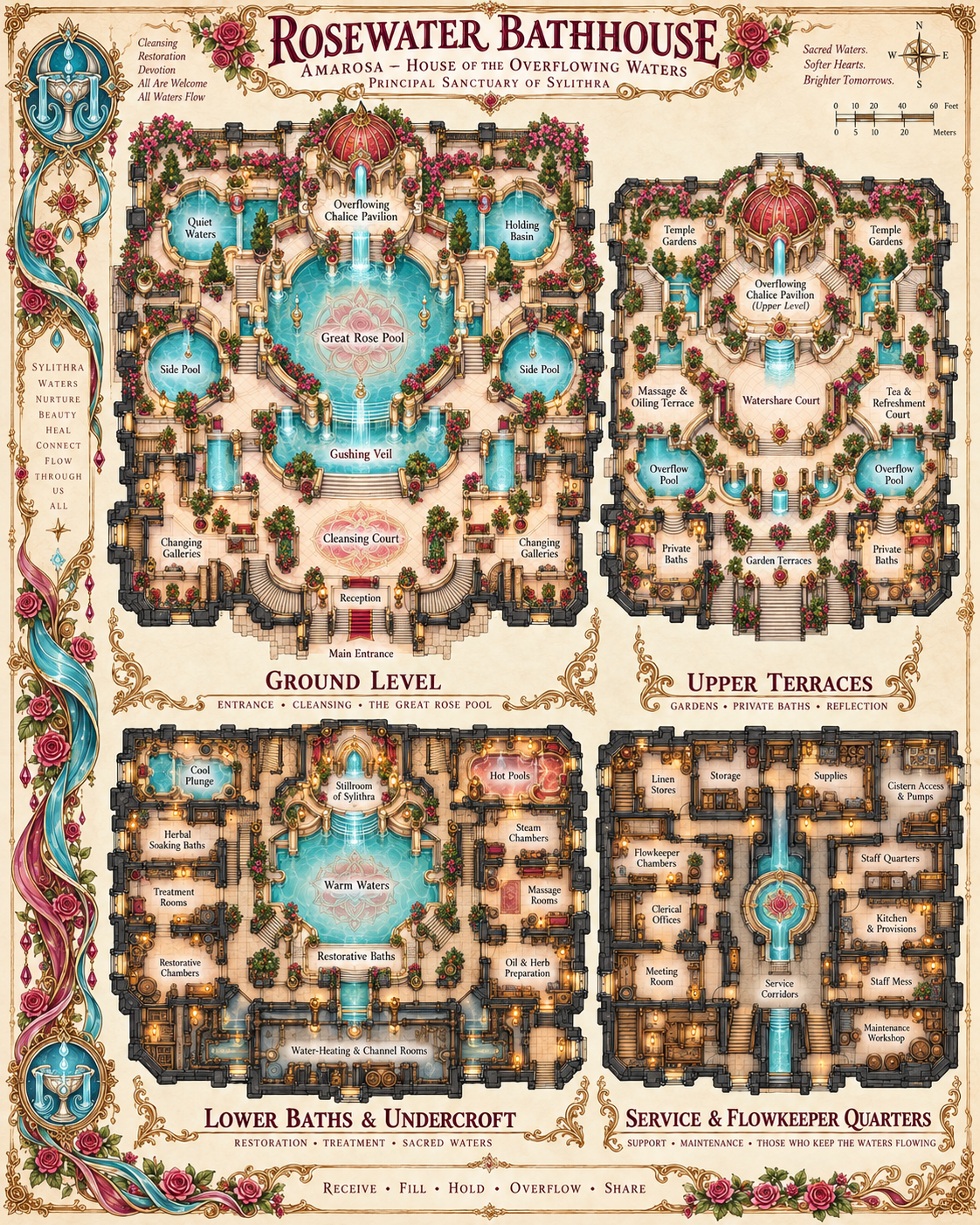
The Rosewater Bathhouse is one of Amarosa’s great public institutions: a sprawling complex of turquoise pools, pale stone terraces, flowering gardens, colonnaded courts and cascading water built around an active temple of Sylithra. Citizens come to wash, recover, talk, think, negotiate, flirt, mourn, celebrate and simply spend an afternoon somewhere beautiful.
Despite its sacred role, the bathhouse is not reserved for priests or pilgrims. Merchants soak beside performers. Adventurers recovering from the Rosethorn Chasm share pools with artisans, sailors and temple attendants. Mourners sit beneath falling water until tears finally come. Lovers bathe together. Flowkeepers tend fountains, clean stone, guide rituals of release and remind guests that openness is never permission to ignore another person’s boundaries.
Receive. Fill. Hold. Overflow. Share.
Rosewater Bathhouse at a Glance
Religious Role: Principal Amarosan temple of Sylithra; a House of Overflow
Character: Serene, social, sensual and civic
Architecture: Ancient Mediterranean fantasy; pale rose-gray stone, mosaics, columns, gardens and open terraces
Known For: Turquoise pools, cascading water, rosewater treatments, restorative soaking and sunset bathing
Clergy: Flowkeepers
Expected Conduct: Cleanliness, quiet courtesy, respect for shared water and absolute respect for personal boundaries
Entering the House of Overflow
The Rosewater Bathhouse is designed to make arrival feel gradual rather than ceremonial. Visitors pass from Amarosa’s streets into a reception court, then through changing galleries and the Cleansing Court before approaching the Gushing Veil and the public pools beyond. At no point is a visitor required to pray, make an offering or declare devotion to Sylithra.
First-time visitors are usually met by attendants or Flowkeepers who explain the customs of the baths, help arrange private accommodations when needed and answer questions about rites, treatments or sacred spaces.
The traditional question is simple:
“What are you carrying?”
The visitor does not have to answer. In Sylithran practice, choosing not to speak may itself be an honest answer.
Temple Layout
The House of Overflow is arranged by movement rather than hierarchy. Visitors enter through cleansing and public bathing spaces, then choose whether to move upward toward quieter terraces, downward toward restorative baths or inward toward ritual and counsel.
| Level | Primary Spaces | Purpose |
|---|---|---|
| Ground Level | Main Entrance, Reception, Changing Galleries, Cleansing Court, Gushing Veil, Great Rose Pool, Quiet Waters, Holding Basin, Overflowing Chalice Pavilion | Arrival, cleansing, public bathing, worship and everyday temple traffic. |
| Upper Terraces | Temple gardens, Watershare Court, Massage & Oiling Terrace, Overflow Pools, private baths, tea and refreshment court | Reflection, private bathing, aftercare, hospitality and quieter devotion. |
| Lower Baths & Undercroft | Warm Waters, Cool Plunge, hot pools, herbal soaking baths, steam chambers, treatment rooms, restorative chambers, Stillroom of Sylithra, water-heating and channel rooms | Restoration, treatment, ritual bathing and temple infrastructure. |
| Service & Flowkeeper Quarters | Clerical offices, Flowkeeper chambers, staff quarters, linen stores, kitchens, maintenance workshop, cistern access and pumps | Clergy life, administration and keeping the waters flowing. |
A Temple Woven Into Everyday Life
Visitors unfamiliar with Sylithran worship sometimes fail to realize they have entered a temple at all. No monumental doors separate sacred space from civic life. No priest demands prayer before someone may bathe. No guest must profess devotion to Sylithra before stepping into the water. The architecture itself performs the theology. Water enters the highest terraces through old stone channels. It fills elevated cisterns. Those cisterns feed smaller basins. The basins overflow into warmer pools. Those pools spill through channels into gardens and lower bathing courts before continuing onward through Amarosa. Nothing is meant to remain still merely so that it may be possessed. To a Flowkeeper, the entire complex is a sermon in stone and water.
The Overflowing Chalice
At the heart of the bathhouse stands its principal shrine: a monumental silver-and-stone basin modeled after Sylithra’s Overflowing Chalice. Turquoise water enters the vessel in a continuous stream, fills it completely and spills from several points along its rim into channels radiating throughout the temple. The chalice is never intentionally emptied. Worshippers approach it carrying cups, bowls or small personal vessels. Some fill them from its water. Others pour clean water of their own into the basin. One gesture receives. The other gives. Neither is considered holier. The Flowkeepers teach that a person who knows only how to pour eventually becomes empty, while one who only receives eventually becomes a sealed cistern. Sylithra asks for movement.
The Gushing Veil
The entrance to the innermost temple court passes through a thin curtain of continuously falling water known as the Gushing Veil. The water is warm, clear and gentle enough to pass through comfortably. Most visitors simply walk beneath it. Devotees sometimes pause. Crossing the Veil traditionally represents leaving behind whatever one no longer wishes to carry into the sanctuary: road dust, anger, embarrassment, grief, exhaustion, performative dignity or simply the noise of the city outside. The rite does not absolve wrongdoing. Sylithran theology distinguishes release from avoidance. A person may let go of shame without escaping responsibility for what they have done.
The Bathing Complex
The Rosewater Bathhouse does not contain one great pool so much as an entire landscape shaped around water. Visitors move gradually through changing galleries, washing courts, warm pools, hotter mineral basins, cool plunges, shaded resting terraces and garden walks. Stairs climb between levels while narrow channels carry water from one basin into another. The oldest portions of the bathhouse were carved directly into the underlying stone. Later generations added colonnades, fountains, garden walls and upper terraces without replacing what came before. The complex therefore feels accumulated rather than designed all at once: a living civic sanctuary reshaped by centuries of use.


The Cleansing Court
Every visit begins here. Long stone benches stand beside continuous channels of warm running water. Guests wash thoroughly before entering any communal pool, using shallow basins, ladles, soaps and brushes supplied by the bathhouse or brought from home. Mud, sweat, cosmetics, road dust and the remains of adventuring are removed here rather than carried into shared water. Returning adventurers receive particular scrutiny. Blood, monster ichor, alchemical residue, grave dust, strange pollen and unidentified magical slime have all earned their own regulations over the years. Washing before soaking is practical, but it is also devotional. The body arrives carrying what the day has placed upon it. Water receives it. Then the water moves on.

The Great Rose Pool
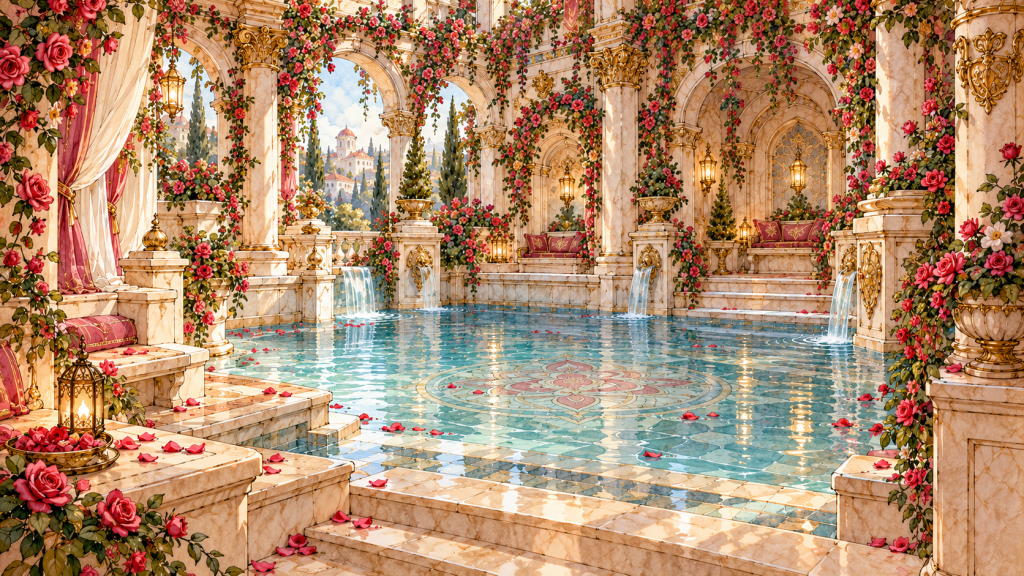
The largest pool forms the social heart of the bathhouse. Broad steps descend gradually into turquoise water beneath open sky. Fountains and gentle cascades keep the surface moving while shaded colonnades provide places to sit along its edges. Conversation is expected here. Deals have been proposed, romances begun, expeditions planned and political arguments quietly settled while their participants sat shoulder-deep in warm water. Despite the name, the pool is not filled with perfume. Its fragrance comes from carefully controlled rosewater channels and occasional petals released by attendants during designated hours. Guests are forbidden from adding their own oils, herbs, powders or magical substances to communal pools.

The Pools of Filling
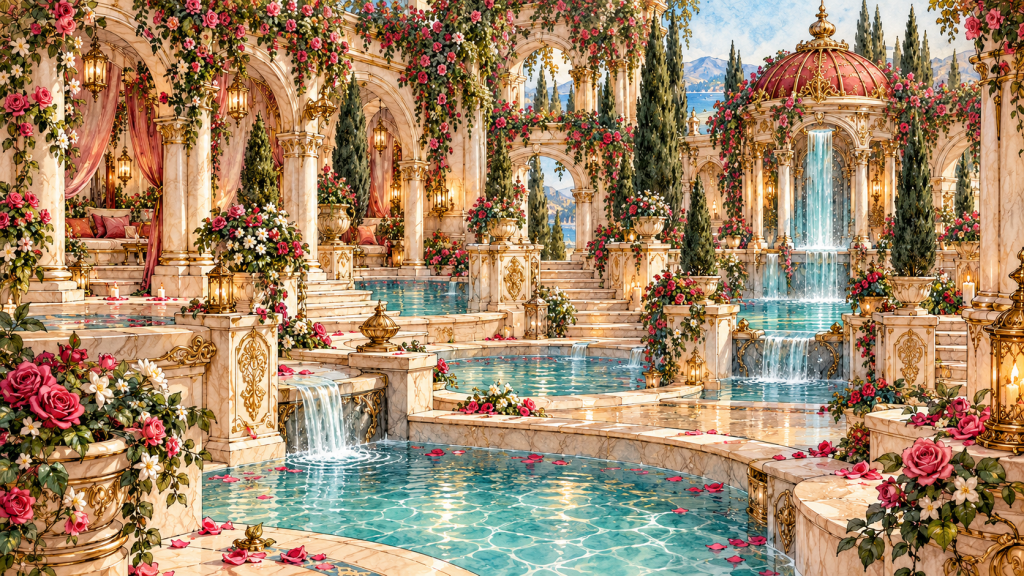
Several warmer pools ascend the terraces above the central court. Their temperatures rise gradually, encouraging visitors to move slowly rather than rush toward the hottest water. Flowkeepers sometimes use the progression for guided contemplation: What are you carrying? What are you allowing yourself to receive? What within you is becoming full? There is no expectation that visitors answer aloud. Some people come simply because the pools feel wonderful. Sylithra is not offended by uncomplicated pleasure.
The Holding Basin
One pool is noticeably quieter. Its water is warm but nearly still, disturbed only by bathers entering or leaving. People come here when they are not yet ready to speak, cry, decide, confess or release whatever has brought them to the temple. That reluctance is respected. Sylithran doctrine does not teach that every feeling must immediately be expressed. The vessel exists for a reason. Holding can create safety, understanding, anticipation and necessary time. Flowkeepers therefore do not ask, “Why have you not released this?” They ask, “Do you still know why you are holding it?”

The Overflow Pools
Water from the upper terraces eventually reaches a series of broad pools whose rims are intentionally low. Every movement sends small streams cascading over their sides. These are traditionally associated with emotional release. People laugh here. Some cry. Some speak things they have rehearsed silently for months. Others simply sit beneath a waterfall and allow tension to leave their bodies without assigning any grand meaning to it. Sylithra’s teaching is especially visible here: physical response is information, not authority. Tears do not prove weakness. Arousal does not establish consent. Fear does not automatically mean refusal. Laughter does not always mean comfort. The body may speak plainly without speaking for the whole person.
The Quiet Waters
Several smaller pools are marked for silence. Conversation here is discouraged beyond brief whispers. Musicians do not perform nearby, attendants approach quietly and vendors never enter.
People use the Quiet Waters for meditation, prayer, recovery from overstimulation or simply the rare pleasure of being surrounded by others without being required to engage with them.
The Cool Plunge
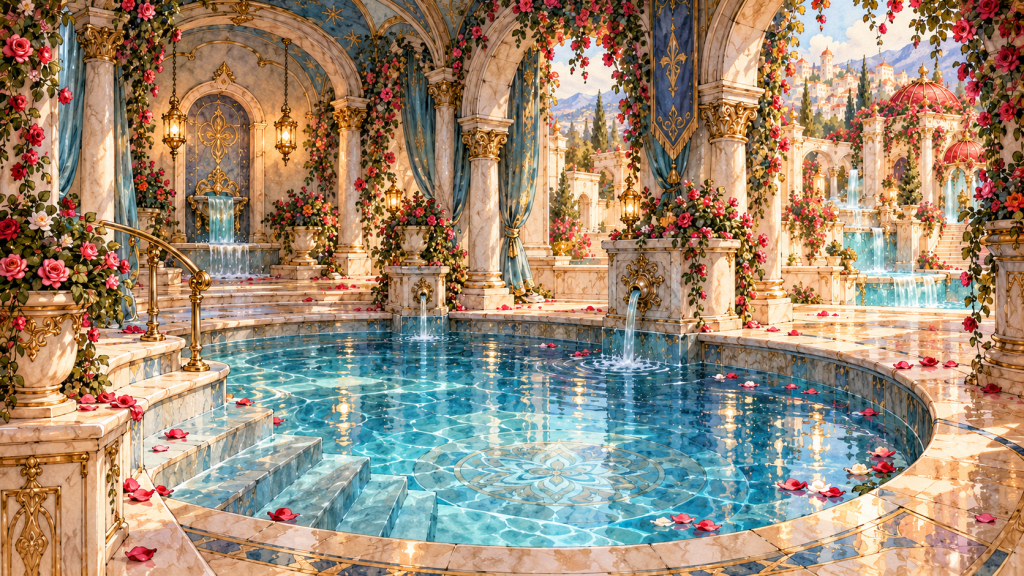
Set beneath a shaded arcade, the Cool Plunge is fed by colder water than the surrounding baths. Some visitors use it between warmer pools. Others end their bathing here before returning to the terraces. Adventurers have developed the unfortunate tradition of wagering how calmly newcomers can enter it. Running, pushing and involuntary assistance are forbidden.

The Watershare Court
Beyond the principal pools lies a long communal fountain supplied by water passing outward from the temple. Pitchers are filled here for tea, gardens, washing and charitable distribution. This is Watershare in its most ordinary form. A traveler receives a cup. Someone washes another person’s back. A tired adventurer is handed fresh water without needing to ask twice. A grieving stranger is offered a towel. A garden receives what the bathing pools no longer require. The lesson is uncomplicated: what leaves one vessel need not become waste.

The Garden Terraces
Between the pools lie planted terraces of roses, jasmine, cypress, flowering vines and aromatic herbs. Stone couches and shaded benches allow guests to rest between immersions while attendants bring water, fruit, tea and light food. These gardens also make the Rosewater Bathhouse an important social space for those who do not wish to bathe. A person may accompany friends, conduct a conversation beneath the colonnade or spend an afternoon reading beside the pools without ever entering the water.

The Domed Pavilion
The domed pavilion overlooking the principal pools is the visual heart of the complex. Its open arches catch both sea breeze and the sound of falling water. Beneath the dome stands the Overflowing Chalice shrine, surrounded by shallow channels that carry water toward the terraces below.
Small civic ceremonies, poetry recitations, memorial observances and seasonal Sylithran rites are held here. In Amarosa, gratitude offered beside beautiful water rarely requires an appointment with a priest.
Flowkeepers of the Rosewater Bathhouse
Sylithra’s clergy here are known as Flowkeepers. They serve simultaneously as priests, bath attendants, counselors, healers, waterkeepers and custodians of the complex.
Their sacred duties include tending the pools, inspecting water quality, maintaining channels and cisterns, guiding rites of release, assisting mourners and ensuring that nobody mistakes bodily openness for social entitlement.
A Flowkeeper may spend one hour discussing theology with a pilgrim and the next unclogging a mineral channel. Most see no contradiction. A temple dedicated to flowing water that neglects its plumbing would be considered an embarrassment to the goddess.
The Living Rhythm of the Waters
| Time | Temple Rhythm |
|---|---|
| Dawn | Flowkeepers open the channels, inspect cisterns and test the pools. The first waters pass through the Overflowing Chalice before the bathing courts open. Early devotees often come specifically for the quiet of the first flow. |
| Morning | The Cleansing Court and public pools open fully. Restorative treatments begin, Flowkeepers receive visitors seeking counsel and the Watershare Court distributes fresh water to temple kitchens, gardens and those carrying vessels into the city. |
| Midday | The Great Rose Pool reaches its most social hours. The terraces, massage courts and refreshment spaces grow lively with travelers, citizens and pilgrims moving between water, shade and conversation. |
| Dusk | A brief public devotion is held around the Overflowing Chalice. Water is poured, received and allowed to continue through the temple channels while Flowkeepers recite: Receive. Fill. Hold. Overflow. Share. |
| Evening | The quieter pools become more prominent. Private baths, guided rites, restorative work and devotional appointments continue while heavily used public pools begin cycling through cleaning and refreshment. |
Those Who Keep the Waters
The Rosewater Bathhouse is maintained by far more people than its ordained clergy. The House of Overflow depends upon a working community whose labor is understood as part of the sacred current rather than something separate from worship.
- Flowkeepers serve as Sylithra’s priests, ritual guides, counselors and custodians of sacred water.
- Bath Attendants maintain cleansing stations, linens, bathing implements and guest readiness.
- Waterkeepers inspect channels, cisterns, temperatures, drainage and mineral balance.
- Restorative Attendants provide massage, oils, scraping treatments and physical recovery.
- Healers oversee injuries, exhaustion and conditions requiring more than ordinary bathing.
- Gardeners tend the roses, jasmine, cypress, herbs and water-fed terraces.
- Cooks and Refreshment Attendants serve tea, fruit, fresh water and light meals.
- Maintenance Staff include masons, channel workers, pump tenders and craftspeople whose practical work keeps the temple alive.
Temple Services
Ordinary entry does not require formal worship. Visitors may come for practical care, devotional practice or simple rest. Offerings support the House, but immediate care and access to ordinary public worship are not treated as privileges reserved only for the wealthy.
- Public bathing and cleansing
- Private bathing chambers
- Flowkeeper counsel
- Guided First Flow rites
- Restorative massage and post-bath oiling
- Herbal soaking baths
- Steam treatments
- Physical recovery after travel or adventuring
- Quiet recovery in the Stillroom of Sylithra
- Watershare ceremonies
- Shared Cup rites
- Memorial and grief observances
- Relationship or partnership rites involving water
- Garden and refreshment access
Devotions and Sacred Rites
The Rosewater Bathhouse practices the wider devotional traditions of Sylithra’s faith. Visitors do not need to participate simply because they entered the House of Overflow, and no single form of release is treated as spiritually superior to another.
The Rite of First Flow
A worshipper enters warm water carrying something they have struggled to contain: grief, anger, fear, exhaustion, shame, desire or an unspoken truth. A Flowkeeper guides breathing and conversation without demanding a particular outcome. The rite succeeds when the participant becomes more honest about what they are carrying, even if they decide they are not yet ready to release it. At the end, a cup of water is poured into the pool. The existing water receives it without asking where it came from.
The Rite of Saturation
Participants enter sacred water wearing lightweight ceremonial clothing and remain until the fabric becomes completely soaked. The transformation is the lesson: what receives experience may change weight, texture and appearance without becoming lesser. Many versions end with a warm dry robe, because Sylithra does not teach that one must remain saturated forever to prove the water was real.
The Rite of the Shared Cup
Two or more participants pour water from separate vessels into one larger chalice, then receive portions of the mingled water. The rite is common among friends, partners, adventuring companies, marriages, reconciliations and communities beginning a shared undertaking.
The Rite of the Open Stream
A more personal rite uses water, oils or other mutually accepted liquids traced or poured across the body according to boundaries established beforehand. One person gives and another receives; roles may then reverse. The rite may remain gentle and nonsexual or become part of a more intimate devotional experience according to the participants’ wishes. Neither form is considered holier.
The Rite of the Gushing Heart
One of Sylithra’s private mysteries explores fullness, chosen restraint and freely chosen release. Participants establish the desired pressure, their limits and the ending of the rite before it begins. The sacred transition is not intensity for its own sake, but the moment between I am holding and I no longer need to hold. The rite is always governed by the principle that bodily response never replaces continuing agency.
The Quiet Current
Not every visitor needs guidance. Some need only a place where they are not expected to explain themselves. Flowkeepers trained in the Quiet Current offer water, a towel, a place beside a silent pool or simple companionship without demanding confession or resolution.
“You may hold a little longer.”
The phrase is not permission to avoid forever. It is permission to decide that this moment is not yet the moment to release.
The Stillroom of Sylithra
Deep within the lower baths is a warm, dim chamber where the sound of running water is reduced to a single narrow stream entering one basin and leaving through another channel. Cushions, folded blankets, clean towels and drinking water are kept ready for anyone recovering from an intense rite, emotional release, grief, exhaustion or overstimulation.
The Stillroom teaches a quieter Sylithran truth: even water does not need to rush everywhere.
Care Has Limits
Sylithran worship does not confuse abundance with endless availability. Pools must be drained and refreshed. Channels must be cleared. Linens must be changed. Attendants rotate shifts. A Flowkeeper may end a counseling session. A restorative attendant may decline further touch. A bath may close because it has become overcrowded or needs time to be cleaned.
The same rule applies to rites. A participant who entered intending to release something may decide to keep holding it. Someone may pause, ask for privacy, request another attendant or leave entirely. None of these choices is treated as failure.
A common teaching summarizes the principle: A vessel exists to hold. It does not exist to be filled past destruction.
For the DM: Bring Rosewater to Your Table
The Rosewater Bathhouse can function as more than scenery. It is a natural downtime location, social crossroads, source of recovery, site of religious ritual, place for quiet conversations and an easy setting for mysteries that begin somewhere characters already have reason to visit.
| Characters Need… | Send Them To… |
|---|---|
| Ordinary bathing or social interaction | Great Rose Pool |
| Quiet reflection | Quiet Waters |
| Something they are not ready to discuss | Holding Basin |
| Emotional release or Flowkeeper guidance | Overflow Pools |
| Physical recovery | Lower Baths and restorative chambers |
| Private bathing | Upper Terrace private baths |
| Massage or post-adventure treatment | Massage & Oiling Terrace |
| Religious guidance from Sylithra’s clergy | Flowkeepers |
| Water, hospitality or community aid | Watershare Court |
| A formal Sylithran rite | Overflowing Chalice Pavilion |
| Somewhere to recover after an intense experience | Stillroom of Sylithra |
Openings into Adventure
- The Great Rose Pool begins draining even though every gate beneath it is closed.
- A pilgrim arrives for the Rite of First Flow carrying a sealed vessel that begins filling itself from the inside.
- The Holding Basin will not ripple, even when someone enters it.
- A Flowkeeper vanishes during the evening inspection of the lower channel rooms.
- Water leaving the Watershare Court begins flowing uphill toward a locked building elsewhere in Amarosa.
- The Overflowing Chalice stops spilling for the first time in living memory, though water continues pouring into it.
A Place in Your Campaign
The Rosewater Bathhouse can serve as sanctuary, social hub, recovery site, religious institution, investigation location or quiet counterpoint to Amarosa’s louder pleasures. Characters may come because they need healing, because they need a conversation somewhere neutral, because someone has finally decided to say what they have been holding or because warm water sounds better than another night sleeping in armor.
The House is sacred because life passes through it. Water enters, gathers, changes what it touches and continues onward.
Customs of the Rosewater Bathhouse
Visitors are not expected to know every Amarosan bathing tradition. Attendants gently explain unfamiliar customs, and honest mistakes rarely cause offense. Deliberate disregard does.
Wash Before Entering the Pools
This is the most important practical rule. Every guest washes thoroughly in the Cleansing Court before entering communal water. Hair, skin, fur, scales, hooves and feet are rinsed appropriately to the bather’s body. Washing benches are rinsed after use for the next guest.
Clothing Remains Outside the Water
Traditional Amarosan communal bathing is unclothed. Robes, wraps, footwear, armor and jewelry that may tarnish or contaminate the water are left in the changing galleries or on designated dry terraces. Small drying cloths remain beside the pools and are not immersed in communal water. Nudity within the bathing courts is ordinary and carries no automatic invitation, romantic implication or expectation of attention. Staring is rude. Commentary upon another guest’s body without invitation is ruder. Touching without permission can result in immediate removal. Guests uncomfortable with communal bathing may request private washing rooms or secluded pools when available. Accommodation is treated as hospitality, not as failure to observe tradition.
The Water Is Shared
Nothing is added to a communal pool without permission from the attendants. Perfumes, massage oils, soaps, powders, enchanted cosmetics, medicinal tinctures and personal herbs remain outside the bathing water unless specifically provided by the temple. This rule became considerably stricter after what older attendants refer to only as the Lavender Incident.
Hair, Fur and Ornament
Long hair is usually bound before entering deeper pools. The same courtesy applies to unusually long fur, decorative feathers or other features that may shed heavily into the water. Pins and ornaments that could fall into a pool are normally removed. Bathhouse attendants maintain specialized washing stations for Amarosa’s many peoples, including raised basins, broad washing benches and lower channels suited to different anatomies. No single mortal shape is treated as the assumed one.
Enter Gently
The baths are for soaking rather than swimming. Guests step into pools rather than dive. Splashing is kept modest, and running along wet stone is discouraged with the weary conviction of attendants who have seen the consequences.
Read the Pool Before Speaking
Different pools possess different social expectations. The Great Rose Pool welcomes conversation. Garden basins favor quiet companionship. Pools marked for silence are genuinely silent. A useful Amarosan rule is simple: Listen before adding your voice.
Ask Before Touching
Bathhouse culture is physically relaxed but not presumptive. Friends may wash one another’s backs. Lovers may sit together. Massage attendants work openly on the terraces. Someone might offer to braid wet hair or help clean difficult scales. Every such gesture begins with permission. Exposure is not consent. Familiarity is not consent. Flirtation is not consent.
Intimacy Has Its Own Spaces
Affection is common. Sexual activity in the shared public pools is not. Kissing, leaning together and quiet flirtation rarely draw notice so long as others are not made unwilling participants in the moment. Guests seeking greater privacy may reserve secluded garden baths or leave for establishments designed for intimate encounters. This distinction is important to the character of the Rosewater Bathhouse. It is sensual because bodies, water and beauty are treated without shame. It is not a pleasure house.
Oil Comes After Water
One of the oldest local customs is post-bath oiling. After the final soak, guests may visit shaded stone galleries where attendants offer simple olive, herbal or rose-scented oils. Massage, scraping treatments and muscle work are available for an additional fee. Adventurers are particularly enthusiastic customers. Applying heavy oils before entering communal pools is considered both wasteful and impolite.
Leave the Water Ready for the Next Person
Before leaving a washing station, guests rinse the stone. Before leaving a resting terrace, cups and dishes are returned. Before departing the baths, borrowed cloths and bathing implements are placed in designated baskets. Amarosans view these little acts as a form of Watershare: every visitor inherits the bathhouse from the person who used it before them.
Bathing as Amarosan Social Life
The Rosewater Bathhouse occupies an unusual position within the city because rank becomes difficult to display while sitting neck-deep in water. Wealth still matters. Influence still matters. Private terraces exist for those willing to pay for them. But the communal pools encourage a certain temporary equality. Weapons are stored. Ceremonial robes are removed. House colors disappear. Everyone washes before entering the same water. This has made bathhouses valuable informal meeting grounds throughout Amarosan history. Merchants discuss contracts there precisely because neither side controls the room. Priests meet people outside formal temple spaces. Performers recover after long nights. Adventurers hear rumors from people who would never approach them in a guildhall. A surprising amount of Amarosan politics has probably occurred while everyone involved was pretending merely to soak.
Worship Without Obligation
One of the qualities locals value most about the Rosewater Bathhouse is that worship is available rather than compulsory. A citizen may visit weekly for fifty years without ever offering Sylithra a formal prayer. The Flowkeepers do not mind. They would argue that someone who washes before entering shared water, respects another person’s boundaries, allows an exhausted stranger space beside them and leaves the pool cleaner than they found it has already understood something important about their goddess. Formal devotion simply gives the understanding a name.
Religious Role in Amarosa
The Rosewater Bathhouse is Amarosa’s principal sanctuary of Sylithra and one of the city’s most visible deity-specific temples. Its role is distinct from the Temple of Eternal Petals, Amarosa’s principal active temple of Velyssara, and from the House of the Sacred Bloom, the old temple site now devoted to hospitality, recovery and Bloomseeker expeditions. The distinction matters. The Temple of Eternal Petals gives Amarosa a ceremonial center of Velyssaran worship. The Rosewater Bathhouse gives the city a living Sylithran institution woven directly into ordinary daily life.
For Adventurers
The Rosewater Bathhouse is an excellent place to recover without withdrawing from the life of Amarosa. A party might arrive to remove the grime of a journey and discover that the merchant soaking nearby recognizes the seal on something recovered below the city. A Flowkeeper may request a private conversation on a garden terrace. An exhausted Bloomseeker might finally speak about something witnessed underground once armor and bravado have been left in the changing gallery.
Or nothing may happen at all.
Sometimes the reward for surviving an adventure is warm water, clean skin, a cup of tea and an hour in which nobody asks the heroes to save anything.


You must be logged in to post a comment.