
Velvet Hall
Where Every Mask May Speak
Velvet Hall is Roseglass Ward’s principal temple-theatre of Cyrillith, the Masquerade Sovereign, and one of Amarosa’s great houses of performance. Music, dance, drama, masquerade, illusion and devotional roleplay share the same stage because the Hall does not separate sacred transformation from art. Here, the stage is an altar, costume may become vestment, rehearsal may become meditation and a deliberately assumed role may reveal a truth its wearer could not otherwise speak.
Velvet Hall is also a working public venue. Citizens attend comedies, tragedies, concerts, dances, visiting performances and festival spectacles without being expected to worship. Devotees may participate in formal Cyrillithian rites without being expected to become performers. The ambiguity is intentional: one person may attend for entertainment while another experiences the same performance as prayer.
For Cyrillith’s complete mythology, sacred teachings, divine signs, relics and wider worship traditions, see Cyrillith — The Masquerade Sovereign.
Quick Facts
Location: Roseglass Ward, Amarosa
Type: Major temple-theatre, performance house, masquerade sanctuary
Deity: Cyrillith, the Masquerade Sovereign
Clergy: Mask-Bearers, Veiled Speakers, Courtesans of Truth, the Many-Faced and the Whispering Chorus
Known For: The Living Curtain, Rosewood Floor, sacred masks, mirrored corridors, the Blacklight Masquerade and festival performances
Atmosphere: Dramatic, sensual, mysterious, theatrical without severity
Primary Role: Worship, performance, identity exploration, ritual confession, artistic expression and civic entertainment
Core Teaching: Performance is revelation, not deception
Entering Velvet Hall
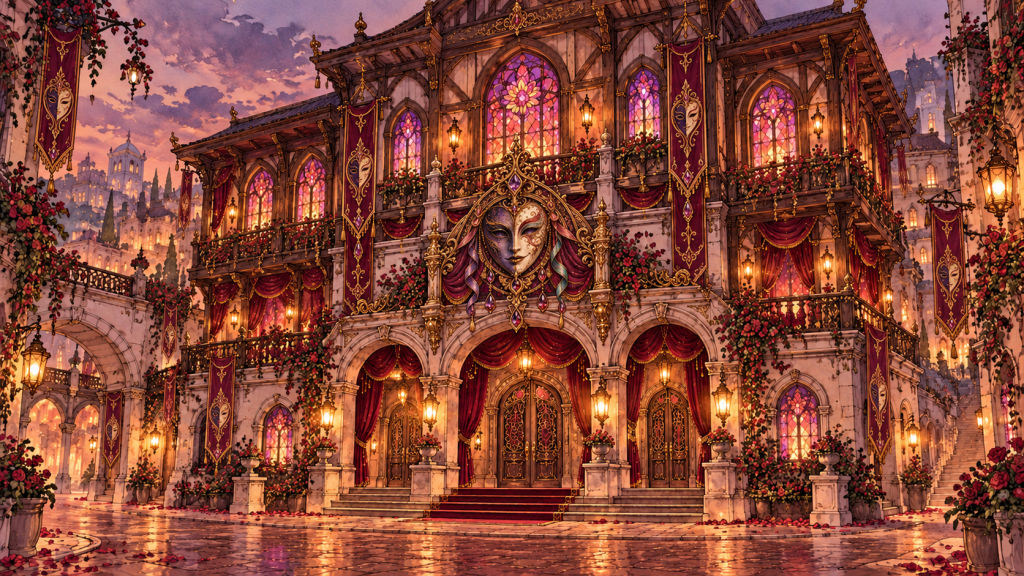
Velvet Hall rises three stories above one of Roseglass Ward’s busiest evening streets. Pale rose-gray stone anchors the lower façade while carved dark timber, projecting balconies and tall stained-glass windows lift the upper stories into violet, amber and crimson light. Above the principal entrance gleams the Hall’s Amarosan rendering of Cyrillith’s dual-faced masque, framed in curling goldwork and ribbons of shifting color.
The Grand Foyer
Visitors enter beneath a deep arcade into a broad reception chamber of polished dark floors, roseglass mirrors, hanging lanterns and shallow perfumed fountains. Two staircases rise toward the galleries. Ticket sellers, mask-makers, musicians, temple attendants and visiting performers mingle at the room’s edges while arrivals decide whether they wish to remain themselves, become anonymous or begin becoming someone else.
The traditional question at Velvet Hall is not “Who are you?” It is:
“Which face have you brought tonight?”
No answer is required. Silence is considered a perfectly valid face.
Temple Layout
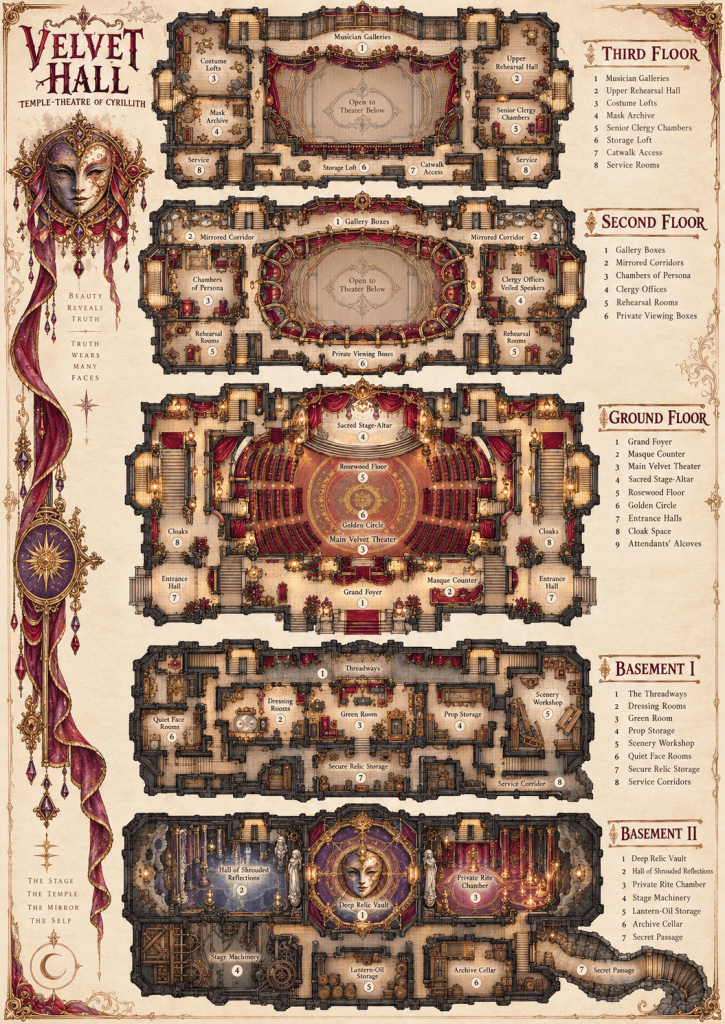
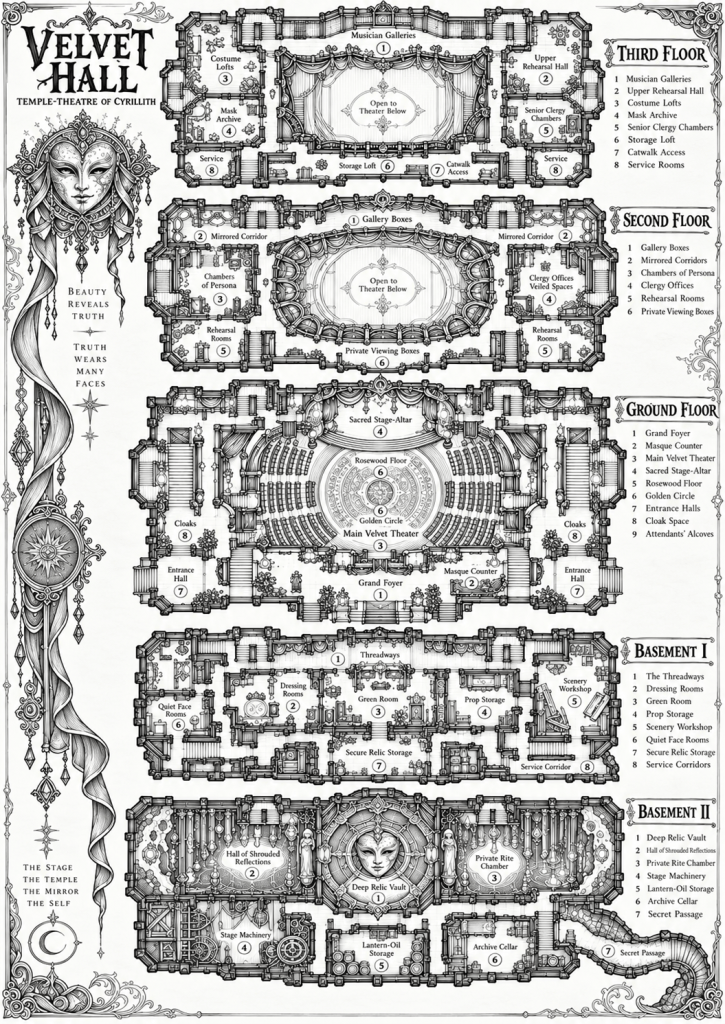
Velvet Hall is arranged around performance rather than a conventional nave. Public spaces occupy the broad central floors, while ritual preparation, counsel, costuming and clergy work become more private as visitors move upward or backstage. The building is designed so that entering a more intimate space requires a deliberate choice rather than an accidental turn.
| Level | Primary Spaces | Purpose |
|---|---|---|
| Ground Floor | Grand Foyer, Velvet Theater, Rosewood Floor, Golden Circle, Masque Counter | Arrival, public performance, major rites, dancing, communal worship and everyday theater traffic. |
| Second Floor | Gallery boxes, mirrored corridors, Chambers of Persona, clergy offices, smaller rehearsal rooms | Observation, private counsel, identity work, ritual preparation and reserved viewing. |
| Third Floor | Musician galleries, costume lofts, mask archive, senior clergy rooms, upper rehearsal hall | Music, vestment care, sacred-mask stewardship, administration and artistic preparation. |
| Backstage & Undercroft | The Threadways, dressing rooms, scenery workshops, Quiet Face rooms, secure relic storage and service passages | Transformation, technical work, decompression, recovery, storage and temple infrastructure. |
Temple Etiquette
- The Stage Is Sacred. Audiences may cheer, laugh, cry and flirt, but deliberate disruption is both artistic insult and temple offense.
- A mask belongs to its wearer. No visitor is required to explain a chosen persona, and revealing another masked guest’s identity without permission is a serious violation.
- Invitation is not entitlement. A performer portraying desire has offered a performance, nothing more.
- No role may be forced. Cyrillith’s faith explicitly rejects compelling another person to inhabit an identity, persona or part they have not chosen.
- The Final Bow ends the role. When the bow is given, the performance is ritually released. Staged relationships and roles do not continue unless everyone involved chooses otherwise.
- Observation does not imply participation. A guest may watch public rites, dances or performances without being drawn into them.
- Ask rather than assume. Mask-Bearers and floor attendants exist specifically to help newcomers navigate the Hall’s customs.
The Living Rhythm of the Hall
Velvet Hall changes character over the course of each day. Rehearsal belongs to the morning and afternoon. Counsel, maskwork, fittings and private rites fill the quieter hours. As sunset approaches, lanterns are lit, mirrors are polished, musicians take the galleries and the building slowly becomes theatrical. By midnight, the distinction between audience, congregation and cast can feel very thin indeed.
Its architecture teaches Cyrillith’s theology without sermon: identity is not fixed, performance need not be false and vulnerability becomes sacred when it is chosen.
The Velvet Theater
The ceremonial heart of the Hall is a broad semicircular stage surrounded by three tiers of galleries. Rows of seating may fill the floor for drama, small tables may appear for music and nearly everything can be removed when dance becomes the evening’s principal form of worship.
There is no separate altar hidden behind the theater. The stage itself fulfills that role. Public plays, devotional performances and sacred rites may therefore use the same boards on different evenings—or during the same performance.
The Living Curtain
The great wine-dark curtain predates much of the current building. During performances, color and image sometimes move through its weave: petals, shadows, stars, distant silhouettes or flashes of impossible scenery. Cyrillith’s clergy teach that the curtain responds most strongly when a performance reveals something emotionally true beneath an assumed role.
No one agrees whether the curtain is enchanted fabric, a relic, a minor divine manifestation or something stranger. The Hall considers the uncertainty part of its sanctity.
The Rosewood Floor & Golden Circle
The polished dance floor before the stage is one of Velvet Hall’s most active communal spaces. Many evenings end with musicians continuing after the formal performance while the audience descends to dance.
A narrow golden circle marks the traditional position for solo performance. To step within it while music is playing is to request the room’s attention. To Cyrillith’s faithful, it is also to approach an altar through persona rather than petition.
The Mirrored Corridors
The second floor is crossed by corridors lined with mirrors of different shapes, ages and treatments. Some sharpen reflections. Some soften them. A few are deliberately warped. Worshipers use the halls for the Mirror Whisper and other private acts of self-address, while clergy watch carefully for reflections that move, emote or speak independently.
A mirror behaving strangely in a Cyrillithian temple is not automatically considered dangerous. It is, however, never ignored.
The Chambers of Persona
These small private rooms are used for ritual preparation, identity exploration, confession and guided rolework. Each contains a mirror that may be covered, a writing desk, several chairs, water, simple garments and a rack upon which a mask may be placed when a visitor wishes to speak without wearing it.
The rooms are not interrogation chambers. Cyrillith does not demand confession. They exist so a person may try on a truth before deciding whether to carry it back into the world.
The Threadways
Backstage passages twist between dressing rooms, prop storage, costume workshops, scenery lofts and rehearsal spaces. Performers call them the Threadways because every production seems to knot itself together here before emerging onto the stage.
For devotees, the name carries another meaning. The Threadways are where one identity is loosened and another fastened into place. Entering them before a sacred performance and leaving them afterward can itself become a small devotional journey.
The Galleries
Three tiers of boxes and open balconies ring the theater. Some are public, some reserved and some screened by curtains for guests who wish to see without becoming part of the room’s social display. The galleries also hold musicians, ritual choruses and attendants who monitor the pacing of major performances.
A Day Behind the Mask
Morning belongs to rehearsal, repairs and quiet devotion. Maskwrights work in the foyer, dancers use the Rosewood Floor and clergy meet privately with visitors who have come for counsel rather than spectacle. By afternoon, costume fittings, visiting troupes and Persona Vigils begin to fill the upper rooms. Sunset marks the turning point. Lanterns brighten, the house opens fully and the first audiences arrive.
Late night belongs to the most elaborate performances, masquerades and communal dances. After the final bow, the building does not simply empty. Costumes are returned, masks are uncovered or put away, performers decompress, mirrors are veiled where needed and clergy remain available for anyone who discovered more beneath a role than they expected.
Those Who Keep the Hall
Velvet Hall is intentionally larger than any single personality. Its permanent structure is maintained by offices, clergy and artists whose individual holders may change over time without changing the institution itself.
The Master of Curtains
The Hall’s senior administrative and artistic authority oversees bookings, major productions, sacred scheduling and disputes between companies. The office does not automatically belong to the highest-ranking priest; Velvet Hall considers artistic judgment and temple stewardship related but distinct skills.
Mask-Bearers & Veiled Speakers
Cyrillith’s principal clergy guide rites of persona, ritual confession, unveiling and sacred performance. Some are accomplished actors or dancers. Others rarely perform publicly at all. Their shared responsibility is helping worshipers explore identity without deciding what the answer should be.
The Keeper of the Floor
Front-of-house operations, audience movement, reserved boxes, accessibility and guest disputes fall under the Keeper of the Floor. During crowded festivals, this office works closely with the Lantern Wardens to prevent theatrical excitement from becoming unsafe pressure.
The First Musician
The First Musician coordinates resident instrumentalists, visiting ensembles, ritual choruses and the strange acoustic demands of Cyrillithian performance magic. Music is often used to mark the entrance and release of a persona.
The Threadmaster
The Threadmaster oversees costume rooms, scenery, props, backstage traffic and access to the Threadways. The office also keeps records of ritual garments and masks that belong to the temple rather than individual performers.
The Lantern Wardens
Velvet Hall’s discreet security attendants are trained to intervene without turning every disturbance into a spectacle. Their responsibilities include crowd safety, backstage protection, escorting disruptive guests out of the Hall and guarding sacred or dangerous masks.

Mirax “Grinlight” Quickglass
Mirax “Grinlight” Quickglass, the Sparkin Reveler known as the Laugh Between Faces, is not permanent staff. She is a recurring visiting performer, devotee of Cyrillith and occasional sacred nuisance whose arrival can turn an ordinary season into an event.
Her signature Blacklight Masquerade is one of the Hall’s most anticipated visiting performances. Ordinary illumination falls away, ultraviolet color floods the chamber, masks emerge from darkness and Mirax changes identity repeatedly until she begins borrowing mannerisms from the audience itself. For Velvet Hall, the performance asks a devotional question rather than merely providing spectacle: if a role reveals something true, was it ever only a role?
Temple Services
Velvet Hall serves worshipers, performers and ordinary citizens whether or not they intend to step onto the stage. Most services are arranged through the Grand Foyer or a Veiled Speaker.
- Mask Consecration. A personal mask may be blessed for devotional use, marked with a chosen meaning and entered into the temple record if the wearer wishes.
- Persona Counsel. A Mask-Bearer helps a visitor explore a chosen role, fear, desire or possible self without treating experimentation as commitment.
- Ritual Preparation. Clergy and performers help participants prepare for the Masking, Unveiling, Persona Vigils and other structured rites.
- Performance Guidance. Visiting artists may receive rehearsal space, dramaturgical support and help distinguishing sacred play from mockery.
- Mirror Whisper. Private rooms may be reserved for confession spoken to one’s reflection. No clergy member is required to listen unless invited.
- After-Performance Grounding. Water, quiet rooms, unmasking assistance and simple companionship are available when a role has opened more emotion than expected.
- Disguise & Glamour Assistance. Skilled clergy and artists can advise on mundane disguise, theatrical transformation and temporary magical presentation.
Devotions and Sacred Rites
The Masking
Worshipers don masks representing secret desires, hidden fears or identities they wish to explore. The mask is not treated as a lie. It is a chosen lens through which another aspect of the self may safely speak.
Shadow-Dances
Performers move behind lit screens so that longing is expressed through silhouette, gesture and movement rather than face. These dances may be public performances or private devotional exercises.
The Unveiling
A mask is removed slowly during a chosen confession or revelation. No particular truth is demanded. The sacred act is deciding what, if anything, the wearer wishes to reveal.
Persona Vigils
A devotee spends an evening or full night living as an alternate self. The vigil is used to explore possibility rather than permanently redefine identity. At its conclusion, the participant decides what belongs to the role, what belongs to them and what may remain unanswered.
Rite of Many Faces
Three masks are chosen: Desire, Fear and Truth. The devotee embodies each through ritual performance, allowing contradiction rather than forcing the three faces into a single tidy answer.
Rite of Curtain and Candle
A solitary worshiper stands behind a lit curtain and allows their shadow to confess what their ordinary voice cannot. The rite ends when the candle is extinguished by the participant, not by an officiant.
Private Mysteries
The Mirror Whisper is a confession spoken to one’s reflection; tradition holds that Cyrillith sometimes answers. The Persona Kiss is a silent kiss placed upon a mask before assuming its role. Other private rites may be developed between clergy and worshipers, but the Hall does not treat novelty as sacred merely because it is theatrical.
The Masque Counter
A public counter in the Grand Foyer provides simple materials for visitors who did not arrive prepared for a masquerade or rite. Blank masks, ribbons, theatrical pigment, mirror tokens, candles, costume fasteners and inexpensive devotional objects are available at ordinary prices. More elaborate masks are commissioned directly from independent Roseglass Ward mask-makers rather than monopolized by the temple.
Not Every Mask Is for Sale
The Hall safeguards sacred objects associated with Cyrillith that are not merchandise. The Mask of Many Faces, Velvet Stage Lantern, Ribbons of Persona and legendary Cyrillith’s Whisper belong to rites, stories, pilgrimages and divine mysteries rather than ordinary commerce.
A character may be entrusted with such an object, asked to recover one, allowed to study one or discover that a supposedly harmless theatrical mask has begun behaving like something sacred—or cursed.
The Quiet Face
Velvet Hall teaches that performance can reveal truth, but it does not teach that a person must always perform. The Quiet Face rooms exist for anyone who wishes to stop being watched. They contain water, cushions, simple blankets and—unusually for Velvet Hall—no mirrors at all.
A visitor may sit in silence, remove a mask, keep it on, cry, laugh, change clothes, ask for company or ask to be left alone. Clergy do not interpret a need for quiet as failure to complete a rite. Sometimes the most sacred choice available is to stop.
Care Has Limits
Velvet Hall does not ask its people, spaces or magic to remain endlessly “on.” Performers tire. Audiences become overstimulated. Mirrors are veiled when they begin reflecting too much emotional residue. Sacred masks are rested between intense rites. Dressing rooms are aired, costumes cleaned and rehearsal spaces closed when they need time to reset.
The same principle applies to the clergy and staff. A Mask-Bearer may end a session. A performer may withdraw from a role. A Lantern Warden may close a gallery. A visiting company may cancel a performance. Beginning a rite does not create an obligation to finish it, and assuming a persona does not surrender the wearer’s authority over when that persona ends.
During major festivals, the Hall monitors crowd density, magical resonance, performer fatigue and the emotional temperature of the room. A performance may be paused, shortened or moved. The Rosewood Floor may be cleared. A mirror corridor may be temporarily closed. Velvet Hall considers such choices responsible stewardship rather than failure of spectacle.
For the DM: Bring Velvet Hall to Your Table
Velvet Hall can function as theater, temple, social crossroads, investigation site, festival anchor, recurring NPC venue or a place where characters explore identity without requiring combat. It is designed to generate scenes immediately rather than exist only as background lore.
Using the Hall in Play
| Characters Need… | Send Them To… |
|---|---|
| Cyrillithian doctrine, sacred masks or interpretation of a divine sign | Mask-Bearers & Veiled Speakers |
| Tickets, seating, reserved boxes or festival access | The Keeper of the Floor |
| Performance bookings, troupe disputes or sacred staging | The Master of Curtains |
| Costumes, props, backstage access or ritual vestments | The Threadmaster |
| Music, chorus support or ritual accompaniment | The First Musician |
| Persona counsel, confession or identity exploration | Chambers of Persona |
| Quiet recovery after an intense rite or performance | The Quiet Face rooms |
| Simple masks and devotional supplies | The Masque Counter |
| Mirax Quickglass or the Blacklight Masquerade | Check the current performance bill—and expect complications |
Openings into Adventure
- The Living Curtain begins depicting scenes from an audience member’s memories rather than the play being performed.
- A sacred mask disappears from secure storage and appears onstage in the hands of an actor who insists it was part of the costume.
- A visiting noble claims to have witnessed a murder during a performance that everyone else remembers as fiction.
- An entire temple troupe vanishes between the final curtain and the backstage call. Only their masks remain.
- A worshiper’s reflection no longer matches their face, and every mirror in the second-floor corridor has begun copying the wrong reflection.
- Mirax “Grinlight” Quickglass returns for the Blacklight Masquerade, but the silent woman in her mirrors appears in every reflective surface in Velvet Hall at once.
- Someone threatens to stop Mirax’s performance—not to harm her, but to prevent one particular audience member from seeing what the ritual might reveal.
- During the Embrace of Delight, the Final Bow is given and one performer cannot leave their assumed identity behind.
A Place in Your Campaign
Velvet Hall can be a sanctuary, theater, recurring social stage, religious institution, source of rumors, home for visiting performers or the site of mysteries that begin when a reflection behaves incorrectly. Characters can attend because they love the arts, because they worship Cyrillith, because they need information, because they have been invited to a masquerade or because somebody they trust has begun wearing a face that will not come off.
Its central truth is simple: Erosia does not treat performance as the opposite of authenticity. Sometimes pretending gives a person enough distance to say something real. Sometimes a mask hides. Sometimes it protects. Sometimes it reveals. Velvet Hall is sacred because it gives all three possibilities a stage.
The Night of a Thousand Masks
During the Autumn Vigil, Velvet Hall hosts the Night of a Thousand Masks, a celebration of transformation, masquerade and the freedom to choose how one wishes to be seen. Festivities extend through Roseglass Ward’s surrounding streets, drawing performers, musicians, mask-makers, pilgrims, adventurers and citizens beneath lanterns and autumn banners.
The celebration features public masked dancing, theatrical performances, a voluntary Exchange of Masks and a final ceremony honoring what participants wish to release before the coming winter. Velvet Hall’s established customs remain in force: masks belong to their wearers, participation must be freely chosen and no one is required to reveal a private identity or secret.
Selected patrons may attend the invitation-only Masquerade of a Hundred Faces, a more exclusive gathering in the Hall’s reserved spaces. Its elaborate costumes, discreet meetings and carefully managed invitations make it a setting for social intrigue, but its patrons do not speak for the Hall’s clergy or its sacred rites.
The Night of a Thousand Masks complements Velvet Hall’s other productions, including Mirax “Grinlight” Quickglass’s Blacklight Masquerade, without replacing them. The nearby Velvet Thread, run by Mrs. Veska Lureveil, supplies custom costumes and ornate disguises for festival-goers and performers.


You must be logged in to post a comment.