
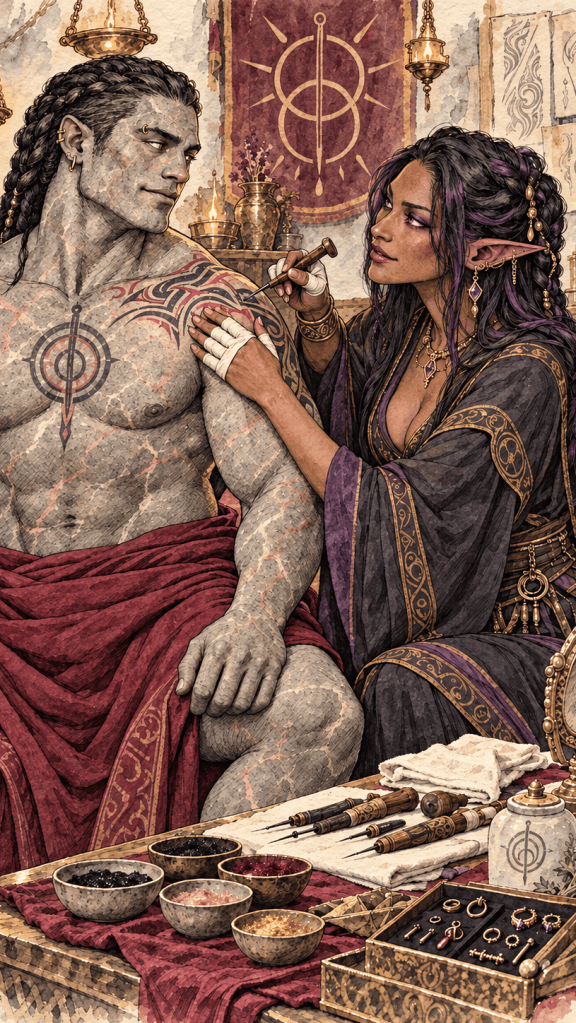
Marked Flesh
Your body has never seemed like an immutable accident. Skin can become testimony. A piercing can consecrate a threshold. A scar may preserve survival, devotion, grief, ownership of the self, or the exquisite memory of a chosen ordeal. You learned to read such markings—and eventually to create them.
Perhaps you apprenticed within a House of the Living Script, studied beneath an itinerant tattooist, prepared ritual pigments for a temple, or served as a piercer among soldiers, performers, and pleasure-house devotees. You may bear an elaborate collection of your own modifications or remain comparatively unmarked, treating your body as a carefully reserved canvas.
Whatever path brought you here, you understand that meaningful modification requires more than a steady hand. You learned anatomy, sanitation, pigment preparation, pain management, aftercare, and the symbolic traditions surrounding bodily marks. You also learned the sacred importance of consent: no mark is honorable when the person receiving it has not freely chosen its meaning.
Skill Proficiencies: Medicine, Religion
Tool Proficiencies: Tattooist’s tools
Languages: One of your choice
Equipment: A set of tattooist’s tools, several sealed vials of mineral and botanical pigment, a packet of sterile needles, jewelry suitable for a single piercing, a small hand mirror, a sketchbook of symbolic designs, clean linen wraps, a keepsake associated with your first meaningful mark, a set of common clothes, and a pouch containing 10 gp
Feature: The Body Remembers
Your experience allows you to recognize common methods of tattooing, piercing, scarification, branding, and ritual modification. By examining a bodily mark, you can usually identify the general technique used to create it, whether it appears deliberate or accidental, and whether it is old, recent, professionally tended, or poorly healed.
When a mark belongs to a tradition you know, you can recall its commonly understood symbolism. This does not reveal secret meanings, personal motives, or membership in a hidden group without further evidence.
Tattooists, piercers, ritual markers, mundane healers, and devotees of Threxira recognize you as someone familiar with their craft. They will generally share ordinary information concerning local practitioners, pigments, modification customs, and safe places where such work may be performed.
Suggested Characteristics
Those of Marked Flesh understand that changing the body can reveal rather than conceal the self. Some treat every mark as sacred autobiography; others are fascinated by the intimate craft itself—the prepared needle, the first breach of skin, the placement of ornament, and the trust required to permanently alter another willing person.
| d8 | Personality Trait |
|---|---|
| 1 | I ask about the meaning of a person’s marks before I ask about their profession. |
| 2 | I sketch designs whenever an interesting symbol or body contour catches my attention. |
| 3 | I can discuss needles, pigments, swelling, and aftercare with unnerving enthusiasm. |
| 4 | Every mark I bear commemorates a choice I refuse to regret. |
| 5 | I instinctively imagine where a new piece of jewelry or inkwork would best suit someone. |
| 6 | I treat the preparation of my tools with the solemnity of a priest arranging an altar. |
| 7 | I find the moment someone first sees their completed transformation profoundly moving. |
| 8 | I am always planning my next modification, even when I insist that my collection is complete. |
| d6 | Ideal |
|---|---|
| 1 | Autonomy. Every person possesses absolute authority over what is done to their body. (Good) |
| 2 | Transformation. Intentional change allows the flesh to reflect the truth within. (Any) |
| 3 | Tradition. Ancient marks preserve histories that written records cannot contain. (Lawful) |
| 4 | Expression. The body is a language, and nobody else may dictate what it is permitted to say. (Chaotic) |
| 5 | Endurance. Pain freely accepted can reveal strength we did not know we possessed. (Any) |
| 6 | Beauty. Ink, metal, and scar tissue can make the living body more completely itself. (Any) |
| d6 | Bond |
|---|---|
| 1 | My first meaningful mark was given to me by someone I will never forget. |
| 2 | I carry the unfinished design of a mentor who disappeared before completing it. |
| 3 | Someone trusted me to transform their body during the most vulnerable night of their life. |
| 4 | One of my markings identifies me as part of a tradition others believed extinct. |
| 5 | I am searching for a legendary pigment said to awaken the memories held within scars. |
| 6 | A person bears a mark I created, and its meaning binds our lives together. |
| d6 | Flaw |
|---|---|
| 1 | I sometimes study another person’s modifications so intently that I forget my manners. |
| 2 | I am tempted by dangerous procedures when their results promise to be extraordinary. |
| 3 | I quietly judge anyone who displays poorly executed or badly maintained work. |
| 4 | I occasionally mistake enduring pain for proof of strength or sincerity. |
| 5 | I have altered my body impulsively and concealed the regret behind a more elaborate design. |
| 6 | I once created a mark whose significance I did not fully understand, and someone dangerous recognized it. |
 Whispers of Erosia
You must be logged in to post a comment.