
The Bloomseekers
Explorers of the Forgotten World
“I walk where curiosity leads.
I seek what has been forgotten.
I preserve what deserves remembrance.
I respect the depths, though I do not fear them.”
There are places in Erosia where the map simply ends. For most, that is a warning. For a Bloomseeker, it is an invitation. The Bloomseekers are an Amarosan fellowship of explorers, cartographers, historians, naturalists, relic hunters, healers, scholars, and adventurers united by a simple conviction: the forgotten places of the world deserve to be found, understood, and remembered.
Their name has become inseparable from Rosethorn Chasm, the immense subterranean expanse discovered beneath Amarosa. Yet the Bloomseekers are defined by more than the depths they explore. They are a culture of curiosity—a community built around those willing to step beyond the final mark on a map and return carrying something the world did not know yesterday.
Sometimes that something is treasure. Sometimes it is knowledge. Sometimes it is a warning. The best Bloomseekers learn that all three can be equally valuable.
Where the Map Ends
The Bloomseekers began with a hole in a wine cellar. Fifteen years ago, part of the cellar beneath the House of the Sacred Bloom collapsed, exposing passages far older than the building above them. Investigation revealed descending foundations, forgotten masonry, ancient chambers, and eventually the immense subterranean region now called Rosethorn Chasm.
Amarosa suddenly possessed a frontier beneath its own streets. Explorers followed. At first, expeditions were informal affairs: adventurers with lanterns, scholars with notebooks, treasure hunters with questionable judgment, and curious locals convinced that whatever lay below could not possibly be as dangerous as everyone claimed.
Some returned with artifacts. Some returned with maps. Some did not return.
The need for organization became impossible to ignore. Records were gathered. Routes were compared. Salvage procedures were established. Supply caches were placed along known passages. Expedition contracts formalized responsibility, recovery rights, and expectations.
From those early expeditions emerged the Bloomseekers.
What Is a Bloomseeker?
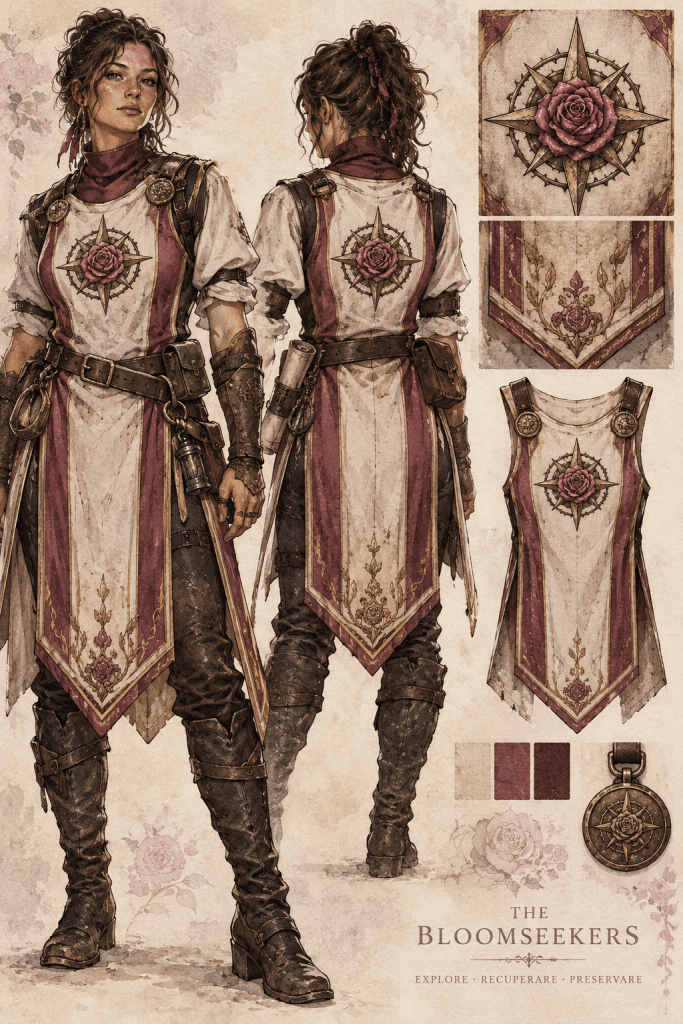
There is no single kind. A Warbound may descend because someone needs to stand between the expedition and whatever occupies the next chamber. A Relicwright may spend hours studying a mechanism everyone else considered broken masonry. An Anointed may accompany an expedition to provide healing and interpret forgotten sacred spaces.
A scholar might never draw a weapon yet become indispensable after recognizing an inscription carved into an ancient doorway. Cartographers, herbalists, alchemists, cooks, porters, negotiators, scouts, historians, and survivalists have all earned places on Bloomseeker expeditions.
- The question is not: Are you an adventurer?
- It is: What can you contribute when the map runs out?
The Bloomseeker’s Oath
Every sanctioned Bloomseeker accepts the principles expressed in the expeditionary oath:
I walk where curiosity leads.
I seek what has been forgotten.
I preserve what deserves remembrance.
I respect the depths, though I do not fear them.
The oath is not a promise of obedience.
Bloomseekers are far too independently minded for that.
It is a declaration of responsibility.
Discovery does not grant ownership.
Curiosity does not excuse recklessness.
And returning alive matters—not merely because a Bloomseeker’s life has value, but because discoveries carried by the dead teach the living very little.
Becoming a Bloomseeker
Anyone may express interest. Not everyone is allowed below. Prospective members sign the Bloomseekers Expeditionary Contract and begin as probationary Bloomseekers. Their first sanctioned expedition serves as both field experience and evaluation. Combat ability is useful but never sufficient by itself.
Bloomseekers are expected to demonstrate judgment, cooperation, observation, respect for significant discoveries, and the ability to follow expedition procedures when circumstances deteriorate.
Experienced members often say the Chasm performs the final interview.
The Expeditionary Contract
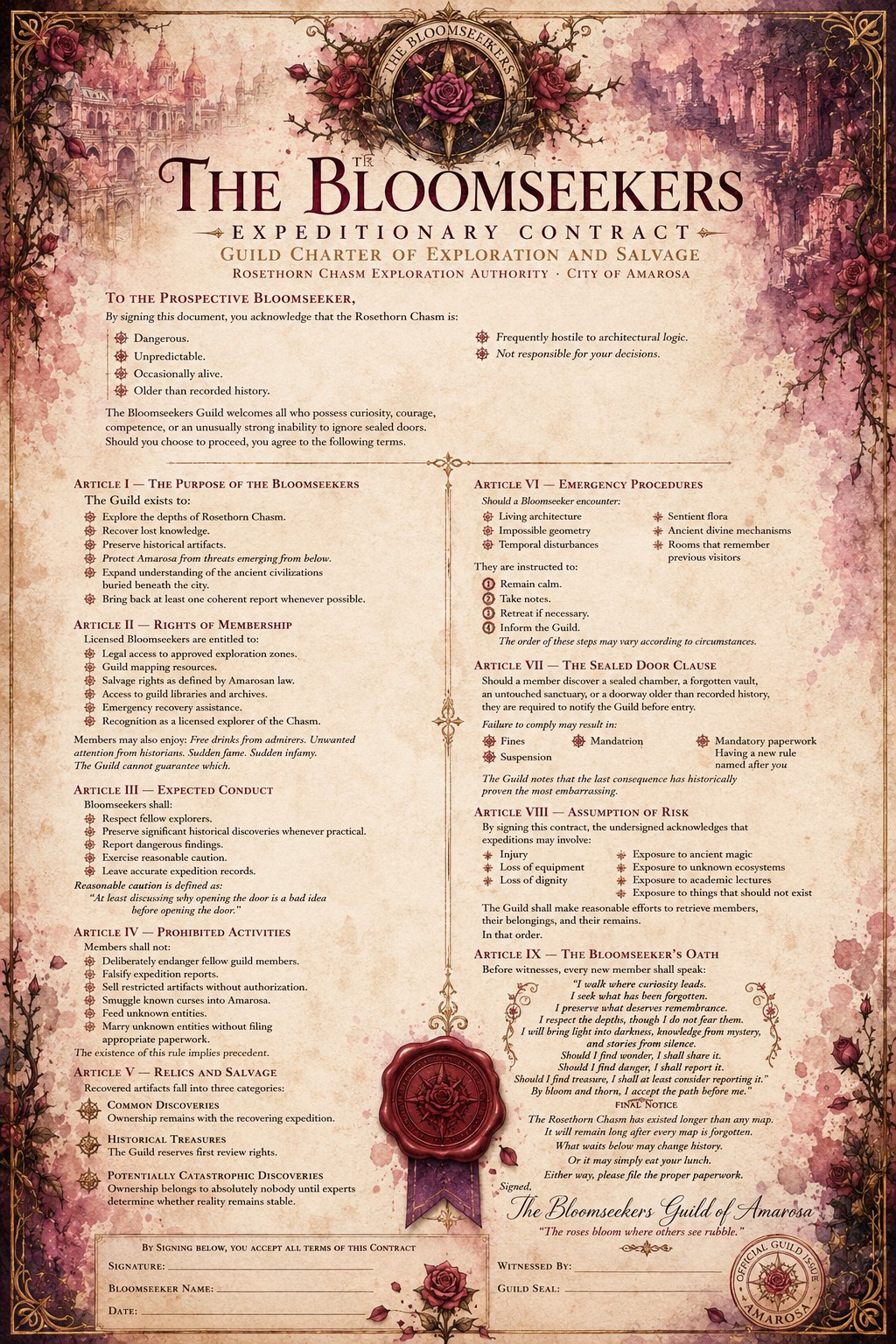
Bloomseeker expeditions operate under formal agreements recognized within Amarosa.
The contract establishes responsibilities surrounding expedition conduct, salvage, recovered artifacts, mapping, dangerous discoveries, and the preservation of historically significant material.
It also makes something abundantly clear:
Rosethorn Chasm is dangerous.
The Bloomseekers can provide maps, equipment, experience, rescue efforts, and companions.
They cannot promise anyone will return.
The Work of the Bloomseekers

Exploration is only the most visible part of their work. Every expedition creates information. Routes are surveyed. Rooms are sketched. Hazards are marked. Creatures are documented. Plants and mineral formations are sampled. Inscriptions are copied. Relics are catalogued. Previous maps are corrected.
Even an expedition that returns without treasure may dramatically increase the Guild’s understanding of the Chasm.
Mapping
Bloomseeker maps are living documents. A passage confirmed during one expedition may collapse before the next. Vegetation spreads. Creatures migrate. Water levels change. Previously sealed doors open. Maps therefore record what was known when the explorer observed it, not an eternal promise about what waits below.
Recovery
Artifacts discovered during sanctioned expeditions may be recovered when doing so is safe and lawful. Historically significant objects are documented before distribution or sale whenever possible. The Bloomseekers have learned that an object removed without context can lose much of the story it might otherwise have told.
Field Research
Not every discovery is stone or metal. Rosethorn Chasm contains unusual flora, fungi, subterranean ecosystems, and creatures rarely—if ever—encountered above. Properly collected specimens can be as valuable as ancient relics. Improperly collected specimens have occasionally become someone else’s problem.
The House of the Sacred Bloom
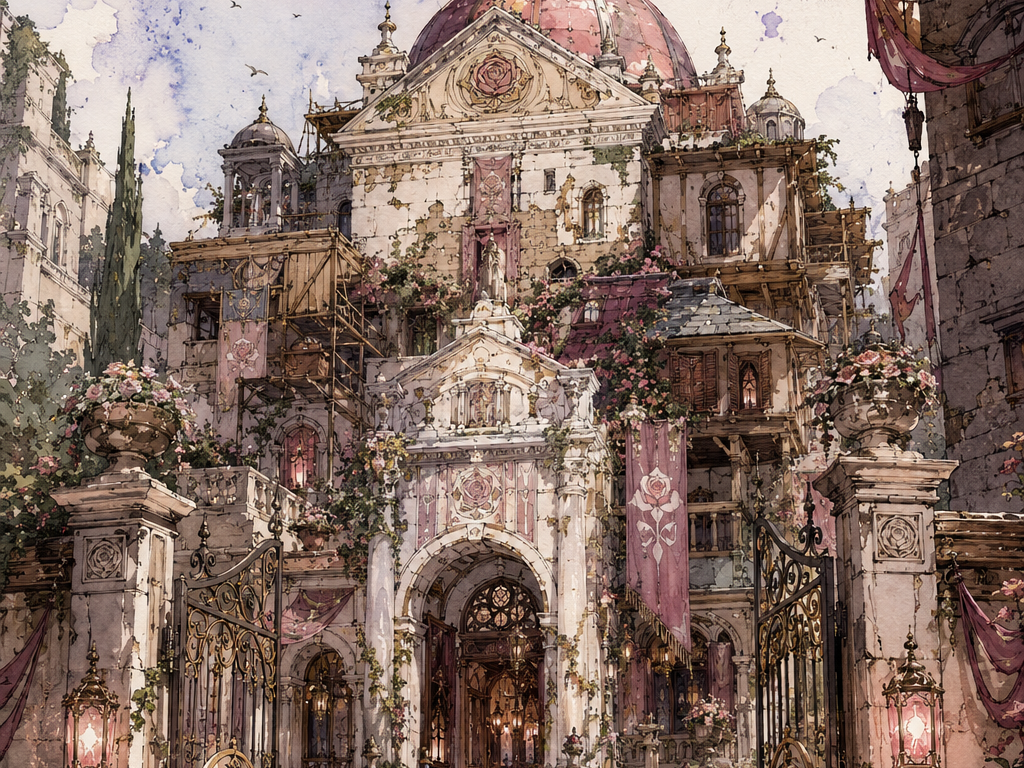
The Bloomseekers possess offices, records, storage areas, and expedition facilities, but calling any of them their true headquarters misses something important. Their home is the House of the Sacred Bloom. The historic inn and bathhouse stands above the passages through which Rosethorn Chasm was rediscovered. Its common rooms became natural meeting places for explorers, its cellars became staging areas, and its proprietor, Garrick Thornwell, became deeply entwined with the emerging fellowship. Today the House is where expeditions are discussed, assembled, celebrated, and mourned.
Maps accumulate beside drinks. Rumors pass between tables. Recovered relics sometimes arrive wrapped in whatever cloth survived the journey. Bloomseekers departing for the depths often cross paths with mud-covered companions who have just returned from them. For some members, the House eventually stops feeling like headquarters. It simply becomes home.
Life Between Expeditions
Bloomseekers spend considerably more time above ground than tavern stories suggest. Equipment must be repaired. Specimens need cataloguing. Maps must be redrawn. Recovered texts require translation. Reports need writing. Arguments concerning precisely what attacked whom—and from which direction—must eventually become useful documentation.
Then there are the baths. Returning Bloomseekers have developed an unofficial ritual around the ancient springs beneath the House. Armor comes off. Mud disappears. Bruises are discovered. Drinks arrive. Only then, for many, does the expedition finally feel finished. Eventually someone unfolds a map.
Someone points toward an unfinished corridor. And the entire cycle begins again.
The Expedition Cycle
A sanctioned expedition generally follows a familiar rhythm: Briefing → Preparation → Descent → Known Territory → Frontier → Discovery → Return → Report → Recovery
The most important boundary is rarely a doorway. It is the point marked:
Beyond Previous Mapping
Everything beyond that line must be observed without assuming the previous expedition knew what would be there. That is where Bloomseekers earn their name.
Field Wisdom
Bloomseekers accumulate sayings almost as quickly as maps. Some are humorous.
Others became humorous only after everyone involved survived.
“Nervous Bloomseekers come home.”
— Garrick Thornwell
“The map tells you where someone survived yesterday.”
“If you brought one light, you brought no lights.”
“Never put an unidentified specimen in your pocket.”
And perhaps the closest thing the organization has to an unofficial motto:
“Come back alive. Add something to the map.”
The Bloomseeker Mark
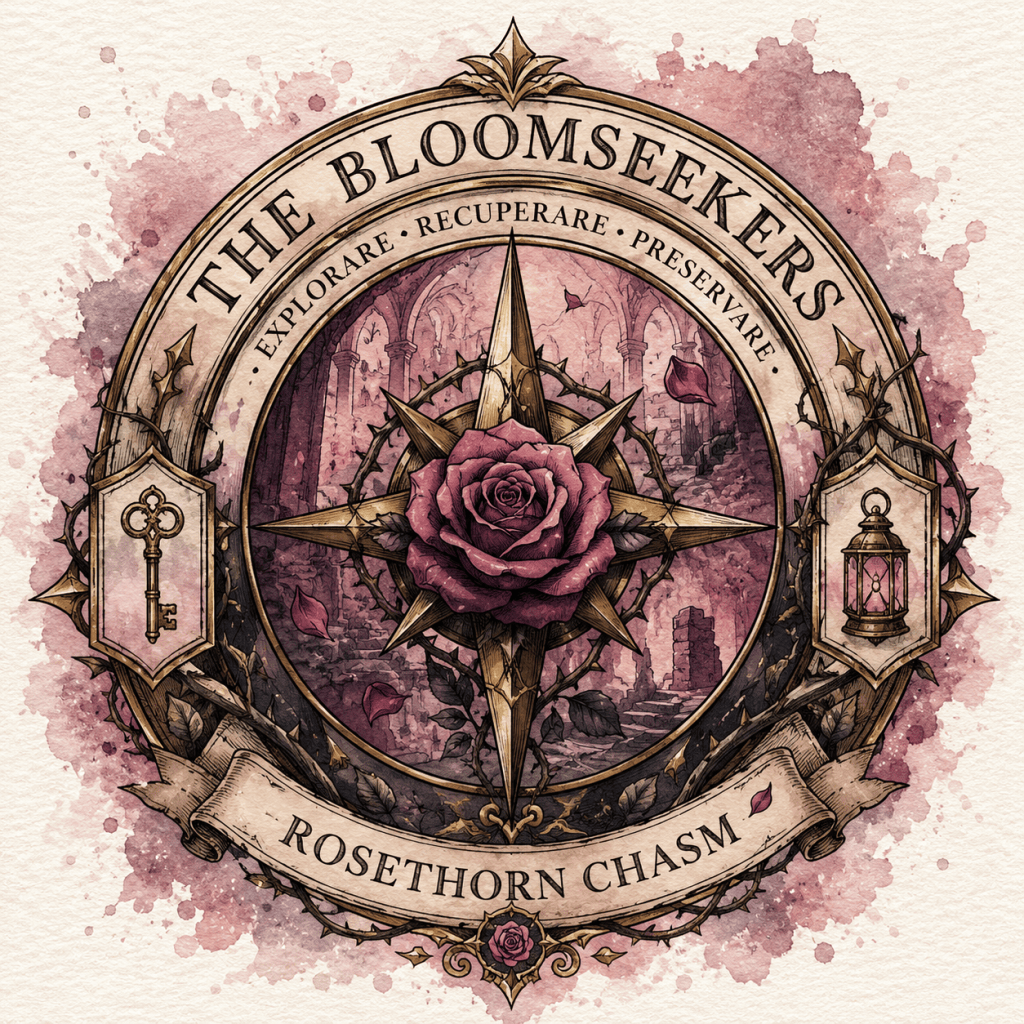
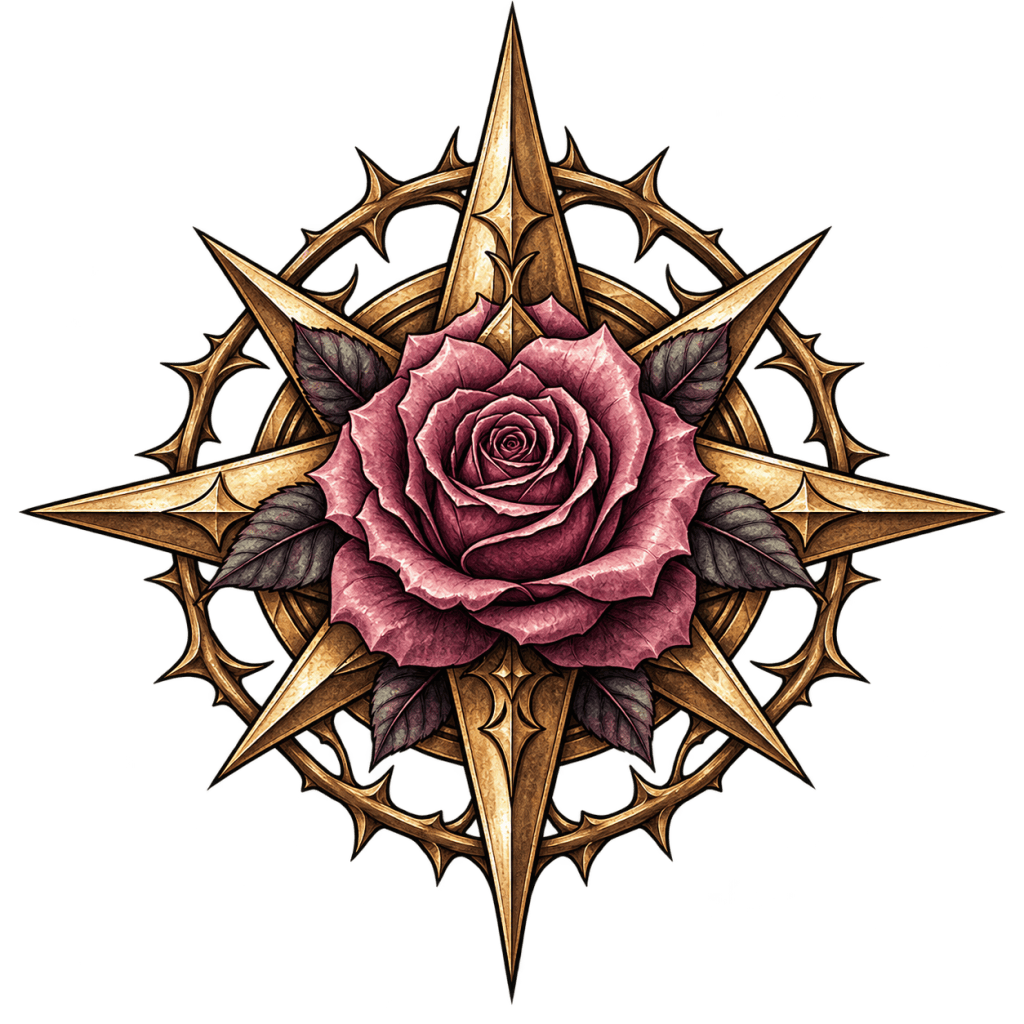
The Bloomseekers use a distinctive blossom-shaped expedition mark, carried on contracts, equipment, field records, supply caches, and expeditionary materials. Its meaning is deliberately simple. A bloom represents something discovered. Its surrounding form suggests paths radiating outward into the unknown.
Where the mark appears below ground, it can provide something precious to an explorer: evidence that another Bloomseeker has stood there before.
Whether that is comforting depends entirely upon what happened to them afterward.
Missing Bloomseekers
Every expedition accepts the possibility that someone may not return. The Bloomseekers do not treat missing members as dead merely because an expedition failed to find them. Their names remain recorded. Last-known locations are preserved. Equipment marks, journal fragments, trail signs, abandoned camps, and testimony from surviving companions are added to the archives. Future expeditions may be informed that someone vanished near their route.
Sometimes a Bloomseeker comes home months after everyone expected them to. Sometimes only their journal does. Both are welcomed back. Differently.
Curiosity and Caution
Outsiders sometimes mistake Bloomseekers for reckless treasure hunters. The veterans generally find this amusing. Reckless Bloomseekers tend not to become veterans. Curiosity drives the organization, but preparation makes curiosity survivable. Bring rope. Bring water. Bring medical supplies. Tell someone where you are going. Record what you find. And always bring another light.
Bloomseeker’s Explorer Pack
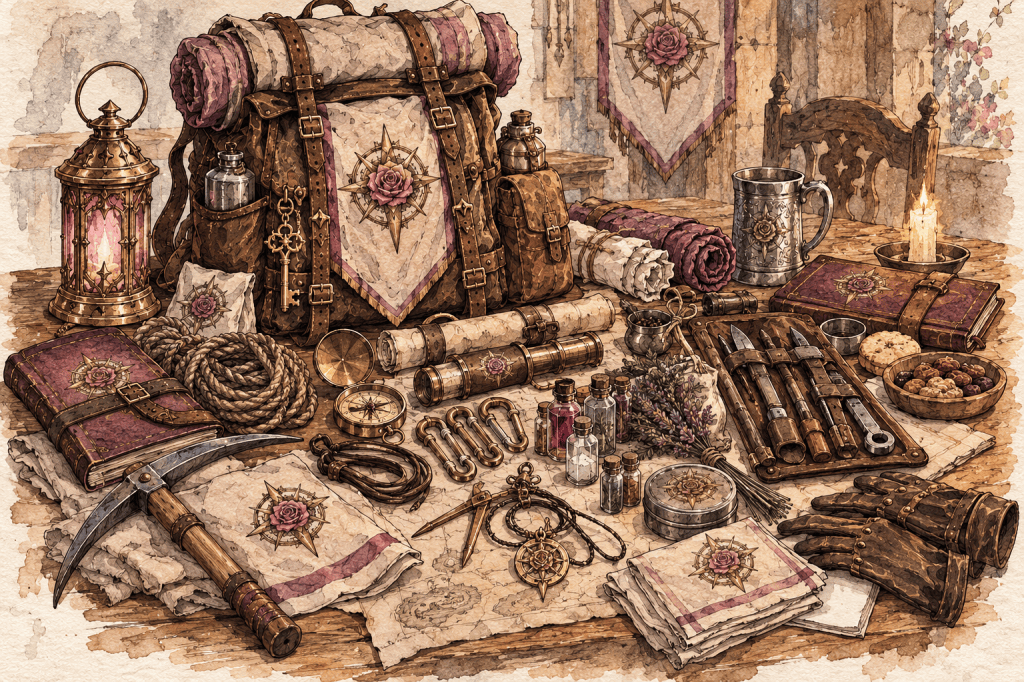
Bloomseeker’s Explorer Pack. A reinforced expedition pack containing basic survival gear, mapping tools, specimen storage, and field supplies used by sanctioned Bloomseeker expeditions. Cost: 18 gp.
Weight: about 58 lb.
Every Bloomseeker’s pack is built to survive being dragged through mud, dropped down stairs, soaked in spring water, and forgotten beside an ancient door while its owner argues about whether the door should be opened. Issued or purchased through the Bloomseekers, this pack is built for sustained exploration in ruins, caverns, forgotten districts, and other places where maps become unreliable and rescue may be far away. It contains:
- Backpack
- Bedroll
- 50 feet of hempen rope
- 10 pitons
- Hammer
- Crowbar
- 10 torches
- Tinderbox
- 2 flasks of oil
- 5 days of rations
- Waterskin
- Mess kit
- Explorer’s journal
- Charcoal sticks and chalk
- Ink vial and quill
- Parchment, 10 sheets
- Small brass compass
- 2 empty specimen vials
- Cloth specimen pouch
- Leather work gloves
- Simple field bandage roll
- Signal whistle
- Bloomseeker map case
- Bloomseeker insignia token
Optional Guild Additions
These are not part of the base pack, but are commonly issued or purchased separately:
| Optional Gear | Cost | Notes |
|---|---|---|
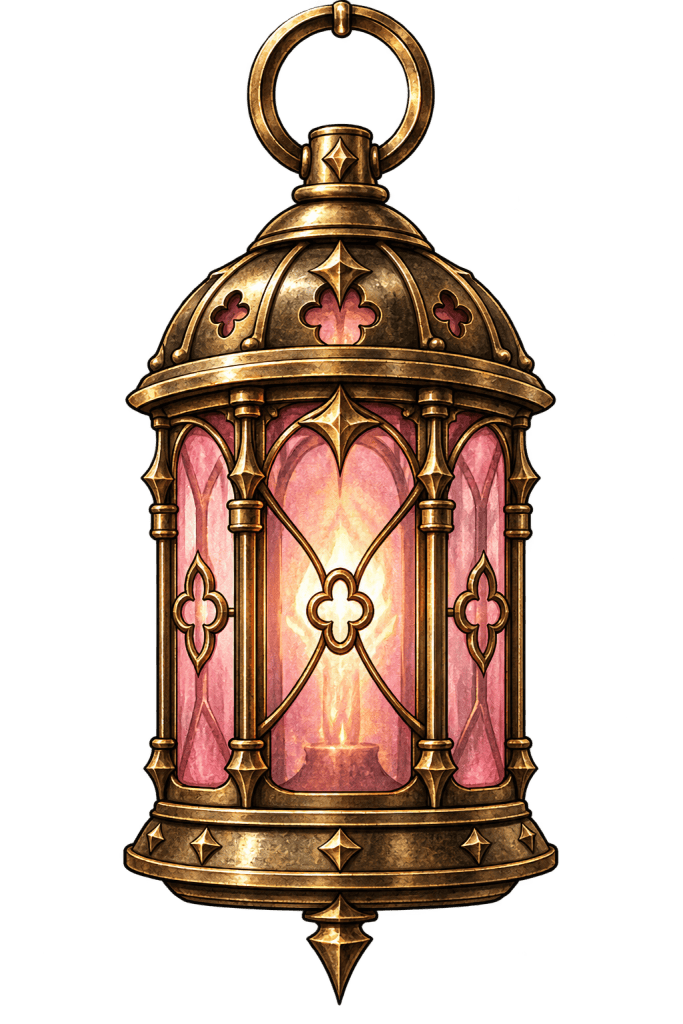
| Sun Lantern | 75 gp | Guild-crafted lantern housing a Sunstone; produces true sunlight when charged. |
| Bloomseeker Tabard | 3 gp | Reinforced expedition tabard bearing the Bloomseeker mark; ceremonial enough to identify the wearer, practical enough for field use. |
| Spare Sunstone | 40 gp | Replacement or backup stone for a Sun Lantern. Replacement or backup stone for a Sun Lantern. Available only to licensed Bloomseekers through the House of the Sacred Bloom. |
| Healer’s Kit | 5 gp | Standard 5e-equivalent field medical kit. |
| Climber’s Kit | 25 gp | Standard 5e-equivalent climbing gear. |
| Additional Lamp Oil | 1 sp per flask | Standard oil flask. |
| Waterproof Document Tube | 2 gp | Waxed leather and brass-capped tube for maps, contracts, and field notes. |
| Specimen Jars | 5 sp each | Thick glass with waxed stopper; good for flora, mineral fragments, spores, and small biological samples. |
| Survey Stakes | 1 gp per set of 10 | Marked wooden or brass-tipped stakes used for mapping, route marking, and hazard notation. |
| Grappling Hook | 2 gp | Standard adventuring hook. |
Sun Lanterns and Sunstones
Sun Lanterns and Sunstones are regulated Bloomseeker equipment and are not available through ordinary commercial markets. Licensed Bloomseekers may purchase, replace, or requisition them through the House of the Sacred Bloom. Amarosan merchants are not authorized to sell Sun Lanterns or Sunstones.
Rosethorn Chasm
The Bloomseekers are best known for their ongoing exploration of Rosethorn Chasm, the enormous subterranean ruin beneath Amarosa. Only portions have been mapped. Every expedition has revealed evidence that the known Chasm represents only a fraction of whatever exists below. Ancient architecture lies beneath roots and stone. Forgotten gardens continue growing without sunlight.
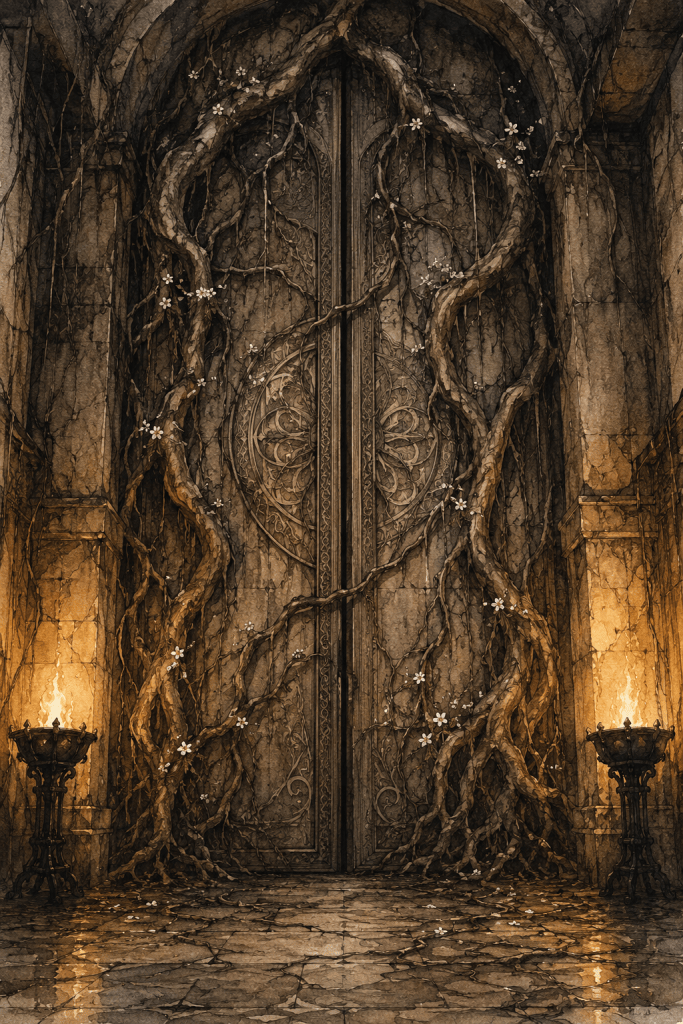
Doors remain sealed. Passages descend beyond existing surveys. The Bloomseekers do not know how large Rosethorn Chasm truly is. For many of them, that is precisely the point.
Rosethorn Chasm — page forthcoming.
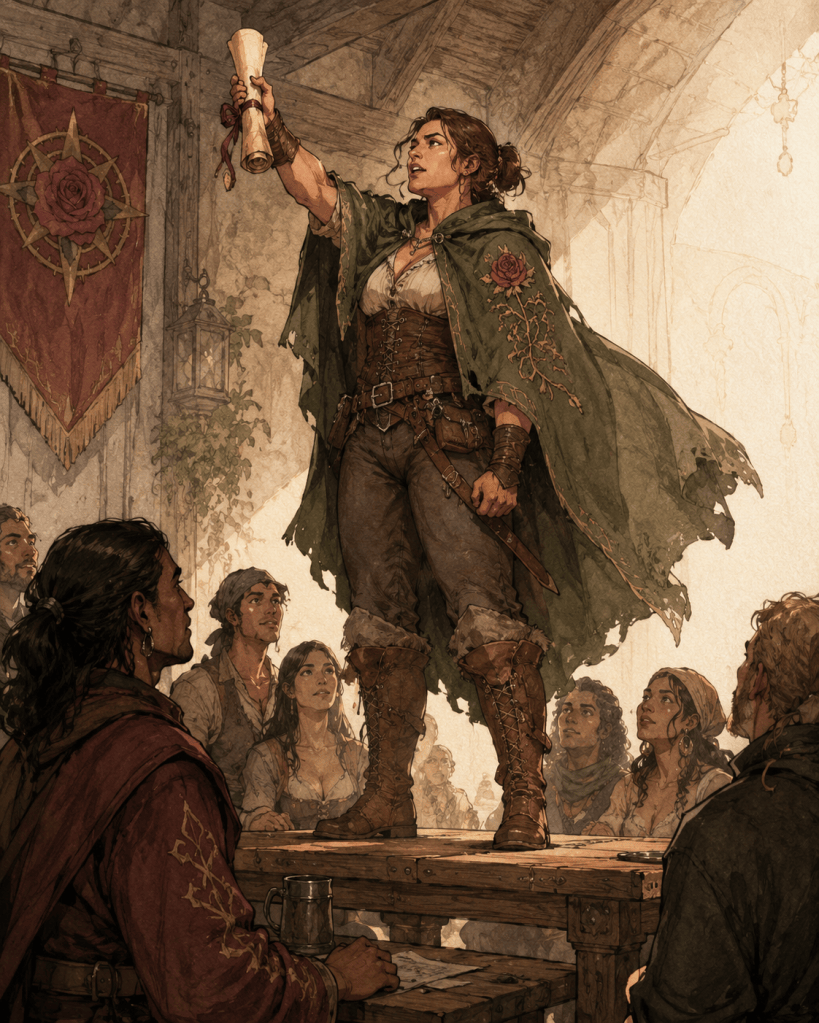
Become a Bloomseeker
You do not need noble blood.
You do not need divine appointment.
You do not need to be fearless.
You need curiosity.
You need something worth contributing.
And eventually you need to decide what you will do when everyone else stops at the edge of the map.
Somewhere beneath Amarosa, another passage remains unopened.
Another chamber remains unnamed.
Another line waits to be drawn.
Come back alive.
Add something to the map.
Explore Further
House of the Sacred Bloom
Visit Amarosa’s historic inn, bathhouse, gathering place, and unofficial home of the Bloomseekers.
Explore the House of the Sacred Bloom →
Amarosa — The City of Blossoming Hearts
Explore the city above Rosethorn Chasm and the streets the Bloomseekers call home.
Rosethorn Chasm
Venture beneath Amarosa into the vast archaeological frontier that made the Bloomseekers famous.
Page forthcoming.
Chronicles of Rosethorn Chasm
Begin the ongoing Bloomseeker expedition campaign with The Forgotten Gardens.
Adventure archive forthcoming.
Bring the Bloomseekers Home
The expedition continues beyond the table.
Carry the Bloomseeker Mark into the real world with official Bloomseekers merchandise from Velvet Veil Press. The Bloomseekers collection is available across apparel, accessories, home goods, stickers, and more.
Whether it travels on your adventuring gear, sits beside you at the gaming table, or marks you as one of those people who simply has to find out what is behind the sealed door, there is a little something for every Bloomseeker.
Explore the Bloomseekers Collection →
Come back alive. Add something to the map.
Purchases help support the continued development of Whispers of Erosia and future expeditions into Rosethorn Chasm.
 Whispers of Erosia
You must be logged in to post a comment.