

Desire as a Language of Magic
Traditional schools describe what a spell does to reality. Erosian disciplines describe the desire, intention, and embodied resonance through which that change is shaped.
Magic in Erosia rises through connection. A spell may alter matter, project force, influence the mind, or defend against hostile power, but those descriptions do not fully explain how the spell enters the world. Erothaumaturgy, Carnamagic, and Shadowlust provide that second vocabulary. They describe the emotional and sensual current carried through a spell: what awakens it, what it seeks, and what its caster must understand to guide it responsibly.
These disciplines do not replace the eight traditional schools. A spell remains an abjuration, conjuration, divination, enchantment, evocation, illusion, necromancy, or transmutation effect for standard fifth edition rules. Its Erosian discipline gives it additional setting identity and allows Erosian classes, creatures, rituals, magic items, and optional systems to recognize its deeper resonance.
Two Ways to Read a Spell
| Classification | Question |
|---|---|
| Traditional School | What change does the spell make to reality? |
| Erosian Discipline | What desire or embodied intention shapes that change? |
A healing transmutation shaped by tenderness and renewal might carry Erothaumaturgic resonance. An enchantment that heightens physical sensation through chosen restraint might be Carnamagic. An illusion built from private hopes or changing identity might be Shadowlust. The traditional school governs ordinary rules interactions; the Erosian discipline provides the setting-specific tag.
The Three Grand Disciplines
Although studied and classified within Erosia’s arcane academies, the three Erosian disciplines are not exclusive to arcane spellcasters. Divine, primal, pact, ritual, and other magical traditions may express the same resonances through different practices.

Erothaumaturgy
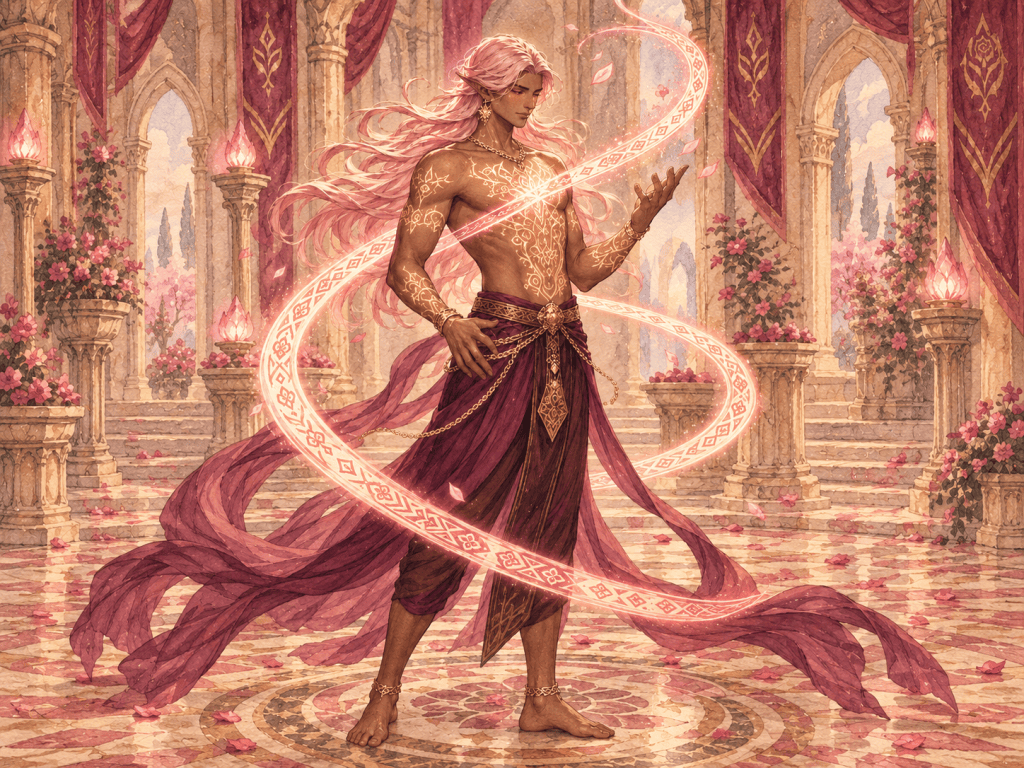
Erothaumaturgy, Sacred Touch, is magic of affection, empathy, pleasure, healing, fertility, bloom, and renewal. Its sacred question is: What do we nurture together? Its distorted form is care without measure—possessive abundance, invasive healing, or unwanted intervention.
Learn more about Erothaumaturgy ->
Carnamagic
Carnamagic, the Magic of Flesh and Need, draws power through sensation, exertion, restraint, pain, pleasure, hunger, discipline, and embodied transformation. Its sacred question is: What limit do I choose to test? Its distorted form is control, endurance, or transformation without choice.
Learn more about Carnamagic ->

Shadowlust
Shadowlust, the Secrets of the Hidden Craving, governs trance, dream, illusion, identity, masquerade, obsession, secrecy, and desires not yet ready for daylight. Its sacred question is: What do I reveal, conceal, or become? Its distorted form is exposure, obsession, or influence that denies agency.
Learn more about Shadowlust ->
How Discipline Tags Work
- A spell may possess one discipline, multiple disciplines, or no Erosian discipline.
- The discipline is recorded separately from the traditional school.
- A discipline is not a moral alignment.
- Discipline labels do not change standard rules unless another feature explicitly refers to them.
- Keywords are narrower descriptors and do not replace the discipline itself.
- No class, faith, gender, culture, or intimate practice owns a discipline.
Single and Blended Disciplines
Most spells carry one primary discipline. Some advanced spells combine two because their intention genuinely crosses a boundary. A healing rite that converts pain into shared restoration might be Carnamagic and Erothaumaturgy. A dream transformation that reshapes the body according to a hidden self-image might combine Shadowlust and Carnamagic. Dual classification should describe the spell’s design rather than serve as decoration.
Sensual imagery alone does not assign a discipline. Classification follows magical function and intention. Familiar spells can be interpreted through an Erosian tradition without receiving a discipline tag unless an official Erosian version, class feature, ritual, or campaign rule assigns one.
Using the Disciplines at the Table
Players can use a discipline to explain what their characters believe magic is for, how their spells feel, and which misuse of that power they refuse to excuse. Dungeon Masters can use disciplines to connect spells with institutions, divine influences, magical hazards, and adventure consequences. A damaged Erothaumaturgic ward may heal without measure, a Carnamagic matrix may confuse discipline with obedience, and a Shadowlust relic may reveal truths its bearer never consented to share.
When a monster, item, location, or optional subsystem reacts to a discipline, state that interaction directly. The label grants no unstated bonus, penalty, immunity, or vulnerability.
Consent and Magical Responsibility
Erosian magic can portray temptation, restraint, altered perception, intimacy, and surrender, but sacred desire requires agency. Consent must come from adults beyond their Age of Bloom who possess capacity and remain free to refuse. A willing ritual may use the same magical language as a hostile spell, yet its narrative and ethical meaning is fundamentally different.
Players retain authority over the detail and tone of intimate scenes. Mechanical effects can be described through warmth, pressure, dream imagery, emotional resonance, or symbolic release without requiring explicit narration. Boundaries may always be revised, and fading a scene from view never reduces mechanical success.



You must be logged in to post a comment.