
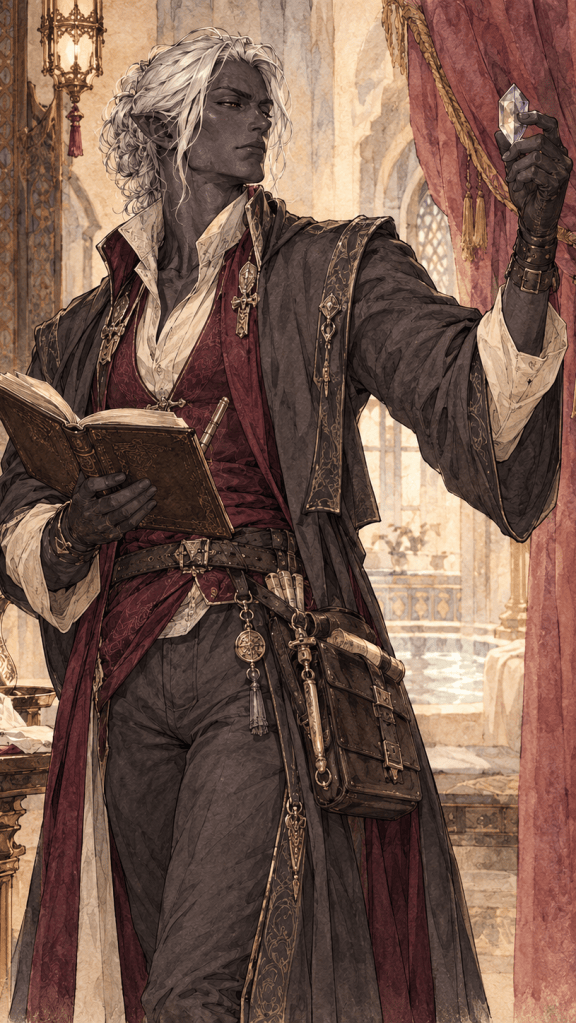
Pleasure House Auditor
There are few places in Erosia where beauty, money, privacy, magic and vulnerable people intersect as frequently as a pleasure house. Someone, eventually, has to inspect the locks.
You once worked as a Pleasure House Auditor, examining licensed bathhouses, courtesan houses, intimate salons, ritual establishments and other businesses whose livelihood depended upon discretion and trust. Your responsibilities were considerably less glamorous than outsiders imagined. You checked sanitation records, staff contracts, emergency exits, privacy wards, enchanted furnishings, account books, consent procedures, magical safeguards and whether the establishment actually possessed the licenses displayed so prominently near the entrance.
Work with your GM to determine who employed you. Perhaps you served a civic licensing office, temple authority, merchant guild or independent certification house. You might have been assigned to wealthy establishments whose owners considered regulations beneath them, tiny neighborhood salons desperately trying to remain compliant, or notorious venues where the difference between eccentricity and criminal negligence required very careful investigation.
You have consequently seen an extraordinary variety of intimate environments while usually being the person least interested in participating. A silk-draped chamber may impress the clientele. You are wondering whether the balcony railing meets code.
Skill Proficiencies: Insight, Investigation
Tool Proficiencies: Calligrapher’s supplies
Languages: One of your choice
Equipment: A set of calligrapher’s supplies, a leather document folio, several blank inspection forms, a measuring cord marked at regular intervals, sealing wax and an obsolete licensing stamp, a small ledger filled with abbreviated notes from previous inspections, a keepsake from an establishment whose staff treated you unexpectedly well, a set of common clothes, and a pouch containing 10 gp
Feature: Licensed Eye
Years of inspection have taught you how legitimate public establishments organize themselves and where neglected businesses tend to hide their problems.
When examining an inn, bathhouse, pleasure house, salon, guildhall, temple lodging, theater, boarding house or similar commercial establishment, you can usually identify ordinary signs of poor maintenance, suspicious alterations, inadequate privacy, unsafe magical fixtures, deliberately confusing bookkeeping and obvious violations of customary operating standards.
You also recognize many of the mundane records associated with licensed businesses, including permits, staff ledgers, supply invoices, inspection seals and ownership documents. You can usually tell when such paperwork is obviously incomplete, improperly issued or inconsistent with the establishment displaying it, though this does not automatically reveal a sophisticated forgery.
Owners, stewards, clerks, attendants and other professionals involved in hospitality or regulated intimate services recognize the language of your former trade. Unless you have given them reason to distrust you, they will generally provide ordinary information about local regulations, reputable establishments, public licensing records and the appropriate authority to contact regarding a legitimate complaint.
Your former position does not grant legal authority in places where you no longer hold office, nor does it compel anyone to open private records merely because you ask.
Suggested Characteristics
Pleasure House Auditors develop an unusual relationship with scandal. Some become painfully methodical professionals who have discovered that almost every disaster begins with paperwork somebody decided was unnecessary. Others cultivate dry humor, formidable patience or an almost supernatural ability to remain unimpressed by surroundings designed specifically to impress.
| d8 | Personality Trait |
|---|---|
| 1 | I cannot enter a public establishment without quietly checking where the exits are. |
| 2 | Elaborate décor impresses me considerably less than clean linens and accurate records. |
| 3 | I have developed an expression that means, “I am not judging you, but I am writing this down.” |
| 4 | Whenever someone assures me that something is “perfectly safe,” I immediately want documentation. |
| 5 | I notice broken locks, loose railings and suspicious stains before I notice attractive people. |
| 6 | I possess an alarming number of stories that begin, “During an inspection in Amarosa…” |
| 7 | I am almost impossible to embarrass, but incorrect paperwork genuinely irritates me. |
| 8 | If furniture looks unusually complicated, I instinctively check whether it was installed correctly. |
| d6 | Ideal |
|---|---|
| 1 | Protection. Regulations exist because somebody was harmed before the rule was written. (Good) |
| 2 | Consent. A reputable establishment makes boundaries clear before anyone needs to enforce them. (Good) |
| 3 | Order. Pleasure does not become less pleasurable because the building passed inspection. (Lawful) |
| 4 | Fairness. Workers deserve the same protections as the patrons paying for their services. (Good) |
| 5 | Transparency. If a business must conceal how it operates, there is usually a reason. (Lawful) |
| 6 | Pragmatism. I do not care what consenting adults do behind a closed door. I care whether the door locks properly. (Neutral) |
| d6 | Bond |
|---|---|
| 1 | An establishment I once inspected treated its workers with such extraordinary care that I still consider its staff friends. |
| 2 | A former coworker discovered corruption within our licensing authority and disappeared shortly afterward. |
| 3 | I once closed an establishment whose employees begged me not to, and I still wonder whether I actually helped them. |
| 4 | A proprietor once protected me when an investigation became dangerous, and I have never forgotten the debt. |
| 5 | I kept one inspection ledger because several apparently unrelated violations formed a pattern nobody else believed existed. |
| 6 | Someone forged my certification mark, and I intend to discover who has been using my reputation. |
| d6 | Flaw |
|---|---|
| 1 | I sometimes mistake inconvenience for evidence that someone has done something wrong. |
| 2 | I become suspicious when an establishment appears too perfect. |
| 3 | I have difficulty relaxing in places where I can see obvious safety violations. |
| 4 | I occasionally forget that not every gathering needs procedures, forms and clearly identified emergency exits. |
| 5 | I once accepted an explanation I should have investigated more carefully, and someone suffered because of it. |
| 6 | Mentioning that something is “not technically prohibited” is an excellent way to gain my immediate attention. |


You must be logged in to post a comment.