
Quick Facts
Scope: Global Cultures
Major Cultural Traditions: Countless
Shared Foundations: The Three Mothers, the Veil, Community, Hospitality, and Discovery
Influences: Geography, History, Faith, Magic, and Local Traditions
Overview
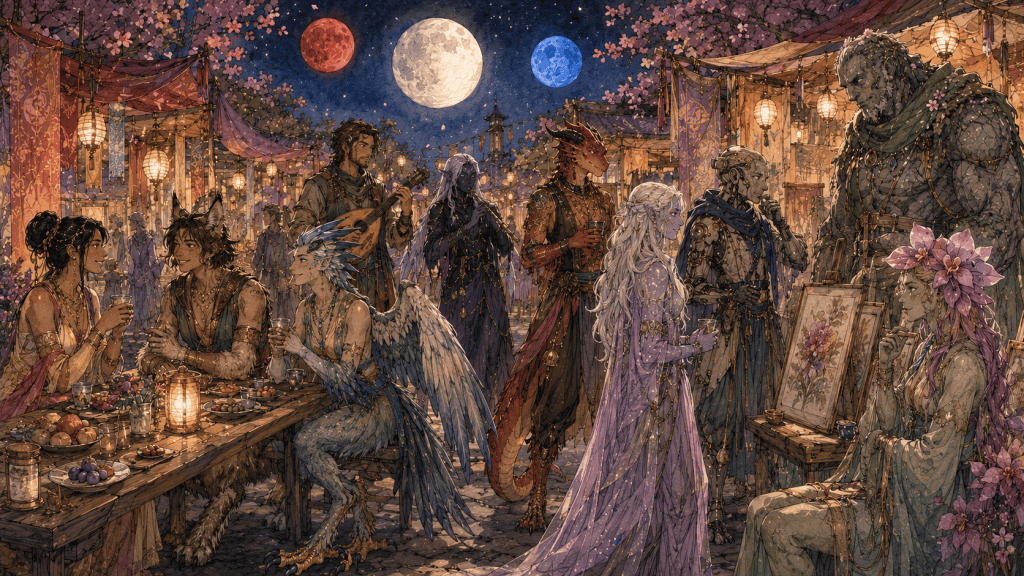
Erosia is home to an extraordinary diversity of cultures, each shaped by centuries of history, regional traditions, local environments, and the values of the people who call those lands home. While kingdoms may rise and fall and political borders may shift with time, culture often proves far more enduring, carried forward through families, festivals, stories, craftsmanship, and shared memory.
Although every culture possesses its own customs, languages, fashions, and beliefs, several ideals are recognized across much of the known world. Hospitality is widely considered a sacred responsibility, curiosity is celebrated rather than discouraged, and personal growth is viewed as a lifelong pursuit. Communities thrive not because every person is the same, but because different talents and perspectives strengthen society as a whole.
Travel has always played an important role in Erosian life. Merchants, scholars, pilgrims, artisans, and adventurers regularly journey between distant settlements, allowing traditions to spread while preserving the unique identities of individual regions. As a result, visitors often discover familiar values expressed through entirely different customs.
A World of Many Peoples
The many ancestries of Erosia have lived beside one another for generations. While each people maintains customs that reflect their own history and heritage, no ancestry possesses a single universal culture. Two neighboring communities of the same people may celebrate different festivals, follow different architectural traditions, or preserve entirely different oral histories.
Instead, culture is most often defined by where one lives rather than what one is. Geography, history, faith, and local traditions shape communities far more strongly than ancestry alone, creating societies where many peoples contribute to a shared cultural identity.
As travelers move throughout the world, they quickly discover that Erosia’s greatest strength lies not in uniformity, but in its remarkable diversity.
Faith and Daily Life
Religion influences nearly every culture throughout Erosia, though its expression varies widely from one community to another. Great temples dominate some cities, while isolated villages may gather beneath ancient trees, within modest shrines, or around family altars passed down through countless generations.
For many people, devotion is woven naturally into daily routines rather than reserved for formal ceremonies. Blessings accompany meals, festivals honor the changing seasons, artisans dedicate their work to patron deities, and travelers often pause to offer quiet prayers before beginning a long journey.
These shared practices create a spiritual rhythm that connects communities across the world while allowing each culture to express its faith in distinctive ways.
Celebration and Tradition
Festivals are among the most recognizable expressions of Erosian culture. Throughout the year, communities gather to celebrate harvests, changing seasons, celestial events, local heroes, artistic achievement, and sacred holidays dedicated to the gods.
Music, dance, storytelling, athletic competitions, elaborate feasts, theatrical performances, and public works of art all serve as opportunities to strengthen community bonds. Many traditions have been practiced for centuries, while others continue to evolve as cultures exchange ideas through trade and travel.
For outsiders, these celebrations often provide the first glimpse into the values and personality of a region.
Centers of Learning and Craft
Knowledge is highly valued throughout Erosia. Great universities preserve history, temples safeguard ancient traditions, guilds refine specialized crafts, and wandering scholars exchange discoveries between distant settlements.
Master artisans are respected not only for their technical skill but also for the creativity and dedication their work represents. Architecture, sculpture, painting, music, tailoring, cooking, and magical craftsmanship all reflect the unique character of the communities that produce them.
Across the world, culture is expressed as much through what people create as through the stories they tell.
Regional Identity
Every region of Erosia possesses its own distinct cultural character. Climate, geography, available resources, neighboring civilizations, and historical events all shape the customs of the people who live there. Coastal cities often develop traditions very different from those found in mountain strongholds or forest villages, even when separated by only a few days’ travel.
As additional regions and nations are explored, each will reveal its own history, architecture, cuisine, festivals, fashions, artistic styles, and social traditions, contributing another unique thread to the ever-growing tapestry of Erosian civilization.
A Living Tapestry
Culture is never static. Every generation preserves cherished traditions while creating new ones, ensuring that Erosia continues to grow alongside its people. New discoveries, distant voyages, changing relationships between nations, and the exchange of ideas all leave their mark upon the world.
Rather than existing as isolated societies, the cultures of Erosia form a living tapestry woven from countless voices, histories, and shared experiences. Together they create a world that feels ancient, vibrant, and continually alive—one where every journey offers the opportunity to encounter something both familiar and wonderfully new.
 Whispers of Erosia