
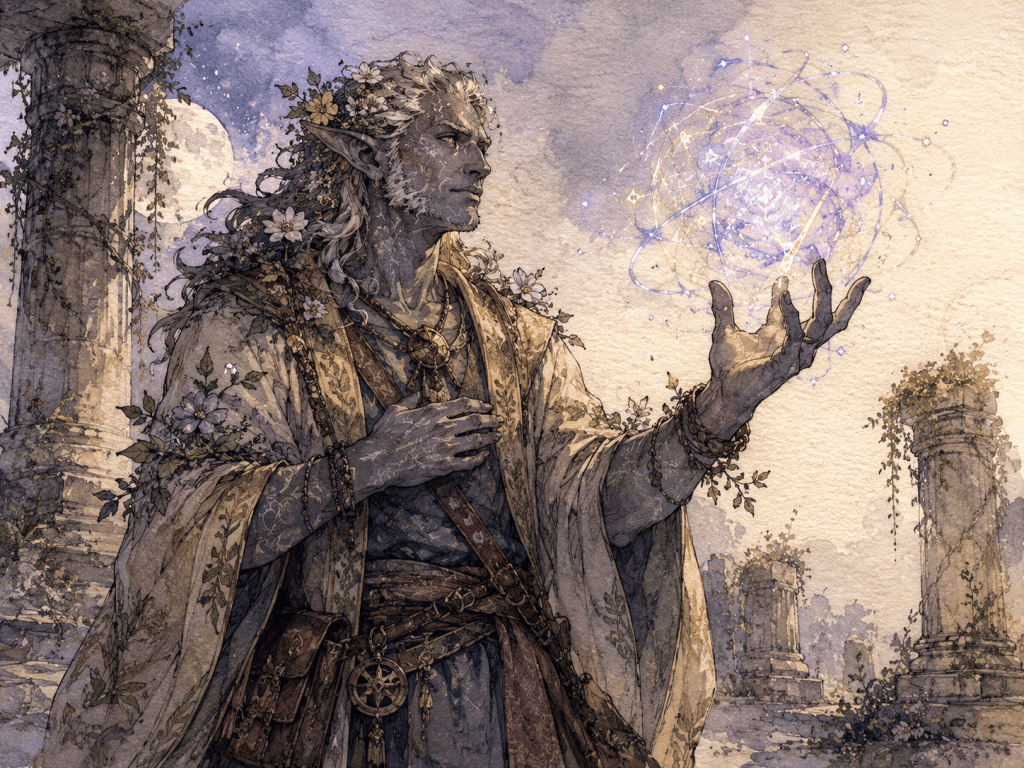
The Moment Possibility Becomes Reality
Spellcasting is the act of transforming possibility into reality. Every spell, whether it is an act of healing, destruction, protection, or transformation, begins as potential within the Veil before briefly manifesting in the mortal world through the actions of the spellcaster.
Although countless magical traditions exist throughout Erosia, they all share this fundamental process. A spellcaster establishes a connection with the Veil, shapes that connection according to their own magical philosophy, and allows the desired effect to exist within reality for a brief moment. Whether that connection is achieved through study, faith, instinct, primordial communion, or an ancient covenant depends entirely upon the tradition being practiced.
Every Tradition Casts Differently
While the outcome of a spell may appear similar to an outside observer, the experience of casting it differs dramatically from one practitioner to another.
An arcane scholar carefully constructs the spell through knowledge and disciplined understanding. A divine practitioner offers prayer and places their trust in a higher power. A practitioner of primal magic works in harmony with the living world, while one who follows the primordial path serves as a conduit for ancient forces older than civilization. Those bound by supernatural covenants call upon the authority granted through their pact, each according to the terms of that sacred relationship.
These methods often produce similar magical effects, yet they reflect profoundly different understandings of how reality responds to the will of the caster.
Shaping the Impossible
A spell is never created from nothing. Instead, spellcasting represents the deliberate act of giving form to a possibility that already exists within the Veil. The spellcaster does not force reality to obey through strength alone, but guides the transition from possibility into existence through discipline, intention, and Magical Resonance.
This process requires both precision and purpose. Even the simplest spell demands concentration of thought and clarity of intent, while more powerful magic requires increasingly complex interactions between the spellcaster and the Veil. As magical effects become more elaborate, so too does the skill required to shape them safely and consistently.
The Language of Magic
Every magical tradition has developed its own methods for expressing spells, yet nearly all rely upon combinations of spoken words, physical gestures, symbolic objects, or carefully prepared rituals. These practices are not arbitrary traditions preserved simply because they have always existed. They provide structure, helping the spellcaster focus intention and express their chosen philosophy in a consistent and reliable manner.
The exact form these expressions take varies widely between cultures and traditions. A temple priest, an academy scholar, and a wandering mystic may perform the same spell in remarkably different ways, each believing their own method best reflects the truths they have devoted themselves to understanding.
Limits and Mastery
Spellcasting is a skill that improves through experience, discipline, and understanding. As practitioners deepen their connection to their chosen tradition, they become capable of shaping increasingly complex magical effects while maintaining greater control over the forces they invoke.
Even the greatest spellcasters, however, recognize that magic is never entirely predictable. The Veil remains one of creation’s greatest mysteries, and no philosophy has fully explained every aspect of its nature. Every spell cast contributes to a tradition of discovery that spans countless generations, reminding even the most accomplished masters that there is always more to learn.
Spellcasting is therefore more than the practice of magic. It is the moment where belief, knowledge, purpose, and possibility briefly become one, allowing the impossible to exist within the world, if only for a moment.
 Whispers of Erosia