
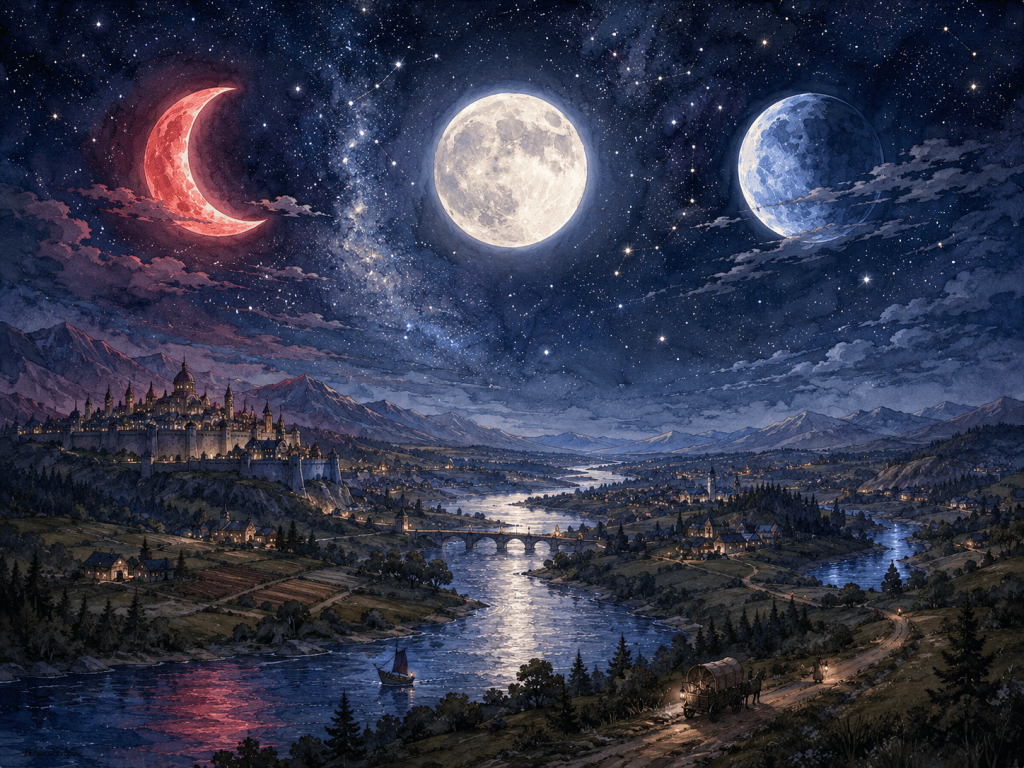
The Rhythm of the Heavens
The Three Moons are never still. Each follows its own celestial path, moving through a continuous cycle of waxing, fullness, waning, and renewal. Because each moon completes its journey at a different pace, the night sky is constantly changing, creating an endless variety of celestial arrangements that have guided the people of Erosia for countless generations.
These lunar cycles influence far more than the appearance of the night. They shape calendars, determine the dates of festivals, guide religious observances, influence agricultural traditions, and provide scholars with a framework for recording the passage of time. Throughout history, the movements of the Three Moons have become one of the few constants shared by every civilization.
Measuring Time
Although individual cultures maintain their own calendars and methods of recording history, nearly all recognize the importance of the lunar cycles. Months are traditionally measured by the changing phases of the moons, while many years are remembered by significant celestial events that occurred during particular lunar seasons.
Communities that live far apart often use different names for the same phases, yet the underlying observations remain remarkably consistent. Farmers anticipate planting and harvest according to familiar lunar patterns, sailors plan long voyages around predictable night skies, and scholars carefully compare centuries of astronomical records in search of recurring cycles.
The Practice of Magic
Spellcasters have long observed that the practice of magic changes subtly as the Three Moons progress through their individual cycles. Although these changes are rarely dramatic, experienced practitioners often speak of certain nights feeling more harmonious for particular forms of spellcasting or more favorable for extended rituals and magical research.
Exactly why these changes occur remains the subject of ongoing debate. Some arcane scholars argue that the lunar cycles influence the relationship between the Veil and the mortal world, while many priests believe the moons simply reflect deeper truths established at the dawn of creation. Regardless of the explanation, few experienced spellcasters ignore the heavens when planning important magical undertakings.
The Rhythm of Daily Life
The influence of the lunar cycles extends well beyond those who practice magic. Markets, festivals, marriages, pilgrimages, and community celebrations are frequently planned according to familiar celestial rhythms. Hunters, travelers, and merchants often choose their departure dates with the changing phases in mind, while many communities preserve traditions that have been observed beneath the same moonlit skies for generations.
Even those who have never cast a spell recognize the practical importance of the Three Moons. Their light illuminates roads, marks the changing seasons, and serves as a trusted companion to anyone who travels after sunset.
Observation and Discovery
The study of the lunar cycles remains one of the oldest scholarly pursuits in Erosia. Great observatories continue to record the movements of the Three Moons with remarkable precision, preserving generations of astronomical knowledge for future study. New observations are constantly compared against ancient records, allowing scholars to refine calendars, improve navigation, and better understand the subtle relationship between the heavens and the practice of magic.
Although much has been learned through centuries of careful observation, the Three Moons continue to surprise even the most accomplished astronomers. Small irregularities, unexpected patterns, and newly discovered cycles remind every generation that the heavens still hold mysteries waiting to be understood.
The changing faces of the Three Moons are more than a measure of passing time. They are a constant reminder that creation itself moves in enduring rhythms, inviting every generation to observe, learn, and wonder.
 Whispers of Erosia