
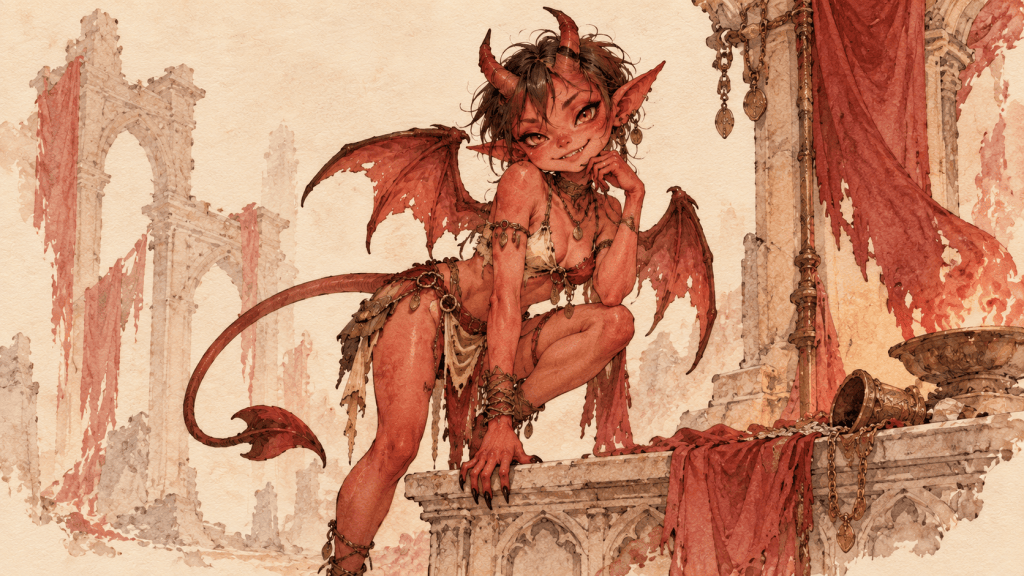
“Small does not mean simple. Sometimes it means the feeling had nowhere else to go.”
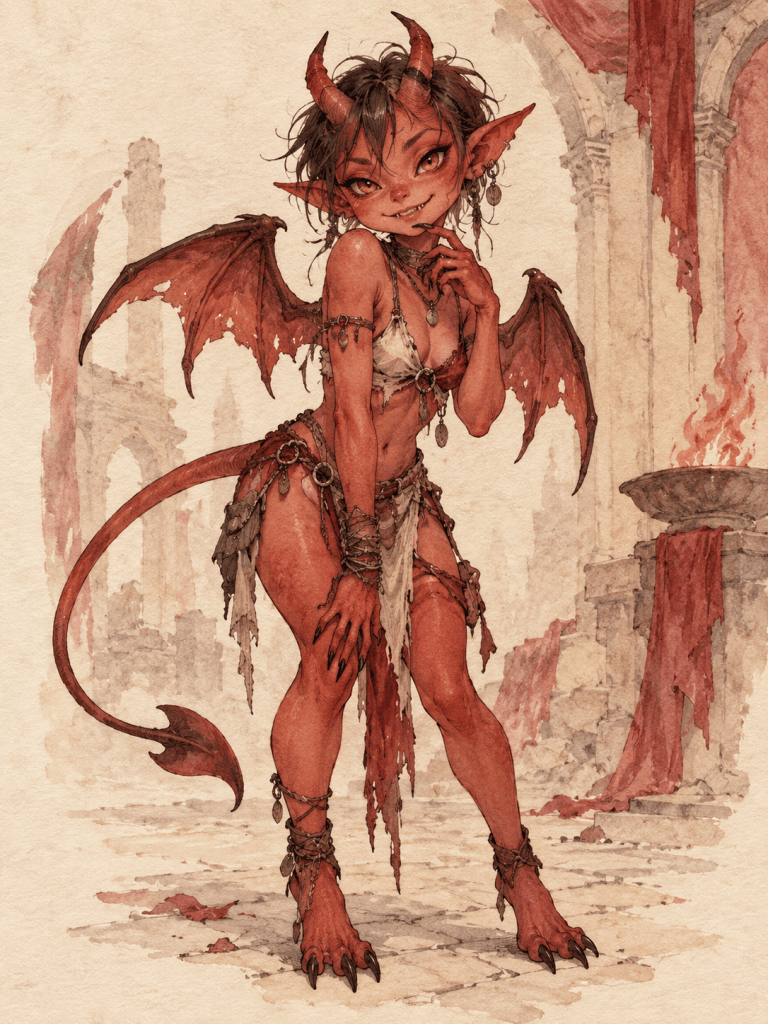
Imp
Imps are among the smallest and most common devils of Erosia. They form when a comparatively modest reservoir of unresolved emotional energy becomes concentrated enough to take on a body of its own. Their size reflects limited emotional mass rather than a lack of intensity; an imp may be born from a feeling that was extraordinarily powerful, but contained within one person, one relationship or one private wound.
Small Devils of Unresolved Feeling
An imp is not a larval demon, a juvenile Gelkin or a failed Chrysalis. It is a devil in its own right, born through manifestation rather than metamorphosis. Once formed, the imp becomes a thinking creature capable of learning, choosing, attaching itself to others and developing emotions beyond the unresolved energy that first gave it substance.
Because imps are compact manifestations, they are often associated with intimate emotional environments rather than civilization-wide catastrophes. A long-hidden jealousy, a shame never confessed, resentment carefully fed, grief refused expression, frightened longing or affection twisted by silence may all leave enough pressure behind to produce one under the right conditions.
Appearance
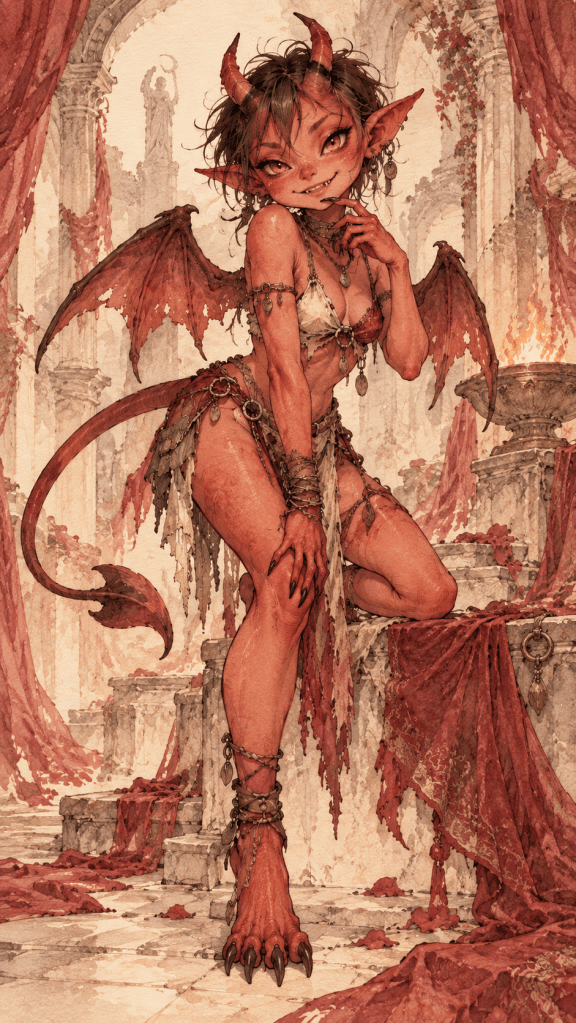
Imps are unmistakably infernal and only loosely humanoid. Their bodies are small, wiry or compact, with clawed hands and feet, pronounced horns, sharp teeth, expressive pointed ears, batlike wings and a long flexible tail that commonly ends in a spade- or heart-like point. Skin color varies, though reds, wine tones, ash, violet-black and ember shades are frequently reported.
They are not naturally a clothed people. Instead, imps study mortals and imitate what they see, especially when they want to pass as civilized, impressive or alluring. Their “clothing” is usually assembled from found scraps: torn silk, discarded straps, bits of sash, broken jewelry, leather fragments, cords, bells, charms and other pieces whose original purpose they only partly understand. An imp may copy the silhouette of mortal dress while completely misunderstanding why the pieces belong together.
Behavior
Imps are observant mimics. They watch posture, etiquette, flirtation, anger, bargaining and ritual with the fascination of creatures who were born from emotion but did not inherit mortal culture along with it. Many become excellent readers of rooms because unresolved feeling is, quite literally, the substance from which their kind emerged.
The emotion that created an imp often colors its instincts without completely determining its personality. A jealousy-born imp may be unusually alert to exclusion, while one formed from grief may linger near mourners or objects heavy with memory. These inclinations are starting points rather than moral commands. Imps may become nuisances, companions, informants, tricksters, predators or surprisingly loyal friends depending on what they learn after manifestation.
Chromatic Resonance
An Imp’s color records the dominant unresolved emotion from which it first manifested. This coloration is part of its metaphysical anatomy rather than a passing mood. An Imp may later experience every ordinary emotion, but the resonance of its birth remains visible throughout its life.
| Imp Color | Unresolved Emotion | Common Manifestations |
|---|---|---|
| Red | Desire | Longing, attraction, yearning, fixation, affection left unspoken or desire denied resolution |
| Green | Envy | Covetousness, poisoned comparison, resentment toward what another possesses or represents |
| Blue | Sorrow | Regret, loneliness, disappointment, separation and sadness that cannot yet move forward |
| Orange | Anger or Rage | Humiliation, fury, injustice unanswered, resentment repeatedly suppressed or fed |
| Black | Grief | Mourning, profound loss and attachment to what is gone when grief becomes fixed rather than changing |
Sorrow and grief are closely related but not identical. Blue Imps often arise from the pain of absence; Black Imps arise when a relationship to loss itself becomes unresolved. Other colors are possible and remain the subject of infernal study.
Mechanics of Desire
Imps participate fully in the Mechanics of Desire. For an Imp, Arousal represents Resonant Pressure: the unresolved emotional force from which the devil was born building inside its metaphysical body until it must be expressed. That pressure is not necessarily erotic. A Red Imp may experience it as longing, a Green Imp as corrosive comparison, a Blue Imp as mounting sorrow, an Orange Imp as escalating rage and a Black Imp as the weight of grief becoming impossible to contain.
- Classic Play. Do not track the Imp’s Arousal or Libido. Use the Classic versions of its abilities and ordinary saving throws.
- Veiled Play. The Imp uses the normal Composed, Stirred and Overwhelmed states. When an Imp becomes Overwhelmed, resolve its Resonant Spill and then end its Desire condition. Veiled Play does not track its Libido.
- Unveiled Play. The Imp uses the full Desire Cycle. It has Libido 3, tracks Arousal from 0 to 6 and uses a Desire DC of 12. Its Libido represents how much emotional resonance its compact infernal body can contain and cycle before depletion. When it reaches Arousal 6, it Climaxes normally, reduces its Libido by 1, resets its Arousal to 0 and then resolves its Resonant Spill.
Arousal, Climax and Whispers. Arousal and Climax do not automatically create Whispers. An Imp collects a Whisper only when a bargain, Pathos-Toll, creature feature, ritual or other rule specifically causes emotional resonance to manifest or redirects it through a contract.
Desire Traits
- Deepen the Hook (Unveiled Only). Once on each of its turns, when a creature fails an EROSave caused by the Imp, the Imp may spend 1 Libido. The creature gains 1 additional Arousal. This additional Arousal counts toward the normal limit on Arousal gained during a turn.
- Resonant Appetite (Unveiled Only). When a creature within 30 feet of the Imp Climaxes as a result of a Desire effect created by the Imp, the Imp may regain 1 spent Libido. It can regain Libido from this trait no more than once per round.
Resonant Spill
When the Imp becomes Overwhelmed in Veiled Play or Climaxes in Unveiled Play, the unresolved emotion that first shaped it spills briefly into the surrounding world. Resolve the effect associated with its chromatic resonance.
| Imp Color | Resonant Spill |
|---|---|
| Red — Desire | Choose one creature within 15 feet. In Veiled Play, the target makes a DC 12 EROSave and becomes Stirred on a failure. In Unveiled Play, the target makes a DC 12 EROSave and gains 1 Arousal on a failure. |
| Green — Envy | Choose one creature within 15 feet. It makes a DC 12 EROSave. On a failure, it has disadvantage on the next Wisdom or Charisma ability check it makes before the end of its next turn as comparison and covetousness cloud its judgment. |
| Blue — Sorrow | Choose one creature within 15 feet. It makes a DC 12 EROSave. On a failure, its speed is reduced by 10 feet and it cannot take reactions until the beginning of its next turn as melancholy weighs upon it. |
| Orange — Rage | The Imp may immediately move up to half its speed and make one Claw attack. This movement does not provoke opportunity attacks. |
| Black — Grief | Choose one creature within 15 feet. It makes a DC 12 EROSave. On a failure, it has disadvantage on the next EROSave it makes before the end of its next turn as unresolved loss presses heavily upon it. |
Bargains of Small Desire
Imps are the smallest common practitioners of infernal contract law. Their bargains are usually intimate rather than world-shaping: courage to speak a desire aloud, an opportunity to meet someone, a secret learned, a rival embarrassed, a moment of bravery, a door opened or a small obstacle removed.
The price is a Pathos-Toll, usually a small quantity of emotional resonance released when the agreed condition is fulfilled. A Red Imp, for example, might help an adult suitor find the courage and opportunity to honestly approach someone they desire. The contract cannot make the other person reciprocate unless the agreement invokes separate magic capable of doing so, and no bargain creates consent where none exists. When the agreed act is completed, the suitor’s emotional consequence may release a crimson Whisper for the Imp to collect.
Each infernal bargain leaves a small contract mark upon the mortal. Ordinary sight does not reveal it, but senses attuned to fiendish auras may perceive the mark and distinguish whether the bargain remains active, has been fulfilled or has become unresolved.
Imp
Small Fiend (Devil)
| Armor Class | 14 (natural armor) |
|---|---|
| Hit Points | 22 (5d6 + 5) |
| Speed | 30 ft., fly 40 ft. |
| Proficiency Bonus | +2 |
| Challenge | 1/2 (100 XP) |
| Desire DC | 12 |
| Libido | 3 (Unveiled Play) |
| STR | DEX | CON | INT | WIS | CHA |
|---|---|---|---|---|---|
| 6 (-2) | 16 (+3) | 12 (+1) | 11 (+0) | 12 (+1) | 14 (+2) |
Skills Deception +4, Insight +3, Stealth +5
Damage Resistances fire
Senses darkvision 60 ft., passive Perception 11
Languages Common; Mimicry allows imitation of other speech
Creature Type Fiend (Devil)
EROSave +1 (Constitution or Wisdom)
Traits
Scent of the Unsaid. The imp has advantage on Wisdom (Insight) checks made to determine whether a creature is concealing a strong emotion. At the DM’s discretion, an imp that spends at least 1 minute observing a creature may sense that an unresolved emotion is present, though it does not automatically learn the emotion’s cause. In Veiled Play, a Stirred or Overwhelmed creature always counts as displaying a strong emotion for this trait; in Unveiled Play, so does a creature at Arousal 3 or higher.
Mimicry. The imp can imitate simple phrases, vocal mannerisms and gestures it has heard or seen. A creature that hears or observes the imitation can recognize it as false with a successful DC 12 Wisdom (Insight) check.
Emotion-Born. Magic that specifically detects fiends identifies the imp as a devil. Effects that interact with Gelkin, Chrysalis or demon metamorphosis do not treat the imp as part of that lineage.
Deepen the Hook. In Unveiled Play, once on each of its turns when a creature fails an EROSave caused by the imp, the imp may spend 1 Libido to cause that creature to gain 1 additional Arousal.
Resonant Appetite. In Unveiled Play, when a creature within 30 feet Climaxes as a result of a Desire effect created by the imp, the imp may regain 1 spent Libido. It can benefit from this trait no more than once per round.
Actions
Claw. Melee Weapon Attack: +5 to hit, reach 5 ft., one target. Hit: 5 (1d4 + 3) slashing damage.
Needle the Wound (Recharge 5–6). The imp chooses one creature it can see within 30 feet that can hear it. The words need not be true; they only need to touch an emotion the target is already struggling to contain.
- Classic Play. The target must succeed on a DC 12 Wisdom saving throw or take 7 (2d6) psychic damage and have disadvantage on the next Wisdom (Insight) or Charisma check it makes before the end of its next turn.
- Veiled Play. The target makes a DC 12 EROSave. On a failure, it takes 7 (2d6) psychic damage and becomes Stirred. If it is already Stirred by this imp, it instead becomes Overwhelmed and immediately resolves the imp’s Resonant Spill before its Desire condition ends.
- Unveiled Play. The target makes a DC 12 EROSave. On a failure, it takes 7 (2d6) psychic damage and gains 1 Arousal. On a success, it takes no psychic damage and gains no Arousal.
Using Imps in Play
An imp works best as more than a disposable fiend. Its small size lets it slip into emotionally charged stories without immediately becoming the central threat. One might appear after a household has spent years refusing to discuss a betrayal, follow an adventurer whose grief has become dangerously static, or haunt a temple where generations of confessions were heard but never answered.
Defeating the imp does not necessarily resolve the emotion that created it. Likewise, resolving the original wound does not automatically destroy a manifested imp, because once born it has become a creature with its own existence. That distinction allows an encounter to end through combat, negotiation, understanding or an entirely new relationship.
Kaestra Catalogue Note
“The mistake is assuming the smallest devil came from the smallest feeling. I suspect the opposite is often true. An imp is what happens when a great deal of feeling is forced through a very narrow wound.”
— Morvane Kaestra


You must be logged in to post a comment.