
Autumn
(Page under development)
Autumn in Erosia is a season of abundance becoming responsibility.
Fields empty. Orchards grow lighter. Cellars fill. Smoke rises from curing sheds and communal kitchens while roads become wet beneath falling leaves. The heat of summer remains in stone, skin and memory, but every shortening evening carries the same quiet warning: what the land will give freely has almost been gathered.
Across Erosia, autumn is associated with gathering, preservation, pursuit, instinct and release. Communities celebrate what has grown while preparing for scarcity. Hunters follow migrating game. Families preserve fruit and grain. Temples give thanks for abundance while reminding worshippers that no feast should consume what tomorrow requires.
There is no single autumn calendar observed everywhere. Different regions, peoples, faiths and settlements recognize the season according to local climate, harvest cycles, lunar traditions and inherited custom. Even so, three ideas are widely understood across much of Erosia: Harvest’s End. The Autumn Vigil. First Frost.
Together, they form one of the most recognizable seasonal passages in the Erosian year.
The Shape of the Season
Autumn is commonly understood through three movements: gathering, vigil and frost.
The boundaries between them are not fixed dates. A vineyard, mountain settlement, forest grove and coastal city may enter the season at different times. What matters is not the number written on a calendar, but what the world is doing.
The Gathering
Early autumn remains a season of plenty. Late fruit ripens. Grain comes in from the fields. Mushrooms rise after rain. Herbs are cut and dried. Herds are brought closer to winter shelter, and markets swell with goods that will soon become difficult to obtain.
The Gathering is not itself a universal festival. It is a period of work, exchange and increasing awareness that abundance has become temporary. Its prevailing cultural question is simple: What has the year given us?
Talyss is strongly associated with this portion of the season. Her influence is found in fruit, seed, growth and the sacred responsibility of allowing abundance to become continuity rather than waste.
Harvest’s End
Harvest’s End marks the point when the great seasonal gathering is considered complete. The exact moment varies widely. In one settlement it may be declared when the final grain field is cut. Elsewhere it arrives when the last orchard is cleared, the final herd returns from summer pasture or the last preservation jars are sealed.
Harvest’s End is a threshold rather than a single universal holiday. Its importance comes from recognition. After Harvest’s End, a community can no longer assume that tomorrow will replace what is consumed today. Granaries, root cellars, smokehouses, seed stores and communal kitchens become symbols of survival rather than simple storage.
The season’s question changes: What must we keep?
The Autumn Vigil
The Autumn Vigil is the major communal observance associated with Harvest’s End and the anticipation of First Frost. Its customs vary enormously, but its purpose is broadly recognizable: celebrate what has been gathered, acknowledge what must be released and prepare the community for the colder, darker season ahead.
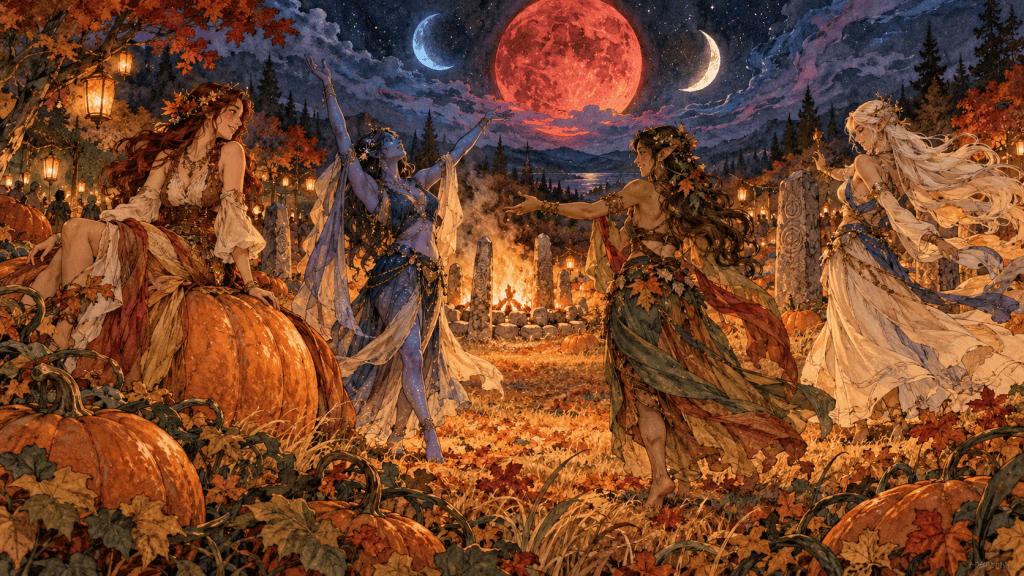
The word vigil does not imply universal solemnity. In many places the observance is loud, crowded and joyful. Markets remain open into the evening. Fires burn in public squares. Families prepare foods reserved for the final abundance of the year. Hunters return from ceremonial expeditions. Musicians, dancers and storytellers perform beneath the Three Moons.
What makes the Vigil a vigil is not silence. It is attention. The community watches the season change.
First Frost
First Frost is not scheduled. It arrives.
Grass whitens. Roof tiles glitter. Standing water forms a skin of ice. Leaves become edged in silver, and breath appears visibly in the morning air.
For many communities, First Frost confirms that the Autumn Vigil has fulfilled its purpose. Preparation gives way to endurance. Some cultures greet it with prayers. Others ring bells, light hearths or open preserved foods for the first time. Still others simply recognize it as weather.
Its power comes from the fact that no priest, monarch or calendar can command it. The world announces the change itself.
The Meaning of Autumn
Gathering
What has grown must be gathered before it is lost. This includes more than crops. Communities gather relatives, livestock, stories, supplies, debts, promises and unfinished work. Roads become busier as travelers decide where they intend to spend the colder season.
Preservation
Abundance becomes meaningful when some part of it survives. Fruit is dried or preserved. Grain becomes both food and seed. Meat is smoked. Herbs are bundled. Wax is poured into candles. Firewood is stacked beneath cover.
Preservation is not simply practical. In many cultures it is treated as an act of care toward people who are not yet hungry.
Release
Autumn is also the season of things being allowed to fall. Leaves drop. Fields are cut back. Animals shed and regrow coats. Plants withdraw into root and seed.
The Cervani expression of this principle is known as Shed, one of their Four Sacred Moods. Shed represents release, letting go and emotional cleansing. Other peoples may never use the Cervani term, but similar autumn traditions appear throughout Erosia.
Some communities burn written regrets. Others bury broken tools, return borrowed objects, settle grudges or formally end obligations that should not follow them into winter.
Pursuit
The narrowing season creates urgency. Hunters track migrating animals. Foragers search for the final medicinal plants. Merchants race worsening roads. Travelers hurry home. Lovers make decisions they have postponed through summer.
Rhaziel’s influence is particularly strong wherever autumn becomes a season of finding something before opportunity disappears.
Instinct
The wilderness does not prepare quietly. Animals migrate, rut, compete, forage and defend territory. Predators follow prey toward winter grounds. Scent becomes sharper in cold air, and the changing behavior of animals is closely watched by hunters and druids.
Ulvexa’s faithful treat these changes as reminders that the body also possesses seasons.
Divine Currents of Autumn
No deity owns autumn. Instead, the season brings certain divine currents closer to everyday life.
Talyss — Growth Becoming Continuity
Talyss is the strongest divine presence surrounding harvest, fruit, seed and the transition from abundance into preservation. Her autumn theology is not simply celebration of growth. It asks what growth has produced and whether enough remains for another season.
Talyssan traditions often emphasize harvested fruit, saved seed, pruning, dormancy and the acceptance that continuation sometimes requires allowing something beautiful to end. Her influence is strongest during the Gathering and Harvest’s End.
Aratheia — Abundance Shared
Aratheia becomes prominent wherever autumn concerns nourishment, hospitality and preparation against hunger. Her temples frequently become practical centers of seasonal activity: kitchens, stores, shelters and places where surplus can be distributed. Her doctrine that food and comfort should not be wasted gives particular weight to autumn preservation.
A full table in Aratheian tradition is not merely evidence of wealth. It is a question: Who has not yet been fed?
Her influence is strongest during communal feasts and winter preparation.
Ulvexa — The Wild Season
Ulvexa is felt in rut, migration, animal behavior, bodily instinct and the growing urgency of the wilderness. Her followers may observe autumn through movement, scent, competition, hunting games, wrestling, dance or controlled expressions of primal desire. Some Ulvexan traditions become particularly active during the mating seasons of locally important animals.
These customs are never universal to all Beastkin or wilderness cultures. Ulvexan observance remains devotional and regional rather than biological. Her influence is strongest in the wild margins of the Vigil.
Rhaziel — The Narrowing Trail
Rhaziel governs pursuit, tracking and the decision to follow something deliberately. Autumn provides countless reasons for pursuit. Hunters seek game. Foragers seek medicine. Travelers race weather. Ritual participants follow marked trails through darkening forests.
Rhazielian communities often transform these activities into contests or symbolic hunts in which the goal is not always capture. Sometimes the lesson is learning when a trail should be abandoned. His influence is strongest wherever autumn becomes a race against diminishing opportunity.
Velyssara — The Sacred Bond Beneath It All
Velyssara is not uniquely autumnal, but her presence remains fundamental. The season repeatedly asks Erosians to recognize dependence: upon the land, upon community and upon those with whom they choose to share shelter, food, warmth and vulnerability.
Autumn therefore creates countless moments in which desire becomes connection. Who do you invite inside? Who receives the last seat beside the fire? Who do you want beside you when the nights become long?
The Autumn Vigil
The Autumn Vigil is best understood as a family of related traditions rather than a standardized ceremony. A farming village might begin the Vigil after the final wagon leaves the fields. A city may wait for surrounding agricultural communities to declare Harvest’s End. A mountain settlement may observe it weeks earlier than a warm coastal region.
Some communities celebrate for a single night. Others stretch the Vigil across several days.
Common Traditions
- The Last Fresh Feast. Foods that will become scarce after frost are served while still fresh. Surplus is preserved or shared rather than discarded.
- The Keeping of Seed. A portion of the harvest is deliberately withheld from consumption. In agricultural communities this may be literal seed grain. Elsewhere it may be symbolic: money saved, promises renewed or something valuable set aside for the future.
- The Autumn Fire. Hearths, bonfires or lanterns remain central to many Vigils. Fire represents warmth becoming deliberate rather than freely given by the season.
- The Shedding. Participants relinquish something that should not follow them forward. The act may involve burning a written confession, cutting away a ribbon, burying an object, speaking an apology or simply naming something aloud.
- The Night Watch. At some point the celebration quiets. Revelers watch the dark, the weather or the Three Moons and wonder whether First Frost will arrive before morning.
The Night of the Unburdened Flame
In some communities, one of the Autumn Vigil’s most intimate adult traditions is known as the Night of the Unburdened Flame. It is not universal, and participation is never assumed. Where it is kept, the rite gives physical form to the Vigil’s oldest question of release: what will you refuse to carry into winter?
At moonrise, households contribute flame to a communal bonfire called the Ember of the Passing Year. Participants bring some small representation of what they intend to release—a marked ribbon, a scrap of bark bearing a private thought, the remnant of a failed undertaking, fallen leaves into which a regret has been whispered, or another harmless token chosen by local custom. These are surrendered to the fire rather than displayed for judgment.
Beyond the ordinary feast and music lies an inner Ember Circle reserved for consenting adults who knowingly choose to enter. At its boundary, participants may remove garments, ornaments, insignia and other marks of station before stepping beneath the Three Moons unadorned. The custom is not understood as an invitation to sexual attention. Clothing represents the identities, duties, ranks and expectations accumulated through the passing year; setting it aside makes the body a symbol of what remains when those burdens are briefly relinquished.
Nothing worn may cross the threshold that the soul does not wish to carry into winter.
The dance that follows is commonly called the Turning of the Ember. Musicians remain beyond the circle while participants move clockwise around the fire beneath the moons. The dance may be exuberant, solemn, awkward, graceful or joyful; performance is not its purpose. Some enter alone. Others ask an Ember Companion—a friend, lover, spouse, sibling, fellow traveler or designated attendant—to remain near them and witness the transition. An Ember Companion need not enter the same state of undress. Their role is presence, not possession.
Many communities protect the meaning of the circle with a simple rule: no courtship begins within the Ember Circle. Attraction may exist, lovers may enter together and celebration outside the rite may become flirtatious, but entering the circle is never treated as consent to pursuit, touch or intimacy. To witness someone unburdened is considered a trust, not an opportunity.
Near the rite’s culmination, the music stops and the dancers become still while the bonfire settles toward coals. This interval is called the Breath Between Years. For several quiet minutes, nothing is demanded: no confession, prayer or declaration. When the first drum sounds again, the dance reverses direction. The old year has been released; movement now turns toward what will be carried forward.
At dawn comes the First Cloaking. Participants deliberately choose what to put back on. An old insignia may be left behind. A new ribbon may be accepted. Friends may exchange tokens, colors or simple promises for the winter ahead. In this way the rite does not culminate in being unadorned. It culminates in choice: Unburden. Unveil. Dance. Be Still. Turn. Choose Anew.
Desire During the Vigil
Autumnal desire is defined less by indulgence than by proximity. Warmth matters because the air is cold. Food matters because abundance is ending. Companionship matters because nights grow longer. Promises matter because travel will soon become harder.
The dominant Desire Currents of the Autumn Vigil are belonging, comfort, security, anticipation, release, pursuit, instinct and abundance. These currents may be romantic, erotic, emotional, spiritual or entirely communal.
A feast can carry as much desire as a kiss. A hunter returning home can experience as much release as a lover. A character who finally forgives someone may reach a more meaningful climax of tension than one who spends the night in another’s bed.
Mechanics of Desire
Seasonal mechanics should support the emotional rhythm of autumn without making ordinary celebration mechanically intrusive.
Veiled Play
Veiled Play treats Desire as light narrative pressure. Characters who meaningfully participate in an autumn rite may receive a modest situational benefit determined by the DM. Appropriate effects include advantage on a relevant ability check, temporary hit points, Inspiration, relief from a minor condition or advantage on an upcoming EROS Save.
The benefit should reflect the fiction. Sharing an Aratheian meal might strengthen recovery. Completing a Rhazielian tracking game might aid the next pursuit. Participating in a Talyssan shedding rite might help resist fear or charm. An Ulvexan competition might sharpen Athletics or Survival.
Arousal may appear when a scene becomes mystically, emotionally or sensually charged, but it should remain occasional rather than constant.
Unveiled Play
Unveiled Play allows autumn rites to interact more directly with Arousal, Libido, Climax and Imbalance. A successful feast, confession, hunt, courtship, ritual shedding or act of communal trust may increase or reduce Arousal according to context. Release-oriented rites may reduce accumulated Arousal or help resolve an Imbalance. Restorative rites associated with Aratheia or Talyss may recover Libido when the fiction supports genuine nourishment, renewal or completion.
Climax does not require sexual activity. During the Autumn Vigil, Climax may represent the moment accumulated seasonal pressure decisively changes: a confession is finally spoken, a pursuit reaches its chosen end, grief is released, a ritual howl breaks months of restraint or someone realizes what they intend to carry into winter.
No autumn mechanic overrides consent or requires intimate participation.
Cultural Variation
The Autumn Vigil should never be written as though every Erosian celebrates it identically. Regional and cultural entries should instead describe a community’s relationship to the season.
Keeps the Vigil
The culture preserves a recognizable Autumn Vigil with its own local customs.
Adapts the Vigil
The community recognizes the same broad observance but alters its theology, timing, customs or emphasis substantially.
Acknowledges the Vigil
People understand the observance and may participate socially, but it carries little major cultural or religious importance.
Replaces the Vigil
The culture marks Harvest’s End or the approach of First Frost through an entirely different observance.
Does Not Observe
The community has no meaningful Autumn Vigil tradition. These categories describe culture, not ancestry. No race is assumed to celebrate an observance merely because of biology, appearance or divine origin.
Regional Traditions
Every major cultural epicenter should eventually receive a short Autumn Vigil entry describing how the season changes locally. A useful regional entry should establish the local timing, dominant divine influences, signature food or drink, one recognizable public tradition, one private or household tradition, one superstition and one way the region differs from neighboring cultures.
These differences should reveal something about the culture. They should not exist merely to provide alternate decoration.
Peoples of Erosia
Individual peoples may possess strong relationships to autumn without possessing a universal racial festival. Cervani traditions are an important example. Their seasonal Shed mood aligns naturally with autumnal ideas of release, emotional cleansing and letting go. A Cervani Grove may therefore emphasize shedding rites much more strongly than a neighboring settlement.
Other peoples may emphasize migration, hearthkeeping, hunting, preservation, trade, courtship or remembrance according to their own histories. Where no meaningful variation exists, none needs to be invented.
Folklore of the Season
Not every autumn observance needs the weight of the Autumn Vigil. Smaller traditions, regional festivals, children’s customs, superstitions and local legends should make the season feel inhabited.
The Night of Hollow Lanterns belongs naturally in this layer. It can exist beside the Autumn Vigil rather than competing with it, representing a more whimsical and folkloric expression of the season. Such traditions may occur before, during or after the broader Vigil period depending on local custom.
Adventure During Autumn
Autumn creates pressure naturally. Roads become unreliable. Rivers rise. Daylight shortens. Food suddenly matters. Animals change behavior. Villages become crowded with returning workers and relatives. Travelers who delay too long may find mountain routes closed or ferries suspended.
Adventure hooks should therefore arise from the season rather than merely wearing autumn decoration. A Talyssan harvest blessing may produce dangerous abundance. An Aratheian granary may contain enough food for only one of two isolated communities. An Ulvexan rut may drive normally shy creatures into settled land. A Rhazielian hunt may continue after everyone involved believes it has ended.
The first frost may arrive weeks too early. Or it may not come at all.
First Frost
Eventually, celebration ends. Perhaps musicians are still sleeping when someone notices white grass beyond the inn. Perhaps children discover ice on a rain barrel. Perhaps a hunter returning before dawn sees every fallen leaf glittering beneath the Pearl Moon.
Whatever the circumstance, First Frost changes the conversation. Autumn asked what the people of Erosia would gather. The Vigil asked what they would preserve and what they would release. First Frost asks whether they meant it.
The doors close earlier. The fires burn longer. And another season begins.


