
It has been a while.
Longer than I intended, actually.
There hasn’t been a development blog in some time, and Patreon has been quieter than I would have liked. That silence hasn’t meant Whispers of Erosia stopped moving. Quite the opposite. A tremendous amount of work has been happening behind the veil, particularly around something I talked about in my last development update: getting Erosia back to the ideas that caused me to create it in the first place.
And nowhere has that process been more revealing than the Velvet Court.
I’ve spent the past several weeks going deity by deity, pulling apart old material, questioning assumptions, rewriting theology, rebuilding visual identities and asking a deceptively simple question:
What was this god actually supposed to be about?
The answer has repeatedly taken me back to the beginning.
Because the Velvet Court did not originally emerge from a carefully constructed taxonomy of fantasy religions.
They started as fetish gods.
That is important.
And I don’t want to hide from it.
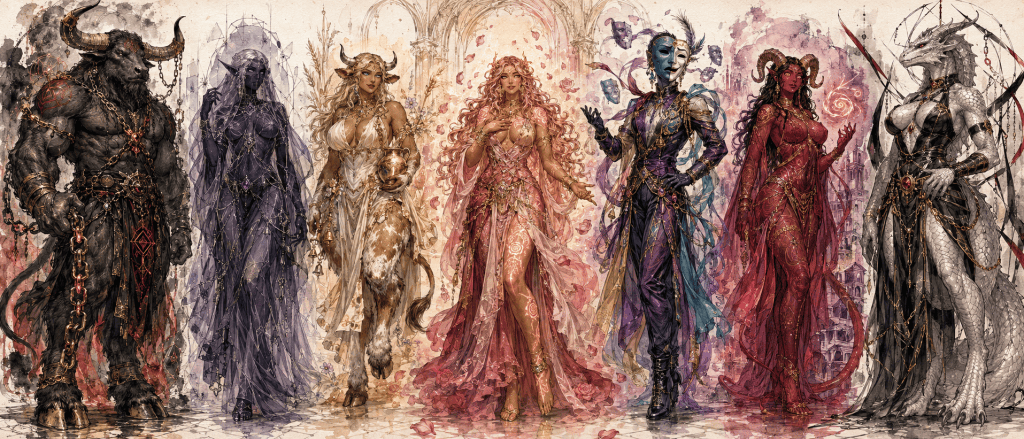
What the Velvet Court Was
At its inception, the pantheon was remarkably direct. Each deity represented a particular fetish, kink or expression of sexuality, wrapped in enough fantasy mythology to give that desire a divine face.
Alphabetically, the original Court looked something like this:
| Deity | Original Fetish / Kink Domain | Original Creed |
|---|---|---|
| Aratheia 🍼 | Nipple Play • Lactation • Nourishment | “Drink sacred sweetness.” |
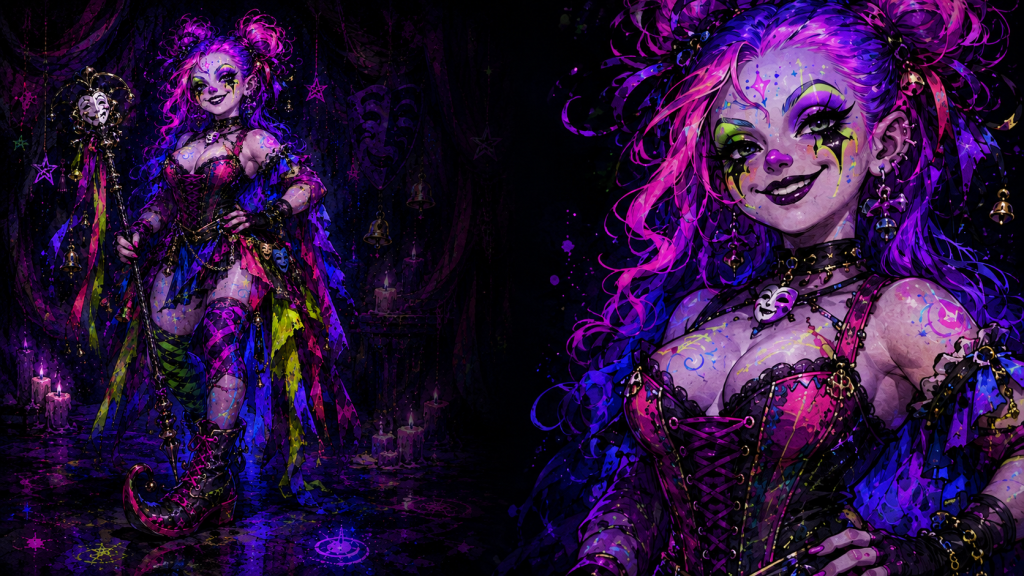
| Cyrillith 🎭 | Roleplay • Masquerade • Fantasy | “Every mask reveals truth.” |
| Delavira 🕯️ | Tease • Denial • Voyeurism | “Pleasure hides in absence.” |
| Eshthara 🌀 | Hypnosis • Trance • Control | “Desire whispers; thought obeys.” |
| Mirellune 🕸️ | Bondage • Latex • Obedience | “Beauty is bound.” |
| Nyzun 🔥 | Impact • Pain • Flogging | “Her hymns are written in red.” |
| Rhaziel 👁️🔥 | Predation • Obsession • Chase | “The hunt is worship.” |
| Solynth 💠 | Submission • Pet Play • Service | “Yield to your truest shape.” |
| Sylithra 💧 | Wetness • Watersports • Overflow | “Let nothing be held back.” |
| Talyss 🍓 | Food Play • Fertility • Group Joy | “Indulgence is divine.” |
| Threxira 💉 | Piercing • Tattoos • Transformation | “Pain writes your becoming.” |
| Ulvexa 🐾 | Primal Lust • Ferality • Breeding | “Bare the beast within.” |
| Velyssara 🌹 | Lust • Tantra • Love | “All bodies are holy.” |
| Velzhari 👠 | Exhibition • Vanity • Public Play | “Let the world crave you.” |
| Zenthira 🔗 | Taboo • Forbidden Love • Craving | “What is forbidden burns brightest.” |
There it is.
No euphemisms.
That was Erosia.
And one of the most important realizations I’ve had during the Second Bloom rebuild is that there was nothing wrong with that foundation.
The problem was that a fetish by itself isn’t yet a compelling TTRPG domain.
From Fetish to Fantasy
This is where the current rebuild has become much more interesting to me. I’ve stopped asking: “How do I make this fetish sound like a fantasy religion?” Instead, I’m asking: “What human desire makes this fetish powerful in the first place?”
That question changes everything. Bondage isn’t interesting simply because someone is tied up. Why do people choose restraint? Why surrender control? Why would someone willingly give another person authority over them? What responsibilities come with accepting that authority?
Suddenly Mirellune isn’t merely the goddess of bondage. She becomes a goddess of trust, authority, structure, devotion and deliberately entrusted control. The bondage remains. The chains remain. The latex remains. But now they mean something. That has become the guiding principle behind rebuilding the entire Velvet Court.
What the Court Is Becoming
This part is still very much work in progress.
As I write this, I am working through Nyzun. That puts me somewhere around the halfway point of the deeper deity reconstruction, and several members of the Court haven’t yet undergone the same scrutiny.
So don’t read the following as the final canonical taxonomy. Think of it as a view through the workshop door.
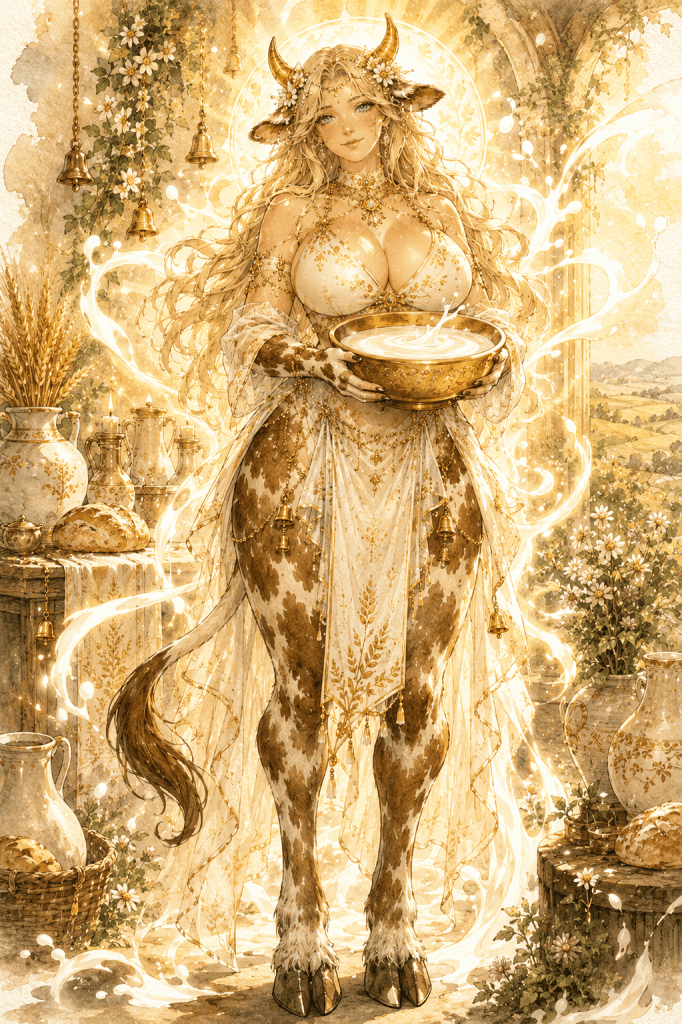
Aratheia
Then: Nipple Play • Lactation • Nourishment
Now: Nourishment • Care • Abundance
Aratheia may be one of the clearest examples of what this process can accomplish.
The Milkmaid Divine hasn’t stopped being associated with lactation. That would defeat the entire purpose of returning to Erosia’s roots.
Instead, I asked what lactation represented within her mythology.
The answer was nourishment.
From there came food, harvest, hospitality, shelter, caretaking, recovery and the vulnerability required to admit that sometimes you are the one who needs to be cared for.
Her central question became:
When someone hungers, what do you give them?
The erotic symbolism remains part of her worship, but adventurers can now encounter Aratheia through a healer tending the wounded, a farmer sharing grain before winter, a roadside sanctuary feeding strangers or a hero learning that accepting help isn’t weakness.
Her current theology increasingly revolves around a simple principle:
What is given freely sustains the world.
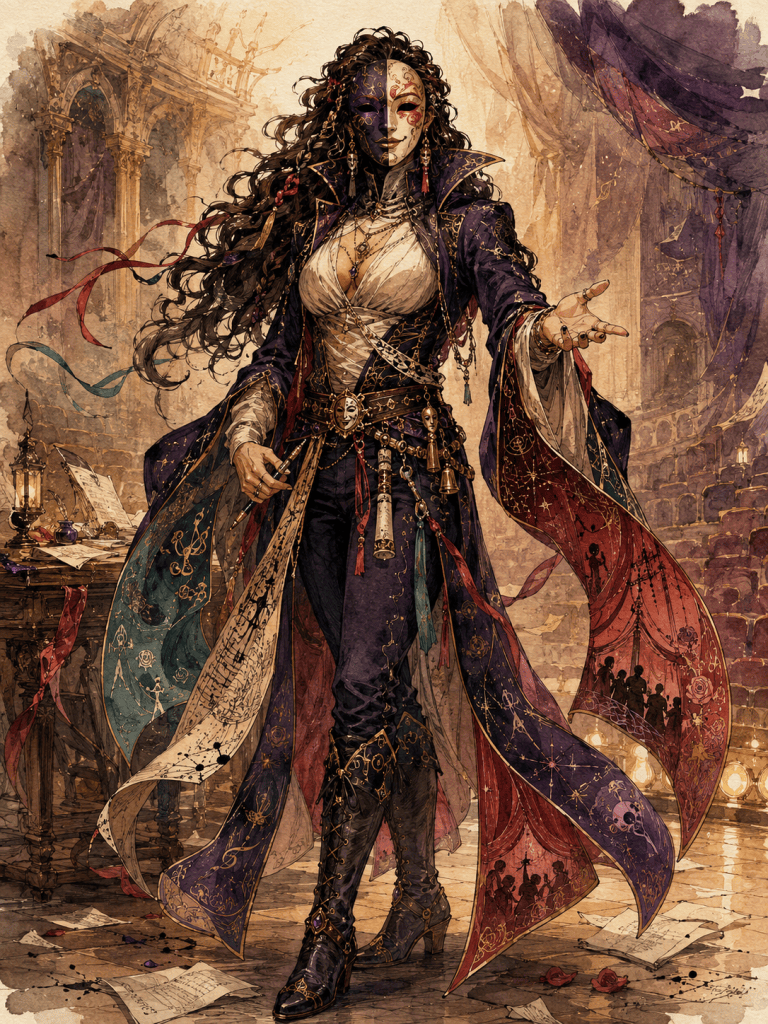
Cyrillith
Then: Roleplay • Masquerade • Fantasy
Now: Performance • Identity • Transformation • Story
Cyrillith began with masks.
Cyrillith still has masks.
But roleplay became much more interesting once I stopped treating the mask as something that conceals identity.
Sometimes pretending to be someone else reveals something about who you actually are.
Cyrillith therefore grew into the divine patron of theater, performance, storytelling, comedy, tragedy, assumed identities and the strange truths we discover while inhabiting roles.
The fantasy remains.
The masquerade remains.
But the TTRPG question underneath them becomes:
What can you become while everyone agrees to pretend?
For a roleplaying game, that feels especially appropriate.
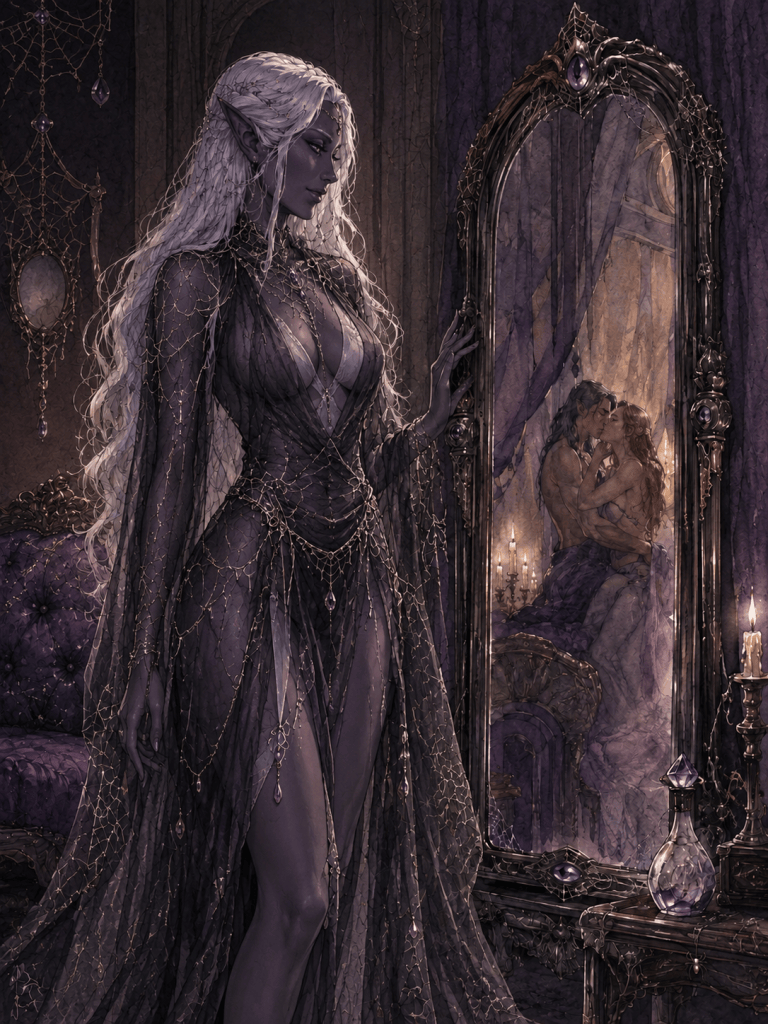
Delavira
Then: Tease • Denial • Voyeurism
Now: Distance • Anticipation • Observation • Longing
Delavira taught me that sometimes the most important part of desire is the space between people.
The Touchless One governs what is wanted but not yet possessed. The glance across the room. The closed curtain. The almost-open door. The knowledge that something exists just beyond reach.
Tease and denial became pacing.
Voyeurism became observation and distance.
And suddenly Delavira had applications far beyond an intimate encounter: secrets, surveillance, patience, anticipation, withheld knowledge and the terrible power of not yet.
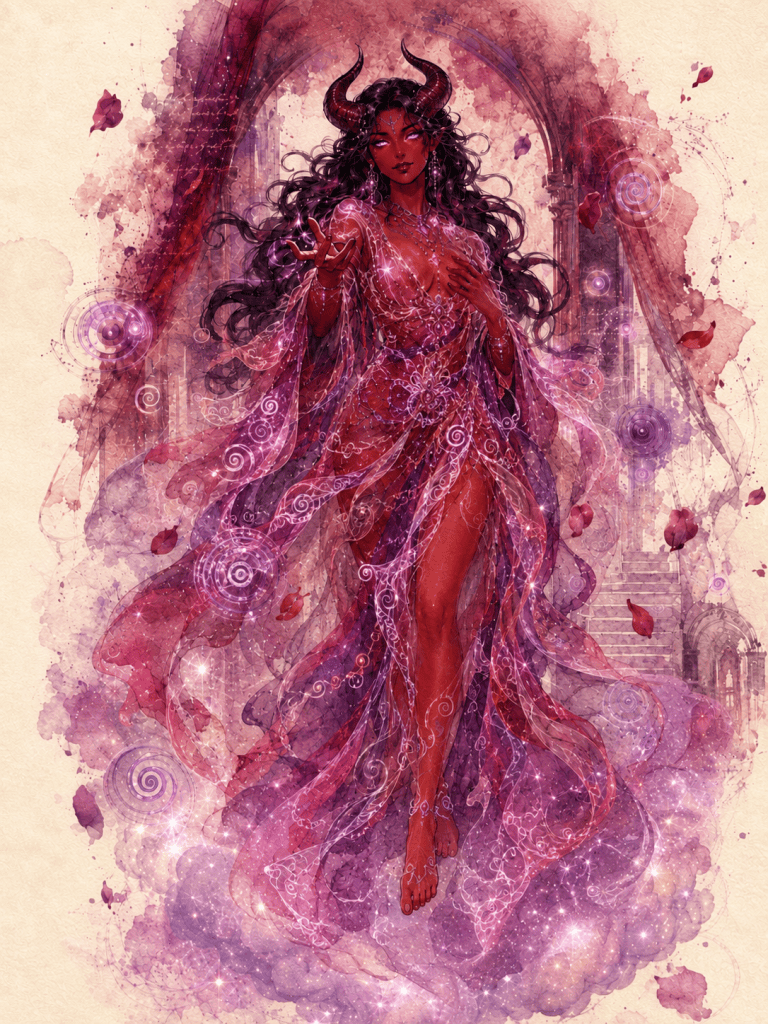
Eshthara
Then: Hypnosis • Trance • Control
Now: Dreams • Suggestion • Imagination • Surrender of Certainty
Eshthara’s evolution became less about controlling another person’s mind and much more about questioning how certain anyone should be about their own perceptions.
Dreams, trance, hypnosis and suggestion all alter perspective.
So Eshthara became the goddess who asks:
What else could this become?
Her worship explores imagination, altered perception, guided attention, dreams and the vulnerability of temporarily allowing another perspective to influence your own.
Importantly, the newer theology has also forced much sharper distinctions around agency. Consent to trance is not blanket consent, and vulnerable minds are expected to be returned carefully rather than exploited.
That isn’t something being bolted onto Erosia from outside.
It is becoming part of the religion itself.
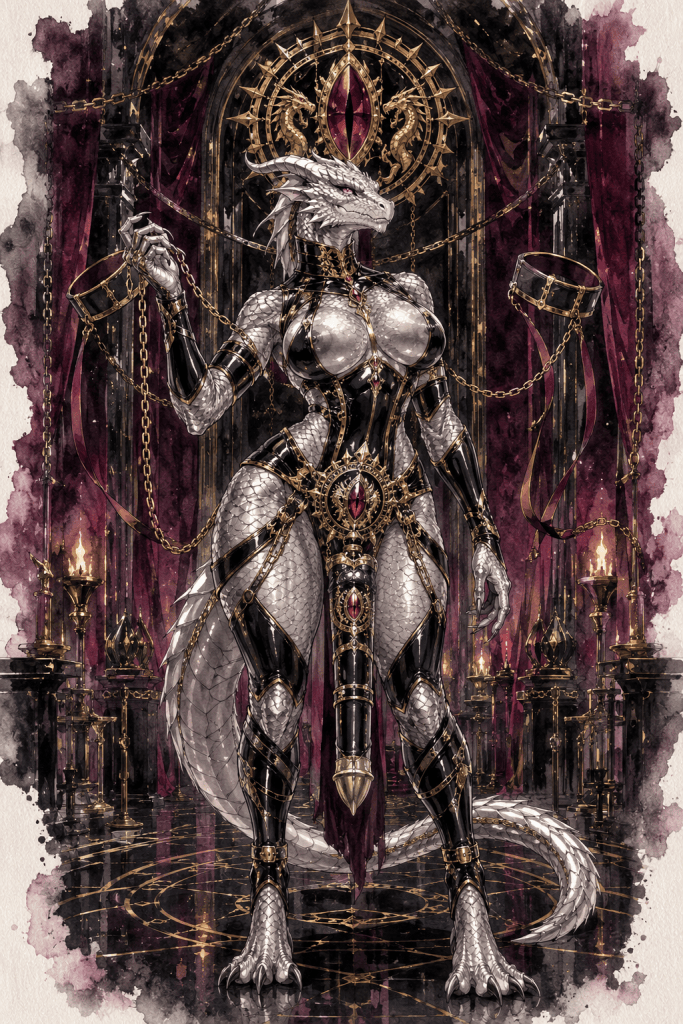
Mirellune
Then: Bondage • Latex • Obedience
Now: Trust • Authority • Devotion • Chosen Surrender
Mirellune has probably undergone one of the largest transformations without actually abandoning much of her original identity.
She still has chains.
She still has collars.
She still has latex, harnesses, restraints, hierarchy and obedience.
But the Silken Sovereign is increasingly concerned with what makes authority legitimate.
Her answer is brutally simple:
It was given.
Her faith therefore explores negotiated authority, responsibility, discipline, vows, structure and the vulnerability involved in deliberately placing some measure of control into another person’s hands.
Her greatest prohibition follows naturally:
No authority may claim legitimacy that was never given.
The chain itself grants no authority.
That makes Mirellune useful not only for intimate power exchange, but for stories involving leadership, apprenticeship, hierarchy, command, trust and responsibility.
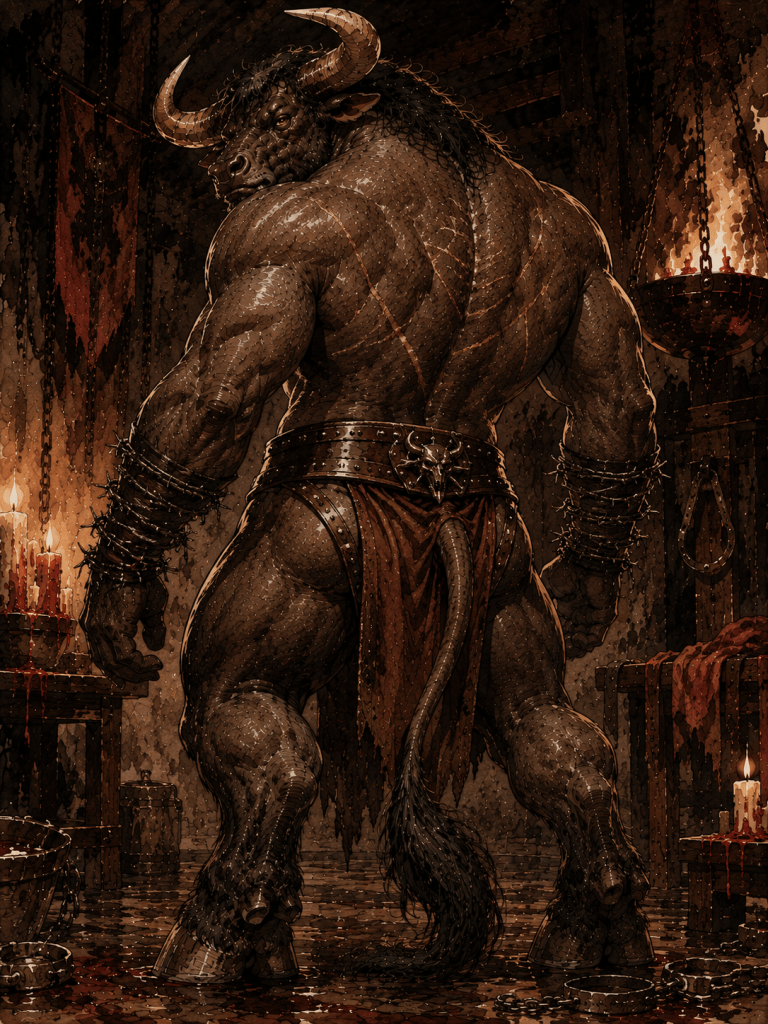
Nyzun
Then: Impact • Pain • Flogging
Now: Sensation • Intensity • Endurance • Limits • Discernment
And this is where I am right now.
Nyzun is still being written.
He is changing significantly.
Originally, Nyzun was essentially the pain deity.
That isn’t enough anymore.
Pain is becoming information.
The Chainsinger is emerging as a god concerned with the Sacred Edge: the boundary between discomfort and injury, fear and danger, endurance and self-destruction.
His followers aren’t simply learning how much they can withstand.
They’re learning how accurately they can perceive themselves while under pressure.
That has produced one of my favorite pieces of theology from this entire reconstruction:
Nothing I feel may make my choice for me.
A worshipper may hurt. They may tremble. They may become frightened, exhausted, exhilarated or overwhelmed. Mastery doesn’t mean becoming unfeeling. It means remaining capable of choice while feeling intensely. And sometimes the greatest act of discipline is stopping.
Nyzun’s developing doctrine explicitly teaches that someone who continues because stopping would make them feel weak may demonstrate less discipline than the person capable of recognizing their actual boundary. That gives a god who started with Impact • Pain • Flogging an extraordinary amount of room at the gaming table. Athletes can worship Nyzun.
Warriors can. Healers can. Adventurers enduring impossible environments can. So can people who explore consensual pain and intense sensation. They are all asking versions of the same question:
Where is my edge—and do I know myself well enough to recognize it?
And the Rest of the Court?
This is where I’m deliberately stopping short of pretending the work is finished.
The remaining gods still have their original foundations:
- Rhaziel began with predation, obsession and the chase.
- Solynth began with submission, pet play and service.
- Sylithra began with wetness, watersports and overflow.
- Talyss began with food play, fertility and group joy.
- Threxira began with piercing, tattoos and transformation.
- Ulvexa began with primal lust, ferality and breeding.
- Velzhari began with exhibition, vanity and public play.
- Zenthira began with taboo, forbidden love and craving.
And above all of them stands Velyssara, whose original domains of lust, tantra and love provided the soil from which the entire setting grew. Some of these gods already have obvious directions. Some have existing material that I know needs reconsideration. And I fully expect at least one of them to surprise me.
That’s part of why I’m writing this before the work is finished.
Mature Doesn’t Mean Less Sexual
This might be the most important distinction I’ve discovered. For a while, I think there was a temptation to make Erosia more mature by making it less obviously sexual. I’m increasingly convinced that was the wrong direction. Maturity doesn’t require removing the fetish.
It requires understanding it. If Mirellune loses bondage, she becomes another generic fantasy goddess of trust. If Nyzun loses pain, he becomes another generic god of endurance. If Aratheia loses lactation, she risks becoming another harvest goddess.
Those original fetishes are what give these gods their particular vocabulary. The goal of the Second Bloom isn’t to replace that vocabulary. It’s to discover what those symbols can say. That also fits the broader direction Erosia has taken as a game. The current DM philosophy treats desire as narrative pressure rather than an assumed payoff, gives encounters social, sensual and physical avenues of resolution, and emphasizes that escalation is optional.
That’s the difference I’m trying to build toward.
Not: “Here’s the bondage goddess.”
But: “Here’s the bondage goddess. Here is what bondage means to her. Here is what her followers believe because of it. Here is what they disagree about. Here is what they consider sacred. Here is what they consider unforgivable. Here is why a paladin might follow her. Here is why a kingdom might fear her clergy. Here is an adventure that could only happen because this goddess exists.”
That’s a TTRPG deity.
Halfway Through the Court
So that’s where development currently stands. Somewhere around halfway. Aratheia, Cyrillith, Delavira, Eshthara and Mirellune have taught me a tremendous amount about what this reconstruction actually is. Nyzun is teaching me more right now.
Then I keep moving through the Court. I don’t know whether every original idea survives unchanged. Probably not. But I increasingly believe the roots should remain visible.
Erosia was born because I wanted to explore something tabletop fantasy usually pushed behind a curtain.
Desire.
Fetish.
Bodies.
Power.
Vulnerability.
Longing.
Pleasure.
And the strange things people discover about themselves when those forces matter to the story instead of merely decorating it. The Second Bloom isn’t about pulling that curtain closed. It’s about finally building the world that deserved to be standing behind it. The fetishes were the beginning. Now I’m discovering the gods inside them.
What do you think? I’d love for you to leave me a comment — Until next Time. DM Ookami.

 Whispers of Erosia
Leave a comment