
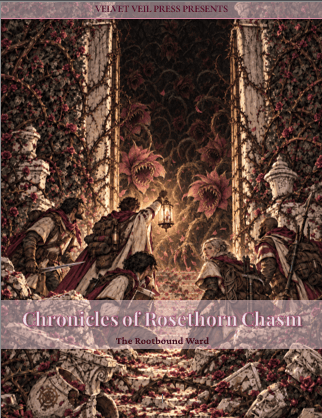
The second expedition into Rosethorn Chasm is complete.
Chronicles of Rosethorn Chasm: The Rootbound Ward is finished and preparing for release on DriveThruRPG. Adventure II picks up only a few days after the events of The Forgotten Gardens, but the tone changes almost immediately. The first expedition was built around curiosity, discovery, and the sense that Rosethorn Chasm was an ancient place waiting to be understood. The second asks what happens when that curiosity begins to carry consequences back toward Amarosa.
That change became the guiding principle for the entire adventure.
From Exploration to Containment
The Forgotten Gardens introduced the Bloom as something beautiful, strange, and dangerous. The characters entered an underground sanctuary reclaimed by impossible vegetation, encountered creatures that belonged there rather than simply waiting for adventurers, and slowly realized that a Petalguard Hunter had been following them through the gardens.
Adventure II begins after they have already survived that lesson. The Bloomseekers return to the House of the Sacred Bloom believing the expedition is over. Then a member of a recovery team becomes violently ill. The wound is small. Healing magic does not solve the problem. Green rootlike lines begin spreading beneath the skin, tiny flowers react to nearby light, and eventually a juvenile organism emerges.
It does not attack. It runs…That was the moment around which the rest of The Rootbound Ward began to take shape. The threat was no longer something waiting beneath Amarosa. Something had come back inside one of the Bloomseekers.
The question changed from “What lives below?” to “Can whatever lives below reach us?”
Returning Somewhere That Has Changed
One of the things I wanted to avoid was treating Tier I as a reset dungeon. The characters have already explored the Forgotten Gardens. They know the fountain, the shrine, the hedge paths, the Ceremonial Garden, and the Ancient Gate. Returning to those places should matter. Roots have thickened. Flowers have opened. Guild marks are disappearing beneath moss. Tracks cross places that were previously quiet. The environment has continued growing while the players were gone.
That continuity is important because Rosethorn Chasm is not intended to feel like a sequence of static encounter maps. It is a place that continues existing between expeditions. The characters may remember exactly where they are. That does not mean the place remembers them kindly.
The Sun Lantern
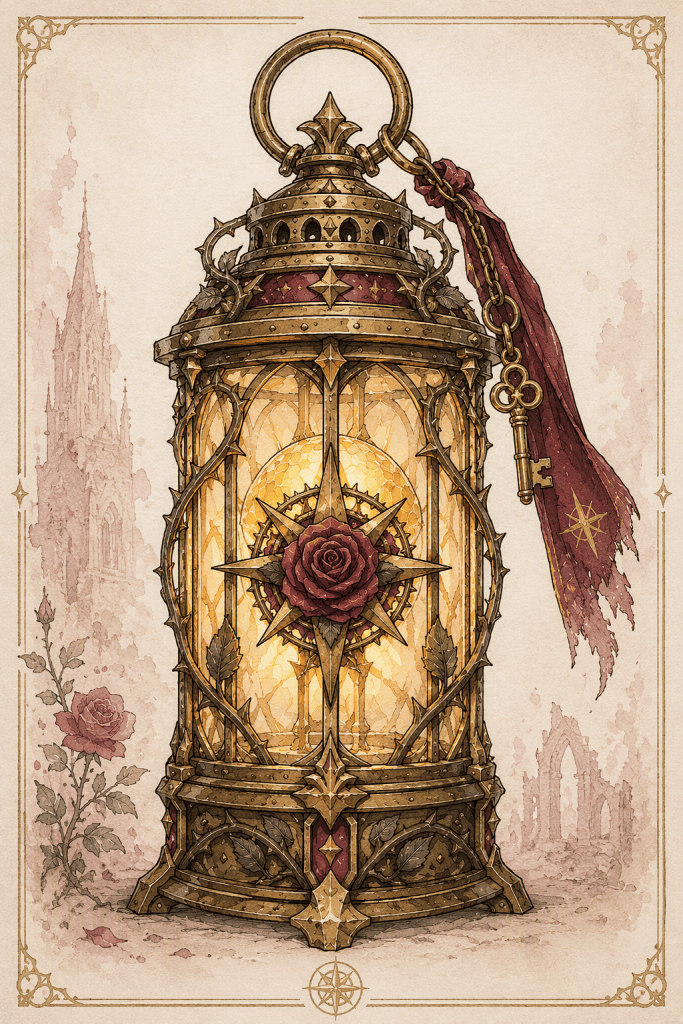
Adventure II also introduces one of the Bloomseekers Guild’s most important pieces of expedition equipment: the Sun Lantern.
The lantern produces up to eight hours of true daylight and always tells its bearer the direction of the House of the Sacred Bloom. For an expedition descending into miles of darkness, that sounds like an extraordinary advantage.
It is.
It is also a problem.
The Bloom does not recoil from sunlight.
It reaches toward it.
Leaves unfold. Flowers open. Root tips begin growing. Nearby vegetation turns toward the lantern’s radiance, and prolonged use begins drawing the attention of the ecosystem.
The Sun Lantern became one of my favorite mechanics in the adventure because it creates a resource decision that is not simply about charges or duration. The safest and most powerful light source the Guild can provide is also announcing the expedition’s presence.
Sometimes the safest thing the characters can do is turn off the light.
Opening the Ancient Gate
The Ancient Gate was the ending point of the first expedition. In Adventure II, it finally opens. Beyond it is not another garden or another dungeon chamber. It opens onto a city street. The Rootbound Ward is a forgotten urban district buried beneath Amarosa, complete with homes, markets, cisterns, shrines, civic buildings, workshops, and old transit infrastructure. Above the rooftops there is no sky. Immense roots have grown across the district until the earth itself has formed a living canopy over the city.
That reveal changes the perceived scale of Rosethorn Chasm. The characters are no longer exploring isolated ruins beneath Amarosa. They are entering the remains of something much larger. More importantly, the Bloom has not simply destroyed the city. In places, it is holding it together.
Roots brace fractured walls. Resin seals broken masonry. Living growth follows old water channels and service passages. The distinction between ruin and organism becomes increasingly difficult to identify the deeper the characters travel.
The Petalguard Was Never Alone
The Petalguard Hunter was designed to dominate the first adventure. Adventure II deliberately takes away that certainty. The characters discover new Bloom organisms serving very different roles. Petal Saplings flee rather than fight. Bloomworn are infected living hosts who may still recognize their own names. Petalguard Runners scout and communicate. Harvesters attempt to restrain and carry living creatures rather than kill them.
The Hunter remains dangerous, but it is no longer the whole story. This was an important design shift. I did not want Adventure II to become “more Petalguards.” I wanted the characters to begin recognizing behavior.
Some creatures hunt. Some scout. Some capture. Some transport. The horror comes from realizing that these are not unrelated monsters sharing the same dungeon. They belong to the same ecology.
The Nursery of the Lost
The Nursery of the Lost became one of the most important locations in the adventure. The characters discover several missing Bloomseekers incorporated into the walls of an ancient civic chamber. Roots and translucent resin hold their bodies in place. Their equipment and Guild badges are still visible.
They are also alive. Some are conscious. That discovery fundamentally changes the Guild’s understanding of its missing explorers. A Bloomseeker who vanished years ago may not necessarily be dead. It also complicates every future decision about Rosethorn Chasm.
Sealing a passage may contain the Bloom. It may also abandon someone who can still be rescued. Destroying part of the underground city may protect Amarosa. It may also destroy knowledge, sanctuaries, and living people who have survived below far longer than anyone believed possible.
I want those choices to remain uncomfortable.
Bloom Pressure
The Rootbound Ward introduces a DM-facing Bloom Pressure system to represent how strongly the local ecosystem is reacting to the expedition. Light matters. Noise matters. Resting in exposed locations matters. Violence matters. Moving quietly through darkness can allow the environment to settle again.
The goal was not to create another resource bar for players to manage. Bloom Pressure exists to help the DM make the Ward respond naturally to the party’s behavior. If the characters move carefully and extinguish the Sun Lantern, the district becomes quieter. If they spend an hour carrying daylight through the streets while breaking doors, fighting creatures, and collapsing structures, the Ward notices. Eventually, things begin moving toward them.
The Bug-Hunt Moment
The Old Transit Hall contains the scene that ultimately defines Adventure II for me. The characters reach an upper balcony overlooking ancient transit infrastructure and see multiple Petalguard forms moving below. Not fighting. Not hunting. Traveling.
Saplings move among larger organisms without being attacked. Runners communicate across the hall. Harvesters carry living bodies. Hunters move beside Bloomworn as though neither considers the other prey. Then the characters understand where the traffic is going. Toward the Ancient Gate. Toward the Forgotten Gardens. Toward Amarosa.
This is the point where the adventure stops being about going deeper. The characters have to decide what should happen to the route behind them. The obvious inspiration is the moment in Aliens when exploration and rescue finally give way to the realization that the entire place may need to be destroyed. Rosethorn Chasm complicates that answer.
There are still people below. There are sanctuaries the Bloom will not enter. There is history no one understands. And no one yet knows whether destroying one route would actually stop anything. So the question becomes more interesting than simply burning everything down.
For the first time, the Bloomseekers have to seriously ask whether anyone should continue exploring Rosethorn Chasm at all.
Adventure II Ends With a Decision
The final act is built around containment rather than extermination. The characters may close the Ancient Gate, collapse part of the Transit Hall, flood the Rootworks, build a temporary defensive line, or devise something considerably more destructive. Whatever they choose should matter later.
A collapsed route stays collapsed. A burned district remains scarred. A flooded passage changes movement through the Ward. Rosethorn Chasm remembers what expeditions do to it.
The characters eventually return to the House of the Sacred Bloom carrying evidence that changes everything the Guild thought it understood about the ruins beneath Amarosa. They know the Bloom can infest living people.
They know it can preserve hosts. They know it can reproduce through them. They know different Petalguard forms participate in the same ecosystem. And they know that ecosystem can move. Will adventure II ends with containment? That distinction is going to matter very soon.
What Comes Next
The Forgotten Gardens was the invitation. The Rootbound Ward is the warning.
Adventure III will begin dealing with the deeper history behind what the Bloomseekers have discovered, although I am being very careful about how quickly those answers appear. Rosethorn Chasm works best when every discovery explains one thing while making the larger mystery stranger.
For now, the Bloomseekers have enough to worry about. There is a forgotten city beneath Amarosa. Something ancient has grown through it. People are still alive inside it. And the road between that place and the surface has finally been opened.
Chronicles of Rosethorn Chasm: The Rootbound Ward is complete and heading to DriveThruRPG.
Thank you to everyone following these expeditions, testing ideas, sharing feedback, and helping this strange place beneath Amarosa continue to grow. The next descent begins soon.


 Whispers of Erosia
Leave a comment