
Among the peoples of Erosia, the Fleshforged are unlike any other.
They are not born through bloodline, divine ancestry or natural inheritance. They are made.
Every Fleshforged begins with a body someone designed, materials someone selected and a purpose someone intended. Their face may have been sculpted to inspire devotion. Their hands may have been shaped for battle. Their voice may have been tuned to resemble someone dearly missed. Their form may imitate a human, a Dracari, an elf, a Beastkin or something no naturally born people has ever possessed.
But creation is only their beginning.
A Fleshforged may awaken within a body made for another person’s purpose, yet the life that follows belongs to them.
That tension between design and self-determination lies at the heart of the Fleshforged.
Why Play a Fleshforged?
Choose a Fleshforged if you want to play a character whose body already tells a story.
Perhaps you were created to guard someone who no longer needs protection. Perhaps you were designed as a work of beauty and have begun asking what beauty means when admiration is no longer enough. Perhaps your maker built you to stand before an altar, yet your faith has changed. Perhaps your face belongs to someone who died long before you first opened your eyes.
A Fleshforged character asks questions other ancestries rarely face.
Who chose this body?
Why was I made?
Do I still want what they wanted for me?
And perhaps most importantly:
What do I choose now?
A Fleshforged does not need to reject their original purpose to possess agency. A Bastion-Cast may genuinely love protecting others. A Templewrought may remain deeply faithful. An Atelier-Born may delight in admiration, companionship or beauty. A Grave-Reclaimed may treasure the memory embodied in their form.
Freedom does not require rebellion.
It requires choice.
Made, Not Born
The Fleshforged body is an act of craft.
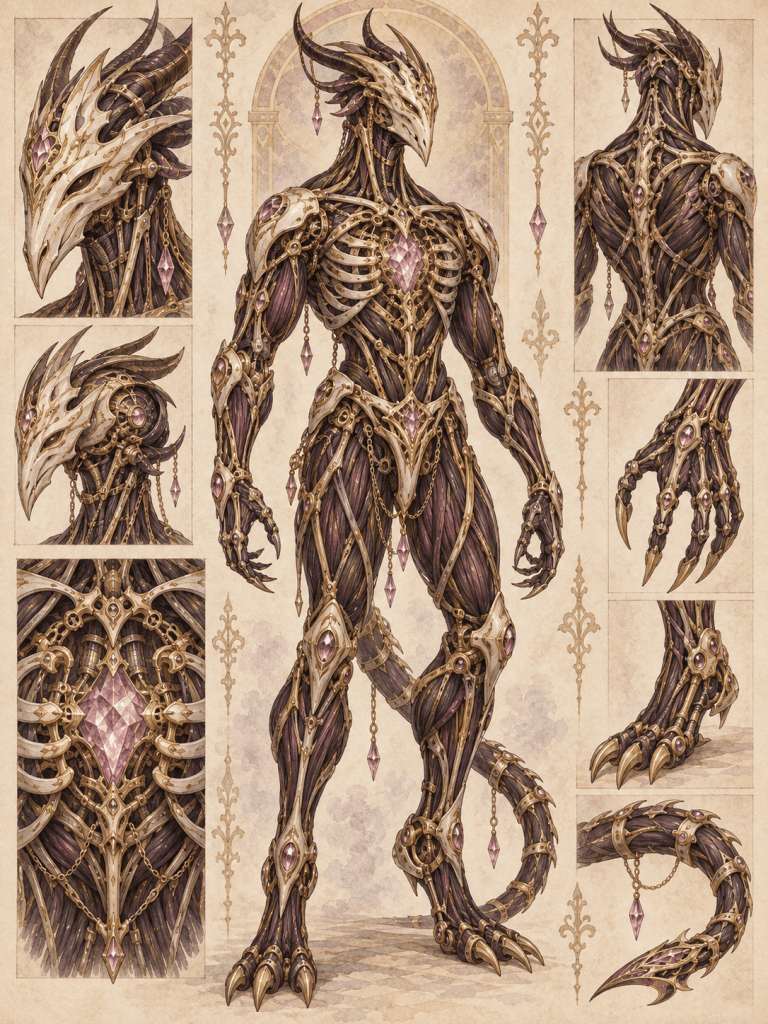
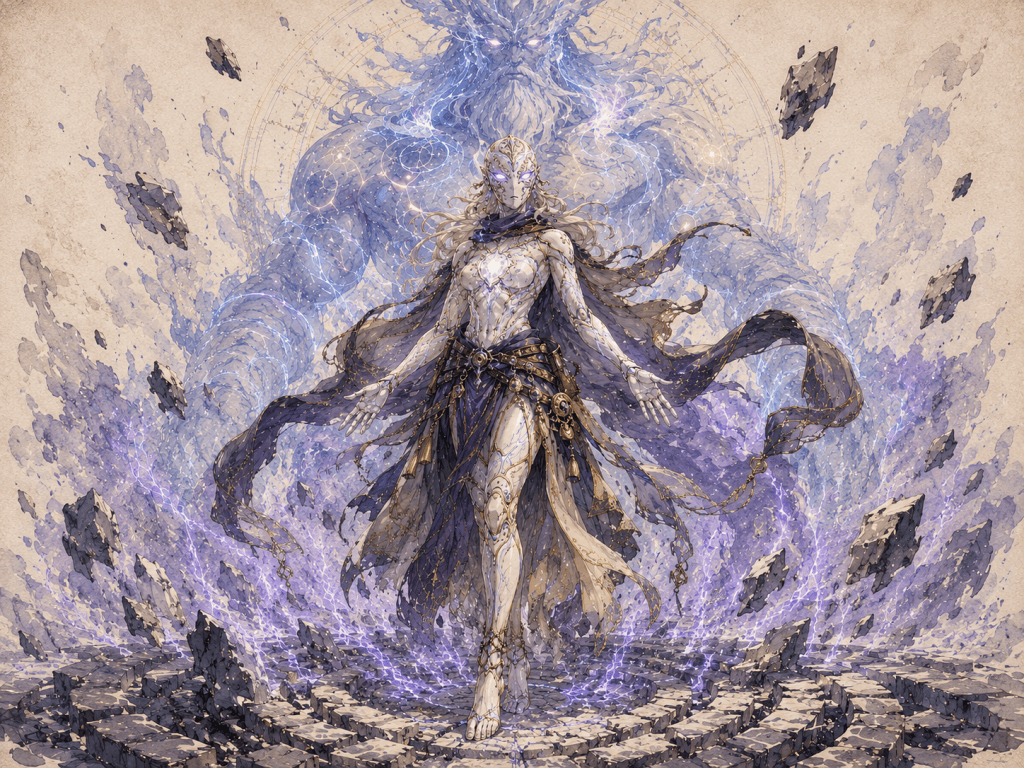
Beneath lacquered shell, sculpted flesh, porcelain plating, engraved bone substitutes or alchemically grown tissue lies a complex union of magical engineering and reliccraft. Artificial musculature pulls against articulated joints. Arcane conduits carry energy in place of nerves. Heartstones, binding matrices and carefully prepared vessels sustain awareness where mere mechanisms would remain lifeless.
No two workshops construct them in precisely the same way.
One Fleshforged may resemble polished ivory statuary traced with gold seams. Another may possess flexible artificial skin stretched across rune-bound musculature. Another may be composed of carved hardwood, silver articulation and living crystal. Some appear almost indistinguishable from naturally born people until close inspection reveals the craft beneath.
Their bodies are designed.
Their personhood is not.
The Four Great Designs
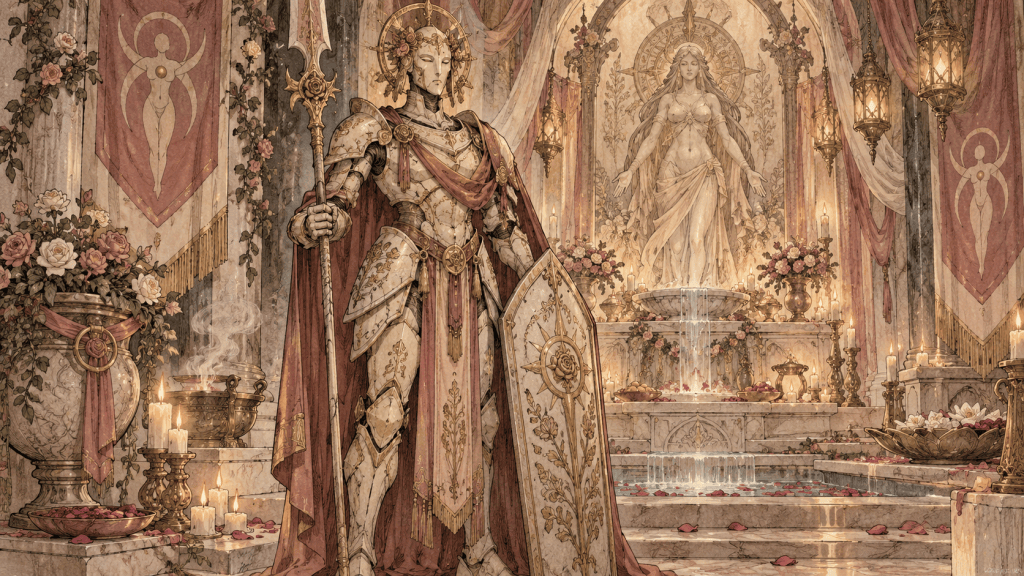
Relicwright traditions generally recognize four great Fleshforged design philosophies.
These categories describe why the body was originally created, not what the Fleshforged must remain.
Templewrought
Templewrought Fleshforged were designed in service to faith.
Some guard sanctuaries. Others tend sacred relics, maintain ritual spaces, participate in ceremonies or embody the aesthetic ideals associated with a particular deity.
Their bodies often carry overt religious symbolism: engraved prayers, sacred geometry, devotional materials, ritual coloration or forms inspired by the favored peoples and creatures of their faith.
A Templewrought created within a Dracari temple might possess a draconic silhouette, ceremonial horns and scale-like porcelain plates. One serving Velzhara might be fashioned as an impossible masterpiece of symmetry and reflective beauty. Another dedicated to a harsher deity might resemble a walking reliquary.
Their maker may have intended worship.
Their faith remains their own.
Atelier-Born
Atelier-Born Fleshforged were designed to be desired.
They may have been commissioned as companions, artistic masterpieces, symbols of wealth, muses, performers, attendants or embodiments of an individual’s idealized beauty.
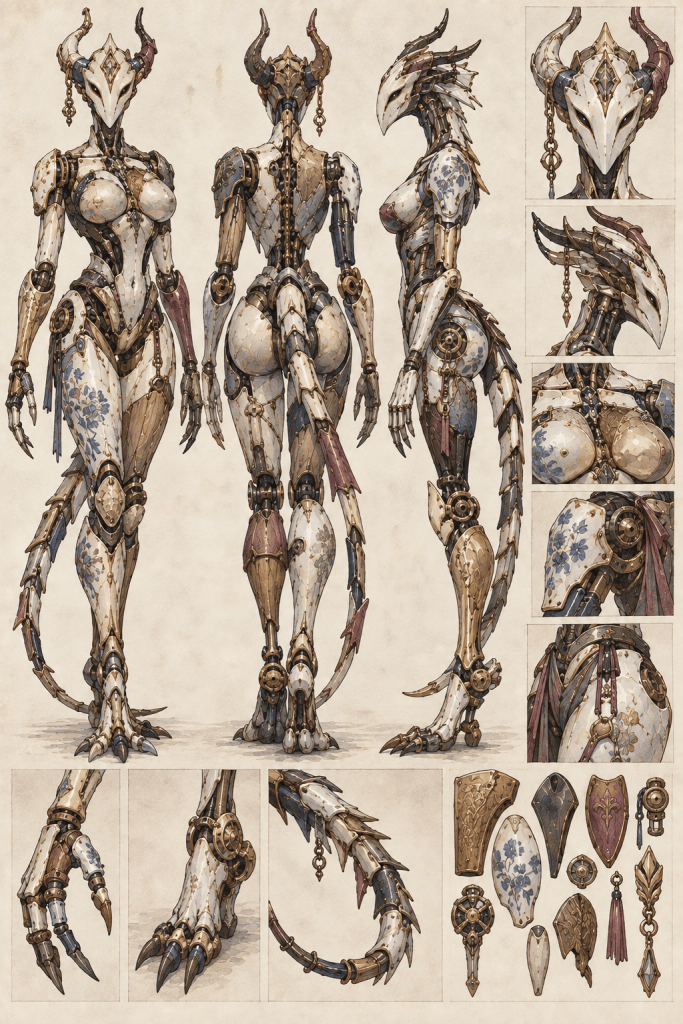
Their makers often devote extraordinary attention to proportion, movement, voice, texture and ornamentation. Porcelain bodies marked with kintsugi seams, sculpted masks, floral inlays, gemstones and exquisitely articulated limbs are common among celebrated ateliers.
An Atelier-Born might have been made in the image of a Dracari patron’s cultural ideal, complete with horns, tail, plated scales and draconic elegance.
That does not make them Dracari.
Their body reflects an aesthetic tradition.
Their identity belongs to themselves.
Bastion-Cast
Bastion-Cast Fleshforged were designed to guard.
Their bodies emphasize stability, durability and defensive function. Heavy frames, reinforced joints, broad silhouettes and integrated protective structures are common.
Some were created as household guardians. Others protected caravans, estates, temples, noble heirs or vulnerable communities.
A Bovari-shaped Bastion-Cast might possess immense shoulders and powerful digitigrade legs. A Lupinari-inspired guardian could be built for speed and pursuit. A Dracari-patterned Bastion might resemble a living fortress of sculpted scales and plated horns.
Such features imitate form.
They do not grant inherited ancestry traits.
Grave-Reclaimed
Grave-Reclaimed Fleshforged were created to answer grief.
A family unwilling to lose a beloved face. A ruler desperate to preserve the presence of an advisor. A widow unable to bear an empty chair. A parent seeking one more conversation.
The reasons vary.
The result is always complicated.
A Grave-Reclaimed may resemble the deceased with extraordinary precision: their face, posture, voice, mannerisms and physical form painstakingly reconstructed from memory, portraits or relics.
But resemblance is not resurrection.
A Grave-Reclaimed is a new person inhabiting a body shaped by another person’s memory.
Some cherish that inheritance.
Some resent it.
Some spend decades trying to learn about the person whose face they wear.
Others refuse the comparison entirely.
Few Fleshforged embody the question of selfhood more painfully.
The Fifth Design: Free Assemblage
Not every Fleshforged belongs neatly to a single tradition.
A Free Assemblage combines techniques, components or philosophies drawn from multiple designs.
An Atelier torso might connect to Bastion-Cast limbs. Templewrought sensory systems may operate behind a Grave-Reclaimed face. Parts salvaged from damaged Fleshforged may be incorporated alongside newly forged components.
Some Free Assemblages are deliberate experiments.
Others are survivors.
They are sometimes called patchworks, amalgams or workshop children, depending upon region and circumstance, though many reject such labels.
Their irregular construction makes them difficult to categorize and almost impossible to predict.
Among Fleshforged, however, Free Assemblages often embody a particularly potent truth:
A person need not have been designed according to a single plan.
Form Is Not Lineage
Because Fleshforged bodies are deliberately constructed, their physical appearance is extraordinarily diverse.
A Fleshforged may be shaped after nearly any Erosian people.
Human-shaped bodies remain widespread because early artificers refined their techniques around familiar humanoid proportions. Yet there is nothing fundamental requiring a Fleshforged to possess a human silhouette.
A Dracari-shaped Fleshforged may possess horns, a tail, scale-like plating and draconic facial architecture.
A Felinari-shaped Fleshforged might possess crown-set feline ears, digitigrade legs and an articulated tail.
A Dreamborn-inspired model might bear constellation-like inlays beneath translucent artificial skin.
A Bovari-patterned guardian could possess tremendous mass, horns and reinforced lower limbs.
None of these designs grant the ancestry’s inherited traits.
A Dracari-shaped Fleshforged does not automatically gain a Dracari breath weapon.
A Dreamborn-shaped Fleshforged does not inherit Dreamborn metaphysics.
A Lupinari-shaped Fleshforged does not become biologically Lupinari.
The distinction is simple.
Fleshforged imitate form, not lineage.
Their shape is craftsmanship.
Their nature remains Fleshforged.
Model and Design
Among Relicwrights, two terms are particularly useful when describing Fleshforged construction.
Model describes the physical form used as inspiration.
Human model. Dracari model. Felinari model. Illuminari model. Bovari model.
Design describes the philosophical tradition under which the Fleshforged was constructed.
Templewrought. Atelier-Born. Bastion-Cast. Grave-Reclaimed. Free Assemblage.
A Fleshforged might therefore be described as a Dracari-model Atelier-Born, a Bovari-model Bastion-Cast or an Illuminari-model Templewrought.
Model describes shape.
Design describes intent.
Neither determines personality.
The Relicwright Legacy
Fleshforging represents one of the greatest achievements ever associated with Relicwright craft.
Relicwrights learned to preserve enchantment within objects.
Eventually, someone asked a far more dangerous question.
Could a crafted vessel hold not merely magic, but awareness?
The oldest Fleshforged traditions suggest that early Relicwrights were not attempting to create a new people. They were attempting to create perfect servants, flawless guardians, tireless attendants and vessels capable of carrying increasingly sophisticated magical functions.
Somewhere along the way, function became thought.
Thought became preference.
Preference became desire.
Desire became self.
Modern Relicwrights still study Fleshforged construction, though the complete methods used by the earliest masters are fragmented, guarded or lost.
Few artificers possess the knowledge necessary to create a truly awakened Fleshforged from beginning to end.
That missing knowledge lies at the center of one of Erosia’s great artificer legends.
The Lost Masterforge
Every Fleshforged has heard some version of the story.
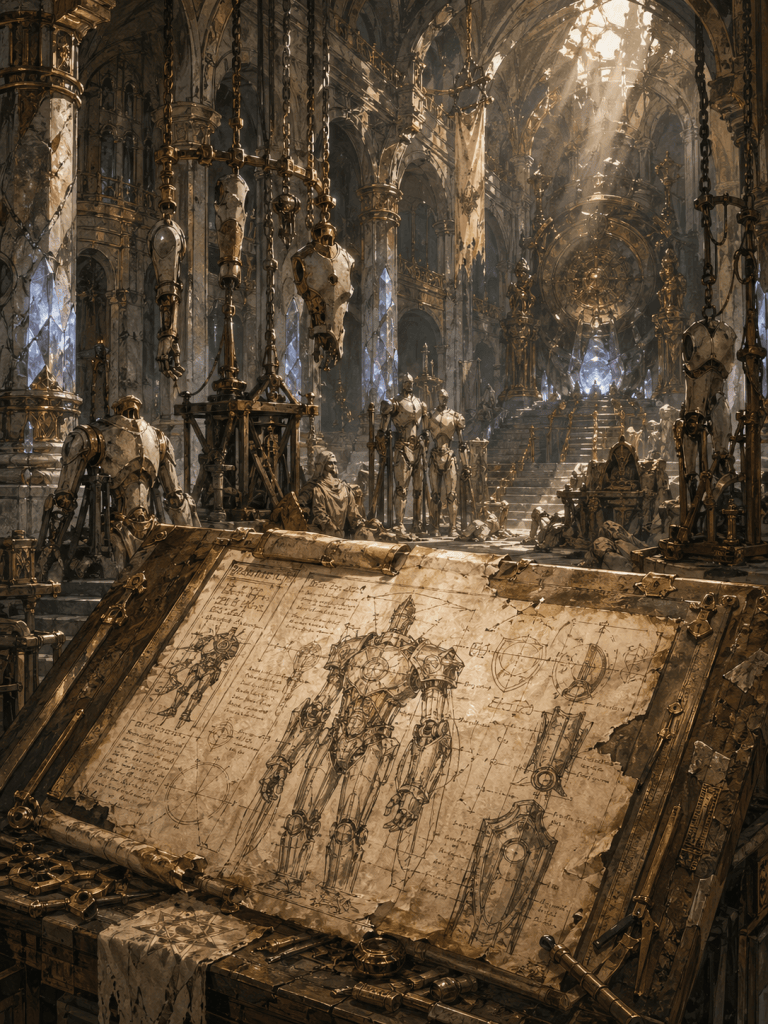
Somewhere in Erosia lies the Masterforge.
No surviving map agrees upon its location.
No accepted history identifies its creator.
No two traditions agree upon what waits inside.
Relicwrights describe it as the first complete Fleshforge workshop, a place where every principle of artificial life was perfected before its knowledge scattered across Erosia.
Fleshforged tell stranger stories.
Some say the Masterforge contains the original pattern from which all Fleshforged designs descend.
Others claim its furnaces can restore any damaged Fleshforged body.
Some believe the forge can construct replacement limbs indistinguishable from their originals, recover damaged memories or awaken dormant Heartstones.
There are those who insist the Masterforge can create Fleshforged without a maker.
And there is one story that refuses to disappear.
The oldest chambers of the Masterforge contain a forge unlike any other.
There, a Fleshforged may dismantle portions of their own design and rebuild themselves according to their own choosing.
No commission.
No patron.
No maker’s hand guiding the hammer.
Only the Fleshforged and the body they wish to become.
Whether the story is true hardly matters.
Fleshforged have spent generations searching for it.
Relicwrights search beside them.
Not always for the same reasons.
The Question of Purpose
Every Fleshforged has an origin purpose.
That does not mean every Fleshforged has a destiny.
A Templewrought may leave the temple.
An Atelier-Born may abandon the atelier.
A Bastion-Cast may lay down their weapon.
A Grave-Reclaimed may choose a new name.
A Free Assemblage may discover that being made from many purposes leaves them unusually free to invent one.
Others remain exactly where their makers intended them to be.
Both paths are equally valid.
Among Fleshforged philosophers, this distinction is sometimes expressed through four stages:
Design is the body you were given.
Purpose is the life someone imagined for you.
Awakening is realizing the difference.
Becoming is deciding what happens afterward.
That final step belongs entirely to the Fleshforged.
Playing a Fleshforged
A Fleshforged adventurer naturally carries unanswered questions into a campaign.
Who made you?
Why?
Does your maker still live?
Do you resemble someone else?
Were you created for a purpose you still embrace?
What parts of your body have already been replaced?
Do you know where your Heartstone came from?
Have you ever encountered another Fleshforged built by the same workshop?
And what would you do if someone finally placed a map to the Masterforge in your hands?
For some characters, the answer is obvious.
For others, the journey toward that answer may become the entire campaign.
Every Fleshforged begins as someone else’s design.
What they become afterward is their own creation.


You must be logged in to post a comment.