
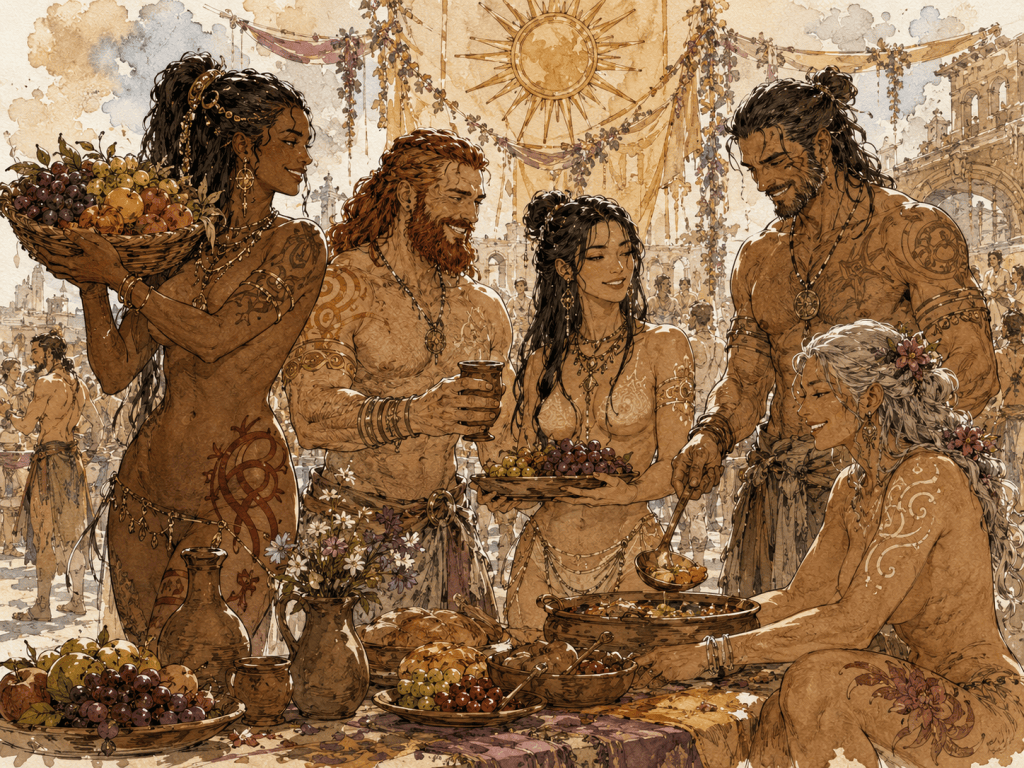
The Body Unashamed — Naturism & Nudity in Erosia
Life in Erosia | Culture, Identity and the Living Form
The Body Unashamed
Across Erosia, the living body is neither a sin to conceal nor a spectacle requiring an audience. Clothing may express identity, artistry, profession, faith, climate or personal comfort. Its absence does not imply an absence of dignity. To be clothed, adorned, painted, lightly covered or ungarmented is not, by itself, a statement of sexual interest.
A Natural Part of Life
Naturism and nudism appear throughout Erosia in ordinary life as well as during celebrations. A person may enjoy the warmth of a garden, visit a communal bath, work beside a sheltered spring, join a shared meal or take part in a traditional gathering without clothing. Another may prefer a wrap, sturdy working garments or elaborate attire. Neither choice needs justification, and neither establishes superiority or greater freedom.
Nudity, Identity and Intimacy
Erosians understand that nudity, the self and sexual intimacy are distinct. A visible body is not an invitation, a promise or a demand for attention. Attraction may exist in any setting, but it arises between people through their own feelings, choices and boundaries. Likewise, someone may enjoy sensuality or romance while fully dressed. A person’s body belongs first to that person.
Choice Is the Custom
Participation in naturist activities is voluntary for residents, travelers, worshippers, performers and adventurers alike. Communities may invite rather than require; hosts should offer ordinary alternatives for those who prefer garments or privacy. A festival does not obligate anyone to remove clothing, accept body painting, consent to touch or explain a personal choice. The same courtesy extends to those who choose to remain ungarmented.
Not a Single Erosian Custom
Erosia is home to many peoples, regions, faiths and ways of life. Naturist practices differ among households and communities, and no ancestry can be reduced to one attitude toward the body. Public bathing, decorative body painting, work garments, ritual undress, sacred washing and informal bodily freedom may have different histories and meanings in different places. Some customs are religious, others civic, practical, artistic or simply personal.
The Divine and the Living Form
Erosia’s deities can find many meanings in the body and its seasons: beauty, life, fertility, change, healing, strength, artistry, truth, mortality and renewal. Such meanings may inspire ceremonies, blessings and festivals, but naturism does not belong exclusively to any one deity or temple. A person need not worship to enjoy bodily freedom, and faith does not require exposure.
Naturism Through the Erosian Year
The changing year offers opportunities to gather around different forms of life. Spring can celebrate awakening and renewal; summer, warmth and vitality; autumn, gratitude and acceptance; winter, sanctuary and care. These are themes for local customs rather than a uniform world calendar or a requirement that festivals include nudity. The celebrations add meaning to a freedom that already exists.
Autumn Vigil: The Unveiled Harvest
Across Erosia, Autumn Vigil includes regional practices such as the Barefoot Vintage, the Emberwater Vigil, the Dance of Falling Leaves, the Lanternskin Revel, the Feast Without Finery, the Three-Moon Unveiling, the Golden Sheaf Gathering and the Rite of the Unadorned Bloom. Amarosa brings several traditions together in the three-day Festival of the Fallen Veil, moving from public waters to Roseglass Ward and the Temple of Eternal Petals.
Explore The Unveiled Harvest and its eight Autumn Vigil traditions.
Visit Roseglass Ward, home to Amarosa’s Lanternskin Revel.
The Peoples of Erosia: A Living Collection
Future entries will explore how different Erosian peoples and communities understand clothing, adornment, bathing, body painting, privacy, climate, work, worship and celebration. These entries will offer stories, contrasting regional examples and playable customs rather than assign fixed attitudes to entire ancestries. Individuals remain free to embrace, adapt or reject the traditions around them.
At the Table
Naturism is part of the setting, not a test for players or characters. Groups can describe it as briefly or as fully as suits their agreed boundaries. In Veiled Play and Unveiled Play alike, ordinary nudity does not itself trigger Arousal, an Erosave or an assumption of attraction. Mechanics of Desire belong only to interactions where their use is appropriate and mutually welcomed. Characters may participate in every community ritual while clothed, wrapped or ungarmented.
A World Comfortable in Its Own Skin
The freedom to be seen is also the freedom not to be looked at, touched, questioned or defined by appearance. Erosia’s festivals may be exuberant, its baths lively, its temples reverent and its gardens peaceful. In all those places, a living body can simply be a living body.


