
A promise can outlive the lips that spoke it.
There are roads in Erosia that travelers refuse to walk beneath a full Pearl Moon. There are bridges where coach drivers will not stop, even when someone calls their name from the dark.
And there are lakes where, if the water grows too still beneath all three moons, people know better than to answer when a woman calls from the mist.
They call her the White Bride of Stillwater.
No temple agrees on her true name. Some say she was Elira Vey, daughter of a wealthy Silkborn house whose family promised her in marriage to secure an alliance she did not want. Others insist she was Maelith of the Veil, a Dreamborn woman who abandoned an elder court for the brief life of a mortal lover.
The oldest songs give her no name at all. They call her only the Bride.
Every version agrees on one thing: She loved someone, and on the night they were meant to meet beside the lake, that person never came.
The Last Vigil
The wedding was meant to take place without priest, magistrate or noble witness. Only the lake, the three moons and two people speaking promises freely to one another would stand witness.
In those days, people around Stillwater said a vow spoken beneath the Pearl, Crimson and Azure moons together could not be witnessed more completely by any temple.
The Bride arrived first. She wore white ceremonial veils woven with silver thread, the traditional dress of an old lakeside marriage rite. She carried no jewels, dowry or family crest. She brought only herself and the promise she intended to make.
She waited at the water as the Pearl Moon crossed the sky. Then the Crimson. Then the Azure. Her beloved did not come.
By dawn, the Bride was gone. Her footprints ended at the lake.
What Happened to Her
There are many explanations. The kindest says her beloved was murdered on the road by those who opposed the union. Another says they lost their courage and fled. A darker telling claims they never intended to come at all.
In the old villages around Stillwater, people tell another version.
They say the Bride did not drown. She simply continued waiting.
One night became another, then another. The body surrendered long before the promise did, and something in Erosia listened.
Perhaps Velyssara heard her devotion. Perhaps Zenthira heard the confession she never had the chance to speak. Perhaps the lake itself became unable to forget her.
Whatever the truth, the Bride remained.
The Apparition
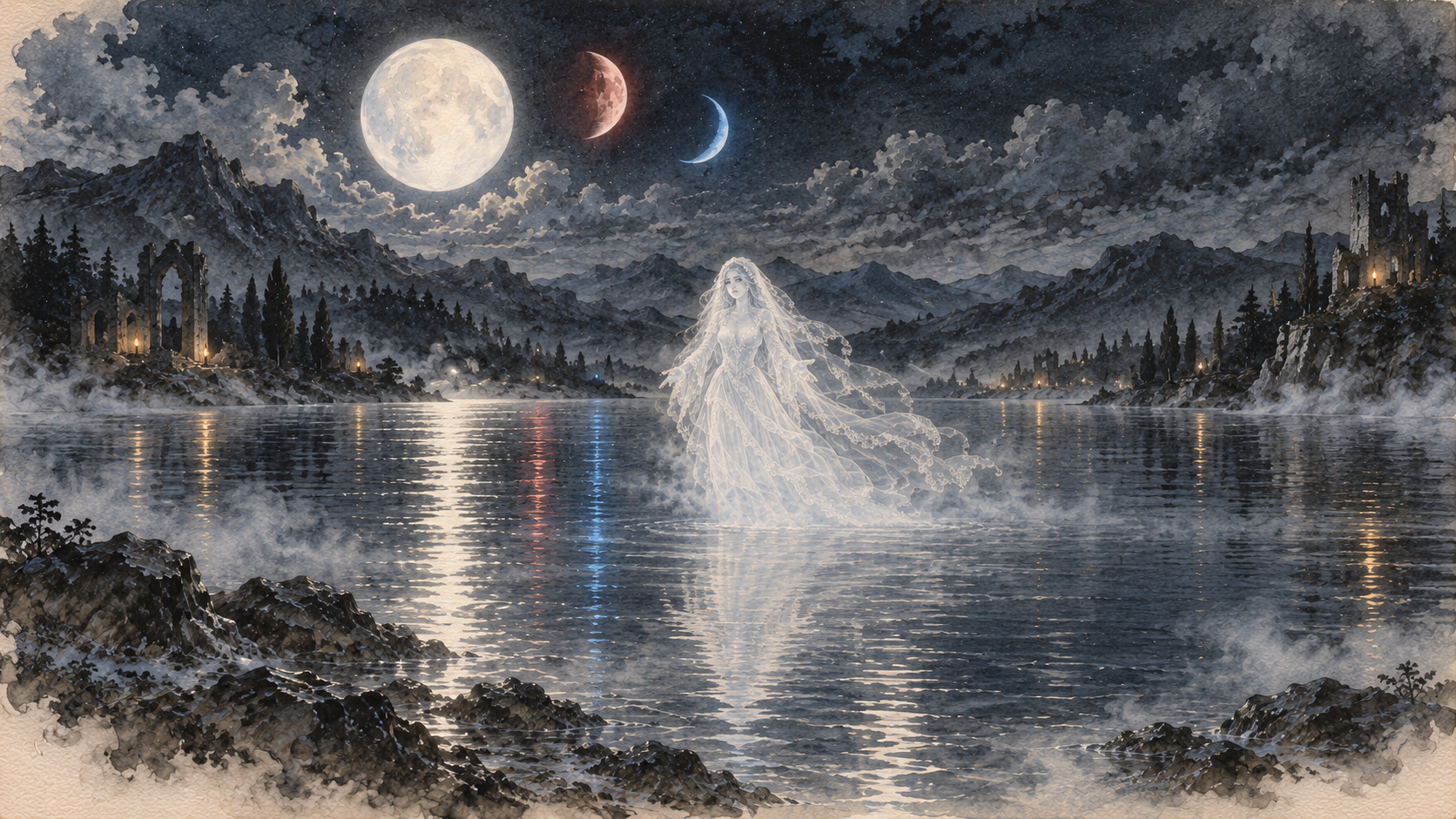
She appears when mist lies heavily over Stillwater. First comes the sound of cloth moving where there is no wind. Then a pale shape forms above the lake: a woman in a white wedding gown, gliding over the water without touching it.
Her veil trails behind her like moonlit fog. Her feet are never seen. Witnesses say the lake, distant shoreline and three moons remain faintly visible through her body and gown.
She is not merely pale. She is absence given shape.
And always, she reaches toward the person watching with both hands open.
Her expression is not angry. That frightens people more.
She looks hopeful.
The Question
Those who remain long enough sometimes hear her speak. Never loudly. Never more than a whisper.
“Did you come back for me?”
The old stories are specific about what follows. If the traveler lies and says yes, the Bride moves closer. If they mock her, she disappears. If they run, she does not pursue them.
But if they answer truthfully — No. I am not the one you waited for. — she lowers her hands.
For a moment, witnesses say, she seems almost relieved. Then she asks another question.
“Would you have come?”
There is no agreed-upon correct answer. Only an honest one.
The Cruel Answer
Some travelers boast that they would have crossed kingdoms for her. Some promise they would never abandon a lover. Some swear devotion to a dead woman they never knew.
The Bride has heard such promises for generations.
Empty words do not anger her. They make her sad.
Those who make vows they do not mean sometimes wake the next morning miles from the lake, their clothes soaked with freezing water. For seven nights afterward, every reflective surface shows the Bride standing behind them.
She never harms them. She simply watches, waiting to see whether their promises mean anything.
The Honest Answer
Travelers who admit uncertainty sometimes receive something stranger.
“I don’t know.”
“I would like to believe I would.”
“I have failed someone before.”
“I was once the one who did not arrive.”
Such answers are said to make the Bride smile. She approaches until only a breath of cold air separates apparition from traveler, then raises one translucent hand and places it over their heart.
For one moment, they remember every person who ever waited for them: every unanswered letter, delayed apology, postponed confession and promise spoken too easily.
Then the Bride disappears, leaving the traveler alone beside the lake.
The Pearl-Moon Tradition
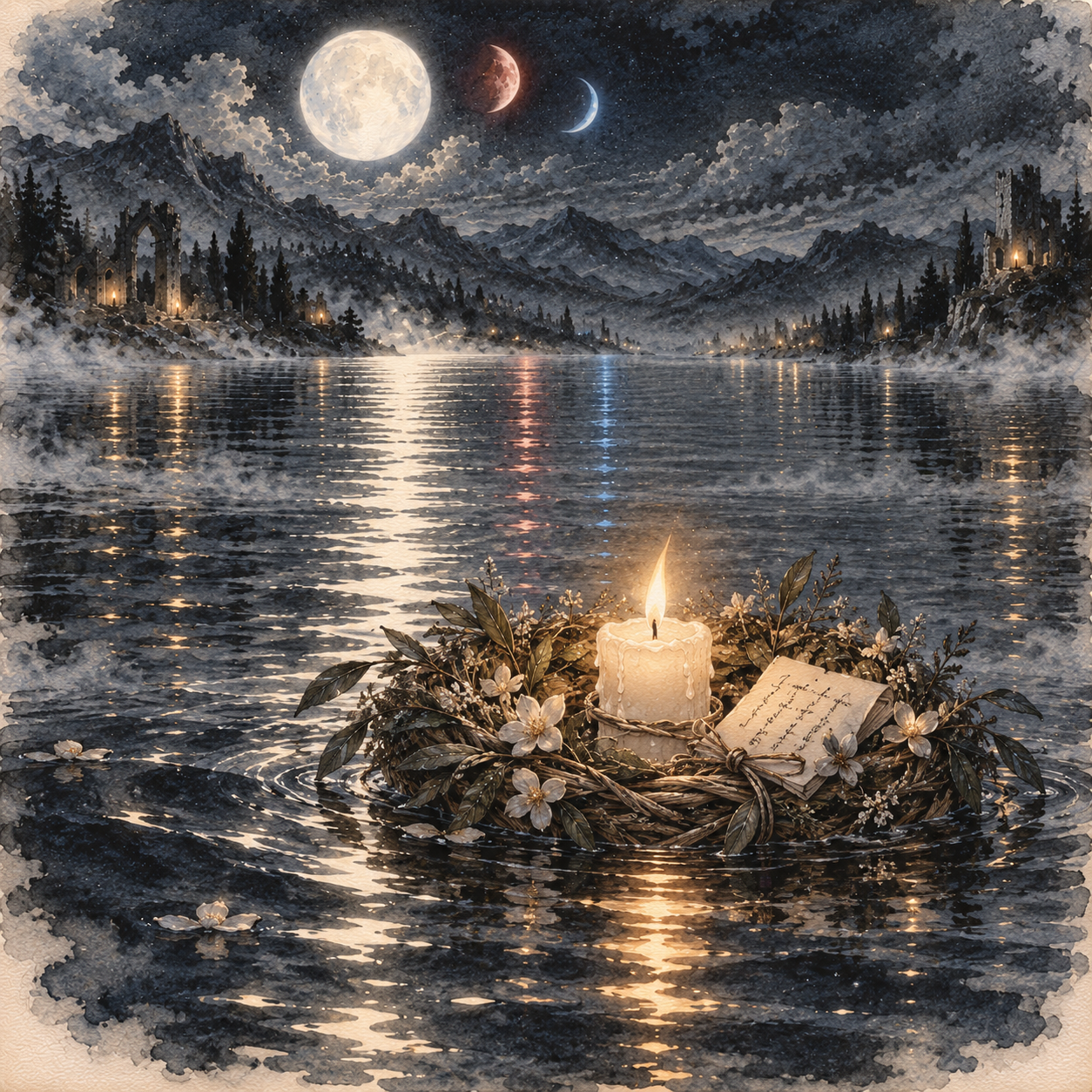
Among villages near Stillwater, lovers still observe an old custom before marriage. Each person goes alone to the shore carrying no ring, gift or witness.
On a small wreath raft, they place a lit candle and a folded written promise: one promise they are afraid they may someday fail to keep.
Not a perfect promise. A truthful one.
They set the wreath upon the water and let the lake choose its course.
If the candle drifts back toward shore, villagers say the Bride has accepted the honesty. If it drifts toward the center of the lake, they say nothing.
No one likes discussing that.
What the Priests Say
Priests of Velyssara disagree about the Bride. Some consider her a tragic spirit caught between devotion and release. Others believe she is no longer truly the woman who once waited beside Stillwater.
In those tellings, she has become something older and stranger: a living memory of every person who has waited for love that did not arrive.
She is a warning that desire without truth becomes suffering and a reminder that promises gain sacred weight only when freely made and honestly kept.
For this reason, some temples refuse to exorcise her. Their priests say there are worse things than ghosts.
There are vows spoken carelessly.
The Final Legend
There is one story rarely told to outsiders. It says the Bride will disappear forever when the person she waited for finally returns.
Not their reincarnation. Not a descendant. Not someone who resembles them.
The person themselves.
Still alive somewhere beyond the Veil. Still searching for the lake. Still trying to come home.
And so, on nights when the Pearl Moon is full, the Crimson Moon hangs divided and the Azure Moon curves thin above the water, villagers sometimes see the White Bride standing in the mist.
Hands extended. Wedding veil dissolving into moonlight. Waiting.
Not because she cannot leave, the story says, but because after all these years she still believes someone promised they would come.




You must be logged in to post a comment.