
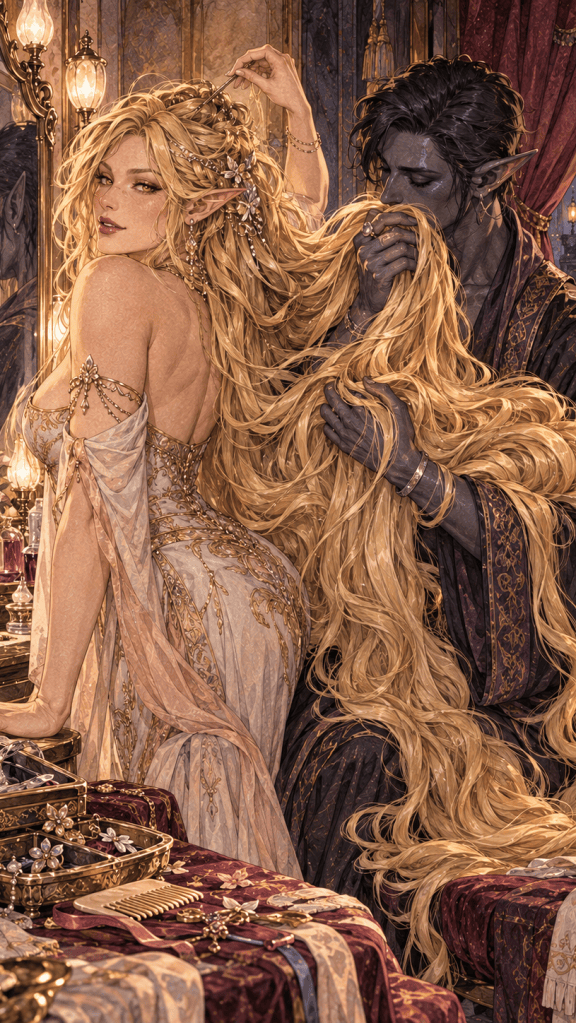
Tress Lover
Hair speaks through touch, fragrance, weight, and movement.
You are fascinated by the countless forms it may take: glossy curls spilling over bare shoulders, a warrior’s severe braid, carefully oiled coils, silken lengths loosened after ceremony, or a freshly shorn head inviting the touch of an open palm. Washing, brushing, cutting, braiding, and adorning another willing person’s hair can feel profoundly intimate to you.
Perhaps you trained as a barber, ceremonial groomer, wigmaker, bathhouse attendant, court stylist, mortuary dresser, or keeper of sacred braids. You learned that hair is never merely decorative. Its length may proclaim mourning, marriage, maturity, rank, profession, devotion, rebellion, or disgrace. A changed style can create a new identity—or conceal an old one.
Your practiced eye recognizes unfamiliar techniques, neglected care, deliberate alteration, and the subtle traces left by travel, labor, illness, perfume, smoke, weather, or magic. A single strand cannot tell you everything, but it can preserve evidence that skin and clothing have already surrendered.
You understand that hair is deeply personal. Touching it without permission can violate boundaries, while being invited to wash, arrange, or cut it may signify exceptional trust.
Skill Proficiencies: Insight, Investigation
Tool Proficiencies: Disguise kit
Languages: One of your choice
Equipment: A disguise kit, a fine-toothed comb, polished shears, a folding razor, several hairpins and ribbons, small bottles of scented oil and cleansing powder, a carefully preserved lock of personally significant hair, a set of common clothes, and a pouch containing 10 gp
Feature: By Strand and Style
Through careful examination, you can identify the ordinary physical qualities of hair, fur, or similar natural fibers. You can usually determine whether a sample was naturally shed, roughly torn, cleanly cut, recently dyed, chemically treated, deliberately perfumed, exposed to smoke or salt water, or affected by obvious neglect.
When examining a hairstyle, you can recognize familiar grooming techniques and understand their common practical or cultural purpose. You might identify a mourning braid, military cut, court fashion, devotional tonsure, marital ornament, occupational binding, or another tradition you have previously encountered.
These observations cannot identify an unknown individual by a single strand, reveal ancestry with certainty, determine exact age, recover supernatural memories, or provide information unsupported by physical evidence.
Barbers, bath attendants, wigmakers, perfumers, costume artists, ceremonial groomers, and household dressers recognize your professional vocabulary. They will generally share ordinary information about local styles, grooming customs, reputable suppliers, and practitioners capable of specialized work.
Suggested Characteristics
Tress Lovers see hair as adornment, identity, evidence, and intimate living texture. Some become trusted groomers, some collectors of memorable locks, and others wander in search of unfamiliar styles and the people who wear them.
| d8 | Personality Trait |
|---|---|
| 1 | I notice someone’s hair before I notice their clothing. |
| 2 | I instinctively imagine how unfamiliar hair would feel beneath my fingers. |
| 3 | I carry combs, pins, ribbons, and oils suitable for several textures. |
| 4 | I become absorbed in repairing a tangled braid or uneven cut. |
| 5 | I remember people by their hairstyle long after forgetting their names. |
| 6 | I ask about the meaning of every unfamiliar braid, ornament, or shaved pattern. |
| 7 | I find the moment someone loosens carefully arranged hair intensely revealing. |
| 8 | When thinking, I braid or twist any loose fiber within reach. |
| d6 | Ideal |
|---|---|
| 1 | Trust. Allowing another person to tend your hair is an intimate act of vulnerability. (Good) |
| 2 | Tradition. Every braid, cut, and ornament carries the memory of those who wore it before. (Lawful) |
| 3 | Reinvention. A person may cut away the past and choose how the world sees them next. (Chaotic) |
| 4 | Beauty. Hair should delight the senses and express the person who bears it. (Any) |
| 5 | Consent. No hand, blade, or comb should touch another person’s hair without permission. (Good) |
| 6 | Possession. A lock freely or secretly taken allows part of someone to remain with me. (Any) |
| d6 | Bond |
|---|---|
| 1 | I preserve a lock of hair from someone I loved and could not keep. |
| 2 | My mentor vanished after being summoned to prepare someone for a secret ceremony. |
| 3 | I once created a disguise that allowed an innocent person to escape persecution. |
| 4 | A distinctive braid is the only clue I possess to the identity of someone I seek. |
| 5 | I have sworn to restore a grooming tradition nearly erased from its people. |
| 6 | Someone entrusted me with cutting away the symbol of their former life, and I still guard their secret. |
| d6 | Flaw |
|---|---|
| 1 | I sometimes reach toward beautiful hair before remembering to ask permission. |
| 2 | I judge people too quickly when their grooming does not meet my standards. |
| 3 | I have secretly kept a lock that its owner expected me to discard. |
| 4 | I become possessive of people whose hair I regularly tend. |
| 5 | I cannot resist investigating hair left at a suspicious scene, even when danger is near. |
| 6 | I once revealed the meaning of someone’s private hairstyle to people who had no right to know. |
 Whispers of Erosia
You must be logged in to post a comment.