
Sigilwright • Arcane Naturalist • Creature Chronicler
The world is stranger than fear allows and more dangerous than wonder admits. Morvane Kaestra has devoted her life to understanding both.
Morvane Kaestra is one of Erosia’s most widely traveled creature chroniclers, a Luminari Sigilwright whose fieldwork carries her from settled roads and temple archives into ruined cities, forgotten forests, dangerous coasts and places where sensible scholars prefer to send letters instead. She studies creatures through direct observation, eyewitness testimony, magical analysis, ecology, anatomy and the physical traces they leave behind.
Morvane is as interested in what a creature changes simply by existing in a place as she is in what it can do in a fight. Her notes are respected because she is willing to revise them, and she treats certainty as something earned through evidence rather than declared because a story has been repeated often enough.
At a Glance
- People: Luminari, Starbinder lineage
- Class: Sigilwright
- Background: Monster Lover, expressed through field naturalism, creature study and supernatural investigation
- Profession: Arcane naturalist, field researcher and creature chronicler
- Primary Divine Alignment: Rhaziel, the Divine Stalker
- Cultural Reverence: Velzhari, through Luminari tradition
- Known For: Field catalogues, disputed classifications, creature research and the ornate MK seal attached to authenticated work
Early Life
Morvane was raised within a Luminari culture that treated knowledge as an obligation rather than an ornament. Discipline, excellence, memory and stewardship were not merely virtues taught in lecture halls; they were expectations that shaped how she learned to move through the world. A thing worth knowing should be known properly, a thing worth preserving should be recorded accurately and power, once understood, should leave the world better than it found it.
She excelled in formal magical study and eventually entered Sigilwright training, where she became less interested in spells as isolated formulae and more interested in the patterns living things created around themselves. A magical creature might alter soil, weather, migration, dreams, local rituals or the behavior of nearby animals long before anyone saw the creature itself. Morvane began to understand that a creature could be studied by examining the world it changed.
The academy taught her how magic worked. The field taught her that living things rarely behaved as neatly as scholarship claimed.
The First Contradiction
Morvane’s career changed during an early field assignment involving a creature scholars believed they already understood. The surviving accounts did not agree. One witness described a territorial predator, another insisted the creature guarded travelers and a third swore it appeared only beneath a particular moon. The accepted bestiary dismissed the contradictions as frightened testimony.
Morvane did not. She followed the tracks, interviewed the witnesses again and compared the sightings against weather, moon phase, food availability and magical resonance. The accounts eventually resolved into a pattern: the witnesses had encountered the same creature under different conditions, and each had described it accurately.
“When three witnesses disagree, do not begin by asking which one is lying. Begin by asking what changed.”
Morvane Kaestra
That expedition became the dividing line in Morvane’s life. She stopped treating contradiction as a failure of testimony and began treating it as an invitation to look for the missing variable.
Purpose & Philosophy
Morvane does not believe her purpose is to catalogue monsters. Her work is an attempt to reduce ignorance without reducing wonder. Fear grows strongest in the empty space between folklore and understanding, and Morvane has seen that emptiness filled by superstition, cruelty, reckless heroism and scholarship written with more confidence than evidence.
Sometimes the creature in the story truly is dangerous. Sometimes it is territorial, sacred, hungry, frightened, intelligent, parasitic, protective or simply living according to rules no one bothered to learn. Morvane wants adventurers to know when to draw steel, but she also wants them to know when not to. To her, useful knowledge should change behavior.
Passion & Desire
Morvane genuinely loves discovery. Reputation matters far less to her than the moment when a pattern finally resolves: a strange track matches a seasonal migration, a supposedly supernatural scream turns out to be courtship, a curse proves to be defensive magic or a creature believed solitary is discovered caring for its young. Those moments still delight her after more than two centuries of study.
Her deepest desire is deceptively simple. Morvane wants the world to remain larger than her understanding of it. She has watched schools of thought become obsolete, seen impossible creatures become accepted scholarship and corrected conclusions she once believed secure. Rather than threatening her, that possibility gives her a reason to keep walking.
Her private fear is the opposite: that one day she will stand before something extraordinary and feel nothing because she believes she has already seen it before. She fears the death of wonder more than she fears being proven wrong.
Rhaziel and the Hunt
Morvane’s personal devotion is most closely aligned with Rhaziel, whose mysteries concern pursuit, attention, investigation and the discipline required to know when a chase has ceased to serve its purpose. She does not worship him because she kills monsters. She reveres him because pursuit itself has meaning.
Morvane’s quarry is understanding. Rhaziel’s teachings remind her that attention reveals, that desire must move and that obsession can become its own trap when the hunter forgets what they are actually seeking. Morvane has lived through periods when the next answer mattered more to her than rest, relationships or returning home. The lesson she returns to is simple: not every trail must be followed to its end.
Her Relationship With Monsters
Morvane rejects the assumption that “monster” automatically means “enemy.” With non-sapient creatures, she thinks first in terms of ecology, instinct and behavior. With intelligent beings, she insists on personhood before taxonomy and has little patience for scholars who write confidently about people they have never attempted to understand.
That does not make her naive. Morvane has seen predation, cruelty, magical corruption, parasitism and creatures that cannot safely coexist with settlements. Understanding something does not oblige her to excuse it. It simply means she prefers knowing what she is fighting before she decides it must die.
The Ethics of the Catalogue
Morvane prefers observation to destruction because a living creature can answer questions a corpse cannot. She studies tracks, shed material, residue, abandoned nests, discarded scales, feathers, spores, venom and other evidence whenever possible. When a creature dies during an expedition, however, Morvane does not waste the opportunity to learn from the remains.
That practice has earned criticism. Morvane may preserve bone, tissue, venom, organs, magical residue or other useful material for research, and not every scholar agrees that respectful study and specimen harvesting sit comfortably beside one another. Morvane believes intention, necessity, consent where meaningful and the avoidance of needless harm matter. Others argue that research can still become exploitation even when conducted carefully.
Morvane does not pretend the debate is settled. She records objections alongside findings when they materially affect the work.
The Creature Chronicler
Morvane does not divide the world neatly into creatures worth studying and creatures worth ignoring. Beasts, monsters, spirits, divine animals, magical plants, aberrant life, undead, constructs, dragons and phenomena that resist ordinary classification all belong within the same greater question: What is this creature, really?
Cryptids are only one part of that life’s work. They are simply the part where rumor most often arrives before scholarship, which makes them an ideal test of Morvane’s methods.
The Kaestra Catalogue
Morvane’s collected journals, specimen notes, correspondence and formal creature entries are commonly grouped under the name The Kaestra Catalogue. Copies circulate among scholars, adventurers, temples, monster hunters and anyone who has learned the value of knowing what left the tracks before following them.
The Catalogue is deliberately unfinished. Morvane leaves margins, blank pages, disputed classifications and corrections because she expects future researchers to improve upon her work. For a culture that prizes memory and preservation, this is one of her quietest acts of rebellion: she does not want to become an unquestionable authority. She wants to become a useful ancestor.
Her MK monogram appears as an ink mark, field stamp or wax seal on work she has personally authored, examined or authenticated. The seal has become familiar enough that readers often notice when it is missing.
In the Field
Morvane is a scholar who goes where the evidence leads. She follows tracks, interviews witnesses, compares local folklore, maps territory, measures magical residue, examines remains and collects samples that can be taken without destroying what she came to understand. She is particularly attentive to contradictions, because moon phase, season, age, sex, magical environment, emotional state, divine influence or transformation may all explain why the same creature was described differently.
She is also an experienced adventurer and a formidable Sigilwright. Morvane’s careful preparation is usually more dangerous than spectacle, and companions learn quickly that “do not attack it yet” does not mean she is unprepared for the possibility that they eventually will.
Personality & Habits
Morvane is composed in public, but expeditions reveal a warmer and stranger person beneath the professional polish. She has dry humor, becomes visibly animated when discussing a creature she finds interesting and asks highly specific questions at socially inconvenient moments. Curiosity regularly outruns her sense of self-preservation, a flaw she recognizes more readily than she corrects.
She keeps meticulous notes, annotates other people’s books, forgets meals while working and has fallen asleep more than once with a journal open in her lap. Morvane also remembers people with the same precision she applies to creatures. A preference mentioned decades earlier may still influence what tea she pours when an old acquaintance visits.
Reputation
Among academics, Morvane is respected, disputed and occasionally described as reckless. Among monster hunters, she is useful enough to tolerate even when she asks them to wait before drawing weapons. Among adventurers, she is known for treating the sentence “no one has ever returned from there” as a research problem rather than a warning.
Rural communities often remember her differently. Some know Morvane as the scholar who proved what was killing livestock, discovered why a sacred beast had changed its behavior or convinced outsiders to leave a harmless creature alone. Others remember only the tall Luminari woman who arrived with a notebook, asked forty questions about claw marks and disappeared into the forest for nine days.
The “Monster Killer”
Morvane’s initials have produced a nickname she did not choose: MK — “Monster Killer.” Caravan guards, adventurers and younger field researchers repeat it with considerably more enthusiasm than Morvane does. She maintains that the name is inaccurate, unscientific and responsible for several unfortunate misunderstandings, which has done nothing to discourage its use.
“Monster killer? No. Dead specimens answer considerably fewer questions.”
Morvane Kaestra, allegedly after an expedition assistant used the nickname within earshot
Working With Morvane
Morvane rarely hires adventurers simply to kill something. She is more likely to need escorts into dangerous territory, witnesses interviewed, samples recovered, nesting grounds observed, damaged ruins reached, a living creature tracked without provoking it or an old report tested against what is actually there.
Those who work with her quickly discover that she expects evidence, honesty and restraint, but she does not require agreement. A companion who proves her wrong with good evidence earns more respect than one who agrees with her carelessly.
Appearance
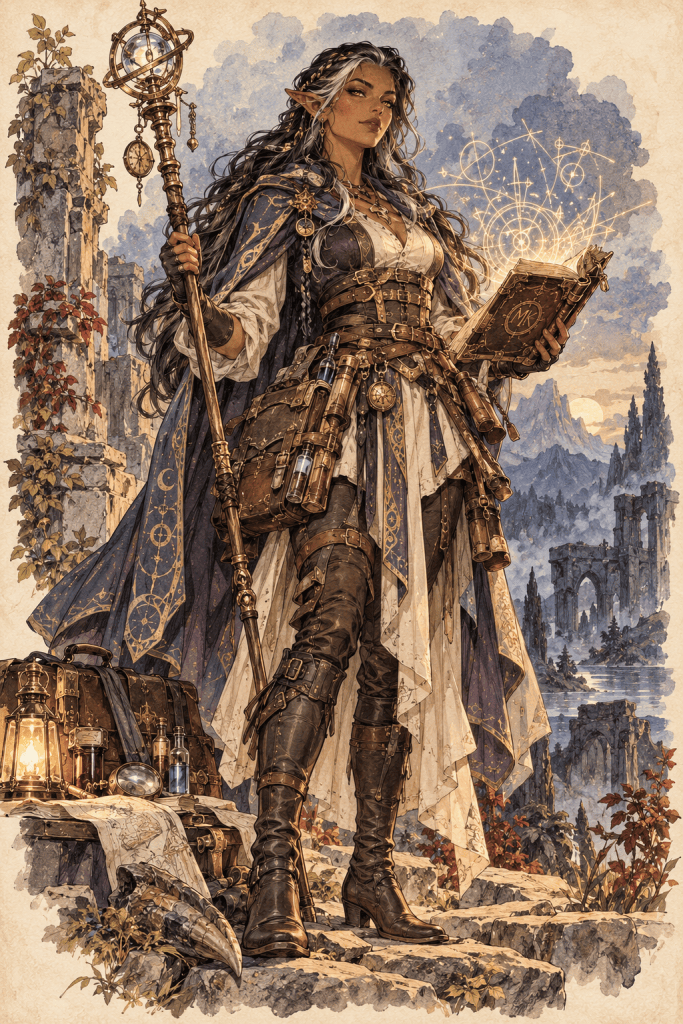
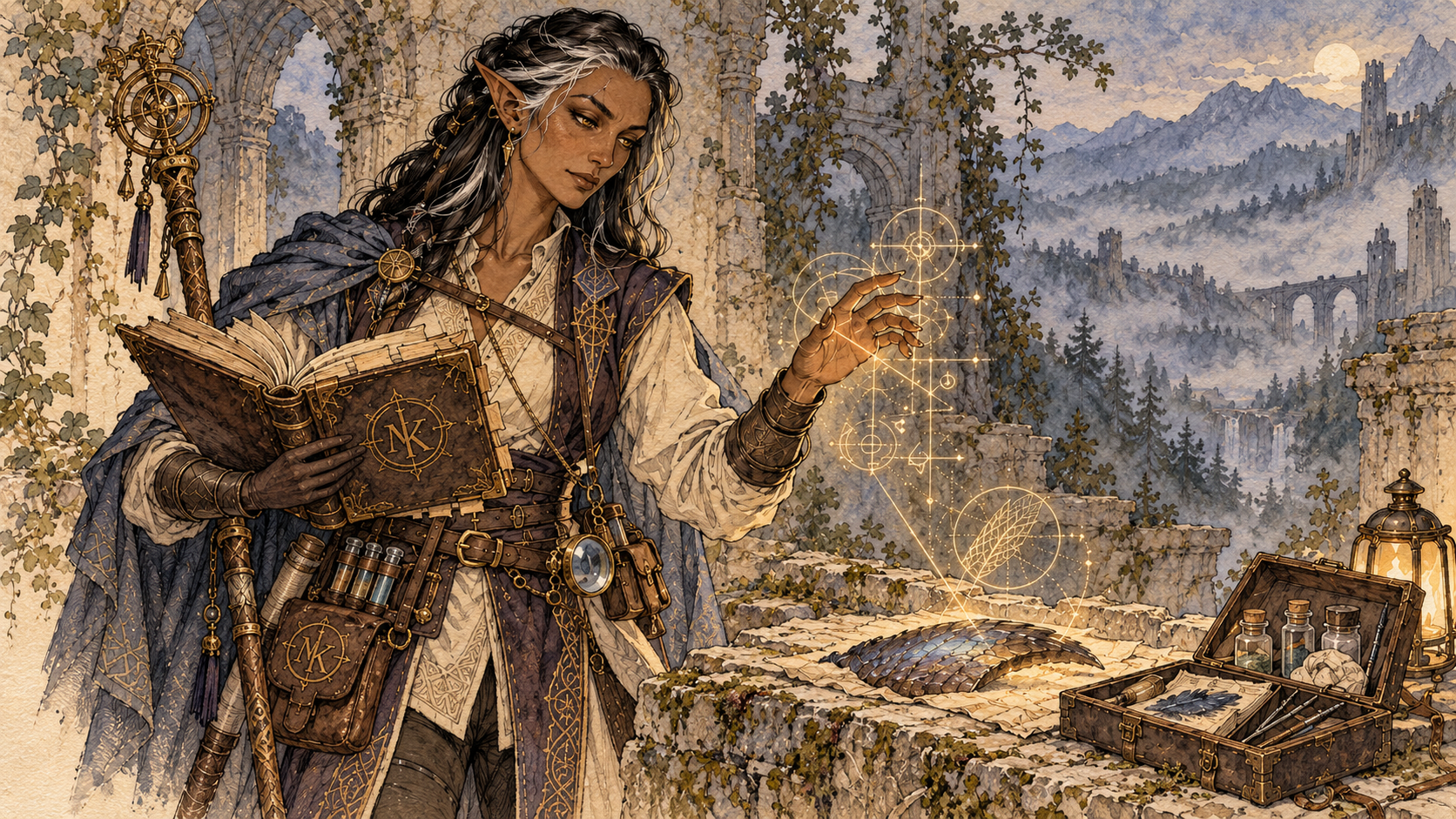
Morvane is a tall, mature Luminari woman of about six feet, graceful and long-limbed with the capable build of someone who has spent decades traveling beyond paved roads. Her skin is deep warm bronze-brown with a subtle golden undertone, while pale antique-gold eyes ringed faintly in silver give her an intensely attentive gaze.
Her midnight-black hair falls to mid-back and is marked by prominent natural silver-white streaks, especially at the temples. She usually wears it partially braided and secured with small metal clasps. A fine pale scar crosses the outer edge of her left eyebrow, joined by less memorable field scars across her hands and forearms.
Morvane dresses as an expedition scholar rather than a court mage: layered travel cloth, a weathered mantle, practical boots, specimen pouches, writing tools and a slender Sigilwright field staff. Her magic manifests as precise pale-gold geometry and equation-like sigils written briefly into the air.
Associated Lore
- Bestiary — creatures, monsters and strange life throughout Erosia
- Luminari — Morvane’s people
- Sigilwright — her arcane discipline
- Monster Lover — the player background closest to her field outlook
- Rhaziel, the Divine Stalker — the deity most closely aligned with her pursuit of knowledge




You must be logged in to post a comment.