
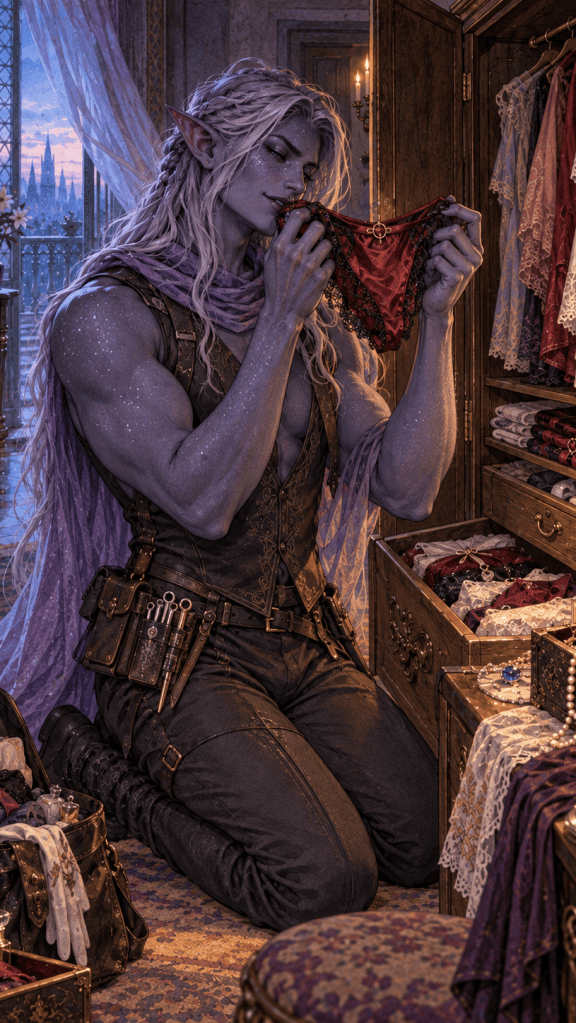
Silken Thief
Gold is anonymous. Silk remembers.
You are fascinated by intimate garments and personal keepsakes: a lover’s ribbon, a perfumed glove, a carefully folded undergarment, a lock of hair bound in lace, or some private token worn close enough to retain its owner’s warmth and scent. Such objects captivate you not because of their market value, but because they carry traces of another life.
Perhaps you once served as a valet, laundress, tailor, chamber attendant, burglar, or discreet procurer. You learned when households sleep, where personal effects are kept, how clothing is cleaned and stored, and which seemingly insignificant possession matters most to its owner. You can distinguish new silk from something frequently worn, identify repairs made by a particular hand, and reconstruct an object’s history from perfume, wear, stitching, and stains.
Some Silken Thieves steal for the forbidden thrill of possessing something intimate. Others accept commissions to recover stolen heirlooms, obtain incriminating keepsakes, or retrieve personal effects from dangerous places. A few acquire nothing without invitation, exchanging chosen garments as tokens of trust and desire.
Whatever path you follow, you know that the smallest scrap of fabric may reveal more than a chest of jewels.
Skill Proficiencies: Investigation, Sleight of Hand
Tool Proficiencies: Thieves’ tools, weaver’s tools
Equipment: A set of thieves’ tools, a roll of fine thread, needles, a magnifying lens, several fabric samples, a vial of mild perfume, a carefully wrapped intimate keepsake of personal significance, a hooded set of common clothes, and a pouch containing 10 gp
Feature: Intimate Provenance
When you spend several minutes examining a mundane garment or personal textile, you can usually determine its material, general quality, approximate age, and whether it has been frequently worn, recently cleaned, repaired, altered, or deliberately preserved.
Visible wear, lingering fragrance, stitching, laundry marks, and traces caught in the weave may also reveal ordinary clues about how the object was used or stored. These clues might suggest that its owner performs physical labor, uses a particular perfume, belongs to a certain household, or relies upon a specific tailor or laundress. This feature cannot identify an unknown owner by itself, establish exact dates, reveal information unsupported by physical evidence, or overcome magical concealment.
You also understand the routines surrounding private possessions. Servants, tailors, laundresses, valets, wardrobe keepers, secondhand dealers, pawnbrokers, and household suppliers recognize your practical knowledge. When treated respectfully, they will generally share ordinary information about local textile customs, reputable craftspeople, laundry schedules, household deliveries, and places where lost or discarded garments are likely to surface.
Suggested Characteristics
Silken Thieves blur the boundary between connoisseur, collector, trespasser, and romantic. What others dismiss as a scrap of cloth may become, in their hands, evidence, treasure, temptation, or a lingering substitute for someone beyond reach.
| d8 | Personality Trait |
|---|---|
| 1 | I notice what people wear beneath their finery—and how carefully they protect it. |
| 2 | I handle intimate garments with the reverence others reserve for sacred relics. |
| 3 | I can identify a household by its soap, starch, perfume, and stitching. |
| 4 | I leave valuables untouched when something more personal catches my attention. |
| 5 | I remember every hidden drawer, laundry passage, and unattended wardrobe I encounter. |
| 6 | I invent elaborate histories for garments whose owners I have never met. |
| 7 | I always repair, clean, and carefully preserve the keepsakes in my collection. |
| 8 | When nervous, I run a favorite ribbon or scrap of silk between my fingers. |
| d6 | Ideal |
|---|---|
| 1 | Intimacy. A treasured possession may reveal truths its owner cannot speak aloud. (Any) |
| 2 | Consent. A freely offered keepsake carries deeper meaning than anything stolen. (Good) |
| 3 | Acquisition. If someone cannot adequately protect a treasure, they do not deserve to keep it. (Evil) |
| 4 | Provenance. Every object deserves to have its history discovered and remembered. (Lawful) |
| 5 | Thrill. The danger of taking something forbidden is part of its beauty. (Chaotic) |
| 6 | Devotion. To preserve what another person has touched is to keep part of them close. (Any) |
| d6 | Bond |
|---|---|
| 1 | I possess a garment belonging to someone I loved but could never approach openly. |
| 2 | A former patron wants back the intimate keepsake they once gave me. |
| 3 | I am searching for the thief who emptied my collection and understood exactly what each piece meant. |
| 4 | A household servant once concealed me inside a wardrobe, and I still owe them my life. |
| 5 | I accepted a commission to acquire one particular garment and discovered evidence of a greater crime. |
| 6 | I preserve the last personal effects of someone whose disappearance remains unexplained. |
| d6 | Flaw |
|---|---|
| 1 | I sometimes convince myself that longing gives me a right to another person’s belongings. |
| 2 | I cannot resist examining an unlocked wardrobe, even when doing so is dangerously foolish. |
| 3 | I become jealous when someone else handles an object I consider part of my collection. |
| 4 | I have stolen something intensely personal from someone who trusted me. |
| 5 | I underestimate how violated people may feel when a private possession disappears. |
| 6 | I keep trophies connected to past thefts, even when they could expose me. |
 Whispers of Erosia
You must be logged in to post a comment.