
It feels fitting that Dev Blog 013 should be devoted to two of the most powerful and enduring magical archetypes in fantasy roleplaying: the sorcerer and the mage.
In Whispers of Erosia: Second Bloom Edition, those archetypes have become the Bloodborn and the Sigilwright.
I knew before beginning either class that they would be beasts to rebuild. Spellcasters already carry enormous mechanical weight. Their identities are tied not only to their class features, but also to their spell lists, resource economies, subclasses and the underlying assumptions a setting makes about magic itself.
That created a difficult challenge.
As with every class in Whispers of Erosia, I wanted an experienced 5e player to be able to sit down, look over the class and immediately recognize the familiar archetype beneath it.
The first reaction should be:
“OK, this is the sorcerer.”
Or:
“OK, this is the wizard.”
Then, after a second look, I want that same player to pause.
I want them to see the new gameplay rhythm, understand the class’s relationship with Desire and realize that this is not merely the familiar chassis wearing unfamiliar clothes.
The second reaction should be:
“Whoa. This is different. This is new. I might actually want to play this.”
That balance between recognition and discovery has guided the entire class redesign project. With the Bloodborn and Sigilwright, however, it became especially important because these classes also gave me an opportunity to confront several questions about magic that have followed me through fantasy games for years.
Where does magical power actually come from?
Why can one person simply cast spells while another must spend decades studying them?
What does a spellbook contain beyond a list of instructions?
Why do material components matter?
What is concentration actually doing?
Why does emotion so often awaken magical power in fantasy stories, yet rarely matter after the awakening?
The Bloodborn and Sigilwright became two very different answers to those questions.
Two Pillars of Arcane Fantasy
The Bloodborn and Sigilwright occupy opposite ends of the arcane spectrum.
The Bloodborn does not learn magic. Something ancient awakens within them, and their life becomes a journey toward surviving, understanding and eventually mastering that inheritance.
The Sigilwright does not inherit power. They study the hidden principles that govern magic until reality becomes something they can observe, describe and deliberately alter.
One is instinctive.
The other is analytical.
One channels a force too vast to belong entirely to any mortal.
The other proves that even the impossible must obey some underlying structure.
The Bloodborn asks:
How much power can I allow through me?
The Sigilwright asks:
What must be true for this spell to work?
Those questions became the foundation of both classes.
The Bloodborn
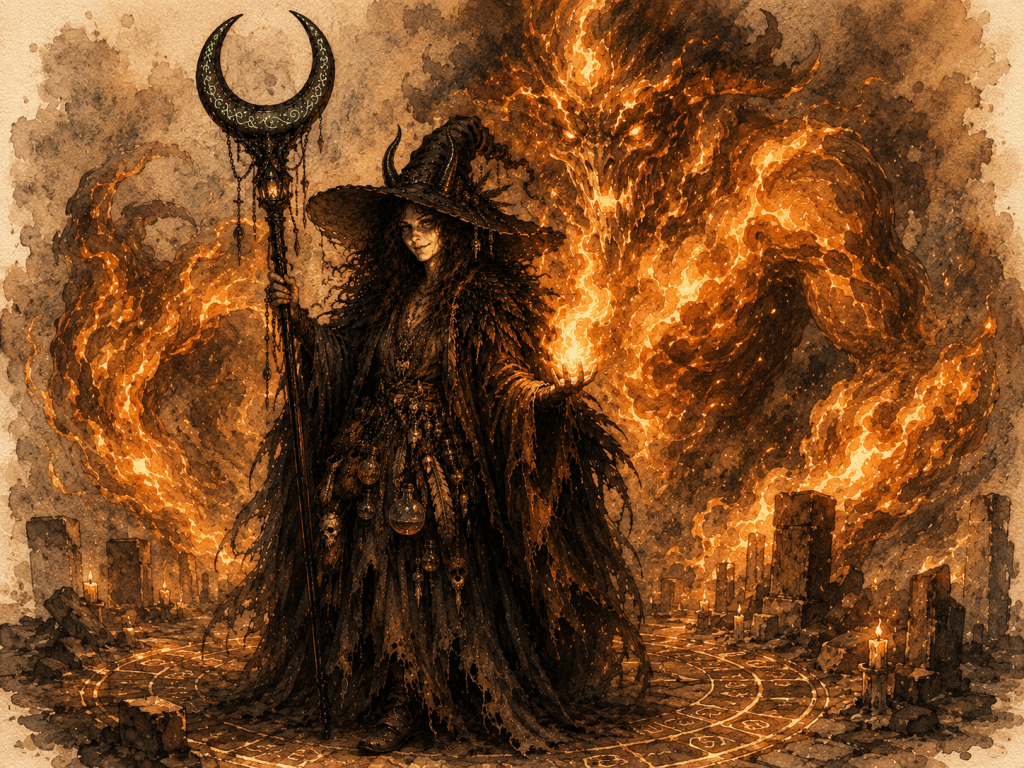
Magic Was Never Given to You
The Bloodborn is the Erosian expression of the sorcerer archetype, but I did not want the class to begin and end with “magic is in your blood.”
That statement creates a compelling image, but it leaves too much unexplained. What is in the blood? Where did it come from? Why does it grant magic? Why does that power take different forms in different Bloodborn?
The answer became the Primordial Currents.
Hidden beneath creation are ancient currents of power associated with dragons, Titans, Giants and the Elemental Sovereigns. These forces are older than kingdoms and perhaps older than the stories mortals tell about the gods. Most people pass through life without ever sensing them.
A Bloodborn hears one answer.
That first contact is known as the Awakening. It may occur during battle, grief, love, discovery, triumph or a moment of quiet revelation. Whatever its cause, the event changes the Bloodborn forever. Their soul becomes a conduit through which one of the Primordial Currents can enter the mortal world.
This solved one of the first major questions about sorcerous magic.
The Bloodborn does not possess an internal reservoir of magical power. The Primordial Current itself is limitless.
The limitation is the conduit.
Flux Is Control, Not Power
The familiar sorcerer resource remains present through Flux Points, preserving the recognizable gameplay of Sorcery Points and Metamagic. However, Flux does not represent a quantity of magic stored inside the Bloodborn.
Flux represents control.
It measures how effectively the Bloodborn can shape the Current moving through them. Flux allows them to alter spells through Metamagic, convert magical energy and guide primordial forces without being overwhelmed by what they have awakened.
That distinction became essential to the class fantasy.
A novice Bloodborn is not weak because the Current has offered them only a small amount of power. They are inexperienced because they can safely express only a fraction of what the Current contains.
An experienced Bloodborn does not discover that the Current has grown stronger. They have become a better conduit.
This is why the greatest Bloodborn are not necessarily those born with the most impressive lineage. They are those who have achieved the deepest harmony with what flows through them.
Desire as Communion
Every Erosian class must experience the Desire Cycle differently. For the Bloodborn, Desire became Communion.
Arousal represents the deepening connection between the mortal conduit and the Primordial Current. As emotional and magical pressure rises, the boundary between the two becomes thinner. More of the Current answers. More of its nature becomes visible.
Libido represents the endurance of the mortal vessel.
The Current does not become tired. The body does.
This creates the Bloodborn’s unique Desire Tempo. The class is encouraged to move toward release because release is not merely an interruption or consequence. It is the moment when the Bloodborn becomes what they have been trying to become throughout the encounter.
For one impossible instant, conduit and Current nearly become one.
Manifestation
The Bloodborn’s Climax is called Manifestation.
When Communion reaches its peak, the Current briefly flows through the Bloodborn without restraint. Their next spell becomes Manifested, transforming it into a purer and more powerful expression of primordial magic.
That spell might strike with greater accuracy, overwhelm resistance, become more difficult to resist or carry additional destructive or restorative power. As the Bloodborn gains levels, Manifestation evolves from a meaningful surge into an encounter-defining event.
At higher levels, the Bloodborn can combine several Manifestation benefits at once, regain Flux after the spell resolves and eventually express the Current with such authority that even magical immunity begins to bend.
This was important because Climax cannot merely be attached to a class as an additional effect. It must become the class’s hero moment.
A Bloodborn player should see their pressure rising and begin planning for the spell that follows. They should care about the timing of their Manifestation. They should anticipate the moment when their ordinary spellcasting gives way to something ancient, personal and overwhelming.
By 20th level, the Bloodborn becomes a Living Conduit, shaping Metamagic with extraordinary efficiency and beginning each battle already aligned with the power that has accompanied them since their Awakening.
The fantasy begins with inheritance.
It ends with harmony.
Explore the Bloodborn
Read the complete class here:
Bloodborn — Whispers of Erosia
The Sigilwright

Magic Must Have Rules
The Sigilwright began with a different frustration.
Fantasy worlds frequently tell us that wizards study magic, but they rarely explain what those scholars are studying.
Are they memorizing gestures?
Copying recipes?
Learning a secret language?
Why does a specific arrangement of words, movements and materials create fire in one case, an illusion in another and a doorway through reality in a third?
For the Sigilwright, the answer is that magic possesses structure.
Reality is governed by hidden symbolic relationships. Emotion creates resonance within the Veil, but resonance alone is unstable. Sigils organize that resonance into a deliberate magical result.
The Sigilwright does not create magic from nothing.
The Sigilwright discovers the equations that reality already follows.
Emotion Is the Constant
One of the most important ideas behind the Sigilwright is that emotion remains necessary for magic.
This matters because the class could easily have become emotionally sterile: a cold mathematician reducing wonder to numbers. That would have contradicted the foundations of Erosian magic.
Instead, emotion became the universal constant.
Every spell begins with resonance. Desire, fear, devotion, grief, ambition, joy and longing disturb the Veil and create magical possibility. The Sigilwright’s role is not to remove emotion from magic, but to understand how that resonance behaves.
Emotion supplies the force.
The equation determines its form.
This allows the Bloodborn and Sigilwright to draw from the same magical universe without becoming interchangeable. The Bloodborn enters Communion with the Current and allows power to move through the self. The Sigilwright observes resonance, identifies its variables and constructs a symbolic solution.
One feels the answer.
The other proves it.
A Sigil Is Not Merely a Rune
The Sigilwright also required a more precise definition of sigils.
A sigil is not simply a decorative rune or an arcane symbol that glows because fantasy art tells us it should. It is a symbolic mathematical element within a magical equation.
A sigil may function as a constant, variable, coefficient, operator, parameter, function or term. Individual sigils do not necessarily represent complete spells. They describe relationships between magical forces.
A spell is the completed equation.
This understanding reshaped nearly every familiar part of wizard magic.
Material components possess measurable sympathetic resonance and function as variables within the equation. A focus stabilizes the formula and allows the Sigilwright to manipulate it without physically inscribing every element. Concentration represents the sustained maintenance of an active magical equation. When concentration breaks, the structure collapses.
Even the spellbook gained a clearer purpose.
A Sigilwright’s spellbook is not simply a collection of spells. It is a research journal filled with equations, proofs, observations, failed experiments, revised theories, lunar studies and records of magical phenomena.
The book does not merely tell the Sigilwright what to cast.
It records what they understand.
Observe, Calculate, Cast, Learn
The complete Sigilwright gameplay identity became:
Observe → Calculate → Cast → Learn
The Sigilwright examines the battlefield, creature or magical phenomenon before them. Through Calculate, they identify useful relationships and prepare an approach. They cast with greater precision because they understand more of the problem. The result then contributes to Summation, the accumulation of magical knowledge during play.
This was the greatest challenge in rebuilding the class.
The wizard chassis is already one of the strongest and most flexible structures in 5e. Adding raw power would have been unnecessary and dangerous. The Sigilwright did not need to become a wizard with larger numbers.
It needed to feel more intelligent.
The new mechanics therefore had to reward observation, preparation, adaptation and increasingly elegant spell use. The class’s power had to come from understanding magical law rather than simply possessing more magical energy.
Summation
Summation represents accumulated understanding.
It is not mana.
It is not a second pool of spell points.
It is the knowledge the Sigilwright gathers as individual observations begin connecting into a larger solution.
Every spell teaches something. Every magical interaction reveals another relationship. Every successful calculation brings the Sigilwright closer to seeing the complete equation beneath the encounter.
This creates a very different Desire Tempo from the Bloodborn.
The Bloodborn experiences rising pressure as deeper Communion with a limitless Current. The Sigilwright experiences it as mounting magical complexity. More variables become visible. More relationships demand attention. The mind approaches the edge of what it can hold.
Where the Bloodborn builds toward release through emotional intensity, the Sigilwright builds toward resolution through accumulating understanding.
Perfection
The Sigilwright’s Climax is Perfection.
For one impossible instant, every variable aligns.
Every equation balances.
Reality offers no resistance.
Perfection is not an uncontrolled magical eruption. It is the exact opposite. It is the moment in which the Sigilwright understands the problem so completely that failure briefly disappears from the equation.
This became the class’s hero moment.
The Bloodborn’s Manifestation should feel like an ancient force finally being allowed to speak at full volume. The Sigilwright’s Perfection should feel like the room becoming silent because the correct answer has been found.
At the height of the class, the Sigilwright does not merely know many spells. They perceive the architecture beneath spellcasting itself. Preparation becomes more adaptable, calculations become more efficient and magical problems that once seemed impossible become solvable.
The fantasy begins with curiosity.
It ends with comprehension.
Explore the Sigilwright
Read the complete class here:
Sigilwright — Whispers of Erosia
Passion and Perfection
The Bloodborn and Sigilwright were developed together because they needed one another.
Without the Sigilwright, the Bloodborn risked becoming nothing more than a spellcaster with innate power and a renamed resource.
Without the Bloodborn, the Sigilwright risked becoming nothing more than a wizard surrounded by geometric imagery.
Placing them side by side forced both classes to answer the same questions in different ways.
Why can you cast magic?
What limits your power?
What does increasing mastery actually mean?
How does Desire change your spellcasting?
What happens when your pressure finally breaks?
For the Bloodborn, magic is inheritance, Communion and expression.
For the Sigilwright, magic is observation, calculation and discovery.
The Bloodborn masters the conduit.
The Sigilwright masters the equation.
Both remain recognizable to anyone familiar with 5e. One preserves the instinctive, Charisma-driven spellcaster who reshapes magic through Metamagic. The other preserves the disciplined Intelligence-driven scholar whose spellbook and preparation grant unmatched versatility.
However, neither class stops at recognition.
Each now possesses its own magical theory, gameplay rhythm, Desire identity and defining moment of release. Remove those elements, and the classes no longer feel complete.
That is the standard I want every class in Whispers of Erosia to meet.
Familiar enough to welcome you.
Different enough to surprise you.
And powerful enough to make you reconsider what the archetype could have been all along.



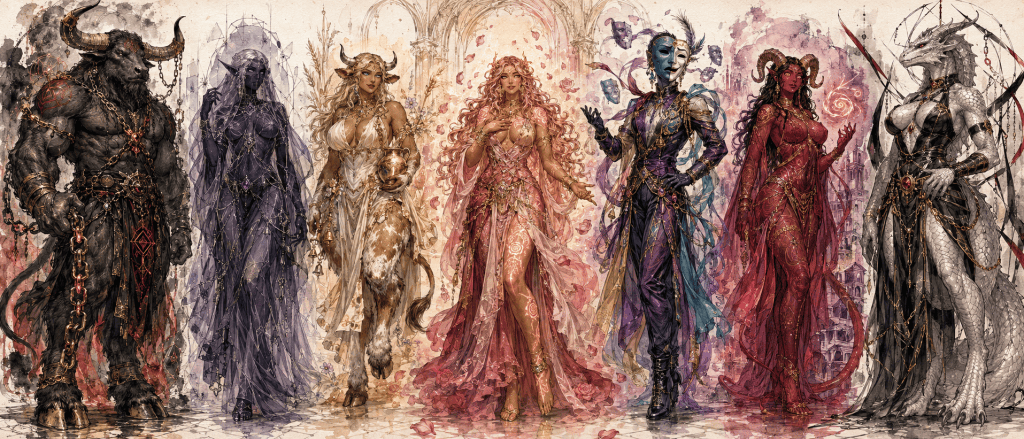
 Whispers of Erosia
Leave a comment