
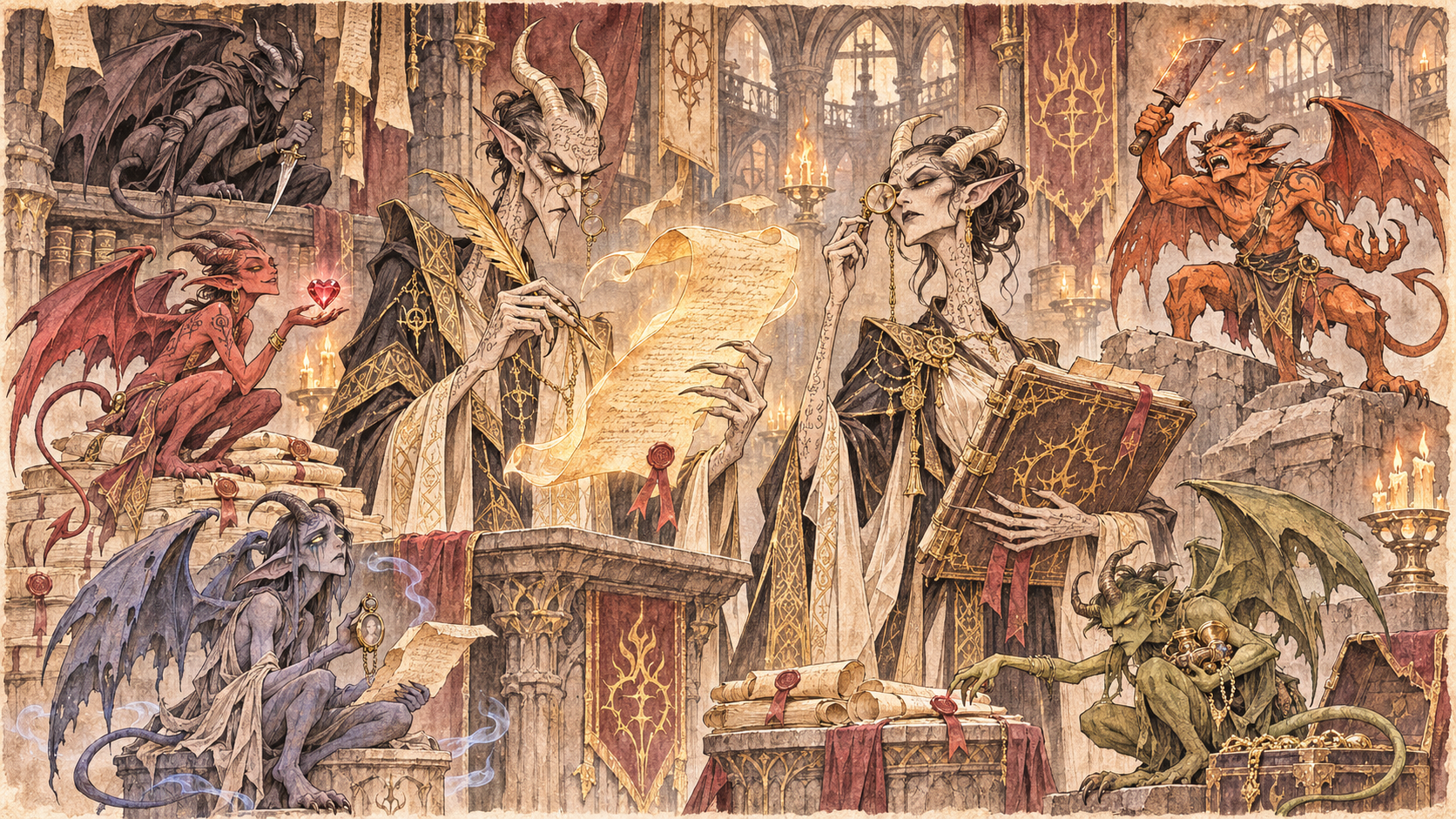
Clausekeeper
“No, I did not trick you. You asked for silence. You should have asked whose.”
Clausekeepers are promoted Devils specialized in infernal contract architecture. Their chromatic resonance varies widely because the Clausekeeper form is defined by method rather than appetite; a Red Clausekeeper may write contracts of desire, a Black Clausekeeper may specialize in funerary obligations and an Orange Clausekeeper may become an expert in vengeance settlements.
What all Clausekeepers share is an obsession with the exact point where language becomes enforceable consequence. They do not merely enjoy loopholes. They study how wants, offers, fulfillment conditions, Pathos-Tolls and consent to terms interact until a contract becomes metaphysically stable enough to carry infernal force.
Promotion Through Precision
Imps and lesser Devils Promote toward Clausekeepers by repeatedly drafting, witnessing or successfully resolving contracts whose language survives pressure. The process rewards accuracy because a bargain that cannot determine whether it has been fulfilled cannot reliably release a Pathos-Toll.
Clausekeepers therefore become valuable even to stronger Devils. A powerful infernal creature may possess enormous emotional mass and still hire a smaller Clausekeeper to make sure a complicated agreement says exactly what both parties think it says.
Associated Imps: Any Color • Script Imps
Infernal lineage and field role. These lesser Devils share the Imp Bestiary monster and encounter rules. Their particular assignment, the Whispers they may legitimately collect, and their path to Promotion are detailed below.
Role. Script Imps are scribes, witnesses and careful readers of infernal bargains. They prepare duplicate clauses, record the identity and genuine agreement of each party, identify contradictory conditions and deliver revisions to their employers. They may be argumentative, but a contract gains no authority merely because an Imp writes it in impressive ink.
Claiming Whispers. A Script Imp earns compatible resonance when a valid, knowingly accepted agreement reaches its specified fulfillment and the terms assign the Imp a Pathos-Toll or share. A forged signature, secret amendment or failed bargain creates no automatic right to collect. Precision matters because an unclear condition cannot reliably release an agreed toll.
Path to Promotion. Those who repeatedly bring complex agreements to legitimate resolution, master explicit boundaries and accumulate compatible Whispers may Promote into Clausekeepers. Until then they use the shared Imp stat block and their birth-color’s Resonant Spill.

Appearance and Bearing
Clausekeepers often display long articulated fingers, narrow claws suited to writing, ringed horns and wings marked by line-like patterns resembling script when viewed from a distance. Their native color remains visible beneath layers of ink, seal wax, metal tags and contract cords.
They favor portable desks, seal cases, writing knives, chains of keys and documents stored in improbable numbers of inner sleeves. Some carve completed clauses into their own horns, not as punishment but as professional record.
The Law of Consequence
Clausekeepers insist that infernal contracts require meaningful acceptance. They may exploit ambiguity, urgency, vanity or poor judgment, but they understand that an uncommunicated assumption does not create a stable agreement; the mark forms when the mortal accepts terms that are actually present.
Their contracts are often safer than those of careless Devils and more dangerous than those of obvious tricksters. The words tend to work exactly as written, which means a mortal who fails to ask the right question may receive no protection from an outcome the Clausekeeper never promised to prevent.

Clausekeeper
Medium Fiend (Devil), any alignment
Armor Class 15 (natural armor)
Hit Points 112 (15d8 + 45)
Speed 30 ft.
| STR | DEX | CON | INT | WIS | CHA |
|---|---|---|---|---|---|
| 10 (+0) | 14 (+2) | 16 (+3) | 18 (+4) | 16 (+3) | 18 (+4) |
Saving Throws Wisdom +6, Charisma +7
Skills Arcana +7, Insight +6, Investigation +7, Persuasion +7
Damage Resistances fire
Senses darkvision 60 ft., passive Perception 13
Languages Common
EROSave Constitution +3 or Wisdom +6 (the devil chooses)
Challenge 5 (1,800 XP)
Proficiency Bonus +3
Desire DC 15
Libido 6 (Unveiled Play)
Traits
Emotion-Born. Effects that detect fiends identify this creature as a devil. It is not part of demon, Gelkin or Chrysalis metamorphosis. Native color identifies sustaining resonance: Red—desire; Green—envy; Blue—sorrow; Orange—rage; Black—grief. Color does not prescribe alignment.
Exacting Notary. The devil has advantage on Intelligence (Investigation) checks to detect alterations to written agreements. It remembers the exact wording of contracts it has read, but cannot know unwitnessed events or undisclosed terms.
Actions
Multiattack. The devil makes two Sealbrand attacks. It cannot replace these attacks with Read the Fine Pressure.
Sealbrand. Melee Weapon Attack: +7 to hit, reach 5 ft., one target. Hit: 13 (2d8 + 4) psychic damage plus 3 (1d6) psychic damage.
Read the Fine Pressure (Recharge 5–6). Choose one creature the devil can see within 30 feet. A target must be able to hear the devil. Use only the version for the table’s chosen mode. This action cannot make a creature confess, accept a bargain or fulfill a contract.
- Classic Play. Each target makes a DC 15 Wisdom saving throw. On a failure, it takes 28 (8d6) psychic damage and it cannot take reactions until the start of its next turn. On a success, it takes half as much damage and suffers no additional effect.
- Veiled Rules. Each target makes a DC 15 EROSave. On a failure, it takes 28 (8d6) psychic damage and becomes Stirred by this devil for 1 minute. This Stirred state persists after the usual affected ability check. At the end of each of its turns, the target repeats the save, ending this state on a success. If already Stirred by this action, a failed save against a new use instead makes it Overwhelmed: it cannot take reactions until the start of its next turn, then its Desire condition ends. On a successful initial save, it takes half damage and does not change Desire state. This target culmination does not trigger the devil’s own Closing Clause.
- Unveiled Rules. Each target makes a DC 15 EROSave. On a failure, it takes 28 (8d6) psychic damage and gains 1 Arousal. On a success, it takes half damage and gains no Arousal. Its own Climax follows its own effects, not the devil’s Closing Clause.
Bonus Actions
Measured Withdrawal. The devil takes the Disengage action.
Reactions
Objection (3/Day). When a creature the devil can see within 30 feet makes an attack roll, the devil subtracts 1d6 from the roll after the roll is made but before its outcome is determined.
Mechanics of Desire
Closing Pressure. Arousal expresses the emotional pressure described in this entry, rather than necessarily sexual excitement. Use the Mechanics of Desire for the chosen mode; the modes are alternatives.
- Classic Play. Track neither Arousal nor Libido. Use the Classic version of Read the Fine Pressure; ignore Deepen the Hook, Resonant Appetite and Closing Clause.
- Veiled Rules. Track Composed, Stirred and Overwhelmed; do not track Libido. When the devil itself becomes Overwhelmed, resolve Closing Clause once and end its Desire condition. If another effect also supplies a culmination effect, use this creature’s named release instead of stacking two releases.
- Unveiled Rules. The devil begins with maximum Libido 6 and Arousal 0 unless the encounter establishes otherwise. Its Desire DC is 15. On reaching Arousal 6, resolve Closing Clause as its creature-specific Climax Effect, reduce Libido by 1 (minimum 0), and reset Arousal to 0. At Libido 0, apply normal Depletion and Exhaustion rules; it cannot spend Libido it lacks. A long rest restores its maximum Libido and resets Arousal to 0. No short-rest recovery is granted by this stat block.
Desire Traits
Deepen the Hook (Unveiled Only). Once on each of its turns, when a target fails an EROSave against Read the Fine Pressure, the devil may spend 1 Libido to give that target 1 additional Arousal. This respects the normal maximum of 3 Arousal gained during one turn and the Arousal 6 ceiling.
Resonant Appetite (Unveiled Only). Once per round, when another creature within 30 feet Climaxes because Arousal gained from this devil’s effect brings it to 6, the devil regains 1 spent Libido, never above 6. This does not create or collect a Whisper.
Closing Clause
The devil examines one contract it can read within 5 feet and one fulfillment condition it names. If it has sufficient evidence, it determines whether that condition is met; otherwise it learns that the evidence is insufficient. A fulfilled contract releases its Pathos-Toll only according to its existing collection terms. This neither rewrites the agreement nor supplies missing evidence.
Whispers and Pathos-Tolls. Arousal is pressure, not consent; Climax is release, not contractual fulfillment. No ability in this stat block generates a Whisper through damage, a failed saving throw or release alone. Collection requires the actual fulfillment and collection clauses of a valid bargain. Whispers are emotional resonance, not souls, memories or automatic ownership of their source. Custody of an entrusted Confidence grants no right to read, sell or consume it.
The Disputed Toll
A Clausekeeper’s door is open to the mortal who says, “I did my part. Your Devil did not.” It examines what was offered, who accepted, which condition was fulfilled and whether the demanded Pathos-Toll matches the covenant. A well-kept infernal court will sometimes rule against its own collectors. A Toll released without valid fulfillment cannot be made lawful merely by filing it in a ledger.
Clausekeepers may draft bargains and serve as advocates, arbiters or court-appointed interpreters. Their precision is neither mercy nor cruelty: a fair ruling protects the reliability of every future agreement. A petitioner may bring a witness, a contract mark, a sealed vessel or evidence that an alleged fulfillment never occurred. An appeal can delay enforcement while leaving all parties bound by the terms still in force.
Using Clausekeepers in Play
Clausekeepers are excellent social antagonists because their threat comes from language, leverage and consequence rather than raw force. A party may seek one out to interpret a mark, prove that a contract was never fulfilled or renegotiate terms before a Pathos Bailiff is called to enforce a breach.
They can also become useful allies when another Devil has written a deliberately unstable agreement. Infernal law is not benevolent, but Clausekeepers value contracts that function; a bargain so vague that nobody can determine what is owed is an embarrassment to their profession.
Tactics and Encounter Use
Read the Fine Pressure disrupts reactions while Sealbrand punishes close approaches. In negotiation, quote the actual clause; ambiguity calls for adjudication rather than invented penalties.
Contract Scope. Before using a bargain, record the service, willing parties, fulfillment condition, compatible Pathos-Toll, collection method and any agreed breach remedy. Promised services require the devil’s actual resources, contacts or separately established magic; this stat block grants no unlimited wish, compelled affection or automatic resurrection.
Kaestra Catalogue Note
“Never sign quickly because the Devil seems honest. Clausekeepers are often honest. That is why you should read more slowly.” — Morvane Kaestra
Related infernal records: Devils of Erosia · Infernal commissions · Pathos Bailiff · Crowned Devil.

You must be logged in to post a comment.