
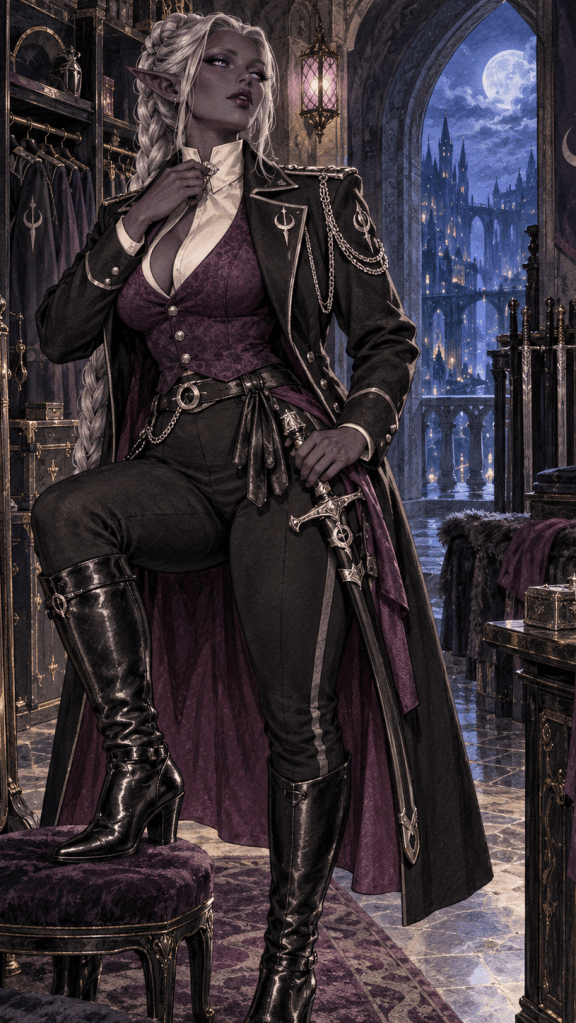
Fantasy Made Flesh
You learned early that becoming someone else could be intoxicating. A uniform changes how you stand. A costume changes how others look at you. The right voice, posture, title and mannerisms can make a fantasy feel real enough that, for a little while, the person underneath disappears. You became fascinated not simply with dressing differently, but with inhabiting a role and inviting others to believe in it with you.
Work with your GM to determine where you learned your craft. Perhaps you performed in theaters or pleasure houses, attended elaborate masquerades, portrayed fantasies for private patrons or belonged to a community devoted to immersive roleplay. You might favor particular archetypes — commanding officers, obedient servants, mysterious strangers, priests, nobles, villains or heroes — or delight in becoming someone entirely different every time. Years of stepping into other identities taught you that convincing performance requires more than clothing; you must understand how the person you’re portraying speaks, moves and expects to be treated.
Skill Proficiencies: Deception, Performance
Tool Proficiencies: Disguise kit
Languages: One of your choice
Equipment: A disguise kit, one costume or uniform associated with a favorite persona, a small collection of costume jewelry and accessories, a hand mirror, a set of common clothes, and a pouch containing 10 gp
Feature: Play the Part
You are practiced at adopting recognizable social roles. When you have appropriate clothing and an opportunity to observe a profession, social station or cultural role, you can reproduce its ordinary mannerisms, terminology and etiquette well enough to pass casual scrutiny.
You can usually identify theaters, costumers, masquerade houses, performers and other places where costumes and disguises can be purchased, altered or borrowed. Performers and professional roleplayers also recognize you as someone familiar with their craft and will generally share ordinary information about local performances, costumes and clientele.
Suggested Characteristics
Those who make Fantasy Flesh spend years discovering how readily clothing, behavior and expectation can transform an encounter. Some maintain beloved personas for years, while others crave the delicious uncertainty of becoming someone entirely new.
| d8 | Personality Trait |
|---|---|
| 1 | Give me the right costume and I’ll become whoever you need. |
| 2 | I unconsciously adopt mannerisms from interesting people I meet. |
| 3 | I have a favorite persona whom my friends know almost as well as they know me. |
| 4 | Uniforms affect me considerably more than I care to admit. |
| 5 | I never enter a masquerade without creating an entire history for my disguise. |
| 6 | I find staying in character far easier than breaking character. |
| 7 | I collect costumes from every culture I encounter. |
| 8 | When someone tells me their fantasy, I immediately begin thinking about how to make it convincing. |
| d6 | Ideal |
|---|---|
| 1 | Fantasy. Sometimes pretending gives us permission to explore something real. (Any) |
| 2 | Freedom. Nobody should be confined to a single role for their entire life. (Chaotic) |
| 3 | Craft. A convincing performance deserves preparation and discipline. (Lawful) |
| 4 | Delight. Helping someone inhabit a fantasy can be a beautiful gift. (Good) |
| 5 | Transformation. Every role reveals something different about the person playing it. (Any) |
| 6 | Mystery. The most interesting person in the room is sometimes the one who isn’t who they claim to be. (Any) |
| d6 | Bond |
|---|---|
| 1 | I still possess the costume from the role that changed my life. |
| 2 | My favorite performance partner knows versions of me nobody else has ever met. |
| 3 | A celebrated costumer once took me in and taught me everything I know. |
| 4 | Someone fell in love with one of my personas, and I never told them who was underneath. |
| 5 | I am searching for a performer who vanished after our final performance together. |
| 6 | One of my assumed identities accidentally became involved in something very real. |
| d6 | Flaw |
|---|---|
| 1 | I sometimes keep playing a role long after the performance should have ended. |
| 2 | An especially attractive uniform can completely derail my train of thought. |
| 3 | I lie about trivial things simply because inventing the alternative is more entertaining. |
| 4 | I have impersonated people who would be furious to discover it. |
| 5 | I sometimes use a persona to say or do things I am afraid to attempt as myself. |
| 6 | At least one person is searching for an identity that never actually existed. |
 Whispers of Erosia
You must be logged in to post a comment.