
Hello, lovers and friends
Hello, lovers and friends. Take my hand and follow me through the latest development of the Whispers of Erosia Online Tome.
Have you ever wondered, either as a DM or a player, what it would be like if the locations in your campaign were places you could actually visit while you played? How many of you have tablets, laptops or computers at your disposal during a game session? I know my players do.
That led me to a question I have been thinking about for some time: What if we could better bridge the connection between paper and digital play? What if the places described in a campaign setting could become locations players could explore online while their characters were participating in downtime?
What if a player could visit a shop, browse its items, services, weapons, potions, food, consumables and curios, and then bargain with the DM over an agreeable price? What if, with a click, that player could open an applicable digital item card and bring it into their character’s inventory?
What if visiting a district in the game could also mean visiting it online? That is the question I am trying to answer with the Online Tome, and Roseglass Ward has become one of the first places where I can look at that idea and say, “Yes, this is beginning to work.”
Come with me as we explore. Wink.
Welcome to Roseglass Ward
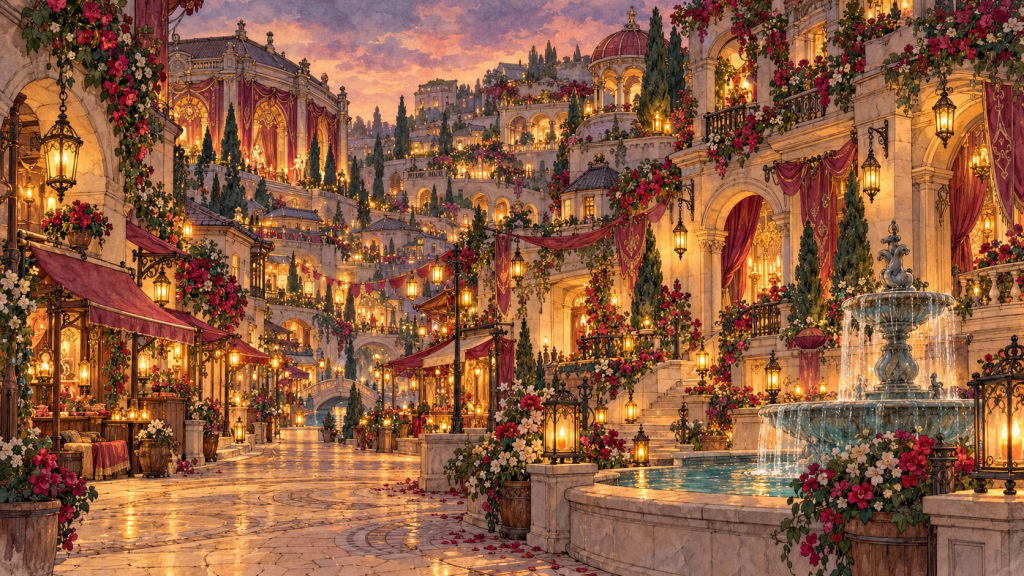
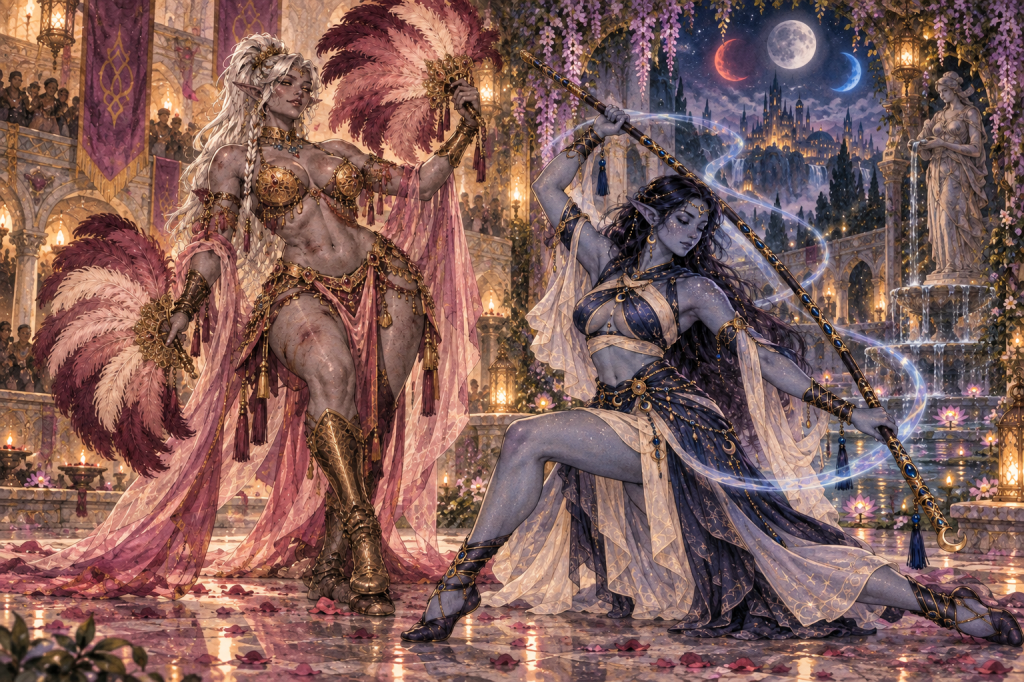
Roseglass Ward is Amarosa after sunset. It is the city’s district of performance, pleasure, hospitality, bathing, shopping, festivals, quiet conversations and the occasional poor decision made beneath very beautiful lanterns.
For this experiment, however, Roseglass has become something more important. It is beginning to function as a playable digital district, rather than simply a page of setting information.
That distinction matters to me. I want the Online Tome to become less about telling you what exists in Erosia and more about giving players and DMs ways to move through it together.
A district page should not only tell you that there is a theater, a bathhouse or a shop somewhere nearby. It should let you follow the street, open that location and discover what is waiting inside.
What could this look like at the table?
Imagine the party returns to Amarosa after a difficult expedition. The DM announces that everyone has three days of downtime and asks what the characters would like to do.
One player wants new clothing for an upcoming masquerade. Another wants a bath and a quiet afternoon after nearly being eaten by something beneath the city. Someone needs herbs, another wants local gossip, and one character has decided that the only sensible response to surviving the adventure is an unreasonable amount of wine.
Traditionally, this is the moment when the DM starts searching through notes. Prices are improvised, inventories are created on the spot, someone asks what the shop sells, another player wants to know what the neighborhood looks like, and the DM suddenly becomes responsible for producing an entire city while everyone waits.
There is nothing inherently wrong with that. Improvisation is one of the joys of tabletop games, but it does not have to carry the entire burden of making a place feel alive.
Now imagine the DM says, “You are in Roseglass Ward. Open the district page and tell me where you want to go.” Suddenly, the players have choices in front of them.
They can explore, browse, follow links and select a destination because something caught their attention rather than because the DM deliberately placed it in front of them. That changes the relationship between players and the setting because, instead of waiting for the world to be narrated to them, they can begin reaching into it themselves.
Begin beneath the lanterns
A visit to Roseglass can easily begin in Lantern Courtyard. It is the public heart of the ward, where musicians, vendors, performers, residents and visitors pass through the same lantern-lit civic space.
There is no proprietor waiting behind a counter and no expectation that characters need to purchase anything. Players can learn about the Lantern Tree, the Courtyard’s customs, its performers and the surrounding streets while deciding what they want the evening to become.
For a DM, that makes Lantern Courtyard an easy place to begin a scene. A contact can ask to meet beneath the lanterns, an NPC can cross the plaza unexpectedly, a rumor can be overheard near the fountain, or the party can simply watch the district move around them until something catches their interest.
The page does not replace the DM. It provides the DM with social terrain and gives the players room to choose what they want to do with it.
Follow the music to Velvet Hall
Perhaps the characters hear music from farther up the street and decide to investigate. A few clicks later, they arrive at Velvet Hall, Amarosa’s principal temple-theatre of Cyrillith, the Masquerade Sovereign.
Players can explore the Hall’s stages, sacred practices, performances, masks, clergy and seasonal productions. They can learn why performance is treated as a form of prayer and how art can become restoration, confession or transformation.
Maybe the characters attend a show. Maybe one of them participates in a rite, seeks instruction, buys a mask or notices an adventure hook the DM had not intended to use that evening.
That last possibility is one of the things that excites me most. A player can see something on a location page and say, “Wait, I want to do that,” and suddenly the player has helped generate the session.
Need something to wear?
Eventually, someone in an adventuring party will decide they need better clothing. In Roseglass Ward, that decision can lead directly to The Velvet Thread, the magical atelier of Mrs. Veska Lureveil.
Players can browse clothing, masks, adventuring equipment, seasonal pieces and magical commissions. They can see prices, compare options and decide whether something is worth spending their hard-earned gold on.
Then the role-playing can begin. A player might announce that Veska wants 35 gold for a particular garment, while the player offers 20 and the DM decides Veska is deeply offended by the suggestion.
Maybe a Persuasion check happens. Maybe Veska lowers the price, demands a favor or decides she would rather throw the character out of her shop than tolerate such an insult.
Either way, the purchase happened inside the world. That is exactly what I want the Online Tome to encourage.
Maybe the characters need to recover
Not every downtime scene should become shopping or nightlife. Sometimes the party has been through something terrible and needs a place where recovery can become part of the story.
That is where the Rosewater Bathhouse becomes useful. Players can explore its turquoise pools, garden terraces, bathing customs and sacred role as Amarosa’s principal House of Overflow devoted to Sylithra.
The DM can use those spaces for quiet role-playing, unexpected encounters or conversations that would feel very different anywhere else. Rivals might share a pool, friends might finally discuss what happened on the last adventure, or a familiar NPC may appear somewhere the party never expected to see them.
Downtime does not have to mean skipping ahead three days. Sometimes what characters do after the danger is over tells us more about them than the danger itself.
Climb above the noise
When the streets become too loud, the party can climb toward the Balcony Garden. At night, the Garden offers wine, moonlight, private terraces, courtship and quiet conversation above the lantern-bright streets.
During the day, another side of the location appears. The Conservatory of the Turning Bloom, Drying Gallery, Seed Shelves, Public Botanical Walk and Seasonal House connect the Garden to Amarosa’s kitchens, bathhouses, tea sellers, performers and rooftop gardeners.
Players looking for herbs can find a reason to visit. Characters seeking privacy can reserve a balcony, while someone interested in Talyss, seasonal cultivation or the optional Mechanics of Desire may find entirely different reasons to remain.
The Garden also demonstrates something I want more of from the Online Tome: A location should be able to change depending on why a character came there. One player sees a wine terrace, another sees an herbal resource, and the DM sees a collection of encounter spaces and story hooks.
And yes, Roseglass has its adult side
The Winking Eye remains one of Roseglass Ward’s best-known establishments. At its heart, it is a pleasure house, while its food, wine, entertainment, lodging, private rooms and information brokerage support that primary identity.
A player may visit because their character wants companionship. Another may simply want supper, a room for the night or a conversation with Madame Rosalyne “Rose” Veilthorn.
Someone else may be there because Rose knows something. That flexibility is intentional because locations become more useful when they are allowed to serve more than one type of scene.
Not every visit should become a quest, and not every adult location needs to exist solely for an erotic encounter. Roseglass works better when its establishments can be part of ordinary life as well as extraordinary adventures.
Shops should be places, not menus
This is one of the ideas at the heart of the experiment. I want an Erosian shop to feel like somewhere a character visited, rather than a list of equipment the player accessed between scenes.
A store can have an owner, regular customers, relationships with neighboring businesses, rumors, seasonal inventory and reasons for prices to change. A player can decide they like the merchant, dislike them, owe them a favor or return often enough to become a regular.
The actual transaction can still be simple. The player finds the item, the DM approves the price, the gold is deducted and the item enters the character’s inventory.
What surrounds that transaction is where the setting begins to breathe. The location becomes part of the story instead of a pause between scenes.
This is the experiment
Roseglass Ward is not complete because every imaginable business now has a page. It is complete because it has reached the point where it behaves like a district.
The locations connect to one another. NPCs have relationships beyond their own buildings, businesses source goods from other businesses, festivals affect multiple locations, religions overlap with everyday life, and a player can move from one place to another without the setting feeling as though it resets at every door.
Most importantly, players can participate in those spaces through the Online Tome. They can browse while the DM is talking to another player, investigate possible downtime activities, compare services or discover something that changes what they planned to do.
I do not want the website to become a replacement for the tabletop. I want it to become another surface of play sitting beside character sheets, dice, maps and conversation.
Where I want this to go
Imagine opening the page for a smithy and actually browsing the weapons hanging on its walls. A player could compare equipment, open an item card and then ask the DM whether the character can afford it.
Imagine visiting an apothecary and seeing the potions currently in stock. A consumable could already include its description, mechanics and price, leaving the DM free to role-play the person selling it.
Imagine visiting a bakery, jeweler, tailor, tavern, herbalist or magic shop and having the same experience. The player explores what is available while the DM remains in control of what enters the campaign, how much it costs and what consequences come with obtaining it.
Eventually, I would like that process to become even smoother. A player sees an item, agrees on the purchase with the DM and, with a click, brings the applicable digital item into their inventory.
That is the bridge I am trying to build between printed material and digital play. The digital layer should not compete with imagination; it should make it easier for players to reach deeper into the imagined world.
What this means for DMs
For DMs, I hope Roseglass becomes less another collection of material to memorize and more a toolbox waiting when it is needed. You should be able to open a location because the party unexpectedly decided to go there and already have atmosphere, characters, services, rumors and possible complications waiting for you.
You do not need to use everything on a page. Choose what serves the session, ignore what does not and change anything your table needs.
The Tome provides the structure, but the DM still decides what is true at the table. That relationship is important because the goal is not to automate the Dungeon Master; it is to give the Dungeon Master more material with which to improvise.
What this means for players
For players, I want downtime to feel more like exploration. Instead of asking only, “What can I buy?” you can begin asking, “Where would my character actually go?”
Maybe your fighter becomes a regular at the same tavern. Maybe your wizard keeps returning to one herbalist because they trust the proprietor, or your bard develops a complicated relationship with a theater that keeps inviting them back.
Those choices are small, but they are how characters begin to belong somewhere. A city becomes meaningful when the party stops treating it as a menu between adventures and starts recognizing the people behind its doors.
Come explore Roseglass Ward
So, lovers and friends, that is the experiment. Roseglass Ward is ready, and I would love for you to walk through it as a DM, a player or simply someone curious about what the Online Tome is becoming.
Meet beneath the lanterns, watch a performance, commission something beautiful, take the waters or climb above the city for a quiet drink. Follow whatever catches your attention and see where the links take you, because that act of choosing is part of what I want this project to become.
If you are a DM, put Roseglass Ward in front of your players the next time they reach Amarosa. Give them a little downtime, let them explore and see what happens when the world is allowed to offer choices before you have decided which one they are supposed to make.
The lanterns are lit, the doors are open, and Amarosa is waiting after sunset. Come see where the night takes you.




Leave a Reply